Volume II, pages 158–177 of the 1732 edition, from MAT to MEM: everything printed on these pages, in order.
Continued from Matthew
But the Author of it is as much unknown, and it is impossible to trace out either the Time or Occasion of this Translation.
Some Moderns1 have thought fit to call in Doubt what we have proved and advanced hitherto, according to the Testimony of all the Ancients, that St. Matthew wrote his Gospel in Hebrew Characters, and in the Hebrew Language; that is, in the Language then commonly us’d by the Jews of Palestine, which was the Syriack, with a Mixture of Hebrew and Chaldee. They maintain, that St. Matthew wrote it in Greek, and that what is said of the pretended Original Hebrew is all a Fiction, or ill understood. The Fathers, as Origen, Epiphanius, and Jerome, do not directly assert it; they quote it indeed, but as a Book of no Authority, which they would not have done had they been convinced, that this was the genuine Original of St. Matthew’s Gospel. If the Church had ever entertained this Notion of it, would they have suffered it to have been lost? If St. Matthew had wrote in Hebrew, should we have seen in this Work the Hebrew Names interpreted into Greek? Would he have cited the Old Testament according to the Translation of the Seventy, as he has always done? The Greek Language was then very common in Palestine, in all the East, through the whole Roman Empire, and even in Rome itself. St. Paul writes to the Romans in Greek; St. Peter and St. James write in the same Language to the Jews dispersed through the Eastern Provinces, and St. Paul to the Hebrews of Palestine. Lastly, since all the other Authors of the New Testament have wrote in Greek, why must St. Matthew alone write his Gospel in Hebrew? These Arguments are what are used to be brought, to support this Opinion.
But it is not difficult to answer all these Reasons. 1. The uniform Testimony of all the Antients, who tell us that St. Matthew wrote his Gospel in Hebrew, is certainly of a very great Weight. They did not speak at Random; they had seen and had consulted this Gospel, as it was written in this Language. ‘Tis true, they have not always spoke of it in a simple and uniform Manner, but that was because there were two of ‘em; the one pure and uncorrupted, of which they have spoke with Esteem; and the other depraved by the Hereticks, which they have contemned, and looked upon as Apocryphal.
-
However common the Greek Tongue might be in Palestine, and though it might Acts xxi. 40. xxii. 2.be the vulgar Tongue of some Cities in this Countrey, that were chiefly inhabited by Grecians; yet still it is certain, that the Generality of the Jews spoke commonly what they called Hebrew, but which was rather Syriack and Chaldee, mixed with some Hebrew Words. This may be seen even by the Gospel it self, which has preserved to us some Hebrew Words pronounced by Jesus Christ, and which is not taken Notice of as any Singularity, so that it can be concluded it was not familiar to him. On the contrary it appears, that it was his ordinary Language. And when St. Paul was seized in the Temple, and desired to speak to the Jewish Populace, he caused Silence to be made, and made a Speech to ‘em in Hebrew, which gained him the Attention he desired.
-
The Hebrew Names interpreted in Greek, in this Gospel of St. Matthew, prove the direct contrary to what they would infer from ‘em. For this demonstrates that the Translation was Greek, and that the Original was in Hebrew.
-
It is not true, that St. Matthew quotes the Scripture according to the Translation of the Seventy Interpreters. Of ten Passages of the Old Testament that he has cited, there are seven of ‘em in which he speaks in a Manner that approaches nearer to the Hebrew than to the Septuagint; and only three which he quotes agreeably to them: But in these Passages the Seventy and the Hebrew themselves agree. St. Jerome2 maintains in general, that this Evangelist follows the Hebrew in his Quotations. But it is plain that commonly he quotes by Memory, and relates not so much the Words as the Sense of the Passages.
-
Lastly, though St. Paul, St. Peter, and St. James have wrote in Greek to the Jews of Palestine, and to the Jews dispersed in the East, it cannot follow but that St. Matthew may have wrote in Hebrew. We do not pretend that he was obliged to write in this Language, we only inquire into the Fact, whether he really did or no. But this Fact is attested by all the Ancients, many of which have seen his Original, and were very capable of making a Judgment of it; particularly Origen, Eusebius, and St. Jerome. To give an Account how this ancient Gospel has been lost, is what cannot be expected from us. But it is easy to conceive, that having been grossly corrupted by the Ebionites, it might first fall into Contempt, and then by Degrees into Neglect and Oblivion. The Greek Translation was valued and preserved, because it retained
its primitive Integrity, and is now become as authentick as the Original it self.
St. Matthew in his Gospel had this chiefly in View, according to St. Austin3, to shew us the royal Descent of Jesus Christ; and to represent to us the Life of his Humanity, in the Manner of his Conversation among Men. St. Ambrose4 observes, that no one of the Evangelists enters so far into the Particulars of the Actions of Jesus Christ, as St. Matthew does, or has given us so many Rules for the Conduct of Life, so many Lessons of Morality suitable to our Necessities, and to the Design of Christ. Petrus Damianus5 says, that St. Matthew holds the same Place among the Evangelists, as Moses does among the Authors of the Old Testament; having been the first Writer of the new Law, as Moses was of the old. When he began to write, the great Question among the Jews was, whether Jesus Christ was the Messiah, or no. St. Matthew undertakes to give Proofs of it. He shews by his Miracles that he was the Christ, that Mary his Mother was a Virgin, that Jesus was not come to destroy the Law but to accomplish it, that his Miracles were no magical Operations, nor the Effects of any human Power, but incontestable Proofs of the Power of God, and of the Mission of Jesus Christ.
If we compare St. Matthew with the three other Evangelists, we may observe a pretty remarkable Difference in the Order and Succession of the Actions of the Life of our Saviour, from Chapter iv. 22. to Chapter xiv. 13. This Diversity has perplexed the Chronologers and Interpreters. Some have pretended that St. Matthew has followed the Order of Time, and that in this Particular we ought to abide by his Narration. Others have submitted to the Authority of the three other Evangelists; and in Truth it is more natural to assent to the Testimony of three Witnesses, than to that of one; and especially since St. Mark forsakes him in this, who is used to follow him in every Thing else. Some have imputed to mere Chance this want of Order in St. Matthew, others ascribe it to Choice and Design. However this Matter be, it can be no Prejudice to the Truth of the Facts, which are the essential Part of the Gospel; and as to the Order of Time, the sacred Authors are not always solicitous to follow it exactly.
There are certain Apochryphal Works imputed to St. Matthew, as the Book of the Infancy of Jesus Christ, condemned by Pope Gelasius6, The Ebionites had also fathered some Writings on this Apostle7. We have seen before, that they had mangled his Hebrew Gospel. They ascribe to him also an Ethiopick Liturgy. The Ebionites, the Cerinthians, and other Hereticks, quoted the Gospel of St. Matthew under the Name of, The Gospel according to the Hebrews8. ‘Tis also probable that it was the same Gospel that was known by the Name of The Gospel of the Twelve Apostles, the Gospel of the Nazarenes, and the Gospel according to St. Peter. Eusebius9 relates, that Pantenus a Christian Philosopher, who lived at Alexandria about the Year of Christ 184, found in the Indies a Gospel of St. Matthew, which was said to have been carried thither by St. Bartholomew. St. Jerome10 and Rufinus say, that he brought it to Alexandria. The same St. Jerome11 says, that there was a Copy of the Hebrew Text of St. Matthew in the Library of Cæsarea in Palestine. In the Year 488 there was found in the Isle of Cyprus, under the Breast of the Body of St. Barnabas12, a Copy of St. Matthew’s Gospel written by St. Barnabas’s own Hand, upon a sort of Wood very hard and precious. This Book was probably in Greek, seeing it was read every Year at Constantinople on Holy Thursday. In the third Age Count Joseph found at Tiberias an Hebrew Copy of St. Matthew, in a private Place; where the Jews kept also the Gospel of St. John, and the Acts of the Apostles, translated from Greek into Hebrew13.
The Mahometans maintain, that St. Matthew wrote his Gospel at Alexandria; but the Oriental Christians say only, that St. Bartholomew carried the Gospel of St. Matthew into Egypt, and thence into Ethiopia. Eutychius, Patriarch of Alexandria says, that St. John the Evangelist, besides his own Gospel that he wrote, translated also that of St. Matthew out of Hebrew into Greek.
Acts i. 21, 22.I. MATTHIAS. St. Matthias the Apostle was first in the Rank of our Saviour’s Disciples, and he is one of those that continued with him from the Baptism of St. John Baptist, to his Ascension. ‘Tis very probable he was of the Number of
the Seventy Disciples, as Clemens Alexandrinus, and some other Ancients14 inform us. We have no Particulars of his Youth or Education, for we may reckon as nothing what is read in Abdias (or Obadiah) concerning this Matter. After the Ascension of our Lord, the Apostles retiring to Jerusalem in Expectation of the Effusion of the Holy Ghost, as had been promised, Peter stood up in the Midst of the Acts i. 15, 16, &c.Brethren, being in Number about an Hundred and twenty, and spoke to this Effect. “What had been foretold by the Holy Ghost in Scripture, by the Mouth of the Prophet David, concerning this Judas, who was the Leader of those that took Jesus, ought necessarily to have been fulfilled. He was in the same Condition as we are, and had a Share in the same Ministry. But having betrayed his Lord and Master, he has obtained a Possession with the Recompence of his Iniquity, that is, he has supplied the Priests with the Money they had given him, as the Reward of his Treachery, wherewith to buy a Field. The Sence of his Crime has driven him to Despair, he has been his own Executioner, and has hanged himself, his Belly is burst, and his Bowels have tumbled out.
“‘Twas of him that the Psalmist spoke, when he said, let his Habitation become a Desart, let there be none to inhabit it, and let another take his Place in the Episcopate15, or in the Superintendance, the Inspection, the Employment that has been committed to him. Therefore of the Number of those who have been in our Company, during the whole Time that the Lord Jesus has lived among us, from the Beginning of John’s Baptism to the Time of our Lord’s being received into Heaven, let one be chosen that may be with us a Witness of the Resurrection.” Then they presented two, Joseph called Barsabas and surnamed Justus, and Matthias. And betaking themselves to Prayers, they said: “Thou, O Lord, that knowest the Hearts of all Men, shew us which of these two thou hast chosen, that he may enter into this Ministry, and into the Apostleship from whence Judas by his Wickedness has fallen.” Then they drew Lots, and the Lot falling upon Matthias, he was from that Time associated to the eleven Apostles. We have discoursed on the Question concerning Elections by Lot, in a Dissertation printed before our Comment on the Acts of the Apostles.
The Greeks believe that St. Matthias preached and died at Colchis16. His Life was published by a Monk of St. Matthias of Treves, who says he had the original Hebrew from a Jew, who explained it to him in the vulgar Tongue, in the twelfth Century.
17 This Life expresses, that St. Matthias was of Bethlehem, of the Tribe of Judah, of an illustrious Family; that in his Youth he was very well instructed by an excellent Man called Simeon, that after Pentecost he had Palestine for his District, where he preached with great Success, and did many Miracles. That thirty three Years after our Lord’s Passion, Ananus the Younger having put to Death James the Lesser at Jerusalem, St. Matthias at the same Time was apprehended in Galilee, and brought before Ananus, who seeing him persist to confess Christ, he condemned him to be stoned. This was presently executed upon him, and afterwards his Head was cut off. But this History is not regarded as very authentick, and there are several of the Learned that look upon it as no better than a pious Fable. They think they have his Relicks at Rome; but the famous Abbey of St. Matthias near Treves, boasts of the same Advantage, and perhaps with something more Reason. The Greeks place his Feast on August the 9th, and the Latins on February the 24th.
The ancient Hereticks have trumpt up a false Gospel of St. Matthias, and the Fathers18 have mentioned it only to reject it, and to testify that the Church does not receive it. Clemens Alexandrinus19 quotes something of the Traditions of St. Matthias. There is great Probability that the Basilidæans, the Marcionites, and the Valentinians were the Hereticks, that were the Contrivers of these Forgeries; they always boasting that they followed the Sentiments of St. Matthias20. Here is something that has been quoted from this Apostle. “If the Neighbour of the Elect sins, the Elect himself sins; for if he had behaved himself as Reason (or as the Word) prescribes, his Neighbour would have had such Respect for his Life, that he would not have sinned.” And elsewhere21, “A Man must so subdue his Flesh, and use it in such a Manner, as to make no Concessions to it for Sensuality or Pleasure; but must improve his Soul by Faith and Knowledge.” And again22, “Admire present Things: This is a Step to arrive at more exalted Knowledge.” The same
Clemens tells us, that some confounded St. Matthias with Zaccheus the Publican23. But this Opinion can by no Means be supported, since Zacheus was converted but a Luke xix 2, 3. Acts ii. 21, 22.few Days before our Saviour’s Passion, and St. Matthias, as we have seen already, was one of the first Disciples of Jesus Christ.
II. MATTHIAS, Son of Theophilus High-priest of the Jews, succeeded Simon Son of Boëthus, in the Year of the World 3999, one Year before the Birth of our Saviour Jesus Christ, and four Years before the Vulgar Æra. He was High-priest but one Year. He had for his Successor Joazar, Son of his Predecessor Simon. Herod the Great deposed Matthias, because he thought him engaged in the Confederacy with Matthias, Son of Margaloth, and Judas Son of Saripheus, who had pulled down from over the Gate of the Temple the golden Eagle that this Prince had set up24. Josephus relates25, that during the Pontificate of Matthias, this High-priest happening to have a Pollution the Night before the Day of the solemn Expiation, and so finding himself incapacitated to perform the Functions of his Ministry, he commissioned Joseph the Son of Ellem his Kinsman in his Place, to exercise the Office of High-priest for that Day only.
III. MATTHIAS, Son of Ananus, High -priest of the Jews, succeeded Simon Cantharus in the Year of the World 4044, of Jesus Christ 44, of the Vulgar Æra 41. He had for Successor Ælioneus, Son of Citheus, in the Year of the World 4045, having held this Dignity but one Year. Josephus relates, that King Agrippa having offered the High-priesthood to Jonathan, Son of Ananus, he excused himself, and said he thought himself unworthy of that Honour, and that it was sufficient for him to have possessed it once already; for he had been High-priest before. But at the same Time he recommended Matthias his Brother26 to the King, as a Person better qualified for this Employment; to which Agrippa gave his Consent.
IV. MATTHIAS, Son of Theophilus, High-priest of the Jews, succeeded Jesus Son of Gamaliel, in the Year of the World 4068, of Jesus Christ 68, of the Vulgar Æra 65. He was deposed three Years afterwards, to make Way for Phannias Son of Samuel, the last High-priest of this Nation, and under whom the Temple was taken and burnt by the Romans, in the Year of Christ 73, of the Vulgar Æra 70. ‘Twas under Matthias that the War broke out, between the Jews and the Romans27. Matthias persuaded the People to let Simon Gioras come into Jerusalem, to set him up against John, and by that Means to balance his too great Authority28. But Simon seeing himself Master of the City, soon forgot the Obligations he had to Matthias, and put him to Death with three of his Sons, without so much as giving them a Hearing29: For they were accused of being in the Interest of the Romans.
V. MATTHIAS, or Mattathias, a Jew, of the Party of the Macedonians, or of the Syrians. He was sent by Nicanor to Judas Maccabæus, to offer to him Proposals of Peace30. The Name Matthias is an Abridgement of Matthanias, or Matthathias; which signifies the Gift of God.
I. MATTHITHIAH, or Mathatias, Son of Shellum, of the Race of Korah, Head of the fourteenth Family of the Levites; 1 Chron. xxv. 21.
II. MATTHITHIAH, or Matthathias, Son of Nebo; he separated himself from his Wife because she was not a Jewess, Ezra x. 43.
MAUSOLEUM. This Word is used for those magnificent Tombs that are erected for Kings, and other great Men. See 2 Chron. xxxv. 24. Vulgat. where it is said that Josiah was buried in the Mausoleum [or Sepulchre] of his Fathers. Mausolus King of Caria, who died in the second Year of the hundredth Olympiad, for whom his Wife erected a most magnificent Tomb, gave Occasion for all such Monuments to be called Mausolea.
His Queen Artemisia was so much concerned at his Death, that having gathered up his Ashes, and beating his Bones to Powder, she put some of it every Day into a Mess of Broth, till she had eat it all up; making, as it were, her own Body the Sepulchre of her Husband. Her Affliction did not allow her to live above two Years after him. But before she died she took Care to eternize the Memory of her Husband by that famous Monument she made for him at Halicarnassus, the Beauty of which caused it to be reckoned as one of the seven Wonders of the World, and has given the Name of Mausoleum to all Structures of this Kind, that are very grand and magnificent.
Scopas, Bryaxis, Timotheus, and Leochares, were the Architects that built it31. Towards the South and the North its Extent was sixty three Feet, but the other two Sides were narrower. The whole Circumference of the Edifice was four Hundred and eleven Feet. Its Height was
t wenty five Cubits, and it was surrounded by thirty six Columns. Scopas made the Eastern Side, Bryaxis that to the North, Timotheus that towards the South, and Leochares the Western End. Artemisia died before the Work was compleated, but the Artists made it a Point of Honour not to quit the Work; they went on with it, and brought it to Perfection. ‘Tis still disputed to this Day, says Pliny, which of the four succeeded best. A fifth Artist put his helping Hand to it, and made upon the Pinacle a Pyramid of the same Height as the Building below. It had four and twenty Steps, and diminished gradually to a Point. At the Top of the Pyramid was a Quadriga, or a Chariot drawn by four Horses, made by Sythis. All together made a Pile, the Height of which was an Hundred and forty Foot. This is what Pliny tells us of the famous Mausoleum, of which there remains now no Footsteps, either at Halycarnassus, or upon Medals, or any other antient Monuments.
Dan. xi. 38, 39.MAUZZIM, or Maozim. Daniel says, that the Tyrant Antiochus Epiphanes, who is the Type and Forerunner of Antichrist, shall honour the God of Forces, [or Mauzzim] and a God whom his Fathers knew not shall he honour with Gold and Silver, &c. Interpreters are much divided about this God Mauzzim. Some take it to be Jupiter Olympius, to whom Antiochus offered Incense in a Place unknown to his Fathers, that is, in the Temple of Jerusalem. Others understand the God Mars, whom Daniel insinuates by the Term Mauzzim, or the God of the Strong. But can Mars be said to be a strange God in Respect of Antiochus Epiphanes? Porphyrius quoted by St. Jerome32 says, that Mauzzim was the God adored in the little City of Modin, the Countrey of the Maccabees. Others think that the Hebrew of Daniel ought to be thus translated, ℣ 37. He shall magnifie himself above all Things, ℣ 38. and against the God Mauzzim. (the most strong God, the God of Fortresses, the God of Hosts). He shall honour in his Stead a strange God unknown to his Fathers. Antiochus Epiphanes exalted himself against the Lord, the most strong God, the God of Israel, and caused to be set up in his Place, in the Temple of Jerusalem, the false God Jupiter Olympius, unknown to his Fathers the ancient Kings of Syria, who reigned in this Countrey before Alexander the Great, Daniel in more Places Dan. viii. 10, 11. xi. 31.than one points out the God of Israel, by the Name Mauz, strong, or God of Hosts.
MAXIMIANOPOLIS, a City of Palestine; the same as Hadad-Rimmon, in the Valley of Jezreel, and in the Countrey of Megiddo33. An ancient Traveller places it at seventeen Miles from Cæsarea, and at ten Miles from Jezreel.
MEARAH, or Maara, of the Sidoniansb. Some understand it of a City, others of a Cave, or a Meadow, in the Countrey of the Sidonians. But it is better to understand it, with Junius, of the River Magoras, which falls into the Mediterranean Sea, between Sidon and Berythus34. The Hebrew Word Mearah, or Maara, may very easily be pronounced Magora.
MEASURE. We shall give by it self a general Table of the Weights and Measures, and also of the Money, of the antient Hebrews. Besides which we have shewn the Value of their Money, and the Contents of their Measures of Length and Capacity, under the particular Names of each. For Example, the Value of the Shekel and Talent under their Names, the Capacity of the Bath or Ephah under their Names; and so of the rest.
Men of Measure, of extraordinary Stature, procerae staturae, as St. Jerome translates it35; Thou feedest them with the Bread of Tears, and givest them Tears to drink in great Measure36. The Hebrew says in three Measures. Thou shalt drink also Water Mic. vi. 10.by Measure37. You shall not drink so much as you would desire to drink. And Micah, The scant Measure is abominable. The Hebrew says, An Ephah. ‘Tis known that the Ephah was a Measure of Capacity among the Hebrews.
John iii. 34. Rom. xii. 3. Ephes. iv. 7. 2 Cor. x. 13. Ephes. iv. 13.Our Saviour says in St. John, that God giveth not the Spirit by Measure. He gives it without Measure to his Son, but to others he gives it by Measure, as St. Paul tells us. According as God hath dealt to every Man the Measure of Faith. And elsewhere, But unto every one of us is given Grace, according to the Measure of the Gift of Christ. And again, speaking to the Corinthians, But we will not boast of Things without our Measure, but according to the Measure of the Rule, which God hath distributed us, a Measure to reach even unto you. And to the Ephesians, Till we all come — unto the Measure of the Stature of the Fullness of Christ. Till we all arrive at the Measure of the Age of the Fullness of Jesus Christ. Many have thought that the Age of the Fullness of Jesus Christ was the Age at which he died, and that we all shall arise at that Age. St. Jerome says38, that this is39
the Tradition of the Churches. Others understand it of that Perfection, at which we ought to endeavour, to form in our selves Jesus Christ in a perfect Age.
Isai.
Isai. xxviii. 17.Isaiah says, Judgment also will I lay to xxvii. the Line, and Righteousness to the Plum-
- met. Ponam in pondere judicium, & justitiam in mensurâ. He will proportion his Corrections according to the Greatness of the Sins of the Wicked; and when their Crimes are excessive, he will break them to Pieces with the Weight of his Judgments, and will overwhelm them with the Measure of his Justice. And elsewhere; In Measure when it shooteth forth thou wilt debate with it. God has rejected the Enemies of his People, and has judged and punished them with a full and superabundant Measure.
MEATS. The Hebrews had several Kinds of Animals which they refused to eat. We have mentioned these under the Article ANIMALS. Among domestick Animals they only eat such as were produced from the Cow, the Sheep, or the Goat. They used also the Hen and the Pigeon, which are domestick Birds, and several other Kinds of wild Animals. It was forbidden them to eat the Flesh with the Blood, and much more to eat the Blood without the Flesh. We may form a Judgment of their Taste for Meat and good Eating, by what the Scripture informs us of 1 Kings iv. 22, 23.Solomon’s Table. Thirty Measures of the finest Wheat-Flower were provided for it every Day, and twice as much of the ordinary Sort; twenty Stall-fed Oxen, twenty Pasture-Oxen, an hundred Sheep, besides the Venison of Deer, Roebucks, Does, and Wild-Fowl. The Lamb and Kid were esteemed as delicious Food. Rebekah prepared some for Isaac, to incline him to give his Blessing to Jacob. Moses appointed it for the Feast of the Passover. Manoah offered a boiled Kid to the Angel, who gave him Notice of the Birth of Samson. Samson carried one to his Wife to make a Reconciliation between them.
The Fat of the Animals that was offered in Sacrifice was reserved to the Lord: It was burnt upon the Fire of the Altar. They offered to him the Fat which covers the Levit. iii. 16, &c.Kidneys and Bowels; and the Rump of the Sheep, which in those Countries were very large and fat. God complains sometimes by Levit. iii 10.his Prophets, that his People only offered him Victims of lean Animals.
It does not appear that the ancient HebrewsMal. i. 13. 14. were very nice about the Seasoning and Dressing of their Food. We find among them Roast-Meat, Boiled-Meat, and Ragouts. They roasted the Paschal Lamb; Meats that were offered were boiled in a Pot; for the Sons of Eli the High-priest h Leo of Modena, Part i. c. 6.
took Flesh out of the Pots of those that offered Sacrifices, saying they would 1 Sam. ii. 15.have it raw, that they might dress it to their own Palates. Rebekkah made a Ragout, or stewed Meat, for Isaac, and served it up to him in the Manner that she knew he loved Gen. xxvii. 4. 14.it. Salt was the only Seasoning that I can find made Use of, in the Meat that was prepared in the Temple. The greatest Part of our Spices we now use, were unknown to the ancient Hebrews. They say that at this Day in Palestine they use Honey in the greatest Part of their Ragouts: Oil, and perhaps some aromatick Herbs were also an Ingredient. The Paschal Lamb was eaten with bitter Herbs, or perhaps with Mustard.
Exod. xxiii. 19. xxxiv. 26.Moses forbids to seeth the Kid in its Mother’s Milk, which may be understood that it was not to be sacrificed as long as it sucked, or else literally, that it should not be boiled in the Milk of its Dam. The Hebrews explain it in this latter Sense. They never mingle Milk in any Ragout or hashed Meat, and eat not at the same Time first Meat, then Milk, or Butter, or Cheese40, for Fear that any Remains of the Meat should stick in their Teeth, and so mix with the Cheese. But they may eat Cheese some Time before, and then Meat afterwards. And they are so cautious of dressing Meat with any Thing made of Milk, either raw or otherwise, that they do not make Use of the same Implements for Meat, and for Butter, Milk, or Cheese. They have different Knives, Spoons, and Plates for each of these Things; and if it happens by Mistake, that one or the other of these Foods have been prepared or dressed by the Utensils belonging to the other; they not only refuse to eat of it, but if the Vessel be an earthen one, they make no farther Use of it.
They eat no Cheese of which they have not seen the making of the Curd, for Fear that the Milk of any unclean or forbidden Animal may have been mixed with it; or that some Part of the Skin may be mixed with the Curd, which may be taken for Flesh or Cheese; or that it may have been warmed in a Kettle, wherein any forbidden Meat has been boiled. They put a Mark upon that Cheese, of which they have seen the Curd made. In the Mountains of Vosge I have seen Jews, who came themselves to make their own Cheeses in the Houses of Christians, where Cows were kept.
They might not kill a Cow and its Calf in the same Day, nor a Sheep or Goat and their Young at the same Time. They might not cut off a Part of a living Animal to eat it, either raw or dressed. If any
Beast or Bird, of the Number of those that might be eaten, should happen to die of themselves, or should be strangled, and the Blood not run away, they were not allowed to taste of it. Also if in the Birds were found any Thorn, Pin, or Needle, that had gored them, or any Impostume in four-footed Beasts, or that their Entrails were affected, or that they were bit by any Beast, they were not to eat of them by the express Command of the Law. Carnem quæ à bestiis prægustata fuerit, non comedetis, sed projicietis canibus. See also Levit. v. 2. vii. 24. xvii. 15. He that by Inadvertence should eat of an Animal that died of it-self, or that was killed by any Beast, was to be unclean till the Evening, and was not purified till he had washed his Cloaths.
If an Animal, though alive, yet should have a Bone broken in one of the Limbs mentioned by the Rabbins, or was wounded and in Danger of dying; it was not to be eaten, for Fear of eating at unawares the Flesh of some impure Animal. They eat of nothing dressed by any other than a Jew, nor dressed their Victuals with the Kitchen Implements of any other but one of their own Nation; nor did they make Use of another Man’s Knife.
The Rabbins had appointed, that at the same Meal they were not to eat of Fish and Flesh, under Pretence of its not being wholesome; but now this is not observed. And as to Fish, they eat indifferently all that are allowed to be eaten according to the Law, without any Scruple as to the Blood, or the Fat, or to reject such as are dead or imperfect; because the Law is silent in these Matters.
The Prohibition of eating Blood, or Animals that are strangled, has been always rigidly observed by the Jews. They do not so much as eat an Egg, if there appears the least Streak of Blood in it. When an Animal is to be killed, it must be performed by a Person skilled in it, because of the Circumstances that are to be observed. For a Time must be pitched on proper for the Action, the Knife must be very sharp, and without Notches, that the Blood may run away glibly and without Interruption. They let it run out upon the Ground, or upon Ashes, and take it up again afterwards. And the better to perform this, they put the Meat into Salt for an Hour, before they put it into the Pot, that the Blood may quite run out; otherwise they must not eat the Meat, except they roast it. And as the Liver abounds with Blood, they must broil it upon the Coals before they boil it.
They take great Care to cut away the Exod. xxii. 31. Levit. xxii. 8.Sinew of the Thigh of such Animals as they intend to eat, according to what is said, Gen. xxxii. 32. Therefore the Children of Israel eat not of the Sinew which shrank, which is upon the hollow of the Thigh, unto this Day: Because he touched the Hollow of Jacob’s Thigh, in the Sinew that shrank. And in several Places of Germany and Italy, the Jews will not so much as eat any of the hinder Quarter, because great Niceness is required in taking away this Sinew as it should be, and very few know how to do it as it ought to be.
As to the Fat, they forbear eating any Fat of Oxen, Sheep, Goats, and Animals of this Kind, according to the express Text of Moses, Levit, vii. 23. Ye shall eat no Manner of Fat, of Ox, or of Sheep, or of Goat. But as for any other kind of Fat, they think it is allowed them, even that of Animals that die of themselves. Adipem cadaveris morticini habebitis in varios usus, &c. But it was not allowed them to eat it; that is to say the Fat, or rather the Animal that thus died of it self. See the Hebrew of this whole Passage. Omnem adipem bovis & agni & caprae non comedetis, & adeps cadaveris & adeps rapti à bestia fiet in omnem usum, sed comedendo non comedetis illum. They thought therefore that it was not permitted them to eat the Fat of the Animals now mentioned41; but that it was allowed them to eat the Fat of all other clean Animals. As to the Fat of Animals that died of themselves, they might not eat of it, but they might apply it to any other Uses.
Yet there are very good Commentators that maintain, that the Fat of clean Animals was not forbidden the Jews, only when they were offered in Sacrifice; and that the Fat that is intermixed with the Flesh was not forbidden in any Case, but only in that where the Flesh it self is forbidden. See the Commentators upon Levit. vii. 23, 24. iii. 26, 27.
In the Christian Church, the Custom of refraining from Things strangled, and from Blood continued a long Time. In the Council of the Apostles held at Jerusalem some Years after the Ascension of our Saviour42, it was declared, that the new Converts from Paganism should not be subject to any of the legal Ceremonies, but that it would be sufficient to require from them, that they should refrain from Idolatry, from Fornication, from the eating of Blood, and from such Animals as were strangled, and therefore the Blood not let out of their Bodies; which Decree was observed for many Ages by the Church. Tertullian43, Athe-
nagoras, Minutius Fœlix44, Justin Martyr45, in their Apologies for the Christian Religion, the holy Martyr Biblis, who suffered about the Year seventy nine, in Answer to the Pagans, who accused the Christians of killing Children and drinking their Blood in their Assemblies, made this Defence, that the Christian Religion would not so much as allow them to drink the Blood of any Animal whatever.
The Council of Gangre held in the Year 32446, the Council of Trullo in the Year 69247, the second Council of Arles in the Year 53348, that of Wormes in the Year 86849, the fifty eighth Constitution of the Emperor Leo; Pope Zachary50, writing to Boniface in 751, unanimously relate, that the Prohibition of eating Blood and Things strangled, was still observed in their Time. St. Jerome takes Notice, that in his Time also they religiously observed the Custom of abstaining from Things strangled and Blood in all the Oriental and Roman Churches. Under Pope Leo the ninth in the eleventh Century, Cardinal Humbert Legate from the holy See to Constantinople51, making his Reply to the Grecians, declares, that in the Church they refrained from Creatures that were strangled by the Negligence of Men, dead of themselves, or drowned; and that they imposed a severe Pennance on such, who without any pressing Necessity went counter to any of these Rules.
But at the same Time he acknowledges, that they made no Scruple of eating Birds taken in Hunting, and wild Fowls catched with Dogs. That in all this they only followed the Precepts of the Apostles, who appointed that Men should eat indifferently of all Things sold in the Shambles, and of every Thing fit to eat, without asking any Questions for Conscience Sake. St. Austin52, who was much more ancient than Cardinal Humbert, affirms, that in the Church they observed the Distinction of certain Foods, so long as the Wall of Separation was kept up between the Jews and the converted Gentiles, and that the Christian Church made up of these two Sorts of People, was not yet intirely formed. But after that there were no longer any Israelites according to the Flesh, there were no longer any Persons that made any Scruple of eating Animals that were killed without letting the Blood run out; and those that have still any Superstition in this Matter, are exposed to the Raillery of others.
This shews what were the Sentiments of this Father, and what was the Practice of the Church of Africa in his Time. In many other Places they did not leave off to observe the Canon of the Apostles, even down to the tenth and eleventh Century. The Greeks even to this Day will not eat the Blood after it is parted from the Flesh53; and more learned Men than one in the last Age have contended, that this Prohibition ought still to subsist and be in Force. Of this Opinion were Salmasius, Blondell, de Courcelles, Gerard Vossius, and Grotius.
Many of the Ancients54, speaking of the Prohibition made by the Apostles at the Council of Jerusalem, take Notice only of what is forbid as to the eating of Blood, without mentioning any Thing of suffocated Animals. St. Austin55, and Gaudentius of Bress56, look upon the Words à suffocato as a Gloss that has been added to the Text, for the explaining what was meant by forbidding the eating of Blood. But the Greek and Latin Copies, both printed and Manuscript, almost all of ‘em, as well as the Fathers, take them to be two different Prohibitions, that of eating Things that have been strangled, and that of the eating of Blood. Some Ancients, by the Words à Sanguine, would have Murder to be forbidden, or the Effusion of Blood; but such a Prohibition by the Council of Jerusalem must have been needless. There are several Greek Manuscripts, and some in Latin, which after these Words, à suffocato & Sanguine, add, do not to another what you would not have done to your self: Which is a Gloss added without any Manner of Necessity.
Meats offered to Idols, called in Greek, Idolothyta57: At the first setling of the Church there were great Disputes concerning the Use of such Meats as had been offered to Idols. Some newly converted Christians, being convinced that an Idol was nothing, and that the Distinction of clean and unclean Creatures was quite abolished, after our Saviour had procured for us the Liberty of being the Children of God; they eat indifferently of whatever was served up to ‘em, even among Pagans, without troubling themselves to enquire whether these Meats had been offered to Idols or no. They took the same Liberty in buying Meat sold in the Markets, not regarding whether they were pure or impure, according to the Notion of the Jews, or whether they had been offered to Idols.
For among the Heathen, as well as among the Jews, there were several Sacrifices, in which only a Part of the Victim was offered upon the Altar, all the rest belonging to him that offered it, which he disposed of at his Pleasure, or eat it with his Friends.
1 Cor. x. 23, 24.But other Christians being more weak, or not so well instructed, were offended at this Liberty, and thought that to eat of Meat that had been offered to Idols, was a kind of partaking of that wicked and sacrilegious Sacrifice. This Diversity in Opinions and Practice produced some Scandal, and some Diminution of Christian Charity, to which St. Paul thought it behoved him Rom. iv. 20. Tit. i. 15.to provide some Remedy. He determined therefore, that all Things were clean to such as were clean, and that an Idol was 1 Cor. viii. 4.nothing at all. That a Man might safely eat of whatever was sold in the Shambles, 1 Cor. x. 25, 26, 27, &c.and need not scrupulously enquire from whence it came. That if an Unbeliever should invite a Believer to eat with him, the Believer might eat of all that was set before him, without any Scruple of Conscience to know from whence it came.
But at the same Time he enjoins, that the Law of Charity and Prudence should be observed; that Men should be cautious in scandalizing or offending weak Minds; and that though all Things may be lawful, yet all Things are not always expedient. That no one ought to seek his own Accommodation or Satisfaction, but that of his Neighbour. That if any one should say to us, This has been offered to Idols, we may not then eat of it, for the Sake of him that gives the Information, not so much for Fear of wounding our own Consciences, but his: In a Word, that he that is weak, and thinks he may not indifferently make Use of all Sorts Rom. xvi. 1, 2.of Food, should forbear, and eat Herbs.
And yet it is certain, that generally Christians abstained from eating Meat that had been offered to Idols. See Revelations ii. 20. where the Holy Ghost reproves the Bishop of Thyatira for suffering a Jezebel in his Church, who called her self a Prophetess, seduced the Servants of God, prevailed with them to commit Impurity, and to eat of Meat that had been consecrated to Idols. Tertullian says58, that St. Paul has put the Key of the Flesh-Market into our own Hands, by allowing us the Use of all Sorts of Meat, except that which has been offered to Idols. Ad constituendam Idolothytorum exceptionem. We know that in the Persecutions of the Roman Emperors59, they often polluted the Flesh sold in the Shambles, by consecrating it to Idols, that they might prevent the Christians from buying of it.
2 Macc. vi. 23.As to the Jews, it is needless to mention with what Resolution they refrained from Meat consecrated to Idols. We know with what Constancy old Eleazar rather suffered Martyrdom than even to pretend to touch Meat that had been offered in Sacrifice to false Gods. Rogabant afferri carnes quibus vesci ei licebat, ut simularetur manducasse de sacrificii carnibus.
When the Israelites offered Peace-Offerings in the Temple, which were Sacrifices of Thanksgiving to God for Benefits, or to obtain others from him; they might eat a Part of their Flesh, after they had given to the Priests what was due to them, and after they had burned upon the Altar what was appointed by the Law. They might eat of the Flesh of these Victims the first or second Day after; but if any Thing remained to the third Day, they were obliged to burn it in the Fire. And if any unclean Person eat of it, his Fault was punished Levit. vii. 18, 19, 20.very severely.
But in Holocausts, there was no Part that belonged to him that offered the Sacrifice; it was intirely consumed in the Fire of the Altar. As to the Sacrifices for the Expiation of Sin, the Flesh of the Victim belonged to the officiating Priest; none but the Males of the House of Aaron had a Right to eat of them, nor could they eat them but within the Precincts of the Temple.Levit. vii. 1, 7, 8, 10.
MEBUNNAI, or Mobanai, the Hushathite, one of the valiant Men of David’s Army, 2 Sam. xxiii. 27. The same as Sibbecai of Hushah, or the Hushathbite, mentioned 1 Chron. xi. 29.
MECHERATH, the Place of the Nativity of Hepher; one of the valiant Men of David’s Army, 1 Chron. xi. 36.
MEDAD and Eldad: These two Men were of the Number of those, whom God had inspired with his holy Spirit, to assist Moses in the Government of his People. Numb. xi. 29, 30.They happening to continue in the Camp, and not to go to the Tabernacle with the rest, in Order to receive the Spirit of God; did however receive it in the Camp, where they prophesied. Presently a young Man ran to Moses, whom the Jews believe to be his Son Gershon, and informed him that Eldad and Medad prophesied in the Camp. Upon which Joshua immediately addressed himself to Moses, desiring him to restrain them. But Moses answered him, Enviest thou for my Sake? Would God that all the Lord’s People were Prophets, and that the Lord would put his Spirit upon them. The Jews pretend, that Eldad and Medad were Brothers by the Mother’s Side to Moses, and
Sons of Jochebed and Elizaphan. Others will have it60, that Amram the Father of Moses, having divorced his Wife Jochebed, married another Wife, by whom he had Eldad and Medad. St. Jerome61 says they continued in the Camp out of a Spirit of Humility, as thinking themselves not worthy of the Honour that was intended them. Some ancient Impostor had composed a Book under the Name of Eldad and Medad, of which a Fragment is preserved in Hermas62. The Lord is near to those who are converted, as it is written in Heldam and Modal, who prophesied to the People in the Wilderness. The Rabbins are divided about the Subject of their Prophesies. Some say they prophesied concerning Gog and Magog; others about the Quails that the Israelites were quickly to receive; others that they foretold the Death of Moses, and that Joshua would become the Head of all Israel.
MEDALAH, a City of the Tribe of Zebulun.Josh. xv. 51.
I. MEDAN. Some write63 that Medan is the same as Magedan, mentioned in St. Matthew, xv. 39. and that this Word signifies the Waters of Dan, or the Fountain that that gives its Rise to the River Jordan. Josephus64 says, this River takes its Original from a kind of Pool which is at the Foot of the Mountain of Panium, at six Score Furlongs from Cesarea Philippi, and that the Waters of this Lake pass by subterranean Channels near the City of Cesarea, where they form the River Jordan. King Agrippa desirous to know how this Lake discharged it self, called by the Greeks Phiala, that is a Plate or Dish, caused great Quantities of Straw to be thrown into it, which was found five Leagues off in the Canal of the Jordan.
Others65 think that Medan in Arabick signifies a Fair, and that this Name is given to the Lake Phiala, and the Countrey round about, because during the Summer Season there is a Conflux of the neighbouring People, who keep there a perpetual Fair; remaining here because of the Agreeableness of the Place, and its Commodiousness for Merchandize.
II. MEDAN, or Madan, the third Son of Abraham and Keturah, Gen. xxv. 2. There is a good deal of Probability, that Medan and Midian his Brother, peopled the Countrey of Midian or Madian, which is to the East of the Dead Sea66; very different from another Countrey of Midian to the East of the Red-Sea, which will be spoken of afterwards.
MEDEBA, or Medaba, Madaba, Medava, a City beyond Jordan, and in the Southern Parts of the Tribe of Reuben, Josh. xiii. 16. The Moabites took Possession of it, Isai. xvi. 2. Eusebius says, that Medeba was not far from Hesbbon or Chesbon. Isaiah attributes Isai. xvi. 2.it to Moab, because the Moabites took it from the Israelites. Josephus67 and some others ascribe it to the Arabians, because the Arabians had indeed made themselves Masters of it towards the Conclusion of the Jewish Monarchy. The The Inhabitants of Medaba having killed John Gaddis, Brother of Judas Maccabæus, as he was passing to the Countrey of the Nabatheans68: Quickly afterwards Simon and Jonathan his Brethren revenged his Death upon the Children of Jambri, as they were conducting a new married Bride to the House of a Man of Quality that had married her.
After the Affront that Hanan King of the Ammonites had offered to David’s Ambassadors, 2 Sam. x. 4. 1 Chron. xix. 4.he easily perceived, that this Prince would not long sit down under it, but would soon endeavour to revenge such an Insult, and that therefore he ought to prepare for the War that was coming upon him. He therefore sent a Thousand Talents to raise Troops among his Neighbours, and procured twenty Thousand Men from Rehob and Zoba, a Thousand from Maachah, and twelve Thousand from Ish-tob. He likewise obtained from Mesopotamia a great Number of Chariots of War. The Chronicles mention 1 Chron. xx. 7.thirty two Thousand, but this is such a prodigious Number, that it is plain there must be some Mistake.
When David had Intelligence of these Preparations, he sent Joab against them at the Head of all his best Troops. The Ammonites did not think fit to suffer themselves to be besieged, nor yet to venture themselves in the open Countrey; they set their Army in Battle-array under the Walls of the City Medeba, and their auxiliary Troops were encamped by themselves in the Plain. Joab divided his Army into two Bodies, one of which under the Command of his Brother Abishai was to make Head against the Ammonites, and the other commanded by himself was to attack the Camp of the Syrians, and the rest of the Foreigners. He says to his Brother, If the Syrians be too strong for me, then thou shalt help me; but if the Children of Ammon be too strong for
thee, then will I come and help thee. Joab began the Attack, and fell upon the Syrians with so much Fury, that he routed them and put them to Flight. The Ammonites seeing the Syrians defeated, betook themselves to Flight also, and retired with Precipitation into Medeba.
Observations upon the Battle of Medeba.☞ The sacred History, ever fruitful in extraordinary Events, especially under the Reign of King David, here gives us an Account 2 Sam. x. 6, &c. 1 Chron. xix. 6, &c.of an Action very singular and surprizing. An Army here advances of its own Accord, and interposes between two other Armies of Enemies, much stronger and more numerous than themselves; and not only makes Head against them both at the same Time, but also obtains a compleat Victory over them. This is what we cannot find an Instance of any where else, either in ancient or modern History; and I think we never have heard of any Action more rare or wonderful than this was. And the sacred Authors themselves judged it so worthy of being transmitted to Posterity, that it is inserted not only in the second Book of Samuel, but also in the first of the Chronicles, on Occasion of the War of the Israelites against the Ammonites, and the Kings their Allies.
It appears that the Armies of these Confederates were very considerable, though the Scripture only mentions thirty three Thousand Men of auxiliary Troops, and a great Number of Chariots of War. It says, 1 Chron. xix. 7.They hired thirty and two Thousand Chariots, and the King of Maachab and his People, who came and pitched before Medeba. And the Children of Ammon gathered themselves together from their Cities, and came to Battle.
When David had Notice of all these Preparations, he gave Orders to Joab to march against them, with the Choice of all his Troops.
The Children of Ammon came out, and put the Battle in Array at the entering in of the Gate, [of Medeba] And the Syrians of Zoba and of Rebob, and Ish-tob and 2 Sam. x. 8.Maachab were by themselves in the Field.
Joab was a very gallant Man, and very 1 Chron. xix. 9.well knew how to extricate himself out of any Difficulties of this Nature; and therefore resolved to attack both these formidable Armies at the same Time. He easily foresaw that he should be hemmed in on all Sides; but his own Valour, and the Bravery of his Troops, seemed to him sufficiently to answer for the Success of this bold Enterprize.
The Scripture is not particular in the Order and Distribution of these three Armies: But as we are now upon the Hebrew Xenoph. Cyro-paid. l. vi. Tacticks, it will be impossible to be mistaken in it, if we have but a little Experience in the Art of War. We need but read with Attention the Description of the Actions, and we may be assured of the Conclusions to be drawn from them. To which may be added, that in many Places the sacred Authors explain to us the Manner of ranging their Armies, which was the same as that of the other People of Asia, and which they have always preserved, except in the Depth of their Files, which makes no considerable Alteration. So that we cannot be much mistaken in the Order that we conceive they observed.
The Jews ranged their Infantry in great Bodies, in the same right Line, with small Spaces between the Battalions, to leave Room for the Retreat of such as were wounded, or for those that were to carry Orders. That is, they generally fought in a perfect Phalanx, having a great Extent of Front. Xenophon says°, in his History of Cyrus, that the Infantry of Cræsus had the Depth of thirty Men. I am persuaded that the Jews ranged themselves according to the same Principles that obtained among their Neighbours, when they found themselves to be strong enough; but when their Weakness would not allow them to range themselves in this Manner, they fought in several great and separate Bodies, after the Manner of Columns, in Order to penetrate into the Enemies Lines in different Places, in which they almost always succeeded.
Joab easily perceiving that he could not fight the Ammonites, without having the Syrians at the same Time at his Back, who were then posted at the Foot of a Mountain, and who would infallibly turn their Army, as really they did, to hemm him in; formed himself into two Lines, or Phalanxes; the Foot in the Center, and the Horse at the two Wings. In Samuel there is no Mention of Horse, but the Chronicles supply this Defect. Currus & Equites. And though they had not been mentioned, yet I should have been the more strongly persuaded of it, that there was Cavalry in the three Armies, because there appears to have been a very great Number in the last Battle, which decided the Fate of the Ammonites, and of the Kings their Allies, a Campaign or two after, where David at 2 Sam. x. 18.the Head of his Army slew the Men of seven Hundred Chariots of the Syrians, and forty Thousand Horsemen, and smote Shobach the Captain of their Host, who died there. The Vulgate says, Occidit David de Syris septingentos currus, & quadringenta millia equitum. I think ‘tis better to translate it, that David made himself Master
ster of all these Chariots, and that he cut in Pieces the Men that drove them. For otherwise Readers might imagine, that David broke the Chariots to Pieces, whereas they were always preserved as Trophies of Victory, as also that they might afterwards be used for the same Purpose.
But now let us return to the first Battle. The Chronicles assign to the Ammonites thirty two Thousand Chariots of War. Father Calmet thinks this Number to be very excessive, and believes there is some Error in the Number. I am of his Opinion, and even doubt, literally speaking, that there could be seven Thousand in the second Battle, which put an End to this War. Much more does the Number of thirty two Thousand seem to be incredible. For though each Chariot should have had no more than two Men in it, and were drawn by two Horses, this would make sixty four Thousand Men, and as many Horses. But what Extent of Countrey must these Chariots have taken up, when ranged in a Line? The Calculation of this would not be difficult; it would be much more so to believe, that the Front of one or two Armies should possess such a Quantity of Ground. For it would require more than a Million of Men, with six in File. Chariots of War have been long in Use among the People of Asia; but do we ever find that the Kings of Assyria, the Medes, or the Persians have ever took the Field with so large a Number? Xenophon assures us69, that Cyrus had three hundred Chariots of War in the Battle which he fought against Cræsus King of Lydia. It does not appear that this Prince had a greater Number, tho’ he was more potent by half than his Enemy. We find much fewer in the Battle of Cyrus the younger against his Brother Artaxerxes70, and even in the Army of Darius, and in that of Alexander the Great71. We may conclude from hence, that it was not possible the Ammonites should have so many Chariots of War, there must be some Mistake in the Number, or that the Hebrew Word which we translate by Chariots must signifie something else.
Lastly Joab committed to his Brother Abishai the Command of half the Army, to lead them against the Ammonites, and himself marched at the Head of the other half, to attack the Syrians; after he had confirmed his Courage, and required of him, that if either of them should happen to be worsted, that the other should come to his Assistance. All these Things being thus concerted between them, Joab, who was brave as well as prudent, began this great Action by the Attack of the Syrians; being well assured, that if he should happen to beat them, before Abishai should fall in with the Ammonites, that these would soon betake themselves to Flight, for Fear of having the two Brothers at once to pour upon them. It happened just as he had foreseen. The Syrians were routed and began to fly. The Ammonites disheartened at such a sudden Rout, gave Ground, and retired into the Town in great Disorder.
MEDES, Inhabitants of the Countrey of Media. ‘Tis commonly thought, that Media was peopled by the Descendants of Madai, Genes. x. 2. מדי Madai. Esther i. 3, 14, 18, 19, x. 2. Dan. v. 28. vi. 3, 12, 15. viii. 20. Strabo, l. i. & l. xi.Son of Japheth. Esther and Daniel commonly put Madai for the Medes, and so generally all the Interpreters understand it. The Greeks maintain, that this Countrey takes its Name from Medus the Son of Medea; and truly if what has been said before under the Article of MADAI is to be relied on, or if this Son of Japheth peopled Macedonia, we must then seek another Original for the People of Media. And indeed it is pretty difficult to comprehend, that Japheth, who, as the Scripture says, is Gen. x. 5,the Father of those People who have peopled the Islands of the Nations, should send Madai very far into Asia, beyond the Euphrates, to a Countrey so distant from those that were peopled by his other Sons. But if Madai and his immediate Descendants have not peopled Media, yet at least we cannot but allow, that some of his Posterity may have carried his Name thither, since we find it so often given to Media, from the Time of the Prophets Isaiah and Jeremiah, and from the Transportation of the ten Tribes, and the Destruction of Samaria, which happened under Salmanasser, in the Year of the World 3283, before Christ 717, before the Vulgar Æra 721. The Expedition of the Argonauts, in which was the Rape of Medea, happened in the Year of the World 2760, about 40 Years before the taking of Troy; so that there is nothing impossible in this Conjecture of the Greeks, that Media has taken its Name from Medus the Son of Jason and Medea; nor nothing contrary to Scripture, which speaks of the Medes from the Time of Salmanasser, in 3283, and often since that Time, in the Times of Isaiah, Jeremiah, Daniel, Judith, Esther and Tobit. From the Expedition of the Argonauts, to the taking of Samaria, are five Hundred and twenty three Years.
The Borders of Media have not always been the same, but it has taken in sometimes a larger, and sometimes a narrower, Extent. Ptolemy makes the Limits to the North to be a Part of the Caspian Sea, and the Mountains of the same Name, and72
Judith i. 1.the Cadusians; to the West the greater Armenia; to the East the Countries of the Parthians and Hyrcania; and to the South Persia, Susiana, and a Part of Assyria. The capital City of Media was Ecbatane, of which Mention is made in the Book of Judith. The Author of this Book makes King Arphaxad, whom we take to be the same as Phraortes, to have at least improved and adorned this City, if not to have been the first Founder of it. Yet Herodotus73 says expressly, that it was Dejoces that first undertook this Work. But as the Undertaking was very great, it is probable he left enough to his Successor Phraortes to compleat, so as to make him be called the Builder of it, and so to verify what is said in Scripture. See ECBATANE before. Rages was also in Tob. i. 14. iii. 7, &c. 2 Kings xvii. 6. xviii. 11. Isai. xiii. 17, 18.Media; and Salmanasser made the ten Tribes of Israel, which he carried beyond Euphrates, to inhabit the Cities of Media.
Isaiah describes the Medes to us, as the Instruments and Executioners of God’s Decrees against Babylon. Behold I will stir up the Medes against them, which shall not regard Silver, and as for Gold they shall not delight in it. Their Bows also shall dash the young Men to Pieces, and they shall have no Pity on the Fruit of the Womb; their Eye shall not spare Children. And Babylon the Glory of Kingdoms, the Beauty of the Chaldees Excellency, shall be as when God overthrew Sodom and Gomorrah. See also Jerem. xxv. 25.Chap. xxi. 2, 3, &c. of the same Prophet. Jeremiah speaks of the Misfortunes which were also to happen to the Medes. He foretels to them, that they also in their Turn were to drink of the Cup of the Wrath of God; and ‘tis likely it was Cyrus, who made them suffer the Evils they were here threatned with. But Darius the Mede succeeded to the Kingdom of Belshazzar King of Chaldæa, and Cyrus succeeded Darius. Dan. v. 31. Dan. xiii. 65.But Daniel, who informs us of this Succession, tells us no Particulars of it; though the other Prophets, who speak of the Affairs of the Medes and of Babylon, sufficiently shew that these Revolutions were not effected without War. However this be, since Darius the Successor of Belshazzar, all the Kings of Babylon assume the Title of Kings of the Persians and Medes, or Kings of the Medes and Persians.
A Chronological List of the Kings of the Medes. World.Year of the
-
Dejoces is chosen King of the Medes in the Year of the World 3294, before Jesus Christ 706, before s Herodot. l. i. Year of the World. 3347.the Vulgar Æra 710, before the Beginning of Cyrus 150; according to Herodotus, thirty seven Years after Arbaces had set the Medes at Liberty, in the Year of the World 3257, before Christ 743, before the Vulgar Æra 747. Dejoces reigned fifty three Years, and had for Successor Phraortes his Son, in the Year of the World 3347, before Jesus Christ 653, before the Vulgar Æra 657. He reigned twenty two Years, and died at the Siege of Ninive. 3369. Cyaxares Son of Phraortes, reigned from the Year of the World 3369, to 3409, during forty Years. While he was at the Siege of Ninive, the Scythians made an Irruption into his Dominions, in the Year of the World 3370, before Christ 630, before the Vulgar Æra 634, and they continued Masters of ‘em for twenty eight Years, to the Year of the World 3398, before Christ 602, before the Vulgar Æra 606. Then Cyaxares drove them out of Media. He died in the Year of the World 3409, before Christ 591, before the Vulgar Æra 595.
-
Astyages his Son, named Ahasuerus, Daniel ix. 1, succeeded him in 3409. and reigned thirty five Years. He died in the Year of the World 3444, before Christ 556, before the Vulgar Æra 560. 3444. Darius the Mede succeeded him in the Kingdom of the Medes, in 3444. He is called Cyaxares in Xenophon, and Astyages in the Greek Text of Daniel. He succeeded Belshazzar his Nephew in the Kingdom of Babylon, or of the Chaldees in 1448, and died in 1466, before 3466. Christ 556, before the Vulgar Æra 560. He left the Kingdom to Cyrus his Nephew, who reunited the two Monarchies of the Persians and Medes, in the Year of the World 3466, before Christ 534, before the Vulgar Æra 538.
MEDIA, Medene, Medena Provincia, Ezr. vi. 2. The Countrey of the Medes, in Hebrew Madai. In Media, in the Castle or Palace of Ecbatana, was found the original Grant or Instrument of Cyrus the Great
to the People of the Jews, allowing them to return and settle in their own Countrey.
MEDIATOR. In the Covenants between Man and Man, wherein the holy Name of God is made Use of, God is the Witness and Mediator of the reciprocal Promises and Engagements that Men make to one another. Thus Laban and Jacob made a Covenant upon Mount Gilead or Galead; and when the Elders of Gilead Gen. xxxi. 49—54.made a Covenant with Jephthah, and engaged themselves to acknowledge him for their Head, they called upon the Name of the Lord, and mutually bound themselves Judg. xi. 10.by Oath to keep their Promises.
When God thought fit to give his Law to the Hebrews, and to make a Covenant with them at Sinai, there was Need of a Mediator, who should relate the Words of God to the Hebrews, and their Answer to God; to the End that the Articles of the Covenant being agreed on by each Party, they might be ratified and confirmed by the Blood of Beasts, and by Oath. Moses therefore upon this Occasion was the Mediator between God and Man, as St. Paul says, Galat. iii. 19. The Law was added because of Transgressions ——, and ordained by Angels in the Hand of a Mediator. Lastly, in the new Covenant that God has been pleased to make with the Christian Church, Jesus Christ was the Mediator of Redemption between God and Man. He was the Surety, the Sacrifice, the Priest, and the Intercessor of this Covenant74. He has sealed it with his Blood, has proposed the Terms and Conditions of it in his Gospel, has instituted the Form of it in Baptism, and the continual Ratification of it in the Sacrament of his Body and Blood. St. Paul in the Epistle to the Hebrews very much magnifies this Quality or Office of Mediator of the New Testament, which was assumed by Jesus Christ.
Heb. viii. 6. ix. 25. xii. 24.Lastly, we acknowledge as Mediators of Intercession between God and us, the Priests and Ministers of the Lord, who offer up the publick Sacrifices of Prayer in the Name of the whole Church of Jesus Christ. We ascribe the same Quality to holy Persons yet alive, to whose Prayers we recommend our selves; to the Angels, who offer up our 1 Thess. v. 25. 2 Thess. iii. 1. Hebr. xiii. 18. Rev. viii. 3, 4. 2 Macc. x. 11, 14. Ecclus. xxxviii. 1, 2, 3, &c. Ἔτι τε ἰατρικῶν, ἀλλὰ καὶ μυστικῶν, &c.Prayers before the Throne of the Glory of the Almighty; and to the Saints in Glory, who intercede Day and Night for us before the Lord.
MEDICINE or Physick, Jesus the Son of Sirach ascribes the Invention of Physick to God himself. Honour a Physician with the Honour due unto him, for the Uses which you may have of him; for the Lord hath created him. For of the most High cometh Genes. l. 2. Act. vii. 22.Healing, and he shall receive Honour of the King. The Skill of the Physician shall lift up his Head, and in the Sight of great Men he shall be in Admiration. The Lord hath created Medicines out of the Earth, and he that is wise will not abhor them. The Scripture makes no Mention of Physicians before the Time of the Patriarch Joseph. It says that he had commanded his Servants the Physicians of Egypt, to embalm the Body of his Father Jacob. The Business of these Physicians was to embalm the Bodies of the Dead, and to cure the Living. The Art of Medicine was very ancient in Egypt. They ascribed the Invention of it to Thaut, or to Hermes, or to Osiris or Isis; and some of the Learned have thought75, that Moses having been instructed in all the Learning of the Egyptians, he must also have known all the chief Secrets of Medicine. They pretend also to prove it, by what he ordered in the Law concerning the Leprosy, concerning the ordinary Infirmities of Women, concerning Animals clean and unclean, concerning the sweetning of the Waters of Mara, &c. It does not appear that Physicians were very common among the Hebrews, especially for internal Maladies. But for Wounds, Fractures, Bruises, and all external Injuries, they had Physicians who understood the dressing and binding up of Wounds, and the Application of certain Medicaments, as Rosin, Balm, Fat, Oils, &c. For the Hurt of the Daughter of my People, says the Prophet Jeremiah, am I hurt, I am black, Astonishment hath taken Jerem. viii. 22.hold on me. Is there no Balm in Gilead? Is there no Physician there? Why then is not the Health of the Daughter of my People recovered? And elsewhere, Go up into Jerem. xlvi. 11.Gilead and take Balm, O Virgin, the Daughter of Egypt; in vain shalt thou use many Medicines, for thou shalt not be cured. And Ezekiel, Son of Man, I have broken the Ezek. xxx. 21.Arm of Pharaoh King of Egypt, and lo, it shall not be bound up to be healed, to put a Roller to bind it, to make it strong to hold the Sword.
But in Distempers that did not appear outwardly, as Fevers, the Gout, Pains of the Bowels or of the Head, the Plague, &c. we hear neither of Remedies or Physicians. 1 Kings xv. 23. 2 Chron. xvi. 12. 2 Kings xx. 7. Isai. xxxviii. 21.Asa being diseased in his Feet, and having applied himself to the Physicians, he was upbraided with it, as an Action contrary to that Confidence which he ought to have had in the Lord. Hezekiah having a Boyl, of which he was ready to die, was cured by Isaiah, only by the Application of a Cataplasm of Figs. There was no Remedy known for the Leprosy, or for those Distempers which are the Conse
quences of Incontinence, and which we meet with often in Scripture. When Job was struck with a very terrible Distemper, we hear no Mention of any Recourse that he had to Physick or Physicians; his Malady was looked on as an immediate Stroke from the Hand of God, his Friends reason about it according to their Prejudices, and undertake to prove, that it was sent him as a just Punishment for his past Sins.
The little Use that was made of the Art of Medicine, and the Persuasion they had imbibed, that Distempers were the Effects of God’s Anger, and caused by evil Spirits, the Executioners of his Vengeance, was the Reason that in extraordinary Maladies they applied themselves to Diviners, Magicians, Enchanters, or to the false Gods of the Pagans, who had the Reputation of giving Oracles, and foretelling future Events. Or sometimes they applied to the Prophets of the Lord, to receive a Cure from them, or at least to know whether they should recover or no. When Abaziah King of Israel, by a Fall from the Roof of his House, had got a great Hurt, he sent to consult the false God Baal-zebub2 Kings i. 2, &c. Jerem. viii. 17. at Ekron, a City of the Philistines. Jeremiah speaks of Enchantments, that were used against the biting of Serpents, and other venomous Animals. Hazael King of Syria sent to consult Elisha the Prophet 2 Kings viii. 7. 2 Kings v. 5, 6.about his Distemper. Naaman the Syrian came into the Land of Israel, to obtain from Elisha a Cure for his Leprosy. At the same Time that our Saviour appeared in Palestine, no doubt but there were Physicians in the Countrey; but it appears that the People made little Use of ‘em, and placed but little Confidence in them. They brought to our Saviour and his Apostles a great Multitude of diseased People from all Parts.
The Jewish Authors speak of Physicians in a Manner that is not at all favourable to ‘em76. “ The best of the Physicians, say “ they, deserve Hell, and the justest of “ Butchers is the Companion of Amalek. “ The Physician kills many Persons by his “ Ignorance, whom he might cure by his “ Art; he lets many of the Poor perish, “ whom he might comfort by his Medicines. He indulges many in a Diet too “ high for ‘em, which is the Cause of their “ Death. He alienates others from that “ Confidence which they ought to place in “ God alone, and makes them place it in “ his Art.” They speak thus by Way of Imprecation, “ He that sins against his “ Creator, let him fall into the Hands of “ the Physician.” Lastly, they say, “ Oh “ that the ablest of the Physicians may go “ to Hell, for he lives splendidly, he fears “ no Distemper, he bruises not his Heart “ before God, and kills the Poor by refusing him his Assistance.
Though the Scripture does not make express Mention of Physicians or of Medicine before the Time of the Patriarch Joseph, who ordered his Physicians to embalm the Body of his Father Jacob, we are not to conclude from thence that the Art of Medicine was a Novelty in the World. Adam had received a perfect and extensive Knowledge of natural Things, of the Power of Simples, of the Virtues of Juices, Liquors, and Minerals; and therefore without doubt could not fail to cultivate and improve this Knowledge, since he found himself condemned to Diseases and Death it self, by an irrevocable Decree. The Occasion he found himself under, of recruiting his Strength, and of preserving his Health, put him under a Necessity of having Recourse to natural Remedies, and consequently of studying the Nature of them, their Effects and Properties.
A Science so useful as this could not afterwards fall into Oblivion; it may be supposed that Adam taught it his Children, that they cultivated it farther, and transmitted it to their Posterity. The Ancients speak with great Advantage of the Knowledge that the Egyptians had acquired in Physick. Homer tells us, that the Egyptians were the most skilful Physicians in the World, and that every one of ‘em understood Physick77. But this without doubt must be an Hyperbole. Indeed Herodotus owns78, that that Countrey abounded with Physicians, because each Part of the human Body, and every Distemper, had its particular Physician. Some confined themselves to the Eyes, others to the Teeth, and others to Diseases of the Head. Diodorus Siculus observes79, that these People had certain sacred Books, which contained the Principles of Medicine used in their Countrey. In the Management of their Patients, it was not allowed them to depart from the Rules prescribed by these Books; if they succeeded in the Cure, well and good; if not, the Physician could lie under no Reproach, because he had only followed the Rules of his Art. But if he did not conform himself to them, even though he should cure his Patient, he was to suffer Death for Male-practice.
Acts vii. 22.Moses had studied all the Sciences of Egypt. Eruditus est in omni sapientia Egyptiorum: And without all doubt he had learned their Physick as well as the rest of their Learning. What he says of the Leprosie, of the Way of knowing it, of distinguishing its several Stages, of curing it,
and of determining whether it was recent, inveterate, and incurable, or whether there might be Hopes of curing it; all this shews a great Degree of Skill in this Distemper. ‘Tis thought that the Wood which he threw into the Waters of Marah, to sweeten a Spring or Ecclus. xxxviii. 4, 5. Numb. xxi. 8, 9a Well of bitter Water, and the brazen Serpent that he set up in the Wilderness to cure those that had been bit by Serpents, were the Arcana of a secret and mysterious kind of Physick. The Distinction he makes between clean and unclean Animals, and of the Defects of the Priests which disqualified them for the sacred Ministry, and many other Remarks upon the Infirmities both of Men and Women, which are to be found in his Books, prove sufficiently that he was not ignorant of the Secrets of Physick. St. Clement of Alexandria says expressly, that Moses had learned the Art of Medicine under some of the most skilful Masters of Egypt80.
But I would not however be understood to affirm that the ancient Physicians of Egypt applied themselves to the Cure of internal Diseases, such as the Fever, and many other Distempers, which are owing to an ill State of the Blood, or of the other Fluids of the Body. ‘Tis plain that the most famous Physicians of Greece, as Chiron, Machaon, Podalirius, Pæan, and Esculapius himself, were no other than good Chirurgeons. Their Art did not go beyond the curing of a green Wound, as Pliny himself observes. Celsus takes Notice, that Podalirius and Machaon, the Sons of Esculapius, who accompanied King Agamemnon to the Wars of Troy, were never made Use of to cure the Plague, nor internal Maladies, but only Wounds and external Injuries.
The Physick of the Hebrews was hardly in any greater Degree of Perfection. Solomon who knew so well the Secrets of Nature, and the Virtues of Simples; who had wrote Treatises upon Beasts, Birds, Fishes, and had composed natural Histories of Trees and Plants, from the Cedar of Libanus to the 1 Kings iv. 33.Hyssop on the Wall: This Prince, I say, so illuminated as he was, might have given us great Light into these Matters, if God had been so pleased as to have permitted his Works to have come down to our Hands. Josephus says, that Solomon had obtained a Power of driving away Devils, and of curing those Evils that they cause to Mankind81: That he had composed Charms against Distempers, and Forms of Exorcisms to drive out evil Spirits from the Bodies of possessed People, and to prevent their returning again. He adds, that the Jews in his Time made great Use of these Remedies. A Jew called Eleazar cured several possessed Persons in the Presence of Vespasian, of his two Sons, and of many Officers and Soldiers.
He put a Ring under the Nostrils of the possessed, in which a Root was concealed, as prescribed by Solomon. At the same Time he pronounced the Name of this Prince, and the Words directed by him. The Demoniack presently fell upon the Ground, and the Devil returned no more into his Body. And as a Proof of the Power and Efficacy of his Art, the same Jew ordered a Basin of Water to be set at some Distance from the possessed, and commanding the Devil to come out, he bid him also to overturn the Basin as he passed; the Basin was accordingly overturned, and the possessed was found to be perfectly cured.
The same Josephus82 speaks of a wonderful Root called Baaras, which produced the Effect here mentioned, and perhaps was the same as that included in Eleazar’s Ring. These are not the only Instances of Cures by superstitious Methods, which we find to have been in Use among the ancient Hebrews. The Scripture often speaks of Charms used in the Bitings of Serpents, and Enchantments made Use of to lay asleep or enchant these Animals, and to prevent their being noxious. See Jeremiah viii 17. Job xl. 25. Psalm lvii. 5. Ecclesiasticus xii. 13. See also our Dissertation upon the Enchantment of Serpents, before the Psalms.
The ancient Greeks had the same Customs. Pindar tells us83, that Esculapius cured all Sorts of Fevers, Ulcers, Wounds, and Pains, by soothing Enchantments, sweetning Potions, topical and external Remedies, or lastly, by Incision. Homer relates84, that by Enchantments the Blood was stopped that issued out of Ulysses’s Wound. Cato85 has preserved certain Verses, which were used in the reducing a dislocated Member. Plato tells us86, that the Midwives of Athens had a Secret by Means of certain Drugs and certain Charms, to cause Women in Travail easily to bring forth Children.
The Hebrews were neither less curious, nor less superstitious than other People. Among them Charms, Enchantments, curious Arts, Talismans, Phylacteries, the Sound of Instruments, and such like, were
used to cure or relieve sick Persons, or to secure them against the Bitings of Serpents, and Fascinations. Saul’s Servants provided a Musician to relieve their Master, when under the Influence of an evil Spirit. The Jews ascribed to Beelzebub those Miracles they saw performed by Jesus Christ. We have given just now the Story of Eleazar the Jew, who recovered a Man that was possessed by the Scent of a Root, and certain Words. The Angel Raphael drove away the Devil by the Fume of the broiled Liver of a Fish. God forbid I should confound this last Example with those before going, relating to the vain Curiosity or Superstition of the Jews. I acknowledge this to be miraculous, or at least that the Manner by which it operated upon the Devil, is to us unknown. The Reader for his further Satisfaction may consult our Dissertation upon the Physick of the Hebrews, prefixed to our Commentary upon Ecclesiasticus, and the Article DISEASES.
MEDITATION; the chief Employment of the just Man is to meditate upon the Law of God Day and Night. This is the principal and most usual Acceptation of the Verb to meditate; to think closely and seriously upon any Thing. We also say, to meditate, when we speak indeed, but low and indistinctly, as when a Man learns any Thing by Heart, or rehearses in a low Voice any Thing in which his Thoughts are deeply engaged. Job says, My Lips shall not speak Wickedness, nor my Tongue utter (or meditate) Deceit. The Psalmist says, My Tongue shall speak (or meditate) of thy Righteousness. Psal. xxxv. 28.And elsewhere, The Mouth of the Righteous speaketh (or meditate) Wisdom. And Solomon says, My Mouth shall speak (or meditate) Truth.
Isaiah compares the Groanings of an Isai. xxxviii. 14.afflicted Man to those of a Dove; and he makes Use of the Word to meditate, to express them both. Sicut pullus hirundinis sic clamabo, meditabor ut columba. And elsewhere, Isai. lix. 11.Sicut columba meditantes gememus. ‘Tis pretty near in the same Sense that Virgil says,
Silvestrem tenui Musam meditaris avenâ.
MEGASTHENES. This Author ought to be admitted into this Dictionary, because he is often quoted by Josephus the Historian, by Eusebius, and also by Strabo, Athenæus, Pliny, and some other Ancients, as having wrote upon the Antiquities of the Indies, and relating many Things therein, which concern the Empire of Babylon, and the Power of Nebuchadnezzar, which have a great Relation to what we learn from Scripture. Now Megasthenes was a Grecian87, and had the Honour of having the Confidence of Seleucus King of Syria, who made Use of him in the Negotiations he had with Sandrorotenus King of the Indies. He had Opportunity, while he was at the Court of this Prince, to study the History and Manners of the Countrey, and to see several Provinces of it, which enabled him afterwards to write the History of it. This Work is entirely lost, and there only now remain some Fragments, as they are quoted by Joseph. Antiq. l. x. c. 11. And against Appion, l. i. In Eusebius’s præparat. Evang. l. ix. In Strabo, l. xv. p. 687, &c. Annius Viterbensis, a famous Impostor born in 1437, published several Authors that he had forged, and Megasthenes among others, whom he calls Metasthenes, because he had so found it in the Latin Version of Josephus, made by Rufinus. But the Books he then published, with Commentaries after his Manner, are every where fallen into so great Contempt, that no one is now rash enough to make Use of their Testimony.
MEGIDDO, or Magedo, a City of the Josh. xvii. 11. Judg. i. 27. 2 Kings xxiii. 29, 30.Tribe of Manasseh, famous for the Defeat of King Josiah, who was overcome and wounded to Death by Pharaoh-nechoh King of Egypt. We have elsewhere observed, that Herodotus88 speaking of this Victory, says that Nechoh obtained it at Magdolos. Mention is made of the Waters of Megiddo in the Book of Judges, Ch. v. ℣ 19.
MEGILLOTH, or Megillat89. This Hebrew Word signifies a Roll or a Volume. The Hebrews give the Name of Megilloth to these five Books: Ecclesiastes, the Song of Songs, the Lamentations, Ruth, and Esther. These they call the five Megilloth.
MEHETABEEL, or Metabeel, Son of Delaiah, Nehem. vi. 10.
MEHIR, or Mahir, Son of Caleb, of the Tribe of Judah, 1 Chron. iv. 11.
MEHUJAEL, or Maviael, Son of Irad, and Father of Methusael, Gen. iv. 18. They were of the Race of Cain.
MEHUMAN, or Mauman, the Chief of the Eunuchs or Officers, of King Abasuerus, Esth. i. 10.
ME-JARKON, or Mejarcon, the Waters of Jarkon, a City belonging to the Tribe of Dan, Josh. xix. 46.
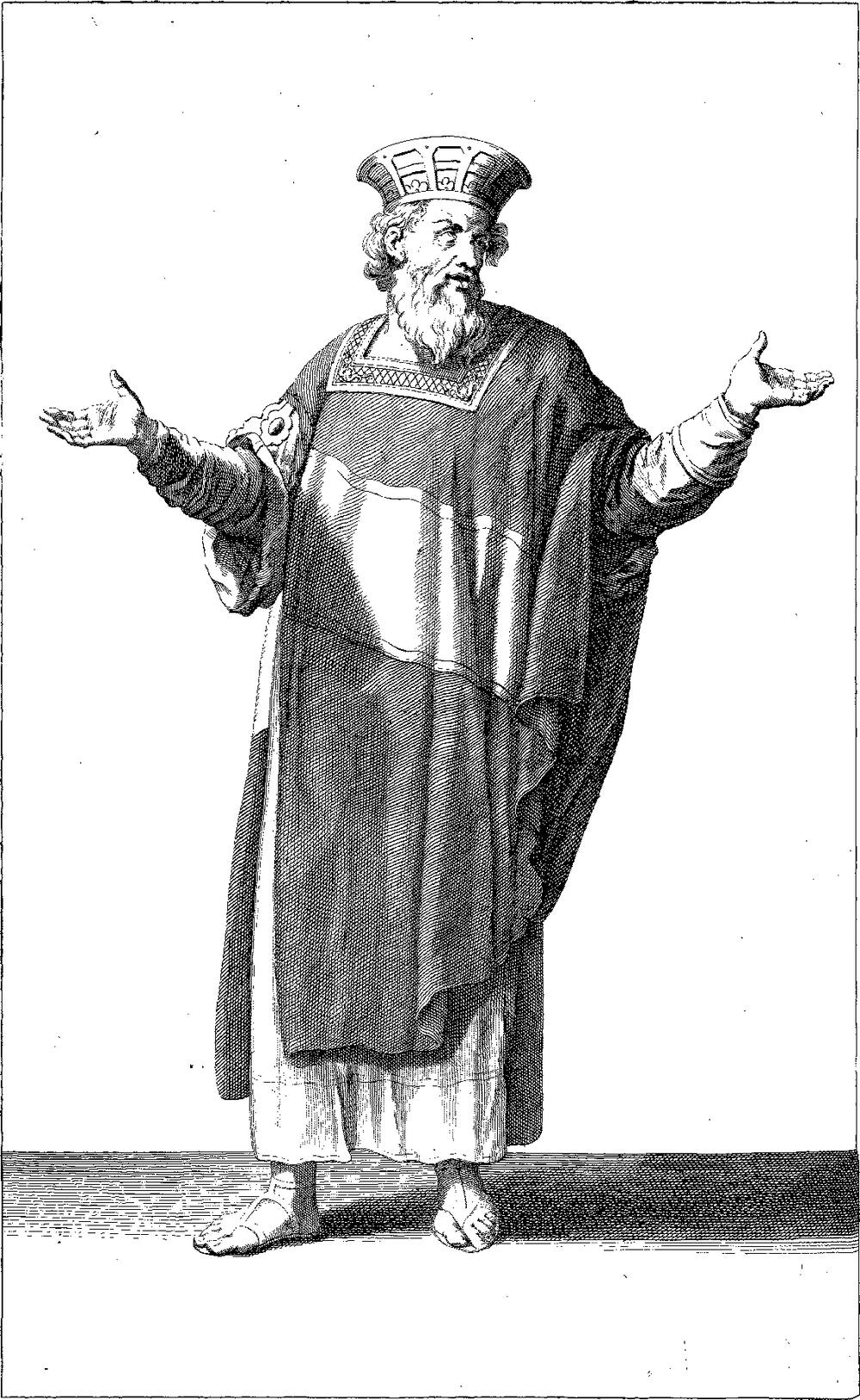
MEKONAH, or Mochona, a City of the Tribe of Judah; Nehem. xi. 28. probably the same as Mechanum, which St. Jerome places between Eleutheropolis and Jerusalem, at eight Miles from the first of these Cities90.
I. MELCHI, Son of Janna, and Father of Levi, in the Genealogy of our Saviour, Luke iii. 24.
II. MELCHI, Son of Addi, and Father of Neri, one of the Ancestors of Jesus Christ, according to the Flesh, Luke iii. 28.
MELCHIAH, or Melchias, Head of the fifth Family of the twenty four sacerdotal Families, 1 Chron. xxiv. 9. See Malchiah.
MELCHISEDEC, King of Salem, and Priest of the most High. The Scripture tells us nothing, either of his Father, or of Heb. vii. 1, 2, 3.his Mother, or of his Genealogy, or of his Birth, or of his Death. And in this Sense he was a Figure of Jesus Christ, as St. Paul affirms, who is a Priest for ever, according to the Order of Melchisedec, and not according to the Order of Aaron, whose Original, Life, and Death are known. When Abraham returned from pursuing the four confederate Kings, who had defeated the Kings of Sodom and Gomorrah, and had taken away Lot, Abraham’s Genes. xiv. 17, 18, 19, &c.Nephew, along with them; Melchisedec comes to meet Abraham as far as the Valley of Shaveh, which was afterwards named the King’s Valley, and presents him with the Refreshments of Bread and Wine, or he offered º Bread and Wine in Sacrifice to the Lord, for he was a Priest of the most High God. And he blessed Abraham, saying, “ Blessed “ be Abraham of the most High God, possessor of Heaven and Earth; and blessed “ be the most High God, who hath delivered thine Enemies into thy Hand.” Abraham being desirous to acknowledge in him the Quality of Priest of the Lord, offered him the Tythes of all he had taken from the Enemy. After this Time there is no more Mention made of Psalm cx. 4.the Person of Melchisedec; only the Psalmist speaking of the Messiah, says, “ Thou art a Priest “ for ever after the Order of Melchisedec.
St. Paul in his Epistle to the Hebrews Heb. v. 6, 10.unfolds the Mystery, which is concealed in what is said of Melchisedec in the Old Testament. First he exalts the Priesthood of Christ, who is a Priest for ever after the Order of Melchisedec, and who in this Quality, in the Days of his Flesh offered up Prayers and Supplications, with strong Crying Heb. vi. 20. Hebr. vii. 1, 2, 3, &c.and Tears, unto him that was able to save him from Death, and was heard in that he feared, Heb. v. 7. He also says, that our Saviour as a Forerunner is entered for us within the Veil, or into Heaven, being made an High-priest for ever after the Order of Melchisedec. “ For, as he adds, this “ Melchisedec King of Salem, and Priest of “ the most High God, who came to meet “ Abraham when he returned from his “ Victory over the Kings, and who blessed “ him, and to whom Abraham gave the “ Tythe of all he had taken, who is called “ according to the Interpretation of his “ Name, first King of Justice, and secondly King of Salem, or King of Peace; “ who is without Father, without Mother, “ without Genealogy, who has neither Beginning nor End of his Life; this Melchisedec, I say, became thus the Image “ of the Son of God, who remains a Priest “ for ever. Consider therefore how great “ he is, since Abraham himself gives him “ the Tythe of the best that he had. But “ without doubt he that receives the Blessing is inferior to him that gives it. And “ indeed under the Law, those that receive Tythe are mortal Men, whereas “ he that receives it here is represented as “ living always. And moreover Levi, who “ receives Tythes from others, has paid it “ himself, as one may say, in the Person of “ Abraham, since he was still in the Person “ of Abraham his Ancestor, when Melchisedec met this Patriarch.
An infinite Number of Difficulties and Scruples have been started upon the Subject of Melchisedec. St. Jerome91 thought that Salem, of which Melchisedec was King, was not Jerusalem, but the City of Salem near Scythopolis, where they still pretended to shew the Ruines of the Palace of this Prince. The Greatness and Extent of these Ruines are a sufficient Proof of the Magnificence of this ancient Building. He thinks it was at this City of Salem or Shalem that Jacob arrived after his Passage over Jordan, at his Return from Mesopotamia, Genesis xxxiii. 18; where the Vulgate mentions, that Jacob came safe and found to Sichem; the Hebrew reads, he came to Salem near Sechem, or Shechem. Some believe that Salem, where Melchisedec reigned, is the same as Salim, spoke of in the Gospel of St. John, Chap. iii. 23. Vid Reland. Palæst.
From the Time of Epiphanius92 there were Names invented for the Father and Mother of Melchisedec. To his Father was given the Name of Heraclas, or Heracles,
and to his Mother that of Astaroth, or Astaria.
The Arabic Catena upon the ninth Chapter of Genesis makes him to be descended from Shem by his Father, and from Japheth by his Mother. Heraclas or Heraclim, the Father of Melchisedec was, as they say, Son or Grandson of Phaleg, and Son of Heber; and his Mother named Salathiel, was Daughter of Gomer Son of Japheth. Joseph Son of Gorion, an Hebrew Historian93, who wrote about the eleventh Century, pretends that Melchisedec was otherwise called Joram; that the Star that ruled at his Nativity had the Name of Sedec, or the Planet Jupiter; that the City in which he reigned was first named Jebus, then Sedec, and lastly Salem or Jerusalem.
Michael Glycas94, Georgius Cedrenus95, and Simon Logothetes96, derive Melchisedec from an Egyptian Race. They say his Father was called Sidon or Sida, and was the Founder of the City of Sidon, the Capital of Phœnicia. As for Melchisedec, he founded Salem upon Mount Sion, ruled there thirty Years, and died without Children. Suidas97 says he reigned there an hundred and thirty Years, and died unmarried; that he was of the cursed Race of Canaan, whence it comes to pass, that the Scripture does not mention his Genealogy. Another Greek Author98, who has borrowed the Name of Athanasius, says that Melchisedec was the Son of an idolatrous King, called Melchi, and of a Queen named Salem. Melchi having resolved to offer a Sacrifice to his Gods, sent his Son Melchisedec to fetch him seven Calves, that he might sacrifice them. As the young Prince was going, he was enlightened of God, and immediately returned to his Father, to remonstrate to him the Vanity of his Idols. Melchi in Wrath sent him back to fetch the Victims. While he was absent, the King offered up to his Gods his own Son, being the elder Brother of Melchisedec, with a great Number of other Children. Melchisedec returning, and conceiving a great Horror at this Butchery, retired to Mount Tabor, where he lived for seven Years, without Cloths, and without any other Food but wild Fruits, and having no other Drink but the Dew, that he sucked up from the Plants.
At the End of seven Years God appeared to Abraham, and bid him go upon Mount Tabor, where he should find Melchisedec. He bid him cloath him, and ask him his Blessing; to which Abraham complied. He found Melchisedec, and having asked his Blessing, Melchisedec anointed him with Oil, blessed him, and changed his Name from Abram into that of Abraham. They came down together from the Mountain, and Abraham returned to his own Habitation. Sometime afterwards, as he returned from pursuing Chedorlaomer, and his Allies, Melchisedec met him, and presented a Cup of Wine to him, having first privately put a Piece of Bread into it, to signify that holy Oblation that is made upon our Altars. But we bring this Relation only as a Romance, and very injudiciously put together; which therefore we need not be at the Trouble to confute.
The Author of the Questions upon the Old and New Testament, printed among the Works of St. Austin99, had written, that Melchisedec was not a Man, but the Holy Ghost, who appeared to Abraham in a human Form. Evangelus (or Evangelius) sent this Writing to St. Jerome100, desiring him to tell him his Thoughts of it. St. Jerome having examined the ancient Doctors of the Church, found that Origen and Didymus took Melchisedec for an Angel; but that Hippolitus, Irenæus, Eusebius of Cæsarea, Eusebius of Emesus, Apollinarius, and Eustathius of Antioch, all agreed to declare, though in different Terms, and by different Ways of Reasoning, that this Prince was a Canaanite by Birth, and King of Salem, otherwise called Jebus, or Jerusalem. This holy Doctor shews, that Melchisedec was an express Figure of Jesus Christ, as King of Salem, or King of Peace, being Priest and King both together, a Priest for ever according to the Order of Melchisedec. And when it is said by St. Paul, that he was without Father, without Mother, and without Descent; this is not intended to acquaint us that he descended from Heaven, or that he was formed immediately by the Hands of God, but merely that he is introduced into the History of Abraham, without informing us who he was, or from whence he came, or at what Time he was born, or when he died.
At the Beginning of the third Century, a Heresy was formed by Theodorus the Banker, a Disciple of Theodorus the Currier, called the Heresy of the Melchisedecians101. These Hereticks affirmed, that Melchisedec was not a Man, but a heavenly Power even superior to Jesus Christ, since Melchisedec was the Intercessor and Mediator of the
Angels, and Jesus Christ was so only for Men. That Jesus Christ was but the Copy of Melchisedec, and his Priesthood was formed only on the Model of that of Melchisedec, according to that of the Psalmist; Thou art a Priest for ever according to the Order of Melchisedec. They answered literally what St. Paul says, that Melchisedec had neither Father, Mother, or Descent. These Hereticks to vindicate their Errors, made Use of certain Books composed by themselves, and which they imputed to Persons not mentioned in the Scripture. This Heresy was revived in Egypt by one Hierax, who maintained, that Melchisedec was the Holy Ghost. Cedrenus and Zonaras102 speak of another Sort of Melchisedecians, otherwise called Autingani, as not daring to touch others, for Fear of being defiled. They lived chiefly in Phrygia, and neither received Circumcision, nor observed the Sabbath. They gave nothing to any one with their Hands, nor received any Thing from any one, but they set it upon the Ground when they offered any Thing, and took it from thence when they received it. They had a profound Veneration for Melchisedec, but it is not known upon what this Veneration was founded. The Jews, according to the Report of St. Jerome103, and the Samaritans according to Epiphanius, maintained that Melchisedec was the same with the Patriarch Shem, the Son of Noah, which Opinion has been followed by a great Number of modern Writers104. M. Jurieu105 has undertook to prove, that Melchisedec was the same as Cham, or Ham. A French Author mentioned by F. Salien106 will have Melchisedec to be Enoch. Another confuted by F. Petau107, said that the Magi who came to Bethlehem to adore Jesus Christ, were Enoch, Melchisedec, and Elias. Some Jewish Authors h have inferred, that Melchisedec was a Bastard, because the Scripture says nothing of his Parents or Descent. Damian the Heretick108, of the Number of the Melchisedecians, affirmed that Melchisedec who appeared to Abraham, was the Son of God, and that the Patriarch worshipped him, and acknowledged him for the Messiah. Peter Cunæus109 has revived this Opinion, and supported it with much Earnestness. Peter du Moulin has also asserted it, and besides in the Year 1686110, one called James Gaillard undertook the Defence of it. The Reader may see our Dissertation, which we have expressly composed on the Subject of Melchisedec, which is printed in the second Tome of the Epistles of St. Paul before the Epistle to the Hebrews: And the Dissertation of Christopher Schlegel, printed at the End of the Commentary of Lewis Tena, upon the Epistle to the Hebrews.
MELEA, Son of Menan, and Father of Eliakim, one of the Ancestors of our Saviour according to the Flesh, Luke iii. 31.
MELECH, second Son of Micah, and Grandson of Jonathan the Son of Saul, 1 Chron. viii. 35.
MELOTA, or Melotes, a Greek Word signifying the Skin of a Sheep with the Wool on, which the Prophets wore, as also the ancient Monks, and poor People in several Countries of the East.
St. Paul in his Epistle to the Hebrews111 makes Use of the Word Melota in the Sense now mentioned. They wandered about in Sheep-skins and Goat-skins. The Word Melota is derived from Melon, a Sheep. It is also sometimes taken for all Sorts of Clothing of Skins with the Hair on, and particularly for clothing of Goat-skins, such as the Monks of Egypt used to wear, according to the Relation of Cassian112.
MELOTHI, a City of Cilicia, that was taken by Holofernes, Judith xi. 13. Vulg. Perhaps it’s the same as Mallos in Cilicia, upon the River Pyramus. The Inhabitants of Mallos, or the Mallotæ, revolted against Antiochus Epiphanes, because this Prince had bestowed their City upon one of his Concubines. Besides the Greek Copy of Judith makes no Mention of Melothi.
MELZAR, or Malazar, the Governor of Daniel and his Companions, when they were Captives at Babylon, Dan. xi. 16. The Word Melzar113 signifies rather an Officer belonging to the Kitchen, a Caterer, or Steward, than seems to be a proper Name114.
2 Macc. xi. 34, 35, 36.MEMMIUS. Quintus Memmius, and Titus Manlius, Roman Legats, being sent to Antiochus Eupator King of Syria, writ to the Jews, signifying, that they confirmed all that Lysias, Regent of the Kingdom of Syria had granted them, and that they would send speedily Deputies to Antioch, who should there take Care of the Interest of their Nation.115
Memnon continues on the next page
Footnotes
-
Erasm. in Matt. vi. 2. v. 22. viii. 22. xix. 5. Apol. ad Stunic. Cajet. ad Matt. i. 23. Calvin. ad Matt. ii. 6. Gemar. Differt. op. T. iii. p. 513. Lightfoot. Hor. Hebr. ad Matth. i. 23. Frassen. Whitaker. Smith. Beza ad Matt. i. Casaub. ad Baron. Cleric. Differt. iii. in suam Concord. Evang. alii plures. ↩
-
Hieronym. Catalog. Vir. illustr. in Matthaeo. ↩
-
Aug. l. i. de Consens. Evang. Vide & Theophyl. proœm. in Matth. ↩
-
Ambros. præf. in Luc. ↩
-
Pet. Dam. Serm. de S. Matth. ↩
-
There is a Latin Manuscript of this Book in the King of France’s Library, Cod. 1697. See the Notes of M. Cotelier upon l. vi. c. 17. of Apostolical Constitutions. ↩
-
Epiphan hæres. 30. c. 23. ↩
-
Origen. Tract. viii. in Matth. Euseb. l. iii. c. 15. Hist. Eccles. Hieronym. in Catalog. Epiphan. hæres. 30. ↩
-
Euseb. Hist. Eccles. ↩
-
Hieron. de Vir. Illus. c. 36. ↩
-
Hieron. de Vir. Illus. c. 3. ↩
-
Theodor. Lector. l. ii. p. 557, 558. Sigebert. Gemblac. ad An. 489. Sur. ad xi. Jun. ↩
-
Epiphan. hæres. 30. n. 6. Matthæi nativ. linguâ, non è Græco versum, ut errant Evangel. Joan. & Act. Apost. the ↩
-
Clem. Alex. l. iv. Strom. p. 488. Beda Retract. in Act. T. 6. p. 3. Euseb. l. i. c. 2. Hist. Eccl. ↩
-
Psalm cviii. 8. 432, 433. ↩
-
Vide Bolland. 24. Feb. p. Epiphan. de Christo, c. 4. ↩
-
Vide apud Bolland. loco citato, p. 441, &c. ↩
-
Origen. in Luc. Homil. i. p. 210. Euseb. l. iii. c. 25. Hist. Eccl. Innoc. Καὶ τῷ Ἐπισκοπῷ αὐτοῦ λάβοι ἕτερος. i. Tom. i. Concil. Labb. p. 1256. ↩
-
Clem. Strom. l. ii. p. 380. a. & l. vii. p. 748. c. ↩
-
Clem. Alex. Strom. vii. p. 765. ↩
-
Stromat. l. iii. ↩
-
Stromat. l. iv. ↩
-
Strom. l. ii. ↩
-
Antiq. l. xvii. c. 8. ↩
-
Antiq. l. xvii. c. 8. ↩
-
Antiq. l. xix. c. 6. p. 676. ↩
-
Josephus de Bello, l. v. c. 33. p. 938. d. ↩
-
Year of Christ 69, Vulgar Æra 66. ↩
-
Josephus de Bello, l. v. c. 33. p. 938. d. e. f. Vulgar Æra 70, J. C. 73. ↩
-
2 Macc. xiv. 19. In the Year of the World 3843, before Christ 157, before the Vulgar Æra 161. ↩
-
Plin. l. xxxvi. c. 5. ↩
-
Porphyr. apud Hieronym. in Dan. xi. & in Isai. xxx. ↩
-
Porphyr. apud Hieronym. in Dan. xi. & in Isai. xxx. ↩
-
Plin. l. v. c. 18. ↩
-
Numb. xiii. 33. ↩
-
Psal. lxxx. 5. ↩
-
Ezek. iv. 11. Vide Judith. vii. 11. ↩
-
Vide Aug. l. ii. c. 15. de Civit. Hieronym. Epitaph. Paulæ. Anselm. & D. Thom. &c. ↩
-
Hieronym. ad Zach. xii. & ad Hoseæ i. ↩
-
Leo of Modena, Part i. c. 6. ↩
-
Joseph. Antiq. l. iii. c. 10. p. 94. C. Rabb. Leo Mettinens. Part. ii. c. 6. 20, 29. xxi. 25. In the Year of Christ 54, of the Vulgar Æra 51. ↩
-
Acts xv. ↩
-
Tertull. Apolog. c. 9. ↩
-
Minut. Fœlix in Octavio. ↩
-
Justin. Martyr. Apolog. 1. ↩
-
Concil. Gangren. c. 11. ↩
-
Can. lxix. ↩
-
Can. xx. ↩
-
Can. lxiv. ↩
-
Zachar. Pp. Ep. xiii. ↩
-
Humbert. Cardinal. dialog. contra calumn. Græcorum. T. iv. Bibl. Pp. ↩
-
Aug. cont. Faust. l. xxiii. c. 13. ↩
-
Zonar. ad Gangrens. Can. Balsamon. Vide Boch. de anim. sacr. par. i. l. i. c. 2. ↩
-
Iren. l. iii. c. 12. Tertull. de Monogam. c. 5. & de pudicitia. c. 12. Cyprian. ad Quirin. l. iii. Aug. contra Faust. l. xxxii. c. 13. & Ep. lxxxii. nov. edit. Jerom. in cap. 5. ad Galat. Ambrosiast. in Galat. ii. ↩
-
Aug. contr. Faust. l. xxxii. c. 13. ↩
-
Gaudent. Serm. 15. ↩
-
1 Cor. vii. 7, 10. Εἰδωλόθυτα ἐσθίειν. ↩
-
Tertull. de jejunio. ↩
-
Theodoret. Hist. Eccles. l. iii. c. 11. & 13. ↩
-
Vid. Tradit. Hebr. in 1 Paralip. iv. 17. ↩
-
Hieron. Ep. cxxvii. Mansione 13. Ita & Hebræi tract. Sanhedr. c. 1. ↩
-
Hermæ l. i. Vision. ii. n. ii. c. 5. ↩
-
Sanut. secret. Fidel. c. 6. p 251. Brocard. descript. terræ sanctæ, c. 3. ↩
-
Joseph. de bello, l. iii. c. 18. p. 860, 861, in Græc. ↩
-
Vide Reland. Palæst. l. i. c. 41. Sanutus secret. fidel. crucis, p. 246, 251. Hegas κεφ. λε. p. 107. ↩
-
Euseb. & Hieronym. locis Hebr. ↩
-
Joseph. Antiq. l. xiv. c. 2. ↩
-
Joseph. Antiq. l. xiii. c. 1. 1 Macc. ix. 36, &c. 4 ↩
-
Xenophon. Cyro-paid. l. vi. ↩
-
Xenophon’ ↩
-
Arrian of the Wars of Alexander. the ↩
-
Retreat of the ten Thousand, l. i. ↩
-
Herodot. l. i. ↩
-
Tim. ii. 5. Mediator Dei & hominum homo Christus Jesus. ↩
-
Clem. Alex. l. i. Stromat. ↩
-
Vide Buxtorf. Lexicon. in רפאRapha, mederi. ↩
-
Homer. Odyss. Δ. Ἰητρὸς δὲ ἕκαστος ἐπιστάμενος περὶ πάντων Ἀνθρώπων. ↩
-
Herodot. l. ii. c. 24. ↩
-
Diodor. l. i. Biblioth. ↩
-
Clem. Alex. l. i. Strom. Ἐπὶ δὲ ἰατρικὴν ὤδε τοῖς διαπρέπουσι αἰγυπτίων ἐδιδάσκετο. ↩
-
Joseph. Antiq. l. viii. c. 2. ↩
-
Joseph. de bello. l. vii. c. 25. ↩
-
Pindar. Pyth. Od. iii. ↩
-
Homer. Odyss. τ. ↩
-
Cato de re rust. art. 160. ↩
-
Plato Theætetr. p. 149. ↩
-
Vid. Voss. de Historicis Græcis, l. i. c. 15. ↩
-
Herodot. l. ii. c. 159. ↩
-
מגילת Megillat, Volumen. ↩
-
Hier. in locis and Bethmaca. º Clem. Alex. l. iv. Strom. Cyprian. l. ii. Ep. iii. ad Cæcil. Eufeb. Cæsar. Dem. l. v. c. 3. Ambros. l. v. Sacram. c. i. & alii plerique Patrum & Interp. Consule si placet Bellarm. l. i. de missa, c. 6. ↩
-
Hieronym. Ep. ad Evang. ↩
-
Epiphan. hæres. 55. c. 4. ↩
-
Gorionid. l. vi. c. 31. ↩
-
Glycas. Annal. p. 135. ↩
-
Cedren. l. i. p. 27. ↩
-
Sim. Logoth. apud Cang. ad Chron. Pasch. p. 500. ↩
-
Suidas in Melchisedec. ↩
-
Apud Athanas. T. iii. p. 239. novæ Editionis. ↩
-
Append. T. iii. Opt. S. Aug. p. 106. e. f. 107, 108. ↩
-
Vide in nov. Edit. Hieronym. p. 570. Tom. ii. hæret. Fab. l. ii. c. 6. ↩
-
Vide Epiphan. hæres. 55. & Theodoret. ↩
-
Vide, si placet, Scaliger. Not. ad Euseb. p. 241. & Authores ab eo citatos. ↩
-
Hieron. Tradit. Hebr. in Genes. & Ep. ad Evang. ↩
-
Vide Lyran. Abul. Cajet. Eugub. in Gen. xiv. Rupert. in Matt. i. Galatic. de Ananis. l. x. c. 6. Genebr. Chronic. Torniel. Annal. Moller in Psal. cx. Montacut. p. 216. Hugo Broughton & Joan. Valles. Suarez, alii apud Tenam, & Schlegel. ↩
-
Jurien. Hist. critique des Dogmes, &c. l. i. ↩
-
Salian. præf. in T. v. Annal. ↩
-
Petav. T. iii. Theol. Dogm. tract. de opificio 6 dierum, l. i. c. 4. art. 3. ↩
-
Vide apud Selden. curis secundis ad Sect. i. de decimis. ↩
-
Epiphan. hæres. 55. ↩
-
Petr. Cunæus, l. iii. c. 3. de Rep. Hebr. ↩
-
Hebr. xi. 37. Περιῆλθον ἐν μηλωταῖς, ἐν αἰγείοις δέρμασι. ↩
-
Cassian. de habitu Monach. c. 11. ↩
-
Dan. i. 11. יאמר אב המלאצר ↩
-
Ita Kimchi, Jun. Tremel. Palan. ↩
-
Vide Acta erudit. Lips. an. 1636. p. 150. ↩