Volume I, pages 98–117 of the 1732 edition, from ALE to AMM: everything printed on these pages, in order.
Continued from Alexander (VII)
Many died amidst their torments, without saying any thing, and the whole Court was full of terror, consternation and trouble. One of those who were racked declared, that Alexander had written to his friends, desiring they would dispose the Emperor to send for him to Rome; and that he had informations of great consequence to lay before him against his Father, who had preferr’d the friendship of Mithridates King of Parthia to his alliance with the Romans. He added, that this young Prince had poison ready prepared at Ascalon to give his Father; search was made to no purpose after this poison, for none ever could be found.
Alexander however was not dejected at this storm: he not only denied nothing which had been extorted from his friends by the violence of torture, but without scruple confessed it; whether he designed thereby to confound the credulity and suspicions of his Father, or to involve the whole Court in such perplexities, out of which they should not be able to extricate themselves. He got four papers presented to the King, wherein he told him, that to torment so many persons upon his account was all in vain; that it was true, he had laid ambuscades for him, and that the principal Courtiers were his accomplices: He named in particular Pheroras, and his most intimate friends. He added, that Salome came secretly to him in the night, and, whether he would or no, would lie with him. That the whole Court wished for nothing more than the moment when they might see themselves delivered from that pain which they were continually kept in by his cruelties and perpetual apprehensions.
In the mean time, Archelaus King of Cappadocia, the Father-in-law of Alexander1, being informed of all that passed at Herod’s Court, came to Jerusalem, with intention to procure, if he could, a reconciliation between Herod and his Son-in-law. At In the Year of the World 3996. before J.C. 4. before the vulgar Æra 8.first he pretended to be angry with Alexander, blamed very much his conduct, and commended the King’s extremely. He said, that for his part he was ready to dissolve the marriage between Alexander and his Daughter Glaphyra, if he could discover that she had any share in the ill designs of her Husband. Herod seeing Archelaus so warmly to espouse his passion, began to relent, and re-assume the sentiments of a Father towards his Child. So that he first was for excusing his Son, and desiring Archelaus not to carry things to an extremity, nor to think of breaking off the marriage of his Daughter with Alexander.
Archelaus then began to justify the young Prince, and to throw the blame of all upon others, and chiefly upon Pheroras King Herod’s Brother. And the King confess’d, that indeed he was the cause of all this mischief. Thus Alexander, by the prudent management of Archelaus, was restored to the good graces of his Father. The same Archelaus afterwards reconciled Pheroras with Herod, and so established peace throughout the whole Court.
In the Year of the World 3998. before J.C. 2. before the vulgar Æra 6.But this calm was not of long duration. One Eurycles a Lacedæmonian, having insinuated himself into Herod’s favour, gained also the confidence of Alexander; so that this young Prince opened his heart freely to him concerning the grounds of that discontent which he pretended to have against his Father2. Eurycles told every thing to the King, who began again to conceive violent suspicions against his Sons, to observe them narrowly, and hearken to every thing that was said against them. Alexander having received among his Guards two persons whom Herod had dismissed from his service, the King grew jealous of them, and ordered them to be tortured. They confessed that Alexander had sollicited them to kill the King, while he was hunting, with a pretence and shew of shooting at some wild beast: That they were told they might be safe, if they gave out that the King falling from his horse was run thro’ with his own weapons. They declared likewise, that there was Gold concealed in Alexander’s stables.
After this the Governour of Fort Alexandrium was taken into custody; he was accused of having promised Alexander and Aristobulus to receive them into his Fortress, and to deliver up the money belonging to the royal Treasury which was lodged there. The Governour suffered the rack with great resolution, and maintained that nothing was more false than this accusation. But his Son coming in, confessed all that they had a mind to, and produced even letters from Alexander, the purport whereof run thus: As soon as we have executed what we have designed, we shall come to you. Therefore be ready to receive us into your Castle, according to your promise. Herod having seen these letters, no longer doubted but his Sons had prepared an ambush for him. Alexander affirmed that he never wrote these letters, but that Diophantus had counterfeited his character. Herod was then at Jericho, and having produced those persons before an assembly of the People, who had been forced by the violence of torments to accuse his Sons, the people stoned them; and had done the same by Alexander and Aristobulus, if the King had not sent Pheroras and Ptolemy to prevent them.
Herod having confined the two Princes in different prisons, commanded them to
set down the whole Conspiracy in writing. Alexander and Aristobulus wrote, that indeed they had desired to retire to the King of Cappadocia, but that they had in no sort conspired against their In the Year of the World 3998. before J. C. 2. before the vulgar Æra 6.Father’s life. That they should have been very glad if Tyrannus, one of their Accusers, had been examined more strictly, whom the people of Jericho, pushed on by the Emissaries of Antipater, had stoned. The King commanded Alexander to be brought in fetters, as he was, to the Princess Glaphyra his Wife, in order to know of her, if she were not an Accomplice with his Son in the evil designs which he had formed against him. The sight of her Husband in so melancholy a condition drew bitter outcries from her, which were followed with a torrent of tears: She protested that she was guilty of nothing; but that indeed, to free herself from the uneasinesses which she suffered, she had resolved to retire with her Husband to the King of Cappadocia her Father, and from thence to go to Rome. Herod wrote to Archelaus, complaining that he too was entred into the Conspiracy with his Sons, without giving him any intelligence of it; and at the same time wrote likewise to Augustus, accusing his Sons of plotting against his life, and designing to fly out of his dominions.
Augustus answered him, that if his Sons were convicted of having made any attempts upon his life, he might punish them as parricides; but if they were guilty only of shewing a desire to withdraw themselves, he should treat them with more gentleness: That therefore it was his advice to have a Council called at Berytus in Phœnicia, composed of his friends and Archelaus King of Cappadocia, in order to deliberate with them concerning what he should do about his Children. Herod therefore convened as many of his friends as he thought proper at Berytus3; but would not invite Archelaus thither, nor the two Princes Alexander and Aristobulus. He left them at Platane, a village of the Sidonians, not far from Berytus, that they might be near at hand, if it should be necessary for them to appear.
Herod came into the assembly, which consisted of an hundred and fifty persons, and began himself to accuse his Sons with great vehemence and passion; and after he had spoken in terms very unbecoming a Father, he said, that not only Augustus had made him master of his Sons destiny, but that the very laws of the Jews declared that if a Son were accused by his Parents, and they put their hand upon his head, all who were present should stone him, Deut. xxi. 18,19,20.and put him to death. He added, that tho’ he might treat his Sons in this manner after the crimes whereof they stood convicted, yet he was willing to have their opinion, and expected that they would join with him in giving an example of that just severity to future generations, which ought to be exercised upon inhuman and unnatural Children.
Saturninus, a Man of Consular Dignity, who was at the head of the Assembly, was for punishing Alexander and Aristobulus, but not with death. His three Sons who were present were of the same opinion: but Volumnius pronounced that they were worthy of death, and the majority gave their advice the same way; so that their death was resolved on by a plurality of voices. Herod therefore carried them to Tyre, and Nicholas of Damascus being just arrived there from Rome, the King asked, what his friends thought of his Sons? Nicholas answered, that the generality was of opinion they ought to be imprisoned, till he might with more leisure take his final resolution. Herod was a long time thoughtful, and at last determined to carry them to Cæsarea.
The whole City was in great expectation to see what course Herod would take in this juncture. Every one pitied the two Princes, but no one dared to speak plainly, for fear of incurring the King’s displeasure. One of Herod’s old Soldiers, who had a Son called Tyro4, of the same age with Alexander, having ventured to take the liberty of making some pretty sharp remonstrances to the King upon this matter, and telling him that the Officers and Soldiers, and the whole Body of the People were moved with compassion for the young Princes, and pitied their sad fate; the King losing all patience, commanded the Soldier and his Son to be seized, and all besides whom he had named; and having put the old Soldier and his Son to the torture, the old Man declared that he had made a resolution to kill the King, and to expose himself, for the love of Alexander, to all sorts of punishments. The King, after this, thought of nothing more than of executing the project which he had formed, of dispatching his Sons. He sent them to Sebasta, otherwise Samaria, and there ordered them to be strangled. Their bodies were carried to the Castle of Alexandrium, where their Ancestors of the Mother’s side had generally been buried. Thus died Alexander and Aristobulus, the Sons of Herod the Great and Mariamne, in the year of the
world 3999, one year before the birth of J. C. and four before the vulgar Æra.
Josephus relates, that Glaphyra, Alexander’s Wife, having been sent back by Herod to her Father Archelaus, married for her second Husband Juba King of Mauritania; and that afterwards she married Archelaus Brother to Alexander her first Husband. This last appeared one night to Glaphyra, and reproached her with the little love she had for him, since not contented with a second marriage, she had contracted a third with his Brother Archelaus. For this reason, added he, I am determined to shew you, that my affection is more constant than yours; and for a proof that I have not forgotten you, within five days I will take you once more to my self, and deliver you from the infamy in which you now live. Accordingly Glaphyra died at the end of five days5.
VIII. Alexander a Jewish Impostor of the City of Sidon, who so much resembled Alexander the Son of Herod and Mariamne, of whom we have been speaking, that all who had ever been acquainted with him were persuaded that this was really he6. He gave out, that his Brother Aristobulus and he had been delivered from death by the kindness of a friend, who had placed others in their room at the time when they were to have been executed. He came into the Isle of Crete, where all the Jews owned him to be the Son of Herod, and furnished him with money to provide an equipage, and make a journey to Rome. He landed at Puzzuolo, where the Jews received him with honour. Herod’s friends, and they who had known Alexander most particularly, were deceived by the great resemblance which he bore to him, so that the Jews of Rome came in crowds to meet him; and he entred the City with a train that might become a King.
Augustus was the only one who was not deluded; the air of this Man, and his hands, which had been hardened by labour, discovered to him that he was an Impostor. He first of all asked him what was become of his Brother Aristobulus, and why he did not come to Rome, to share either in his good or bad fortune. He answered, that he was in the Isle of Cyprus; that he was left behind there, because they would not both expose themselves to the dangers of the sea; and that if any misfortune should befall one of them, the other might be preserved. Augustus putting on a serious air, took this young Man aside, and said to him, If you will declare the truth to me, I promise to dismiss you without taking away your life. Tell me then who you are, and who has engaged you to play the counterfeit in this manner; for you are not of an age to form an intrigue of this nature of your self. The young Man being unable to persist longer in this falshood before the Emperor, confessed the whole cheat to him; and Augustus, not to violate the promise he had made, sent him to the Gallies, because he was a corpulent and robust Fellow; and put the person to death who had persuaded him to act this part. This happened some time after the death of Herod, in the year of the world 4001. of J. C. 1. and three years before the vulgar Æra.
IX. Alexander, the Son of Phasaël and Salampso, Herod’s Sister. Joseph. Antiq. l. 17. c. 7. p. 628. a.
X. Alexander, the Son of Alexander the Son of Herod, and Glaphyra Daughter to the King of Cappadocia. Joseph. Antiq. l. 17. c. 17. p. 628. e.
XI. Alexander, the Son of Tigranes, and Grandson of Alexander who was put to death by Herod. He married Jotape the Daughter of Antiochus King of Comagena. Joseph. Antiq. l. 17. c. 7.
XII. Alexander, a Jew of Cyrene, was accused by Ruffians before Catulus Governour of this Province, and by him put to death7, about the year of J. C. 73.
XIII. Alexander, the Son of Simon the Cyrenian, and Brother of Rufus, who assisted our Saviour in carrying his Cross, as he was going to Mount Calvary.
XIV. Alexander Lysimachus, Alabarch of Alexandria, and Brother to Philo the Jew. Some believe that this was he who was in company with the Priests, when the Apostles were carried before the Senate to give an account of their doctrine and conduct. This Alexander was the wealthiest Jew of his time. He made rich presents to the Temple, and was the Father of Tiberius Alexander, who renounced the Religion of the Jews, and turned Pagan8. Alexander Lysimachus had the management of the Empress Antonia’s affairs. Caligula put him in prison; and he was not set at liberty till the reign of Claudius, Caligula’s Successor9.
XV. Alexander, a Jew of Ephesus, who addressed himself to the Rabble that had mutinied against St. Paul, and endeavoured to appease them. But when he appeared in the Assembly, and was known to be a Jew, the Ephesians began to cry more loudly, Great is the Diana of the Ephesians. It is not known whether this Alexander were for or against S. Paul, whether he were a Jew, or a Jew converted to Christianity.
XVI. Alexander, an Artificer in Copper, spoken of by St. Paul to Timothy.
The holy Apostle excommunicated him and Hymenæus, because they had blasphemed against the truth.
I. ALEXANDRA, otherwise Salome, (for Salome in Hebrew10 signifies much the same thing as Alexandra in Greek; and in like manner Alexandra is in Greek the same as Salome in Hebrew. In the latter times of the Hebrew Commonwealth, almost all the Jews had two names; one Greek, the other Hebrew or Syriac.) Alexandra was first of all Wife to Aristobulus, sirnamed Philellen, or a friend to the Greeks, by whom she had no Children. She afterwards married Alexander Jannæus, Brother to Aristobulus her first Husband, and of whom we have spoken at large under the Article of ALEXANDER JANNÆUS. She lived seven and twenty years with this second Husband; and when she saw him ready to expire before the Castle of Ragaba, which he was then besieging, she represented to him the sad condition which she and her Children would be left in, because the Jews had always, and almost unanimously, opposed him11.
Alexander answered her, that in the first place she should conceal his death from the Soldiers, till Ragaba was taken; secondly, that when she came to Jerusalem she should send for the principal Pharisees, whose power was very great among the Jews, whether they had a mind to make those odious whom they hated, or to recommend them to the esteem and friendship of the people. When therefore they are come, says he, shew them my body, and tell them that you leave it absolutely to their disposal; that they may throw it into the common Sewer, if they please, without burial, and abuse it every way that they can think on, in revenge for the little consideration I have had for them. You must add, that you resolve to do nothing without their approbation and advice, in the government of the Kingdom. If you behave yourself in this manner, you may assure your self that they will perform all funeral honours for me, in a more splendid manner than you would do your self, and that they will be so pleased with the deference you will pay them, as to let you govern in peace.
In the year of the World 3926. before J. C. 74. before the vulgar Æra 78.Alexandra followed the advice her Husband gave her12, and the Pharisees, who were won by these marks of respect which the Queen shewed them, began publickly to praise the King as a Prince who had governed with great justice; that he deserved all imaginable honours from the People, and to have his funeral performed in the most magnificent manner. The people were easily persuaded to be of the Pharisees opinion, and never was any Prince buried in a more pompous manner than King Alexander Jannæus. This Prince, when he died, left two Sons, Hircanus and Aristobulus, and gave the Regency of the Kingdom to the Queen Alexandra. Thus she governed peaceably and happily; because she always seemed to disapprove whatever her Husband had done against the People. As for the rest, she had no more properly than the title of Queen, the Pharisees in reality governing in her name. Some affairs of consequence notwithstanding she would undertake without their direction, and kept a good number of Soldiers in her pay, so that she was formidable to all her neighbours, and obliged them to give her Hostages.
Under her government the whole Country enjoyed peace; no enemy from abroad disturbed the tranquillity of the People. The Pharisees were the only persons that caused any disturbance, by demanding of the Queen that she would revenge the death of eight hundred Men, who had been crucified by King Alexander Jannæus, and would deliver up those who had promoted this act of inhumanity. They first of all ordered one Diogenes to be dispatched, and after him another; so that none of Alexander’s friends could be secure of their lives. At last the principal Persons about Court, and they who had served in the late King’s armies, came to the Palace with Aristobulus at their head, and shewing sufficiently by their air that what had passed was no way In the Year of the World 3933. before J. C. 67. before the vulgar Æra 71.agreeable to them, they demanded of the Queen, that if there was no consideration to be had for their old services, she would at least permit them to retire, and to secure their lives from the vexations of the Pharisees.
Aristobulus, the Son of Alexandra, expressed his dissatisfaction more than all the rest, and spoke to his Mother with a great deal of vehemence. The Queen not knowing what else to resolve on, distributed these old Officers in the several Fortresses of the Country, but put none of them into the Castles of Hircanium, Alexandrium, and Machærus, whither she had removed every thing valuable that she had.
In the Year of the World 3934, before J. C. 66, before the vulgar Æra 70.Some time after Alexandra sent her Son Aristobulus towards Damascus, with troops against Ptolemy Mennæus, who very much incommoded this City. But Aristobulus returned without having done any thing that was memorable. After this, Tigranes coming to besiege Ptolemais, Alexandra sent Ambassadors to him with great presents, desiring him not to undertake any thing against her dominions. Tigranes received the Ambassadors very well, promised to have regard to the
Queen’s request, and was soon after obliged to return into Armenia to oppose Lucullus, who was ravaging it.
At last Queen Alexandra falling dangerously ill, Aristobulus her Son thought it not convenient to defer any longer the execution of a design which he had formed a great while since. He went out by night, attended only with one Servant, and visited all the Castles where his Father’s friends commanded, in order to make himself Master of them, and prevent the Pharisees, lest they should seize upon the Government. The next day, as soon as it was light, and it was known that Aristobulus was absent, the Queen suspected that he was gone upon some enterprize, and was confirmed in her opinion, when Couriers came one after another, to inform her that the Fortresses had for the most part surrendred one after another to Aristobulus.
This news threw her into great consternation; orders were given for seizing the Wife and Children of Aristobulus, whom he had left at Jerusalem, and they were kept in the Fortress which was adjoining to the Temple. In the mean time Aristobulus immediately got possession of two and twenty places of strength, and saw himself soon at the head of a great number of Troops which came in voluntarily to serve him. Hircanus his Brother, and the principal persons of the Nation, came to the Queen, and desired her to put things into some order; but her indispolition would no longer give her leave to think of war. She died soon after, at the age of seventy three, after she had been nine years Regent. In the year of the World 3935. before J. C. 65. before the vulgar Æra 69.
II. ALEXANDRA, the Daughter of Aristobulus, and Wife of Philippion13, the Son of Ptolemy Mennæus, Prince of Chalcis, a Province situated between Libanus and Antilibanus. Ptolemy himself falling in love with Alexandra, killed Philippion, and married his Widow.
III. ALEXANDRA, Daughter of the High-Priest Hircanus, and Wife to Alexander the Son of Aristobulus, which Aristobulus was Brother to the High Priest Hircanus, and the Son of Alexander Jannæus, King of the Jews. The Alexandra of whom we are speaking, was the Mother of Mariamne, Herod the Great’s Wife, and of Aristobulus who was invested with the High-Priesthood, but enjoyed it a year only, Herod having procured him to be drowned in a bath at Jericho14.
Herod having put to death the High-Priest Hircanus, sent for a Priest called Ananel, from Babylon, on whom he conferr’d the High-Priesthood. Alexandra was so provoked at it, that she wrote to Cleopatra, the Wife or Mistress of Antony, whom she intreated to ask of Antony the Pontificate for her Son Aristobulus, Brother to Mariamne, and Grandson to Hircanus15. Antony having heard much of Mariamne’s extreme beauty, and of Aristobulus, desired Herod by letter to send Aristobulus to him. Herod excused himself, and being over-powered by the sollicitations of his Wife Mariamne, he gave the High-Priesthood to Aristobulus his Brother-in-law; but, as we have said, he knew well how to get rid of him very soon; in the mean while he complained mightily of Alexandra, who had addressed her self to Antony for this favour. He commanded her to continue in the Palace, and not to intermeddle in affairs of any kind. The King had her narrowly observed, so that she could neither do nor say any thing, but In the year of the World 3968. before J. C. 32. before the vulgar Æra 36. In the year of the World 3969. before J. C. 31. before the vulgar Æra 35.what was immediately reported to him.
Alexandra inraged to see herself reduced thus to a kind of Captivity, wrote to Cleopatra, and complain’d of it16. Cleopatra sent her word, that she should endeavour by all means to retire with her Son Aristobulus into Egypt; and that she would very readily receive them. Alexandra therefore took care to have two Biers or Coffins provided, one for her self, the other for her Son; she gave orders for the carrying these two Coffins to a Vessel which waited for them at sea. But one of Alexandra’s Slaves discovered this intrigue to Herod, who gave directions for seizing both her and her Son, at the very instant when they were conveying them away in the manner which she had projected. However, he did not treat her ill on this account, apprehending the resentment of Cleopatra, and that she might in return do him some ill office with Mark Antony.
In the year of the World 3970. before J. C. 30. before the vulgar Æra 34.After that Herod had procured the death of Aristobulus, Alexandra’s Son, this Princess pretended to believe, that it was purely accidental, waiting in the mean while for a fair opportunity of taking her revenge17. She wrote an account to Cleopatra of what had passed, and the danger she was in every day of losing her life. Cleopatra was touched with her misfortune, and never ceased importuning Antony to revenge the death of this young Prince, till she had prevailed with him to send to Herod, and order him to appear before him, and clear himself of the crime he was accused of. Herod went, but so wrought upon Antony by his presents, that he wou’d no longer hearken to Cleopatra, and declared, that Herod being King of the Jews, was accountable to no man for his actions.
In the mean time a report was spread, that Antony had put Herod to death; whereupon Alexandra sollicited Joseph, Herod’s Uncle, who governed in the absence of this Prince, that she and Mariamne might be carried to the Roman Legions, that if any disturbance should happen, they might be secure. But this design was not executed, because they received letters at the same time from Herod, which contradicted the rumour that had gone abroad. And when this Prince returned to Jerusalem, being informed of all that had passed by his Sister Salome, he ordered Alexandra to be close confined, and put in fetters.
In the Year of the World 3976. before J. C. 24. before the vulg. Æra 28.Herod having put to death Mariamne, for reasons which will be mentioned in another place, her Mother Alexandra fearing the same fate18, pretended to condemn her Daughter’s conduct, and to approve of her death. When she was led to the place of execution, Alexandra loaded her with abusive language, and would have flown at her and torn her hair; which all who were spectators of her behaviour looked upon as instances of folly and baseness that deserved contempt. The grief which Herod conceived at the death of Mariamne was the cause of an indisposition that had reduced him very low; and Alexandra thinking he was at the last extremities, sollicited the Governours of the two Forts in Jerusalem to put them both into her hands, and secure them for Herod’s Children by Mariamne, to prevent others, if the King should die, from getting them into their possession. The Governours, who did not love Alexandra, gave immediate intelligence to Herod of what was doing; and he, without any delay, gave orders for dispatching her, which were as soon executed; in the year of the World 3976. before J. C. 24. before the vulgar Æra 28.
IV. ALEXANDRA, the Daughter of Phasael, Herod the Great’s Brother. She married Timias, one of the most powerful Men in the Isle of Cyprus, and died without Children19.
ALEXANDRIA, a celebrated City in Egypt, built by Alexander the Great, in the year of the World 3673. before J. C. 327. or 331 before the vulgar Æra. It is situated between the Mediterranean and the Lake Mæris20. There was before a village called Rachotis, at the nearest place to this port. Dinocrates the celebrated Architect drew the plan of it, and gave the dimensions of it. The City of Alexandria is pretty often to be met with in the Latin text of those books of the Old Testament which were written before the Nahum iii. 8. Jer. xlv. 25. Ezek. xxx. 14,15,16.reign of Alexander. But this name is no where in the original Hebrew; we read there of No-Ammon21, which is probably the City of Diospolis in the Delta, between Busiris to the South, and Mendesa to the North.
The Arabians inform us that Alexandria was called Caissoun, before Alexander the Great rebuilt or enlarged it22. Dinocrates who prepared the plan of it, was the same Architect who rebuilt the Temple of Diana of Ephesus, which had been burnt by Erostratus. He had the direction of the work of this new City; but that it might be carried on with more diligence, Alexander appointed Cleomenes, one of his Captains, to be the Surveyor23. Cleomenes was of Naucratis in Egypt. Justin calls him the founder of Alexandria, as having contributed a great deal to the improvement of it24. Aridæus, Alexander’s Brother, was charged with the care of carrying the body of this Prince from Babylon to Alexandria. He employed two years in making preparations for the removal of it, the pomp whereof is described to us by Diodorus Siculus. There had been a prophecy current, intimating that the place where Alexander should be buried should be prosperous and flourishing: The Governours therefore of the several Towns and Provinces disputed among themselves who should have the honour and advantage of possessing his Body. There was a proposal for the conveying it to Aigui in Macedonia, where generally the Kings of this Country were buried; but Egypt carried it. His body therefore was deposited first of all at Memphis, and afterwards was removed to Alexandria. It is said25 to have been laid in a coffin of gold, and to have been embalmed in honey.
Alexandria belonged successively to the Greeks and Romans, then to the Greeks again, till it fell under the dominion of the Arabians, while Omar III. Mahomet’s Successor was Caliph. The happy situation of this City between the Mediterranean and the Red Sea, and upon the river Nile, drew thither the Commerce of the East and West, and made it in a very little time one of the most flourishing Cities in the world. When the Arabians took it, there were four thousand Palaces still standing in it26, four thousand Bagnios, forty thousand Jews paying tribute, four hundred squares, and twelve thousand persons who sold herbs and fruits. This
City, which was formerly so rich and powerful, is no more than a village without any thing remarkable in it besides its ruins, and the remains of its past grandeur27. The Egyptians or Kopts call it generally Rachot, this being, as we have observed, the name of the old village in the room whereof it was built. See hereafter the titles NO-AMMON and THEBES.
The Christians still at this day reverence the Churches of Alexandria dedicated to St. Mark and St. Catherine; one is celebrated for the tomb of this Evangelist, whose body was carried away by the Venetians. There is a picture in it which, according to the tradition of the Kopts, who are the possessors of this Church, was painted by St. Luke. It represents the Archangel St. Michael, at a little more than half his length, with a sword in his hand. The other Church is famous for the martyrdom of St. Catherine, which she suffer’d for the sake of Jesus Christ in the reign of Maximian.
Another thing considerable there is, the remains of Cleopatra’s magnificent Palace, and without the City Pompey’s Pillar is very much admired, the shaft whereof is six fathoms high, all of one piece, of admirable Granite28. It is the finest column that is any where to be seen.
After the death of Alexander the Great, Ptolemy, firnamed Soter, who had been Captain of the guards to this Emperor, had his bones conveyed to Alexandria, and made this City the capital of his Kingdom. The Ptolemy’s his successors reigned there for two hundred and ninety three years. The Commonwealth of the Jews had great correspondence with the Kings of Egypt, who succeeded Alexander, and reigned in Alexandria. Here is a list of these Princes.
Alexander the Great died in the year of the world 3681, before J.C. 319, before the vulgar Æra 323.
Ptolemy, the Son of Lagus, firnamed Soter, reigned thirty nine years, and died in 3720.
Ptolemy Philadelphus reigned thirty nine years, and died in 3758.
Ptolemy Euergetes reigned twenty five years, and died in 3783.
Ptolemy Philopator reigned seventeen years, and died in 3800.
Ptolemy Epiphanes reigned twenty four years, and died in 3824.
Ptolemy Philometor reigned thirty seven years, and died in 3861.
Ptolemy Euergetes or Physcon, reigned fifty three years, part with his Brother Philometer, part alone. He died in 3888.
Ptolemy Lathyrus reigned thirty six years six months. He died in 3923.
Cleopatra, the Daughter of Lathyrus, and Wife of Alexander I. reigned six months.
Alexander I. the Nephew of Lathyrus, was established in 3924, and died in 3943. See Usher under the year 3924.
Alexander II. the Son of Alexander I. was dispossess’d by the Alexandrians in 3939.
Ptolemy Nothus, or Auletes, the Son of Lathyrus, reigned thirteen years, and died in 3953.
Ptolemy, firnamed Dionysius or Bacchus, reigned three years eight months, and died in 3957.
Cleopatra reigned from 3957, and killed herself in 3974. The City of Alexandria29 received the light of the Gospel, by the ministry of St. Mark, the Disciple of St. Peter, about the year of J.C. 59 or 60. He suffer’d martyrdom there towards the year 68, and was succeeded by Anian, whom he had converted in his first voyage to this City.
ALEXANDRIUM, a Castle built by Alexander Jannæus, King of the Jews, upon the top of a Mountain near Corea30. We do not know distinctly where Corea was, but we know that it was the principal City of Judæa, on the side of Samaria, in the way to Jericho, towards the frontiers of Ephraim and Benjamin31. Gabinius demolished the Castle of Alexandrium32, but Herod rebuilt it33. The Princes of Alexander Jannæus’s family were for the most part buried there. Thither Herod order’d the bodies of his Sons Alexander and Aristobulus to be carried, who had been put to death by his directions at Sebaste, otherwise called Samaria34.
ALEXAS, the third Husband of Salome, Sister to Herod the Great. Alexas and Salome were the Persons to whom Herod the Great sent orders for executing those Jews of the first rank whom he had confin’d in the Hippodrom at Jericho, as soon as he expired; that all Judæa being afflicted at the death of so many Persons of quality, might appear at least to be then mourning for their King. But Alexas, instead of obeying such cruel orders, set them all at liberty as soon as the King’s eyes were closed; whereby he procured the esteem and friendship of all the Jews35, in the year of the World 4000, of J.C. 1, before the vulgar Æra 5.
ALIAN,
ALIAN, the eldest Son of Shobal, the Son of Seir, 1 Chr. i. 40.
ALLEGORY, is a figure in discourse which we are then said to use when we make the terms which are peculiar to one thing to signify another. It is a Metaphor continued and pursued: For example, when the Prophets represent the Jews under the Allegory of a Vine, planted, cultivated and watered by the hand of God, and which instead of producing good fruit, brings forth verjuice or sour grapes; and so of others.
Allegories36 are very frequent in Scripture, as well as Metaphors, Parables, Similitudes, and Comparisons. The Jews, says St. Jerom37, and in general the People of Syria and Palestine, were fond of this sort of figurative discourse, and made use of it in almost every thing they said. One principal business of a Commentator is, to distinguish between the allegorical and literal meaning of any passage, and to reduce the allegorical to the literal sense. The antient Jews, as the Therapeutæ38, the author of the book of Wisdom39, Josephus40, and Philo a, and in imitation of them, the generality of the old Fathers, turned even the historical passages of the Scripture into Allegories, and such places where the literal sense is most clear. These allegorical explanations may edify indeed, but they are good for little else: They cannot regularly be produced as proofs of any thing, unless where Jesus Christ or his Apostles have made use of them as such. See hereafter this title, the Sense of Scripture.
,הללו־יה Hallelu-iah.ALLELUIA, or Hallelu-iah, that is say, praise the Lord. This word is to be met with, either at the beginning or the end of some Psalms41. Alleluia was sung upon solemn days of rejoicing. Per vicos ejus (Jerusalem) alleluia cantabitur, says Tobit, speaking of Tob. xiii. 12. Rev. xix. 1, 3, 4, 6.the rebuilding of Jerusalem. St. John in the Revelations says, that he heard a great voice of much people in Heaven, who said Alleluia; and the four and twenty Elders and the four beasts fell down and worshipped God that sat on the throne, saying Alleluia.
T his hymn of joy and praises was transferr’d from the Synagogue to the Church. At the Funeral of Fabiola several Psalms were sung with loud Alleluia’s, says St. Jerom42. The Monks of Palestine were awaken’d at their midnight watchings with the singing of Alleluia’s43. So much energy has been observ’d in this term, that it has been thought proper to preserve it, without translating it either into Greek or Latin, for fear of impairing the genius and softness of it. The Church has for many ages prohibited the use of it in times of penance, and in the ceremonies of mourning. It is not repeated in Lent, nor in the obsequies of the dead. Notwithstanding in the mass for the dead, according to the Mosarabick ritual, at the Introit they sing, Tu es portio mea, Domine, alleluia; in terra viventium, alleluia, alleluia. In the life of S. Radegonde it is said, that at her Funeral solemnities, instead of Alleluia nothing was heard but sighs, which intimates that Alleluia was sometimes used on these occasions, as we see above at the Funeral of Fabiola; but in matters of discipline and mere custom, such as this is, ceremonies never have been uniform and universal.
ALLON, of the Tribe of Simeon, the 1 Chr. iv. 37. Ἀλλόφυλοι ,פלשתים Philistiim.Son of Jedaiah, and the Father of Shiphi.
ALLOPHYLI, is a Greek term, which signifies properly Strangers; but it is generally taken in the Old Testament to signify Philistines.
ALLUSH, or Alush. The Israelites being in the Wilderness of Shur, departed Numb. xxxiii. 13. Judith i. 9. in Græco.from Dophkah, and went to Allush: From thence they proceeded to Rephidim. In the book of Judith Chellus or Chalus, and Kades, are set down as two places pretty near each other. Eusebius and St. Jerom fix Allush in Idumea, towards the Country about Gabala, that is to say, about Petra, the capital of Arabia Petræa; for according to Eusebius and St. Jerom, the Gabalene is near Petra44. Allush is called likewise Eluza or Chaluza. In the accounts of the Empire, it is situated in the third Palestine, and by Ptolemy among the Cities of Idumæa. The Jerusalem Targum upon Genesis xxv. 18. and upon Exodus xvi. 22. translates the desart of Seir by Allush.
,עלמהHalma. Isaiah vii. 14.ALMAH. This Hebrew word signifies properly a Virgin, a young Person unacquainted with Man, one who is not married. In this sense we meet with it in the famous passage of Isaiah; the words whereof are these, Behold a Virgin shall conceive and bear a Son. The Hebrews have no term that more properly signifies a Virgin than Almah; but it must be confessed
without lessening however the certainty of Isaiah’s Prophecy, that sometimes by mistake any young woman whatsoever, whether a Virgin or not, is called Almah45. In like manner in Latin the name of Virgo is sometimes given to a young woman who has not her virginity. See our Dissertation before the Prophecy of Isaiah upon this passage of the Prophet, Ecce virgo, &c. vii. 14. St. Jerom in his Comment on it remarks, that the Prophet declined making use of the word Bethulah, which signifies a young Woman or young Person, but employed the term Alma, which denotes a Virgin who was never seen by Man. This is the proper signification of the word Alma46, which is derived from a root that signifies to conceal. It is very well known that young Women in the East do not appear in publick, but are shut up in their houses, and their Mothers apartment, like Nuns47. The Chaldee Paraphrast and the Septuaginti translate Alma Virgin; Akiba48 the famous Rabbin, a great enemy to Christ and Christians, who lived in the second Century, understands it thus. The Apostles and Evangelists, and the Jews of our Saviour’s time, explained it in the same sense, and expected a Messiah born of a Virgin. Mahomet and all his followers acknowledge the Virginity of the blessed Mother of our Lord.
ALMON, a City belonging to the Tribe of Benjamin, Josh. xxi. 18. It is probably the same as Alemeth, whereof we have already said something. It was given to the Priests of Aaron’s family, 1 Chr. vi. 60.
ALMOND-TREE, a sort of tree whereof there is often mention in the שקדAmygdalus.Scripture. The Hebrews call it Shaked, from a root, which signifies to watch, because the Almond tree is one of the first trees that blossoms in the Spring. The Lord intending to declare to Jeremiah that he was ready to display his wrath against his People, shewed him the branch of an Jer. i. 11.Almond-tree: Quid tu vides Jeremia? virgam vigilantem ego video. Instead of virgam vigilantem, the Hebrew reads, a rod of an Almond-tree.
Numb. xvii. 8.Aaron’s Rod, which bore blossoms and fruit in the Wilderness, was also of the wood of the an Almond-tree. The Author Eccl. xii. 5.of Ecclesiastes, expressing in an enigmatical manner, that an old Man’s hair will grow white, says, that the Almond-tree shall flourish. This tree blows white and very Genes. xxx. 37. לוז Luz.early. It is said in Genesis, that Jacob fixed rods of the Almond-tree before the places where his flocks came to drink: But the Hebrew instead of Almond-tree signifies Hazel, Luz.
ALMUGIM, a certain kind of wood mentioned in the first book of Kings, Ch. x. 11. which in the Vulgate1 is translated ligna thyina, and in the Septuagint wrought wood. The Rabbins generally render it Coral, others Ebony, Brazil, or Pine. It certainly is not Coral, for Coral is not proper to make musical instruments of, nor to be used in rails, or in a staircase, which were the uses that the Scripture tells us this wood Almugim was put to. The Pine-tree is too common in Judæa and the neighbouring country to go in search for it as far as Ophir. The word Thyinum is that of the Citron-tree, known to the Ancients, and very much esteemed for its sweet odour and great beauty49. It came from Mauritania.
We are of opinion that by the word Almugim or Algumim, or simply Gummim, taking al for a kind of article, may be understood oily and gummy sorts of wood, and particularly the tree which produces Gum Ammoniac or Gum Arabic. It is said that the Gum Ammoniac proceeds from a tree resembling that which bears Myrrh; and that the Gum of Arabia comes from the black Acacia, which we take to be the same as the Shittim wood, whereof there is such frequent mention in Moses. If this were so, Solomon’s Almugim and Moses’s Shittim would be the same wood. See our Comment upon 1 Kings x. 11. and what we have to say on the article SHITTIM.
ALOES, a sort of tree which comes from the Indies, of about eight or ten foot high. At the head of it is a large bunch of leaves, which are thick and indented, broad at bottom, but growing narrower toward the point, and about four foot in length. The blossom of it is red intermixed with yellow, and double like a pink. From this blossom comes fruit, round like a large pea, white and red. The juice of these leaves is drawn out by cutting them with a knife, and so receiving it in bottles.
The Eastern Geographers all tell us, that the wood of Aloes, the smell whereof is exquisite, is to be found only in those Provinces of the Indies which are comprehended in the first climate; that the most excellent of all is that which grows in the isle of Senf, situated in the Indian sea, in the way to China50: Others are of opinion that the wood of Aloes which is produced in the isle of Comar, or at Cape Comorin, is the best of all; and that it
was of this a certain King of India, made a present weighing ten quintals, to Nouschirran, and that as it was applied to the fire, it melted and burnt like wax. A great deal of this wood is brought likewise from the islands of Sumatra and Ceilan. So much for the wood of Aloes.
Some Interpreters are of opinion that the Numb. xxiv. 6. כאהלים נטה יהוהHebrew Ahalim signifies the Aloes-tree. The Vulgate reads, Ut tabernacula quæ fixit Dominus, as the tents which the Lord hath spread; but the Hebrew may be translated thus; As the Ahalims which the Lord hath planted. The Septuagint and St. Jerom sometimes translate Ahalim Statte or Aloe; but as the Aloes taken for a tree is not common in Arabia, or the neighbouring countries, others translate Ahalim Santal; but the Santal-tree was unknown to the Antients, and the Moderns who speak of it say it comes from the Indies. The Aloes of Syria, Rhodes, and Candia, called Aspalathus, is known to be a shrub full of thorns, the wood whereof is made use of by Perfumers, after they have taken off the bark, to give a consistency to their perfumes, which without it would be too liquid. See Prov. vii. 17. and Cant. iv. 14. for the signification of Ahalim.
2. ALOES, consider’d as a Plant or Herb, is a Plant, the leaves wherof are about two inches thick, prickly and chamfer’d; in the middle there rises a stem, wherein there is a white kernel, extremely light, and almost round. There are Aloes to be found at present in several places in France. There is a very bitter juice extracted out of this Plant, which preserves dead bodies from putrefaction. They say, but this is mere fable, that Aloes never flowers but once in a hundred years, and that as its flower opens it makes a great noise. There have been several seen blowing in the Royal Garden at Paris, and without making any sensible noise. It is very probable that this Plant is the only true Aloes, for what is said of the wood of Aloes is by many learned Men thought fabulous.
John xix. 39.From this Plant is extracted the drug called Aloes, which is a very bitter liquor made use of in embalming, to secure bodies from putrefaction. Nicodemus bought about an hundred pounds of Myrrh and Aloes to embalm the body of Jesus Christ. In the Proverbs the debauch’d Woman says, that she had perfum’d her bed with Myrrh, Aloes, and Cinnamon; and the Spouse in the Canticles, that Myrrh, Aloes, and all manner of perfumes, are to be found in the garden of her beloved. The Hebrew text in these places reads Ahalim, which the Rabbins interpret Santal, and which is an aromatick wood; but the generality understand by it either the Aloes we have been just now speaking of, or another Aloes of Syria, which we have said something of in the article preceding this.
The Arabians call the Aloes that are taken for a Plant Sabr o. They believe that of all the several species of Aloes, that which grows in the island of Socotorah is the most excellent; that Alexander the Great transplanted the inhabitants of this island into Arabia and Ethiopia, and settled Macedonians in their room, to cultivate Aloes; the People of Socotorah gather the leaves of this Plant in the month of July, and boil them in great Chaldrons to extract the juice out of them, which they put into bottles, and expose them to the Sun during the dog days.
ALPHA, is the first letter of the Greek Alphabet, as Aleph is the first of the Hebrew Alphabet. In the Greek Alphabet Alpha stands for one, or the first51. For this reason God in the Revelations is styled AlphaRev. i. 8. and Omega, the Beginning and End.
ALPHABET HEBREW. See hereafter HEBREW LETTERS.
1. ALPHÆUS, the Father of St. Mat. x. 3. Luke vi, 15.James Minor, first Bishop of Jerusalem. Alphæus was the Husband of Mary, who is believed to have been Sister to the holy Virgin52; for which reason James is called the Lord’s Brother. Many are of opinion that Luke xxiv. 18.Cleophas mentioned by St. Luke, and Alphæus are the same Person, Alphæus being his Greek name, and Cleophas his Hebrew or Syriac name, according to the custom of this Province, where the Men generally had two names.
Mark ii. 14. 14.2. ALPHÆUS, the Father of Levi, or St. Matthew, whom the Son of God took from his office, and made an Apostle and Evangelist. We know nothing particularly of Alphæus, the Father of St. Matthew.
ALTAR. As Sacrifices offered up to God are as ancient as the world, Altars are of no less antiquity. The Scripture in some places speaks of Altars erected by the Patriarchs, without describing the form or matter of them. The Altar which Jacob set up at Bethel was nothing but the stone which had served him for a bolster. Gideon sacrificed upon nothing better than a stone which was before his house. The first Altars which God com
manded Moses to raise to him, must have Exod. xx. 24, 25.been of Earth or rough Stones; and the Lord declared to him, that if any use were made of Iron in them they would be impure. Ch. xxv. 1, 2, 3, &c.The Altar of Burnt-offerings which he caused sometime after to be made, was a kind of trunk of Shittim wood, hollow, and covered over with plates of Brass. See hereafter BURNT-OFFERINGS, and ALTAR OF BURNT-OFFERINGS.
The Altar which Moses injoined Joshua to build upon Mount Hebal, was to be of Deut. xxvii. 5. Josh. viii. 31.unpolished Stones; and it is very probable that those which were built afterwards by Samuel, Saul and David, were of the same structure. The Altar which Solomon 2 Chron. iv. 1, 2, 3.erected in the Temple, was of Brass, but filled, as is believed, with rough Stones. It was twenty cubits long, twenty wide, and ten in height. Lastly, that which was rebuilt at Jerusalem by Zerubbabel, and the other Jews who returned from Babylon, was only of rough Stones: nor was that which the Maccabees rebuilt any better. Josephus53 says, that the Altar which in his time was in the Temple, was of rough Stones, fifteen cubits high, forty long, and as many in width.
ALTAR OF INCENSE. This was a small table of Shittim Wood, covered with Exod. xxx. 1, 2, 3.plates of Gold, of one cubit in length, another in width, and two in height. At the four corners of it were four kinds of horns, and all round a little border or crown over it. Every morning and evening the Priest in waiting for that week, and appointed by lot for this office, offered incense of a particular composition upon this Altar; and to this end entred with the smoaking Censer filled with fire from the Altar of Burnt-Offerings into the Holy, where this Altar was fixed over-against the Shew-bread Table. This was the Altar which was hidden by Jeremiah before the Captivity. 2 Macc. ii. 5, 6.The Priest having placed the Censer on it, retired out of the Holy.
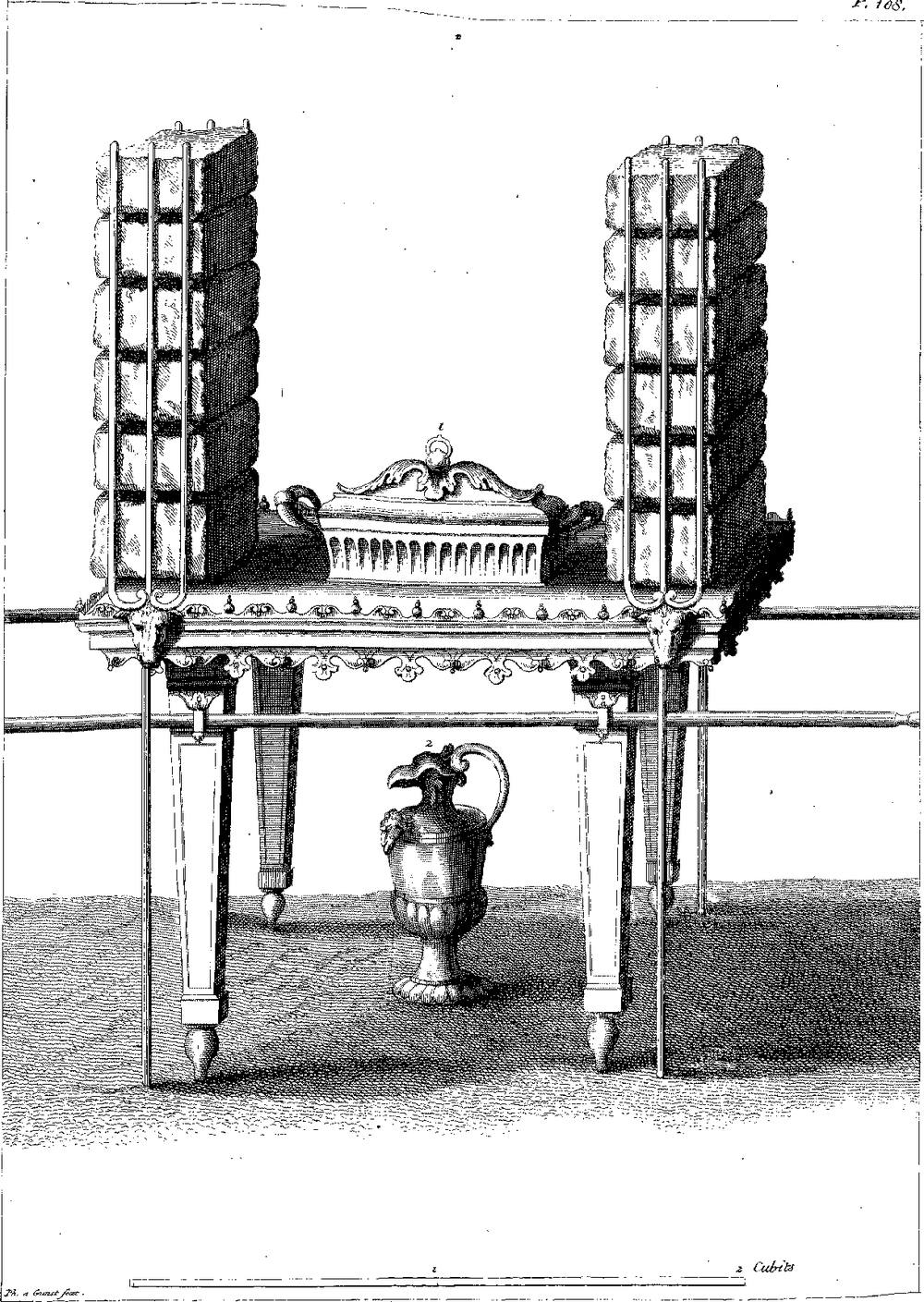
III. ALTAR, or Table, for the Shew-Bread, was a small Table of Shittim Wood, Exod. xxv. 23, 24.covered with plates of Gold, having a little border round it, adorned with sculpture. It was two cubits long, one cubit wide, and one and an half in height. It was placed in the Holy. Upon this Table, every Sabbath -day, were put twelve loaves with salt and incense. See SHEW-BREAD.
IV. ALTAR OF BURNT-OFFERINGS. This was a kind of Coffer of Shittim Wood, covered with brass plates. It Ch. xxvii. 1, 2, 3.was five cubits square, and three in height. Moses placed it to the East, before the entrance of the Tabernacle, in the open air, that so the fire which was to be kept perpetually upon it, and the smoak arising from the Sacrifices which were burnt there, might not spoil the inside of the Tabernacle. At the four corners of this Altar there was an appearance as it were of four horns, covered with the same metal as the rest of the Altar. Within the depth or hollow of it was a grate of brass, on which the fire was made; thro’ this fell the ashes in proportion as they increased upon the Altar, and were received below within a pan which was placed under it. At the four corners of this grate were four rings, and four chains, which kept it up at the four horns of the Altar above mentioned. As this Altar was portable, Moses had rings made, and fastened to the sides of it, into which were put staves of Shittim Wood, overlaid with brass, by the help whereof it was removed from place to place.
Such was the Altar of Burnt-Offerings belonging to the Tabernacle erected by Moses in the Wilderness: but in Solomon’s Temple it was much larger. This was a kind of Cube, twenty cubits long, as many wide, and ten in height. It was covered with thick plates of brass, and filled with rough stones; on the East side there was an easy ascent leading up to it. When the Jews returned from the captivity of Babylon, they rebuilt the Altar of Burnt-Offerings after the model of Solomon’s; but after both the Temple and Altar had been prophaned by the orders of Antiochus Epiphanes, this Altar was demolished, and the stones of it were laid up in some part of the Temple which was unpolluted, till a Prophet should be raised up by God, who should come and declare the use for which they were reserved. Herod the Great having made a new Temple, 1 Macc. xiv. 41.built an Altar of Burnt-Offerings like that which had been there before; but Josephus says, that the ascent up to it was on the South side.
The Altar of Burnt-Offerings, according to the Rabbins54, was a large mass all built of rough and unpolish’d stones, the basis whereof was two and thirty cubits, or forty eight feet square. From thence the Altar rose one cubit or a foot and an half, then there was a diminishing of one cubit in thickness; from thence the Altar being only thirty cubits square, rose five cubits, and received a new diminution or in-benching of two cubits, and consequently was reduced to twenty eight cubits square. From thence again it rose three cubits, and grew two cubits smaller. Lastly, it rose again one cubit, and so being in all twenty four cubits, or thirty six foot square, it formed the hearth on which the Sacrifices were burnt, and the perpetual fire kept up.
The diminution of two cubits abovementioned, which was about the middle of the Altar, served as a passage for the
Priests to go and come about the Altar, to attend the fire, and place the Sacrifices on it. This Altar was composed of large plates of massy Brass, whence it is called the 1 Kings viii. 64.brazen Altar. It is believed that the Altar was all filled with rough Stones or Earth, according to what is said in Exodus, An Altar Exod. xx. 24, 25.of Earth thou shalt make unto me, and shalt sacrifice thereon thy Burnt-Offerings, and thy Peace-Offerings—— and if thou wilt make me an Altar of Stone thou shalt not build it of hewen Stone, for if thou lift up thy tool upon it, thou hast polluted it. At the four corners of the Altar, on the last diminution or inbenching, were four small pillars of a cubit square, hollow in the middle for half a cubit square, and in the form of a perfect cube. These are the horns of the Altar, so often mentioned in Scripture, they were hollow, that part of the blood of the Sacrifices might be poured into them.
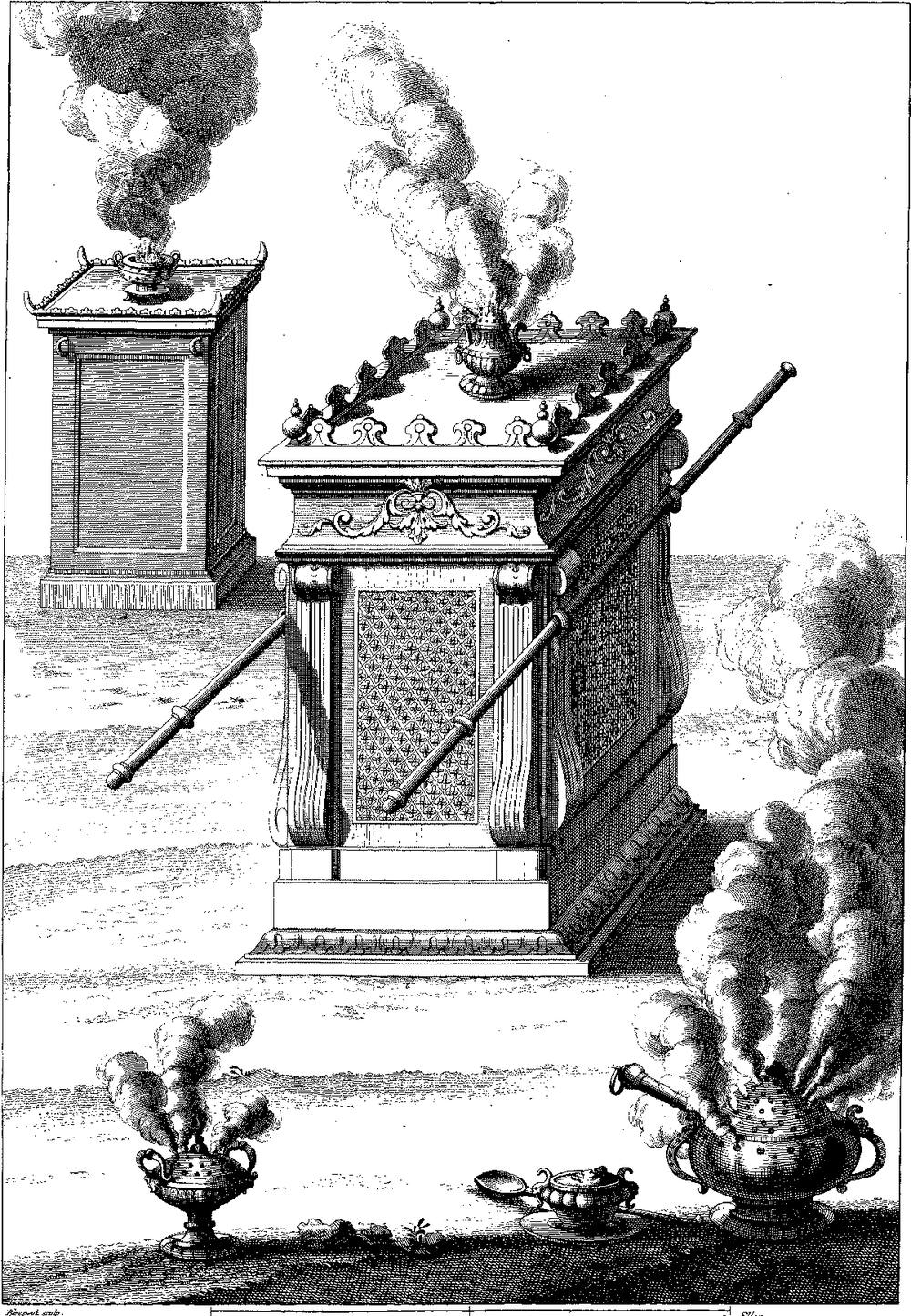
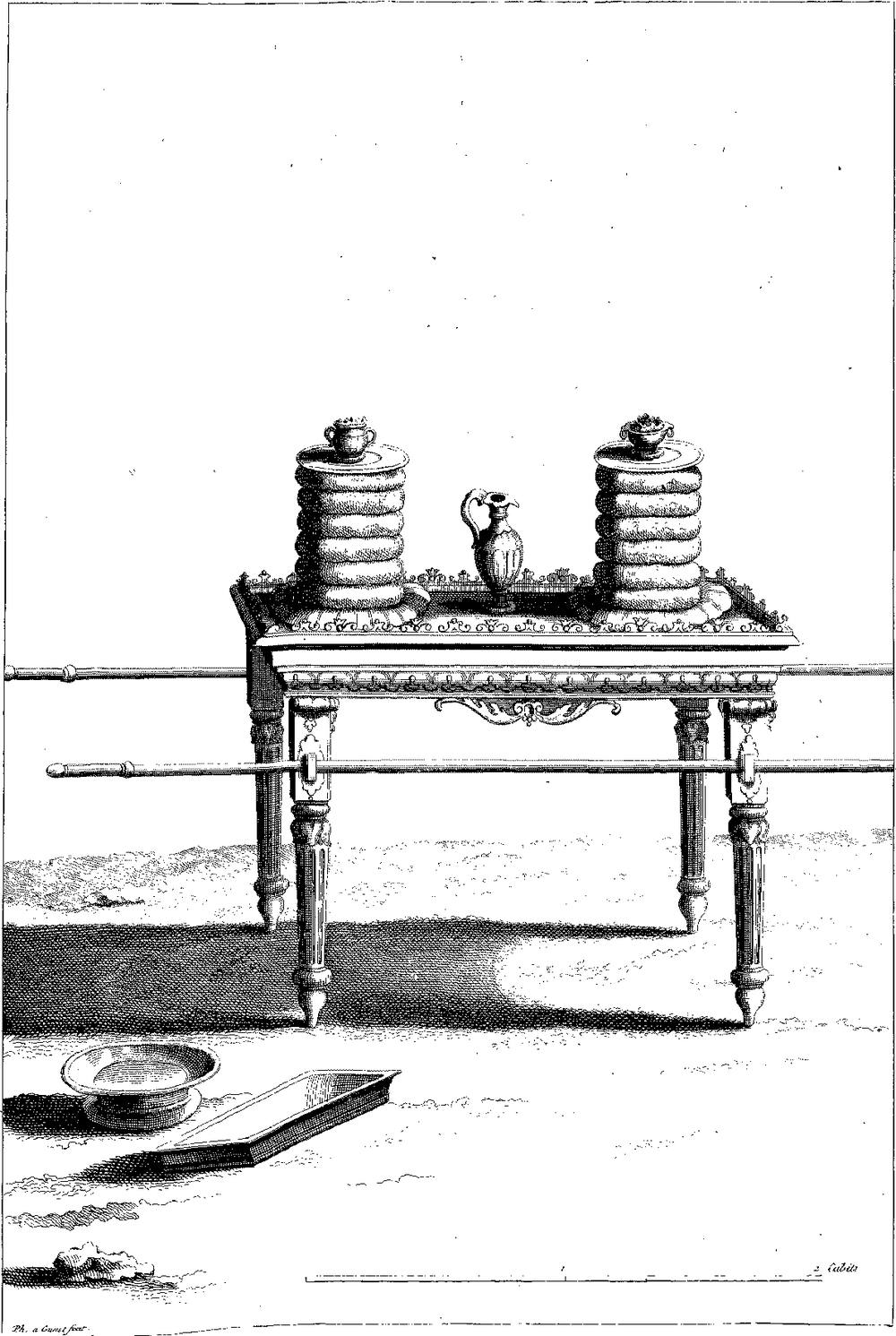
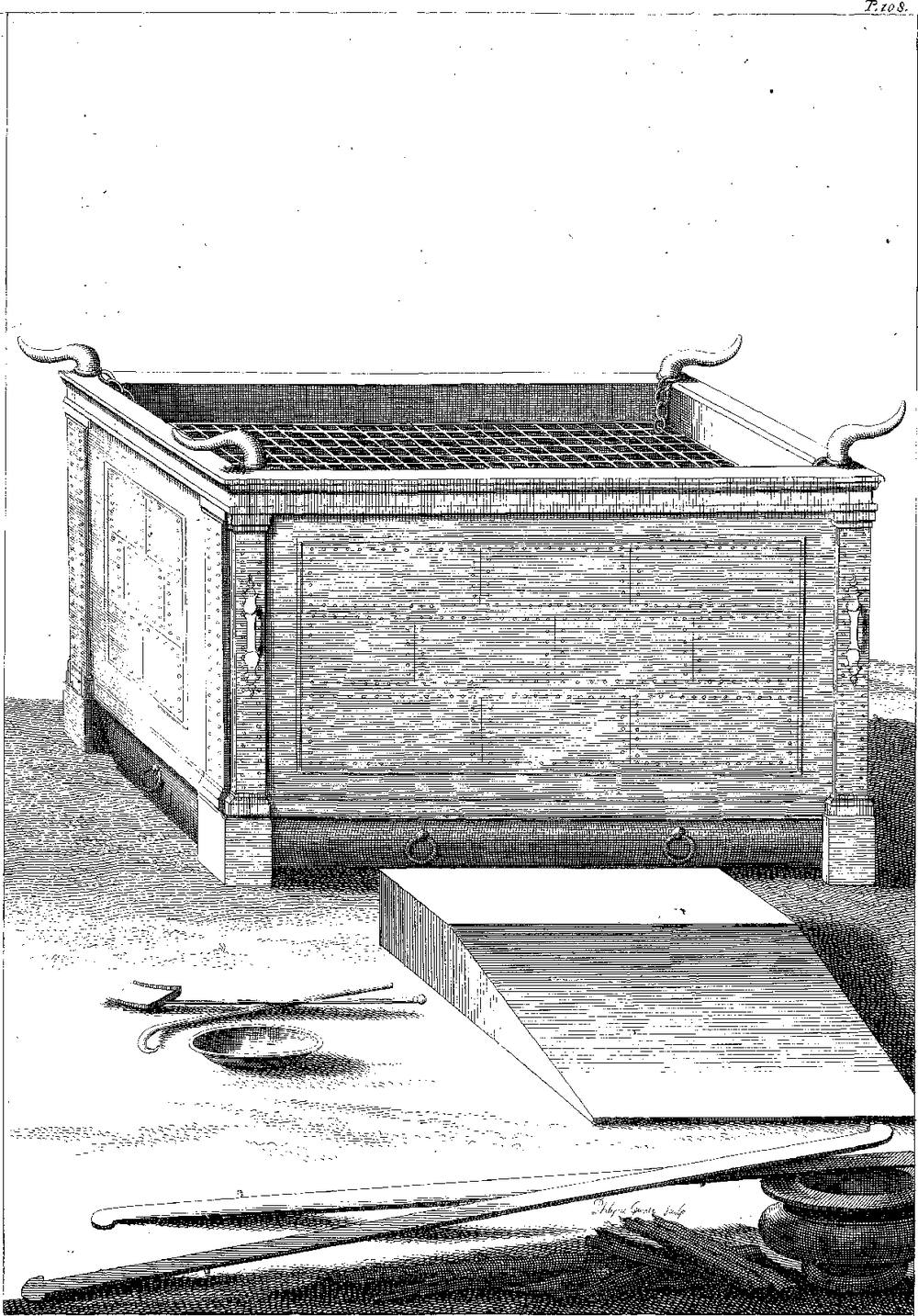
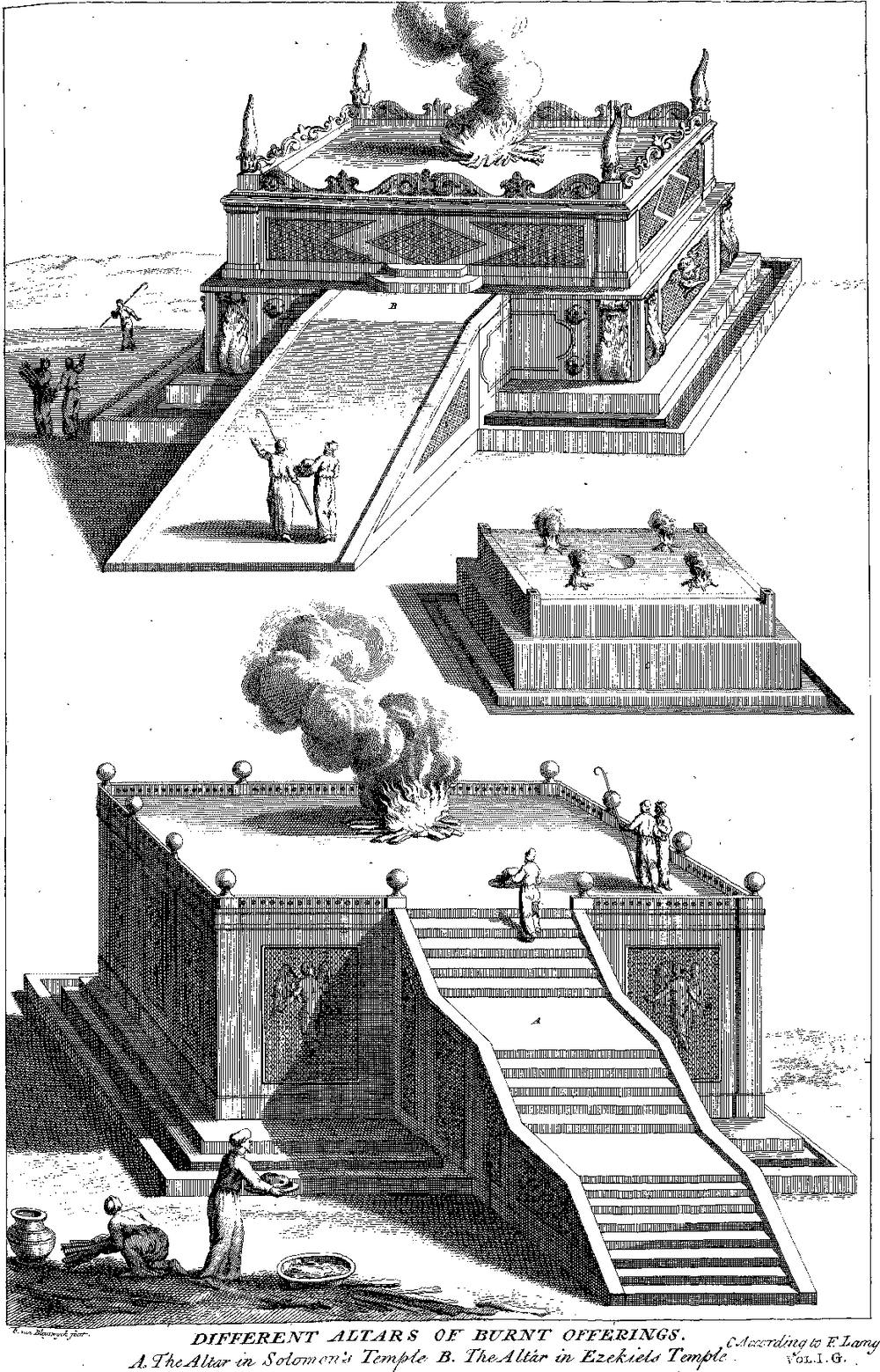
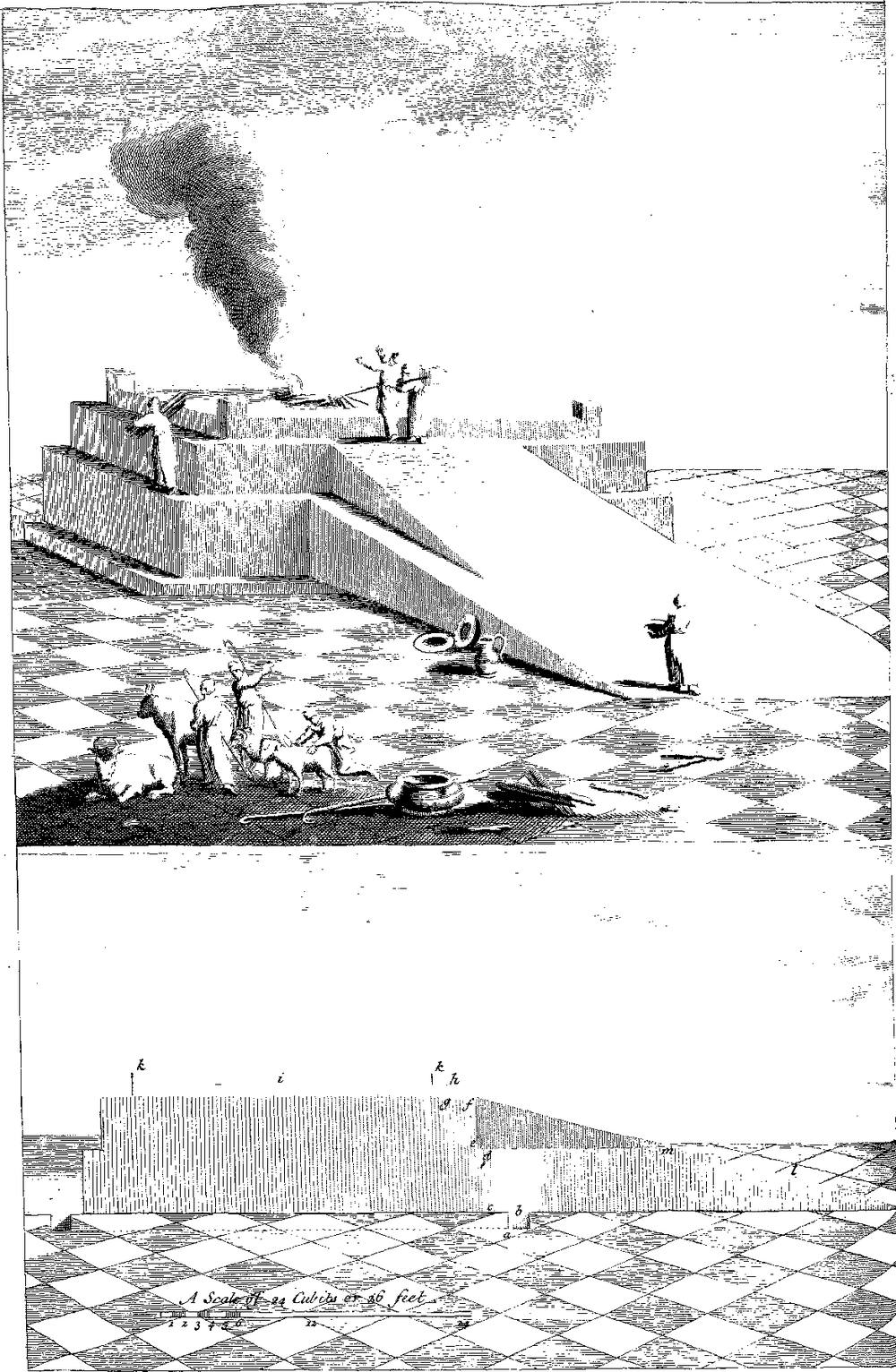
The ascent to the Altar was by an insensible rise on the South side, and was called Kibbesh; it was two and thirty cubits in length, and sixteen in breadth, and landed upon the upper benching-in, near the hearth or top of the Altar; for to go up to the Altar by steps was by the Law forbidden. Ver. 26.The Priests might go round about the Altar, and perform their offices very conveniently upon the two inbenchings which we have described; namely, that of the middle, which was a cubit, and that above it, which was likewise a cubit broad; for it would have been very uneasy for them to have walked bare-foot on the hearth, which was always heated by the fire that was continually burning there.
An Explanation of the Profil of the Altar of Burnt-Offerings, according to the Rabbins. a. A Trench which went quite round the Altar, wherein was thrown the blood of the Sacrifices. a. b. The foundation of the Altar one cubit high, and thirty two cubits square. b. c. The first in-benching, one cubit broad. c. d. The elevation of five cubits. d. e. The second in-benching, a cubit broad. e. f. The elevation of three cubits. f.g. The third in-benching, a cubit broad on every side. g. h. The last rising, of one cubit.
m. The passage on both sides the Kibbesh, to the second in-benching.
V. ALTAR at Athens, inscribed To the Unknown God. St. Paul being come from Thessalonica to Athens, disputed every day, either in the synagogue with the Jews, or in the market-place with the Philosophers. As he discoursed on the Resurrection of the dead, and declared Christ crucified to be both God and Man, some of the Philosophers brought him before the Judges of the Areopagus, there to give an account of his opinions. While therefore he stood before these Judges, he spoke to them in the following Acts xvii. 22, 23.words: Ye Men of Athens, I perceive that in all things ye are too superstitious; for as I passed by and beheld your devotions, I found an Altar with this inscription, To the Unknown God; whom therefore ye ignorantly worship, him declare I unto you.
The question is, what this Altar was thus consecrated to, the Unknown God? St. Jerom55 informs us, that it was not inscribed upon exactly as St. Paul relates, but that the words were these, To the Gods of Asia, Europe, and Africa; to the unknown and strange Gods; and that the Apostle purposely changed the plural into the singular, because it was necessary for his design to demonstrate only to the Athenians, that they adored an Unknown God.
Others56 believe, that St. Paul proposed to speak of those Altars which were to be seen in several places of Attica, without any particular inscription, erected after a solemn expiation for the Country, made by the Philosopher Epimenides57.
Others affirm this Altar to the Unknown God to be that mentioned by Pausanias and Philostratus58. These Authors tell us, that there were Altars at Athens consecrated To the Unknown Gods. There were probably several Altars, each with an Inscription, To the Unknown God; for which reason they mention them in the plural number, as Altars inscribed To the Unknown Gods. Lucian, in his dialogue intitled Philopatris, swears by the Unknown God of Athens. He adds, Being come to Athens, and finding there the Unknown God, we worshiped him, and gave thanks to him with hands lifted up to Heaven.
Peter Comestor, Author of the Historia Scholastica, relates that Dionysius the Areh. i. The hearth of twenty four cubits, or opagite observing while he was at Alexanthirty six foot square. dria, the Eclipse which, contrary to Nature, k. The horns of the Altar, of one cubit, and happened at the death of our Saviour, from hollow, half a cubit square. thence concludes, that some unknown God l. The sloping ascent to the Altar, of thirty suffered; and not being then in a condition to two cubits in length. learn more of the mat
ter, he erected, at his return to Athens, this Altar to the Unknown God, which gave occasion to St. Paul of making the discourse at the Areopagus, which is related to us by him.
Theophylact accounts in another manner for the occasion of this Altar. After a battle which the Athenians had lost, a spectre appeared to them, and told them, that he was the cause of the misfortune which had happened to them, out of an aversion he had to their celebrating Games in honour of all the other Gods, and none to him: After this he disappeared, without declaring his name. The Athenians, to repair their fault, immediately erected an Altar to the Unknown God.
Oecumenius reports this matter something differently. The Athenians being seized with a burning distemper, which would not allow them to endure any thing upon their bodies, addressed themselves in vain to all the Gods which were honoured in their City. As they saw that they received no relief from hence, they bethought themselves of erecting an Altar to the unknown God, out of an apprehension that some strange Deity had in his indignation smitten them. To this Unknown God they attributed the cure of their disease.
Others say, that during the war between the Persians and Greeks, the latter sent Philippides to desire succour of the Lacedæmonians. Upon Mount Parthenius the God Pan appeared to him, and complained that he was the only God to whom they did not pay their Adorations, and at the same time promised them his assistance, provided they admitted him into the number of their Gods. They did so, and erected an Altar to him; and left there should be any other God dissatisfied with their indifference, they built an Altar to the unknown God.
Every one of these opinions has its particular difficulties. The Altar intitled, To the Gods of Asia, Europe, and Africa, to the unknown strange Gods, is not in all probability that mentioned by St. Paul. The Areopagites would never have understood it by the bare name of the unknown God.
One of the Altars set up by Epimenides, which had no inscription to any Deity, can never be that which we enquire after. The Histories related by the Author of the Historia Scholastica, Theophylact, and Oecumenius, have no warrant from Antiquity. It is therefore probable enough that the Athenians, a People extremely superstitious, apprehensive that they had forgotten some Divinity, and had not paid their worship to it, erected Altars in some part of their City inscrib’d to the unknown God; from whence St. Paul took occasion to preach Jesus Christ to them, a God with respect to them truly unknown, and already in some sort adored by them without their knowing him.
These are St. Chrysostom’s thoughts upon the matter59, founded on what we have above mentioned from Philostratus, Pausanias, and Lucian.
St. Austin never questions but the Athenians, under the name of the unknown God, adored the true one. He compares their Worship with that which Schismaticks, who are not within the pale of the Church, pay to God. The Apostle’s intention therefore was, to induce them to adore that wisely and profitably in the Church which they blindly and vainly worshipp’d out of the Church, Ut eundem Deum quem præter Ecclesiam ignoranter, atque inutiliter colebant, in Ecclesia sapienter & utiliter colerent. See our Dissertation on the Altar to the unknown God prefixed to the Acts of the Apostles.
ALVAH: Thus the wood is called which God shewed Moses, that with it he Exod. xv. 25.might sweeten the waters of Marah. The Scripture has not preserved the name of it, but the Mahometans give it that of Alva, and maintain that Moses had a piece of it, which he received by succession from the Patriarchs, Noah having kept it in the Ark, and deliver’d it to his Posterity60. Moses, as they say, placed it afterwards in the Ark of the Covenant, together with the Manna and tables of the Law. The word Alva has some relation to Aloes, which is a very bitter wood; and some Interpreters are of opinion, that Moses took a very bitter sort of wood on purpose, that so the power of God might be the more remarkable in sweetening these waters. Josephus says that this Legislator used the wood which he found by chance, lying at his feet.
ALVAN, Shobal’s eldest Son, and of the race of Esau. He was the second Prince of Edom, and succeeded Timna. Gen. xxxvi. 23.
AMAD, a City belonging to the Tribe Josh. xix. 26.of Asher.
AMAL, the fourth Son of Hemel, 1 Chr. vii. 35.
AMALEK, the Son of Eliphaz and Timna his Concubine, and Grandson to Esau. He succeeded Gatam in the Government of Edom, which lies Southward of Genes. xxxvi. 12. & 16. 1 Chr. i. 36.the Tribe of Judah. Amalek was the Father of the Amalekites, a powerful People, who dwelt in Arabia Petræa, between the Dead Sea and the Red Sea, or between Havilah and Shur, 1 Sam. xv. 7. sometimes in one Canton, and sometimes in another; for we cannot assign the particular place of their habitation. It does not
appear that they had any Cities, and perhaps they had but one, which is mentioned in the 1 Sam. xv. 5.first book of Samuel. They lived generally in hamlets, caves, or tents.
The Israelites had scarce passed the Red Sea before the Amalekites came to attack them in the desart of Rephidim, and put those cruelly to the sword who were obliged either through fatigue or weakness to remain Ex. xvii. 8.behind. Moses, by God’s command, directed Joshua to attack this People, to record the act of inhumanity, which they had committed, in a book, in order to have it always before his eyes, and to revenge it in the most remarkable manner. Joshua therefore fell upon the Amalekites, and defeated them, while Moses was upon the Mountain, and with Aaron and Hur in his company, lifted up his hands to Heaven. This happened in the year of the World 2513, before J. C. 1487, before the vulgar Æra 1491.
Observations on the Battle of Rephidim between Israel and the Amalekites.This battle is celebrated in the Scripture: It was one of the most obstinate on both sides, and the victory uncertain and for a long time in suspence. It was fought near Mount Horeb, at the foot of a hill rising at the bottom of the Mountain, and upon the declivity of it the Hebrews were probably incamped. I find the sacred Writer to be so concise in his description of this Battle, that a comment and conjectures may be excused, which however might be more tolerable than the extravagant and confused imaginations which we meet with in the figures of the Scripture Battles, drawn by our Painters with a design rather to amuse us and communicate their own fancies, than to instruct us in the military discipline of the Jews, and furnish us with any true idea of it. It was the method of the People of Asia, and consequently of the Hebrews, to engage in Phalanxes when their forces were equal, but not like those of the Greeks, with the whole front closed and united: Their Phalanx was divided into several bodies, with little intervals between them, for their chariots and troops lightly arm’d, that is, their Slingers and Archers, to retreat to: Sometimes they ranged themselves in great square bodies at a reasonable distance from one another, when they could not equal the Enemy’s front. This method of engaging in large square bodies was common to the Asiaticks and Hebrews, who perhaps had borrowed it from the Egyptians. If any one should require Authorities for this opinion, nothing is more easy than to give him satisfaction; for if this People had made no changes in the way of fighting from the time of Moses to the Battle between Crœsus and Cyrus, as is very probable, we shall find that forty thousand Egyptian Pikemen, who came to the assistance of the first of these, formed four great square bodies, by whom Cyrus was several times put to a stand, and at last they capitulated, for there was only one of them broken. This is a particular which I learn from Xenophon in his Institution of Cyrus, and the account of his retreat with ten thousand Men after the Battle of Cunaxa. But suppose this Authority were not to be admitted, the Scripture would furnish me with infinite examples, and Polybius himself, whither I refer the Reader. They who do not understand Greek may have recourse to the Comment on Polybius, where they will find this way of engaging practised in Antiochus’s war against Ptolemy Philopator. They fought in great Bodies not only with their foot, but with their horse likewise, leaving some little interval between the Squadrons; and the same method may be observed to be in use among the Hebrews; for I do not at all question but that Moses imitated the Egyptians in their way of making war.
Judith iv. 13, 14.I have therefore ranged the Israelites in several Bodies according to their Tribes, with retreats or divisions which were very necessary. Amalek acted like an understanding General, who does not stay to expect the Enemy in his own country, but marches forward to meet and fight him, and so divert his intentions of making inroads into it. The Benedictine Commentator cites Philo, who says, That the King of the Amalekites apprehending lest the Israelites might ravage his territories, resolved to prevent them; and putting himself at the head of his Troops, he marched to oppose their passage, with a design, if they shewed an inclination to resist him, of attacking them with all his Forces. I should have been very well pleased if the sacred Writer had informed us in this place what the number was, and nature of Amalek’s Forces. The book of Judith in few words acquaints us with it, and describes to us the Army of the Amalekits as a formidable one, composed of many horse, and a great number of chariots, the Soldiers whereof were furnished with good weapons, and abounding with confidence in their own strength61. Upon this footing we range the Amalekites in the same order with the Hebrews, the Horse on the wings, and the Chariots on the whole front of the line, and between the distance of the several Bodies.
According to the Scripture way of expressing itself, Moses stood in need of all the virtue of his miraculous Rod, and his
ter of so dreadful an Enemy; if God had not concerned himself in the affair, and turned to his People’s side, at the earnest supplications of his Servant, the battle had been lost; the number, valour, and advantage of Amalek’s arms had made the balance incline on his side.
Victory, which God at all times either gives or takes away at his pleasure, was entirely with the Israelites; but it had certainly fled to the Amalekites, if Aaron and Hur, who were with Moses on the Mountain, remote from danger, had not supported the extended arms and hands of this Legislator. This is a mystery which I leave to the Commentators, as their peculiar province; for the preservation or destruction of God’s People lay in the hands and arms of these persons extended in the form of a Cross. To this the success of the Battle was owing, which was such that Amalek was entirely defeated and cut in pieces. Notwithstanding, no victory ever was more disputed; the Battle lasted the whole day till the approach of night; for Ex. xvii. 12.the Scripture says, That the hands of Moses were steddy till the going down of the Sun. As the success of this action was the pure work of God, he said to Moses, Write this for a memorial in a book.
Under the Judges we see the Judg. vi. 3. Judg. iii. 13.Amalekites united with the Midianites and Moabites, in a design to oppress the Israelites; but Ehud deliver’d the Israelites from Eglon, and Gideon deliver’d them from Midian and Amelek. Many years after the World 2930, before J. C. 1070. 1 Sam. xv. 2, 3, &c.the Lord said to Samuel, Go to Saul and say, Thus saith the Lord of Hosts, I remember that which Amalek did to Israel, how he laid wait for him in the way when he came up from Egypt. Now go and smite Amalek, and utterly destroy all that they have, and spare them not, but slay both Man and Woman, Infant and Suckling, Ox and Sheep, Camel and Ass.
Saul marched therefore against the Amalekites, advanced as far as their Capital, cut them in pieces from Havilah towards the mouth of the Euphrates, as far as Shur towards the Red Sea, and put all the People of the Country to the sword, but spared the best of all the cattle and moveables, and so violated the command of God. This act of Disobedience was the cause of Saul’s misfortunes, and of his being rejected by God, as we have shewn in the article AGAG, and shall shew farther in that of SAUL.
After this war the Amalekites scarce appear any more in History. Some years after In the Year of the World 2949, before J. C. 1051.this event, a troop of Amalekites came Esau, Jacob. Eliphaz, Levi. Amalek, Koath. —— Amram. —— Aaron. Sam. xxx. 1, 2, &c.David, where he had left his Wife and all his substance. But he returning from an expedition which he had made in the company of King Achish into the valley of Jezreel, pursued them, overtook, dispersed them, and recover’d all the booty which they had carried off from Ziklag.
The Arabians maintain Amalek to have been the Son of Ham, and Grandson of Noah; that he was the Father of Ad, and Grandfather of Schedad. This opinion is not to be rejected: It is not easy to conceive how Amalek, the Son of Eliphaz, and Grandson of Esau, could be the Father of a People so powerful and numerous as the Amalekites were when the Israelites departed out of Egypt. Moses in the book of Genesis relates, that in Abraham’s Gen. xiv. 7.time, and long before the birth of Amalek, the Son of Eliphaz, the five confederate Kings carried the war into Amalek’s Country, about Kadesh, and into that of the Amorites, who dwelt at Hazeron-tamar.
The same Moses in another place relates, Numb. xxiv. 20. ראשית גוים עמלק ואחריתו עדי אבדthat the Diviner Balaam observing at a distance the land of Amalek, said in his prophetick style, Amalek is the first, the head, the original of the Nations, but his latter end shall be that he perish for ever. This commendation of first of the Nations cannot certainly agree with the Amalekites who were so modern; for the Generation then living was but the third from Amalek. Moses never reproaches the Amalekites with attacking the Israelites their Brethren; an aggravating circumstance which he would not have omitted if they had been descended from Esau, and in this sense Brethren to the Israelites. Lastly, we see the Amalekites almost always joined in Scripture with the Canaanites and Philistines, and never with the Edomites; and when Saul made war with Amalek, and destroyed it, the Edomites made not the least motions towards their assistance, nor to revenge them afterwards. It is therefore probable that the Amalekites, who are so often mentioned in Scripture, were a People descended from Canaan, and devoted to the Curse, as well as the other Amorites, and very different from the descendants of Amalek, the Grandson of Esau.
What follows is the account which the Arabians give us of the Amalek destroyed by Saul. He was the Father of an ancient Tribe in Arabia, exterminated in the reign of Saul. It contained only the Arabians, who are called pure, the remains of whom were mingled with the posterity of Joktan and Adnan, and so became Mosara
bes or Mostaarabes, that is to say, Arabians blended with foreign Nations. They farther believe, that Goliath, who was overcome by David, was King of the Amalekites, and that the Giants who inhabited Palestine in Joshua’s time, were of the same race; that at last part of the Amalekites retired into Africk, while Joshua was yet living, and settled upon the coasts of Barbary, along the Mediterranean Sea.
Judg. xii. 14, 15.The Son of Amalek62 was Ad, a celebrated Prince among the Arabians. He began to raise stately buildings, and a City very much to be admired, which was the place of his own residence, and of the Giants in his time. Some make him to be the Son of Uz, and Grandson of Aram, the Son of Shem. Let this be as it will, the Mahometans say that Ad was the Father of an Arabian Tribe called Adites, who were exterminated, as they tell us, for not hearkening to the Patriarch Eber, who preached the unity of God to them. Ad had two Sons, viz. Schedad and Schedid. This is what the Arabians relate of the Amalekites.
AMALEK, a mountain in the land of Ephraim, upon which the Town of Pirathon was situated, where Abdon, the Son of Hillel, Judge of Israel, was buried; in the year of the World 2848. before J. C. 1152. before the vulgar Æra 1156.
AMAN, a City belonging to the Tribe of Judah, Josh. xv. 26.
AMANA, a Mountain mentioned in Cant. iv. 8.Solomon’s Song. Some are of opinion that this is mount Amanus in Cilicia. St. Jerom63 and the Rabbins64 make the land of Israel to extend Northward as far as this Mountain; and in Solomon’s time the dominion of the Hebrews did extend so far. Mount Amanus separates Syria from Cilicia, and reaches from the Mediterranean to the Euphrates.
AMANA, a Mountain beyond Jordan, in the Tribe of Manasseh65. It is three leagues from the Lake Moron; and at the bottom is three leagues in circumference, where there is a fine vineyard to be seen; but the top is always covered with snow, for which reason the Arabians have given it the name of Gebel Chaïque; that is to say, the Old Man’s Mountain, because the top of it is all white. Some think this to be Mount Amana, which the Spouse speaks of in the Canticles. I do not observe that either Josephus, St. Jerom, or Eusebius had any knowledge of this Mountain: at least they say nothing of it under the name of Amana.
I. AMARIAH, the eldest Son of Meraioth, and Father of the High-Priest Abitub. Amariah was High-Priest in the time of the Judges. We are not able to fix the years of his Pontificate. His name is to 1 Chron. vi. 7, 11.be met with in the Chronicles. And if he exercised this Office, he should be placed, as I think, before Eli, who was succeeded by Ahitub, who in the Chronicles is put Ver. 7. Ezra x. 42.immediately after Amariah.
II. AMARIAH, one of those mentioned by Ezra, who separated from the Wives which they had taken, contrary to the Law.
III. AMARIAH, Grand-father to the Zeph. i. 1.Prophet Zephaniah, and Father of Gedaliah.
AMASA, the Son of Jether and Abigail2 Sam. xvii. 25. 2 Sam. xix. 13, &seq., David’s Sister. Absalom, during his rebellion against David, placed his Cozen Amasa at the head of his Troops. It was Amasa that engaged Joab, General of David’s army, and was worsted; in the year of the World 2981. After the defeat of Absalom’s party, David, out of hatred to Joab, who had killed Absalom, offered Ch. xx. 1, 2, &c.Amasa his pardon, and promised him the general command of his army, in the room of Joab, whose insolence had made him insupportable. Upon the revolt of Sheba the Son of Bichri, David gave order to Amasa for assembling all Judah, and marching at the head of them, against Sheba.
Amasa thereupon took his leave, but not being able to form his army at the time prescribed, David directed Abishai to pursue Sheba with what Soldiers he had then about his own person. Joab with his people accompanied him; and these troops were scarce got so far as the great Stone which is in Gibeon, before Amasa came and joined them with his forces. Then said Joab to Amasa, Art thou in health, my Brother? and took him by the beard with the right hand to kiss him. But Amasa not observing the sword which was in Joab’s hand, the latter smote him therewith in the fifth rib, and shed out his bowels to the ground, and he died. Such was the end of Amasa, David’s Nephew, in the year of the world 2981. before J. C. 1019. before the vulgar Æra 1023.
II. AMASA, the Son of Hadlai, was one of those who were against permitting such Captives as were taken in the Kingdom of Judah, in the reign of Ahaz, to 2 Chron. xxviii. 12.come into Samaria.
I. AMASAI, the Son of Elkanah, 1 Chron. vi. 25.
II. AMASAI, the same perhaps with him who is taken notice of in 1 Chron. vi. 25. He was a Levite, who perceived himself to be inspired by the Spirit of God to go over to David, and carry thirty gallant Men with him. They came and joined him while he was in the desart, flying from
to meet them, and said, If ye be come peaceably to help me, mine heart shall be knit unto you: but if ye be come to betray me to mine Enemies, seeing there is no wrong in mine hands, the God of our Fathers look thereon, and rebuke it. Then said Amasai, Thine are we, David, and on thy side, thou Son of Jesse: Peace be unto thee, and peace be to thine helpers. David therefore received them; and gave them the command of some Troops.
AMASIS, King of Egypt. Notwithstanding his name is not to be met with in the Text of Scripture, he is nevertheless celebrated in Sacred History. The Scripture 2 Kings xxiii. 29. Jer.xlvi.2.speaks of Nechoh, who killed Josiah King of Judah, in the battle of Megiddo. Nechoh was succeeded by Psammis, Psammis by Apries, in Jeremiah called Hophrah, and Hophrah by Amasis66, who lived in Egypt at the same time as Cyrus reign’d in Babylon. He governed four and forty years, loved and respected always by his Subjects, and favoured by Fortune, from the year of the World 3435 to 3472. He died in the time of Cambyses, before J. C. 521. before the vulgar Æra 525.
AMATH, or Emath, a City of Syria. It is the same with Emesa upon the Orontes. See Emath.
AMATHA, a Town near Gadara, where there were hot baths.67 Gabinius established one of the five Seats of Justice at Amatha.68 The word Hamath in HebrewCalor. signifies hot waters; whence so many Towns in Palestine called Amath, Amathus, or Emmaus.
AMATHUS, a City situated beyond Jordan. Eusebius69 places it at the distance of one and twenty miles from Pella, towards the South. Alexander Jannæus took and destroyed it.70 Some are of opinion, that Gabinius fixed one of the five Seats of Justice in this City.71 Others think, that it was at Amatha on this side of Jordan. M. Reland conjectures, that Amathus and Ramoth-gilead are the same.
AMATHEANS, the descendants of Amath, one of the Sons of Canaan. We are of opinion, that they dwelt at Emath, or Amath, or Emesa in Syria, upon the river Orontes.
I. AMAZIAH, the eighth King of Judah,2 Chron. xxiv. 27. xxv. 1, 2, 3, &c. 2 Kings xiv. was Son to Joash, and succeeded him in the year of the World 3165. before J. C. 835. before the vulgar Æra 839. He was five and twenty years of age, when Deut. xxiv. 16.he began to reign, and he reigned nine and twenty years at Jerusalem He did that which was good in the sight of the Lord, but not with a perfect heart. When he saw himself settled in his Kingdom, he put to death the murderers of his Father, but not their Children; because it is written in the Law, The Fathers shall not be put to death for the Children, neither shall the Children be put to death for the Fathers; every man shall be put to death for his own sin.
In the general muster which he made of his People, he found there were three hundred thousand men capable of bearing arms. He bought besides, an hundred thousand of the Kingdom of Israel; for which he paid the King of Israel an hundred talents; which make thirty four thousand two hundred and eighteen pounds fifteen shillings, English. His design was to employ these Troops against the Edomites, who had revolted from the Kings of Judah, in the reign of Joram, 2 Kings viii. 20. In the year of the World 3173, before J. C. 827, before the vulgar Æra 831. 2 Chron. xxv. 7.about fifty four years before.
At that time a Prophet of the Lord came to him, and said, O King, let not the army of Israel go with thee; for the Lord is not with Israel. But if thou wilt go, do it, be strong, for the battle of God shall make thee fall before the Enemy; for God hath power to help, and to cast down. And Amaziah said to the Man of God, What shall we do for the hundred talents which I have given to the army of Israel? And the Man of God answered, The Lord is able to give thee more than this. Amaziah hereupon separated the army which came to him from Ephraim, and sent the troops belonging to it back into their own Country. They returned therefore strangely irritated against Amaziah. They dispersed themselves over all the Cities of Judah, from Bethoron to Samaria, killed three thousand men, and carried off a great booty, to make themselves amends for that which they had promised themselves in the war against Edom.
Amaziah marched therefore only with his own forces, gave battle to the Edomites in the Valley of Salt72, killed ten thousand Edomites upon the spot, and took ten thousand more, who had saved themselves, in all probability, upon a rock, where they were assaulted, and thrown headlong from the top to the bottom, so that they were 2 Kings xiv. 7.dashed to pieces73. Now Amaziah having thus cut off the Edomites, and taken their Gods, adored them; offered incense to them, and acknowledged
them for his own Deities. This action provoked the Lord, who sent a Prophet to him, which said unto him, Why hast thou sought after the Gods of the People, which could not deliver their own People out of thine hand? Amaziah answered him, Art thou made of the King’s counsel? Forbear; why shouldst thou be smitten? Then the Prophet forbore, and said, I know that God hath determined to destroy thee, because thou hast done this, and hast not hearkned 2 Kings xiv. 8. 2 Chron. xxv. 14.unto my counsel.
God therefore permitted Amaziah to be so blinded as to believe himself invincible. He sent to defy the King of Israel, saying, Come, let us look one another in the face. The motive of this war was, probably, to oblige Joash King of Israel to repair the ravages which his troops had made, as I before hinted, in their return to the Country of Samaria. Joash answered Amaziah, The Thistle that was at Lebanon sent to the Cedar saying, Give thy Daughter to my Son to wife: And there passed by a wild beast that was in Lebanon, and trod down the Thistle. Thou sayest, Lo, thou hast smitten the Edomites, and thine heart lifteth thee up to boast: Abide now at home, why shouldst thou meddle to thine hurt, that thou shouldst fall, even thou, and Judah with thee?
Amaziah was deaf to these reasons; because God had given him up to his own evil sense of things. He advanced as far as Beth -shemesh with his army; and Joash King of Israel gave him battle. Amaziah gave ground, his army was defeated, and he himself fell into the hands of his Enemies. Joash forced the Camp at Beth-shemesh, and carried Amaziah to Jerusalem. Then he gave orders for demolishing four hundred cubits of the City-walls, from the gate of Ephraim as far as to the corner gate. He carried all the gold and silver to Samaria, all the rich vessels which he found in the House of God, and in the treasuries belonging to the royal Palace; and the Sons of those among his own people, who had been sent as hostages to Jerusalem.
After this Amaziah reigned still fifteen or sixteen years at Jerusalem; but returned not to the Lord with all his heart; wherefore God, to punish him, permitted a Conspiracy to be formed against him at Jerusalem. He was in hopes of making his escape to Lachish; but the Conspirators sent after him, and had him there assassinated. He was brought back upon two horses, and buried with his ancestors in the City of David. He died in the year of the World 3194. before J.C. 806. before the vulgar Æra 810. Uzziah, or Azariah his Son, who was but sixteen years of age, succeeded him.
II. AMAZIAH, Priest to the golden Calves that were at Bethel. The Prophet Amos having said upon a certain day, that the High Places consecrated to Idols should be destroyed; and that however holy they might then be thought by Israel, they would be overthrown, and the House of Jeroboam extirpated by the sword; Amaziah Priest of Bethel sent to Jeroboam King of Israel, saying, Amos hath conspired against thee in the midst of the House of Israel: the land is not able to bear all his words. For thus Amos saith, Jeroboam shall die by the sword, and Israel shall surely be led away captive out of their own land. Also Amaziah said unto Amos, Go, thou Seer, flee thee away into the land of Judah; and there eat bread, and prophesy there. But prophesy not any more at Bethel; for it is the King’s Chapel, and it is the King’s Court74.
Amos answered Amaziah, I am no Prophet, nor the Son of a Prophet; but I am an herdman, and a gatherer of Sycamore -fruit75. The Lord took me as I followed the flock, and the Lord said unto me, Go, prophesy unto my People Israel. Now therefore hear thou the word of the Lord. Thou sayest, Prophesy not against Israel; and drop not thy word against the House of Isaac. Therefore thus saith the Lord, Thy wife shall be an harlot in the City, and thy Sons and thy Daughters shall fall by the sword, and thy land shall be divided by line; and thou shalt die in a polluted land; and Israel shall surely go into captivity forth of his land.
S. Cyril of Alexandria says76 that Amaziah, provoked at the Prophet’s discourse, had his teeth broke in his head, in order to oblige him to be silent. Others say, that the same Amaziah procured several punishments to be inflicted on him; and that his Son Uzziah gave him a blow upon the temples with a stake, and knocked him down. The Prophet was carried back half dead to Tekoah, the place of his birth, where he died, and was buried with his fathers77. But these traditions are of no great certainty. It appears by the writings of this Prophet, that he retired into the lands belonging to Judah, and that he prophesied there for some time after what is related of Amaziah. Amos lived under Jeroboam the second, about the year of the World 3215. before J.C. 785. before the vulgar Æra 789.
AMBIVIUS (Marcus) succeeded Coponius in the government of Judæa78. Annius Rufus was his successor, in the 13th year of J. C.
ארב מאר בהAMBUSHES, Ambuscades, Insidiæ. To lay in ambush. Insidiari. These words are not always taken in their proper signification, for laying ambushes for any one, attacking him in secret, laying snares for him. They sometimes signify no more than attacking a man who has no distrust of such a thing; attacking one behind, concealing ones self in some particular place in order to surprize any one. See the book of Judges, ch. ix. 25, 32, 34, 35. Abimelech, who lay lurking with his people in the heights of Sichem, so however as to rob and treat those who passed that way very ill, came and attacked the City of Sichem with his troops divided into three bodies: Tetendit insidias juxta Sichimam in quatuor locis. Literally according to the Hebrew, They prepared Ambuscades against Sichem in four Heads or Companies. And a little farther, ver. 43. Abimelech being informed that the Sichemites were marched, took his Army and divided it into three Bodies, and laid wait for them in the field. It seems certain, that in these passages Ambushes, properly so called, were not the things in question. In the first Book of Samuel, Saul complains that David laid אחלמה Achalma. 70. Ἀμέθυστος. 1 Sam. xxii. 8,13.Ambuscades for him; Insidiator usque hodie permanens. Now nothing could be worse grounded than this accusation, if we understand the word insidiari in its proper signification; but he might say, tho’ unjustly, that David was his secret enemy. And 2 Chron. xx. 22.in the Chronicles it is said that God turned the Ambushes laid by the enemies of Israel upon themselves; that is to say, their endeavours, their malice, their arms, he turned against themselves; for the enemies there mentioned came not in private, or by stratagem; they marched openly in arms against Israel.
AMELEK, the Father of Joash. This was that Joash who received orders from King Ahab to keep the Prophet Micaiah in his custody till this Prince’s return from Ch. xviii. 25.the war against the Syrians; in the year of the world 3107. before J. C. 893. before the vulgar Æra 897.
AMEN, in Hebrew, signifies true, faithful, אמןAmen, John i. 51. & passim.certain. It is made use of likewise to affirm any thing; and was a sort of affirmation used often by our Saviour. Amen, Amen, dico vobis. Lastly, it is understood as expressing a wish,79 Amen, So be it; or an affirmation, Amen, Yes. I believe it. How 1 Cor. xiv. 16.shall he that occupieth the room of the unlearned say Amen at thy giving of thanks, seeing he understandeth not what thou sayest. The Hebrews end the five books of Psalms, according to their way of distributing them, with the words Amen, Amen; which the Septuagint have translated Genoito, Genoito; and the Latins, Fiat, Fiat. The Greek and Latin Churches have preserved this word in their prayers, as well as Alleluia and Hosanna; because they observed more energy in them than in any terms which they could use in their own languages. At the conclusion of the publick prayers, the People answered with a loud voice, Amen. And St. Jerom80 says, that at Rome, when the People answered Amen, the sound of their voices was like a clap of thunder, In similitudinem cœlestis tonitrui Amen reboat. The Jews assert, that the Gates of Heaven are opened to him who answers Amen with all his might.
AMERUTHA, a town of Upper Galilee, which Josephus fortified against the Romans, as he says in the account of his own life81. This is very probably the same as Meroth, which terminates the Upper Galilee westward82. It is perhaps Mearah of the Sidonians, spoken of in Joshua xiii. 4.
Ex. xxviii. 19. & xxxix. 12.AMETHYST, a precious Stone, the ninth in place upon the High Priest’s Rational or Breast-plate. The colour of it comes near that of new wine, and goes off with a violet. It is said to prevent people’s getting drunk; that it is a defence against the effects of poison; and that it is a help to conception. The Hebrew name which the Septuagint translaté
and Vulgate Amethyst, is Achalma, which may signify Sleep. The Chaldee, Onkelos, and the Syriac, translate it Een-egla, or the Eye of a Calf. The name of Issachar was engraven on this Stone.
AMI, Chief of a great family, which in Ezra’s time returned from Babylon, Ezra ii. 57, 58.
I. AMINADAB, of the Tribe of Judah, the Son of Aram, and Father of Naasson, and Elisheba the Wife of Aaron the High Priest.
II. AMINADAB. The Chariots of Aminadab are mentioned in the Canticles, as being extremely light. Or ever I was aware, my Soul made me like the Chariots Cant. vi. 12.of Aminadab83. He was very probably a celebrated Charioteer, whose horses were singularly swift.
III. AMINADAB, the Son of Koath, a Brother of Korah, 1 Chron. vi. 22.
of King Saul, who was killed with him in the battle of Gilboa, in the year of the 1 Sam. xxxi. 2. 1 Chr. viii. 33. x. 2.World 2949. before J. C. 1051.
V. AMINADAB, or Abinadab, a Levite, and inhabitant of Kirjath-jearim, with whom the Ark was deposited, after it was brought back from the land of the 1 Sam. vii. 1.Philistines z. He dwelt at Gibeah, that is to say, in the highest part of the City of Kirjath-jearim. Eleazar his Son was consecrated or appointed peculiarly to the office of keeping the Ark of the Lord. It is not certain whether Aminadab were at that time living. The Ark remained at Kirjath -jearim from the year of the World 2888 to 2959, that is to say, threescore and eleven years. Then David brought it from Kirjath-jearim to Jerusalem; but dared not 2 Sam. vi. 1, 2, 3.bring it into his own house, by reason of the death of Uzzah; he lodged it therefore at Obededom’s, where it continued some months.
AMITTAI, Father to the Prophet Jonah. Jonah i. 1. and 2 Kings xiv. 25.
AMIZABAD, the Son of Benaiah. Benaiah is known to have been one of the principal Officers in David’s armies. His Son Amizadab commanded a troop under 1 Chr. xxvii. 6.him.
AMMAN, Ammanites. See AMMON, AMMONITES. The Capital of the Ammonites, called in Scripture Rabbath-Ammon, and in profane Authors Philadelphia, is likewise sometimes called Amman, and the Country of the Ammanites, Ammanitis.
I. AMMIEL, the Son of Gemal, of the Tribe of Dan, was one of the twelve deputed to go and view the Land of Canaan, Numb. xiii. 12.
II. AMMIEL, a native of Lodobar, a City situated in the Tribe of Simeon. Ammiel was the Father of Machir and Ch. iii. 5. & 2 Sam. ix. 4, 5.Bathsheba, who was first married to Uriah, then to David, by whom she had Solomon.
III. AMMIEL, the Son of Obededom the Levite, who was made Porter of the Ch. xxvi. 5.Temple under the reign of David.
I. AMMIHUD, the Son of Ephraim, and Father of Elishama, Numb. i. 10. and 1 Chr. vii. 26.
II. AMMIHUD, of the Tribe of Simeon, and Father of Shemuel, or Samuel, very different from the Prophet of that name, Numb. xxxiv. 20.
III. AMMIHUD, of the Tribe of Naph -
² Joseph Antiq. l. 6. c. 2. tali, Father of Pedahel, Numb. xxxiv. 28.
IV. AMMIHUD, the Father of Talmai, King of Geshur, 2 Sam. xiii. 37.
Jerem. xlix. 25. Ezek. xxx. 14, 15, 16. Nahum iii. 8.AMMISHADDAI, Father of Ahiezer, of the Tribe of Dan, Numb. i. 12. x. 25.
I. AMMON, or No-Ammon, a City of Egypt. The Chaldee and the author of the Vulgate generally translate this term Alexandria. They doubtless were not ignorant that Alexandria is much more modern than Jeremiah, Ezekiel, and Nahum, who speak of No-Ammon, which by these Interpreters is render’d Alexandria; but they might believe this last to be at or near the same place where Alexandria was afterwards built, which nevertheless does not appear by History; for there was only the town of Rachotis upon the Sea near the place where the City of Alexandria was built.
The marks whereby the Prophets describe No-Ammon are, that it was situate among the Rivers, that it had the waters round about it, whose rampart was the Sea, and her wall was from the Sea; which induces us to think that No-Ammon84 is Diospolis, or the City of Jupiter, situated in the Delta, upon an arm of the Nile, between Busiris to the South, and Mendes to the North, at a very little distance from the Mediterranean. There were such lakes about it as might be well called Seas in the style of the Hebrews. The ruin of this City, which was foretold, and so distinctly describ’d by the Prophets, happen’d under Esar-haddon and Nebuchadnezzar, and perhaps under Sennacherib. See our Comments upon the Prophets Ezekiel xxx. 14, 15, 16. and Nahum iii. 8. But notwithstanding all we have here said to support the opinion of No-Ammon’s being Diospolis, we must confess ingenuously, upon farther reflection, that this is not at all certain, and Thebes, the Capital of Upper Egypt, may be understood to have been No -Ammon. The Reader may see what we have to say in favour of this opinion in the article THEBES.
II. AMMON, or Hammon, or Jupiter Ammon, the celebrated God of the Egyptians, whom we take to be the same as Ham, who peopled Africk, and was the Father of Mizraim, the Founder of the Egyptians85. Ammon had a famous Temple in Africk, where he was adored under the figure of a Ram; for in this manner
Ammon (II) continues on the next page
Footnotes
-
Antiq. l. 16. c. 12. ↩
-
Joseph. Antiq. l. 16. c. 16. ↩
-
Antiq. l. 16. c. 17. ↩
-
Translators’ note. The Father, not the Son, is called by Josephus, Teron, or, as our Au- thor has it, Tyro. Εἰ δὲ αὐτῷ πάλαι στρατιώτης ὀνόματι Τύρων, υἱοῦ αὐτῷ καθ’ ἡλικίαν ὄντος Ἀλεξάνδρῳ φίλα, &c. Antiq. l. xvi. c. xi. ↩
-
Joseph. Antiq. l. 17. c. 15. ↩
-
Joseph. Antiq. l. 17. c. 14. ↩
-
Joseph. de Bello, l. 7. c. 38. ↩
-
Joseph. Antiq. l. 20. c. 3. ↩
-
Antiq. l. 19. c. 4. ↩
-
שלמהpacifica, felix. Ἀλέξανδρος may signify one who assists men, or one who protects them against the violence of other men. ↩
-
Antiq. l. xiii. c. 23. ↩
-
Ibid. c. 24. ↩
-
Antiq. l. 14. c. 15. ↩
-
Ibid. l. 15. c. 3. ↩
-
Ibid. c. 2. ↩
-
Ibid. c. 3. ↩
-
Ibid. c. 4. ↩
-
Joseph. Antiq. l. 15. c. 11. ↩
-
Ibid. l. 18. c. 7. ↩
-
Arrian. l. 3. Strabo l. 17. Pausan. in Eliacis. ↩
-
Translators’ note. See a particular account of this place, and a description of the Delta, under their respective Articles in this Dictionary. ↩
-
D’Herbelot. Bibl. Orient. p. 320. ↩
-
Arrian. Quint. Curt. &c. ↩
-
Justin l. 13. c. 4. ↩
-
Said Sil. Batrik. ↩
-
Bibl. Orient. p. 320. ↩
-
Thevenot. p. 1. l. 2. c. 1, 2. ↩
-
Granite is a stone which some pretend the Ancients had the secret of dissolving. ↩
-
Translators’ note. The Jews were very numerous in this City; here they had several fine Synagogues, and were permitted to have a particular Magistrate of their own nation, to de- cide matters in dispute among them, according to their own laws. The Alexandrian Jews had likewise a Synagogue at Jerusalem, where there was an Academy for the instruction of their youth in the Law and Hebrew language: And the History of the Acts informs us, that the Jews of this Synagogue were some of the warmest oppofers of St. Stephen. ↩
-
Antiq. l. xiii. c. 24. xvi. 2. xiv. 6 & 10. ↩
-
See Joseph. l. 5. de Bello, c. 4. & Antiq. l. 14. c. 6. ↩
-
Antiq. l. 14. c. 10. ↩
-
Ibid. l. 14. c. 27. ↩
-
Ibid. l. 16. c. ult. ↩
-
Ibid. l. 17. c. 10. ↩
-
Translators’ note. The old Philosophers and Poets were used to explain things generally in an al- legorical way: Pythagoras instructed his Disciples in this symbolical manner, believing it to be the most proper method of explaining Religion, and that it was an help to Memory. Euclid of Megara did indeed forbid the use of Allegories and Emblems, as fit only to render things obscure: And Socrates taught in a manner the most natural and simple, ex- cepting those Ironies which he sometimes interspersed in his Discourses. But the Philosophers for the most part were excessively fond of Allegories and mystical Theology, and the Christian Writers of the most early Ages in this particu- lar too much resemble them. ↩
-
Hieronym. in Matth. xviii. ↩
-
Philo de vita contemplativa, p. 901. ↩
-
Wisd. xviii. 24. & alibi ↩
-
Joseph. Proœmio in lib. Antiquit. ad finem. ↩
-
See St. Jerom, or the Author printed under his name, upon Psalm cv. ↩
-
Hieronym. in obit. Fabiolæ. ↩
-
Idem in Epitaphio Paulæ. ↩
-
Eufeb. & Hieron. in onomastico, voce Idumæa, & in Masaris, & in Allud vel Allus. ↩
-
See Prov. xxx. 19. Viam viri in adolescentula. Heb. .בעלמה ↩
-
Hieronym. in Isai. Ergo Alma non solum puella, sed cum Ἐπιτάσει, virgo abscondita & secreta quæ nunquam virorum patuerit aspectibus. ↩
-
Vide Philon. l. contra Flac. & de speial. leg. ↩
-
In Gemar. Almugim, 2 Chr. xi. 7. אלגומיםAlgumim. LXX. ξύλα πεύκινα, vulg. Ligna pinea. 3 Reg. x. 11. ξύλα πελεκητά. LXX. Ligna dolata. ↩
-
Plin. l. 13. c. 16. ↩
-
Bibl. Orient. p. 913. ↩
-
Translators’ note. Thus Martial, in imitation of the Greeks, who were used to distinguish the rank of People by Letters, says, Epig. l. 5. Ep. 26. Quod Alpha dixi, Codre, penulatorum Te nuper, ali- qua, cum jocarer in charta: Si forte bilem movit hic tibi versus Dicas licebit beta me togatorum. ↩
-
See Bolland. ix. April. p. 811. ↩
-
De Bello l. 6. c. 14. ↩
-
Mishnaioth. in Middoth. Maimon. in Beth-Habb. Ahirach. c. 1, 2. ↩
-
Hieronym. in Ep. ad Tit. c. 1. ↩
-
Grot. Voss. Beza in Act. xv. 11. Casaub. ad Laert. Selden. de Synod. l.3. c.13. Hammond. alii. ↩
-
Diogen. Laert. l. 1. in Epimenide. ↩
-
Philostr. Pausan. in Attic. l. 6. c. 2. Ἀγνώστων θεῶν βωμοὶ ἵδρυνται. ↩
-
Chrysost. in Acta. ↩
-
Bibl. Orient. p. 105. col. 1. & p. 1022. col. 1. ↩
-
Translators’ note. This Citation is taken from the Latin Vulgate*; for there is no mention of it in the* Greek Original*, nor* is it inserted in our English Translation. ↩
-
Bibl. Orient. p. 51. Ad. ↩
-
Hieronym. Epist. ad Dardanum & ad Ezek. vii. item ad Ezek. xx. ↩
-
In Gemar. Jerosol. Schevush. ↩
-
Eugene Roger, Terre Sainte, l. 1. c. 20. ↩
-
Translators’ note. See Marsham Canon. Chron. Sæcu- lum 18. & Diodor. Non mihi Pyramidum tumulis evulsus Amasis. Lucan. ↩
-
Euseb. Onomast. ↩
-
Joseph. de bell. l. 1. c. 6. p. 722. d. ↩
-
Euseb. Onomastic. in ‘Αιϑάμ. ↩
-
Antiq. l. 13. c. 21. ↩
-
Ibid. l. 14. c. 10. & de bell. l. 1. c. 6. ↩
-
This Valley is generally placed to the South of the Dead Sea; but we think rather, that it was in Idumæa, between the City of Palmyra and that of Bozra. See M. le Brun’s Voyage. ↩
-
It is said that Amaziah took Petra, and gave it the name of Jectael. Some think that he took Petra the Capital of Arabia Petræa; but others are of opinion that he only took the Rock, which ten thousand Edomites had retreated to. ↩
-
Amos prophesied under Jeroboam II. and then the Kings of Israel kept their Court at Samaria. But they had in all probability a palace at Bethel. ↩
-
Amos vii. 14. Vellicans Sycomoros. בלם שקמיםTheodot. Χαρακᾶν συκαμίνους. Plin. l. 13. c.7. Sycomorus scalpendo tantum ferreis unguibus, aliter non maturescit: id cum factum est, quarto die demetitur. ↩
-
Cyrill. Præfat. exposition. in Amos. ↩
-
Epiphan. de vita & morte Prophet. cap. 12. Isidor. de vita & morte SS c. 43. Doroth. in Synops. &c. IV. AMINADAB, or ABINADAB, the Son of t Antiq. l. 18. c. 3. ↩
-
Antiq. l. 18. c. 3. ↩
-
Numb. v. 22. Respondebit, Amen, Amen. Deut. xxvii. 15, 16, 17, &c. Dicet omnis populus Amen, Amen. ↩
-
Hieronym. Præfat. in lib. 2. Epist. ad Galat. ↩
-
Joseph. in vita sua, p. 1013. ↩
-
Antiq. l. 3. c. 2. ↩
-
Translators’ note. The Vulgate reads it thus, Anima mea conturbavit me propter quadrigas Aminadab; and our Septuagints, ἅρματα Ἀμιναδάβ*; but the Vatican Edition reads it thus*, ἔθου με εἰς ἅρματα λαοῦ ἡγουμένου*; which is a sense the* Hebrew will admit of, .שמהני מרכבות עם נדיב ↩
-
Translators’ note. Sir Isaac Newton, in his short Chronicle, says, that Sesac, King of Egypt adorned Thebes, and dedicated it to his Father Ammon by the name of No-Ammon, or Ammon-No, that is, the People or City of Ammon; whence the Greeks called it Diospolis, the City of Jupiter. Sesac also erected Temples and Oracles to his Father in Thebes, Ammonia, and Ethiopia, and thereby caused his Father to be worshipped as a God in those Countries: And this, continues Sir Isaac Newton, was the original of the Worship of Jupiter Ammon, and the first mention of Oracles that I meet with in profane History, Sir Isaac Newton’s Chronology, &c. p. 18. ↩
-
Translators’ note. Sir Isaac Newton, in his Account of the Empire of Egypt, tells us, that Sesostris or Sesac, after his Father’s death, built Temples to him in his Conquests; whence it came to pass that Jupiter Ammon was worshipped in Ammonia, and Ethiopia, and Arabia, and as far as India, according to the Poet, Lucan l. ix. Quamvis Ethiopum populis, Arabumque beatis Gentibus, atque Indis unus sit Jupiter Ammon. Chronology, &c. p. 216. ↩