Volume I, pages 722–739 of the 1732 edition, from JAC to IDO: everything printed on these pages, in order.
Continued from Jacob
so soon? Jacob replied; the Will of God has so ordered it, that I immediately found, what I sought for. Isaac called to him to come near him, that he might touch him, and be assured that he was indeed Esau. He touched him, and finding him to be very hairy, he said, The voice indeed is Jacob’s, but the hands are Esau’s. After therefore that he had eat and drank, he bid Jacob come near to him, that he might kiss and bless him. Jacob therefore approaching to him, Isaac smelt the smell of his raiment, and said to him, See, the smell of my son is as the smell of a field, which the Lord hath blessed: Therefore God give thee of the dew of heaven, and the fatness of the earth, and plenty of corn and wine. Let people serve thee, and nations bow down to thee, be lord over thy brethren, and let thy mother’s sons bow down to thee. Cursed is every one that curseth thee, and blessed be he that blesseth thee.
Isaac had scarce finished these words, when Esau came, and brought the venison, which he had been preparing for his father. Isaac hereupon was very much surprized, and said to Esau, thy brother Jacob has imposed upon me, and stol’n the blessing from me, which I designed for thee. Esau replied, he is very justly called Jacob, or one who supplants. This is now the second time, that he hath supplanted me: he robbed me of my birthright, and he has now once more robbed me of the blessing, which was due to me. And addressing himself to Isaac, he desired him earnestly to bless him. But Isaac answered him, I have made him thy master, and subjected all his brethren to him; I have given him corn and wine for his support; and after this, what, my son, am I able to do farther? Esau answered, hast thou not one blessing, O my father? bless me, even me also. And as he wept, and made great outcries, Isaac, touched with compassion, said to him, Behold, thy dwelling shall be the fatness of the earth, and of the dew of heaven from above. And by thy sword thou shalt live, and shalt serve thy brother: but the time shall come, when thou shalt shake his yoke from off thy neck, and be delivered from it. Some translate the Hebrew in another sense1: Thy blessing shall be far from the fat of the earth, and the dew of heaven: but thou shalt live by thy sword, &c.
From this time Esau bore always a secret hatred to Jacob, and said in his heart, Gen. xxviii. 1; 2, &c.The time of mourning for my father will come, and then I will get rid of my brother Jacob. Rebekah being informed of Esau’s wicked design, sent for Jacob, and told him the necessity of his going into Mesopotamia, and retiring to his uncle Laban’s at Haran, till Esau’s passion was cooled. She afterwards communicated the same thing to Isaac; and told him, that her life would be insupportable to her, if Jacob should marry a Canaanite. Isaac therefore sent for Jacob, gave him his blessing, and directed him to go into Mesopotamia, and marry one of his uncle Laban’s daughters. Jacob departed privately; and being come after sun-set to a certain place, where he proposed to pass the night, he took one of the stones which he found there, and having put it under his head, fell asleep. While he was thus sleeping, in a dream he saw a ladder, the bottom whereof rested on the earth, and the top of it reached to heaven; he saw likewise the Angels of God ascending and descending by it. He saw likewise the Lord standing above it, who said to him, I am the Lord God of Abraham thy father, and the God of Isaac, to thee and thy posterity I will give the Land whereon thou liest; thy family shall be as numerous as the sand of the sea, and all nations shall be blessed in thee, and in him who shall spring from thee.
When Jacob awoke out of his sleep, he said, the Lord is surely in this place, and I knew it not. How dreadful is this place? this is none other but the house of God, and this is the gate of heaven. And rising early in the morning, he took the stone upon which he had rested his head, set it up as a monument, pouring oil upon it, and called the place where he had slept, Bethel; a name given afterwards to the city of Luza, which was in that neighbourhood. At the same time he begged of God to protect him in the journey, which he was going to undertake, and devoted to him the tythe of all that he should acquire Gen. xxix. 1, &c.by his labour. He departed from Bethel, and after some days journey, came into Mesopotamia, near the city of Haran, where his uncle Laban lived. He enquired of the shepherds, whom he found near this place, whether Laban was in health. They told him, he was very well, and that his daughter Rachel was coming thither to water her flock. As soon as she came, Jacob removed the stone which covered the well, assisted her in giving water to her sheep,
and declared to her, that he was her cousin -german, the son of Rebekah, Laban’s sister. Rachel immediately ran with this news to her father; and Laban came with speed to receive his nephew, and carry him to his house. After he had been there a month, Laban said to him, Is it necessary, because you are my nephew, that you should serve me without any consideration? tell me then, what recompense is it that you require? Now Laban had two daughters, the eldest whereof was called Leah, and the other Rachel. Jacob therefore replied to Laban, I will serve you seven years, if you will give me Rachel to wife. Laban consented, and soon after the nuptial ceremony was performed according to the fashion of that country. In the evening Laban procured Leah to be brought into Jacob’s chamber, instead of Rachel; so that Jacob discerned nothing of this cheat till the next morning. Then he complained of it violently; but his father-in-law, in answer to his complaints, told him, that it was not the custom of the country to marry the youngest daughter before the eldest; and that if he still desired to have Rachel, he should marry her, provided he would serve him seven years longer. How unjust soever this condition was, Jacob agreed to it, out of the extreme affection, which he had for Rachel; and when he had married her, he preferred her to Leah. But God so permitted it, that she was fruitful, while Rachel was barren. Leah had four sons successively, Reuben, Simeon, Levi, and Judah; and Rachel seeing that she had no children, gave her Gen. xxx.servant Bilhah to her husband, that by her means at least, she might have children by Jacob. Bilhah therefore had Dan and Naphtali, whom Rachel looked upon as her own. Leah, in imitation of Rachel, gave likewise her servant Zilpah to her husband, who brought him Gad and Asher. After this Leah conceived again, and had a fifth and sixth son, Issachar and Zebulun, and a daughter, whose name was Dinah. At last the Lord remembered Rachel, and gave her a son, who was called Joseph.
Jacob observing his family to be pretty numerous, and that the time during which he was obliged to serve Laban, was ended, desired leave from him to return into his own country with his wives and children. In the year of the World 2260, before J. C. 1740, before the Vulgar Era 1744.But Laban, who had experienced how useful Jacob’s services were to him, desired him to continue his care of his flocks, with a promise of any recompense that he should ask. Jacob offered to serve him six years longer, provided he would give him all the young encrease of his flocks of goats and sheep, that should be of different colours, that is to say, speckled; and farther, the brown sheep also. The rest, continued he, shall be all yours; that is to say, all that shall be born of one colour only among the sheep and goats, excepting the brown sheep. Hereby Jacob reserved to himself the least part for the fleece. He added; And that you may be satisfied, that I have no design of using any art in producing more lambs or kids of different colours, separate all that are of one colour in your flocks, and leave the care of them to your sons; and give me only those to keep, which are of different colours. Laban willingly accepted these conditions, and that very day there was a separation made of the flocks, according to the plan, which Jacob had proposed; and there was a distance of three days journey between the flocks of Laban, and those of Jacob.
Gen. xxxi. 10, 11, 12, &c.But the Lord intending to reward Jacob’s labours, discovered an artifice to him in a dream, which succeeded admirably in producing sheep and kids of different colours. This was to put upon the places where his cattle came to water, while they were warm, green branches with the bark in some parts peeled; this begat a diversity of colours in the eyes both of the sheep and goats, which appeared not in the branches themselves only, but in the shadow of them also, represented in the water: so that the sheep having their eyes struck with them, conceived and brought forth young ones of different colours. He did not however make use of this artifice in all the seasons. It is commonly believed, that he exposed the branches in the spring only; because he was desirous to have many of the young ones of the autumn production. But in autumn he let things go in the natural way, being well enough content that Laban should have some of those which were born in spring, and were conceived in autumn2. The artifice which Jacob made use of upon this occasion, had nothing in itself supernatural. We know very well, that beasts which receive lively impressions from any objects, generally conceive and produce young ones with some spot of the colour they were so affected with. There is nothing miraculous in the means, which the revelation of God thus discovered to Jacob in his dream. This is the most common opinion entertained among the Latins. St. Jerom3, St. Austin4, and St. Isidore of Seville5, have followed it, and farther supported it with reasons of their own: but St. Chrysostom6, Theodoret7, and some others have been of opinion, that all this was above the strength of nature.
Jacob acquired so much wealth by the means we have been speaking of, that Laban and his sons grew jealous of him, and could not forbear shewing their uneasiness at it, as if Jacob had robbed them of that, which he possessed. They no longer looked upon him with the same eyes they did before, and said publickly, that he had enriched himself with their fortunes. At the same time, the Lord in a dream advised Jacob to return into his own country, and assured him that he would protect him. Jacob resolved therefore upon returning to the Land of Canaan; and having communicated his design to his wives, he found them disposed to follow him. He took his wives therefore, his children and his cattle, and without saiyng any thing to Laban of the matter, set forward towards Palestine. He had performed three days journey, before Laban had notice that he was gone, and had carried away all that belonged to him. He immediately pursued him, and at last overtook him, on the seventh day of his pursuit, upon the mountains, which were called Gilead. He complained in rough terms to Jacob of his conduct towards him, in flying away thus, without taking leave of him. He added, that he had it in his power to make him repent of what he had done; but that the God of Abraham had appeared to him in the night, and forbad him to say any thing offensive to him; that he easily forgave the desire he shewed of seeing once more his country and relations: but, said he, why have you robbed me of my Gods? for Rachel had taken Laban’s Teraphim without Jacob’s knowledge.
* See the Article Teraphim.Jacob answered; I departed without your notice, because I was afraid lest you should forcibly detain your daughters. And as for the robbery you charge me with, I am consenting, that he, upon whom you shall find your Gods, shall be put to death before all our brethren. Hereupon Rachel concealed the images under the bolster of the Camel’s saddle, upon which she was sitting; and when Laban came into her tent to look there for them, as he had done in all the rest, she desired him to excuse her, if she did not rise, saying, that what was common to women, was then upon her. Thus she disappointed all the search her father had made. Jacob in his turn complained to Laban of all the ill treatment he had received from him during his abode in Mesopotamia, and of all that he had done during the strict search יגר שהדותא Jegar Schehadatha. Gen. xxxii. 2. גלעד Galaad.which he had made in their several tents. But at last all ended in swearing an eternal alliance between them and their families after them. They set up an heap of stones upon the Mountains of Gilead to serve as a Monument of their friendship. Jacob called this heap Galeed; and Laban Jegar-Sahaduthah; and after having eaten together upon the same place, which from that time was called Gilead, they separated in perfect good understanding. Laban took the road to Mesopotamia; and Jacob going on towards the Land of Canaan, arrived at the brook Jabbok, to the east of Jordan; at the place which from that time was called Mahanaïm, or the two camps, by reason of the two kinds of battalions of Angels, which met Jacob at this place. It is said that these Angels, divided thus into two bodies, were the tutelary Angels of Mesopotamia, which accompanied Jacob as far as Jabbok; or the Protectors of the Land of Canaan, who received him, and guarded him on his arrival.
During Jacob’s absence, his brother Esau had settled in the Mountains of Seir, to the East, southward of the place where Jacob was at that time. Jacob fearing lest his brother might still have some resentment remaining, for the injury, which he thought he had received from him, believed it convenient to win upon him by presents and submissions. He sent therefore to give him notice of his arrival, and desire his favour. As soon as Esau was informed of his coming, he departed with four hundred men to go and join him. Jacob thought he had some evil design, and in order to appease him, sent him goats, sheep, camels, cows, she -asses and their foals, with particular directions to those who had the conduct of them, to present them all to Esau in his name, and tell him, that they were presents which he sent him in order to find favour in his eyes, and that he himself was coming after with an intention to salute him. After all his people had passed the brook Jabbok, he remained alone on the other side, and behold an Angel appeared in the form of a mana, and wrestled with him till the morning. The Angel seeing he could not get the better of Jacob, touched the sinews of his thigh, which immediately withered, and Jacob continued lame with itb. The Angel said, Let me go, for the dawn begins to appear: but Jacob answered, I will not let thee go, unless thou givest me thy blessing. The Angel asked him, what was his name: He replied, Jacob. And the Angel said,
Hereafter thou shalt no more be called Jacob, but Israel. And Jacob asking him likewise his name, he said, Why dost thou ask my name? and he blessed him there. Jacob therefore called this place Peniel, saying, I have seen God face to face, and my life is preserved. The adventure which happened in this place to Jacob, when the Angel touched the sinews of his thigh, is the reason why the Israelites never eat the sinews of the thigh in any beast.
When Jacob had passed the Jabbok, he divided his people into two bands. Leah and her children went first. Rachel and Genes. xxxiii.her son Joseph last. Each of them was attended with her maid-servants. Jacob perceiving Esau at a distance coming towards him, went forwards, and threw himself seven times upon the earth before him. Leah and Rachel did the same with their children. The two brothers tenderly embraced each other, and Jacob begged of Esau to accept the present which he had offered him by his servants. Esau received it, though with some difficulty, and proposed to accompany Jacob with his people, in order to serve him as a guard: but Jacob desired him not to give himself this trouble, saying, that he was obliged to make very slow journeys by reason of the people and cattle which he carried with him; but that he hoped he should have an opportunity one day to visit him at Seir. Esau therefore returned, and Jacob came to Succoth beyond Jordan, where he built an house. There he dwelt for some time; afterwards he passed the river Jordan, and came to Salem, a City of the Schechemites, where he continued, having purchased that part of the field, where he set up his tents, for the sum of an hundred Kesita’s, or an See hereafter the Article Kesita.hundred Lambs, or so many pieces of Money, of the children of Hamor, Schechem’s father.
While Jacob abode at Salem, his family was disturbed by the rape of his daughter Dinah, who was ravished by Schechem, the son of Hamor, as we have related in In the year of the World 2265, or 2266, before J. C. 1734, before the Vulgar Æra 1738. Genes. xxxiv.the Article DINAH, and shall again mention in Schechem. The sons of Jacob took revenge in a remarkable manner for this affront, by killing all the Schechemites, and pillaging their city. Jacob fearing the resentment of the people of that country, was obliged to retire to Bethel, according to the order which he had received from God, who appointed him to stay there, and erect an Altar. In the way of preparation for the Sacrifice, which he was to offer there, he commanded his people to purify themselves, to change their clothes, and throw away all the strange Gods, which they might have brought with them out of Mesopotamia. Jacob took all these Idols which they gave him, and hid them under an oak near Schechem. He departed from thence without any one’s daring to attack him, came happily to Bethel, sacrificed there; and the Lord appearing to him, renewed the promises he had made of protecting him, and multiplying infinitely his family.
After he had performed his devotions at Bethel, he took the way of Hebron, in order to go see his father Isaac, who dwelt hard by in the Valley of Mamre.
In the way, Rachel died in labour of Benjamin, and was buried near Bethlehem. Jacob erected a Monument for her; and proceeding in his journey towards Hebron, he pitched his tents at the tower of Edar. He had the satisfaction to find Isaac living, and this good Patriarch lived still two and twenty years with Jacob, not dying till the year of the World 2288, at the age of an hundred and fourscore. Jacob and Esau paid the last duties to him.
About ten years before the death of Isaac, Joseph’s misfortune happened, who was sold by his brethren, as we shall relate in the Article JOSEPH. Jacob, believing that he was devoured by wild beasts, was afflicted in a manner suitable to the tenderness which he had for him. In his grief he said, I will go down into the grave unto my son mourning; and he continued to lament him, without receiving comfort from any one. He passed about two and twenty years mourning in this manner, till Joseph discovered himself to his brethren8, whom Jacob had sent into Egypt during the famine, in order to purchase corn there. Jacob being informed, that his son, whom he had so long lamented, was still living, awaked, as it were, out of a dream, and said, It is enough, Joseph my son is yet alive, I will go and see him before I die. He left therefore the Valley of Mamre, with all his family, and came to Beersheba, where there was an Altar consecrated to the Lord; there he offered his Sacrifices, and God appeared to him in the night, and said, he might go down into Egypt, and that Joseph would close his eyes. He arrived in Egypt with his family, consisting of seventy persons.
Upon his coming, he sent Judah before him, to inform Joseph of his arrival, and desire him withal to come and receive him in the land of Goshen, as had been agreed. Joseph made haste thither, they embraced with tears, and Joseph presented him to Pharaoh. Jacob having wished this Prince all manner of happiness, Pharaoh asked him, what age he was of: He answered, The time of my pilgrimage is an hundred and thirty years; few and evil have my years been in comparison of the age of
my fathers. Joseph therefore gave his father and his brethren the land of Goshen, which is one of the best countries in Egypt, and during the famine, supplied them abundantly with every thing necessary for their subsistance.
Jacob lived seventeen years in Egypt, Gen. xlviii. In the year of the World 2315, before J. C. 1685, before the Vulgar Æra 1689.from 2298 to 2315. Then falling sick, Joseph came to see him with his two sons Ephraim and Manasseh. When Jacob understood that he was there, he heaped many blessings on him, told him that he adopted Ephraim and Manasseh, and they should be looked upon as Reuben and Simeon; that they should divide the land of Canaan with them, which God had promised him at Bethel: and calling the two sons of Joseph to him near his bed-side, he embraced and blessed them. Then Joseph taking them out of his father’s arms, placed them on each side of him, Ephraim at Jacob’s left, and Manasseh at his right hand. But Jacob, directed by the spirit of prophecy, laid his right hand upon Ephraim’s head, and his left upon Manasseh’s, so crossing his hands; and began to bless them. Joseph supposing that he was mistaken, would have had him change the disposition of his hands, put his right upon Manasseh, and his left hand upon Ephraim. Jacob however would not comply, and said to Joseph, I know what I do, my son. The eldest shall be the father of many people, but the youngest shall be greater than he. Thus he gave Ephraim the preference to Manasseh; and the Tribe of the former was accordingly more powerful always than that of the latter; and Ephraim next to Judah was the most considerable Tribe in Israel. Jacob afterwards told Joseph, that God would visit the Hebrews, who were in Egypt, and would bring them back into the land of Canaan, which was promised to their fathers. He added, I leave thee one portion above thy brethren, which I took out of the hand of the Ammorite with my sword, and with my bow.
In the year of the World 2315, Gen. xlix. before J.C. 1685, before the Vulgar Æra 1689.Some time after, Jacob called all his sons to give them his last blessing, and foretel what should happen to them in the last times. He spoke to all of them one after another; bestowed commendations on some, and reproaches upon others, and described very distinctly the character of each of the Tribes, and the Country which should fall by lot to them; he particularly commended Judah and Joseph, and promised to the Tribe of Judah, that the scepter should not depart from it till the Messiah should come, who is the expectation of the nations. After this, he requested of his sons to bury him in the cave, which was in the field of Ephron over against Mamre, where Abraham, Sarah, Isaac, and Rebekah were buried; then he laid himself down again upon his bed, and died. Joseph directed that he should be embalmed after Genes. l.the manner of the Egyptians, and there was a general lamentation for him throughout Egypt for seventy days. After which, Joseph and his brethren, accompanied with the principal men of Egypt, carried him, with the King of Egypt’s permission, to the burying-place of his fathers, near Hebron, where his wife Leah had been interred. When they were come into the land of Canaan, they mourned again in a grievous manner, for seven days; upon which occasion, the place, where they staid, was called the mourning of Egypt.
The Author of Ecclesiasticus has in few words given us the encomium of Jacob. “ Ecclus. xlvi. 25, 26.The Lord hath made the blessings and “ the covenant, which he made with Abraham and Isaac, to rest upon the head “ of Jacob. He acknowledged him in his “ blessing, and gave him an heritage, and “ divided his portions, among the twelve “ Tribes did he part them.” Jacob not only foretold the coming of our Saviour by his prophecies, but farther represented him in all his conduct, in his labours, his flight, and his marriage, first, with Leah the figure of the Synagogue; then with his beloved Rachel, the figure of the Church.
The Mahometans maintain that Jacob, the father of the twelve Patriarchs, from whom issued the twelve Tribes, was a Prophet, and that all the Prophets descended from his race, except Job, Jethro, Moses’s father-in-law, and Mahomet. They believe farther, that the Royal Power continued in his family till the time of John the Baptist and Jesus Christ; that as the twelve Tribes of the Jews sprung from Jacob, so the Tribes of the Arabians were derived from Ishmael, Abraham’s eldest son.
JACOB’S WELL, or Fountain. This is the Well near Schechem, at which our Saviour conversed with the woman of John iv. 16.Samaria. Jacob dwelt near this place, before his sons slew the inhabitants of Schechem. The old travellers speak of a Church dedicated to St. John the Baptist, and built in the form of a cross upon Jacob’s Well or Fountain9. The Well was in the Church, and before the rails of the Altar. It was said that the bucket was still to be seen there, which the woman of Samaria made use of, and the sick came thither to drink out of it, and recover their health.
JACOB’S FORD. Some affirm Jacob’s Ford to be above the mouth of the river Jordan, in the Sea of Tiberias, and below Cæsarea Philippi, at the place where at present there is a bridge. But there is no probability, that Jacob passed the Jordan
in this place. It is much more likely that he passed it at Bethsan, or somewhere near it; since it is certain that at his return from Mesopotamia, he crossed the Jabbok at Mahanaim, and from thence went to Peniel, and Succoth, which are near Beth-san, and at a great distance from this supposed Ford of Jacob. Now it appears, that he passed the Jordan in the way to Haran, at the same place where he crossed it at his return; since he says, With my staff I passed over this Jordan, and now am I become two bands.
JACOB, the father of Matthan10, and Matth. i. 15.grand-father of Joseph. We know nothing particularly of his life.
JADA, the son of Onam, and father of Jether and Jonathan. 1 Chr. ii. 28,32.
JADASON. There is mention made of it in Judith i. 6. where it is said, that Nebuchadnezzar overcame Arphaxad by the Tigris and Euphrates, and the Jadason or Hydaspe, as the Greek text has it. In the Syriac it is said the Eulæus, which is by much the more probable; for the river Hydaspe was in the Indies, and the Eulæus near the city of Susa in Persia.
JADAU, the son of Nebo, was one of those who in the time of Nehemiah separated from the wives, which they had married contrary to the Law in that case provided. Ezra x. 43.
JADDUA, or Jaddus, High-Priest of the Jews in the time of Alexander the Joseph. Antiq. l. ii. c. 8.Great11. Josephus relates, that Alexander being imployed in the siege of Tyre, sent to demand succours and provisions of the High-Priest Jaddus, and required him to acknowledge him, and pay the same obedience to him, as he had paid before to the Persians. Jaddus excused himself on the score of the fidelity, which he owed to Darius, whom he had always owned as his Sovereign. Alexander was incensed at his answer, but dissembled his resentment, in order to take his revenge after the reduction of Tyre. Then he marched against Jerusalem, and the High-Priest perceiving that he was not strong enough to resist him, had recourse to God by Sacrifices, Fastings, and publick Prayers, which he appointed to be observed by all the people. The Lord appeared to him in the night, and encouraged him, telling him that he had nothing to do but to open the city-gates to Alexander, to go and meet him with all the ornaments of his Dignity, to direct the Priests and People to appear in white habits, and covered as usual upon some festival, whereby he would soften the King’s heart, and incline him to be favourable to the Jews.
Jaddus the next day gave an account to the people of the vision which he had seen, and disposed them to receive Alexander. When this Prince was come pretty near the city, Jaddus at the head of his Priests and People went out of Jerusalem, and presented himself before Alexander. Every one expected that the King would load the High-Priest with reproaches, and make the inhabitants feel the effects of his indignation. But it happened quite otherwise. Alexander threw himself at the High -Priest’s feet, as if in his person he had seen some God; and as Parmenio asked him the reason of such an extraordinary behaviour, he answered, that while he was deliberating whether he should undertake his expedition into Asia, God had appeared to him in the form of this High-Priest, and exhorted him to fear nothing, but boldly to pursue his enterprize, telling him that he would give him all manner of assistance: that the honour which he seemed to shew the High-Priest, he paid to God himself, whose image he was. After this, he made his entry into the city, offered Sacrifices to God in his Temple, granted the Jews both in Palestine, and beyond the Euphrates, the privilege of governing themselves according to their own Laws, and an exemption from tribute every seventh year, wherein the Jews did not cultivate their lands, and had no harvest. See the Article of ALEXANDER the Great. There are some Criticks, who Rab. Azarias in Meor enaim. 3 par. & alii quidam.believe, that what Josephus relates of Alexander and Jaddus, is mere fable.
Jaddus was succeeded by Onias I. his son. He had a brother, whose name was Manasseh, who having married Nicaulis, the daughter of Sanballat the Cuthæan or Samaritan, was obliged to retire to his father-in-law, and obtained permission of Alexander to build a Temple, on Mount Gerizim, whereof he was the first See Joseph. Antiq. l. ii. c. 8. p. 383. Antiq. l. 8. c. 3. p. 277.High-Priest.
JADIAEL, the son of Benjamin. 1 Chron. vii. 6.
JADON. Josephus calls the Prophet by this name, who was sent to Jeroboam at Bethel, when he dedicated his golden calves. The Scripture does not name this Prophet, but the generality of Interpreters believe with Josephus, that this was the Prophet Iddo. See IDDO and JEROBOAM.
JADUR, otherwise Jagur, a City of Judah, Josh. xv. 21. the situation whereof we are not acquainted with. All that we know is, that it lay to the south of Judah.
JAFA, or Jaffa. Thus the modern Interpreters call Joppa, a maritime City in Palestine. See JOPPA.
JAGUR, the name of a City. See JADUR.
JAH. This is one of the names of God which we meet with, in compound with
many Hebrew words; for example, Adonijah, Halleluiah, Malachiah; that is to say, God is my Lord, praise the Lord, the Lord is my King.
I. JAHATH, of Gershom’s family, the son of Libnah, and father of Zimmah the Levite. 1 Chron. vi. 20.
II. JAHATH, a Levite of Merari’s family; surveyor of the workmen imployed by Josiah in repairing the Temple. 2 Chron. xxxiv. 12.
JAHAZ, a City beyond Jordan, near Numb. xxi. 23. Deut. ii. 32.which King Sihon was defeated by Moses. It was given to the Tribe of Reuben. It is the same probably as Jahzah, situated to Josh. xiii. 18.the north, and pretty near Ar, Capital of the Moabites. It was given up to the Levites. 1 Chron. vi. 78.
JAHAZAH, a City in the Tribe of Reuben, which was given up to the Levites of Merari’s family. In the Hebrew of Josh. xxi. 36. 1 Chron. vi. 78.Joshua and the Chronicles it is Kedemoth12. We do not find Jahazah in any enumeration of the Cities of Reuben.
JAHAZEEL, one of those brave men who deserted Saul’s party to join David. 1 Chron. xii. 4.
Jud. iv. 17.JAHAZIAH, the son, or inhabitant of Tikvah; for the word Son is often taken for inhabitant: for example, the sons of Sion and daughters of Jerusalem, &c. Jahaziah was one of the Commissioners appointed to enquire after the Jews who had married strange women, which examination was made after their return from the Captivity. Ezra x. 15.
Gen. xlvi. 14.JAHEL, or Jael, the wife of Heber the Kenite, killed Sisera, General of the Canaanitish army, who having fled for safety to her tent, and being there asleep, Jahel took the opportunity, and pierced his temples with a large nail, which she drove into them with an hammer. This fell out in the year of the World 2719, before Jesus Christ 1281, before the Vulgar Æra 1285.
JAHLEEL, or Jalel, the third son of Zebulun, Head of the Family of the Jahleelites. Numb. xxvi. 26.
JAHMAI, the son of Tola, and grandson of Issachar. 1 Chron. vii. 2.
JAHZEEL, of the Tribe of Naphtali, Head of the Family of the Jahzeelites. Numb. xxvi. 48.
JAHZERAH, the son of Meshullam, and father of Adiel. 1 Chron. ix. 12.
I. JAIR, of the Family of Manasseh, possessed a large Canton beyond Jordan; the whole country of Argob as far as the Judg. x. 3.borders of Geshur and Maachathi. He succeeded Tola in the Judicature or Government of the Israelites, and was himself succeeded by Jephthah. His Government continued two and twenty years; from 2795 to 2817. Jair had thirty sons, who rode on Asses13, and were Lords or Governours of thirty towns, called Havoth- Jair. He was buried at Carnon beyond Jordan.
II. JAIR, the son of Shimei, and father of the celebrated Mordecai. Esth. ii. 5.
III. JAIR, Havoth-jair. See above HAVOTH. These were Villages possessed by Jair.
Matth. ix. 18. Mark v. 22. Luke viii. 43.IV. JAIR, or Jairus, Chief of the Synagogue at Capernaum. His daughter falling dangerously sick, he besought Jesus Christ with great importunity and passion, to come and lay his hands upon her and heal her. Jesus followed him; and as he was upon the way, Jairus was told, that his daughter was dead, and it was to no purpose for Jesus to give himself the trouble of going farther. But Jesus encouraged them, and said to Jair, fear not; believe only. When they were come to the house, they found the mourners and the musicians prepared to attend the young woman to the grave. Jesus enjoined them to be silent, and said, the child was not dead. He went into the chamber with her father and mother, and three of his principal Disciples; and taking the dead person by the hand, he commanded her to rise, as if he had awaken’d her only out of sleep. She accordingly rose, and began to walk. Now she was about twelve years of age, and Jesus ordered, that they should give her something to eat.
JAKIM, Chief of the twelfth Family of the four and twenty Classes of Priests. 1 Chron. xxiv. 12.
JAMBRES, one of the two Magicians who opposed Moses in Egypt, and by their juggling tricks imitated the true miracles of this Legislator. 2 Tim. iii. 8. See JANNES and JAMBRES.
JAMBRI, was a man of power in the City of Medaba, beyond Jordan. His sons one day attacked John, the brother of the Maccabees, Simon and Jonathan, as he was going to the Nadabatheans loaded with a good booty, killed him and took away 1 Macc. ix. 36,37.what he had. To revenge the blood of their brother, and indemnify themselves for the loss they had sustained from Jambri’s family, Jonathan and Simon having intelligence of some remarkable marriage, and that Jambri’s sons were to conduct the bride to Medaba, they lay in ambuscade,
fell upon the company, who thought of nothing but their diversion, took part of them, and carried off all their spoil. This happened about the year of the World 3843, before Jesus Christ 157, before the Vulgar Æra 161. See hereafter the Article IX. JONATHAN.
I. JAMES, surnamed major, or the Elder, to distinguish him from James minor, or the younger, was brother to St. John the Matth. iv. 21.Evangelist, and son to Zebedee and Salome. He was of Bethsaida in Galilee, and left every thing to follow Jesus Christ. His mother Salome, who was one of those women that attended our Saviour in his journeys, desired of him one day, that her two sons James and John might be seated at his right hand, when he should be in possession of his kingdom. But the Son of God replied, that it was only in the power of his Heavenly Father to dispose of these places of honour. St. James and his Matth. xx. 21.brother St. John, before their vocation, carried on the trade of fishermen with Zebedee their father; nor did they absolutely quit their profession till our Saviour called them, as they were in their boat busied in refitting their nets. They were witnesses of our Lord’s transfiguration; and when certain Samaritans refused to admit Mark i. 18, 19. Matth. xvii. 2. Luke ix. 54.Jesus Christ into their town, James and John importuned him to cause fire to descend from heaven in order to consume them. For this reason it is thought the name of Boanerges, or son of thunder was given them. But our Saviour checked their zeal, telling them that they knew not what spirit did or ought to animate them.
Some days after the Resurrection of our Saviour, James and John went a fishing in the Sea of Tiberias. They were present at the Ascension of our Lord, and St. James Sophron. de Viris illustr. c. 5. p. 264.is said to have preached to all the twelve Tribes of Israel dispersed throughout the World. But for this there is no other certainty than bare hearsay. His martyrdom is related in the Acts of the Apostles, and Acts xii. 1, 2, &c.happened in the 42 or 44 year of Jesus Christ; for the date of this particular is not well agreed upon. Herod Agrippa King of the Jews, and grandson to Herod the Great, had him seized, and executed at Jerusalem; and as he observed his death to be agreeable to the Jews, he proceeded to lay hold also on St. Peter. Clemens Clem. Alex. apud Euseb. l. 2. c. 9.Alexandrinus informs us, that he who brought St. James before the Judges, was so affected with his constancy in confessing Jesus Christ, that he too declared himself to be a Christian, and was condemned as well as the other to be beheaded. As they went together to the place of execution, this man asked forgiveness of St. James; who deliberated a little with himself, whether he should treat one as a brother, who as yet had not received the Sacrament of Jesus Christ. But after a short pause, he embraced him, and said, Peace be with you: after which both their heads were struck off.
The Greeks observe his Festival upon the 30th of April, and the Latins on the 25th of July. St. Epiphanius14 says, that St. James as well as John, both continued always single: that they never had their hair cut, never bathed, wore only a single Tunick, and a linnen Cloak, and never eat either fish or flesh. The Spaniards pretend that this Saint is the first Apostle of their Country, and that his body was brought thither soon after his death: particulars, for which they produce not any good proofs. It is certain that his Relicks have been in great repute, and very much reverenced in this country, every since the ninth century15.
II. JAMES Minor surnamed the brother of our Lord16, and Bishop of Jerusalem, was the son of Cleopas, otherwise called Alphæus, and Mary sister to the blessed Virgin; consequently cousin-german to Jesus Christ according to the flesh. He was surnamed the Just, for the admirable holiness and purity of his life17. He is said to have been a Priest, and to have observed the laws of the Nazarites from his mother’s womb, eating and drinking nothing that was capable of intoxicating18; he never cut his hair, never eat any thing that had had life, used no bathing, nor oils, wore no sandals or woollen clothes, but only a linnen cloak, and a tunick of the same. The very great respect which his virtue had acquired, was the reason, they say19, of his having a very extraordinary privilege allowed him, viz. the liberty of entring when he pleased into the Holy Place of the Temple of Jerusalem. St. Jerom assures us20, that the Jews had such an esteem for St. James, that they strove with emulation to touch the hem of his garment. The Jewish Talmud relates several miracles said to be wrought by James the Disciple of Jesus the Carpenter; among others, it is there affirmed, that he being called to cure a Jew, whose name was21 Eligazar, and who had been bitten by a serpent, one of the Rabbins maintained that he ought not to suffer himself to be healed in the name of Jesus Christ. While they were deliberating hereupon, Eligazar died, to the great satisfaction of
those obstinate Jews, who preferred death to health procured by the name of Jesus Christ.
Our Saviour appeared to James Minor 1 Cor. xv. 7.eight days after his Resurrection, and communicated the gift of knowledge to him22: And when he ascended up to heaven, trusted him with his throne upon earth, and recommended his Spouse to him, the Church of Jerusalem. He was therefore from that time appointed to be Bishop of that Church; but he performed none of the Offices belonging to this Dignity, till the Apostles either by election, or out of esteem and respect for him, had conferred this honour on him. We are assured23, that he wore a plate of gold upon his forehead, as a mark of his Episcopacy, with the name of God in all probability imprinted on it, in imitation of the Jewish High-Priests. St. James was at Jerusalem, and there considered as one of the principal Pillars of the Church, when St. Paul first came thither after his conversion, Gal. i. 18.in the year of Jesus Christ 37. And in the Council of Jerusalem held in the year 51, St. James, as Bishop of the City, gave his vote last; and the result of the Council Acts xv. 12, 13, &c.was principally formed from what St. James said, who, notwithstanding he observed the ceremonies of the Law, and took care that others should observe them in his Church, was of opinion, that such a yoke was not to be imposed upon the Faithful, who were Converts from Judaism.
Euseb. l. 2. c. 23.The progress which the Gospel made, having alarmed the chief persons among the Jews, Ananus the son of Annas the High-Priest, mentioned in the Gospel, undertook to put St. James to death. To this end he chose the time when Festus being dead, who had been Governour of Judæa, and Albinus his successor not yet arrived, the Province was without a Governour. Ananus therefore and the principal Pharisees, convening him in a publick manner, told him, that the people were led into an error concerning Jesus Christ, whom they took to be the Messiah, and that it was in his power to convince them of this mistake, since every one was ready to believe whatever he should say of it. They made him therefore go up into one of the Galleries of the Temple, that he might be heard by the whole multitude, which was assembled from all parts to keep the Feast of the Passover. When therefore he was placed above, they cried out to him from below, Tell us, thou Just Man, what we should believe concerning Jesus, who was crucified. He answered with a loud voice, Jesus the son of man, whom you speak of, is now seated at the right hand of the supreme Majesty as Son of God, and must one day come, borne upon the clouds of heaven. At these words a great number of persons gave glory to God, crying out, Hosanna. But the Pharisees and Doctors exclaimed, what, is he, whom we call the Just, likewise mistaken! And going up to the place where he was, they threw him down from the top of the Temple. He did not die of his fall, but kneeling on the ground, he prayed for his enemies; who hereupon by Ananus’s order began to stone him; at last a Fuller dispatched him, by Joseph. Antiq. l. 20. c. 8.giving him a blow upon the head with the stick, which he made use of in the business of his trade24.
He was buried near the Temple25, in the place where he had suffered martyrdom; and in the same place a Monument was erected for him, which was much celebrated till Jerusalem was destroyed by the Romans. The wisest of the Jews very much disapproved the murder of St. James, and the passionate behaviour of Ananus, whereof they made great complaints to Agrippa, and Albinus Governour of the Province; the latter Joseph. Antiq. l. 20. c. 8.of whom by his letters threatned to punish his temerity, and Agrippa divested him of the High-Priesthood, which he had exercised only three months. Josephus is cited26 as affirming, that the war which the Romans made against the Jews, and all the calamities which afterwards happened to them, were imputed to the death of this Just Man. The ancient Hereticks have forged some writings, which they ascribed to St. James, the brother of our Lord27. But the Church acknowledges his Epistle only as authentick; and this is the first of the seven, called Canonical. It is written to all the convert Jews in all parts of the world. It is our opinion, that he wrote it a little before his death, which happened in the year 62. In this he contends principally against the abuse, which many made of St. Paul’s principle, whereby he asserts, that Faith and not the Works of the Law, justifies before God. St. James strongly maintains the necessity of good Works. Although his Epistle is directed to the Jews, who were dispersed, it is thought he wrote it in Greek, because he cites the Scripture in it according to the Version of the Septuagint. Besides, Greek was at that time the common language of almost the whole East.
JAMIN,
JAMIN, second son of Simeon, Head of the Family of the Jaminites. Gen. xlvi. 10. and Numb. xxvi. 12.
I. JAMNIA, Jemnaa, or Jabneh, Jamne, Jamni, or Jamnes, a maritime town in Palestine, situated between Azotus and Joppa. It has a pretty good Haven. We do not find its name in the Hebrew Text of Joshua, but only in the Greek, Josh. xv. 45. where Jamnai near Ekron is placed among the Cities of Judah. Uzziah King of Judah, the son of Amaziah, took it 2 Chron. xxvi. 6. Antiq. l. 5. c. 1. 2 Macc. xii. 9.from the Philistins. Josephus says, that it was given upon the division to the Tribe of Dan. We read in Maccabees, that the Port of Jamnia was two hundred and forty furlongs from Jerusalem.
II. JAMNIA. Josephus speaks of a Town in Upper Galilee, called Jamnia or Jamnith.
JANAI, or Jaanai, of the Tribe of Gad, the son of Abihail. 1 Chron. v. 12.
JANNA, or Janne, the son of Joseph, and father of Melchi. Luke iii. 24.
JANNÆUS, or Alexander Jannæus. Plin. l. 30. c. 1. 1 Tim. iii. 8.See above III. ALEXANDER.
JANNES, and Jambres; or, as Pliny calls them, Jamne and Jotape, two Magicians, who, as St. Paul says, resisted Moses while he was in Egypt. King Pharaoh could find these two persons only, who were able to hold out against Moses, and by their enchantments imitate some part of Jonathan. in Numb. xxiii. 22.the real miracles performed by him. The Paraphrast Jonathan says, that they were the two sons of Balaam, who accompanied him, when he went to Balak King of Moab.
Artapanus tells us, that Pharaoh sent for Magicians28 from Upper Egypt above Ambros. in 2 Tim. iii. 8.Memphis, to set them in opposition to Moses. Ambrosiaster or Hilary the Deacon, says, that they were two brothers. He Origen. tract. 95. in Matth.cites a book intitled Jannes and Mambres29, which is likewise quoted by Origen, and ranked among the apocryphal books by Pope Gelasius, (Gelas. Dist. 15.) Some of the Hebrews (Vide Buxtorf. Lex. Thalmud. & Fabric. de Apocryph. V. T.) call them Janes and Jambres; others, Jochana and Mamré, or Jonas and Jombros. There are some, who say, their names are the same as John and Ambrose. Some will have it, that they flew away with their fathers; others, that they were drowned in the Red Sea with the Egyptians; others again, that they were killed by Phinehas in the war he made Ap. Euseb. præp. l. 9. p. 241. Pallad. Hist. Lausiac. c. 15. n. 722, 723. Bibl. Orient. p. 648, 649. Monosab.against the Midianites. Palladius, Author of the Historia Lausiaca, relates, that Macarius the Egyptian went purposely into a desart at the distance of some days journey from his dwelling, to see the tombs of these two famous Magicians, which he found in an old garden planted with trees, where there was an house with a great deal of rich furniture. Devils defended the entrance of it, and threatned Macarius: but he dispersed them; and having visited the house and garden, retired.
Numenius, cited by Aristobulus, says, that Jannes and Jambres were sacred Scribes of the Egyptians, who excelled in magick at the time when the Jews were driven out of Egypt. These were the only persons whom the Egyptians found capable of opposing Moses, who was a man whose prayers to God were very powerful. These two men, Jannes and Jambres, were alone able to frustrate the calamities which Moses brought upon the Egyptians. Pliny speaks likewise of the Faction or Sect of Magicians, whereof he says Moses, Jannes and Jocabel, or Jotapa, were Heads. By this last word he meant probably the Patriarch Joseph, whom the Egyptians looked upon as one of their most celebrated Sages. The Mussulmen add several particulars borrowed from apocryphal Books, or the tradition of the Eastern people, to the real history of Moses. They say, for example, that Moses having wrought his first miracles before Pharaoh, this Prince deliberated with his Council what he had to do in such a juncture; and that the result of the debate was, that he should amuse Moses with fair promises, and in the mean time send orders for the most expert Magicians in Egypt, the number of whom at that time was very great in Thebaïs, and set them in opposition to this man, who seemed more dextrous than any of those who had hitherto appeared.
Hereupon Couriers were immediately dispatched to the most celebrated Magicians of Thebaïs, commanding them to come forthwith to Pharaoh’s Court. Sabour and Gadour, two brothers, who passed for the most experienced, and were the principal of the Country, prepared themselves to pay obedience to the King’s Orders; but they went first by the advice of their mother, to their father’s tomb, in order to consult his ghost concerning the success of their journey. They called him by his name, and conjured him up: upon his answering them, they told him, that there were two brobrothers
come into Egypt, for Moses and Aaron were inseparable, who without arms or soldiers, had created very great disorders in the King’s Affairs; that this Prince had sent for them to resist them, and oppose them with juggling tricks more powerful than theirs; that they were informed these two strangers had a Rod which would turn into a Dragon, and devour every thing that appeared before it.
Their father answered; As soon as you come to Pharaoh’s Court, learn whether the Rod you tell me of is transformed into a Dragon, while these two Magicians are sleeping. For no Inchantments by any Magician have their effect while he is in this condition; and be assured, that if it happens otherwise to these, no creature is capable of resisting them.
The two brothers therefore departing from Thebaïs, arrived at Memphis where the King kept his Court, and understood with great surprize, that while Moses and Aaron were at rest, their Rod immediately assumed the figure of a Serpent, which guarded them with vigilance and suffered no one whatsoever to approach their persons.
The two Magicians very much astonished at this prodigy, did notwithstanding present themselves before the King with all the other Magicians of the country, who came thither from all parts, and according to the account some give of them, amounted to the number of seventy thousand; for besides the two brothers Sabour and Gadour, who resorted thither with all their Disciples, there were two others whose names were Giaath and Mospha, whose train was not inferior to theirs. Lastly, the great Simeon, High-Priest of Egypt, and chief of all those who particularly professed Magick, appeared there likewise at the Head of a very numerous company of his profession.
All these people had provided Rods and Cords, to counterfeit the Miracle wrought by Moses; and as soon as this Prophet had thrown his miraculous Wand upon the ground, and it became a serpent, they too threw down their Rods and Cords, the inside whereof they had filled with quicksilver: these no sooner felt the heat of the sun, than they began to move, and to turn and wind of themselves several ways. The generality of the spectators, who beheld this at a distance, believed at first sight of their moving, that they were real serpents. But they were soon undeceived when they saw, that Moses’s serpent had torn in pieces and devoured all those which had been thus counterfeited.
This spectacle frightned the by-standers, who thereupon betook themselves immediately to flight. The two brothers Sabour and Gadour, glorified God, and were converted; they sincerely renounced their vain profession, and generously died for the true Religion; Pharaoh having ordered their hands and feet to be cut off, and their bodies to be fastned to gibbets, imagining that they had been corrupted by the Israelites to favour Moses and Aaron.
This whole recital supposes, that the Magicians wrought no true miracle, but only play’d hocus-pocus tricks, endeavouring thereby to impose upon the eyes and understanding of the spectators. Moses however expresses himself throughout in such a manner as might persuade us, that Pharaoh’s Magicians really operated the same effects as he himself produced; so that Pharaoh and his whole Court were persuaded, that the power of their Magicians was equal to that of Moses, till the Egyptians not being able to produce lice, as Moses had done, were constrained to own, that the finger of God was concerned in it. Exod. viii. 18, 19.Till then they had acknowledged nothing divine or supernatural in any thing he did. And it is agreed, that magick, and juggling tricks, evil Angels and Sorcerers, may sometimes imitate very nearly true miracles, and the operations of the Almighty. We confess that God may sometimes permit the Devil and wicked men to work true miracles; but he will never permit the Elect and those who with sincerity and reality seek after truth, to be led into error to the end. The falshood, error, malice and disorder which the Devil endeavours to establish, will sooner or later be discovered. See hereafter the Article MIRACLE.
JANNEUS, or Alexander Jannæus. See III. ALEXANDER above.
JANOHAH, a City in the Tribe of Ephraim, upon the frontiers of the Half-tribe of Manasseh. Josh. xvi. 6. Eusebius places a town called Jano at twelve miles distance from Schechem or Naplouse in the Acrabatene; and another of the name of Janua, at three miles distance from Legio towards the south.
IANTHINUS. St. Jerom uses this term often in Exodus, to signify a violet colour. It is derived from the Greek ios, a violet, and anthos, a flower. The Septuagint translate the Hebrew, techashim, a purple colour, which is much the same as a violet. Bochart thinks it to be the same colour as that which the Latins call hysginus, which is a deep blue, or purple inclining Plin. l. 8. c. 48.to black. Pliny; Cocco-tinctum Tyrio tingere, ut fiat hysginum. The Jews generally believe, that the skins of the techashim, Exod. xxv. 7. Hebr. ערה תחשים Ezek. xvi. 10.mentioned by Moses, are the skins of animals; but they are not agreed concerning the kind of these supposed animals. Ezekiel tells Jerusalem, that God had treated her as a beloved Spouse, that he had given her shoes of tachash, of violet or purple colour. Calceavi te Ianthino.
JANUM, a City of Judah. Josh. xv. 53.
JAO, or Jave, or Jabe. These are diminutives or abridgements of Jehovah, the incommunicable name of God, the name with four letters, which the Hebrews out of respect, or rather superstition, do not venture to pronounce. See JEHOVAH. The Samaritans pronounce Javi or Jabi30 after the manner of the Greeks, who pronounce B like a V consonant.
JAPHA, a City of Galilee, near Jotapata,Joseph. lib. de vita sua, p. 1016. & de Bello Jud. l. 3. c. 11. p. 848. Josh. xix. 12. according to Josephus. He fortified it with a double enclosure of walls; but this did not prevent the Romans from making themselves masters of it, and carrying fire and sword into every part of it, after they had taken it by assault. It is probably the same City, which in Joshua is called Japhia, and made part of the Tribe of Zebulun.
JAPHA, or rather Jaffa. This is the name which the moderns give Joppa.
JAPHETH, the son of Noah. He is commonly named the third in order of Noah’s sons. Japheth was born in the 500 Gen. v. 31.year of Noah. Moses says expressly, that he was the eldest of Noah’s sons31, according to the translation of the Septuagint and Symmachus. The same Moses says, that Ham was the youngest of the three. Gen. ix. 24. When Noah knew what his younger son had done unto him. Lastly, Moses says, that Gen. xi. 10.Shem two years after the Deluge, was but an hundred years old. He was not born therefore till the 502 year of Noah: so that Japheth was the eldest of the three.
Europe and a part of Asia was Japheth’s portion. His descendants possessed all Europe and the Isles in the Mediterranean, as well those which belong to Europe, as others which depend on Asia. They had all Asia minor, and the northern parts of Asia above the sources of the Tigris and Euphrates. Noah, when he blessed Japheth, Gen. ix. 27.said to him, God shall enlarge Japheth, and he shall dwell in the tents of Shem; and Canaan shall be his servant. This blessing of Noah was accomplished, when the Greeks, and after them the Romans, carried their conquests into Asia and Africk, where were the dwelling and dominions of Shem and Canaan.
Gen. x. 5.The sons of Japheth were Gomer, Magog, Madai, Javan, Tubal, Meshech, and Tiras. The Scripture says, That they peopled the Isles of the Gentiles, and settled in different countries, each according to his language, family, and people. We are of opinion, that Gomer was the father of the Cimbri, or Cimmerians; Magog of the Scythians; Madai of the Macedonians or Medes; Javan of the Ionians and Greeks; Tubal of the Tibarenians; Meshech of the Muscovites or Russians; and Tiras of the Thracians. But we shall speak in particular of these descendants of Japheth under their proper titles. By the Isles of the Gentiles, the Hebrews understand the Isles of the Mediterranean, and all the countries separated by the Sea from the continent of Palestine; whither also the Hebrews could go by Sea only, as Spain, Gaul, Italy, Greece, Asia minor.
Hesiod. Theogonia.Japheth was known by profane Authors under the name of Iapetus. The Poets make him to be the father of Heaven and Earth, or of Titan and the Earth. His habitation was in Thessaly, where he became celebrated for his power, and violence. He married a Nymph, whose name was Asia; by her he had four sons, Hesperus, Atlas, Epimetheus and Prometheus, who are all very famous in the fabulous history of the Ancients. The Greeks believe, that Japheth was the father of their race, and acknowledged nothing more ancient than him; from whence comes the proverb, As old as Japheth; or, that Japheth alone is understood to signify one who is extremely aged. It is very probable likewise, that Neptune was confounded with Japheth. There is some resemblance in their name. Neptune is the God of the Sea, as Japheth is Lord of the Isles of the Gentiles. Saturn divided the whole World between his three sons, Jupiter, Pluto, and Neptune; thus Noah distributed the whole Earth between Shem, Ham, and Japheth. Jupiter is the same as Ham or Ammon; Pluto is concealed under the name of Shem; and Japheth under that of Neptune. See Bochart, M. Huet, F. Morin, &c.
Besides the seven sons of Japheth above mentioned, the Septuagint, Eusebius, the Alexandrian Chronicle, and St. Austin give him an eighth, called Eliza, who is not named either in the Hebrew or the Chaldee. The Arabians likewise affirm Japheth to have had a son, of whom there is no mention in this place; viz. Cozar, who fled, as they say, to the banks of the Wolga, where he built a city, and gave it his own name. There are some Authors who maintain, that the Israelites of the ten Tribes carried into captivity by the Kings of Assyria, went into the land of Cozar, and advanced as far as Tartary and China. But the Hebrews assert, that Cozar was only the grandson of Japheth by Togarma. This account is in Josephus the son of Gorion, but it is no where to be seen in the Hebrew Text.
Arnobius the younger, on the hundred and fourth Psalm, says, that Japheth possessed the river Tigris, and two hundred Countries or Provinces, which spake three
and twenty languages; so that these three and twenty languages, joined with the other languages of the sons of Ham and Shem, make in all seventy two; and that all the countries peopled by the three sons of Noah, are in number a thousand.
Bibl. Orient. p. 470. See Numb. ix. 10, 11. 2 Macc. xiii. 51.The Mussulmen place Japheth among the Prophets sent by God: they believe him to be Noah’s eldest son, and that his father after the Deluge gave him for his allotment the Provinces which lie to the east and north of the Mountains of Armenia, upon which the Ark rested.
Before Japheth departed, to go into the country which was given him for his inheritance, Noah made a present to him of a stone, which the Eastern Turks call Giudè*-* Tasch and Senk-Jede, upon which he wrote the great name of God; by virtue whereof, he who possessed this stone might bring down rain from heaven at discretion. This pretended stone has been long preserved among the people of the Mogul’s country.
The Eastern people affirm Japheth to have had eleven male children; namely, 1. Gin, or Sin, or Tchin, the father of the Chinese. 2. Seklab, the father of the Sclavonians, or ancient Chalybes. 3. Manschuge, from whom are derived the Goths and Scythians, otherwise called Gog and Magog or Jagiouge and Magiouge. 4. Gomari or Gomer, mentioned by Moses, whom we believe to be the father of the Cimbri and Germans. 5. Turk, the founder of the people known under the general name of Turks. 6. Khalage, a race of those people called Turks. 7. Kho-zar, from whom the Kozarians are descended. See above CHOZAR or COZAR. 8. Ros or Rous, father of the Russians or Muscovites. 9. Soustan. 10. Gaz. 11. Tarage, from whom came the Turcomans. Japheth married his eleven sons to their own sisters, that so the country which they were to have in possession, might be the sooner peopled. In effect, the northern Provinces are supposed to have been first peopled.
Judith ii. 25.JAPHETH. Judith speaks of a Province called Japheth. From Cilicia to the borders of Japheth, which were toward the south. We know of no Province to the south of Cilicia, which was peopled by Japheth. Wherefore some would read Jephlath, or Jephlati instead of Japheth. Others read Japha or Jaffa, which is the same as Joppa. But we must confess that we know not what this Japheth is, which is said to lie towards the south of Cilicia.
JAPHIA, a City of Zebulun. See JAPHA, and Josh. xix. 12.
I. JAPHIA, King of Lachish, killed by Joshua. Josh. x. 3.
II. JAPHIA, one of David’s sons. 2 Sam. v. 16.
JAPHLET, the son of Heber, descended from Achor. 1 Chron. vii. 32.
JAPHLETI, a Town on the frontiers of Benjamin and Ephraim. Joshua xvi. 3.
JAR, or Jiar, an Hebrew month, which answers to our April. It was the eighth of the civil, and second of the sacred Year. It consisted but of nine and twenty days. Upon the tenth day of this month the Jews mourn the death of Eli the High-Prieft, and of his two sons Hophni and Phinehas. They who could not observe the Passover in the month Nisan, keep it in the month Jar. On the fifteenth of this month, God sent a prodigious quantity of quails to the Hebrews in the wilderness; and on the sixteenth the Manna began to fall. On the eighteenth day began their wheat-harvest, three and thirty days after the Passover. On the twenty-third, they celebrate a Festival in memory of the purification of the Temple, by Judas Maccabæus, after he had driven the Syrians out of it. On the twenty-ninth they commemorate the death of the Prophet Samuel.
JARA, or Jarvah, the son of Gilead. 1 Chron. v. 14.
JARAH, the son of Ahaz, of Saul’s Family. 1 Chron. ix. 42.
Josh. xxi. 20.JARAMOTH, a City in the Tribe of Issachar, which was given to the Levites the sons of Gershom, and appointed to be a City of refuge. It is the same probably as Rameth or Ramoth. Joshua xix. 20.
JARAMOTH, Jarmuth or Jerimoth, a City of Judah. Joshua killed the King of Jerimoth. Josh. x. 5. St. Jerom places Jarmuth at four miles distance from Eleutheropolis, near Esthaol; and speaking of Jarmus, he says, that Jarmutha, the same probably as Jarmuth and Jerimoth, is ten miles from Eleutheropolis in the way to Jerusalem. There must be a mistake in one or other of these passages.
JARDEN. This is the Hebrew name of the river Jordan.
JARED, the son of Mehalaleel, and father of Enoch. He begat Enoch at the age of an hundred and sixty two years, and died in his nine hundred and sixty second year. Gen. v. 18, 19.
JARHAH, an Egyptian, Sheshan’s slave. His master gave him his daughter Ahlai in marriage, by whom he had Attai. 1 Chron. ii. 34, 35.
JARIB, the son of Simeon. 1 Chron. iv. 24.
JARMUTH. See JARAMOTH.
JASHEN, 2 Sam. xxiii. 32. or Hashem the Gizonite, as he is called 1 Chron.
xi. 33. was the father of some valiant Men, who distinguished themselves in the reign of David.
I. JASHOBEAM, the son of Zabdiel, commanded a body of Troops consisting of four and twenty thousand men, who did duty in King David’s Court in the month Nisan, which answers to our March. Some believe him to be the same as Jeshobeam the son of Hachmoni, who is spoken of above. Hachmoni signifies the Wise; Zabdiel it may be was his true name, and Hachmoni a sort of surname.
II. JASHOBEAM, the son of Hachmoni, Captain over thirty men, or an Officer in David’s Army. He lift up his Spear against three hundred men, whom he killed in one rencounter. He was one of the three Heroes, who passed through the Enemies Camp, and went to procure water for David out of the Cistern of Bethlehem. 1 Chron. xi. 16, 17.
The Hebrew Text of the second book of Samuel, which speaks of Jashobeam, runs literally thus:32 He who sate in the throne of Wisdom, the head of the three, Adino of Ezni, who lifted up his spear against eight hundred men, whom he slew. But the Text of Chronicles, which is parallel to this, imports b Jashobeam an as follows: Hachmonite, chief of the thirty, he lift up his spear against three hundred, whom he slew at one time. The difference between the two Texts might persuade one, that these two persons are intirely different; but how are these matters to be reconciled? Jashobeam is the son of Hachmoni, he kills three hundred men; he is chief of the thirty. Adino, on the contrary, is head of the three, and kills eight hundred men. Notwithstanding, when we examine the thing nearly, it appears, that all the difference proceeds only from some letters which are read differently in the Texts of these two passages. I would therefore mend the Text in the second book of Samuel thus: c Jashobeam the son of Hachmoni, head of the thirty, he lifted up the wood of his spear against three hundred men whom he slew. The Septuagint read, Jeshbaal son of Techemani, was head of the three. This is Adino the Eznite, who drew his sword against eight hundred. In the Roman Edition, Jebosthe the Canaanite, head of the three, &c. We cannot see from whence they took Adino the Eznite, which is intirely superfluous in this place.
III. JASHOBEAM, the Korhite, or of the Race of Korah, was one of those brave men who came and joined
VOL. I. 9 D David, during Saul’s persecution. 1 Chron. xii. 6.
I. JASHUB, of the Tribe of Issachar, Chief of the Family of the Jashubites. Numb. xxvi. 24.
II. JASHUB, or Shear-Jashub, the son of Isaiah. See Isai. vii. 3. Shear-Jashub signifies the remainder shall return. And the Prophet by giving his son this name, intended to shew, that the Jews, who should be carried away Captives to Babylon, should one day return.
JASHUBI-LEHEM. This word is put for Bethlehem. 1 Chron. iv. 22.
I. JASON, the son of Eleazar, was sent to Rome by Judas Maccabæus, to renew the alliance with the Romans, in the year 1 Macc. viii. 17.of the World 3842, before Jesus Christ 158, before the Vulgar Æra 162.
II. JASON, a Jew, a native of Cyrene, who wrote in five Books the History of the Persecutions, which the Jews suffered under Antiochus Epiphanes and Eupator. These five Books were abridged by a Jew, whose name we are not acquainted with. His work has been conveyed down to us, and is the second book of Maccabees; but that of Jason is lost. Both were written in Greek. It is believed, that the Abbreviator of Jason has added something at the end of the second book of Maccabees. We do not know exactly the Age either of Jason, or his Abbreviator.
III. JASON, High-Priest of the Jews, and brother to Onias III. was a man of unbounded ambition, who made no scruple of divesting his brother of the High-Priesthood, in order to take possession of this Dignity himself; and this by sacrilegiously purchasing it with a sum of money of Antiochus Epiphanes, the most impious Prince of his time, and the greatest Enemy to the Jews. The History of Jason is differently related by the Author of the second book of Maccabees and Josephus the Historian. Joseph. Antiq. l. 12. c. 4. ad finem.Josephus says, that at the death of Onias
III. Jason his brother took possession of the High-Priesthood, excluding his nephew Onias IV. the son of Onias III. the lawful Heir of his Dignity. Jason obtained a confirmation of the Priesthood, which he had thus usurped, from Antiochus Epiphanes, by offering him a large sum of money. But Antiochus growing dissatisfied with Jason, dispossessed him, and put his brother Menelaus in his place, who bought the High-Priesthood at a better price. Thus the three brothers, Onias III. Jason and Menelaus successively possessed this great Dignity, while Onias IV.
to whom of right it belonged, continued deprived of it. He was obliged to fly into Egypt, where he built the Temple Onion.
The Author of the second book of Maccabees relates this matter differently. 2 Macc. iv. 8, &c.He says, that Jason, growing uneasy to see the Priesthood too long enjoy’d by his brother Onias III. offered a large sum of money to Antiochus Epiphanes, in order to purchase this Dignity of him: he obtained it, and his brother Onias III. was deprived of it. Jason having afterwards sent one Menelaus to Antiochus, who was of the Tribe of Benjamin, and brother to Simon, Governour of the Temple; this Menelaus prevailed so effectually with Antiochus Epiphanes, by presenting him with a good sum of money, that he procured the High-Priesthood for himself, and Jason was divested of it. The same Author represents Jason to be a man of no Religion, who did all he could to abolish the worship of God in Jerusalem, and prevail with the very Priests themselves to go over to the Religion of the Greeks. He is to be looked upon as the first cause of all the misfortunes which the Jews underwent from Antiochus Epiphanes.
During the whole time of Menelaus’s usurpation, Jason kept himself concealed 2 Macc. iv. 26.in the Country of the Ammonites; but some time after, Epiphanes going into Egypt, and a report spreading that he was dead, Jason, attended with a body of a 2 Macc. v. 5, 6, &c.thousand men, made haste to Jerusalem, and entred the City, notwithstanding the resistance of the citizens. Hereupon Menelaus fled into the Citadel, and Jason began to treat the inhabitants after the manner which is generally practised in places taken forcibly and by storm. But the rumour of the King’s death being soon contradicted, he was obliged to fly a second time into the Country of the Ammonites. At length Aretas King of the Arabians, endeavouring to hem him in, in order to get him into his hands, he fled into Egypt, and not believing himself to be secure there, he went for refuge to Lacedæmon, a City in alliance with the Jews, to whom the Lacedæmonians said they were related. But he died there, and his body remained without burial, there being none in the place who had any compassion for him, and were inclined to pay the last offices to him, which are not refused even to strangers. Jason enjoyed the High-Priesthood no longer than from the year of the World 3830 to 3832, when Menelaus was appointed in his room.
IV. JASON, mentioned in the Epistle to the Romans, ch. xvi. 21. was St. Paul’s Host at Thessalonica. Jason hazarded his life to preserve him in a sedition which Acts xvii. 7.was raised against him in that City. It appears by the Epistle to the Romans, that he was related to St. Paul. Jason and Sosipater my kinsmen. The Greeks make him Bishop of Tarsus in Cilicia, and give him the title of Apostle. They honour his memory on the 28th or 29th of April.
JASPER, in Latin, and in Greek, Jaspis, in Hebrew, Jaspé, is commonly taken in Scripture for a precious Stone; though, according to the usage of other Languages, Jasper is reckon’d rather among marbles. The most beautiful are green, and the most esteemed are full of little red spots, here and there scattered upon the green. They are likewise much in request, which come near the colour of Lacca or Purple. We see some of a carnation colour, red, rose-colour’d, striped, white, and some of several colours: Nature in some has represented trees, flowers and landskips, as if they had been painted. Jasper is not transparent, and comes pretty near the nature of Agate. There is Jasper found in Persia, the Indies, Syria, Cappadocia, and in many other places of the East. There are some found likewise in Armenia, and even in the Pyrenees, and in Bohemia. Several properties are ascribed to it, as that it stops bleeding, helps women in labour, and is of use as a preservative and counter-charm. In Exod. xxviii. 18. where we read Jaspis in the Vulgate, the Hebrew has Saphir33. And ver. 2034, where we read Beryllus in the Vulgate, in the Hebrew it is Jaspé, which in the Septuagint is translated Onyx, in Josephus, Beryl, in Jonathan, Panther, because of the variety of colours in the Jasper. The Septuagint are not uniform in their manner of translating the names of such precious Stones as are in the Hebrew; and we have already observed, that the Hebrews themselves generally do not know the true signification of them. They translate them at random. They who please may consult Lewis de Dieu upon the xxviiith ch. of Exodus, where he has very well examined this matter.
JATHNIEL, the son of Meshelemiah, one of the Porters of the Temple. 1 Chron. xxvi. 2.
JATTIR, a City in the Tribe of Dan. Josh. xv. 48. It was afterwards given up to the Levites of Kohath’s Family. Joshua xxi. 14. Eusebius says, that Jattir or Jether, or Jethira, is situated in the Canton called Daroma, towards the City of Malatha, twenty miles from Eleutheropolis. It is probably the same as Ether or Athar.
JAVAN, the fourth son of Japheth, was the father of the Ionians or Greeks, as well those who were in Greece, as those who were in the Isles and Continent of Asia minor, who were properly called Ionians. But anciently the people of Macedonia, Attica, Bœotia, and Achaia were called likewise Ionians. Homer in his Hymn in honour of Apollo, calls the inhabitants of Delos, Ionians. And the Scholiast on Aristophanes says, that the Barbarians call all the Greeks, Ionians35. Javan was the father of Elishah, Tarshish, Kittim, and Dodanim.
JAZAR, a City beyond Jordan, given to the Tribe of Gad, and afterwards to the Josh. xxi. 36. xiii. 25.Levites. It lay at the foot of the Mountains of Gilead, near the brook Jazar, which forms a rivulet or torrent that falls into the Jordan.
JAZIZ, the Hagarite, had the principal care of the flocks of Sheep belonging to David. 1 Chron. xxvii. 31.
IBEX, a wild Goat, which is very swift, and runs up steep rocks. See 1 Sam. xxiv. 2. The Hebrew, Joale, is likewise to be met with in Job xxxix. 1. Psalm ciii. 18. and Prov. v. 12. Bochart, from some Arabian Authors, describes this creature in the following manner: It is a kind of wild Goat, says he, that lives upon steep Rocks; Nature has given it large Horns, which it bends backwards as far as its buttocks, so that it leaps from the highest precipices, and falls upon its back without hurting itself, because its horns receive and break the blow.
IBHAR, one of David’s sons, born of one of his Concubines. 2 Sam. v. 15.
Levit. xi. 17. Ibis. Strabo, l. 17.IBIS, an unclean Bird, very common in Egypt. Strabo says it is like a Stork, and that some are black, and others white. The Egyptians worship these birds, because they devour the Serpents, which otherwise would over-run the country. The Hebrew word Janeschoph, which is translated Ibis, may come from Nescheph, which signifies darkness; for which reason Junius and Bochart, instead of the Ibis, understand by it an Owl. The Syriac renders it Swan, and the Arabic, Nisus, which is a Sea-Eagle.
It is agreed, that the Ibis is of the species of Storks. The white Ibis is a real Stork; the black, which is properly the Ibis, is a bird peculiar to Egypt; it never goes out of it, and some say that it cannot even live out of it. At a distance it seems to be all black, but if you look near it, it is of the colour of a Lapwing or a Wood-raven, the feathers whereof seem to be mixed with green, and a colour bordering upon blue, blended something with purple. The belly of it and sides under the wings are white, its beak is large, strong, and of a scarlet colour, as well as its legs and feet. Its beak is about eighteen inches long, its neck a foot or fourteen inches, its body and breast are as large as the back of a goose. When its head is under its wings, it has the form of a heart.
Polyæn. l. 7. Stratagem.The white Ibis is to be seen in all parts of Egypt, but the black is not commonly to be met with any where but about Damietta. The Egyptians had so much veneration for it, that it was a capital crime among them to have killed so much as one, tho’ through inadvertency . Cambyses King of Persia, who was not unacquainted with their superstition in this respect, had some of these birds placed before his army while he besieged Damietta. The Egyptians not daring to shoot against them, nor consequently against their enemies, suffered the town to be taken, which was as it were the key of all Egypt. The Ibis not only eats the flying Serpents, or Saraphs, but kills them after it is sated with them. It eats likewise the Eggs of Serpents, and carries them to its young ones, which are very greedy of them. After the death of the Ibis, the Egyptians were used to embalm it, in order to preserve it, made a kind of funeral for it, and paid great honours to it.
Salmas. in Solin. p. 418. Solin. c. 34.It is very remarkable in this bird, that altho’ it be a water-fowl, and lives principally about the Nile, yet it never enters the water, and does not know how to swim. The use of glysters is said to have been learned from the Ibis, and not from the Stork. It generally builds its nest upon Palm-trees, to avoid the cats. The Ancients asserted in their writings, that it conceived at its beak, and even laid its eggs that way; but these are both equally mistakes. Aldrovandus relates, that the flesh of the Ibis is red, like a Salmon’s, that it is sweet, that its skin is very hard, and smells like wildfowl.
IBLEAM, a Town in the Half-tribe of Manasseh, which was settled on this side Jordan. It is probably the same as Bileam, mentioned 1 Chron. vi. 70. which was resigned to the Levites of Kohath’s Family. The situation of Ibleam is not very well known to us.
IBRI, the son of Merari, a Levite. 1 Chron. xxiv. 27.
IBUM. The Rabbins give this name
to the ceremony of a brother’s marrying his sister-in-law, the widow of his brother deceased without children, by virtue of the Mosaick Law mentioned in Deut. xxv.
IBZAN, of the Tribe of Judah, eighth Judge of Israel. He was of the City of Bethsan, or Scythopolis, and succeeded Jephthah in the year of the World 2823. Judg. xii. 10.He died at Bethlehem, and was buried there after seven years government. He was the father of thirty sons and thirty daughters, whom he had had by several wives. He married all his children, and was father-in-law to thirty daughters and as many sons-in-law. He was succeeded by Ijon, in the year of the World 2830, before Jesus Christ 1170, before the Vulgar 1 Sam. iv. 19, 20, 21.Æra 1174.
ICHABOD, the son of Phinehas, and grandson of Eli the High-Priest. His mother was delivered of him the very moment she heard the fatal news of the Ark’s אי כבודI-cabod.being taken. Ichabod may signify where is the glory? because at this instant there was intelligence brought, that the Ark of the Lord, the Glory of Israel, was fallen into the enemies hands.
ICONIUM, at present Cogni, formerly Acts xiii. 51. xiv. 1, &c.the capital City of Lycaonia in Asia minor. St. Paul coming to Iconium in the year of Jesus Christ 45, converted many Jews and Gentiles there. It is believed, that in his first journey to this City, he converted St. Thecla, so celebrated in the writings of the ancient Fathers. But some incredulous Jews excited the Gentiles to rise against Paul and Barnabas, so that they were upon the point of offering violence to them, which obliged St. Paul and St. Barnabas to fly for security to the neighbouring Cities. St. Paul undertook a second journey to Iconium in the year 51 of Jesus Christ; but we know no particulars of his journey, which relate peculiarly to Iconium.
IDALAH, a City in the Tribe of Zebulun, Josh. xix. 15. Some call it Jetala; but the Hebrew reads it Jadala; the Septuagint, Nabal; the Syriac, Aral.
I. IDDO, the son of Levi. 1 Chron. vi. 21.
II. IDDO36, the son of Ahinadab, to whom Solomon gave the government of Mahanaim, and the Canton belonging to it, beyond Jordan. 1 Kings iv. 14.
2 Chron. xii. 15. 2 Chron. xiii. 22.III. IDDO, a Prophet of the Kingdom of Judah, who wrote the actions of Reboboam’s and Abijah’s reigns. It seems by 2 Chron. xiii. 22. that he had intitled his work Midrash or Enquiries. We know nothing particularly concerning the life of this Prophet. It is probable that he likewise 2 Chron. ix. 2. Joseph. Antiq. l. 8. c. 3.wrote some prophecies against Jeroboam the son of Nebat, wherein part of Solomon’s life was included. Josephus, and many others after him, are of opinion, that it was Iddo, who was sent to Jeroboam, while he was at Bethel, and was there dedicating an Altar to the golden Calves; and that it was he, who was killed by a lion. See 1 Kings xiii. Joseph. In the year of the World 3030, before J. C. 970, before the Vulgar Æra 974. Ezra viii. 17.Antiq. l. 8. c. 3.
IV. IDDO, father of Berachiah, and grandfather to the Prophet Zechariah. Zech. i. 1. In Ezra, Zechary is called only the son of Iddo. Ezra v. 1. vi. 14.
V. IDDO, Chief of the Half-tribe of Manasseh beyond Jordan, in the time of David and Solomon. 1 Chron. xxvii. 21.
VI. IDDO, Chief of the Nethinims, who were in captivity in the Mountains of Casphia. Ezra sent to them, inviting them to return with him to Jerusalem.
IDOL. The Greek word Eidolon signifies in general a representation, a figure. It is always taken in Scripture in an ill sense for all sorts of representations of the heathen Deities, whether of Men, Stars, or Animals; whether of figures in relievo, imbossed, or in painting, of what matter or nature soever. God forbids the use of all sorts of Idols, or figures and representations of the creatures, with an intention to pay an idolatrous and superstitious worship Exod. xxiii. 4.to them. Thou shalt not make to thyself any graven image, nor the likeness of any thing in the heavens above, or in the earth beneath, or in the waters under the earth; thou shalt not bow down to them nor worship them. We shall speak of the Idols and false Gods mentioned in the Scripture, in the particular Articles under their names.
The Heathens had Idols of all sorts, and of every kind of matter, such as gold, silver, brass, stone, wood, potter’s earth, &c. The Stars, Spirits, Men, Animals, Rivers, Plants and Elements were the subject and model of them. There have been whole Nations seen to worship a rough stone. The Arabians, by the report of Maximus Tyrius, adored a great square stone. It is certain that before Mahomet they had a very great veneration for a certain black stone, which is still at this day fastned to a pillar standing in the Porch of the Temple at Mecca, and is kissed very devoutly by the Mahometans. The ancient Israelites had many Deities or Idols, the figure whereof is not known to us. The Mahometans speak of an Idol called Soura, which they say had been worshipped in the time of Noah before the Deluge. The ancient D’Herbelot. Bibl. Orient. p. 827.Arabians likewise adored an Idol under the name of Uza, as who should say, the mighty or powerful God. The God Helagabalus was nothing but a stone in the form of a cone, under
which they worshipped the Sun. They adored likewise Spears or Lances37, great pieces of Timber, Fire, Animals, the Sun, Moon, Stars, Earth, Flowers, Plants, Trees, and Fountains. Barbarous people, such as the ancient Gauls, and Germans, had scarce any other Gods but these.
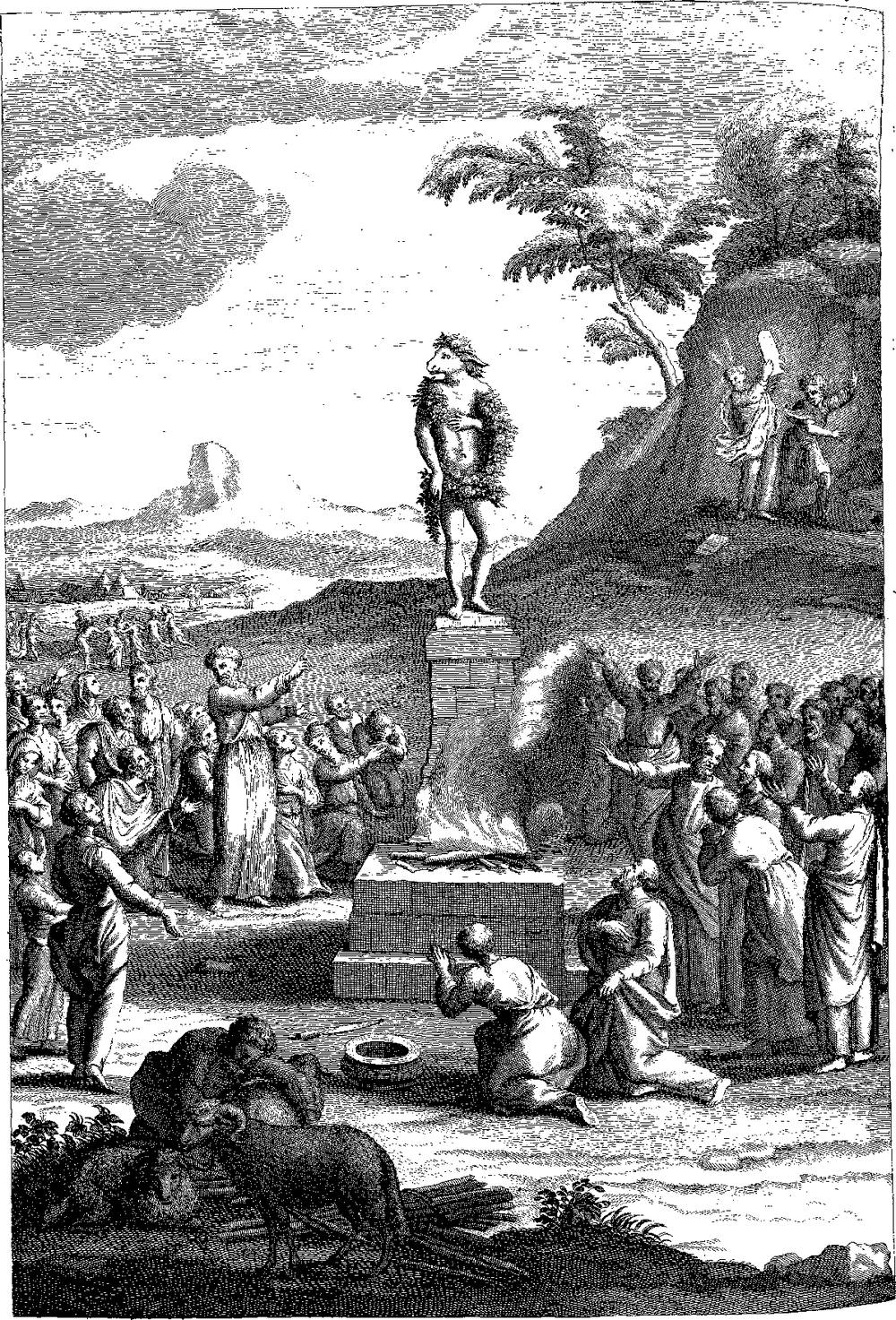
It is very well known what the ancient Idols of the Egyptians were; because a great number of them has been transmitted down to us. They were for the most part very ill-contriv’d Figures, representing Animals, or symbolical Figures compounded of Man and some Animal or other: here, the head of a Dog grafted upon the body of a Man; there, the head of a Cat upon that of a Woman; Oxen, Sparhawks, Ravens, Serpents, the vilest Insects, the very Herbs of their Gardens in this country received divine honours.
If in this point we refer ourselves to the Rabbins and the generality of Interpreters, they will tell us, that the Idols mentioned in Scripture were grotesque Figures. Dagon was described in the form of a Fish; Beelzebub in that of a Fly; the golden Calves set up by Jeroboam, as well as those worshipped in the wilderness, were cast in the shape of a Bull. We have spoken of all these Idols under their respective Titles. See MOLOCH, CHEMOSH, BAALPEOR, DAGON, ASTEROTH, BAAL, &c. and the Articles HIGH-PLACES and SAMARITANS.
IDOLATRY, the superstitious Worship which is paid to Idols and false Gods. This word is in general understood for all impious, superstitious, and sacrilegious Worship. People are not agreed about the original of Idolatry. The Author of the book of Wisdom proposes three Causes of it: first, the love of a Father who having lost his Son in an advanced age, to comfort himself under this loss, causes divine honours to be paid to him. Secondly, The beauty of Works engrav’d. Thirdly, The skill of an Artificer in Potters-earth, who consecrates a Statue of his own making as if it were a Deity. They who believed that man was formed by chance, imagined, that by degrees he came to institute a Religion for his own use, and that fear and superstition were the first causes of this Religion. Primus in orbe Deos fecit timor. Man under the disturbance of mind, proceeding from his fears, Lucret. l. 5. de rerum natura.forged, says Lucretius, imaginary Deities.
The most knowing in this matter are persuaded, that the first objects of idolatrous worship were the Sun, Moon, and Stars. The brightness, beauty, and usefulness of them, with respect to us and every thing about us, induced men to ascribe some divine virtue to them, and afterwards a religious worship. Others38 have believed, the most ancient Idolatry to have been that of Angels. At first some respect was shewn them, founded on the excellency of their Nature, and the assistance which we receive from them: afterwards a sort of worship, subordinate to that which is due to God, was paid them. Lastly, they were adored without any reference to God. After this, some imagined that Angels belonged to the Stars; and so the worship which was paid them, was insensibly transferred to the Sun, Moon, and Stars.
Vossius, who examined this matter with so much care, maintains, that men began first to depart from the worship which they owed to God, by rendring divine honours to the two Principles of Good and Evil. Mankind observing, that the World abounded with Good and Evil, were not able to imagine, that God, who is all over Goodness, should be the Author of Evil. They invented therefore two Deities of equal power, to whom they allotted quite different offices. The first Principle, the author of Good, created the World; the second Principle, the author of Evil, spread throughout it all the Evil he could. To the worship of these two Principles succeeded that of Spirits, particularly that of Dæmons; afterwards that of Souls was introduced, Wisd. xiii. 13, 14. xiv. 15. xv. 7, 8. Vossius Tract. de Idolat. l. 1. c. 1.of Heroes, and illustrious Persons.
But if we would recur to the true cause of Idolatry, we must search for it in the depravation of man’s heart, in his ignorance, vanity, pride, love of pleasure, his fondness of things sensible, his libertinism, brutal passions, the irregular love of amorous persons, the mistaken tenderness of a father for his child, or of a wife for her husband; an extravagant respect in subjects for their Prince, or of children for their Father, an excessive gratitude for the benefits and services received from certain persons, admiration of the great qualities of creatures, or of illustrious persons: one or many of these reasons, joined with the indelible Idea conceived by man of the Divinity, induced him to pay respect, worship, and a superstitious adoration to what he loved, esteemed, or honoured with excess.
If any one ask at what time this disorder began, some of the Rabbins will tell him, that before the Flood, the descendants of Cain introduced into the world the worship of the creature. They believe Enos to have been the first inventor of it: in this sense they explain a certain passage in Genesis, which, according to
Idolatry continues on the next page
Footnotes
-
משמני הארץ יהיה מושבך ומטל השמים מעל ↩
-
There is some difficulty in the Hebrew Text concerning this matter, which may be seen in the Commentators. ↩
-
Hieronym. qu. Hebr. in Genes. ↩
-
Aug. qu. 93. in Genes. & lib. 18. c. 5. de Civit. ↩
-
Isidor. l. xii. Origen. c. 1. ↩
-
Chrysost. Homil. 57. in Genes. ↩
-
Theodoret. qu. 89. & in Genes. Some are of opinion that it was the Devil who contended with Jacob (Ita quidam apud Procop. in Genes.) Others, that it was the Son, the second Person of the Trinity. Justin. Dialog. Clem. l. 1. Pædag. Tertull. contra Praxeam. Hilar. l. 4. c. 5. de Trinit. Athanas. Orat. 3. contra Arian. Chrysost. in c. vii. Act. Apost. Theodoret. qu. 92. in Genes. Others have thought with the Prophet Hosea xii. 3. that it was an Angel: and this is the opinion which is become the most common since St. Austin. lib. 16. de Civit. c. 39. & qu. 104. in Genes. Some believe that he continued lame all the rest of his life. Others will have it that he was cured very soon after; and whereas we read in the Vulgate, that he came to Salem, they translate, he arrived safe and found on the other side of Jordan. ↩
-
Joseph was sold in 2276. The first year of the famine was in 2296. Jacob sent his sons into Egypt in 2297. Joseph declared himself to his brethren, and sent for Jacob into Egypt in 2298. ↩
-
Hieronym. in Epitaph. Paulæ. Antonius Martyr. Itiner. Item Itiner. Adamnani & Villibaldi, apud Reland. Palæst. t.2. p.1008, 1009. ↩
-
Translators’ note. See the Text, where it’s plainly said, that Jacob was the son of Matthan and father of Joseph. See Matth. i. 15,16. ↩
-
Jaddus was High-Priest from 3665 to 3682, during the space of seventeen years, according to Eusebius. ↩
-
Translators’ note. The Author seems here to be mistaken: for in the Hebrew of Chronicles vi. 63. (not as in the citation 78.) it is said, ממטה ראובן את בצר ואת־יהצהAnd in the verse following קרמותis mentioned as another city distinct from that of Ja- hazah. So likewise in the Septuagint after ‘Ιαζὴρ, as it is called in Joshua, and ‘Ιασὰ in the Chronicles, we find Καδμώθ. In the Hebrew Text of Joshua, the Author’s citation is not at all inserted. ↩
-
This expression shews, that they were powerful. See Judg. v. 10. xiii. 14. ↩
-
Epiphan. Hæres. 58. c. 4. p. 491,492. ↩
-
See the Martyrologies of Ado, Usuard, and Notker. ↩
-
Gal. i. 19. Joseph. Antiq. l. 20. c. 8. p. 698. ↩
-
Clem. Alex. & Hegesipp. apud Euseb. Hist. l. 2. c. 1. ↩
-
Epiphan. Hæres. 78. c. 13,14. Euseb. l. 2. c. 23. ↩
-
Hegesipp. Epiphan. & Euseb. locis cit. ↩
-
Hieron. in Galat. i. 19. ↩
-
Vide Baron. an. 63. §. 8. ↩
-
Clem. Alex. apud Euseb. l. 2. c. 1. Origen. contra Celf. l. 1. c. 35. Hieronym. in Galat. i. 19. ↩
-
Euseb. l. 2. c. 1. Epiphan. Hæres. 29. & 78. ↩
-
Ita Clem. Alex. Euseb. Epiphan. Hieronym. ↩
-
Euseb. l. 2. c. 23. Hieronym. de Viris illustr. c. 2. ↩
-
Origen. contra Celsum, l. 1. Euseb. l. 2. c. 23. Hieron. de Viris illustr. ex Josepho, apud quem non leguntur hodie verba ab Origen. & Euseb. laudata. ↩
-
We have besides the Preparatory Gospel of St. James, which the Eastern people are well acquainted with. (See Fabricius’s Library of the Apocryphal books of the New Testament, p. 66.) We have likewise a Liturgy under his name. ↩
-
Translators’ note. They are called by several names, in several translations; by the Septuagint, Φάρμακοι*, poisoners, and* Ἐπαοιδοί*, Inchanters; by Sulpitius Severus, Chaldæans, that is, Astrologers; by others, Sapientes and Malefici*, Wisemen, (that is, they were esteemed so among the Egyptians) Philosophers and Witches. ↩
-
Translators’ note. St. Jerom translates their names Johannes and Mambres; and there is a tradition, they say, in the Talmud, that Juhanni and Mamre, chief of Pharaoh’s Physicians, said to Moses, Thou bringest straw into Ephraim, where abundance of Corn grew; as if they should have said, To bring your magical Arts hither, is to as much purpose, as to bring water to the Nile. ↩
-
Ἰαυέ vel Ἰαυέ vel Ἰαβέ, vel Ἰάω. Hebr. יהוהVide Epiphan. Hæres. 40. Theodoret. qu. 15. in Exod. ↩
-
Gen. x. 21. אחי יפת הגדולἈδελφῷ Ἰάφετ τῷ μείζονος. Sym. τῷ πρεσβύτου. ↩
-
2 Sam. xxiii. 18. instead of and instead of ↩
-
Exod. xxviii. 18. סַפִּירSaphir. LXX. Ἴασπις. ↩
-
Ver 20. Heb. יָשְׁפֵהLXX. Βήρυλλος. ↩
-
Scholiast. Aristoph. in Acarnan. Act. 1. Sc. 8. Ἴωνες γὰρ οἱ ᾿Αθηναῖοι πάντας τὰς Ἕλληνας Ἴωνας οἱ βάρβαροι ἐκάλουν. * ——————Crocodilon adorat Pars hæc, illa pavet saturam serpentibus Ibin. Juv. Sat. xv. † Ægyptiorum morem, says Cicero, quis ignorat? quorum imbutæ mentes pravitatis erroribus quamvis carnificinam prius subierint, quàm Ibim, aut felim, aut canem, aut crocodilum violent: quorum etiam si imprudentes quidpiàm fecerint, pœnam nullam recusent. Tusc. Disp. l. v. As also in his first Book de Naturâ Deorum, c. 29. And Herod. l. 11. c. 65. Ὃς δ’ ἂν Ἶβιν ἢ ἱέρηκα ἀποκτείνῃ, ἤντε ἑκὼν, ἤντε ἀέκων, τεθνάναι ἀνάγκη. ↩
-
Translators’ note. In the English Version it is, Ahinadab the son of Iddo had Mahanaim*; and herein it agrees both* with the Hebrew Text and the Septuagint. ↩
-
Clem. Alex. in Protreptico, p. 29, 30. Eufeb. præpar. l. 1. Philosoph. Orient. voce Angelus & Astra. ↩
-
Joh. Clerici Index Philolog. ad Hist. ↩