Volume I, pages 554–571 of the 1732 edition, from FAS to FIS: everything printed on these pages, in order.
Continued from Fasting
The ninth is a Fast, by reason of the division between the schools of Shammai and Hillel.
Upon the first day of the seventh month of the civil year, which is the first month of the ecclesiastical year, they fast because of the death of Aaron’s children consumed by the sacred fire.
On the tenth day of the same month they fast, by reason of the death of Miriam, Moses’s sister.
On the twenty-sixth, for the death of Joshua.
On the tenth of the eighth month, they fast for the death of the High Priest Eli, and the taking of the Ark.
On the twenty-eighth, for the death of Samuel.
On the twenty-third of the ninth month they fast, because Jeroboam King of the ten Tribes, forbad his subjects to carry the first fruits to Jerusalem. 1 Kings xii. 27.
On the twenty-fifth of the same month they fast for the death of the several Rabbins, Simeon the son of Gamaliel, Ishmael the son of Elisha, and Ananias the High Priest’s Vicar.
The twenty-seventh of the same month was a Fast, in memory of Rabbi Hanina’s being burnt with the book of the Law.
The seventeenth of the tenth month was a Fast, because Moses broke the Tables of the Law. Exod. xxxii. 19. On the same day they remember the cessation of the Sacrifices, and the Idol placed by Antiochus Epiphanes in the Temple.
The ninth of the eleventh month is a Fast, because God told Moses, that none of the Israelites who were murmurers, should enter into the promised Land; and because upon that day the Temple of Jerusalem was burnt, first of all by the Chaldæans, and a long time after by the Romans. This is the Fast taken notice of in Zechary, as kept in the fifth month of the Sacred Year. Zech. vii. 5.
On the eighteenth day of the same month they fast, because in the time of Ahaz, the lamp which was kindled every evening in the Holy, was extinguished.
The seventeenth day of the twelfth month in the civil year is a Fast, in memory of their death, who being sent to view the promised Land, made a disadvantageous report of it to the people, and induced them to murmur. See Numb. xiv. 22, 23.
Besides these Fasts, which are common to all the Jews, tho’ not with the same obligation, they have others, which are devotional, practised by the most zealous and pious part of them1: For example, the Luk. xviii. 12. Matth. ix. 14.Pharisee, mentioned in the Gospel, says, that he fasts twice a week, that is to say, every Monday and Thursday;2 upon Thursday, in memory of Moses’s going up Mount Sinai upon that day; and on Monday, in memory of his coming down from thence. The Pharisees and Disciples of St. John Baptist said to our Saviour, Why do we and the Pharisees fast oft, but thy disciples fast not. And Jesus Christ, speaking of St. John’s Fasting, says in an aggravating Ib. xi. 18. Justin. l. 36. histor.manner, John came neither eating nor drinking, and they say, he hath a Devil. What the manner was of St. John’s living, is very well known. It is said, that there were Pharisees who fasted four days in the week. Some of the Antients were of opinion, that the Jews fasted every Sabbath-day. Justin says, that Moses and the Israelites, having been for seven days wandering in the desarts of Arabia, without finding any sustenance, they consecrated the Sabbath-day, which is the seventh day, and appointed it to be a Sueton. in August. Juvenal. Satyr. 6.perpetual Fast. Augustus in his letter to Tiberius tells him, that no Jew ever kept the Fast upon the Sabbath-day, as he did the day on which he wrote to him. Juvenal says, that the very Kings of the Jews fast upon the Sabbath-day, and go barefooted:
Exercent ubi Festa mero pede Sabbata Reges. Martial. l. 4. Epigr. 4.And Martial attributes the stink peculiar to the Jews, to their Fasting on the Sabbath. But these Authors were not well informed. The Jews not only do not fast upon the Sabbath-day, but all Fasting upon this day is very expressly forbidden them by the rules of their Doctors.
Tract. Taanith, n. 8. p. 368.We read in the Mishna, the determination of the Sages, declaring, not only that it was not lawful to fast on days set apart for Festivals, and others on which it was not allowable to use this abstinence; but that the same was likewise prohibited the day before, and according to some Doctors, the day after too. Maimonides and Barthenora observe upon this text, that the old book which contained the Calendar of the Jewish Feasts, was lost in their time, and that they had no regard to the custom of not fasting the evening before, or the day after any festival, nor even upon the old Feast-days themselves, which were then no longer observed. In the Greek of Judith we read, that this pious woman fasted every day of her life, excepting the eves of the sabbaths, and the sabbaths; and the eves of the new-moons, and the new-moons; and the feasts and solemn days of the house of Israel. Here is an instance of the practice
which we have been remarking in the Mishna. This custom was observed out of respect to the Festival, that the joy of it might not be interrupted by the preceding or subsequent Fast.
Isa. lv. 6. Leon de Modene, ceremonies des Juifs, partie 3. c. 8.On Fast-days in the morning there are confessions added to the prayers, and the recital of some melancholy accidents which happened on such a day, and gave occasion for the Fast then celebrated: the volume of the Law is opened, and the following words are read out of the 32d chapter of Exodus, ver. 11. And Moses besought the Lord his God, and said, Lord why doth thy wrath wax hot against thy people, which thou hast brought forth out of the land of Egypt, &c. And in the afternoon, in the prayer of Mincha or the Offering, the same is read again with the addition of these words out of Isaiah, Seek the Lord while he may be found, call upon him while he is near, &c.
Isa. xl. 1, 2, &c.There are some Jews who abstain from eating meat and drinking wine from the 17th of Tammuz to the 9th of Ab, which makes three weeks. But this they do voluntarily, and because all these days have been unfortunate to Israel On the 9th of Ab, which answers to the moon of July and August, in memory of the Temple burnt by Nebuchadnezzar, and afterwards by Titus, the Jews continue Fasting without either eating or drinking, barefoot, and without shoes, and without the liberty of washing themselves, from about an hour before sun-set till the next day, when the stars begin to appear. In the evening of the vigil, after the common-prayer is ended in the synagogue, they sit upon the ground, and read the lamentations of Jeremiah. They repeat the same thing the next day, adding many other lamentations to them, continuing sorrowful all the day, without being permitted to study in the books of the Law, but only to read Job, Jeremiah, and other sad and melancholy subjects. The Sabbath which follows this Fast is called Nacama, that is to say, Consolation, because they then read these words of Isaiah; Comfort ye, comfort ye my people, saith your God, speak ye comfortably to Jerusalem, &c. and comfort themselves with the hope of the re-establishment of Jerusalem and the Temple.
Besides the general Fasts enjoined the whole nation, there are others peculiar to every nation; for example, to the Germans, who after the Feasts of the Passover and Tabernacles, have a custom to fast three days: namely, on the two following Mondays and the Thursday between them. And this is founded on an apprehension, that as the preceding Feasts were of eight days continuance, they might have offended God during this time. For the same reason they Buxtorf. Synag. Jud.fast on the last day of the year, and some on the eve of the first day in every month. If in the way of penance, or out of any particular devotion, some chuse to fast beyond the time above mentioned, they are used to pronounce these words before sunset: I undertake to fast to-morrow. After which they remain without eating or drinking from that evening to the same hour the next day, and add a prayer, wherein they beg of God, that their Fast may supply for them the room of sacrifice. On this day they lie upon a harder bed than usual, lessen the number of their pillows, change their fine sheets, and take coarse ones.
Idem. part. 1. c. 4.If any one dreams of something bad, or unfortunate; for example, that he sees the book of the Law burning; that he sees the day of forgiveness at the hour of evening prayer; that he sees the beams of his house, or his teeth falling; and this dream gives him uneasiness, he fasts that day in the most rigid manner, without either eating or drinking from one evening to another. This kind of Fast seems to be of such consequence to them, that they may observe it even upon the sabbath-day, or any other festival; which is allowed upon no other occasion.
Ecclef. ix. 7.In the evening when this Fast concludes, he who dreamt, sends for three of his friends before he goes to rest, and says seven times to them, May my dream be happy! to which they answer every time, May it be happy, and may God make it so! Then they add some passages out of the Prophets, and that he may presage well of the forgiveness of his sins, they repeat these words to him out of Ecclesiastes, Go thy way, eat thy bread with joy, and drink thy wine with a merry heart, for God now accepteth thy works. After which, he who had fasted may eat.
Basnage Hist. des Juifs, t. 5. l. 7. c. 18. art. 4.They have a great deal of confidence, that Fasting will either procure a happy interpretation of their dream, or divert the ill effects of it; they hold, that Fasting is with respect to dreams, what fire is to the tow which it sets on fire and burns. If any one falls sick, sets out upon a dangerous journey, or is taken prisoner, they fast in order to obtain his health or deliverance. A child who has loved his father tenderly, fasts every year upon the day of his death. The very Magicians fast, in order to conjure up the souls of the dead, and the devils in hell: with much more reason then, say the Sages, should good men fast, that they may engage the Spirit of God to rest upon them.
The Rabbins maintain, that it is not allowable to fast in the month of March, because in this month the Israelites departed out of Egypt, and it should be intirely consecrated to joy and gratitude.
Some however do fast upon the day of Miriam’s death, Moses’s sister, because at that time the people wanting water in their camp at Kadesh-barnea, murmured Numb. xx. 1, 2, &c.against God.
The common way of Fasting among the Jews is to take no food, nor any drink from the foregoing evening till after sun-set the day following. Nevertheless there are some Jews who believe, that it is lawful to eat till the morning of that day on which they are to fast; and that it is sufficient to continue the whole day from break of day till the rising of the stars, without taking any nourishment. Upon Fast-days meat being forbidden, they content themselves with some particular herbs, for all are not permitted; butter is prohibited, but not eggs. They celebrate no Weddings on Fast-days, and they are not allowed to be shaved or powdered, or to bathe themselves; they sometimes throw ashes upon their heads, and go bare-foot. But these last ceremonies are not indispensably obliging. They esteem Fasts and Abstinence as a supplement to the old Sacrifices, and place great merit in them.
The Mussulmen3, in imitation of the Christians, fast during the whole month of Ramadan, which is the ninth of the Arabian year. This month is lunar, and perpetually changing place, shifting successively through all the seasons of the year, because these people receive no intercalation. This Fast is said to have been instituted in memory of the Alcoran, which Mahomet declares was sent to him in this month. Their Fast consists in neither eating nor drinking, nor smoking for the whole day, from morning to the rising of the stars. After which, they eat and drink as much as they please, all night; only wine is more strictly forbidden upon these occasions than at any other times: some have been obliged to swallow melted lead, for having violated this rule.
No one is excused fasting, neither women, soldiers, travellers, labourers, nor artificers, neither poor nor rich; the Sultan fasts as well as others. The sick, who are unable to keep the fast of Ramadan, are obliged to fast some other month after their recovery. Thirst is in particular very troublesome to travellers and labourers; but they must endure it: or if they break their fast, they must resolve to fast as many days some other time. The generality continue all day long in great inaction, avoiding more especially those exercises which might cause drought.
As to the Fasts observed by Christians, without taking notice of that of forty days, which our Saviour passed in the wilderness without eating, and is above the ordinary strength of man, it is not to be at all doubted, but that as he was very much addicted to the legal observances, he both kept himself, and required his Disciples to keep all the Fasts, which the Jews were under any obligation to observe. But it does not appear by his own practice, or any commands which he gave to his Disciples, that he instituted any particular Fasts, or injoined any to be kept out of pure devotion. The poor, laborious, and almost always wandering life which he led for the three last years of his continuance in the world, did not allow him to undertake such practices. But when the Pharisees in the way of reproach told him, that his Disciples did not fast so often as theirs, or John the Baptist’s, he Luke v. 34, 35.replied, Can ye make the children of the bride-chamber fast, while the bride-groom is with them? but the days will come, when the bride-groom shall be taken away from them, and then shall they fast in those days. Accordingly the life of the Apostles and first Believers was a life of self-denial, of sufferings, austerities, and fasting: whereof we may judge by the life of St. Paul, with which we are better acquainted than with that of the other Apostles. He 2 Cor. vi. 5. & xi. 27.says, that he had been, and still every day was exposed to a thousand wants and frequent fastings, In hunger and thirst, in fastings often. He exhorts the faithful to imitate him in his patience, in his afflictions, in his labours, in his watchings, in his fastings. In laboribus, in jejuniis, in vigiliis. Ordinations and acts of consequence in the Church were attended with fasting and prayers. The fasts of Wednesday Acts xiii. 2, 3.and Friday, called Stations,4 and that of Lent, particularly of all the Holy Week, are thought to be of apostolical institution.
One cannot be sufficiently astonished at the extreme remissness which is become general among Christians in the point of Fasting, particularly in the Latin Church: and what surprizes more than all the rest, is, that some Casuists and Prelates, who ought to be better acquainted with the spirit of the Church, and more zealous in supporting the interests of Truth, and the rules of ancient Discipline, both write and teach, that the drinking even of wine, liquors, tea, coffee, and chocolate, breaks no one’s fast, because say they, liquids only moisten, and do not nourish: as wine, for example, which is the extract of a very juicy fruit, some sorts whereof, Galen says, are as nourishing as hog’s flesh, which, as any one can tell, is a kind of food the fullest of gravy that we know of; Chocolate, they say, tea, and coffee, which are comcompound
liquors, and other liquors wherein there is a mixture of Aqua vitæ, do not nourish: yet even pure water nourishes, refreshes, and delights. It has been always the notion of all people, both Greeks and Barbarians, that in Fasting they were to mortify the senses, not only by hunger, but by thirst too: the Jews, Mussulmen, and primitive Christians, nay the very Pagans themselves, as may be seen by the example of the Ninivites, did not think otherwise.
It is a manifest mistake to say, that water and things liquid do not nourish; do they not turn to chyle in the Stomach? do they not enter into the heart and blood? And are not the most solid fruits reduced to liquid juices, that they may be able to nourish and support us? For in short, every thing we eat must be changed into chyle, lympha, and so into blood, in order to contribute to our sustenance. It is true, a man who was to drink nothing but water, without eating, could not live long; but they who drink water, wine, or any thing else, while they are Fasting, have eaten before, and will eat again after they have drunk, and perhaps plentifully; so that drinking is not only a new nourishment to them, but is farther a dissolver, and helps the digestion of what they have taken before. Lastly, though liquids were only to refresh and please, people should not allow themselves the use of them in times of Fasting, they being contrary to the spirit of this holy exercise, and condemned by the example of Jews, Mussulmen, and Pagans, and, what should be of much greater force with us, by that of the primitive Christians.
Levit. iii. 17.FAT. God forbad the Hebrews to eat the Fat of Beasts. All the Fat is the Lord’s. It shall be a perpetual statute for your generations throughout all your dwellings, that ye Judæi recentes, Lyr. Villet. Vide Joseph. Antiq. l. 3. c. 10.eat neither Fat nor Blood. Some interpreters take these words in all the rigour of the letter, and suppose the use of Fat as well as blood to be intirely forbidden the Jews. Josephus says, that Moses forbids only the Fat of oxen, goats, sheep, and of their species, which agrees with the Law in Leviticus, ch. vii. 23. Ye shall eat no manner of Fat, of ox, or of sheep, or of goat. The modern Jews observe this custom; and with respect to the Fat of every other sort of clean creature, they think it is allowed them, even that of beasts which have died of themselves: this is conformable to that other Law; And Levit. vii. 24.the Fat of the beast that dieth of itself, and the Fat of that which is torn with beasts, may be used in any other use.
Cornel. Tirin. Menoch. Bonfrer.But other interpreters maintain, that the Law which seems to forbid generally the use of Fat, is to be restrained to Fat separated from the flesh, such as that which covers the kidneys and intestines; and this only in the case of its being actually offered in sacrifice: which is confirmed by this passage of Leviticus, wherein God enjoins the Israelites not to eat the Fat of bullocks, goats, and sheep. Whosoever eateth of the Fat of the beast, of which men offer an offering made by fire unto the Lord, even the soul, that eateth it, shall be cut off from his people.
The word Fat in the Hebrew Style signifies not only that of beasts, whereof we have been speaking, but every thing likewise which relates to it in other things; for Psalm cxlvii. 14. Psalm lxxxi. 16. Psalm xvii. 10.example, Adipe frumenti satiat te. And in another place, He should have fed them with the Fat of wheat: Cibavit eos ex adipe frumenti. Fat is also used sometimes for the source or cause of compassion or mercy. As the bowels are stirred at the recital of any misfortune, or at the view of some melancholy and afflicted object, it has been thought that sensibility resided principally in the bowels, which are commonly loaded with Fat. The Psalmist reproaches the wicked with having closed their Fat, with having shut up their bowels against him, with being in no sort affected with compassion at the sight of his extreme grief. Mine enemies compass me about, they are enclosed in their own Fat. In another passage he says, prodiit quasi ex adipe iniquitas eorum, they sin’d with affectation, almost like the person spoken of by Moses, Deut. xxxii. 15. Jesurun waxed fat, he kicked, and forgot God that formed him.
Psal. cxlii. 7. Gen. xxvii. 28.The Fat of the Earth, crassitudo terræ, signifies the dung or marl wherewith the earth is fatned. Our bones are scattered at the grave’s mouth, as dung is spread upon the earth. The Fat of the Earth implies likewise the fruitfulness of it. Det tibi Deus de rore cœli, & de pinguedine terræ abundantiam frumenti & vini. God give thee of the dew of heaven, and the fatness of the earth, and plenty of corn and wine.
Fat denotes abundance of every thing Jer. xxxi. 14. Job xxxvi. 16. Psal. lxiii. 5.that is good; I will satiate the souls of the Priests with Fatness. Inebriabo animam sacerdotum pinguedine. And in Job, Thy table shall be full of Fatness: Requies mensæ tuæ erit plena pinguedine. And the Psalmist, My soul shall be satisfied as with Marrow and Fatness.
FATHER. This word, besides the common acceptation of it for immediate Father, is likewise taken in the Scripture-style for Grand-father, Great Grand-father, or the very Author and first Father of a family, how remote soever he may be from those who speak. For example, the Jews in our Saviour’s time, and their descendants of this present generation, and the posterity of them to the consummation of ages, will call themselves sons of Abraham, Isaac,
and Jacob. Nebuchadnezzar is termed Belshazzar’s Father, though Belshazzar was his grandson. Jesus Christ is called the son of David, though David was so many generations distant from him.
By Father is likewise understood the Institutor, the Master of those who are of a Gen. iv. 20,21,22.certain profession. Jabal was the Father of such as dwell in tents, and such as have cattle. Tubal was the Father of all such as handle the harp and organ, or flute, &c. The famous founder of Tyre, Huram, is called the Father of the King of Tyre, and 2 Chr. ii. 13. & 2 Chr. iv. 16.even of Solomon, because he was their principal workman, and the chief director of their undertakings. The principal, the eldest of the Prophets were considered as the Masters and Fathers of the rest, who were their Disciples; for this reason the young Prophets are called the Sons of the Prophets, and these style the eldest, Fathers. My Father, my Father, said Elisha to Elijah, the chariot of Israel, and the 2 Kings ii. 12.horsemen thereof.
Father is a term of respect which inferiors often give to their superiors, and servants to their masters; My Father, said 2 Kings v. 13.Naaman’s servants to their master, if the Prophet had bid thee do some great thing, wouldst thou not have done it? &c. The King of Israel, in like manner, called the Prophet Elisha his Father: My Father, 2 Kings vi. 21.shall I smite them? The Prophet being upon his death-bed, Joash came to see him, and said, O my Father, my Father, the 2 Kings xiii. 14.chariot of Israel, and the horsemen thereof. Rechab, the Institutor of the Rechabites, is called their Father; Jonadab the son of Rechab, our Father.
A man is said to be a Father to the poor and orphans, when he takes care of their necessities, is affected with their miseries, and provides for their wants. I was a Father Job xxix. 16.to the poor, says Job. God declares himself to be a Father of the fatherless, and Ps. lxviii. 6.a Judge of the widows. Patris orphanorum & Judicis viduarum.
God is frequently called heavenly Father, and simply Father. Indeed, he is truly and eminently the Father, Creator, Preserver, and Protector of all creatures, and principally of those who invoke him, who know and serve him. Is he not thy Father that bought thee? says Moses; hath he not Deut. xxxii. 6.made thee and established thee? Since the coming of Jesus Christ, we have acquir’d a new right to call him our Father, by reason of the adoption and filiation which our Saviour has merited for us, by clothing himself with our humanity, and purchasing us by his death; Ye have not received the Spirit of bondage unto fear, like the Jews, but ye have received the Spirit of adoption, whereby we cry, Abba, Father. The Spirit itself beareth witness with our spirit, that we are the children of God.
Job intitles God the Father of rain; Quis est pluviæ pater? who produces it, who causes it to fall? In another place he says, I have said to corruption, thou art my Father. I acknowledge that I am sprung out of corruption, and shall return to the putrifaction of the grave; or otherwise, in the condition which I am reduced to, I look upon worms and putrifaction as my friends and relations Joseph says, that God had made him a° Father to Pharaoh, that he had given him very great authority in this Prince’s kingdom, and that Pharaoh looked upon him as his Father, and had so much confidence in him, and consideration for his person, that he gave him the government of his house, and of all his dominions.
The Devil is esteemed to be the Father of the wicked; Ye are of your Father the Devil. Ye would imitate the desires of your Father, says Jesus Christ to the Jews; he was a murderer from the beginning, he abode not in the truth. He is a lyar, and the Father of falsehood; he is a falsifier, a deceiver, a seducer. He deceived Eve and Adam; he introduced sin and falsehood into the world. He inspires his followers with his spirit and sentiments; he keeps the school of fraud and deceit; his only business is to tempt and ensnare us.
The Prophets reproach the wicked Jews with saying unto idols, You are my Father. In reality they said so, though not perhaps with their mouths, since they adored them as their Gods.
The Father of Sichem, the Father of Tekoah, the Father of Bethlehem, &c. the Father and Head of those who inhabit these Cities; he who built or rebuilt them. These expressions are very common in the first book of Chronicles, as well as Machir the Father of Gilead, the Father of Maresa, the Father of Kirjath-jarem, and the Father of the Valley of Artificers.
To be gathered unto their Fathers, to sleep with their Fathers, to go to their Fathers, are common expressions to signify death. In these passages, the Fathers signify those who lived before us, and whom we are going to meet again in another life.
Jesus Christ is called in Isaiah, the everlasting Father, because by him we are begotten in God for eternity; he procures life eternal to us, by adopting us to be the sons of God, and the communication of his merits, which are applied to us by our good works, and faith animated by love. St. Paul says, much in the same sense, that God is the Father of Spirits; our Fathers are the Fathers of our Bodies only, but God is the Father of our Spirits; he not only creates them, but he justifies them likewise,
glorifies and makes them happy. Jesus Matth. xxiii. 9.Christ in the Gospel does not permit us to give any man the name of Father, because we have one only who is in Heaven. Not that it is meant here, that we should abandon or despise our earthly Fathers, God requires us to honour them, and give them all necessary assistance; but when the interests of God are at stake, his glory, or our own salvation, if our fathers and our mothers are an obstacle to them, we should say to them, We know you not; and to God, in the language of Isaiah, Doubtless thou art our Father, though Abraham be ignorant of us, and Israel acknowledge us not; thou, O Lord, art our Father, our Redeemer. Or Ps. xxvii. 10.with David, My Father and my Mother have forsaken me, but the Lord taketh me up. What our parents have done for us in comparison with what we owe to God is so inconsiderable, that we may say, our Fathers are nothing to us, and that God alone deserves the title of our Father.
Saint Luke, speaking of St. John Baptist, says, that he was sent to turn the hearts of the Fathers to the Children, and the disobedient to the wisdom of the just. He will re-unite the sentiments of the ancient and later Israelites; both will speak the same language, have the same thoughts. The Jews will be no longer seen to degenerate from the righteousness of their ancestors, nor to contradict the Holiness of their Religion by their ill Lives, nor persecute the Saints and Prophets, by their opposition to their maxims and instructions. The Fathers and Sons shall live hereafter in perfect good understanding.
The first Father, the Father of the living, is Adam; the Father of the faithful, is Abraham; the Father of the Circumcision, or the Jews, the same Abraham; the same Patriarch is called the Father of many Nations, because in reality several people Gen. xvii. 4.sprung from him, as the Jews, Ishmaelites, Edomites, and many others.
FAUNI. These are wild beasts of the nature of apes, having four paws, but using commonly the hindermost only. Their faces are made almost like a man’s, the forepart is without hair, the hinder part abounds with it. Some of them are found in the Indies, and in the province of Angola. One of them, it is said, was brought to Holland some years ago, where it lived some time. St. Jerom says, that in the Emperor Constantine’s time, one of them was carried to Alexandria, where it pined and died very soon of melancholy. It was imbalmed and brought to the Emperor, who was then at Antioch. The same Saint says, that St. Antony met with one in his way, as he was going to search after St. Paul the Hermit. Plutarch relates, that after the defeat of Mithridates, one of them was carried to Sylla. There are other Fauns, which are the country Deities of the Heathens, described with horns upon their heads, and with the feet of goats.
The Fauns, or Deities of the woods and groves, were not known among the Greeks, but by the Latins only, who kept their festival upon the fifth of December, and sacrificed a Goat to them in the meadows with great rejoicings of all the villages about. Faunus among the Romans, was the same thing as Pan with the Greeks; at least the Fauns were companions to Pan. Notwithstanding they were honoured as Demi-Gods, it was nevertheless believed, that they died after a certain time. The Prophet Jeremiah, and some others, give them the Epithet of Ficarii, which some translate eaters of figs. Several copies read Sicariis, instead of Ficariis, and explain it of some cruel and murderous Fauns; but the reading Ficariis is most generally received. Others derive Ficarii, not from figs, ficus, ficus, but from the word ficus, fici, which signifies a spongy and fibrous excrescence of flesh, which appears in different parts of the body, and principally about the fundament and pudenda, to which the Fauns were believed to be very subject. They are represented exactly like Satyrs, sometimes in a human shape with the tail only of a horse or goat, and sometimes with the ears of a goat and horns. Lastly, they are almost always confounded with the Satyrs, for which reason when any speak of them, they say, Faunus an Satyrus? because they cannot tell whether it be one or the other, both being painted alike.
As to the existence of Fauns, St. Jerom, we know, has done all he can to prove it in his Life of St. Paul the Hermit, but he has not succeeded in persuading many to be of his opinion. There are still multitudes who are incredulous in this point, tho’ the relations we have of Savages, and men born and living in the Sea, might make a thing of this nature less incredible. In some particular places there are Apes to be seen, which very much resemble Fauns and Satyrs; and are so ingenious and diverting, as to persuade one that they have understanding. It is very probable, that the ancients who honoured Fauns, Sylvani, Pans, and Satyrs, both spoke and thought of them as they did of Tritons, Nymphs, and Nereids: they imagined there were certain Genii, who reigned in the woods, fields, and desarts, in the sea, and waters; and superstition afterwards framed such bodies for them as it pleased, as our Painters give such as they think fit to Angels, and Demons, to Virtues, Vices, Towns,
Provinces, to the Gods of Rivers, and Goddesses of Fountains, &c.
In the passage cited out of Jeremiah, the import of the Hebrew is this, a The Ziims dwelt there with the Ijims; and we find the same terms in Isaiah xxxiv. 14. where, according to the Vulgate, we read, Devils and onocentaurs shall meet there. In the Hebrew, b The Ziims shall meet with the Ijims. Upon comparing all the passages where we find these terms, it appears to us, that Ziim signifies fishermen, mariners, seafaring men; and Ijim Isles; and that this place in Jeremiah may be translated thus, The fishermen shall inhabit the Isles. And that in Isaiah thus, The fishermen, or they who shall sail into this country, will meet with Islands. That is to say, Babylon shall be destroyed in such a manner, that the waters shall cover its very ruins, and the fishermen and mariners, who shall pass by, shall see there nothing but some Islands, formed by the heaps of its ruins.
FEAR, is sometimes used for the Object of Fear. Thus it is said, the fear of Isaac, to describe the God whom Isaac feared. Except the God of my father, the God of Abraham, and the Fear of Isaac had been with me, surely thou hadst sent me away now empty. —— God says, that he will send his Exod. xxiii. 27. Deut. ii. 25.Fear before his people, in order to terrify and destroy the inhabitants of Canaan; that the terror of them shall put their enemies to flight. Job speaks of the terrors of God, Job vi. 4. Psalm lxxxviii. 15.that they set themselves in array against him; and the Psalmist, that he had suffered the terrors of the Lord with a troubled mind.
FEASTS. God out of his great wisdom appointed several Festivals among the Jews for many reasons. 1. To perpetuate the memory of those great events and wonders which he had wrought in favour of his people; for example, the Sabbath brought to remembrance the creation of the world; the Passover, the departure out of Egypt; the Pentecost, the Law given at Sinai, &c. 2. To keep them firm to their Religion, with the view of ceremonies, and the majesty of Divine Service. 3. To procure them certain pleasures, and allowable times of rest: for their Festivals were accompanied with Rejoicings, with Feasts of charity, and with innocent Diversions. 4. To give them instruction; for in their Religious Assemblies the Law of God was read and explained. 5. To renew the acquaintance, correspondence, and friendship of their Tribes and Families with one another, by coming from the several towns in the counry, and meeting three times a year in the Holy City.
The Hebrews had a great number of Feasts. The first, and most ancient of all, was the Sabbath, or the seventh day of the week, instituted to preserve the memory of the World’s Creation; The Lord blessed the seventh day, and sanctified it, says Moses, because that in it he had rested from all his work. Some of the ancient Fathers, and some Rabbins5 were of opinion, that the Sabbath had been observed among the righteous, from the beginning of the World. But the most universal opinion is, that people did not begin to cease from work upon that day, till after the command which God gave the Israelites to that purpose, some time after their coming out of Egypt, when they were incamped at Marah.
The Sabbatical year which returned every seven years, and was intirely set apart for rest, and the Jubilee year, which was at the end of seven times seven years, or the forty ninth year; were sorts of Feasts too, and may be considered as consequences of the Sabbath.
The Passover was instituted in memory of the Israelites departure out of Egypt, and of the favour which God shewed his people in sparing their first-born, when he passed in Egypt, and killed all the first-born of the Egyptians. It was celebrated on the fourteenth, or rather fifteenth day of the first month in the Ecclesiastical year, which was the seventh of the civil year. The Feast began after-noon on the fourteenth, and was celebrated properly on the fifteenth of Nisan; it lasted seven days. But the first and last days only of the Octave were days of rest. See the Article PASSOVER.
The Feast of Pentecost was celebrated on the fiftieth day after the Passover, in memory of the Law’s being given to Moses on Mount Sinai, fifty days after the departure out of Egypt. They reckoned seven weeks from the Passover to Pentecost, beginning at the day after the Passover. The Hebrews for this reason call it the Feast of Weeks, and the Christians Pentecost, which signifies the fiftieth day.
The Feast of Trumpets was celebrated at the beginning, or on the first day of the civil year, upon which a Trumpet was sounded, proclaiming the beginning of the year, which was in the month Tizri, answering to our September. It was rather a civil Feast than a sacred Solemnity. We know no religious cause of its establishment. Moses commands it to be observed as a day of rest, and that particular sacrifices Levit. xxiii.should be offered upon it.
The New Moons, or first days of every month, were in some sort a consequence of the Feast of Trumpets. The Law did not oblige people to rest upon this day,
but ordained only some particular sacrifices Numb. xxviii. 11. Numb.x. 10. 1 Sam. xx. 5, 18.to be offered. It appears, that upon these days also, the Trumpet was sounded, and some sort of entertainments were made upon them. See CALENDS or NEW-MOONS.
FEAST of Expiation, or Chippur or Pardon, was celebrated on the tenth day of Tizri, which was the first day of the civil Levit.xxii. 27, 28. Numb. xxix. 7.year. It was instituted for the Expiation of all the sins, irreverences, and pollutions of all the Israelites, from the High-Priest to the lowest of the people, committed by them throughout the whole year. Upon this day they fasted strictly, and offered several Sacrifices. See above, EXPIATION.
The FEAST of Tents, or Tabernacles, upon which all the Israelites were obliged to be at the Temple, and to dwell for eight days under Tents made of leaves, in memory of their fathers dwelling forty years in Tents, as travellers, in the wilderness. It was kept on the fifteenth of the month Tizri, which was the first of the civil year. The first and seventh day of this Feast were very solemn. But during the other days of the Octave, See Levit. xxiii. 34, 35, & Numb. xxix. 12, 13.they might work. At the beginning of the Feast, two vessels of silver were carried in a ceremonious manner to the Temple, one full of water, the other of wine, which were poured out at the foot of the Altar of burnt-offering upon the seventh Mischna, tit. Suca, & Bartenora in cap. 4. Mischnæ.day always of this Festival.
The Octave of the three great Feasts of the year, which are the Passover, Pentecost, and the Tabernacles, that is to say, the seventh day after these Feasts, was a day of rest as much as the Festival itself; and all the Males were obliged to be at the Temple Exod. xxiii. 14. Deut. xvi. 16. Deut. xvi. 7.upon these three Feasts. But the Law did not require them to continue there during the whole Octave. They were at liberty to return the day after the solemnity, excepting in the Feast of Tabernacles, for then they seem obliged to be present at it for the whole seven days.
Besides these Feasts mentioned by Moses, we find the Feast of Lots, or Purim6, instituted upon the occasion of the Jews deliverance, when Haman, in the reign of AhasuerusEsth. ix. 29, 30., had contrived their destruction. See ESTHER, MORDECAI, AHASUERUS.
The Death of Holofernes, taken notice of in Judith. See JUDITH.
The FEAST of the Dedication of the Temple, or rather of the Restoration of the Temple, which had been profaned by Antiochus 1 Macc. iv. 52,54, 55, &c. John x. 22. Joseph. Antiq. l. xii. c.11.Epiphanes, was celebrated in the winter; and this is believed to be the Feast named Encænia in the Gospel. See above,
DEDICATION. Josephus says, it was called the Feast of Lights. Our account of it in the book of Maccabees is as follows: Judas and his brethren having defeated the army of Gorgias, went directly to the Temple of Jerusalem, which they found forsaken and profaned, so that the Courts were full of thick bushes and brambles, the doors were burnt, the Altar profaned, and the buildings in ruins. After having shed abundance of tears on this occasion, they began to clean every thing, and employed the Priests in demolishing the Altar which had been polluted. The stones belonging to it they laid up in a proper place, waiting till a Prophet should come, who might inform them what to do with them. They erected another of rough Stone, refitted the Holy and the Sanctuary, and placed therein the Candlestick, the Table of Shew-bread, and the Altar of Perfumes. They kindled the Lamps, put the Loaves upon the sacred Table, set the Incense on fire, offered Sacrifices and Burnt-offerings, and performed the Dedication of the Temple in eight days time, with all the solemnity that circumstances would allow of. Josephus adds, that this Festival was called the Feast of Lights, probably because this happiness befell them when they least expected it, and they looked upon it as a new Light that had risen upon them.
Leo of Modena is more particular in relating the manner of celebrating this Feast. He says, the ancient Sages appointed the celebration of it in memory of the victory obtained by Judas Maccabæus over the Greeks. “ The first day they light up one lamp, two upon the second, and so continuing to the last, till eight are lighted. “ This is founded on the ensuing Story, “ namely, while the enemies were masters “ of the City and Temple, and were profaning the latter, Joshanan and his sons “ drove them thence, and defeated them; “ and, as at his return there was no pure “ oil to be found, in order to light up the “ lamps in the Candlestick with seven branches, they met with some in a little “ carved vessel, enough to burn one night, “ but miraculously this oil lasted eight “ nights; which obliged them, in memory “ of this event, to light as many lamps “ as we have mentioned. “ In this Festival is likewise celebrated “ Judith’s enterprize against Holofernes; “ though, as some say, it was not executed “ in the same season. “ During these eight days, people may “ work, and carry on their trades; for all “ that is extraordinary consists in the order “ of lighting these lamps, and in adding “ to the usual prayers a thanksgiving for “ this victory, and every morning the “ cxiiith and following Psalms, together “ with the xxxth. There was likewise some “ small difference as to eating. This Feast “ is called Hanucha, that is to say, Exercise, “ or
“ or renewing, because they then began “ to restore those exercises which at that “ time were interrupted.”
On the twenty-first of September, the Jews keep a Feast, as they call it, of Branches, in memory of the taking of Jericho.
In the same month they have the Feast of the Collections, because upon that day they make a collection for the expence of the Sacrifices.
They have likewise a Festival for the death of Nicanor. 1 Macc. vii. 48, 49. 2 Macc. xv. 37.
The Feast for the discovery of the sacred fire in the time of Nehemiah. 2 Macc. i. 18, & seq.
Rev. i. 10.The Feast called Xylophoria, upon which wood in great quantity was carried to the Temple. Joseph. de Bello, l. 2. c. 17.
In the Christian Church we have no Festival that appears clearly to have been instituted by Jesus Christ or his Apostles. Nevertheless our Saviour having commanded us to eat his body and drink his blood, and to commemorate his Passion as often as we celebrate his mysteries, has hereby seemed to institute a Feast, and a perpetual memory of his Passion. Christians have always celebrated the memory of his Resurrection, and keep this Feast not once only in the year, but on every Sunday; and we see in the Revelations, that then, so early, this day was called commonly the Lord’s day. I was in spirit on the Lord’s Barnab. Epist. p. 56.day. St. Barnabas says, We celebrate the eighth day with joy, because it is the day upon which Jesus Christ rose from the dead. We see the same thing in St. Ignatius the Martyr7, in St. Justin8, Irenæus9, Tertullian10, and Origen11.
FERRET, a sort of rat, with a long snout, and thick tail. It has but four teeth. It bites horses, and its biting is mortal. Moses declares it to be unclean. Levit. xi. 30. The Greek word Mygale is compounded of mus, a rat, and gale, a weasel, because this animal has something of both. The Hebrew Levit. xi. 30. אנכה Anaca, μυγαλή.word Anaca, which answers to it, is by some translated, hedge-hog, by others, leech, or salamander. Bochart thinks it signifies a lizard.
FESTUS. Portius Festus succeeded Felix in the government of Judæa, in the year Vide Antiq. l. 20. c. 7.of Jesus Christ 60. As Felix his predecessor was inclined to do an obliging thing to the Jews, when he resigned his government, he left St. Paul in bonds at Cæsarea in Acts xxiv. 27.Palestine. Festus, at his first coming to Jerusalem, was intreated by some of the principal Jews to condemn Paul, or at least to give orders for conveying him to Acts xxv. 1, 2, 3, &c.Jerusalem, they having conspired to assassinate him in the way. Festus rejected their petition, saying, it was not customary with the Romans to condemn any man without hearing him; but he told them they might come to Cæsarea, and he would hear their accusations against Paul. Accordingly, some days after they came thither, but Paul appealed to Cæsar, and so stop’d the prosecution of the Jews, and secured himself from the wicked intentions of Festus, whom they had corrupted with a sum of money.
Joseph. de Bello, l. 2. c. 24. & Antiq. l. 20. c. 7.Festus finding how much robbing there was every where in Judæa, was very diligent in pursuing the thieves who laid waste the whole Province. He likewise suppressed a magician, who drew the people after him into the desart; lastly, he died in Judæa about the beginning of the year of Jesus Christ 62, and Nero named Albinus Antiq. l. 20. c. 8. Gen. iii. 7.to succeed him.
FIG, Fig-tree. This tree and its fruit are very well known: they were very common in Palestine; and there is mention often made of them in Scripture. Our first parents covered their nakedness with Fig-leaves, gathered either from common Fig-trees, or from some of another kind, the leaves whereof were much larger.
Amos vii. 14.The prophet Amos being reproved by Amaziah the Priest of Bethel, for prophesying things to the disadvantage of the kingdom of Israel, made this reply to him, I am no prophet, neither a prophet’s son: but I am an herd-man, and a gatherer of wild Figs, or sycamore fruit. Pliny, Theophrastus, and Dioscorides speak of these wild Figs, and the manner of pricking them. Scalpendo tantùm ferreis unguibus, Plin. l. 15. c. 7.aliter non maturescit, says Pliny, but it ripens four days after it is pricked: Sed cum factum est, quarto die demetitur.
You have here M. Tournefort’s description of caprification, or the pricking of Figs, as it is practised in the Islands of Zia, Tina, Mycone, Scio, and generally in the other Islands of the Archipelago: “ It is previously to be observed, that in most of “ these Islands there are two sorts of Fig-trees cultivated; the first is called Ornos, derived from the Greek, Erinos, “ wild Fig-tree, or the Caprisicus of the “ Latins. The second species is the common Fig-tree that grows with us. The “ wild bears three sorts of fruits, Fornites, “ Cratitires, and Orni, absolutely necessary “ to make the Figs of the other Fig-trees “ ripen.
“ Those which are called Fornites, appear in the month of August, and last “ till November without dying. In these “ there are little worms ingendred, from “ which certain gnats proceed, that are observed to flutter only about these trees. “ In October and November, these gnats “ of themselves prick or sting the fruits of “
the second growth of the same sets of the Fig-tree, which fruits, called Cratitires, do not shew themselves till the end of September; and the Fornites fall gradually after the gnats have issued from them. The Cratitires, on the contrary, remain upon the tree till May, and include eggs which the gnats of the Fornites laid in them as they pricked them.
“In the month of May, the third kind of fruit begins to come forward upon the same stock of the wild Fig-tree which produced the two others. This is much larger, and is called Orni; when it is come to a certain bigness, and the eye of it begins to open, it is pricked in this part by the gnats of the Cratitires, which are in a condition to pass from one fruit to the other, in order to lay their eggs there.
“It sometimes happens, that in particular situations, the gnats of the Cratitires are slower in coming out, while the Orni of the same places are disposed to receive them: and then they are forced to go look for the Cratitires in another quarter, and to fix them to the ends of the branches belonging to such Fig-trees, as have their Orni well prepared, that so the gnats may prick them; if this opportunity is slipt, the Orni fall, and the gnats of the Cratitires fly away.
“The peasants, whose business it is to cultivate Fig-trees, are the only persons, who know the moments, as we may say, wherein it is necessary to make this provision; and to this end they carefully observe the eye of the Fig: for this part not only directs them to the time when the prickers should come forth, but to that likewise wherein the Fig is to be pricked with any success. If the eye is too hard and too close, the gnat cannot lay its eggs in it; and if it be too open, the Fig falls.
“Neither of these three sorts of fruits are good to eat; they are designed only to ripen the fruit of the Fig-trees which are not wild. The use they put them to, is such as follows: In the months of June and July, the peasants take the Orni at a time when their gnats are ready to come out, and carry them as it were in a string to their Gardenfigs. If this favourable opportunity is lost, the Orni fall, and the fruit of the garden Fig-tree not ripening, in a little time falls likewise. The country-men know these precious moments so well, that every morning, when they are making their review, they carry only the Orni that are in good condition to the Fig-trees which are not wild, otherwise they would lose their harvest. They understand so perfectly how to manage the Orni, that the gnats which proceed out of them shall “ripen the fruit of the garden Fig-tree in forty days.
“I could not but admire the patience of the Greeks, who were employ’d for more than two months in carrying the gnats which are thus used for pricking, from one Fig-tree to another; the reason I learned very soon. One of their trees generally produces two hundred and fourscour poundweight of Figs; whereas ours do not yield above five and twenty pounds. The prickers contribute perhaps to the ripening of the fruit upon the common Fig-tree, by causing the nourishing juice to extravasate, the tubes whereof are torn while they are laying their eggs. It may be likewise, that besides their eggs, there may some liquor come from them, proper to raise a gentle fermentation in the milk of the “Fig, and to soften the flesh of it.”
I will not venture to affirm, that this way of pricking Figs, or ordering the pricking of them, was in use in Palestine, when the prophet Amos was living, nor that it was the business of his profession to take care of the flocks, and to ripen garden Figs with the help of wild Figs; but the Reader by this description of M. Tournefort’s, will see a very extraordinary manner of hastening the maturity of these fruits, which certainly has a good deal of relation to what Amos did.
Matth. xxi. 19.It is said in the Gospel, that Jesus Christ coming from Bethany early in the morning, and finding himself to be very hungry, drew near to a Fig-tree with a design of gathering some Figs; and seeing nothing but leaves upon it, for this was not the season for Figs, he cursed it; and immediately it withered to the root. That which occasions some perplexity in this passage, is St. Mark xi. 13. Mark xi. 13.Mark’s declaring expressly, that this was not a time for Figs. The earliest Figs are in the months of July and August, and the latest in September and October. Now that which is related in the Gospel happened four or five days before the Passover, and consequently before the fifteenth day from the moon in March. This season therefore was not a time to expect Figs for eating on a Fig-tree: and the very supposition of it carries a sort of incongruity with it. 1. To look for fruit upon a tree at a time when it was very well known that it could not bear any; and, 2. to curse this tree because there was no fruit on it, as if it was a fault in it. The Interpreters have racked their brains to salve these inconveniences, and avoid acknowledging, that our Saviour was capable of performing any action which carries with it some idea of indecency. Some have Οὐ γὰρ ἦν καιρὸς συκῶν. Hammond. Le Clerc. Simon’s Notes on the New T.stament.translated it, For this was not a year for Figs, they had failed this year. But allowing the Greek text would admit of this
sense, which certainly it will not, even by their confession, who propose this translation, to what purpose would this reflexion be at such a season? Jesus Christ goes to look for Figs upon a tree in the midst of March, four months before the earliest Figs are ripe, and six after the latest; he finds none, and curses the Fig-tree; but why? because the Fig-trees had failed this year. Does this reflexion rectify the incongruity which appears in this action of our Saviour’s?
Heinsius. l. 2. c. 6. Exercit. Sacr.Others, as Heinsius, Gataker, and the Gothick Version translate, For there where he was, it was the season for Figs. To support Gataker in Marc. xi.this Version, both the pointing and the common accents of the text must be changed, and the Evangelist made to speak in too concise a manner, too different from the general Style of St. Mark. Besides, it is not true that in Palestine the tenth or twelfth day of the moon in March was the season for Figs. It is certain, that they do not ripen so soon in this country.
The generality both of the ancient and modern Interpreters have looked upon this action of our Saviour’s, as a figure of the reprobation of the Jews: the Fig-tree we are speaking of, had only leaves on it; herein it resembled the Jews, who had only the appearances of Piety and Religion. The Fig-tree was no way culpable for not bearing fruit at a time it naturally produced none; but the Jews were criminal for not bringing forth the fruits of Good-works when our Saviour appeared among them. He cursed the innocent Fig-tree, to shew the malediction which was ready to fall upon the incredulous and impenitent Jews. These reasons are plausible enough; but there is still an objection behind. For how will they prove that the Synagogue is reprobated with justice, if the Fig-tree is cursed unjustly?
We must therefore endeavour to find, if it be possible, some solution of these difficulties. We own that it was not then a season for Figs; the Text of St. Mark expressly says it, and the sequel of the Story sufficiently proves it, since this happened before the middle of March: but we are of opinion, that there might be some of the forward kind; and our Saviour might presume so, seeing the tree full of leaves. It is certain that there are forward Figs: Isai. xxviii. 4.Isaiah compares the beauty of Samaria to those early Figs, which people gathered and eat as soon as they found them; As the hasty fruit before the summer, which when he that looketh upon it, seeth it, while it is yet in his hand, he eateth it up. And Hosea ix. 10.Hosea says, that the Lord found Israel in the wilderness as the first ripe in the Fig-tree Jer. xxiv. 2.at the first time. And Jeremiah describes them as excellent Figs, One basket had very good Figs, even like the Figs Theophrast. Hist. Plant. l. 4. c. 2. Plin. l. 13. c. 8. & l. 15. c. 18.that are first ripe. Theophrastus and Pliny acknowledge, that there is a sort of Fig-tree always green, and always with fruit upon it, some ripe or very far advanced, according to the season, the other in blossom or buds. In Palestine, where the winter is very mild, there might easily be forward Figs in March; wherefore our Saviour did nothing contrary to the rules of wisdom and decency, by going to look for Figs at this season upon a Fig-tree which had leaves on; and his cursing the barren Fig-tree upon this occasion, is an exact figure of the reprobation of the Jews.
To live in peace under our own Vines and our own Fig-trees, represents in the Scripture-style, a time of happiness and prosperity. 1 Kings iv. 25.And Judah and Israel dwelt safely every man under his Vine and under his Fig -tree. See also Micah iv. 4. and Zech. iii. 10. and 1 Macc. xiv. 12. Isaiah applied a lump of dry Figs upon an 2 Kings xx. 7.ulcer, or imposthume; or, lastly, on Hezekiah’s throat; for it is not known what disease he had upon him: and immediately after he was cured. Physicians agree, that Figs are useful in all these sorts of ailments. They are employed with good success in bringing imposthumes to a ripeness, in healing ulcers, squincies, and sore throats. To FIND, to meet with, is used sometimes for to attack, to surprize one’s enemies, to discover their ambushes, &c. and it is in this sense that some Criticks explain the following Genes. xxxvi. 24. מצא אח הימםpassage of Genesis, Iste est Ana qui invenit aquas calidas in solitudine. In the Hebrew, He found the Emims. These Emims are believed to be powerful people, Emim populus magnus & validus, & tam excelsus, ut de Enacim stirpe, quasi gigantes crederentur,Deut. ii. 10, 11. says Moses in Deuteronomy. Anah therefore found a troop of these people; he surprized, attacked, and defeated them. The verb to Find is understood in the same sense Judg. i. 5. They found Adonibezek in Bezek. They attacked him there. And 1 Sam. xxxi. 3. according to the Hebrew, the Archers belonging to the Philistins, found Saul, attacked him; and 1 Kings xiii. 24. A lion found him in the way, and slew him, attacked and killed him.
Job vi. 30. Psal. x. 39.To Find, to discover, to punish, as a Father who discovers the faults of his children, or a Judge who discovers the offences of a criminal. Ye shall find no iniquity in my tongue. And the Psalmist, Quæretur peccatum illius & non invenietur. The iniquity of the sinner shall be punished, and he himself shall not be found; he shall be extirpated, he shall perish: or else, if we read it with an interrogation, There shall be search made after his iniquities, and shall they not be found? as he flatters himself, saying, Dixit enim in Psal. xxi. 8.corde suo non requiret? And again, Thine hand shall
Psal. cxvi. 3.find out all thine enemies, shall punish them. And the pains of Hell found me; the dread of Hell, or of the grave, I saw my self exposed to it. Evils have found us. This is a very significant way of speaking, to describe any sudden and unexpected calamity, Adjutor in tribulationibus quæ invenerunt Psal. xlv. 1. Psal. xxxi. 29.nos nimis. And Job, If I rejoiced at the destruction of him that hated me, or lift up my self when evil found him. It is said of a man smitten by God, that he is no more found; & non inventus est locus ejus, that he has Psalm xxxvi. 36.disappeared.
To find favour in the sight of any one, is another very expressive form of speech which is very common in the Scripture.
FINGER. The Finger of God signifies his power, his operation. Pharaoh’s Magicians Exod. viii. 19.discovered the Finger of God in the miracles which Moses wrought. This Legislator gave the Law written with the Finger Exod. xxxi. 18. Psal. viii. 4. Luke xi. 20.of God, to the Hebrews. The Heavens were the work of God’s Fingers. Jesus Christ says, he casts out Devils with the Finger of God; whereby he intimates that the Kingdom of Heaven is come.
To put forth one’s FINGER, is a bantering gesture. Si abstuleris de medio tui catenam, & desieris extendere digitum. If thou take away from the midst of thee, the chain or yoke wherewith thou overwhelmest thy creditors, and forbear pointing at them, and using jeering and insulting gestures. Some take this for a menacing gesture, as Nicanor stretched out his hand against the Temple, threatning to burn it.
FIRE. God hath often appeared in Fire, and incompassed with Fire; as when he shewed himself in the burning bush, and descended on mount Sinai in the midst of flames, thunderings and lightning. Fire is a symbol of the Deity. The Lord thy God, Deut. iv. 24.says Moses, is a consuming Fire. He shewed himself to his Prophets Isaiah, Ezekiel, and St. John, in the midst of Fire. The Psalmist describes the chariot of God to us, all in a flame, xviii. 9, 10. God threatens us to appear in the midst of Fire at his second Dan. vii. 10.coming. Daniel says, that a fiery stream issued, and came forth from before him. The wrath of God is compared to Fire, and the effects of his wrath, which are war, famine, and other scourges, are described under the same Idea. Fire is often put for Thunder, Lightning, the Fire of Heaven.
The Angels themselves as the Ministers of God, are compared to a burning Fire. Psal. civ. 4.The Lord, or his Angel, representing his Majesty, led the Israelites in their journey through the wilderness, under the form 2 Macc. i. 19. and ii. 10. Exod. xii. 21. Gen. iv. 4. Gen. xv. 17.of a pillar of Fire, which gave them light in the night-time. Fire from Heaven fell frequently on the victims sacrificed to the Lord, as a mark of his presence and approbation. It is thought, that God in this manner expressed his acceptance of Abel’s sacrifices. When Abraham made a Covenant with the Lord, a Fire like that of a furnace passed through the divided pieces of the sacrifices, and consumed them. Fire fell upon the sacrifices, which Moses offered at Levit. ix. 24. Judg. xiii. 19, 20. 2 Chr. vii. 1. 1 Kings xviii. 38. Levit. vi. 12. 2 Macc. i. 19, 20, and ii. 1, 2, 3.the dedication of the Tabernacle, and on those of Manoah, Sampson’s father; upon Solomon’s, at the dedication of the Temple; on Elijah’s, at mount Carmel; and lastly, on Nehemiah’s, at the return from the captivity.
There was a perpetual Fire kept up in the Temple upon the Altar of burnt sacrifices, which the Priests had the care of preserving, by burning wood continually upon it12. When Nebuchadnezzar made himself master of Jerusalem, the prophet Jeremiah took this sacred and perpetual Fire, and being attended by some other Priests, concealed it in a cistern, wherein there was no water. When the Jews returned from the captivity, Nehemiah having sent the grand -sons of those Priests, who had hid this Fire, with orders to search for it; instead of the Fire they brought him muddy water, which he pouring on the Altar, immediately a very clear Fire arose, which consumed the sacrifices that were upon it.
Besides this Fire, which was always burning upon the great Altar of burnt-offerings, Ezek. xlvi. 23, 24.there were several kitchins in the Temple, wherein the provision appointed for the subsistance of the Priests, was dressed; and the peace-offerings, which were offered by the People, and eat by them in the Temple-court before the Lord.
Joseph. de Bello, l. 2. c. 11. seu p. 811. seu 17. in Lat. Nehem. ix. 7. Dan. iii. 11, 12, 13 &c.A great quantity of wood was brought into the Temple, to supply a sufficient stock of fewel for all these fires; and for this purpose was instituted a kind of Feast, called Xylophoria, in Josephus.
The ancient Chaldæans adored Fire, as well as the old Persians, and some other people of the East. Several have been of opinion, that Abraham was thrown into the Fire, because he refused to worship this element. This St. Jerom intimates, where he says, that God delivered this Patriarch out of the Fire of the Chaldæans, instead of saying, that he brought him out of the city of Hur in Chaldæa. Nebuchadnezzar commanded Daniel’s three companions to be cast into the fiery furnace, because they refused to pay adoration to a statue, which he had erected: but God secured them from the effect
of the Fire, and the flame did not hurt them.
Isai. xxxiii. 14.HELL-FIRE is described after a sufficiently clear manner in the Old Testament. Moses inveighing against the Israelites, who rebelled against the Lord, says to them, A Fire is kindled in my anger, and shall burn unto the lowest hell, and shall consume the earth with her increase, and set on fire the foundations of the mountains. Here Hell-fire and the place of torment for the wicked, is seated in the deepest part of the earth. Isaiah is still more express, Who among us shall dwell with the devouring Fire? Who amongst us shall dwell with everlasting burnings? And elsewhere, They shall go forth and look upon the carcases of the men that have transgressed against me, for their worm shall not die, neither shall their Fire be Ecclus. vii. 17.quenched. And Ecclesiasticus, The vengeance of the ungodly is Fire and Worms. See also Job xx. 26. A Fire not blown shall consume them. And xxiv. 19. Ad nimium calorem transeat ab aquis nivium.
Matth. ix. 24.Our Saviour in the Gospel makes use of the same similitude, to represent the punishment of the damned. He likewise speaks frequently of the eternal Fire prepared for the Devil, his Angels, and Reprobates. And Jude ver. 7.St. Jude says, Even as Sodom and Gomorrah, and the cities about them, in like manner giving themselves over to fornication, and going after strange flesh, are set forth for an example, suffering the vengeance of eternal Fire. It is needless to produce a heap of other passages out of the New Testament, since every one agrees, that the Eternal Fire whereby the wicked are to be consumed, is there very clearly set forth. St. John in the Revelations, ch. xx. vs. 14, 15. saw a lake of Fire, into which the Beast and his false Prophet had been cast, and was the portion of infidels, murderers, and abominable persons. Lastly, Fire is the common symbol of God’s Vengeance on the wicked.
But whether this is to be understood of an elementary and material, or a metaphorical fire, of a common living and sensible, or of an allegorical and figurative worm; in a word, whether the Fire of Hell consists only in a quick, and sharp anguish, and the worm in the remorse and despair of the damned, is what the Doctors and Fathers are divided about. Origen13 has taught in several places, that the flames of hell, as well as the worm of the damned, were not real. We learn the same thing from St. Ambrose,14Nec corporalium aliquis stridor dentium, nec ignis aliquis perpetuus flammarum corporalium, neque vermis est corporalis. This Fire, adds he, is nothing else but sorrow for passed sins; the worm nothing but remorse of conscience. St. Jerom15 acknowledges it to be the opinion of several, that the Fire wherewith the damned are burnt, is only the sting and troubles of their conscience. Ignis qui non extinguitur, a plerisque conscientiâ accipitur delictorum. St. Gregory of Nice is clearly of this opinion16; and St. John Damascenus17 says expressly, that it is not a material Fire; that it is very different from our common Fire; and that men scarce know what it is. This sentiment is still at this day very common among the Greeks; and at the Council of Florence they maintained, that the Fire of Purgatory was not a true and real Fire.
But in the Latin Church, the most common opinion, and which has most followers, is, that the damned are tormented with a real fire, which does most truly burn them, and that they are gnawed by a material and sensible worm, which does not die. St. Austin18 is not content barely with proposing his thoughts on this subject; he prevents the objection which naturally arises in the mind about it. For how can an elementary Fire, or a living and material worm operate upon the soul, which is a spiritual substance? To this St. Austin replies, Why should not this be credible of the soul, when separated from the body, since the mind of man, which certainly is not corporeal, does actually experience the pain of Fire? for after all, it is not the body which suffers heat, or cold, or pain; it is the soul, which is united with the body. And why should not Devils, and the souls of the damned, be inseparably linked to the Fire, which burns them, and the worm which gnaws them, as well as our soul to our body? with this difference however, that our soul gives life to our body, whereas the flames we are speaking of, cause only torment to Devils and the Damned. Adhærebunt ergo spiritus dæmonum, imo spiritus dæmonis, licet incorporei, corporeis ignibus cruciandi; non ut ignes isti quibus adhærebunt, eorum jacturâ inspirentur, & animalia fiant; sed, ut dixi, miris & ineffabilibus modis adhærendo, accipientes ex ignibus pœnam, non dantes ignibus vitam.
St. Cyprian19 represents Hell to us as a smoaking gulph, including an active and devouring Fire. St. Chrysostom20 describes to us rivers of flames, and waves of Fire which beset the Damned there without consuming them. St. Jerom21 acknowledges, that there are two very real torments there, excessive Cold, and a burning Fire; and the Author printed under his
name upon the book of Job22, says, that Hell-fire is no common one, that requires fewel to keep it up, but is preserved, and continues of it self; Ignis gehennæ non materiis quibusdam & pabulis vivit ut ardeat, sed per seipsum. ut creatus est vigens, &c St. Gregory23 the Great says the same thing in a very particular manner: Gehennæ ignis cum sit corporeus, & in se missos reprobos corporaliter exuret, nec studio humano succenditur, nec lignis nutritur, sed creatus semel durat inextinguibilis, &c. In his fourth book of24 Dialogues he inculcates the same doctrine, and argues almost like St. Austin, concerning the manner wherein corporeal Fire acts upon the soul disingaged from matter. The schoolmen for the most part have adopted this last opinion, which is almost universal in the Latin Church.
The Son of God says, that he had brought down Fire upon earth, and desired Luke xii. 49.nothing more than to have it kindled. He came to baptize with the Holy Ghost and Matth. iii. 2.with Fire. To verify this prediction, he sent the Holy Ghost, which descended upon his Disciples in the form of tongues, or like sparks of Fire. Acts ii. 3.
Fire must one day consume the world, according 2 Pet. iii. 12. 2 Pet.iii.7.to St. Peter: Cœli ardentes solventur, & elementa ignis ardore tabescent. And again, The Heavens and the Earth which are now, are reserved unto Fire against the day of judgment. And elsewhere: The day of 1 Cor. iii. 7.the Lord shall declare every man’s work, because it shall be revealed by Fire, and the Fire shall try every man’s work of what sort it is. The Psalmist describing the coming of the Lord to judgment, says, Fire goeth before Ps.xcvii. 3,4,5.him, and burneth up his enemies round about. His lightnings enlightned the world, the earth saw, and trembled; the hills melted like wax at the presence of the Lord, &c.
The Heathens had some knowledge of this truth, whether they learnt it by conversation with the Hebrews, or by reading the Sacred writings; whether this were one of the truths preserved among all nations by tradition; or whether lastly, reasoning, and the knowledge they had of the Elements and the state of the earth, enabled them to comprehend that the world would one day be consumed by Fire. Josephus remarks it Joseph. Antiq. l. 1. c. 3.as an ancient tradition, that before the deluge the sons of Seth having learned from Adam, that the World would be destroyed first by water, and afterwards by Fire, resolved upon preserving to posterity the discoveries they had made in Astronomy; to this end they engraved them upon two pillars, one of Stone to resist the water, and the other of brick to resist Fire; that they placed these two columns in the Syriad25, and that the pillar of stone was still to be seen in his time.
Apud Simplic. Comment. in Ariftot. de lib. de Cœlo, l. 1. c. 9.I do not here examine the truth of this tradition, but it is very certain, that long before Josephus, the Greek Philosophers believed the world would be destroyed by Fire. Heraclitus held this opinion, and said that after it had passed through the flames, it would receive a new birth amidst the Tull. Cic. l. 2. de nat. Deorum.Fire. The Stoicks afterwards maintained the same opinion; and Cicero has taken particular notice of it in his books concerning the nature of the Gods. Ex quo eventurum ut ad extremum omnis mundus ignesceret, cum humore consumpto neque terra ali posset, neque remearet aër — ita relinqui nihil præter ignem: a quo rursum, ac de eo, renovatio mundi fieret. That after this conflagration, the world, which they held to be a God, and a living Animal, would be enewed.
Ovid speaks likewise of this old tradition, which asserted, that the world would be one Ovid. Metamorph. I.day consumed in flames.
Esse quoque in fatis reminiscitur affore tempus, Quo mare, quo tellus, correptaque regia cœli Ardeat, & mundi moles operosa laboret.
Lucan expresses himself in the same Lucan. Pharsal. l. 7.manner. He tells Cæsar, that it is to no purpose to afflict himself for not having burned the bodies of the soldiers killed in the battle of Pharsalia, that the time would come when they should be consumed by Fire, together with the rest of the world.
Hos, Cæsar, populos, si nunc non usserit ignis,
Uret cum terris, uret cum gurgite ponti;
Communis mundo superest rogus, ossibus astra
Mixturus ——
See our Dissertation concerning the End of the World.
FIRE, eternal, worshipped by the Persians. See hereafter ZOROASTRES and SABIAN. The Magians gave out, that this Fire was conveyed to them from heaven, and that it was for this reason they kept it in so religiously. The Kings of Persia never went abroad without having some portion of the Sacred Fire carried before them. It Q. Curt.may be seen in Quintus Curtius with what ceremonies this was performed. Ammian. Marcell. l. 25.Ignem cœlitus lapsum apud se sempiternis ferculis custodiri, says Ammianus Marcellinus; cujus portionem exiguam ut faustam, præisse quondam Asiaticis Regibus dicunt.
This seems all to be an invention borrowed from the Hebrews, who kept up a perpetual fire upon the Altar of burnt-offerings,
offerings, which descended from Heaven upon the first victims that were sacrificed by Aaron and his son, upon the Altar of the Levit. ix. 24.Tabernacles. It is not certain that the Law enjoining a constant Fire to be preserved upon the Altar, was put in execution in the wilderness, where the people were obliged to incamp frequently, and to be marching a long time. Maimonides believes three fires were kept upon the Altar of burnt-offerings; one in which the burnt-offering was consumed every day, and the victims which were sacrificed; the second supplied coals for burning incense upon the golden Altar in the Holy. The third was always burning in compliance with the Law, which requires that there should be Fire constantly kindled upon the Altar of the Lord. Some of the Rabbins inform us, that there was no necessity for putting wood upon the Fire of the Altar, that if any were laid on, it was rather to conceal the miracle, than that there was any occasion for it.
FIRE, punishment of Sin. See PUNISHMENTS.
Genel. i. 6.FIRMAMENT. The Scripture says, that God made the Firmament in the midst רקיעLXX. & alii Græci Στερέωμα. Firmamentum.of the waters, in order to separate the inferior from the superior waters. It makes use of the word rakiah, which is translated expansum, something expanded, or firmamentum, something firm and solid. The verb rakah from Exod. xxxix. 3. Numb. xvi. 38,39whence rakiah is derived, signifies to spread metal with the hammer, to make flat, to crush to pieces, to beat. Moses uses this word to describe the gold which was beaten in order to cover the Ark and the Tables of the Holy with it; Ezekiel, and the Author of Ezek. vi. 11. xxv. 6. 2 Sam. xxii. 43.the second book of Samuel, to signify beat, overwhelm, and trample enemies under foot; Isaiah, to denote the plates of gold wherewith the Idols were covered; the same Isaiah Isai. xl. 19.and the Psalmist, to express the spreading forth of the earth, and its floating on the waters, for this was the conception which the Isai. xlii. 5. and xliv. 24. Ps. cxxxvi. 6. Jerem. x. 9.Hebrews had of it: Lastly, Jeremiah, to signify the plates of Gold, or the beaten Gold brought from Tarshish.
All this intimates, that by the word Firmament, rakiah, the Hebrews understood the Heavens, which, like a solid and immense Genes. i. 17.Arch, served as a bank and barrier between the upper and lower waters, and that the Stars are set in this Arch like so many precious stones in Gold or Silver. But we are not to infer from this Idea of the ancient Hebrews, that it really was so. In matters of this kind, the knowledge whereof is very indifferent, the Sacred Writers generally suit their expressions to the popular prejudices of mankind.
FIRST, Primus. This word does not always signify a priority of rank or order, but is used sometimes for Before that. For example, Hæc descriptio prima facta est a Præside Syriæ Cyrino. Literally, This was the first enrolment made by Cyrenius Governor of Syria. But as we know certainly that Cyrenius, Cyrinus or Quirinus, was not Governor of Syria in the reign of Herod, we are obliged to explain it thus, This enrolment was made before Cyrenius was Governor of Syria. In the same manner, Ante me factus est, quia prior me erat. In the Greek literally, He was first of me; He was before me. And John i. 15, 30. Ib. xv. 18. Matth. vi. 33. 1 Tim. i. 15, 16.again, Si mundus vos odit, scitote quia me priorem vobis odio habuit; If the world hateth you, ye know that it hated me before you, &c. Our Saviour required his Disciples to seek first the Kingdom of God, to seek it before all things; and St. Paul says, that God displayed his mercy towards him, who was the first of sinners, and that in him first he shewed forth all long-suffering, in him he manifested his extreme patience, before he shewed it forth in them to whom he preached the Gospel.
Gen. xxx. 41. Ex. xxx. 23. Lament. iv. 2. Ezek. xxvii. 17. Id. vf. 22. Hag. ii. 4.Primum tempus, the first season, the Spring. Prima myrrha, the most excellent myrrh. Primus inter servos Saul, the most in esteem of Saul’s Servants. Amicti auro primo, the most precious Gold. Frumentum primum, & aromata prima, the best wheat, and the best spices. Quis ex vobis vidit domum istam in gloriâ suâ primâ? Who of you hath seen the Temple in its antient splendor?
FIRST-BORN. This word is not always to be understood strictly according to the letter; it is sometimes taken for that which is first, most excellent, most distinguished in any thing. Thus it is said of Jesus Christ, that he is the First-born of every creature; and in another place, the First-begotten, or First-born of the dead; that is to say, begotten of the Father before any Creature was produced; and the first who rose from the dead by his own power. Wisdom in like manner says, that she came out of the mouth of the most high, before he had produced any creature. Primogenita ante omnemEcclus. xxiv. 3. Vulg. If. xiv. 30. creaturam. Thus in Isaiah, The First-born of the poor, signifies the most miserable of all the poor; and in Job, The First-born of death, the most terrible of all deaths. And so in other instances.
Job. xviii. 13. Ex. xii. 29. Ib. xiii. 2, 3, &c. 12, 13.When God by the sword of the destroying Angel had killed all the First-born of the Egyptians, he ordained, that all the First-born both of men and tame beasts for service, should be consecrated to him. The male children only were subject to this law. If a woman’s first child were a girl, the father was not obliged to offer any thing either for her, or for the children who came after her, tho’ they were males. And if a man had many wives, he was obliged to offer the First-born of every one of
them to the Lord. The children who were First-born, were offered at the Temple, and their Relations redeemed them for the sum of five shekels.
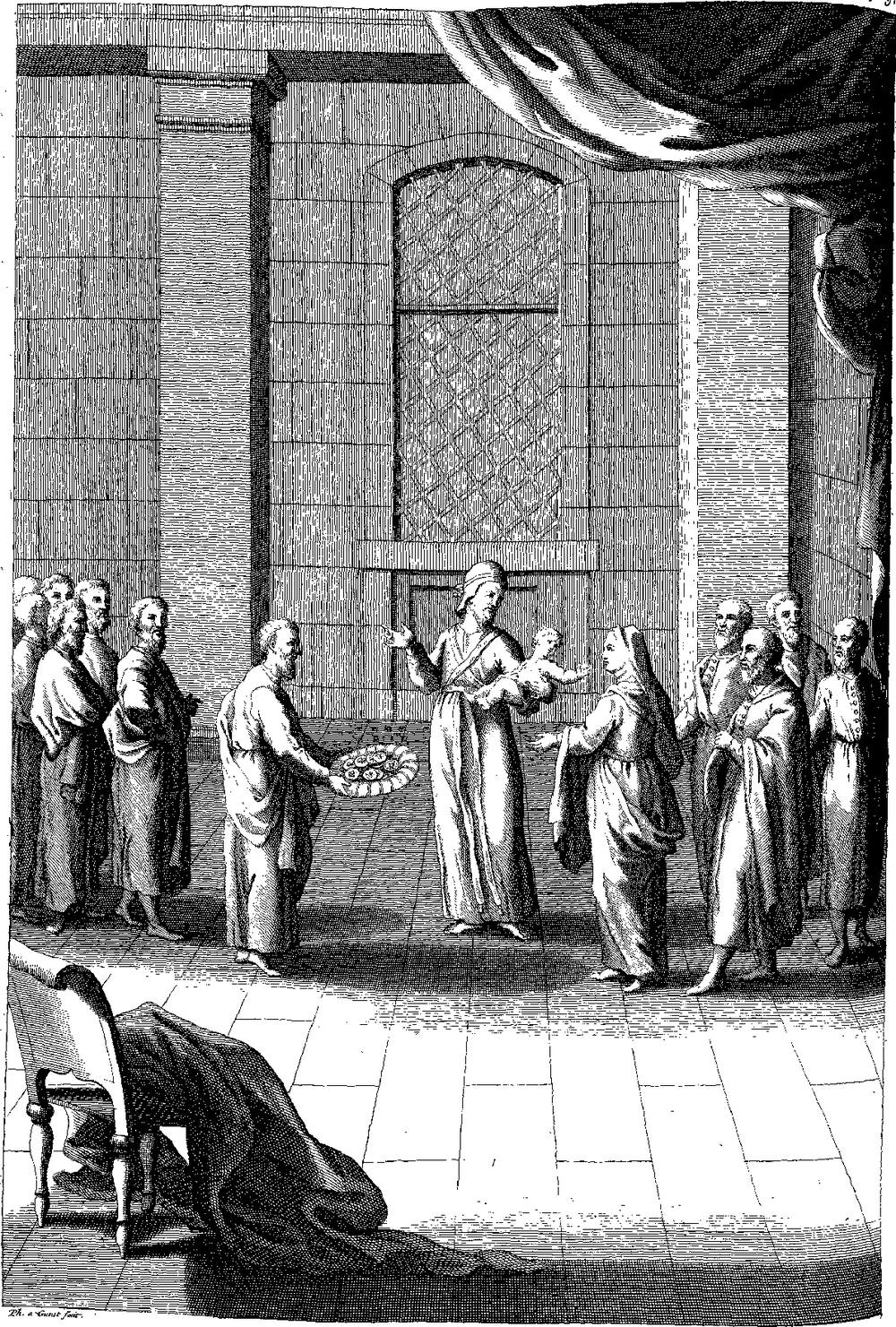
Levit. xxvii. 6. Exod. xiii. 13. Numb. xviii. 16. Numb. xvii. 17, 18, 19.If it were a clean beast, as a calf, a lamb, or a kid, it was to be offered at the Temple. It was not to be redeemed, but it was killed; the blood of it was sprinkled about the Altar, the fat was burnt in the fire upon the Altar, and the flesh was for the Priest. If it were an unclean beast, and such as they were not allowed to eat, such as an Horse, an Ass, or a Camel, it was either redeemed, or something else was given in exchange for it. The First-born of an Ass was redeemed by giving a Lamb, or five shekels. If it were not redeemed, it was to be killed. There are some Commentators26 who hold, that the First-born of dogs were killed, because they were unclean; and that nothing was given Ex. xiii. 13. and xxxiv. 20.for them to the Priests, because there was no trade driven with them. See Deut. xxiii. 18. Thou shalt not bring the price of a dog into the house of the Lord.
As to the first-fruits of trees, see Levit. xix. 23. The fruit was reckoned unclean for the three first years. In the fourth year all the fruit was the Lord’s. The proprietor had no right to gather any for his own use, till the fifth year.
It has been made a question, whether our Saviour, as the First-born of the blessed Virgin, was subject to this Law. Concerning this particular, there are three opinions. Some believe our Saviour was not subject to it, because his mother’s womb was not opened, when he was born, and he came into the world without breaking the seal of her virginity27. Others28 think, that by the terms of the law he was obliged to it; that plainly declaring without exception, that all the First-born of male children should be consecrated to the Lord, and that in the passage of Exodus here in question, Omne masculinum adaperiens vulvam, is equivalent to omne masculinum primogenitum. Now Jesus Christ was without doubt the First-born of Mary. Lastly, others29 seem to believe, that Moses’s words are prophetical, and, rigorously speaking, have a regard to Jesus Christ only, who by his birth opened the Blessed Virgin’s womb; whereas at the birth of other men, their mother’s womb is opened in the act of marriage, before it is so at their birth. Quia omnium mulierum, non partus infantis, sed viri coitus, vulvam reserat, says Origen. Ecquis proprie vulvam adaperuit, quàm qui clausam patefecit? says Tertullian.
The ceremonies which the Jews observe at present for the redemption of their First-born, are as follows. If it be a girl, Leo of Modena’s ceremonies of the Jews. Part 4. ch. 9.there is no particular ceremony; but if it be a boy, when the child is full thirty days old, one of the descendants of Aaron is sent for, who is most agreeable to the father; and many persons being met together in the house, the father brings a good deal of gold and silver in a cup or bason. Then the child is put into the Priest’s hands, who with an audible voice asks the mother, Whether this boy is her’s? She answers, Yes. He adds, Have you never had any other child, male or female, no untimely birth, or miscarriage? She answers, No. If so, says the Priest, this child, as the First-born, belongs to me.
Then turning to the father, he says, If you desire to have him, you must redeem him. This gold and silver, the father replies, is offered to you for this purpose only. The Priest goes on, Are you then willing to redeem him? I am, says the father. Then the Priest turning to the assembly, says, This child, as the First -born is therefore mine, according to this Law, Those that are to be redeemed from a month old shalt thou redeem, according to thine estimation for the money of five shekels, &c. but I am content with this in exchange. At the conclusion of these words, he takes two gold crowns, or thereabouts, more or less, as he pleases; and after this restores the infant to the father and mother. This is a day of rejoicing in the family. If the father or mother are of the race of the Priests, or Levites, they do not redeem their son.
Besides the First-born of men and beasts which were offered to the Lord, or were redeemed by giving money to the Priests, there was another kind of First-born which were carried to the Temple, in order to make feasts of charity with them. It is of this last kind that mention is made in Deuteronomy xii. 17,18. Thou mayst not eat within thy gates the tythe of thy corn, or of thy wine, or the firstlings of thy herds, or of thy flock, nor any of the vows which thou vowest; … but thou must eat these things before the Lord thy God in the place which he shall chuse, thou, and thy son and thy daughter, thy man-servant and thy maid-servant, and the Levite that is within thy gates: and thou shalt rejoice before the Lord thy God in all that thou puttest thine hands unto. And again Deuteronomy, ch. xv. ver. 19. All the firstling males that come of thy herd and of thy flock, thou shalt sanctify unto the Lord thy God; thou shalt do no work with the firstling of thy bullock, nor shear the firstling of thy sheep. Thou shalt eat it before the Lord thy God year by year, in the place which the Lord shall chuse.
It is certain that the First-born as well of men as of beasts belonged plainly to the Lord, and that private people were not allowed to eat, or to devote them, nor to employ them even in pious uses, or make religious feasts with them. They did in no way belong to them: but after they were redeemed, they might use them as their own property. Of these First-born therefore they probably made the entertainments we have been speaking of; or else under the name of First-born we are to understand the best and most excellent parts of such animals as were designed for the religious repasts which were to be made before the Lord, in like manner as by First-fruits are comprehended all the offerings of every thing which was best.
The First-born among the Hebrews, as well as among all other nations, enjoyed particular privileges: and as Polygamy was in use with them, it was highly necessary to fix these rites. Moses regulates this particular Deut. xxi. 15, 16, 17.in the following manner: If a man have two wives, one beloved, and another hated, and they have borne him children, both the beloved and the hated; and if the First-born son be hers that was hated: then it shall be when he maketh his sons to inherit that which he hath, that he may not make the son of the beloved, First-born, before the son of the hated, which is indeed the First-born: but he shall acknowledge the son of the hated for the First-born, by giving him a double portion of all that he hath. The privileges of the First-born consisted, first, in a right to the Priesthood, which, before the Law, was fixed to the eldest of the family. Secondly in his having a double portion among his brethren.
The right to the Priesthood continued in force only while brothers dwelt together in the same place and family: for as soon as they were separated, and made a family apart, every one became the Priest and Head of his own house.
As to the double portion, it is explained two ways. Some believe, that half of the whole inheritance was given to the elder brother, and that the other half was shared in equal parts among the rest. But the Rabbins Selden. de Successsion. in bona. c. 5. 6. 8.inform us on the contrary, that the First-born for his share took twice as much as any one of his brothers. If a father left six sons, they made a division into seven equal parts; whereof the eldest had two, and each of the others one. If the eldest was dead, and had left children, his right devolved upon his children, and his heirs. The daughters had none of these privileges, notwithstanding they were elder than either their brothers or their sisters.
The Patriarch Jacob transfer’d the right of the First-born from Reuben to Joseph; Isaac from Esau to Jacob; and David from Adonijah to Solomon: but all this was done by the particular order of Providence, and a revelation from God.
The First-born are called in Scripture the Principle, or the Beginning, or First-fruits of their father’s strength, Gen. xlix. 3. Reuben primogenitus meus, tu fortitudo mea & principium doloris mei. The Hebrew, fortitudo mea & principium roboris mei. Compare Deut. xxi. 17. Psal. lxxvii. 51. The First-born are the first-fruits, the first efforts of the father’s youthful vigour.
Cod. Menachoth. Vide Maimonid. in Temedim. & Mosaphim.FIRST-FRUITS. The presents were so called which the Hebrews made to God, consisting of part of the fruits of their harvest, to express their submission and dependance, and to acknowledge the sovereign Dominion of God, the author of all happiness. These First-fruits were offered at the Temple first, before any part of the crop was touched; and afterwards, when the harvest was over, before any private persons began to use their corn; and for this reason they were called First-fruits. The first of these First-fruits, which were offered in the name of the whole Nation, was a sheaf of barley, which was gathered on the 15th of Nisan in the evening, and this was threshed in the Court of the Temple. After it was well cleaned and winnowed, about three pints of it were taken, roasted, and pounded in a mortar. Over this was thrown a log of oil, and an handful of incense was added to it; and the Priest taking this offering, waved it before the Lord towards the four parts of the world, threw an handful of it in the fire upon the Altar, and the rest was his own. After this, every one was at liberty to reap and get in his harvest. See hereafter the article SHEAF.
Levit. xxiii. 17. Joseph. Antiq. l. 3. c. 10. p. 93.When the wheat-harvest was over, that is to say, the day of Pentecost, they offered again First-fruits of another kind in the name of all the nation, which consisted in two loaves, of two assarons, that is to say, of about three pints of flour each. These loaves were made of leavened dough. Josephus mentions only one loaf, and says, that it was served up to the Priests that evening at supper, together with the other offerings, and that all were to be eaten that day, without leaving any thing for the next.
Besides these First-fruits, which were offered in the name of the whole nation, every private person was obliged to bring his First-fruits to the Temple. The Scripture prescribes neither the time nor the Vide Misn. tract. Thrumoth. c. 4. n. 3.quantity. The Rabbins say, that they were obliged to bring at least the sixtieth part of their fruits and harvest. The most liberal gave the fortieth, the least liberal the fiftieth, others the sixtieth. They met in companies of four and twenty persons to carry Ibid. tract. Becharim. c. 3. n. 3, 4, 5, 8.their First-fruits in a ceremonious manner. The company was preceded by an ox
appointed for the sacrifice, with a crown of olives on his head, and his horns gilded over. One who played upon the flute, walked before them as far as Jerusalem. The First-fruits were of wheat, barley, grapes, figs, apricocks, olives, and dates. Every one carried his basket. The richest of them had one of gold, others, one of silver, and the poorest a wicker-basket. They walked in pomp as far as the Temple, singing songs in their procession. When they came near Jerusalem, the citizens went out to meet them, and saluted them with great civility.
Numb.xv. 19, 20.When they were got as far as the mountain, on which the temple was situated, every one, even the King himself, if he were there, took his basket upon his shoulder, and carried it as far as the Court belonging to the Priests. Then the Levites sung these words; I will magnify thee, O Lord, for thou hast set me up, &c. Psal. xxx. And he who brought the First-fruits said, I profess Deut. xxvi. 4, 5, &c.this day unto the Lord thy God, that I am come unto the country, which the Lord sware unto our fathers for to give us. Then he put the basket upon his hand, the Priest supporting it at the bottom, and continued, A Syrian ready to perish was my father, and he went down into Egypt, and sojourned there with a few, and became there a nation great, mighty, and populous. And the Egyptians evil intreated us, and afflicted us, and laid upon us hard bondage. And when we cried unto the Lord God of our fathers, the Lord heard our voice, and looked on our affliction and our labour, and our oppression: and the Lord brought us forth out of Egypt with a mighty hand…He hath brought us into this place, and hath given us this land, even a land that floweth with milk and honey. And now behold, I have brought the First-fruits of the land, which thou, O Lord, hast given me. Having said these words, he put his basket beside the Altar, prostrated himself, and went away. We may see what relates to the First-fruits treated very much at large in the Mishnah, in the treatises intitled Thrumoth, and Becorim, in the Commentators, who have written on the Mishnah, and on the xxii. 29. xxiii. 19. Chapters of Exodus.
There was besides, another sort of First-fruits which was paid to God. When the bread in every family was kneaded, a portion of it was set apart, and given to the Priest or Levite who dwelt in the place. If there were no Priest nor Levite there, it was cast into the oven, and there left to be consumed by the fire. The Law had not fixed the quantity of bread, which was to be offered every time: but St. Jerom says, that Hieronym. in cap. xlv. Ezech.custom and tradition had determined it to be between the fortieth and sixtieth part Deut. xi. 6, 7, 8.of what was kneaded. Philo. l. de præmiis Sacerdot.Philo speaks of this custom as a thing in use among all the Jews. Leo of Modena, Parr. 2. c. 9. of the ceremonies of the Jews.Leo of Modena declares, that the same was still observed in his time. This is one of the three precepts peculiar to the women; because they generally are the persons who make the bread. When they have made a piece of paste about as large as forty eggs, they take a small part of it, which they form in the manner of a cake, then throw it into the fire, with these words, Blessed be thou, O Lord God, King of heaven, who hast sanctified us by thy precepts, and commanded us to separate a cake of our dough. The Rabbins hold that no one is obliged to pay the First-fruits, excepting in the Land of Promise, that they are to give at least the twenty-fourth part of the lump which they have kneaded, and the bakers the forty-eighth part only.
Exod. xiii. 1, 2, 3, &c. xxxiv. 20. Numb. xviii. 16. Levit. xxvii. 6.Lastly, those offerings are often called First-fruits in Scripture which were brought by the Israelites out of devotion to the Temple, in order to make their feasts of thanksgiving, to which they invited their relations and friends, and the Levites who were in their cities. The First-fruits and Tenths were the most certain and substantial revenue belonging to the Priests and Levites. The First-fruits of all the produce of the country, and the First-born of all beasts were given to them. The very children who were First-born, were the Lord’s; they were offered in his Temple, and redeemed with a certain sum of money, which was five shekels.
The Latin word Primitiæ is taken not only literally for the First-fruits of the earth, and Offerings which were made to God, but likewise for what is excellent in every thing. For example, St. Paul says, that Christians have the First-fruits of the Holy Spirit, Primitias Spiritus habentes; that is to say, a greater abundance of God’s Spirit, and more perfect and more excellent gifts than the Jews had. In another place he says, that Jesus Christ is risen from the dead, and become the First-fruits of them that slept. Jesus Christ is, as is said elsewhere, the first-begotten of the dead, or the first-born of those who rose again: Primogenitus mortuorum. And the same St. Paul says, that the Thessalonians were as it were the First-fruits whom God had chosen to salvation. Elegit vos Deus primitias in salutem. He hath chosen them with a particular distinction, as the First-fruits are chosen from amidst the most exquisite of the several fruits, with a design of offering them to the Lord.
FISH, in Hebrew, Dag. The Hebrews place Fish among creeping things. We have very few Hebrew names for any particular Levit. xi. 9, 10, 11, 12. Deut. xiv. 9, 10.Fish, and I do not know that there are any in the sacred Text. Moses is content to say in general, that all sorts of
Fish continues on the next page
Footnotes
-
Translators’ note. As there are some among the Jews who attribute great degrees of merit to Fasting, and look upon these Absti- nences as substituted in the room of the old Sacrifices; so there are some Doctors among them, who say, that Fast- ing is indifferent to God, and is either good or bad, as it fits the Body better for devotion, and that all depends upon the observance of the Law. They, who argue in this manner, have a right notion of mortifications. ↩
-
Constit. Clem. Epiphan. Theophyl. Buxtorf. Synagog. c. 9. Grot. Druf. in Luc. xviii. ↩
-
D’Herbelot Bibl. Orient. p. 708. Tournefort Voyage, l. 2. in 8°. p. 342. Lucas Voyage d’Egypte, t. 1, &c. ↩
-
Vide Tertull. Clem. Ignat. Epiphan. Ambros. Aug. alios apud Grot. in Luc. xviii. 12. & Thomassin du Jeune. ↩
-
See our Comment. upon Genesis ii. 3. Et Selden. de jure nat. & gent. l. 3. c. 13. ↩
-
Translators’ note. After the service of the Synagogue, and the history of Esther, with some particular passages of Scripture have been read, the Jews begin their Feast, which is attended with such excesses, and so general a debauch, as make it look like a Bacchanalian Festival of the old Heathens. See Buxtorf’s Synag. Juda- ic. ↩
-
Ignat. Epist. ad Magnes. ↩
-
Justin. Apolog. 2. ad finem. ↩
-
Irenæ. apud Scriptorem quæst. ad Orthodox. ↩
-
Tertull. Apolog. &c. lib. de anima. ↩
-
Origen. homil. 6 in Exod. ↩
-
Translators’ note. This custom of preserving a perpetual Fire in the Temples of their Gods, was common among the ancient Heathen. We read of such a Fire kept up with superstitious care in the Temple of Jupiter Ammon, and in that of Hercules at Gadis, in Egypt, and in almost all the Eastern Countries. And Virgil tells us, that Jarbas the Getulian, Centum aras posuit, vig- ilemque sacraverat ignem, Excubias Divûm æternas. Virg. Æn. 4. ↩
-
Origen. homil. 13. in Exod. & lib. 2. de princip. c. 11. ↩
-
Ambros. l. 7. in Luc. c. 14. ↩
-
Hieronym. in Isai. lxvi. ↩
-
Greg. Nic. de anima & resurrect. ↩
-
Damascen. l. 4. de fide, c. ult. ↩
-
Aug. l. xxi. de civit. c. 10. & de fide & operib. c. 15. ↩
-
Cyprian. de laude Martyrii. ↩
-
Chrysost. homil. 44. & 45. in Matt. ↩
-
Hieronym. in cap. x. Matt. ↩
-
Comment. in Job sub nomine Hieronymi, c. xx. ↩
-
Greg. l. 15. Moral. c. 29. ↩
-
Id. l. 4. Dial. c. 29. ↩
-
Translators’ note. This Terra Seri- adica Mr. Dodwell in his Appendix ad Dissertationes Cyprianicas supposes to be in Egypt. Vossius and Marsham believe Seirath to be meant by it, a place in Gilgal, where the quarries were. Judg. iii. 26. See Fabricius’s Bibl. Græc. l. 1. c. xi. ↩
-
Vide Lyran. ad Deut. xxiii. 18. Bochart. de animal. facr. part. 1. l. 2. c. 56. ↩
-
Cyril. Ierosol. homil. de Occursu Domini. ↩
-
Rupert. Jansen. Tostat. alii. vide Cornel. a Lapide in Exod. xiii. 1. ↩
-
Origen. in Luc. homil. 14. Tertull. de Carne Christ. c. 23. Ambros. in Luc. l. 2. art. 56. Hieron. l. 2. contra Pelag. Theophyl. Enthym. in Luc. ii. ↩