Volume I, pages 535–553 of the 1732 edition, from EUP to FAS: everything printed on these pages, in order.
Continued from Eunuch
Isai. lvi. 4. 1 Sam. viii. 15.I am a dry tree. But notwithstanding this, they who were faithful observers of God’s Law, had their portion in the rewards and happiness of the righteous. Thus saith the Lord unto the Eunuchs that keep my Sabbaths, — and take hold of my covenant, Even unto them will I give in mine house, and within my walls, a place and a name better than of sons and daughters.
There were Eunuchs in the Courts of the Kings of Judah and Israel, officers called Sarisim, Eunuchs. But they were in all probability slaves taken from some foreign 1 Kings xxii. 9. 2 Kings ix. 32. and xxiv. 12, 15. and 1 Chr. xxviii. 1. Matth. xix. 12.people; or if they were Hebrews, the name of Eunuchs, which is given them, shews no more than their office and dignity. Our Saviour in the Gospel speaks of a sort of Eunuchs, different from that which we have mentioned, persons who have made themselves Eunuchs for the Kingdom of Heaven; that is to say, who upon some religious motive have renounced marriage, and the use of all carnal pleasures. Origen1, and some ancient hereticks, construed our Saviour’s words literally, and pretended, that he advised men to make themselves Eunuchs, in order to obtain the Kingdom of Heaven2.
EUNUCH, Queen Candace’s. See PHILIP the DEACON.
EVOCATION, or conjuring up the soul of Samuel. See the article SAMUEL.
EUODIAS, spoken of by St. Paul in Philipp. iv. 2.his epistle to the Philippians. Some Greek manuscripts read Euodum or Euodium, as if the Apostle were speaking of a man: but the printed copies, and the generality of manuscripts read it in the fœminine, Euodiam. And there is a good deal of probability, that Euodias and Syntyche were two women of great virtue, who had assisted St. Paul in the propagation of the Gospel. These two persons were at variance upon some occasion which is not known to us: St. Paul conjures them to be of the same mind. Others are of opinion3, that Euodias was a woman, the other Syntichus, a man; and that St. Paul intreats them to be reconciled. But Syntiche being placed in the Calendar upon the 22 of July, among the female Saints, we must believe it to have been the most common opinion, that Euodias and Syntiche were both women.
EUPATOR. See ANTIOCHUS EUPATOR.
EUPHRATES. A famous river, the source whereof is in the mountains of Armenia; it runs through the frontiers of Cappadocia, Syria, Arabia Deserta, Chaldæa and Mesopotamia, and thence falls into the Persian Gulf. At present it discharges itself into the Sea through a channel, which is common to this river and the Tigris; but formerly it had a particular channel of its Plin. l. 6. c. 27, & 28. Gen. ii. 14. Plin. l. 5. c. 24. D’Herbelot. Bibl. Orient. p. 353. Josh. i. 4. Deut. i. 7. Strabo l. xi.own: and in Pliny’s time, there were footsteps of this old channel to be seen. Moses says, the Euphrates is the fourth of those rivers, the source whereof was in Paradise. The Scripture often calls it the great River, and assigns it for the Eastern boundary of that Land, which God promised to the Hebrews. Profane4 Authors inform us, that the Euphrates overflows its banks in the Summer, like the Nile, when the snow upon the mountains of Armenia begins to melt. The Author of the book of Ecclesiasticus seems to say the same thing, Ecclus. xxiv. 36.
The source of the Euphrates, as I have observed, as well as of the Tigris, is in the mountains of Armenia. Some of the Ancients Lucan. Pharsal. l. 3.were of opinion, that these two rivers rose from one common spring.
Quaque caput rapido tollit cum Tigride magnus
Euphrates, quos non diversis fontibus edit
Persis ——
And Boëthius in his consolation of Philosophy5,
Tigris & Euphrates uno se fonte resolvant,
Et mox abjunctis dissociantur aquis.
But at present we know the contrary, and that these two famous rivers have their source at a great distance from one another. Pliny and Strabo place the head of it in mount Abo, or Aba, in Armenia; but in almost every thing besides, these two Authors are opposite to each other. Strabo says, this river springs out of the North side of mount Taurus, and that it runs at first Westward, and afterwards towards the South. Pliny, on the contrary, tells us, from witnesses who had been upon the spot, that the Euphrates flows from North to South, and then returns to the West.
The Arabians divide the Euphrates into the larger and the lesser; the larger is that which rising in the Gordian mountains, discharges itself into the Tigris near Anbar and Pelongiah. The smaller, the channel whereof is often wider than that of the larger, takes its course towards Chaldæa, passes through Corofah, and empties itself into the Tigris, between Vassith and Naharvan, in a place called at present Carna, that is to say, Horn, because in reality it is the horn, or confluence6
fluence of the great and little Euphrates.
From the lesser, one passes into the larger Euphrates, through a canal dug by Trajan’s order. This is the Fossa Regia, or the Basilius fluvius of the Greeks and Romans, by the Syrians called Nahermalca, through which the Emperor Severus passed in his way to Ctesiphon on the Tigris, when he besieged this city. The violence of the Persian Gulph causes a reflux higher than thirty leagues above the mouth of the Euphrates. The Arabians are persuaded, that the waters of this river are very healthy, and have the vertue of curing all sorts of diseases.
I. EUPOLEMUS, the son of John, one of the Ambassadors whom Judas Maccabæus sent to Rome, 1 Macc. viii. 17. in the year of the world 3843.
II. EUPOLEMUS, an old Author, cited in Josephus, Clemens of Alexandria, and Eusebius7. We know not in what time he lived. He wrote concerning the Kings of the Hebrews.
EUTYCHUS, the name of a young man of Troas, who being with some other disciples at the place where St. Paul was, and sitting down upon a window, while the Apostle was preaching, fell asleep, and tumbled from the third story into the street. St. Paul coming down, lay upon him, embraced him, and said, Trouble not Acts xx. 10. In the Year of J.C. 60, of the Vulg. Æra 57. Numb. v. 21. 2 Chr. vii. 11. Παραδειγματίσαι. Job xvii. 6. Matt. i. 19.your selves, for his life is in him; and he brought him back to them alive.
EXAMPLE, is taken in good and bad part; God will make thee an Example among all the nations. Thou shalt be an Example of his severity and rigour. Job says, that he is the example, the by-word of the publick; that he is produced as an example of misery and misfortune. Joseph was unwilling to accuse the Blessed Virgin, and make her an Example of publick vengeance. Cum nollet eam traducere: he was unwilling to bring her honour in question. The Greek implies, he was not inclined to make an Example of her, by any publick and exemplary punishment.
Example is likewise used for a pattern of virtue: May Ruth be an Example of virtue Ruth iv. 11.in thine house. Old Eleazar suffered martyrdom, and left a great Example of courage and virtue to both young and old. 2 Macc. vi. 31. John xiii. 15. 1 Tim. iv. 12.Our Saviour says, he has given us an Example of humility, that we should imitate him. And St. Paul requires Timothy to be an Example to the faithful.
EXCELSA, High Places, where the Israelites sacrificed to Idols, or even to God himself, contrary to his express command. See hereafter HIGH PLACES.
EXCOMMUNICATION, an Ecclesiastical penalty, whereby they who incur the guilt of any mortal and heinous sin, are separated from the Communion of the Church, and deprived of all spiritual advantages. There are two or three sorts of Excommunication: the greater, whereby the person offending, is separated from the body of the Faithful: thus St. Paul excommunicated 1 Cor. v. 1—5. 2 Thess. iii. 6.the incestuous Corinthian. The lesser, whereby the sinner is forbidden to administer or receive the Sacraments: And lastly, that which deprives him only of the company of the faithful; whereof there is some mention made in the second Epistle to the Thessalonians. Now we command you, Brethren, that ye withdraw yourselves from every brother that walketh disorderly, and not after the tradition which he received of us. See likewise vf. 14. And if any man obey not our word by this Epistle, note that man, and have no company with him, that he may be ashamed. St. Austin8 speaks in several places of this last sort of Excommunication. We see the practice of it in the rule of St. Benedict9. Theophylact10 says, that this separation from the company of the faithful was formerly esteemed a great punishment.
The primitive Church was very reserved in separating the faithful from its bosom by Excommunication. It rarely did so, and then for very serious and very important reasons, and always with great concern. There is a distinction made between that Excommunication which is medicinal, and that which is mortal. The first was made use of against such penitents as were separated from the Communion of the Church, till they had gone through that penance which it enjoined them. The second was employed against Hereticks and impenitent sinners, and such as were disobedient to the Church. The power of Excommunicating was given to the Church in the persons of the first Pastors of it. It is part of the power of the keys, which Jesus Christ himself conferred immediately upon the Apostles, and in them upon the Bishops their Successors.
The causes of Excommunication may be reduced to three heads, Error, Sin, and Disobedience. In the beginning, the Spiritual sword was never used but in Spiritual causes; but afterwards there was a necessity of restraining the attempts of wicked men against the persons and estates of Ecclesiasticks, by censures and excommunication. The customary manner of Excommunicating in the Primitive Church was this: the faithful separated themselves from those, whose company the Apostles and Bishops had forbidden them, without obliging their superiors to proceed any farther.
Afterwards the bishops made use of threatnings, anathemas, and sentences of Excommunication; lastly, to make these ceremonies more frightful, they were attended with actions capable of infusing terror, such as lighting of wax-candles, extinguishing them, throwing them on the ground, and trampling them under foot while they pronounced Excommunication, pronouncing curses against the person Excommunicated, &c.
The principal effect of Excommunication, is to separate the Excommunicated person from the society of the faithful, to take from him the privilege of being present in religious assemblies, to deprive him of the Eucharist, of attendance at the common Prayers, of the Sacraments, and of all those other duties, whereby Christians are linked in one and the same society and communion. An Excommunicated person is with regard to the rest of the faithful as an Heathen and a Publican, according to the terms of the Gospel. But it does not deprive him of any of Matth. xviii. 17.those duties which he has a right to claim, as a man, a citizen, a father, an husband, or a king, either by the law of nature and nations, or by the civil law. And when the Apostles enjoin men to have no conversation with the Excommunicated, not to eat with them, or even salute them, this is to be understood of 1 Cor. v. 1, 2, 3, 4, 5. & 2 Thess. iii. 6, 14. 2 John ver. 10, 11.offices of mere civility, which a man is at liberty to pay or not to pay, and not of any natural obligations, and such as are founded upon nature and the law of nations.
As to the Excommunication of the Jews, we see the practice of it in the time of Deborah and Barak, if the Rabbins in this particular are to be credited11. It is said in Deborah’s song, Curse ye Meroz, (said the Angel of the Lord) curse ye bitterly the inhabitants thereof: because they came not to the help of the Lord, to the help of the Lord against the mighty. Meroz therefore was Excommunicated, say the Jews, by the sound of four hundred trumpets; Barak, who is called the Angel of the Lord, cursed him, and with him those that sat near him. But this example does not appear very proper to shew the antiquity of Excommunication. We see it in a more express manner in the time of Esdras and Nehemiah, when they Excommunicated those who would not dismiss Joseph. Antiq. l. xi. c. 5.the strange women whom they had married contrary to the law, and ingaged themselves upon pain of Excommunication, to observe the laws of the Lord.
Joseph. de Bello, l. 2. c. 12.The Essenes, at the time when they professed, engaged themselves by the most terrible oaths to observe the laws of their Sect, and when any one among them fell into any considerable fault, he was driven from their society; and he who was so expelled, died very often in some unhappy way: for by virtue of his oaths and vows, he could receive no food from the hands of strangers, and being debarred all commerce with those from whom he was separated, he was forced to live upon wild herbs like a beast, till his members corrupted, and by degrees fell asunder. It sometimes happened that the Essenes would be touched with compassion, would deliver persons out of this sad state, and receive them again into their body, when they thought that the offenders had sufficiently expiated the fault which they had committed. So much for Excommunication, its causes, effects, and absolution.
Our Saviour in the Gospel speaking to his Apostles, foretold, that the Jews out of hatred to him, would treat them ill, and excommunicate them12. They shall drive you out of their synagogues, says he to them; they shall bring you before their tribunals, and condemn you to be scourged. It is said, that among the Jews, they generally whipt the excommunicated persons, before they expelled them out of their synagogues. Excommunication was preceded by censure and admonition, which were used at first privately; but if the guilty person did not amend, the house of Judgment, the assembly of Judges, declared to him with menaces, that it was necessary he should reform. If he persisted in his obstinacy, his censure was made publick upon four sabbath-days successively, at which times the name of the offender and the nature of his fault were proclaimed in order to bring him to shame. Lastly, if he continued incorrigible, he was excommunicated. Our Saviour seems to allude to this practice, where he commands us to tell our brother his fault between him and us alone; then that we should take some witnesses with us in order to admonish him; and lastly, that we should inform the Church against him. And if after this he does not return to his duty, that then we should look upon him as an heathen and a publican.
The sentence of Excommunication among the Jews was conceived in these terms, Let such an one be in Excommunication or Separation; or, let such an one be Excommunicated or separated. The Judges, or the Synagogue, or even private persons had a right to Excommunicate; but regularly the House of Judgment, or the Court of Justice, solemnly pronounced the sentence of Excommunication. One particular person
might Excommunicate another, and he might likewise excommunicate himself; as they who bound themselves under a curse, and engaged themselves neither to eat nor drink, till they had taken St. Paul either Acts xxiii. 12.dead or alive. Lastly, beasts were sometimes Excommunicated ; and the Rabbins teach us, that Excommunication has its effect even upon dogs. They believe that a man may be Excommunicated in a dream, when, while he is asleep, he thinks he sees the Judges, who in a judicial manner pronounce him so, or even some private person who declares him Excommunicated. In this case, they look upon themselves to be under the sentence of Excommunication; because, say they, it is possible that God may have Excommunicated them while they were asleep, or his ministers by his order may have done so.
They who pronounced the sentence of Excommunication, may take it off, and declare him, who had incurred it, to be absolved; provided he gives any marks of his repentance. He who had been Excommunicated, while he was present, must be present too when he is absolved. Any one who had been Excommunicated by a private person, might be absolved by a publick Judge, or by three men chosen for this purpose. He who had Excommunicated himself, could not regularly absolve himself: ten persons chosen from among the people were necessary upon this occasion. Lastly, he who had been Excommunicated in a dream, was to seek for ten men learned in the law, and versed in the knowledge of the Talmud, in order to give him absolution13.
There are generally three sorts of Excommunication distinguished among the Niddui, Separatio.Jews. The first is called Niddui, that is to say, Separation. This is the lesser Excommunication. It lasted thirty days, and separated the Excommunicated persons from the use of things holy. The second was called Cherem, that is to say, Anathema; this was Cherem, Anathema.an aggravation of the first, and answers almost to our greater Excommunication. It excludes a man from the synagogue, and deprives him of all civil commerce14. Lastly, the third sort of Excommunication is called Scammatha, and was of a higher nature than Scammatha, Excisio.the greater Excommunication. It was published, as they say, by sound of four hundred Trumpets, and removed all hope of returning to the synagogue. Some affirm, that the penalty of death was annexed to it. But Selden maintains, that these three terms, Niddui, Cherem, and Schammatha, are often times synonymous, and that the Jews never had, properly speaking, more than two sorts of Excommunication; one greater, the other less. The Reader may consult this author in his first book de Synedriis veterum Hebræorum, chap. 7, & 8.
Leo Mod. P. 2. c. 3.Leo of Modena says, that when the Rabbin Excommunicates any one, he curses him publickly; after which, not any one Jew can speak to the Excommunicated person, nor come near him within the distance of a fathom. He is not suffered to come into the synagogue, and he is obliged to sit down upon the ground barefooted, as if some near relation of his were dead; till he is absolved by one or more Rabbins, and blessed again. If the fault deserves a more solemn Excommunication, there is a meeting in the synagogue, and every one lights black torches; then when the horn sounds, a curse is pronounced against him, who has done, or shall do such a thing. To which the whole assembly answers, Amen.
2 Kings xxiiii. 11. 1 Chr. ix. 26—33. xxiii. 28. Jerem. xxv. 2.The heathens had likewise their Excommunication for great crimes, as we see among the Greeks, Latins, and Gauls: but this does not relate to our subject. We confine ourselves to the books of the Old and New Testament.
EXEDRA. We often meet with this Latin word in the books of Kings and Chronicles. It signifies properly such seats as were under porches, where it is usual for people to get together, or the chambers joining to these porches, where there were several seats for the use of those, who retired thither. In Scripture, it is taken for those apartments which reached all along the courts of the Temple, whither the Priests and Levites, who were upon duty, withdrew to eat, drink, and sleep, and where the provisions of the Temple were locked up, and the riches which were there offered.
EXODUS. This word comes from the Greek, Exodos, which signifies going out. The second of those sacred books, which are contained in the Old Testament is so called, because it comprehends the history of the departure of the Israelites out of Egypt under the conduct of Moses. Herein we have the birth of Moses, his education, and flight; the persecutions
which the Hebrews suffered from the Kings of Egypt; the return of Moses from the land of Midian; the plagues which he brought upon Egypt; the departure of the Hebrews; the passage of the Red Sea; the manner wherewith the Law was given; the erection of the Tabernacle, and the celebration of the second Passover. It contains the history of an hundred and forty five years, beginning from the death of Joseph, which happened in the year of the World 2369, before Jesus Christ 1631, before the Vulgar Æra 1635, to the year of the World 2514, which is the end of the first year after the going out of Egypt. The Hebrews call this book Veelle Schemoth, because it begins with these words, Now Schemoth, Græc. Exitus.these are the names, &c.
The Hebrews, according to the chronology followed by us, dwelt in Egypt no longer than two hundred and fifteen years, from Jacob’s entrance into this country in the year 2298, to the departure of the Israelites out of it under Moses, in the year of the World 2513. Notwithstanding we read expressly in Exodus, ch. xii. ver. 40. that they abode there four hundred and thirty years. Now the sojourning of the children of Israel who dwelt in Egypt, was four hundred and thirty years. M. Boivin the elder, who has been employ’d a very long time in examining the chronology of Josephus and the Septuagint, pretends by the help of a passage from Manetho, to have settled the number of four hundred and thirty years mentioned by Moses. The Manethon apud Joseph. l. 1. contra Appion.passage from Manetho is this: “We had a King named Timaus, under whom, for what reason I cannot tell, God declared himself very much against us. On a sudden, when it was least expected, certain men of an obscure original came from the East, and invaded our country: they easily made themselves masters of it, even without the hazard of a battle. Having seized the Princes who governed Egypt, they burnt the cities, destroy’d the temples of the Gods, and treated those who fell into their hands, with the utmost rigour of war. At length they chose one among them for their King, whose name was Salatis.
“This Prince established the seat of his Empire in Memphis, and all upper and lower Egypt became subject to him. He settled numerous garrisons in the strongest places of the country, and fortified principally the eastern frontier; well foreseeing that the Assyrians, when once they grew more powerful, would not fail to attempt the conquest of Egypt. Having observed a city called Abaris in the Nome of Sais, of a very advantageous situation, he fortified it, and enclosing it with walls of a vast circumference, he placed a garrison in it consisting of two hundred and forty thousand men…
“Salatis died after a reign of nineteen years; and was succeeded by Bæon, who reigned forty four. Apachnas succeeded Bæon, and reigned six and thirty years; Apophis sixty one; Janias fifty years and one month; Assis, the last of all, reigned nine and forty years and two months. These six Princes reigned successively in Egypt, and treated the country like enemies, endeavouring, as we may say, to tear up the very roots of it.
“The race of these Princes was called Hic-sos, that is to say, Shepherd-Kings … Some affirm they were Arabians: in other books we read, that they were not Kings, but Captives; for Hic in Egyptian, when it is pronounced like Hac, signifies Captives; and this appears to me most probable, and most conformable to ancient history.”
Manetho adds, that these Shepherd-Kings and their descendants were possessed of Egypt five hundred and eleven years; after which, the Kings of Thebaïs and the rest of Egypt made a long and bloody war with them.
Under King Alis-Phragmuthosis, the Shepherds were overcome, and driven out of Egypt, and reduced to the town of Avaris or Abaris, which they had inclosed with walls, to the extent of ten thousand acres of land. Here Themosis, the son of Alis-Phragmuthosis, besieged them with an army of four hundred and fourscore thousand men; and seeing that he was not able to reduce them by force, he permitted them to retire to what place they pleased. They departed therefore out of Egypt, and went into Judæa, where they built Jerusalem, and made it so large as to be capable of containing their whole multitude. They passed through the desarts of Syria, fearing the power of the Assyrians, who were at that time masters of Asia.
Upon this is founded the restitution in Chronology, relating, as we have said, to the children of Israel’s abode in Egypt. M. Boivin disposes his System in the following order: The Hebrews passed seventy one years in Egypt very peaceably under Jacob and Joseph, in the time of those Pharaohs who were protectors of the Israelites. After this, they reigned there two hundred fifty nine years and ten months under Ephraim the son and successor of Joseph, and under Beriah, Rephah, Resheph, Tela, and Tahan his sons, whose names are mentioned in the Chronicles. The same Ephraim and his sons, in the sacred history of the Egyptians cited by Manetho, are called Salathis, Bæon, Aphachnas, Apophis, Janias, Assis.
Lastly, they spent ninety-nine years and two months there in bondage, under the Pharaohs their enemies; under the Ephraïmites, Laadan, Ammihud, and Elishama, whose names likewise are mentioned in the Chronicles. The Israelites therefore changed their condition three times in Egypt, where they were successively Shepherds, Kings, and Captives. Their pastoral life and bondage are particulars not contested; it only remains to shew, that they ever reigned there. The Scripture says nothing of it; but it relates actions there perform’d by them, which, in M. Boivin’s judgment, are arguments of their regal power and absolute authority.
He supposes, that at the death of Joseph, or Pharaoh his protector, there was a change of Dynasty in Egypt, and that the heirs of Pharaoh, who had raised Joseph, were supplanted by Vaheb, whose name we meet with in the book of the wars of the Numb. xxi. 14.Lord, cited in Numbers, and who in Manetho is called Timaüs. This new Pharaoh, who knew not Joseph, nor the services which he had done the Egyptians; Vaheb, I say, jealous of the power of the Israelites, undertook to restore idolatry in the land of Goshen, which was in the possession of the Hebrews. Ephraim, the son and successor of Joseph, opposed this, and determined to revenge the death of the old Pharaohs, the protectors of his family; but he was not successful in this war: in his first expedition, which was against the town of Gath, he lost nine of his sons, whose names were, Shathelah I. Bered, Tahath I. Eladah, Tahath II. Zabad, Shathelah II. Ezer, and Elead.
1 Chr. vii. 22. 1 Chr. vii. 20, 21.The Scripture speaks of this expedition, but it says no more, than that they were killed by the men of Gath, because they came down to take away their cattle; and besides, Gath was not in Egypt.
The other sons15 of Ephraim came to comfort their father, and resolved to revenge the death of their brethren. Ephraim therefore at the head of the shepherds, that is to say, of all those who worshipped the true God, attacked the Egyptians. In this war, says our Author, were performed the miracles in the field of16 Tanis, whereof there is mention in the Psalms. Vaheb was consumed by a whirlwind of fire, as the book of Pf. lxxviii. 12, 43.the wars of the Lord says; And the sun stood still, and the moon was stayed, until the people had avenged themselves upon their enemies; as the book of Jasher mentions, which is cited in Joshua. Then Ephraim, otherwise called Salathis, assumed the title of Chr. vii. 26.King of Egypt, and was succeeded by his sons above-mentioned.
Josh. xxiv. 14.After the Ephrámites had enjoyed the kingdom two hundred fifty nine years and ten months, they degenerated, forgot the Lord, and fell into idolatry, as we see in Joshua. God delivered them up to their enemies, who defeated them in a great battle described in Psalm lxxviii. 9, 10, 11, 12, 42, 43. They continued subject to the Egyptians ninety nine years and two months, till their departure out of Egypt under the conduct of Moses.
M. Boivin believes, there is an interruption of history in the Scripture from the death of Joseph, with which Genesis concludes, to the birth of Moses, wherewith Exodus begins. He pretends, that the history of this time was contained in old books which are lost, and whereof there now remain only the titles, and some fragments in the sacred writers; such as the book of the wars of the Lord; the book of Jasher; Josh. x. 13. & 1 Sam. i. 18. Numb. xxi. 27.and that of Proverbial Songs.
This system would be much more plausible, if the number of years observed in Manetho agreed exactly with that of Moses: but whereas Moses takes notice but of 430 years from the entrance of the Hebrews in Egypt, to their departure thence under Moses; Manetho says, that the Shepherd-kings and their descendants reigned five hundred and eleven years in Egypt, after which the Kings of Thebaïs made war for a long time against them, and at last obliged them to retire into Judæa. The difference of years is great, and I can scarce see any means of reconciling it; besides, the reign of Ephraim and his five sons successively without interruption, and without any one of these leaving the Kingdom to his son, seems incredible. It is very hard to prove, that the last of these five sons lived 250 years, as he must be supposed to do in M. Boivin’s System: however, the manner of his disposing this succession of the Shepherd-kings is as follows.
| Kings of Goshen. | Jacob, 17 years. Joseph, 54 years. |
| Hicsos, or Shepherd-kings, according to Manetho. | Ephraim, under the name of Salathis, 19 years. Beriah, otherwise Bæon, 44 years. Rephah, otherwise Aphachnas, 36 years. Resheph, otherwise Apophis, 61 years. Telah, or Janias, 50 years, 1 month. Tahan, or Assis, 49 years, 2 months. |
|
Hacsos, or captive Shepherds. Bondage in Egypt. | Laadan, 40 years. Ammihud, 40 years. Elishama, 19 years, 2 months. From Jacob’s entrance into Egypt to Moses’s departure out of it, are 430 years. Exod. xii. 40. Nun, the Son of Elishama, contemporary with Moses, who reign’d 40 years. Joshua, the son of Nun, judged 27 years. |
All these were descended from Joseph by Ephraim.
EXORCISTS. This word comes from the Greek, Exorcisein, which signifies to conjure, to use the name of God with a design Ἐξορκίζειν. Adjurare.to drive Devils out of the places or bodies, which they possess. We call one of the four minor Orders in the Christian Church Exorcists, whose office it was to conjure those, who were possessed with Devils. We see from the first Apologists of our Religion17, that the Devils dreaded the Exorcisms of Christians, and that common Believers exercised a very great power over these wicked spirits. It is credible, that when the gift of miracles ceased to be so common, there were Exorcists appointed pretty early in the Church, who were particularly set apart for the exercise of this office, which before the generality of the Faithful performed of themselves, either upon the merit of their faith, or by virtue of some particular gift, which they had received at Baptism.
The Jews had likewise their Exorcists, as Jesus Christ intimates in the Gospel: for the Pharisees having given out, that he cast out Devils only in the name of BeelzebubMatth. xii. 27., his answer was, If I by Beelzebub cast out Devils, by whom do your children cast them out? therefore they shall be your Joseph.Judges. Josephus relates, that a certain Antiq. l. Jew, whose name was Eleazar, cured the 8. c. 2.possessed with the help of a ring, in which a root was set, said by some to have been discovered by Solomon. The smell of this root put under the nose of the possessed person, made him fall on the ground; and the Exorcist conjured the Devil, forbidding him to return into that body. He says in another place, that a particular root, called Barad, which grows in Judæa, had the virtue of casting out Devils, when application of it was made upon the body of the Person possessed.
Mark ix. 28. Luke ix. 49.The Apostles inform us, that there were Jewish Exorcists, who took upon them to cast out Devils in the name of Jesus Christ Master, we saw one casting out Devils in thy name, and we forbad him, because he followeth not us; which practice these Exorcists continued after our Saviour’s death. Then certain of the vagabond Jews Exorcists, took upon them to call over them which had evil Spirits, the name of the Lord Jesus, saying, We adjure you by Jesus, whom Paul preacheth. And the evil Spirit answered and said, Jesus I know, and Paul I know, but who are ye? Lastly, Justin, Irenæus, Origen, and Tertullian speak of Jews, who boasted of a power to cast out Devils18, and sometimes in reality did so, by calling upon the God of Abraham.
EXPIATION. The Hebrews had several sorts of expiatory sacrifices, for sins of ignorance committed contrary to the Law, See Levit. iv.and for purifying themselves from certain legal pollutions, which were looked upon as indecencies, or even as faults, which required to be Expiated by certain victims. For example, a woman after lying in, and Levit. xii. 6, 7. Ib.xiv.4,5, & seq.a leper when he was cleansed of his leprosy, were to offer sacrifices, in order to be purified; in like manner as they, who, having touched something impure, had forgotten or neglected to purify themselves at the time and in the manner which the Ib. v. 1, 2, 3.Law prescribes. These Expiatory Sacrifices of themselves did not remit real faults committed against God, they did not take away the deformity of Sin, which is displeasing unto God; but did no more than repair the legal and external fault, and secure the transgressor from the temporal penalty, wherewith God, or the Judges punished those faults, when any one neglected to atone for them in the ways appointed by the Law.
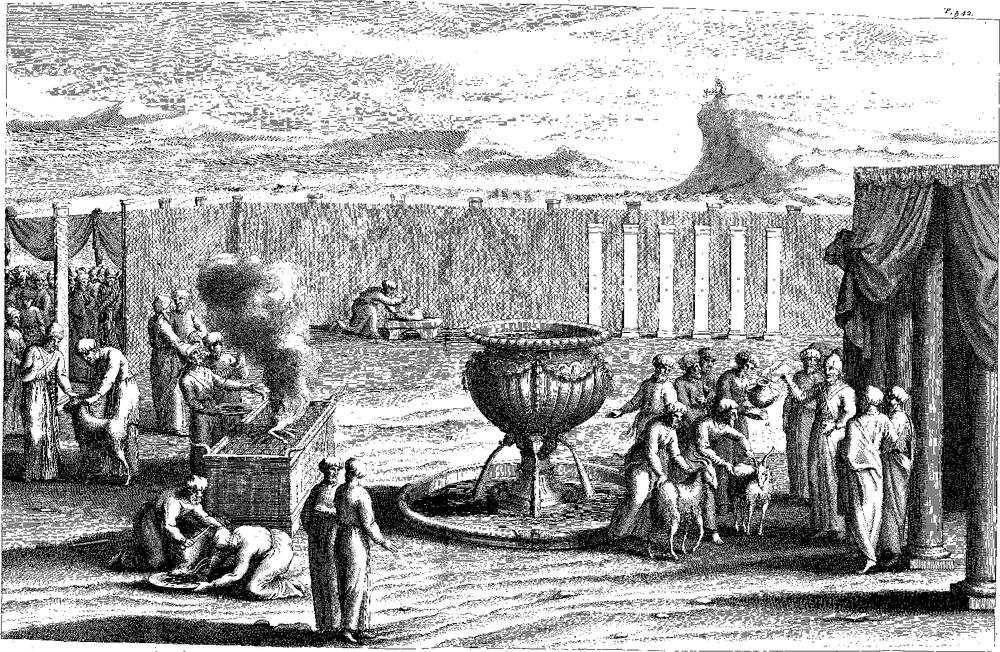
The ceremonies observed when any IsraeliteIb. iv. 27, 28, &c. Ib. iv. 28. offered a sacrifice for sin, were these: He brought his victim to the Tabernacle, put his hand upon the beast’s head, confessed his fault, and slew his victim in the court, at the place where the burnt-offerings were offered, to the North of the Altar. The Priest took the blood of the beast, with some of it upon his fingers he touched the horns of the Altar of burnt-offerings, poured out the remainder of the blood at the foot of the Altar, took away all the fat which covered the intestines and kidneys of the victim, and burnt it upon the Altar. Lastly, the Priest prayed for him, who offered the sacrifice, and his fault was pardoned.
For a sin-offering they might offer a goat, or a ram, a lamb or a kid, or two pigeons; Ib. iv. 32. Ib. v. 15. Ib. vers. 11.or lastly, the poorer part of them an offering of some meal. There were particular ceremonies, when the High Priest, or any Prince of the people, or all the people were fallen into any trespasses. But in the main they were almost always the
same. The flesh of such beasts as Ib. vii. 5, 6, 7.were offered for the Expiation of sin, belonged to the Priests. No stranger had a right to taste of it.
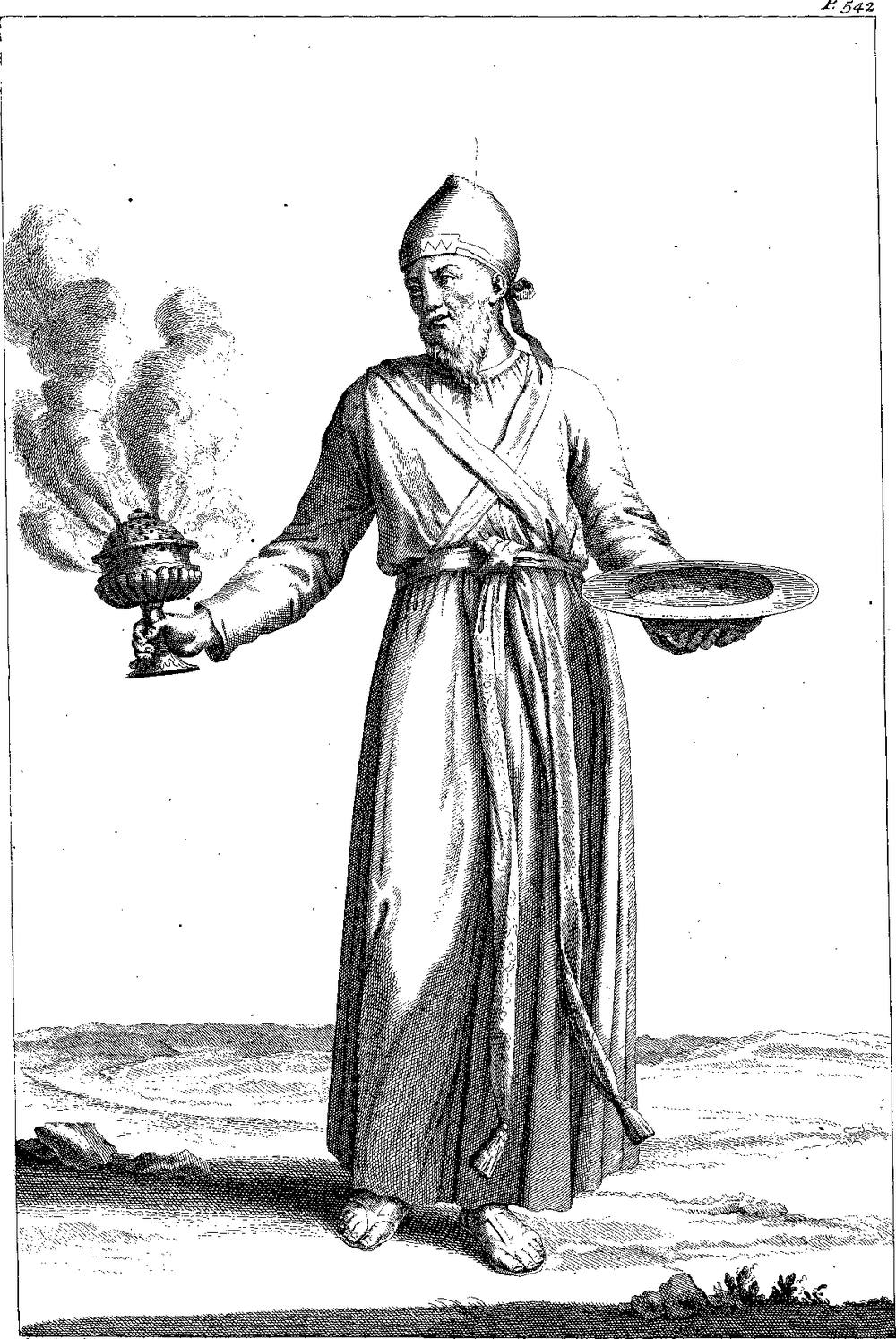
Expiation. The great Day of Expiation. This was kept upon the tenth day of the month Tizri, which answers to our September. The Hebrews call it Kippur or Chippur, that is to say, Pardon or Expiation, because the faults of the whole year were then Expiated. The principal ceremonies at that time observed, were such as follow. The High Priest after he had washed not only his hands and feet, as usual in common sacrifices, but his whole body, dressed himself Ib. xxi. 4.in plain linen like the rest of the Priests. He then neither wore his purple robe, nor the Ephod, nor the Pectoral, because he was going to Expiate his own and the people’s sins. He first of all offered a bullock and a ram for his own sins, and those of all the other Priests. He put his hands upon the heads of these victims, and confessed his own sins, and the sins of his house; then he received from the Princes of the people two goats for a sin-offering, and a ram for a burnt-offering to be offered in the name of all the multitude.
It was determined by lot which of the two goats should be sacrificed, and which set at liberty. After this, he put some of the sacred fire of the Altar of burnt-offerings into a Censer, threw incense upon it, and entred thus into the Sanctuary. After he had perfumed it, he went out, took some of the blood belonging to the young bullock which he had sacrificed, carried it into the Sanctuary, and dipping his finger in it, he sprinkled it seven times between the Ark and the Vail, which separated the Holy of the Sanctuary. Then he came out a second time, and beside the Altar of burnt-offerings killed the goat, upon which the lot was fallen to be sacrificed. The blood of it he carried into the Sanctuary, and sprinkled it seven times between the Ark and the Vail, which separated the Holy of the Sanctuary. From thence he returned into the Court of the Tabernacle, and sprinkled both sides of it with the blood of the goat; while all this was doing, none of the Priests or people were permitted to be in the Tabernacle, or in the Court. After this he came to the Altar of burnt-offerings, moistened the four horns of it with the blood of the goat, and young bullock, and sprinkled it seven times with the same blood.
The Sanctuary, the Court, and the Altar being thus purified, the High Priest directed the goat which was intended to be set at liberty, to be brought to him.
iv. 1, 2, 3. & c. He put his hand upon the goat’s head, confessed his sins, and the sins of the people, and then gave the goat to one prepared for this purpose, who was to carry it into some desart place, and let it loose, or, as others say, throw it down some precipice. See what has been said upon Azazel. This ceremony being over, the High Priest washed himself all over in the Tabernacle, and putting on other clothes, some say his Pontifical dress, that is to say, his Robe of purple, the Ephod, and the Pectoral, he sacrificed two rams for a burnt-offering, one for himself, the other for the people.
The great Day of Expiation was one of the principal solemnities of the Hebrews. It was a day of rest, and strict fasting; they confessed themselves ten times on this day, reckoning from the Eve before supper, in memory of the High Priest’s pronouncing the name of God ten times in this solemnity. The manner wherein this confession is Buxtorf. Synag. Jud. c. 20.performed, is as follows. Two Jews retire to a corner of the Synagogue, he who confesses himself, turns his face to the North, and his back to the South, bends his body very low, lays his back bare, confesses his sins, and strikes his breast, as often as he who receives his confession whips him with a leather strap, wherewith he gives him nine and thirty lashes, and at the same time repeats these words, Psalm lxxviii. 38. But the Lord was merciful, he forgave their misdeeds, and destroyed them not; yea, many a time turned he his wrath away, and would not suffer his whole displeasure to arise.
Upon this day they are reconciled with each other; he who has offended his neighbour goes to him the night before, and asks his pardon; if he, who has been offended, will not forgive him, the former takes three persons with him, comes to him, and again asks forgiveness two or three times: if the other persists obstinately in refusing it, he goes and takes ten men19, with whom he comes once more to him, and in their presence desires him to forgive; and if still refused, he who has taken all these steps, is judged to be absolved, and firmly believes, that he has done enough to merit forgiveness Ibid.in the sight of God. If the person offended is dead, he who desires to make him satisfaction, goes to the place where he is buried, with ten persons in his company, and says before them all, I have sinned against the God of Israel, and against such an one, who is here interred.
Buxtorf says, that they prepare themselves for this solemn day, as soon as the month Tizri begins, which is the first
of the civil year ; and that during all the ten days which precede it, they fast, and imploy themselves in acts of penance, and pray to God to divert the evil, which they have deserved. They rise early in the morning, confess themselves three times a day, prosecute no causes, and excommunicate no one. Upon the ninth day of the month, which is that before the day of Expiation, every one takes a white cock, if any of this colour may be found ; if not, then of some other kind of feather, provided it be not red ; repeats some prayers, and striking his head three times with the cock’s head, he says at every blow, This cock shall be for my redemption, shall suffer the death which I have merited, shall be my reconciliation, shall die for me, and I shall go into a life of bliss and immortality with all Israel. After this, he cuts its throat, Buxtorf. Synagog. Jud. c. 20. Ceremonies of the the Jews, part. 3. c. 6.takes out its bowels, picks off the feathers, dresses, and eats it. Leo of Modena says, that this was practised formerly in Italy and in the Levant, but that this custom was suppressed there, because it was acknowledged to be a piece of superstition without any foundation.
Many Jews spend the night which precedes the great day of Expiation, in the Synagogue, and imploy themselves in prayer and penitential exercises. They put on mourning, dress themselves in white or black, and some clothe themselves in that habit, with which they desire to be buried. They go without shoes and stockings, and are at the Synagogue very early. There they go to prayers four times in a solemn manner, in the morning, at noon, in the afternoon, and evening.
You have here some particular ceremonies, and Rabbinical explanations, of what is at this day practised among the Jews20. It was the custom formerly for the High Priest to separate from his wife seven days before this Festival, lest he should contract some pollution with her ; as if it happened that she had the infirmity upon her, which with women is generally periodical. Rabbi Judah maintained, that if the High Priest’s wife died in the interval of these seven days, he immediately married again, that so the Law might be complied with, which appointed him to make Levit. xvi. 17.atonement for himself and for his wife ; or, according to the text, for himself and his *house *: but this determination was not approved by the Sages.
Upon the vigil of the day of Expiation, some of the Elders were presented to the High Priest, who read before him, and exhorted him to read, in order to discover whether he had learned to read, or whether he had not forgotten it. But this precaution was necessary only under the second Temple, when the High Priesthood was sold. These Elders likewise prevented him from eating too much on the night before the festival, lest he should fall asleep. He was after this conducted into the chamber of one Abtinez21, where he was obliged to swear, that he would not change the ancient rites in any particular. It is believed, that this precaution proceeded from the inclination only of the Sadducees, that the High Priest should scatter the perfume before his entrance into the Holy, which was contrary to tradition. We know that Hircanus and Ananus, both High Priests, were Sadducees, and this oath was necessary for people of their stamp. As it seemed injurious to the High Priest, he wept when he took it, the Priests too wept at the consideration of their being obliged to administer it to him.
The night was spent in explaining the Law, or in reading some passages of Job, Esdras, or Daniel. If the Priest was not learned enough to be always discoursing, he had young people on each side of him who played upon the flute, or pushed him in order to awaken him, when he fell asleep, and who continued this exercise till the hour of sacrifice. In the morning they prided themselves in cleaning the Altar, and carrying away the ashes: the very great haste which the Priest made thither, oftentimes occasioned bad accidents ; for while they were pushing one another upon the steps, it sometimes so fell out, that one or other fell down and hurt themselves, which made it necessary to divide the offices. There were generally nine Priests appointed for the morning sacrifice, and eleven for the evening ; but in great solemnities, such as that of the Expiation, ten were ordered for the morning, and twelve for the evening. The Levites were likewise chosen to dress and make ready the victims, four and twenty for a calf, and to each was assigned a part of the beast, which he was to skin or prepare.
Every Priest, before he began his several offices, was to wash himself. The Rabbins say, the High Priest washed himself five times, because he was obliged to change his habit five times ; and as often as he so changed, it was necessary for him to wash himself. These habits were of linnen ; those used in the morning were of linnen of Pelusium, and those wore in the evening of Indian linnen, and cost eight drachms.
Anciently the lots which were drawn for the scape-goat were of wood, but the son of Gamaa made them of Gold. King Mono-
Monobasus appointed all the handles of the vessels, which were made use of in the Temple upon the day of expiation, to be made of the same metal.
The High Priest carried into the Sanctuary a Censer of the finest gold, fill’d with perfumes, and begged of God, that the air might be of a good temperature, that the scepter might not be taken out of the hands of Judah that year, that there might be no famine in Israel, and that the prayers of travellers or strangers might not be heard; his prayer was short, lest the people should be frighted if he continued too long in the Sanctuary; for they were persuaded that there was danger continually in going into that place, which God filled with his presence. The High Priest went out of it walking backward, with his eyes directed always towards the ark, or towards the foundation stone, which the Rabbins suppose to have been placed in the middle of the Sanctuary, ever since the Ark was lost under the second Temple. After this he sacrificed a goat, the throat whereof was to be cut in the manner which has been already related.
The Azazel, or scape-goat, was conducted to the precipice by Laymen as well as by the Priests. There was a way or causey prepared purposely on this occasion, and there were tents or ten relays from Jerusalem to the place where he was to be thrown down. This was a dreadful precipice, and so abounding with rocks, that before the goat was faln half way, his limbs were all beat to pieces; and in order to give notice of the execution to the people, who waited for the news of it within the Temple with uneasiness, there were signals raised at proper distances, for the more speedy communication of it. It is affirmed likewise, that at the same time the scarlet ribbon, which was fastned to the Temple-gate, immediately changed colour, and turned white, as a mark that God had accepted the Sacrifice, and that the sins of the people were forgiven. They add, that this miracle ceased forty years before the destruction of the second Temple.
When the ceremony was over, the High Priest read the Law, gave the blessing to the people, changed his dress, and made a great entertainment for joy of his coming unhurt out of the Sanctuary. The people fasted very punctually during all this Holy Day, to which they attributed great effects: for, according to the Jews, repentance, tho’ accompanied with a resolution of living well, does but suspend sins, whereas the feast of Expiation abolishes them entirely, and they who die before this day, expiate them by their death. This is what we learn from the Rabbins, concerning the manner wherein the feast of the Expiation was celebrated of old.
As to the modern Jews, their way of solemnizing it is as follows. They prepare themselves for this great festival the day before by prayer, and by the Sacrifice of a Cock, as has been already observed. After this, they go to the place where they bury the dead, and beg of God to forgive sinners in regard to the memory of the Saints, who are there interred: they plunge into the water, that so the ablution of their sins, thus made, may be entire. They prepare wax candles against the next day; every one carries his own to the Synagogue; the most devout have two, one for the Body, the other for the Soul, by the names whereof they call them.
In the evening when the feast begins, they go to the Synagogue; there every one lights his taper, and all sing with very loud voices. The women at the same time light up candles in their houses, from the brightness whereof, and the consistency of the tallow or wax, they form presages. If the light is clear and bright, they conclude from thence, that their sins are certainly remitted; if it is pale, they are very much disturbed at it; and so likewise if the wax or tallow run, they dread the effects of God’s anger.
The next day, early in the morning, they go to the Synagogue: the whole day is spent in strict fasting, without exception of age or sex; they suffer no one to eat, unless children under twelve years of age. They read a long prayer, wherein they declare, that all the oaths and promises which have been unperformed throughout the course of the whole year, are made void, because the atonement is made for sin. We read in Leviticus what relates to this feast, and the goat Azazel. They continue their prayers all day, and sometimes all the following night. At the conclusion of the festival, the Rabbi gives the blessing to the people with his hands lifted up; and the people out of respect to the Priest’s hand, or rather to the majesty of God whom he represents, put their hands before their eyes, and cover their faces. They found the horn in memory of the Jubilee, and believe that God causes his voice to be heard, declaring his forgiveness of Sins, and that every one may return home with this confidence, that his iniquities are pardoned. Whereupon they go to their respective homes, put on clean, white clothes, sit down to table, and break their fast; for before they had neither eat nor drank all day. After this manner the Jews at present celebrate this Holy Day.
Maimon. de Pœnitent. c. 10. p. 99.They believe, that Adam repented and began his penance on the day of solemn Expiation; that on the same day Abraham was circumcised, and Isaac bound in order to be sacrificed; for which reason they pray to God to forgive them, because of Isaac’s binding. Moreover, they teach, that upon this day Moses descended from mount Sinai with the new tables of the Law. Some change their name, as an indication of their inward change, and that they may address themselves to God, saying, I am another person, it is not I who have committed this sin.
EXTREME, Extremity, last. Extremi populi, the lowest of the people. Jeroboam appointed Priests of the High-places out of the lowest of the people: the Hebrew literally, 1 Kings xii. 31. Gen. xlvii. 2. Judg. xviii. 2.of the Extremities of the people. Joseph, in the book of Genesis, presents five of his youngest brethren to Pharaoh; Extremos fratrum suorum quinque viros. They of Dan sent five men of their Extremities; or five men out of the lowest among them, to go and seek a more commodious habitation for their tribes. Isaiah says, that God hath removed all the Extremities Isai. xxvi. 15.of the country, the last and lowest of the land.
But some interpreters maintain, that the Extremities in these passages do not signify the last and meanest, but on the contrary the first and most distinguished; as if one should say, they who are at the head, at the top, at the honourable Extremity. Others assert, that these expressions denote Grot. Vatab. Jun. Fag. &c.no choice or distinction of honour; that the five brethren here presented by Joseph to King Pharaoh, were the first that came to his hand.
The Extremity of the Earth. The praise of the Lord will be heard from the Extremity Isai. xlii. 10. Isai. xliii. 6. Ps. cxxxv. 7. Jerem. x. 13. Isai. xli. 9.of the world, from all places in the world. The Lord will bring back his people from the Extremity of the earth. He causeth the vapours to ascend from the Extremity of the World. He calls Abraham from the Extremity, the ends of the earth. All these expressions are marks of a remote country; as we say, that people come from the end of the world, when they come from a great distance.
Numb. xxiv. 14, 24. Deut. xxxi. 19. Isai. lxii. 11. עיןOculus, Fons, Color. Numb. xi. 7.The last times, Extremo tempore, or ad extremum, denote either some very remote time; or the time of the Messiah, or sometimes the end of the world.
EYE. Every one knows what the Eye is. The Hebrews call fountains, Eyes; and give the same name to colours. And the Eye, or colour of the manna was as the Eye, or colour of bdellium. By an evil Eye in Hebrew is meant, envy, jealousy, stinginess, mistaken parsimony. To lay their Eyes on any one, signifies, to look favourably upon him, to have a regard for him and his interests. The Eyes of the Lord are over the righteous, Psal. xxxiv. 15. He favours them, and heaps blessings on them. To find grace in any one’s Eyes, Ruth ii. 10, &c. to win his friendship and good graces. The Eyes of servants look unto the hands of their masters, Ps. cxxiii. 2. Servants have always their Eyes fixed upon the hands of their masters, to observe their least motions, and obey the least signal. Their Eyes were opened, Gen. iii. 7. They began to comprehend what before they did not comprehend. The wise man’s Eyes are in his head, Eccles. ii. 14. He knows where he goes, and what he has to do: he does not act by chance. The Eye is not satisfied with riches, Eccles. iv. 8. Covetousness is insatiable, &c. The Eye of the soul in a moral sense signifies the intention, the desire. To find favour in any one’s Eyes, to be good or pleasing in another’s Eyes, are expressions very common among the Hebrews, and are clearer than any explanation we can give of them.
Gen. xliv. 21.To set one’s Eyes upon any one, to do him service, to favour him extremely, or barely to see him with friendship. Joseph ordered his brethren to bring his younger brother Benjamin to him, that he might set his Eyes upon him. God threatens to set his Eyes upon the Israelites for evil, and not Amos ix. 4. Ps. xxxiv. 16. Amos ix. 8. Ps. xxxii. 8.for good. Ponam oculos meos super eos in malum, & non in bonum. The Psalmist says, that the Eyes of the Lord are over the righteous. He promises to fasten his Eyes upon his friends; firmabo super te oculos meos. Nebuchadnezzar recommends it to Nebuzaradan that he would set his Eyes upon Jeremiah, and permit him to go where he pleased. But sometimes expressions Jerem. xxxix. 12. xl. 4.of this kind are taken in a quite opposite sense, for the severity of revenge: for example; Behold the Eyes of the Lord are upon the sinful kingdom, and I will destroy it from off the face of the earth.
Ezek. v. 11. viii. 18. & passim.This likewise is a very common expression, Mine Eye will not spare, neither will I have pity. Probably, because the Eye upon these occasions is the organ which shews compassion or fury, vengeance or pardon; gentleness or severity: thine Eyes look gently, or angrily upon me.
To be Eyes to the blind, or to serve Job xxix. 15.them instead of Eyes, is sufficiently intelligible. The Persians called those officers of the crown, who had the care of the King’s interests, and the management of his finances, the King’s Eyes.
Job xxxi. 1.I have made a covenant with my Eyes, not even to look upon a maid: a very expressive
Eph. vi. 6.pressive way of speaking, the force whereof would be impaired by any explanation.
Eye-service is peculiar to slaves, who are Coloss. iii. 22.governed by fear only. Servi ad oculum.
1 John ii. 16.The lust of the Eyes, or the desire of the Eyes, comprehend every thing that curiosity, Ezek. xxiv. 6, 21, 25.vanity, the love of the creatures, or the love of pleasure, seeks and pursues after; the attractions of what is good, beautiful, agreeable, magnificent, and pleasing; in a word, every thing that the Eyes can present to men given up intirely to their passions.
The abomination of the Eyes. In Ezekiel, Cast ye away every man the abomination Ezek. xx. 7, 8.of his Eyes. Let not the idols of the Egyptians seduce your Eyes; but they would not abandon these abominations of their Eyes. They did not every man cast away the abominations of his Eyes. Solomon says, that he had denied himself Eccles. ii. 10.nothing of all which his Eyes desired.
The height or elevation of the Eyes is taken for pride. Extollentiam oculorum meorum ne dederis mihi, Ecclus. xxiii. 5.
Gal. iv. 15.The women tinged their Eyes with antimony. See above ANTIMONY.
St. Paul says, that the Galatians would willingly have plucked out their Eyes for him, when he began to preach the Gospel to them; expressing barely in the way of exaggeration their zeal, affection, gratitude, and devotion to him. In a contrary sense, the Israelites, transported with passion, said to Moses, Wilt thou put out the Numb. xvi. 14.Eyes of these men?
The Hebrews call the apple of the Eye, the black daughter of the Eye. Let not the Lament. ii. 18.apple of thine Eye cease weeping. To keep any thing as the apple of the Eye, to keep Deut. xxxii. 10.it with particular care. He that toucheth you, toucheth the apple of mine Eyes; injures me in that which is most dear to me.
EZBAI, the father of Naarai, one of the thirty brave officers in David’s army. I Chron. xi. 37.
I. EZBON, the son of Bela, and grandson of Benjamin. I Chron. vii. 7.
Gen. xlvi. 16.II. EZBON, the son of Gad, in all probability founded or repaired the city of Heshbon, or Esebon.
EZEKIEL, the son of Buzi, a prophet Ezek. i. 3.of the sacerdotal race; was carried captive to Babylon by Nebuchadnezzar, with Jehoiachin King of Judah, in the year of the World 3405, before Jesus Christ 595, before the Vulgar Æra 599. God communicated the Spirit of Prophecy to him, only during the captivity; for it does not appear that he had prophesied before his coming into Mesopotamia.
He began his ministry in the thirtieth Ezek. i. 1. Ezek. i. Ezek. iii. Ezek. iv.year of his age, according to the general account, or rather in the thirtieth year after the covenant was renewed with God in the reign of Josiah; which answers to the fifth year of Ezekiel’s captivity, in the year of the World 3409, and he prophesied twenty years to 3430, which was the fourteenth year after the taking of Jerusalem, before Jesus Christ 570, before the Vulgar Æra 574.
One day therefore, when Ezekiel was among the captives upon the river Chebar, he had a vision, wherein the Lord appeared to him upon a throne, or kind of chariot borne by four Cherubims, supported upon four sorts of wheels. He heard the voice of the Lord, who sent him to declare what Ezek. ii.would happen to his people. There seemed to be presented to him a book rolled up, and he thought that he did eat it. After which, he went among the captives, and continued there for seven days sitting by the river Chebar, and weeping without ceasing. At that time the Lord directed his word to him, and made him the watchman of his people; and again appeared to him in his glory, commanded him to shut himself up in his house, and foretold to him, that he should be seized on, and bound with chains as a mad man, which happened accordingly.
While he was thus confined in his apartment, God commanded him to delineate upon a brick, or piece of soft earth, the city of Jerusalem besieged, and surrounded with ramparts, after the old way of besieging cities; to put a wall of iron between him and the city; to fix his eyes upon it, and to continue three hundred and ninety days lying upon his left side, to signify the iniquity of the children of Israel; and after this to turn again, and lie forty days upon his right side, to signify the iniquities of Judah. By these four hundred and thirty days was denoted the siege of Jerusalem by22 Nebuchadnezzar, its duration, and that of the captivity of the ten tribes, which was to last three hundred and ninety years; and the captivity of Judah, which was to continue forty years, beginning at the last time of Jerusalem’s being taken in the reign of Zedekiah, or rather in the fourth year after this siege, when Nabuzaradan carried away what remains there were of the Jews in the country, and transported them to Babylon, in the year of the World 3420, and ending at the death of Belshazzar, about the year 3466, according to Usher; or reckoning from the taking of Jerusalem, in 3416 to 3457, which according to our computation is
the first year of Cyrus’s reign at Babylon.
God afterwards commanded him to take Jerem. lii. 30. Ezek. iv. 9, 10.wheat, barley, beans, lentiles, millet, and fitches, and with these to make as many loaves as he was to continue days lying upon his side, and to rub them over with excrements issuing from an human body. Ezekiel expressing some reluctancy as to this last article, God permitted him to use cow-dung instead of it. All which was a figure of what was to happen in Jerusalem, where the Israelites were reduced, during the siege, to the necessity of eating unclean bread, and that too in small quantity, and in continual apprehensions and uneasiness. After this he was directed by God to cut off his hair, to Ezek. v.divide it into three parts; to burn one, to cut another to pieces with a sword, and scatter the rest in the wind; to shew that the inhabitants of Jerusalem should partly be consumed by famine and pestilence; that another part of them should be put to the sword, and a third dispersed into different places in the World.
In the year of the World 3410, before J. C. 590, before the Vulgar Æra 594. Ezek. viii.The year following Ezekiel was transported in spirit to Jerusalem; and God shewed him the abominations and idolatries committed by the Jews there, which were to draw down upon them the most terrible effects of divine vengeance. While he was yet in the Temple, God commanded five Angels, who carried each an instrument of death, to kill all those in Jerusalem, who were not distinguished by the sign of life; and at the same time enjoined an Angel, who was with the other five, to go into the midst of the city, and mark all those with the letter T, who sighed, and were afflicted at the disorders of Jerusalem. All this was executed, and vengeance began at the Temple of the Lord, which was soon filled with blood and slaughter. The Lord having Ezek. x.again appeared in his glory, commanded the same Angel, who had impressed the character of life on those, who were to be saved, to take coals of fire from between the Cherubims, which bore the throne of the Lord, and scatter them over the city: this was an indication of the fire of war, and of divine vengeance, which was to fall very soon upon it.
Five years before the last siege of Jerusalem, the Lord said to a Ezekiel, Prepare thy self like one who quits his country to go to some other place; thou shalt remove thy goods before thy people in full day, and In the year of the World 3411, before J. C. 589, before the Vulgar Æra 593. a Ezek. xii.shalt pass from one place to another in their sight, to see if they will consider it. Dig through the wall of thine house, and go out through the breach which thou shalt have made. Thou shalt have men, who shall bear thee upon their shoulders in the dark, and thou shalt cover thy face with a veil, that so this spectacle may ingage their attention. Thou shalt tell them, that what thou dost shall be executed, when the enemy shall take Jerusalem, and that King Zedekiah shall be treated after this manner, and carried away from his palace. He added, that these things were not very remote, and that the accomplishment of them should be soon seen. Lastly, he makes a strong invective against false prophets and false propheteses, and against those, who suffer themselves to be seduced by their Ezek. xiii. xiv.vain preaching.
While these things passed in Mesopotamia, Zedekiah King of Judah entred into secret measures with the Kings of Egypt, Edom, and some other neighbour Princes, in order to rebel against Nebuchadnezzar King of Babylon. This Prince marched against Jerusalem, and besieged it in the year of the World 3414, before Jesus Christ 586, before the Vulgar Æra 590, upon the tenth day of the tenth month in the ninth year of Zedekiah. On the same day of the same year, Ezekiel, who was in Mesopotamia, at above two hundred leagues distance from Jerusalem, declared this event to the Jews, who were with him in captivity; he represented the future ruin of Jerusalem and its inhabitants under the figure of a caldron full of flesh and bones set upon the fire, till the flesh and bones were consumed, and the very copper of the caldron melted and burnt. At the same time the prophet’s wife dying, God forbad him to weep and mourn for her. The people asking the prophet what was meant by all those figurative actions; he answered them, that God was going to deprive them of all that was most dear to them; of their Temple, City, Country, Relations, and Friends, and that they should not have even the sad consolation of mourning for them.
During the siege of Jerusalem, Ezekiel, prophesied against Egypt, and Tyre. He was informed, that Jerusalem was taken but not till the fifth day of the tenth month in the year of the World 3417, about six months after the city was surrenderedb; from whence we may judge, that the prophet dwelt in some very retired corner of the province, and very remote from Babylon, where this news without doubt was brought very soon. In the evening of that day when the messenger arrived, the Lord opened the Prophet’s mouth, and inspired him to foretel, that the remains of the people, which were still left in Judæa, and flattered themselves with the hopes of a speedy restoration, would likewise be dispersed, as it accordingly happened four years after. It was at the same time probably, that he foretold the calamities of the Zidonians, Tyrians, Edomites, and Ammonites, which happened five years after the destruction of Jerusalem c.
Ezek. xxvi. xxvii. Ezek. xxix. xxx. xxxi.The siege of Tyre and Nebuchadnezzar’s war against Egypt, are, next to the affairs of the Jews, what is most remarkable in Ezekiel. After these melancholy visions, God shewed him more comfortable objects, such as the return from the captivity, the rebuilding both of the Temple and City, the restitution of the Kingdom and Cities of Judah and Israel; their victories over their enemies, and the re-establishment of their state in a more flourishing condition, than it had been in before. All which is comprized in the xxxvi. xxxvii. xxxviii. and following chapters to the end of the book.
Hieron. in Ezek xii. p. 766. nov. Edit.St. Jerom is of opinion, that as Jeremiah prophesied at Jerusalem at the same time as Ezekiel did beyond the Euphrates, the prophecies of this last were sent to Jerusalem, and reciprocally those of Jeremiah into Mesopotamia, in order to comfort and encourage the captive Jews in their exile.
It is said, that Ezekiel was put to death by Vide Epiphan. de Vita & Morte Prophet.the Prince of his people, because he exhorted him to leave idolatry. We cannot well tell who this Prince could be of the Jewish people upon the river Chebar, where Ezekiel dwelt. It is affirmed for certain likewise, that his body was laid in the same cave, wherein Shem and Arphaxad were deposited, upon the banks of the Euphrates. Benjamin of Tudela says, that this tomb is behind the synagogue, between the Euphrates and the Chebar; that it is placed in a very fine vault built by King Jehoiachin; that the Jews keep a lamp always burning there, and boast, that they have there the Prophet’s book written with his own hand, which they read every year upon the great Day of Antiq. l. x. c. 6.Expiation.
Josephus says, that Ezekiel left two Antiq. l. x. c. 10.books concerning the captivity of Babylon. He says in another place, that this Prophet having foretold the ruin of the Temple, and that Zedekiah should not see Babylon, this writing was sent to Jerusalem; circumstances, Athanas. in Synopsi.which we do not read in the works of Ezekiel now remaining. Athanasius believed, that one of the two volumes written by Ezekiel was no longer in being. Spinoza thinks, that what we have of this Prophet is a fragment only of some larger writing. But we see no good proof of all this, nor do we know from whence Josephus got what he tells us of these two supposed works of Ezekiel.
The writings of this Prophet have been at all times acknowledged to be canonical; nor was it ever disputed that he was the author of them. Nevertheless the Jews say, that the Sanhedrim deliberated a long time whether his book should be put into the canon. The great obscurity of his prophecy both in the beginning and end of it, was objected; as also what he says, chap. Hieron. Præfat. in Ezekiel. & Comment. in cap. i. Prophet. b Exod. xxxiv. 7. & xx. 5. Clem. Alexand. l. 1. Stromat.xviii. 2, 20. that the son should not bear the iniquity of his father23; which is contrary to Moses b, who says, that the Lord visiteth the sins of the fathers upon the children unto the third and fourth generation.
Clemens of Alexandria says, that some believed Nazaratus the Assyrian, Pythagoras’s preceptor, to be the same as Ezekiel. But for his part, he is not of this opinion: he does not believe that Pythagoras ever saw Ezekiel. This Philosopher lived long after our Prophet. Epiphanius and Dorotheus relate several things in the Life of Ezekiel, which are thought fabulous by the most learned criticks. They say, for example, that this Prophet wrought many miracles in Chaldæa; that he distributed the tribes of Gad and Dan in Babylon; that he sent serpents against them, which devoured their children and their cattle, as a punishment of their idolatry; that he brought the people back to Jerusalem, in order to confound the incredulous; lastly, that he was buried in the land inhabited by the Spiræ or Sapiræ. The time and manner of his death are very uncertain, whatever particular authors may say of them. The Jews did not permit any to read this Prophet, at least the beginning of his book, till they were thirty years of age.
They speak of this Prophet in a very contemptible manner24. They say he was Jeremiah’s boy, puer, servant; that he was the object of raillery and ridicule to his people; for which reason he was called the son of Buzi, that is to say, the son of contempt, or of the despised. They accuse him with teaching several things contrary to Moses; for example, relating to the matter of sacrifices, and with saying, that God would not transmit the punishment of the father’s sin upon the children; whereas Moses declares, that it descends to the third and fourth generation. Upon this pretence, the Sanhedrim Compare Exod. xx. 5. & Ezek. xviii. 2, 3, 4, &c.took it once under consideration, whether they should raze him out of the number of sacred Writers, and expunge his works out of the canon of Scripture.
Another reason for their thus deliberating about the suppression of his works, was, their obscurity, and principally the vision of the mysterious chariot in the first chapter; the votes of almost all had been given for condemning him, if Rabbi Chananias,
Ezek. xxxvii. 1.who was living at that time, had not offered to remove all these difficulties. His proposal was approved, and a present was made him of three hundred tun of oil for the use of his lamps, and to give him light while he was employ’d in this undertaking. We may easily comprehend, that this is all an hyperbole of the Talmudists, to exagerate the difficulty of explaining the prophecy of Ezekiel; and it is credible, that all which they relate concerning the deliberation of the Sanhedrim on this occasion is mere fable.
Benjamin of Tudela tells us in his travels, that he saw a magnificent Mausolæum at some leagues from Bagdat, upon the top whereof was a famous library. The Mausolæum was the prophet Ezekiel’s tomb, which was frequented every year by the Heads of the Captivity, who resorted thither with a numerous retinue. It is a place of devotion not only for the Jews, but likewise for the Persians, Medes, and for abundance of Mussulmen, who go thither to make their presents, and perform their vows. This place, among the people I have mentioned, is in singular veneration, their very armies never touch it. There is a lamp continually burning upon the prophet’s tomb, and the Head of the Captivity of Bagdat is at the expence of keeping it up. This pilgrimage continues still at this day with much devotion.
The tomb is upon the banks of the Chaboras. There are sixty towers belonging to it, and a synagogue in each. Near it is another edifice built by Jechoniah, when Evilmerodach restored him to his liberty. This palace has a view of the Euphrates on one side, and on the other of the Chaboras. The portrait of Jechoniah was still to be seen in the time of Benjamin of Tudela, in one of the vaults of this edifice; and the pictures of all the officers who accompanied him: in the rear of whom was the prophet Ezekiel.
As to the library which this traveller saw in the same place, he says it was very numerous, and that all who died without children augmented it, by sending their books thither. There too was shewn, as they say, the original of this prophet’s predictions, written with his own hand. This account is very circumstantial, and has pretty much the air of truth.
Notwithstanding, an author of good antiquity says, that he was killed by the General of his own nation, who was enraged at the Prophet’s censuring his conduct, and that he was buried in a cave, where Shem and Arphaxad, the ancestors of Abraham, were deposited. An author who lived in Constantine’s time, says, that Ezekiel lies buried at Bethlehem, in the same place as Jesse, David, and Solomon.
Ezekiel, we know, speaks of a famous resurrection, and that being conducted one day into a field full of bones, the Spirit of God induced him to walk round the field, and said to him, Do you believe that these bones shall be raised up? And at the same time he said, Prophesy upon these bones, and say to them, O ye dry bones, hear the word of the Lord, behold I will cause breath to enter into you, and ye shall live. Accordingly as the Prophet was speaking, all these bones began to stir, and come together, and at last were restored to life. There has been much disputing concerning this event, whether it were real, or figurative only, and happened mentally, in spirit, to describe, in a more express and lively manner, the return of the Jews from their captivity. Many of the Rabbins have been of opinion, that the thing strictly did so happen, as the Prophet relates it; but the generality of Commentators believe, that it all passed in idea and vision only.
The Mahometans report it in the following manner. The little town of Davardan, D’Herbelot. Bibl. Orient. p. 942. Khazkhil.which is a dependant on the city of Vassith, having been attacked with the plague, many of the inhabitants forsook their habitations, and preserved their lives: Another year the plague broke out afresh, and all the inhabitants left it with their flocks. As they were got into a large valley, two Angels appeared at the two extremities of it, and declared to them from God, that they would die very suddenly; accordingly they all did so, together with their cattle. The inhabitants of the neighbourhood having been informed of it, came thither in order to bury them; but the number of the dead was so great, that they could not accomplish their design. They shut up the valley therefore with two walls at the two ends, and left a great part of the carcasses upon the ground, where they were very soon consumed, and nothing but the bones remained of them. The prophet Ezekiel going by this way some years after, put up this prayer to God: O Lord, as thou hast been pleased to manifest thy power upon these persons with great terror, look now upon them with an eye of clemency and mercy. God heard his prayer, and restored them to life. Such is the character of these eastern people, there is scarce any history which they do not disguise, and embellish after their own manner. The Mussulmen make Ezekiel the successor of Caleb, the son of Jephunneh, who judged Israel after the death of Joshua. Which is one of the most absurd anachronisms.
II. EZEKIEL, the father of ShechaniahClem. Alex. l. 1. Stromat. Euseb. Præparat. l. 9.. Ezra viii. 5.
III. EZEKIEL, an Hebrew Poet, who wrote a tragedy in Greek, whereof Moses was the subject. Clemens of Alexandria and Eusebius have cited it. Frederick Morel published it at Paris in Greek and Latin, in the year 1609.
I. EZER,
I. EZER, the father of Husha, of the Tribe of Judah. 1 Chr. iv. 4.
II. EZER, a Priest who returned from the captivity of Babylon. Nehem. xii. 42.
III. EZER, the second son of Seir the Horite. Gen. xxxvi. 21, 27.
EZION-GABER, a city of Idumæa or Arabia deserta, upon the coasts of the Red Sea, and upon a gulf of this Sea, called the Gulf of Elan. After the Israelites had been some time at Hebrona, they came to Ezion -gaber, from thence they went to the wilderness of Sin, where the city of Kadesh Numb. xxxiii. 35.was situated. At the port of 1 Kings ix. 26.Ezion-gaber25 Solomon equipped his fleets for the voyage to Ophir. See what we have said above concerning Elam, a town lying upon the gulf of Elan. Josephus says, that Ezion-gaber is the same as Berenice, a famous city upon the coast of the Red Sea. Antiq. l. 8. c. 2. p. 269. But is is very probable that he has confounded Berenice, which lies upon the western shore of the Red Sea, inclining towards Ethiopia, with the city of Ezion-gaber, situated upon the Gulf of Elan, and on the opposite shore.
EZRA. See ESDRAS.
FABIUS, a Tribune in Pompey’s army. He was one of the first, who entred the breach in the Temple of Jerusalem. I do not know whether this is Antiq. l. 14. c. 8. p. 475. & de Bello l. 1. c. 5. p. 720.the same Fabius, who was corrupted by Antigonus, the son of Aristobulus .
FACE. The Lord promises Moses, that his Face shall go before the Israelites26: In the Year of the World 3941, before J.C. 59, before the Vulg. Æra 63.Facies mea præcedet te, & requiem dabo tibi. By these words some understand God himself, my Face, I my self, say the Septuagint, or rather my Angel, the Angel of my Face, the Angel Michael whom I have appointed || Antiq. l. 14. c. 21. † Exod. xxxiii. 13, 14.to be the conductor of my people. By the Angel of his presence in Isaiah is meant likewise the Messiah, Isai. lxiii. 9. Angelus faciei ejus salvavit vos. The principal Angels are called Angels of his presence, the Archangels who appear in the presence of God, who see his Face, and are the nearest to his person. The Scripture speaking in a popular manner, represents God frequently in Heaven like the Assyrian or Persian Monarch in his palace, admitting a certain number only of his principal officers to his presence, who have the honour to see and serve him. See Tobit xii. 15. Rev. i. 4.
Moses in the place abomentioned begs of God to show him his Face, si inveni gratiam in conspectu tuo, ostende mihi faciem tuam. And afterwards, to manifest his glory to him, ostende mihi gloriam tuam, which is the same as faciem tuam. God replies to him, I will make all my goodness pass before thee, or all my glory; and I will proclaim my name, which I will give thee as a signal of my presence: but for my Face, thou canst not see it; for there shall no man see it and live. It was a certain persuasion, and very prevalent in the world, that no man could support the sight of God without expiring. See Gen. xvi. 13. xxxii. 30. Exod. xx. 19. xxiv. 11. Judg. vi. 22, 23.
The Lord executed his promise, he passed before the cave where Moses was placed. Moses saw his glory as it passed before the mouth of the cave, but beheld not the Face of God, ch. xxxiv. 6, 7. whose back parts only were visible to him. Nevertheless it is said in the book of Numbers, ch. xii. 4. that God spoke mouth to mouth to him, even apparently, and not in dark speeches. And in another place, Numb. xiv. The Canaanites have heard that thou art among thy people, and that thou art seen Face to Face. And in Deuter. v. 4. it is said, that God talked with the Hebrews Face to Face out of the midst of the fire. But in all these places Face to Face is to be understood simply, as if he had said, that God manifested himself to the Israelites, that he made them hear his voice in a manner as distinct, as if he had appeared to them Face to Face.
The bread of Faces, the Shew-bread which was always in the presence of God. See SHEW-BREAD.
The Face of God denotes sometimes his Ps. xxxiv. 17. Ib. liv. 22. Ib. lxviii. 2.anger. The Face of the Lord is upon those who do evil. And they were dispersed by the Anger of his Face . And again, As wax melteth before the fire, so let the wicked perish before the Face of God. We find likewise the word Face used in a contrary sense:
Ps. xxxi. 16. Ps. lxxx. 7.Make thy face to shine upon thy servant. And in another passage, Cause thy Face to shine, and we shall be saved. And I shall be Ib. xvii. 15.satisfied when I behold thy glory, thy Face in righteousness. Thou shalt hide them in Ib. xxxi. 20.the secret of thy face; thou shalt protect them, thou shalt heap thy favours on them.
Ib. lxxxi. 2.To consider the face of any one, to have respect to persons. Usque quo facies peccatorum sumitis? And Solomon, Qui Prov. xxviii. 21.cognoscit faciem in judicio, non bene facit. The Judge ought to shut his eyes against the persons whose cause comes before him, and open them only to justice. Sometimes to know the Face, signifies to do a favour, as in Malachi i. 8, 9. Si quomodo suscipiat facies vestras Dominus. I have accepted Gen. xix. 21.thee concerning this thing also, &c. literally in the Hebrew, I have accepted thy Face.
To spit in one’s Face, is a sign of the utmost contempt. The woman, whose husband died without children, if her husband’s brother refused to marry her, spit in his Face. Deut. xxv. 9.
Ib. xlii. 5.The salvation of the Lord’s Face, signifies the Salvation which he by his favour promises.
Rom. i. 17.FADUS. Cuspius Fadus, Governour of Judæa*. See* CUSPIUS.
FAITH, Fides, is a theological virtue, whereby we hold for certain that there is a God, and are persuaded to submit to all those truths which he hath revealed to us by Scripture or Tradition, and proposes to us by his Church. This Faith, accompanied with the practice of good works, gives life to a righteous man, The Just shall live by Faith. It may be considered either as proceeding Hab. ii. 4.from God, who reveals his truths, or man, who yields his assent to them: and in both these senses it is called Fides. Shall the unbelief of the Jews make the Faith of God of none effect? says St. Paul; that is to Rom. iii. 3.say, his sovereign and infallible truth, which discovers his mysteries to us.
The Jews have thirteen Articles of Faith, which are received among them, without any contradiction27.
I. That there is one God the Creator of all things, the first principle of all Beings, who subsists independently of any part of the Universe, and without whom nothing can subsist.
II. That God is one, and indivisible; but his Unity is different from all other Unities.
III. That God has not a body, and that he is incorporeal in such a manner, as to have no corporeal quality.
IV. That he is eternal, and that all other Beings, besides him, have had a beginning with Time.
V. That God only is to be adored and served, and that no other is to be served or worshipped, either as mediator or intercessor.
VI. That there have been, and still may be Prophets, disposed to receive the inspirations of God.
VII. That there never was a greater Prophet than Moses, and that the degree of Prophecy, wherewith he was honoured, was singular, and very superior to that of all other Prophets.
VIII. That the Law given by Moses to the Jews, was dictated intirely by the Holy Spirit, yet it includes not so much as one syllable, that is purely Moses’s; and that the explanation of these precepts, which they have received by tradition, came intirely from the mouth of God, who gave it to Moses.
IX. That this Law is immutable, and that no one can either add to it, or take from it.
X. That God knows and disposes of all human actions.
XI. That God rewards those, who observe his Law, and punishes those who violate it; that the best reward is that of another life, and the greatest punishment is the damnation of the soul.
XII. That a Messiah will come, whose merit will be infinitely superior to that of all other Monarchs who were before him; that altho’ his coming be late, it is not however to be doubted, nor is any time to be prescribed when it shall happen, much less is it to be fixed from Scripture, since there never is to be a King of Israel, who is not of the race of David or Solomon.
XIII. That God at the consummation of time will restore all the dead to life, and will afterwards proceed to judge all mankind universally both in Soul and Body.
As to the Articles of Faith acknowledged by Christians, they are comprehended in the Creeds, and in the Decisions of Councils.
Faith is taken likewise for a firm confidence in God, whereby we are induced to address ourselves without hesitation to him, whether we petition him for favours in our prayers, or miracles for his own glory. If you have Faith as a grain of mustard-seed, ye shall say unto this mountain, Remove hence to yonder place, and it shall remove, and nothing shall be impossible Matth. xvii. 20.unto you, says our Saviour. If any of you lack wisdom, let him ask of God, that giveth to all men liberally; but let him ask in Faith, nothing wavering, &c. says St. Jam. i. 5, 6.James.
Lastly, Faith is taken for honesty, fidelity in performing promises, truth; and
in this sense it is applied both to God and man. Isaiah describing the Messiah, says Righteousness shall be the girdle of his loins, and faithfulness the girdle of his reins; that is to say, he will be just and faithful.
FALSE PROPHETS. See PROPHETS.
Joel i. 2, 3, 4, &c.FAMINE. The Scripture speaks of several Famines which happened in Palestine, and in the neighbouring countries; Gen. xii. 10.for example, in the time of Abraham, and again in the time of Isaac. But Ib. xxvi. 1.the most remarkable, whereof we have any knowledge, is that of seven years, Ib. xli. 27.which fell out in Egypt, while Joseph abode there. It is considerable for the continuance, extent, and greatness of it; and in this particular the more so, that Egypt is one of the countries in the world least subject to these calamities, by reason of its extreme fruitfulness.
Famine is sometimes a natural effect, as when the Nile does not overflow in Egypt, or the rains do not fall in Judea, at the customary times, that is to say, in spring and autumn; or when the caterpillars, the May-bugs, and locusts swarm in the country, and destroy the fruits of it. The Prophets in several places take notice of these last causes of famine. See, for example, the magnificent description which Joel, makes of the coming of the locusts; he compares them to a numerous and terrible army, and describes the ravages committed by them in the land.
Famine was also the effect often of God’s 2 Sam. xxiv. 12, 13.anger against his people; for example, the Lord sent the Prophet Gad to David, to tell him, that as a punishment of his vanity, whereby he had been induced to number his people, God gave him the option of seven years famine, or of being for three months pursued by his enemies, or of seeing the plague raging for three days in his 2 Kings viii. 1, 2.country. And in the reign of Ahab, The Lord called for a Famine, and it came upon the land seven years. The Prophets frequently threaten the Israelites, with the sword of Famine, or with War and Famine, two evils that go generally together.
Amos threatens the people of God with another sort of Famine, which was that of hearing the word of God. Behold the days come, saith the Lord, that I will send a Famine in the land, not a Famine of bread, nor a thirst for water, but of hearing the words of the Lord.
FASCINATION, a charm which hinders one from seeing things, as they are in reality. We read in a spurious book, called, The Gospel of Christ’s infancy28, that a young man having been changed into a Isai. xi. 5. Gal. iii. 1. Wisd. iv. 12.mule, was cured and restored to his first condition by the Blessed Virgin, who put the infant Jesus on him. Homer speaks of Ulysses’s companions, who were changed into swine by Circe’s charms. We read of the like Fascinations in the Life of St. Hilario, written by St. Jerom, and in many other Lives of the Saints. The metamorphosis of Apuleius is a matter very well known. St. Austin29 mentions some persons who changed those into beasts of burden, that were persuaded by them to eat certain drugs. All these changes consisted only in the imagination of the spectators, and in the Fascination of their senses, and of theirs to whom these accidents happened.
St. Paul makes use of the word Fascination in a figurative sense, when speaking to the Galatians, he says, Quis vos fascinavit non obedire veritati? Who hath so far bewitched your heart and mind, as to induce you to embrace vain novelties, and abandon the truths which I have preached to you. And the wise man, Fascinatio nugacitatis obscurat bona: the Fascination, inchantment, the charms of wordly things, of pleasures, &c. casts a blemish upon good things. See what St. Austin says, relating to the supposed metamorphoses caused by Sorcerers, in the XVIIIth book of his de Civit. Dei, c. 16, 17, 18, &c. and what has been said of Nebuchadnezzar’s metamorphosis into an Ox.
FASTING. Fasting has in all Ages and among all Nations been an exercise much in use in times of mourning, sorrow and affliction. The sense of it is in some sort inspired by nature, which in these circumstances denies itself nourishment, and takes off the edge of hunger. We see no example of Fasting, properly so called, before Moses; whether this Legislator had observed nothing of it in the old Patriarchs, which yet is hard to believe, since we see that there were very great mournings among them, and those too very particularly described, such as that of Abraham for Sarah, and that of Jacob for his son Joseph; or whether he did not think it necessary to speak of it in any express manner. But it appears by the Law, that even devotional Fasts for the expiation of their sins, were common among the Israelites. Moses ordains, that if a married woman ingages herself by vow to keep any Fast in the way of supererogation, unless her husband contradicts it, she shall be Numb. xxx. 14.obliged to perform her vow. I say nothing of the forty days which Moses passed without eating any thing on Mount Horeb, because this Fast is out of the common rules of Nature.
Since the time of Moses, examples of Fasting have been very common among the Jews. But as to the Fasts which we read of in their Calendar, they are later than the Law. Moses injoins no particular Fast in his books, excepting that upon the so-lemn day of Expiation, which was gene-rally and strictly observed30. Joshua and the Elders of Israel remained prostrate be-fore the Ark from morning until evening, without eating, after the Israelites were defeated by Josh. vii. 6.the men of Ai. The eleven Tribes which had taken arms against that of Benjamin, Judg. xx. 26.seeing they could not hold out against the inhabitants of Gibeah, fell down before the Ark upon their faces, and so continued till the evening without eat-ing. The Jews 1 Kings vii. 6.perceiving themselves to be pressed by the Philistines, assembled before the Lord at Mizpah, and fasted in his presence till the evening. David fasted while the first child he had by Bath-sheba, the wife of Uriah, 2 Sam. xii. 16.was sick. The Prophets, Jesus Christ, St. John Baptist, and the Apostles, upon many occasions fasted.
The very Heathens themselves sometimes fasted; and the King of Niniveh, terrified by Jonah’s preaching, made an order, Jonah iii. 5, 6.that not only men, but beasts also, should continue without eating or drinking; that both men and beasts should be covered with sack-cloth, and each after their man-ner should cry unto the Lord. The Jews, in times of publick calamity, appointed extraordinary Fasts, and made even the children at the breast fast, as we see in Joel. Some of Joel ii. 16.the Fathers31 have affirmed, that in the fast observed by the Nini-vites, the children at the breast were made to fast. Virgil introduces a shepherd say-ing, that his very cattle Virg. Eclog. 5.fasted at the death of Cæsar. It is said that in the Canaries and Peru, when there is too great a drought, the inhabitants shut up their goats, and make them fast till they cry with hun-ger. This is what instinct has inspired Pagan nations with.
The Jews in their common Fasts, begin the observance of them in the evening after Sun-set, and remain without eating till the same hour the next day, that is to say, till the rising of the Stars: in all this time they Vide Hieron. l. 2. adversus Jovinian.neither eat nor drink. Upon the great day of Expiation, when they are more strictly obliged to fast, they continue doing so for eight and twenty hours. Men are obliged to fast from the age of full thirteen, and women from the age of full eleven years. Children from the age of seven years, are compelled, in proportion to their strength, to exercise themselves in Fasting. Du-ring this Fast, they not only abstain from all sorts of food, but from bathing likewise, from perfumes, odours, and anointing. They go barefoot, are continent, and make no use of marriage. And this is the Idea which the Eastern people have generally of Fasting: It is an abstinence from every sensual way of touching, and every kind of eating and drinking. Upon the great day of Expiation it is the custom among the Samaritans, to make infants fast as soon as they are weaned, or, as some say, while they are even at the breast; and this during the twenty-four hours Fast which is observed upon this day; whereas the Jews do not require children to fast till they are seven years old.
The principal days on which the Jews are obliged to fast are these. In the month Tizri, which is the first of the civil, and the seventh of the ecclesiastical year, they fast upon the third day in memory of the murder committed upon the person of Ge-daliah. See 2 Kings xxv. 25. Jerem. xli. 2. Zechary speaks of this Fast, calling it the Fast of the seventh month. Zech. vii. 5.
Upon the seventh day of the same month, they celebrate a Fast upon the score of the golden Calf.
The tenth is the solemn Fast of Expiation. Lev. xxiii. 19.
The sixth day of the second month called Marchesvan, they fast upon the oc-casion of Zedekiah, King of Judah’s ha-ving his eyes put out by Nebuchadnez-zar’s order.
The seventh day of the third month is a Fast in memory of Jehoiakim King of Judah, and his piercing the prophecies of Jeremiah with a pen-knife, and burning them.
On the eighth day of the fourth month the Jews fast out of hatred to the translation of the Bible from the Hebrew into Greek, performed by the order of Ptole-my Philadelphus.
On the ninth day of the same month they observe a Fast, for which the Rabbins assign no reason.
On the tenth day of the same month, they fast in memory of the siege of Jerusalem, undertaken by Nebuchadnezzar.
On the eighth day of the fifth month, they fast in memory of the righteous, who lived under Joshua.
On the twenty-third day of the same month, they celebrate a Fast upon the occasion of the war, made by the eleven Tribes against that of Benjamin, in order to punish the injury offered to the Levite’s wife.
The seventh day of the sixth month, is a Fast because of Moses’s death.
Fasting continues on the next page
Footnotes
-
Origen. in Matth. i. 15. p. 369, 370. Hæretici Valesii apud Aug. hæres. 17. & Epiphan. hæres. 58. ↩
-
Translators’ note. Eu- sebius informs us ‖, that this was done so commonly by the inhabitants of Syria and Osroene in honour of the Mother of the Gods, that King Abgarus, in order to put a stop to this practice, was obliged to make a Law, that they who were guilty of it, should have their hands cut off. ↩
-
Quid. apud Theophylact. Erasm. &c. ↩
-
Strabo l. 16. Plin. l. 18. c. 17, 18. & Solin. c. 50. &c. ↩
-
Boet. l. 2. de consol. Philos. cap. 1. Vide & Q. Curt. l. 5. & Sallustii fragmenta. ↩
-
Translators’ note. Euseb. Præp. Evang. l. 6. c. 10. ↩
-
Joseph. l. 1. contra Appion. Clem. Alex. l. 1. Stromat. Euseb. Præparat. l. 9. ↩
-
Aug. lib. contra Epist. Parmen. c. 2. & contra Donatist. post collat. c. 4. & lib. de fide & operib. c. 2. ↩
-
S. Benedict. Reg. c. 24, 26. ↩
-
Theophylact. in 2 Thessal. iii. ↩
-
Vide Gemar. Babylon. ad tit. Moëd-Katon, c. 3. & Selden de Synedr. l. 1. c. 7, 8. ↩
-
Translators’ note. It has been matter of surprize to some, that Jesus Christ, whose design it was to build the Church upon the ruins of the Synagogue, and who evidently attacked the very foundations of the Jewish religion, was notwithstanding never excommunicated. Perhaps the Jews might look upon Christ and his followers as a new Sect; and as it was not then a custom to excommunicate whole Bodies, they might have the same indulgence as the Sadduces, Essenians, Herodians, and Pharisees. Histoire des Juifs, par Basnage, l. vi. c. 21. ↩
-
Translators’ note. Absolution was given by declaring only that the offender was loosed from Excommunication: And our Saviour seems to have borrowed this expression from the Jews his contemporaries. ↩
-
Translators’ note. God declares that whoever sacrifices to strange Gods, shall be Kerem, that is to say, shall be punished with death; or, as the Spanish Jews translate it, sera destruido. ↩
-
Translators’ note. The author here is guilty of a small oversight in his translation of the text, wherein it is said, not that his sons, but his brethren, came to comfort him. ולבאו אחין לנחמוLXX. Οἱ ἀδελφοὶ αὐτοῦ*. Vulg. fratres ejus. The Alexandrian* copy reads indeed οἱ ἀδελφοὶ without the pronoun relative after it, and may favour the author’s construction. ↩
-
Translators’ note. Here too our author varies from the original, but keeps close to his vulgate. In the Hebrew it is שדה צעןwhich our English version literally and properly renders the field of Zoan: The Vulg. in campo Taneos: And the Septuagint in like manner, ἐν πεδίῳ Τάνεως. ↩
-
Justin. Martyr. Apolog. pro Relig. Christ. Tertull. Apolog. Credite illis cum verum de se loquantur, qui mentientibus creditis. Nemo ad suum dedecus mentitur. Prudent. Apotheos. contra Jud. ↩
-
Justin. Dialog. cum Tryphon. Iren. l. 2. c. 5. Origen. l. 1, & 4. contra Cels. Tertull. l. 4. contra Marcion. ↩
-
Translators’ note. Maimonides requires but three on the second day, as well as on the first; after which, he who refuses to be reconciled, incurs the guilt of sin. Tract. de Pœnitentiâ, Cap. II. pag. 52. ↩
-
Basnage hist. des Juifs. t. 5. l. 7. c. 15. art. 5. Misna, Ordo Festorum, &c. ↩
-
This Abtinez formerly presided over those who prepared the perfume, and gave his name to this apartment, built over the water-gate. And without doubt it was for the same reason appointed by the Council of Trent, that people should come to confession at least once a year, that so their sins might not increase to too great a number, or be forgotten by them, and the pardon of them not obtained so easily. ↩
-
The siege of Jerusalem began upon the tenth day of the tenth month in the ninth year of Zedekiah. The City was taken upon the ninth day of the fourth month in the eleventh year of the same Prince’s reign; in all 19 months, or 570 days. But as Neb- uchadnezzar interrupted the siege to march against the King of Egypt, we may take four months and an half out of this number, and there will remain four hundred and thirty days. ↩
-
Translators’ note. The orthodoxy of Ezekiel from this expression became suspected, and the Sanhedrim had it under consideration to deprive him of his prophetick character, because he taught things contrary to the Law of Moses, which is a Rule of Faith to the Jews. But this difficulty was removed by Ananias. See Huet. Demonstr. Evang. Prop. iv. De Prophet. Ezechielis. And as to the particular objection here alledged, the Reader, if he pleases, may consult the Commentators. ↩
-
See Bartolocci Bibl. Rabb. l. 2. Basnage Hist. des Juifs, t. 4. p. 294. l. 6. c. 19. ↩
-
Translators’ note. Near the mouth of this harbour there was a ridge of rocks, upon which the fleet of ships was lost, that had been fitted out for Ophir by Jehosaphat in conjunction with Ahaziah King of Israel. From these rocks the place took its name, Ezion-gaber signifying the back-bone of a man, which these rocks resembled. See. Prid. Connect. &c. P. 1. B. 1. ↩
-
Translators’ note. This passage is not in the Original, nor consequently in the English version, the faithful copy of the Hebrew; but we find it in the Septuagint, διεμερίσθησαν ἀπὸ ὀργῆς τῦ προσώπυ αὐτῦ. Vulg. Divisi sunt ab ira vultûs ejus. ↩
-
Leo of Modena’s ceremonies of the Jews, part 3. c. 12. ↩
-
Evang. infant. p. 183. apud Fabr. Apocryph. N. T. ↩
-
Aug. l. 18. de Civit. Dei, l. 18. cap. 16,17,18. ↩
-
Levit. xxiii. 27, 29. Also on the tenth day of this seventh month, there shall be a day of atonement—— And whatsoever soul it be that shall not be afflicted in that same day, he shall be cut off from among his people. ↩
-
Basil. homil. 8. in Avaros, & orat. 4. de Trinit. Chrysost. t. 1. homil. 7. de pœnit. Ambr. seu Maxim. serm. olim. 40. inter Ambros. ↩