Volume I, pages 516–534 of the 1732 edition, from EQU to EUN: everything printed on these pages, in order.
Continued from Epoch
World 2517, before Jesus Christ 1483.
The sixth, at the Dedication of the Temple in 3001, before Jesus Christ 999.
The seventh at the end of the Babylonish Captivity in 3468, before Jesus Christ 532.
The eighth, at the birth of Jesus Christ in the year of the World 4000, before the Vulgar Æra 4 years. And for profane History, we fix, 1. The foundation of the Assyrian Empire by Belus in 2737, before Jesus Christ 1263.
-
The Æra of Nabonassar, or the Epoch of Sardanapalus’s death, and the foundation of the Babylonian Empire, and that of the Medes in 3257, before Jesus Christ 743.
-
The reign of Cyrus at Babylon, and the foundation of the Persian Empire in 3468.
-
The reign of Alexander the Great over the Persians, and the foundation of the Grecian Monarchy, in 3674, before Jesus Christ 326.
-
The beginning of Augustus’s reign in 3960, forty years before the birth of our Saviour, and forty four years before the Vulgar Æra.
EPOMIS. A Greek word, translated super -humerale in Latin; it answers the Hebrew Ephod. See EPHOD.
EQUIVOCAL. An Equivocal word is one which expresses two very different things; for example, in the Scripture the word Father, signifies in the natural acceptation of it, father, and grandfather, great-grandfather, the author of a race, a generation, a family: thus Adam is the Father of all mankind. By Father is likewise meant master, inventor: for example, Jubal is said, to be the father of all such as handle the harp Gen. iv. 21.and organ. The name of father may likewise denote one whom we respect; thus Hiram King of Tyre calls a certain ingenious artificer whom he sent to Solomon, Father, &c. 2 Chron. ii. 13.The terms brothers and sisters are in like manner equivocally used in the Sacred language; and signify not only brother and sister in the common and natural acceptation, but also cousins of both sexes, near and remote relations, those of the same nation, friends of either sex, the wife and husband. See Cant. viii. 1, 8, 10, &c. Our Saviour sometimes used words of an Equivocal meaning, but without any design of deceiving; for example, when he says, Lazarus our friend John xi. 11.sleepeth, which his Disciples understood of common sleep, but by him was meant the sleep of death. And in another place, Destroy John ii. 19.this Temple, and in three days I will rebuild it; whereby he meant his body, which was to rise again in three days: whereas the Jews understood by it the Temple of the Lord, which they believed Jesus Christ by these words promised to rebuild in three days.
The Patriarchs sometimes used Equivocations, in cases wherein they seemed desirous to deceive; for example, when Abraham said that Sarah was his sister, and Isaac the same of Rebekah; they whom they spoke to understood them without doubt in the natural sense, and as if they meant, that Sarah was not Abraham’s wife, nor Rebekah Isaac’s; and although the Scripture relates these instances, it does not always propose to justify them. Religion condemns all falsehood, but it does not censure every Equivocation. There are some which deceive no one, and are mentioned without an intention to deceive; others there are, which are reckoned pleasantries, and jests, which morality does not exclude from conversation, as offending neither against truth, charity, sincerity, nor justice.
ER, the Patriarch Judah’s eldest son, who married Tamar. But as he was very wicked in the sight of God, the Lord Genes. xxxviii. 7.brought him to an untimely end. As Er had no children by his wife Tamar, Judah married her to Onan his second son, who was as wicked as his brother. The Hebrews believe, that Er married Tamar when he was but eight years old, and that he lived but one year with her. The Testament of the Seder Olam, c. 2. Testamentum Judæ.twelve Patriarchs says, that the Angel of the Lord slew him the third night after his marriage, as a punishment for refusing to treat Tamar as his wife, because she was not a Canaanite; for Er’s mother being by descent a Canaanite, had, as it is said, conceived a great aversion to Tamar her daughter-in-law, who was of the race of Aram, or the Syrians. Wherefore she advised her son not to consummate his marriage with Tamar. But there is no certainty in these traditions, Vide Auth. Oper. imperfecti in Matth. Homil. 1.notwithstanding their antiquity.
ERAN, the son of Shuthelah of the Tribe of Ephraim, Head of the Eranites. Numb. xxvi. 36.
ERASTUS, a Corinthian, and Saint Paul’s Disciple, is called by this Apostle Rom. xvi. 23.Chamberlain of the city, that is to say, of Corinth, where St. Paul was at that time, or of Jerusalem according to the modern Menea 10. Novemb. Ughell. l. 6. p. 1130. Acts xix. 22.Greeks. Erastus adhered to St. Paul, and resigned his employment of Chamberlain. He followed him to Ephesus, where he was in the year 56 of Jesus Christ, whence St. Paul sent him to Macedon with Timotheus, probably to prepare the alms expected from the faithful. They were both with him at Corinth in the year 58, when he wrote his Epistle to the Romans, whom he salutes in both their names; and it is probable that Erastus afterwards continually followed the Apostle till his last voyage to Corinth in the way to Rome, where he suffered martyrdom in 65, for then Erastus remained at Corinth, as St. Paul sent word to Timothy in a short 2 Tim. iv. 20.time after.
Usuard, Ado, and the Roma Marty
rology say, that St. Paul left Erastus in Macedonia, and made him Bishop of it; and that at last he suffered martyrdom at Philippi. The Greeks on the contrary in their Calendars make him Bishop of Paneas, near the sources of the river Jordan, give him the title of Apostle, place him in the number of the seventy Disciples, and say he died in peace after having gone over all the earth, preaching the faith of Jesus Christ. But not any of these produce one proof of what they say. The Latins honour him upon the 26th of July, the Greeks upon the 10th of November.
EREBINTHON-OICOS, that is to say, the House of Chiche-peas, a Village near Jerusalem. Joseph. de Bello, l. 6. c. 13.
ERECH, a City of Chaldæa, built by Nimrod, the grandson of Cush. Gen. x. 10. This is probably the Town of Aracca, placed by Ptolemy in the Susiana, upon the river Tigris, below that part of it where it joins the Euphrates. Ammianus calls it Arecha. From this City the Arectæan fields, which abound with Naphta, and Tibull. Ardet Arectæis aut unda per hospita campis.sometimes take fire, derive their name.
EREMBON, a Village of Judæa sixteen miles south of Eleutheropolis. Euseb. de locis. The same perhaps as Eremintha, mentioned likewise by Eusebius.
ERI, the son of Gad, Head of the family of the Erites. Gen. xlvi. 16. and Numb. xxvi. 16.
ERICIUS, an Hedge-hog. See hereafter HEDGE-HOG.
Antiq. l.ix. c. 11.EROGE. Josephus says, that in the reign of Uzziah King of Judah, there was so great an Earthquake at Jerusalem, that part of the mount of Olives separated from the rest, and rolled as far as a place called Eroge, at the distance of four furlongs from the City.
ERUCA, a Caterpillar. The Hebrew word Gazam, which we translate Caterpillar, signifies, according to Bochart, a sort of Joel i. 4. Gazam. LXX. Κάμπη. Vide & Joel ii. 25. Amos iv. 9. Isai. xx. 1.Locust. Others translate it a worm.
ESAR-HADDON, the son of Sennacherib, and his successor in the kingdom of Assyria. He is called Sargon or Saragon in Isaiah. He reigned twenty-nine years, made war with the Philistins, and took Azoth from them by the conduct of Tartan the General of his army; for as to his part, he was not in this expedition. He likewise attacked Egypt, the land of Cush, and Edom, with a design in all probability to revenge the affront which Sennacherib his father had received from Tirhakah King of Cush, and the King of Egypt, who were Hezekiah’s confederates. This is that Esar-haddon who sent Priests to the Cuthæans, whom Salmanesser King of Assyria had planted in the country of Samaria, in the room of those Israelites, whom he had transported into places beyond the river Euphrates. He made war with Manasseh King of Judah, took Jerusalem, and carried the King away to Babylon, whereof he had made himself master by force, and perhaps because there was no heir of the family of Belesis King of Babylon. He is said to have reigned nine and twenty or thirty years at Niniveh, from the year of the World 3294, which was that of Sennacherib’s death, to the year 33231. Besides which, he reigned thirteen years at Babylon, in all two and forty years. He died in the year of the World 3336, and was succeeded by Saosduchinus.
2 Chr. xxxiii. 12. Isai. xiii. 13. Uffer. ad an. M. 3323. ex Canone Reg. Ptolemaico. Gen. xxvi. 24, 25, 26. Esau.ESAU, the son of Isaac and Rebekah, was born in the year of the World 2168, before Jesus Christ 1832, before the Vulgar Æra 1836. When the time came of Rebekah’s delivery, she was brought to bed with twins, and the first of them which came into the world, was as hairy as an hide; for which reason he was called Esau, that is to say, a man full grown, or a man of perfect age. Some derive the word Esau from the Arabick, Gescha or Gescheva, which signifies a hair-cloth. When Esau was grown up, he exercised himself in hunting and tilling the ground; and his father Isaac had a particular tenderness for him. Upon a certain day, when Jacob had prepared a mess of porridge, Esau returning very much fatigued out of the fields, desired him to give him some of his red pottage, for he was extremely tired: this Jacob promised he would do, provided he would sell him his birth-right. Esau therefore sold it, and engaged himself by oath to resign it to him. After which, he eat up his mess, and went away, very little concerned at what he had done.
In the year of the World 2208, before J. C. 1792, before the Vulgar Æra 1796.Esau at the age of forty years married two Canaanitish women; one, whose name was Judith, the daughter of Beeri the Hittite, and the other Bashemath, the daughter of Elon, of the same country. These marriages were very displeasing to Isaac and Rebekah. Now Isaac being old, and his sight extremely decay’d, he bid Esau go into the field and provide something for him to eat, and at his return he would give Gen. xxvii. 1, 2, 3.him his last blessing. Esau took his weapons and went an hunting. But in his absence, Jacob, assisted by his mother Rebekah, came to Isaac for his blessing, and being disguised, and pretending to be Esau, he obtained it. Isaac heaped many blessings on him, and declared him Lord of all his brethren. When Esau returned, and understood what had passed, he asked him, whether he had not reserved one
blessing for him. Isaac moved by his tears, said, Behold thy dwelling shall be the fatness of the earth, and of the dew of heaven from above. By thy sword shalt thou live, and shalt serve thy brother; and it shall come to pass, when thou shalt have the dominion, that thou shalt break his yoke from off thy neck.
Esau was hereupon very much enraged against Jacob, and contracted a secret aversion to him. He considered with himself, that the days of mourning for his father were at hand, and then he determined to murder his brother Jacob. But his designs being revealed to Rebekah, she sent Jacob to his uncle Laban in Mesopotamia, there to stay till Esau’s indignation was appeased. She prevailed with Isaac to be consenting, so Jacob departed without Esau’s knowledge, and went to Haran. In the mean time Esau married several wives, as well Canaanites, as the daughter of Ishmael and Nebajoth2, by whom he had several children. He settled in the mountains to the east of Jordan, and there became very powerful.
Jacob, at his return from Mesopotamia with his wives and children, fearing lest In the year of the World 2265, before J. C. 1735, before the Vulgar Æra 1739. Gen. xxxii. xxxiii.Esau might still have retained his resentments, sent messengers to him with presents, in order to procure his good graces, and disarm his passion. Esau received Jacob’s messengers very well, and came himself with four hundred men to meet him. Jacob believed that he was coming to put all his company to the sword; he therefore addressed himself to God, and besought him to protect him from his brother. But Esau came with peaceable intentions, and the two brothers embraced one another very tenderly. Esau received the presents which Jacob made him, offered to accompany him with his people, and be a guard to him till he got beyond Jordan. But Jacob thanked him, and Esau returned the same day to Seir. The two brothers were both present when their father died; and as they were In the year of the World 2288, before J. C. 1712, before the Vulgar Æra 1716. Gen. xxxvi. 2.very rich in cattle, and the country did not afford pasture for such numbers, they separated. Esau retired to mount Seir, and the mountains of the Horites, where he had before dwelt.
Esau had three wives; the name of the first was Judith, or Aholibamah; the name of the second was Bashemath, or Adah; and the third was Mahelath, or Bashemath. Judith was the mother of Jeush, Jaalam, and Korah. Adah was the mother of Eliphaz; and Mahelath had Reuel. We know nothing certainly concerning the death of Esau. The Testament of the twelve Patriarchs, a work of some antiquity, but apocryphal, tells us, that Esau coming to attack his brother with his forces, was killed in the fortieth year of the Patriarch Judah’s age, which might be the hundred and twenty-first of Esau, of the World 2289, before Jesus Christ 1711, before the Vulgar Æra 1715. King Erythros, from whom the Red Sea is said to have taken its name, and whose tomb is shewn in the isle of Tyrina or Ogyris, is believed to be the same as Edom. Erythros in Greek signifies red, and Edom the same in Hebrew. The Testament of the twelve Patriarchs, already mentioned, says, that he was buried in mount Seir; but this piece deserves no credit. When Judah was forty years of age, Jacob had been a long time in Egypt; he died the year before.
The Mahometans call him Ais, and add some particulars to his history: for example, that Jacob having by surprize obtained the blessing which Isaac designed for Esau, the latter desired his father to beg of God, that he would be pleased out of his family to produce Kings and Conquerors, since he had made it his petition for Jacob, that Saints and Prophets should issue out of his race; this Isaac would not refuse him. In pursuance of this promise, God gave Esau a son, whose name was Roum, from whom the Greek and Roman Emperors are descended.
It is a common tradition among all the eastern nations, which have any knowledge of the sacred Writings, that in the time of Abdon, Judge of the Hebrews, a colony of Edomites transplanted themselves into Italy, where they settled; that Latinus reigned among them, and Romulus the Founder of Rome derived his original from them. This is all a fable, maliciously invented by the Jews, in order to make room for the application of every thing said in Scripture against Edom and the Edomites, to Christians, and even the sacred Person of Jesus Christ.
The most famous Rabbins obstinately maintain this impertinent tradition. The Talmud calls Italy and Rome, The cruel empire of Edom. The Jews assert, that the Edomites having embraced Christianity under Constantine, got to Rome, and into the Roman Empire; others will have it, that an Idumæan Priest brought Christianity to Rome. Some of the Cabbalists have the impiety to say, that the soul of Esau passed by transmigration into the body of Jesus Christ; for a proof of which opinion they remark, that if we read the Hebrew letters backwards which compose the names of Jesus and Esau, we shall find they are the same: they are born under the same planet, Mars. Edom signifies red; the Roman Emperors were clothed in red; the Cardinals still wear the same colour. Fine reasons indeed!
Josephus
Vid.Euseb. in Jezreel, & in Arbile. & Joseph. de Bello, l. 4. c. 2. Josippos l. 1. c. 2. p. 4.Josephus the son of Gerion relates the matter otherwise. Tzepho, grandson to Esau, being detained prisoner in Egypt by Joseph, fled to Æneas King of Carthage, who made him General of his troops. Æneas went from Africk into Italy, beat Turnus the King of Beneventum twice, and forcibly carried away Junia [or Lavinia] whom he proposed to marry. Pablus, nephew to Æneas, was killed in the action, as well as Turnus, and two Towers or Mausolæums were erected for them, which he says were still to be seen between Rome and Alba, at the time when he was writing this account. The Africans, under the command of Tzepho, repassed often into Italy for the sake of plunder. In one of these expeditions having lost a young calf, he found it again in a cave, where one who was half a goat, and half a man, would have devoured it: but he killed this monster, and carried off his calf. [The Author seems to have had an eye to the fable of Cacus.] The inhabitants of this country being delivered from this monster who destroyed their flocks, honoured Tzepho as an Hero, and gave him the name of Janus. They called him likewise Saturn, from the name of the Star which was at that time adored by them. Thus you see here an Edomite King and God of Italy.
The sequel of Ben-Gorion’s history is not at all less impertinent, than that part which we have just now produced from it. He relates, that Latinus the successor of Tzepho, declared war with Asdrubal King of Carthage, to revenge himself of Æneas, who had caused a bridge or aquæduct to be built, which convey’d the waters of Italy into Africk. Part of the bridge was broken down, Asdrubal defeated, and killed. Latinus pursued his conquests as far as Germany and Burgundy. What impertinences are these! Nevertheless, some Authors have adopted them, in part at least; for there is an inscription cited, which was found at Palermo in Sicily, wherein these words were to be read: There is no other God besides the one only Fazellus de rebus Sicul. Decad. 1. l. 8. c. de Panormo.God; there is no powerful Being but the same God. The God, whom we adore, is the only one who gives victory. The governour of this tower is Shaphat, the son of Eliphaz, the son of Esau, brother to Jacob, son of Isaac, who was the son of Abraham.
Abulfaragius says, that Esau made war with Jacob, and that Jacob killed him with an arrow; which has some resemblance with what we read in the Testament of the twelve Patriarchs. The Mahometans maintain, that Sennacherib was of Esau’s race; they call likewise the Greeks and Latins, red Franks, or Edomites, as descendants, according to their assertion, from Roum the son of Esau.
I. ESDRAELON, the Plain of Esdraelon, situated in the Tribe of Issachar, reaches from east to west, as far as from Scythopolis to mount Carmel. It is called likewise the great Plain, the Valley of Jezreel, and the Plain of Esdrela.
Hieronym. ad Osee i.II. ESDRAELON, or Esdrela, a Village, from whence the Plain of Esdraelon took its name. It is the same as Jezreel in the Tribe of Issachar. Josh. xix. 18. ten miles from Scythopolis, as the old Itinerary informs us. See JEZREEL.
Ezra i, ii, iii, iv, &c.ESDRAS, or Ezra, was of the sacerdotal family. By some he is said to have been the son of Jeraiah the High-Priest, who was put to death at Riblatha by Nebuchadnezzar, after the taking of Jerusalem. But it is much more probable that he was his grandson only, or even his great-grandson. It is believed, that the first time of his returning from Babylon to Jerusalem was with Zerobabel, in the beginning of Cyrus’s reign at Babylon, in the year of the World 3468, before Jesus Christ 532, before the Vulgar Æra 536. Esdras wrote the history of his return, and what followed upon it; and as he was very skilful in the law, and abounded with zeal for God’s service, he had doubtless a great share in all that was transacted at that time.
Ezra iv. 7; 17. In the year of the World 3484, before J. C. 516, before the Vulgar Æra 520. Ezra vii. 1—6, & seq.The enemies of the Jews having found means to render them suspected at the court of Persia, an order came from thence, forbidding them to proceed farther in the building of the Temple, which work they had reassumed after the death of Cyrus and Cambyses. But this order having been revoked in the beginning of Darius’s reign, who was the son of Hystaspes, in 3485, they began again to build, and dedicated the Temple in 3489, before Jesus Christ 511, before the Vulgar Æra 515.
Esdras notwithstanding returned to Babylon, upon some affairs probably relating to his nation; and in the seventh year of the reign of Artaxerxes Longimanus, of the World 3537, before Jesus Christ 463, before the Vulgar Æra 467, this Prince sent him back to Jerusalem, and granted all that he had requested of him. He gave him letters patents, whereby he permitted all the Israelites who were in his kingdom to return to Jerusalem, to carry thither all the gold and silver that they had, and all that the King and his Counsellors offered to the Temple of the Lord, and to employ it in buying victims to sacrifice in the House of God. The King likewise restored to them the rich vessels of the Temple, which had not been returned by Cyrus. Artaxerxes commanded his Treasurers in the Provinces beyond the Euphrates, to furnish Esdras with every thing necessary for the sacrifices, either in corn, wine, oil, salt, or money. He farther granted immunities to all the Priests and Ministers of the Temple. Lastly, he gave leave to Esdras to appoint Judges, and Magistrates to judge the people, and granted
him power to govern and instruct those who were returned to Jerusalem.
Esdras having received these powers and orders, assembled a great company of Israelites,Ezra viii. and set forward in his way to Jerusalem. When he came as far as the banks of the river Ahava, he sent to invite some Priests and Ministers of the Temple, who were at Casiphia, probably in the Caspian Mountains, to return with them to Palestine, and two hundred and fifty eight persons were brought to him. He published a feast in order to pray to God that they might have a happy journey. He remitted into the hands of the principal persons in his company, an account of the gold and silver vessels which the King had restored, and given to him. At last they proceeded on their journey, in number seventeen hundred and seventy-five men, and all arrived happily in Judæa, in the year of the World 3537, before Jesus Christ 463, before the Vulgar Æra 467.
Esdras being informed, that several of the Israelites, both Priests and Levites, Magistrates, and common people, had married Ezra ix.wives, who were strangers and idolaters, he rents his clothes, and tore the hair of his head and beard, and having taken his seat in the Temple, continued in great grief and silence till the evening sacrifice. Then he put up his prayers to God, and asked pardon for the sins of the people. A great multitude having flocked together about him, the principal of the people resolved to renew the covenant with the Lord, and to dismiss the strange wives, whom they had married, together with the children who had been born of them: and to this, all the people who were present, ingaged themselves by oath. But as there were many absent, Esdras directed an order to be published in Judah and Jerusalem, for all the people to meet Ezra x. In the year of the World 3538, before J. C. 462, before the Vulgar Æra 466.within three days at the Temple.
The people being all assembled on the day appointed, Esdras discovered to them the heinous nature of the sin, which they had committed, in marrying strange women; and declared to them the resolution which had been taken some days before, of separating from them, and dismissing their children with them. All the people answered, that they consented to this resolution. But as the season was very bad, and this was not the work of one day, it was determined that Commissioners should be named, who In the year of the World 3550, before J. C. 450, before the Vulgar Æra 454. Ezra i. ii. &c. Nehem. viii. In the year of the World 3551, before J. C. 449, before the Vulgar Æra 459. Nehem. xxx.should proceed to execute this resolution. This is what was performed in the year of the World 3538, before Jesus Christ 462, before the Vulgar Æra 466.
Esdras had the principal authority in Jerusalem, till the arrival of Nehemiah, who was sent into Judæa by Artaxerxes with the power and character of Governour. In the second year of Nehemiah’s Government, and after the walls of Jerusalem were rebuilt, the people being assembled at the Temple, to celebrate the Feast of Tabernacles, Esdras was desired to read the Law. He therefore read it from morning to noon, accompanied with some Levites, who stood besides him, and kept the people silent. The next day they came to Esdras, desiring to know of him how they were to celebrate the Feast of Tabernacles. This he explained to them, and continued for eight days reading the Law to them in the Temple. All this was followed with a solemn renewal of the covenant with the Lord.
This is what we know with most certainty relating to the life of Esdras. Josephus says, that he was buried at Jerusalem: but the Jews believe that he died in Persia, in a second journey which he made to Artaxerxes. His tomb is shewn there in the city of Zamuza. He is said to have lived near a hundred and twenty years.
Some have asserted, that he was chiefly concerned in revising and compiling most of the books of Scripture3. He corrected them, made some little changes in them, digested them into order, and put them into the condition wherein we now have them. As he had a great deal of zeal and knowledge, and was very careful to collect all the old monuments of his nation ; and withal, was filled with the Spirit of Prophecy, it is very probable that he did indeed take abundance of pains in collecting the sacred writings, and composing the Canon, which fixes the books of the Old Testament to be two and twenty in number, as is at this day acknowledged by the Hebrews.
Hieronym. Prolog. Galeato Talmudici in Sanhedrin.Some have also assured us that he was the inventor of the Massora and the vowel points, and that he changed the old writing, or the old Hebrew characters, and substituted the Chaldee characters in their room, which the Jews at this day make use of. Some have believed, that he renewed, repaired, and comcomposed
a-new the Holy Scriptures, which were intirely lost during the captivity of Babylon. Lastly, some have asserted, that he and the prophet Malachi were the same. Each of these Articles would require a large Dissertation, but as we cannot in a Dictionary dwell long on any particular subject, we shall declare our thoughts in few words on each of these difficulties.4
The Massora and vowel points are much later than the original of Christianity, and consequently than the time of Esdras, as we shall shew under the articles MASSORA, MASSORITS, VOWEL POINTS. With regard to the old Hebrew characters, which are the same as those of the ancient Phœnicians, and present Samaritans, we have shewn in a particular Dissertation, 1. That there is no inconveniency in allowing that Esdras changed the old Hebrew Scripture, in order to substitute the modern Hebrew Character, which is the same as the Chaldæan, in the room of it. 2. That this change at first was not universal, but performed in part only and insensibly; since a long time after Esdras, there were some footsteps of the Old Hebrew Character, still visible in the Jewish way of writing.
The authority of the fourth book, attributed 4 Esd. xiv. 19, 20, 21, &c.to Esdras, has induced several of the Fathers to be of the opinion, that Esdras dictated over again all the Holy Scriptures, which this Book declares to have been lost during the captivity of Babylon. But this fourth book has been demonstrated to be an Apocryphal piece, and of no authority5; and that what is therein asserted concerning the renewing of the Scriptures, is contradicted by the Scriptures themselves. See our Dissertation on this matter prefixed to our Comment upon the first book of Esdras, or the book of Ezra.
Lastly, the opinion which declares Malachi and Esdras to be the same person, Hieron. Præfat. ad Malac. & in Commentar. pluries.is maintained not only by St. Jerom, and the Rabbins, but likewise by Abbot Rupert, and some others. In our Preface to this Prophet, we have brought some reasons to support this conjecture. It is certain that Malachy or Malachia is not so much a proper, as a common name, which signifies the Angel or Messenger of the Lord; and that in Esdras’s time the Prophets were frequently called Malachias, or Angels of the Lord. See Haggai i. 13. Malach. iii. 1. The Fathers have often cited Malachi under the name of Angel, or one sent from God. See the Article relating to him.
Nehem. xii. 22.We have four Books under the name of Esdras: but the two first only are acknowledged in the Latin Church to be Canonical; the two others are Apocryphal. The first and second make but one in the Hebrew. The first of these books is certainly the work of Esdras; herein he relates those things whereof he was a witness, and speaks often in the first person. The second book, which goes under the name of Esdras, is commonly attributed to Nehemiah. It must however be confessed, that some small matters have been added to it, which cannot belong to Nehemiah. For example, there is mention made in it of the High-Priest Jaddua, and King Darius. This Jaddua is Jaddus, in whose time Alexander the Great came to Jerusalem; and Darius is Darius Codomannus, who was overcome by Alexander the Great, above an hundred and twenty years after the arrival of Nehemiah at Jerusalem.
The third book6, which goes under the name of Esdras, is thought by the Greeks to be Canonical. It is the same in substance as the first of Esdras, but interpolated, and with the addition of several circumstances, the principal whereof is the history of three of Darius’s Guards, of which number Zerubbabel was one. The Author relates, that these three Guards offered to maintain each his particular proposition; the first, that the strongest thing in the world was wine. The second, that the King was so. Zerubbabel, who was the third, asserted that women were so, but that truth was still stronger than every thing besides. As soon as Darius was awake, the three Guards proposed their problems to him. The King convened his officers, and the governours of the several Provinces; the propositions of the three Guards were read to them, and each of them spoke what was proper to support his opinion. Zerubbabel carried the prize, by the confession of the whole assembly, and for a reward, Darius gave him leave to return to Jerusalem, to rebuild the Temple, and to carry back thither the Sacred vessels, which Nebuchadnezzar had taken away several years before. But, as I have already said, the Latin Church esteems this Book to be Apocryphal.
The fourth book of Esdras is written with
art enough, as if Esdras himself had composed it; but there are several marks of falshood discernable in it. The Author believed that the day of Judgement was near, and that all the Souls both of good and bad men, would be delivered out of Hell after the day of Judgement. He speaks of two monstrous animals, created by God at the beginning of the world, in order to make a great Feast with them, for all the Elect after the Resurrection. He says, that the ten Tribes of Israel are gone into a certain country, which he calls Arseret, that Esdras repaired the whole body of the Holy Scriptures, which were intirely lost. He speaks of Jesus Christ and his Apostles in so clear a manner, that the Gospel itself is not more express. See our Dissertation on this Book, prefixed to the Books of Esdras. Neither the Synagogue, nor the Greek or Latin Church ever unanimously received it as Canonical, tho’ some of the Fathers have sometimes cited it, and the Latin Church in its Office has borrowed some words out of this Book. It is not now any where in Greek; it never was in Hebrew; it is printed in Latin at the end of the generality of our Bibles.
The two Books of Kings, and the Chronicles, and several other Books of the Bible have been attributed to Esdras; and it is very probable, that he did at least review and compile them. The Jews likewise ascribe to him certain regulations, some particular blessings, and prayers. Lastly, some speak of a Revelation, a vision, and a dream of Esdras. But nothing Vide Jo. Albert. Fabrit. Cod. pseudepigraph. V. T. art.229. p. 1145. & seq.of all this is authentick. The Jews have an extraordinary esteem for Esdras; they say, that if the Law had not been given by Moses, Esdras would have deserved to have been the Legislator of the Hebrews. The Mahometans call him Ozair the son of Seraiah. They relate of him, that being on the road in his return from BabyloniaAlcoran 1. Bacra d’Herbelot. Bibl. Orient. p. 697. Ozair. to Judæa, he stopped at a village very near the town, which went by the name of Sair-Abad, or the house of walking, or Diar-Anab, the place of vine-yards, that there he build a cottage along an old front of the wall, living upon fruits which he gathered in the neighbouring fields. As he was beholding Jerusalem from thence, which at that time was nothing but a heap of ruins, it came into his mind to say, How will God be able to restore these ruins, and revive the inhabitants of this place? Scarce had he conceived this thought, but God smote him with Death, and he remained an hundred years upon the same spot, without burial.
Now it so fell out, that the King of Persia some time after sent Jews to Jerusalem, with power to rebuild it; Esdras after having been an hundred years dead, rose again like one awakened out of a dream, and believing that he had not slept above a day, he cast his eyes upon Jerusalem, which he beheld to be rebuilt and well peopled; whereupon he cried, Certainly God is omnipotent, since he is able to do whatsoever he pleaseth.
See our Dissert. on this Subject.It is an ancient Tradition, which we meet with in the book which goes under the name of the fourth book of Esdras, and in several of the Fathers, such as Irenæus, Tertullian, Clemens Alexandrinus, Basil, Jerom, St. Austin, and some others, that Esdras was the restorer of the Sacred Writings, and that all the copies of them being burnt, lost or dispersed, under the last Kings of Judah, and during the captivity, Esdras wrote them a-new. The Mahometans have embellished this tradition with some additional circumstances. They say that Esdras, upon the return from the captivity, instructed the people without ceasing, and discoursed to them continually about the Law of God; but as the Sacred Texts were lost, they made no great account of his instructions.
The Jews, as a trial whither he had preserved the remembrance of the Holy Scriptures, as he boasted, put five pens in his hand, with which he began to write with as much ease and rapidity, as if he had but one only; and thus he transcribed all the Sacred Books from his memory, without using any Copy.
This wonder notwithstanding did not convert the Jews. They said among themselves, How can we know whether this which Esdras has written, be the true text of Scripture, since there is not one among us who ever read it, or can give any testimony of it. Hereupon one of them rose up, and said, I remember to have heard my father say, that formerly my grand-father had concealed a copy of the Law with in the hole of a rock in such a place. Thither they went therefore, searched and found the copy which had been so long hidden; this they compared with what Esdras had written, and it was found to be so very like it, that there was no variation even in a single letter. The people hereupon astonished at this prodigy cried out, Ozair is the Son of God, since he was able to perform a thing so extraordinary, and so much above the capacity of any human strength. From hence Mahomet took occasion to blaspheme Jesus Christ, by affirming, that God had no son, because he does not ingender.
The fourth book which goes under the name of Esdras, relates the matter differently. Esdras having desired of God, that he would please to communicate his Spirit 4 Esdr. xiv. 23, 24, &c.to him, that he might write down what the Sacred Books contained, which were then lost. God said to him, Go, find the
people, and tell them that they must not seek for you these forty days; prepare several box-tables, and take with thee Sarea, Debrias, Selemia, Ecanus, and Asiel, five persons who write very nimbly, then return hither, and I will kindle in thine heart a light, which will not be extinguished, till what I have said is put in execution. Esdras did as God commanded him. He came to the appointed place, and God presented him with a cup full of liquor, in colour like fire. He drank of it, and perceived his heart to be inflamed with an extreme ardour. Then he began to dictate to the five men abovementioned. He spoke for forty days intire, and in this time two hundred and four books were written by them. He took no nourishment but in the night. God commanded him to reserve seventy of these books, and give them to the wisest of the people; and for the rest, he enjoined him to publish them openly, that they might be read by the worthy and unworthy.
D’Herbelot. Bibl. Orient. p. 698. col. 2.The Christians of the East say, that Esdras swallowed the dust of the ditch, wherein the sacred fire had been concealed, and so received the gift of the Holy Ghost, which enabled him to restore the Sacred Writings. All which proves the great progress which this opinion has made, both in the Church and out of it, which we have confuted at length in a Dissertation written particularly upon this subject.
2 Macc. viii. 23.II. ESDRAS. The Text of the Vulgate imports, that after Esdras had first read some time in the Sacred Volume, Judas Maccabæus gave battle to the Syrians: but the Greek Text, and the Syriac, instead of Esdras read Eleazar, and there is a good deal of probability, that he who read thus, was Eleazar the brother of Judas.
ESHBAAL, the same as Ishbosheth, the 1 Chr. viii. 33.fourth son of Saul. The Hebrews to avoid the pronunciation of the word Baal, put Bosheth in its place, which signifies confusion. Thus instead of Mephibaal, and Eshbaal, they said Mephibosheth, and Ishbosheth.
ESHBAN, the son of Dishon, the son of Esau, Gen. xxxvi. 26.
I. ESHCOL, one of Abraham’s allies, who dwelt with him in the valley of Mamre, and accompanied him in the pursuit of Chedorlaomer, and the other confederated Kings, who pillaged Sodom and Gomorrah, and carried away Lot, Abraham’s nephew, Genes. xiv. 24.
II. ESHCOL, the valley or brook of Eshcol, or, valley of Grapes, in the Southern part of Judah. Here it was that the Hebrew Messengers cut a bunch of grapes, so large, that it was as much as two men could carry. St. Jerom in Paula’s epitaph, speaks of Eshcol as if it were a Numb. xiii. 24, 25. and xxxii. 9. and Deut. i. 24. Josh. xv. 33. Euseb. in Estaoul.city.
ESCHECK, the son of Mola, 1 Chr. viii. 39.
ESHEON, a town of the Tribe of Judah, Josh. xv. 52.
ESHTAOL, a town in the Tribe of Dan. It belonged at first to the Tribe of Judah. Eusebius says, it was ten miles from Eleutheropolis, in the way to Nicopolis.
I. ESHTEMOA, the son of Ishbah, 1 Chr. iv. 17.
II. ESHTEMOA, the son of Hodiah, 1 Chr. iv. 19.
Josh. xv. 50. and xxi. 14. 1 Sam. xxx. 18.ESHTEMOTH, a city in the southern part of Judah. Eusebius says, it was a large town in the Canton of Eleutheropolis, to the north of this city. A cession was made of it to the Priests, to be an habitation for them. 1 Chr. vi. 58.
ESHTON, the son of Mehir, and father of Beth-rapha, 1 Chr. iv. 11, 12.
ESLI, the son of Nagge, one of Jesus Christ’s ancestors according to the flesh. Luke iii. 25.
ESROM, the son of Phani, and father of Aram, Ruth iv. 18. Matth. i. 3. Luke iii. 33.
ESSA, a town beyond Jordan, which was taken by Alexander, King of the Jews. Antiq. l. 13. c. 23.
Plin. l. 5. c. 17.ESSENES, or Essenians. We are not acquainted with the original of the Essenes, or the Etymology of their name. Pliny says, they had been many thousand years in being, living without marriage, and without any conversation with persons of the other Sex. Ita per sæculorum millia, incredibile dictu, gens æterna est, in qua nemo nascitur. The fourth book of Maccabees7 calls them Hasdanim, and says, that they had been for some time established into a Society before Hircanus was High Priest of the Jews, about the year of the world 3894, before Jesus Christ 106, before the Vulgar Æra 110. The first of the Essenes mentioned by Josephus, was one Judas, who lived in the Antiq. l. 13. c. 19. Suidas in Πεδρονοι, &c.time of Aristobulus, and Antigonus, the son of Hircanus. Suidas, and some others after him, were of opinion, that the Essenes were a branch of the Rechabites, who, we very well know, subsisted before the Babylonish captivity.
Epiphanius8 derives their name from Jesse, the father of David, or from our Lord Jesus Christ, whose name, according to his interpretation of it, signifies Physician, or Saviour. He says it was a Sect of the Samaritans, into whom Elxai had infused several errors. Drusius believes
the Essenes to be a branch of the Pharisees. Salmasius will have it, that they derived their name from the town of Essa Serrar. in hæref. l. 3. c. 1.abovementioned. Lastly, Serrarius reports twelve opinions concerning the name only of the Essenes. We take the Chasidim spoken Pf. lxxviii. 2. lxxxiv. 9. Vulg.of in some of the Psalms, and the Assidians in the Maccabees9, to be the true source of the Essenes.
The description which Josephus gives us10 of the Essenes, is as follows. They live in perfect union among themselves, and abhor voluptuousness, as poison of the most dangerous consequence. They do not marry, but they bring up other men’s children with as much care, as if they were their own, and infuse into them very early their own spirit and maxims. They despise riches, and possess nothing but in common. Oyl and perfumes11 are not permitted to be in their habitations. They have an austere and mortified air, but without affectation; go always dressed in white. They have a steward, who has the care of distributing to every one what they want. They are hospitable to those of their own sect; so that when any of them go a journey, they are never obliged to take any provisions with them.
The Children which they educate, are all treated and cloathed in the same manner, and do not change their dress till the cloaths they have are intirely wore out. All the trade they have, is carried on among them by exchange, every one gives what is superfluous to receive that which he stands in need of. They do not speak before the sun rises, excepting that they pronounce some prayers taught them by their Fathers, which they address to this Luminary12, as it were to incite it to appear. After this, they go to work, and continue at it till the fifth hour, which answers pretty near to our eleven a-clock in the morning.
After this exercise, they all meet together, and putting on pieces of white linnen, they all bath in fresh water, then retire to their cells, where no strangers are permitted to enter. From thence they go into their common refectory, which is as it were a Sacred Temple, where they continue in profound silence. They are served with bread, and every one has his particular mess. The Priest says grace, after which they may eat; they finish their meal also with a prayer. Then they pull off their white cloaths which they wore, while they were at table, and return to their work until the evening. Then they come again to the refectory, and bring their guests with them, if they have any.
They are very religious observers of their words, and their bare promise is as binding to them as the most sacred Oaths. They avoid swearing, as they would perjury it self. The care which they take of their sick is very particular, and they never suffer them to want the least thing. They read carefully the writings of the Ancients, and by this study they acquire a very good knowledge of plants, stones, roots, and remedies. Before they admit any, who desire it, to be of their sect, they put them to a year’s probation, and during this time inure them to the practice of their most uneasy exercises. After this term, they permit them to come into the common refectory, and the place where they bath; but they do not admit them into the inner part of the house, till they have gone through another trial of two years. When these two years are expired, they are allowed to make a kind of Profession, whereby they engage themselves by the most horrible oaths to observe the laws of piety, justice, and modesty; fidelity to God and their Prince, never to discover the secrets of the Sect to strangers, and to preserve the books of their masters, and the names of Angels with great care. If any one violates these promises, and incurs the guilt of any notable fault, he is expelled the Society, and generally dies of want, because he can receive no food from any stranger, being tied to the contrary by those oaths we have been speaking of. Sometimes the Essenes, moved with compassion receive them, when they have given long and solid proofs of their conversion.
Next to God, they have the greatest respect for Moses, and old men. The Sabbath is very regularly observed among them; they not only forbear to kindle any fire, or prepare any thing upon this day, but they do not so much as stir any moveable thing belonging to them, nor even ease themselves of the superfluities of nature. Upon other days, when they are obliged to do this office, they retire to some place at a distance, and after they have dug an hole of about a foot deep, with a spade, which they always carry along with them fastened to their girdle, they do what is necessary, stooping, and covering themselves all round with their cloaths, lest they should pollute the rays of God; says Josephus. After this, they fill
the hole which they had made with earth, and purity themselves after this action, as if they had contracted some pollution.
The Essenes generally live long, and many reach the age of an hundred years; which is said to be owing to the simplicity of their diet, and the great regularity of their lives. They shew an incredible firmness under torments, whereof there were some eminent examples during the war between the Romans and the Jews. They hold the souls of men to be immortal, and believe that they descend from the most elevated part of the air into the bodies, which are animated by them, whither they are drawn by some natural attraction, which they are not able to resist. After death, they return with rapidity to the place from whence they came, being as it were freed from a long and melancholly captivity. Concerning the state of men’s souls after death, they have the same sentiments almost as the Heathens, who place the souls of good men in the Elysian fields, and those of the wicked in Tartarus, and the kingdom of Pluto, where they are tormented according to the quality of their faults.
There are some among them, who are married; in every other respect they agree with the other Essenes. They take no wives till after they have been well assured for three years together that they have enjoyed a good state of health, and are likely to produce sound Children. As soon as their wives are breeding, they come no more near them; slavery is esteemed by them as an injury done to human nature, wherefore they have no slaves among them. Many of them have the gift of prophecy, which is ascribed to their continual reading of the Sacred Writers, and their simple and frugal way of living. They believe that nothing happens in the world but by the Decrees of God; and their sect is very nearly related to that of the Pythagoreans among the Greeks. Besides the men, who professed to live in the manner we have described, there were women too who observed the same institution, and the same practices.
Philo lib. quod omnis probus liber. Plin. l. 5. c. 17.Altho’ the Essenes were the most religious of their nation, they nevertheless did not go to the Temple of Jerusalem, nor offered any bloody sacrifices. They were afraid of being polluted by the conversation of other men, whose lives were not so pure as theirs. They sent their offerings thither, and themselves offered up to God the sacrifice of a clean heart, free from the guilt of any great offences. Philo says, the Essenes were in number about four thousand in Judæa; and Pliny seems to fix their principal abode above Engedi, where they fed upon the fruit of Palm trees, which were common in those parts. He adds, that they lived at a distance from the Sea-shore, for fear of being corrupted by the conversation of strangers.
Philo assures us, that in several cities there were some of them, but they chose rather to dwell in the fields; applied themselves to agriculture, and other laborious exercises, which did not take them out of that solitude whereof they made profession.
Their studies were neither Logick, nor natural Philosophy, but Morality, and the Laws of Moses. To these they applied themselves principally upon Sabbath-days, upon which they assembled in their Synagogues, where every one was seated according to his rank; the elder above, the younger part of them below. One of the company read, and another of the most learned of them expounded. They made use of symbols very much, of allegories and parables, after the manner of the Ancients. This is the Idea which Josephus and Philo give us of the Essenes. We do not see any where in the Gospel, that Jesus Christ hath spoken of them, or that he preached among them. It is not improbable that St. John Baptist lived among them, till the time Vide Epiphan. hæref. 29. de Nazaræis.when he began to baptize and preach repentance. The wilderness where Pliny places the Essenes, was not very far from Hebron, which is thought by some to be the place of St. John’s birth. See above Philo l. quod omnis probus liber.ASSIDEANS.
You have here the description which Philo gives of the Essenes, who may be called Practical, to distinguish them from the Therapeutæ, whom we may term Contemplative Essenians. The number of the first is about four thousand, they live in Palestine, remote from the conversation of other men. “Their name is borrowed from “ the Greek word Hosios, which signifies “ Holy, and denotes their great piety; but “ this etymology is not altogether exact. “ Tho’ they are very religious, and very “ much devoted to the worship of God, “ they sacrifice nothing that hath life to “ him. They content themselves with ofsering the sacrifice of a pure and holy “ Soul, which to this end they endeavour “ by all means to purify. Their abode is “ in the country, they avoid great cities, “ because of the corruption which generally reigns there, being persuaded, that “ as people contract diseases by breathing “ an infected air, so the bad examples of the “ inhabitants in the places where we live, “ make often such impressions upon the “ mind as are not to be effaced.
“ Some employ themselves in husbandry, others in trades, and manufactures “ of such things only as are of use in time of “ peace their designs being to do good only, “ to themselves and other men. They heap “ up neither gold nor silver, nor make any “ large acquisitions of land to increase their revenues,
“ revenues, they are satisfied with possessing what is requisite to relieve the necessities of life. They are perhaps the only men who without land or money, by choice rather than necessity, find themselves to be rich enough, because their wants are but few, and as they understand how to be content with nothing, as we may say, they always enjoy plenty. You do not find an artificer among them who would make an arrow, a dart, or sword, or helmet; a cuirass, or shield, or any sort of arms, machines, or warlike instruments. They make none of those things even in time of peace which men apply to bad uses. They concern themselves neither with trade nor navigation, lest this should engage them to be avaritious. They have no slaves, but serve one another; they condemn the dominion which masters exercise over their slaves, not only as something unjust, and repugnant to society, but likewise as impious, and contrary to the law of nature, which like a common mother has produced all men at their birth brothers and equals; but covetousness, which has got the superiority, destroys this relation, and sows hatred and indifference between them, instead of that friendship and familiarity which should prevail among them.
“ As to philosophy, they leave logick to those who are pleased with disputes about words, and look upon it themselves as absolutely useless towards the acquiring virtue. They give up likewise physicks, and metaphysicks, except so much as relates to the existence of God, or the original production of all things, to those who have leisure to apply themselves thereto, or are fond of nice and fine -spun speculation. But they study morality with great diligence, the rules and foundations whereof they discover in the laws of their country, which are such as could not proceed from the mind of man without a particular inspiration from God. In this they are instructed every day, but principally on the seventh, which is holy among them; upon this day they abstain from all kind of labour, and repair to their Synagogues, or places of Assembling, where every one seats himself according to his rank from the time of his admission into the Body; the latest always take the lowest places, and there compose themselves with a becoming decency to hear the word of God. This being done, one of them takes up the book and reads; another, who is generally one of the most learned of them, explains what has been read. The method which they follow in their explanation, is to unfold the allegorical meanings of the Scriptures.
“ Their instructions run principally upon holiness, equity, justice, œconomy, policy, the distinction of real good and evil; of what is indifferent, what we ought to pursue or avoid. The three fundamental maxims of their morality, are the love of God, of virtue, and our neighbour. They demonstrate their love of God in a constant chastity throughout the whole course of their lives, in a great aversion to swearing, and lying, and in attributing every thing that is good to God, without ever making him the author of evil. They show their love to virtue in their disinterestedness, in their dislike to glory and ambition; in their renouncing pleasure; in their continency, patience, and simplicity; in being easily contented; in their mortification, modesty, respect for the laws, their constancy, and other virtues. Lastly, their love to their neighbour appears in their liberality, in the equality of their conduct towards all, and in their community of fortunes, upon which it may be proper to enlarge a little in this place.
“ First, no one among them in particular is master of the house where he dwells; any other of the same sect, who comes thither, may be as much master as he. As they live in society, and eat and drink in common, they make provision for the whole community, as well for those who are present, as for those who come not looked for. There is a common chest in every particular society, where every thing is reserved which is necessary for the support and cloathing of each member. Whatever every one gets is brought into the common stock; and if any one falls sick, so as to be disabled from working, he is supplied with every thing necessary for the recovery of his health out of the common bank. The younger pay great respect to the elder, and treat them almost in the same manner, as children treat their parents in their old age.
Joseph. Antiq. l. 18. c. 2.“ Josephus informs us, that the Essenians attribute every thing to God. They hold the souls of men to be immortal, and believe justice to be of all things the most deserving of our pursuit and concern. They send their offerings to the Temple, but offer no bloody sacrifices there. They are refused admission there by reason of the purifications in use among the Jews, (to which probably they will not submit, because they believe themselves to be so much purer than others,) and are obliged to offer their sacrifices in their own particular society. They are for the rest very honest people, whose principal employment is husbandry. Their justice is admirable, and exceeds all that we know
“ of it among the Greeks and Barbarians; they exercising themselves in it continually, and never interrupting the course of it. Their fortunes are common, and he who enters rich into their society, possesses no more than the poorest of them all. Their number is above four thousand: they allow of neither women nor slaves to be among them, looking upon the latter as a perpetual source of injustice, and women as the cause of much perplexity and division; thus living separately from other men, they serve one another as they have mutually occasion.
“ They chuse Priests of the most distinguish’d merit to be receivers of the estates and common revenues of their society, who likewise have the charge of issuing out what is necessary for the table of the house. There is nothing singular or affected in their way of living; it is simple, and the same almost as that of the Pleists among the Dacians. In another place Josephus says, that the Essenians maintain all things to be governed by fate, and that nothing happens to mankind but what is regulated by it.” Concerning the Essenians, the Reader may consult those Authors who have treated of the Jewish Sects. See our Bibliotheca Sacra, under the title, Sects of the Jews.
ESTHER, otherwise Hadassah13, of the tribe of Benjamin, the daughter of Abihail. Her parents being dead, Mordecai her uncle by the father’s side, took care of her education. In the year of the World 3486, before J. C. 514, before the Vulgar Æra 518. Esth. ii.After that Ahasuerus, otherwise Darius the son of Hystaspes, had divorced Vashti, there was search made throughout all the provinces of the Persian empire for the most beautiful women that were to be found. Esther was one of those who were chosen: she was carried to court, and committed to the care of an eunuch, who was to provide for her table, and furnish her with every thing besides that was necessary. Seven young women were appointed to wait on her, and she continued thus a whole year preparing herself by the use of sweet oil and perfumes to be produced before the King.
In the Year of the World 3490, before J. C. 510, before the Vulgar Æra 514.The time being come when she was to be conducted to the King’s apartment, all the ornaments were given her that she desired, and she found favour in the eyes of King Ahasuerus. He put a royal diadem upon her head, and declared her Queen in the room of Vashti. The King was married to her with royal magnificence, and upon this joyful occasion bestowed largesses and pardons on his people. Now Esther declared to no one who she was, nor took notice that Mordecai was her uncle, because he had cautioned her against it.
King Ahasuerus having advanced one of his officers, whose name was Haman, to great honours, and he requiring such respects as were due to God only, Mordecai resolutely refused to pay them, and so drew upon himself the indignation of Haman; who, to revenge himself of the pretended contempt which Mordecai had offered to his person, obtained an order from the King to put all the Jews to death, who were in his dominions. Mordecai gave notice of this to Esther, and advertised her of the necessity there was, that she should wait on the King, and desire the revocation of this edict, which Haman had procured from the King by surprize. Esther excused herself, and alledged, that the King had not sent for her in thirty days, and that she dared not go to him without being called, because of that charge which the King had published, whereby he forbad any person whatsoever upon pain of death to come into his inner room, without being first sent for by his command; unless upon the appearance of any such person before him, he extended his golden sceptor towards him, and by this mark of clemency secured him from the penalty in this case appointed.
Mordecai was not satisfied with this reason, but sent word to Esther, that no danger should deter her from assisting the people of her own nation in such an extremity; and that God for this purpose had in all probability raised her to the royal dignity, that she might be able to act upon such an occasion as this was. Esther therefore disposed herself by prayer, by fasting and humiliation to appear before the King, and likewise desired Mordecai to pass three days and three nights in fasting and prayer, in order to draw down the blessing of God upon her undertaking.
After three days, Esther dressed herself in her royal robes, and going to the King’s apartment, she placed herself over against the door of the inward chamber, where the King’s throne was. Ahasuerus seeing her, stretched out his golden sceptor towards her, and said, Esther, what is thy petition? for shouldst thou ask half of my kingdom, I would give it thee. Esther answered, I humbly intreat the King to come this day to a banquet, which I have prepared for him, and, if he pleases, to bring Haman with him. The King and Haman both went to the Queen’s entertainment, and the King again told her, that she was at liberty to ask whatsoever she desired. But all that she then requested was, that he would dine with her again the next day, and that Haman might be of the company.
Esth. vii.with him; and Ahasuerus, in the heat of wine, having once more repeated the promises which he had before made her, Esther replied, if I have found favour in thy sight, O King, give me my own life, and the lives of all my people, for whom I implore thy clemency. Whereupon the King demanded, who had conspired against her’s and her people’s lives? she said, Haman who is here before thee, and is our most cruel adversary. The King at the same time rose in great passion, and went out into the garden belonging to the palace, near the room of entertainment. Haman likewise rose from table, and threw himself at the Queen’s feet, beseeching her to preserve his life. At the same time the King returned, and seeing Haman upon the bed belonging to the table at which Esther eat, he cried out, How! will he offer violence to the Queen in my presence, and in mine own house? these words were scarce spoken by the King, when Haman was seized on, his face covered, and he led to the place of execution. See HAMAN.
Esth. viii.The same day the King revoked the orders he had given to destroy all the Jews in his dominions, and permitted them to revenge themselves upon their enemies, to kill men, women, and children, and to pillage their houses. The day for executing this piece of revenge was appointed to be upon the thirteenth day of the month Adar, which was the very day on which Haman had resolved to extirpate them. In pursuance of this permission, the Jews made a great Esth. ix.slaughter of their enemies over all Ahasuerus’s kingdom; so that in the city of Shushan only they killed five hundred, without reckoning the ten sons of Haman. They continued still the next day to destroy their enemies with the King’s permission; but in Shushan only, and some other cities, there were reckoned to be seventy-five thousand massacred by the Jews upon the thirteenth day of Adar. They chose the fourteenth day of the same month to appoint a solemn festival in memory of this event; which festival is called Purim, that is to say, the Lots, because upon this day they were to have been executed according to the lot which Haman had drawn with this purpose.
The book of Esther14, which contains the history here related, has always been esteemed to be canonical both among the Jews and in the Christian Church: but the canonical authority of those additions which are to be met with at the end of this book in the Latin editions, and are not in the Hebrew copies, has been much disputed. Those copies of the Greek version which are in our hands, are not uniform, and differ very much from the Hebrew; and the old Latin translations of this work, which were extant before that of St. Jerom, differ both from the Hebrew text, and from the Greek versions. In the beginning of this book in Greek15, we read, that in the fourth year of Ptolemy and Cleopatra, Dositheus accompanied by his son Ptolemy, carried the letter of Purim into Egypt, which was said to have been translated into Greek by Lysimachus the son of Ptolemy. The King Ptolemy, in whose reign this translation was brought into Egypt, is believed to be Ptolemy Philometor, who died in 3861, long after Ptolemy Philadelphus, in whose reign the version of the Septuagint is commonly supposed to have been made. This Lysimachus was probably the author of those additions, which are to be observed in the Greek text of Esther.
As to the original author of this book, people are pretty much divided. Clemens of Alexandria, and after him, some Rabbins, and many of our Commentators, attribute it to Mordecai; and the book itself favours this opinion, wherein it is said, that Mordecai himself wrote this event. Others16 make Esdras to be the author of it. Others17 again are of opinion, that the great Synagogue composed it, and placed it in the Canon of the Scriptures. The time wherein this history was transacted we fix in the reign of Darius the son of Hystaspes, whom we believe to be the same as Ahasuerus. See AHASUERUS, HAMAN, MORDECAI, in which articles we relate several circumstances belonging to the history of ESTHER. See likewise our Preface to the book of ESTHER.
ETAM. The rock Etam, to which Samson retired after having burnt the harvest of the Philistins. Judg. xv. 8.
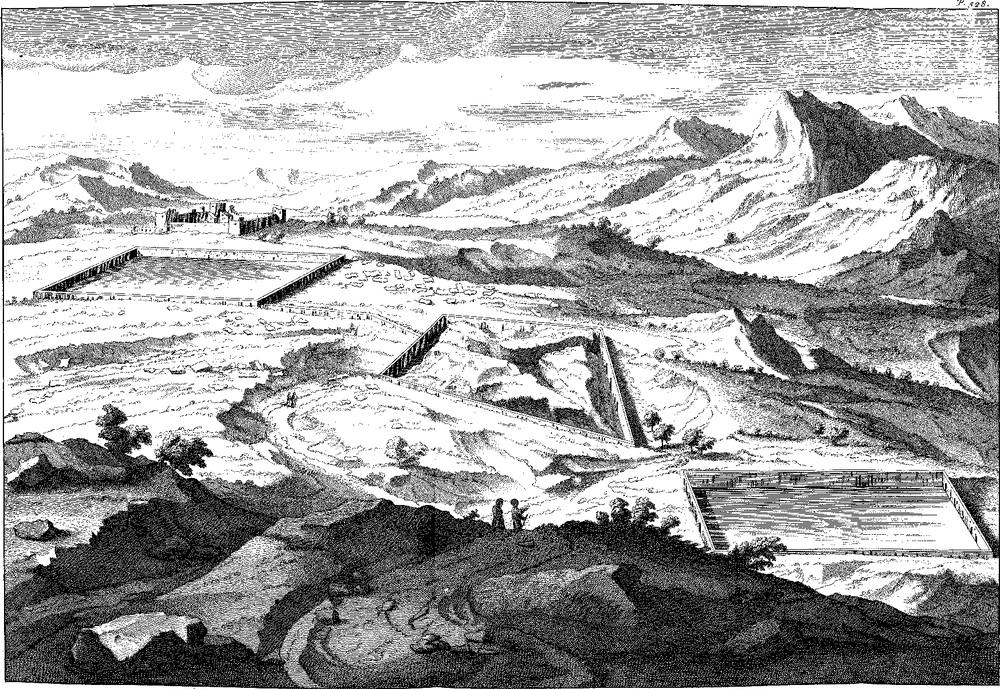
ETAN, Aitham, or Ethan, in the tribe of Judah18. It appears by the second book of Chronicles xi. 6. that Etan lay between Bethlehem and Tekoah. Josephus19 speaks of a place of pleasure called Hethan, at the distance of two Schænos’s from Jerusalem, that is to say, five leagues from that city20, whither Solomon went frequently, because this place was very agreeable for its fine gardens and waters. It was from thence probably, that Pilate some few years before the destruction of Jerusalem, brought water through aqueducts into the city, at great expence; in accomplishing which work, he was forced to take a large compass by reason of the mountains lying in the way21. Travellers speak of the fine
water, and vast basons, that are still at this day to be seen in the neighbourhood of Bethlehem, which the people by tradition believe, and with a great deal of reason, to have been made by Solomon. These basons are a very magnificent work, and the water in them very fine, and in great plenty. There are three basons, the first is two hundred paces long, and an hundred wide; the second is an hundred and ninety paces long, an hundred and fifteen wide, and sixty in depth; the third is two hundred fourscore and nine paces long, an hundred ninetyseven wide, and an hundred and four in depth. The remains likewise of the aqueduct are to be seen, through which this water was convey’d to Jerusalem.
ETERNAL, ETERNITY. These words are often taken for a long time, and are not always to be understood rigorously; Gen. xlix. 26. & Deut. xxxiii. 15.for example, we find eternal mountains, so called to denote their antiquity. God promises a throne to David, an eternal Kingdom, a posterity which will never be extinguished; that is to say, that his and his sons empire will be of a very long duration; that it will be even eternal, if hereby we understand the kingdom of the Messiah. Thus the righteous shall never be moved. Thou shalt be our guide from this time forth and for ever, &c. that is to say, during our whole life.
But Eternity when God is the subject in question, always denotes a real Eternity. Exod. xv. 18. Deut. xxxii. 40.Dominus regnabit in æternum & ultra. And elsewhere, I will lift up my hand to heaven, and swear, saying, I live for ever, eternally. The blessed will enjoy eternal life and happiness, and reprobates be cast into Matth. xxv. 46.eternal fire. The Son of God is called Priest for ever after the order of Melchisedech. His Gospel, the Eternal Gospel. The Redemption Psal. cx. 4 Rev. xiv. 6. Hebr. ix. 12. Hebr. xiii. 20. 2 Cor. iv. 17.which he has procured for us, Eternal Redemption: his blood which he shed for us, the blood of the eternal covenant: the glory and reward which he hath merited for us, an Eternal weight of glory; Æternum gloriæ pondus. The mystery of his incarnation and our salvation, Mysterium temporibus eternis tacitum; the mystery which was kept secret since the world began: it was revealed indeed to the Patriarchs and Prophets, but in an obscure and hidden manner. Eternal tabernacles, or Luke xvi. 9.tents, are the habitations appointed by God in heaven for the predestinate. Wisdom is Eternal, ab æterno ordinata sum: it is Prov. viii. 23. Wisd. vii. 26.brightness reflected from eternal light, &c. Candor lucis æternæ.
ETHAM, the third station of the IsraelitesNumb. xxxiii. 6. Exod. xiii. 20. after their coming out of Egypt. Etham must have lain towards the point of the Red Sea. It is the same perhaps as ters. Buthus, or Buthum. From Etham the Hebrews went to Pihahiroth.
1 Kings iv. 31.ETHAN, the Ezrahite, one of the wisest men of his time: nevertheless Solomon was wiser than he. The lxxviith Psalm bears the name of Ethan the Ezrahite. Ethan the Ezrahite, and Ethan the son of Kishi of the tribe of Levi, and family of Merari, are the same person. He was called 1 Chr. vi. 44.likewise Idithun, and he appears under this name in the beginning of several Psalms. Ethan was one of the principal masters of the Temple-musick.
1 Chr. xv. 17. & seq.ETHAN, the son of Shammah, a Levite of the family of Gershom.
Ethan. validus. fortis.ETHAN; Rivers of Ethan. They are spoken of in Psalm lxxiv. 15. by which either the waters of Ethan above-mentioned are meant, or violent and rapid rivers, according to the import of the Hebrew, Ethan, which signifies strong, high, elevated22. The Jews understand by it such rivers as the Israelites passed in going to the land of Promise. They believe that the river Arnon as well as Jordan was dried up to give a passage to the Hebrews.
ETHANIM, an Hebrew month, 1 Kings viii. 2. In this month the Temple of Solomon was dedicated. After the Jews returned from the captivity, the month Ethanim was called Tizri, which answers to our September.
ETH-BAAL, King of the Zidonians, father of Jezebel, the wife of Ahab, 1 King. xvi. 31.
ETHECA. We meet with this word in Ezekiel xli. 15, 16. Ethecas ex utraque parte centum cubitorum. This word is formed from the Hebrew, Athikim, or Ethikim, which may signify a gallery, portico, or place apart. St. Jerom, who has used this term Etheca in the xlist chapter of Ezekiel, in the xliid chapter, 3, 5. renders it porch; and this is its true signification. Notwithstanding in his Comment he reads Eccheta, and says that this word signifies a balcony. Vide nov. Edit. Hieronym. p. 714.Ecthetas Romæ appellant solaria de cœnaculorum parietibus eminentiâ, sive Mæniana, ab eo qui primus invenit.
Euseb. & Hieronym. in Jether, & Ether. Josh. xv. 42. Josh. xix. 7.ETHER, otherwise Athar, or Jether, twenty miles from Eleutheropolis near Malatha, in the most southern part of Judah. Ether at first was allotted to the tribe of Judah, and was afterwards yielded up to Simeon.
ETHIOPIA, otherwise Abyssinia, one of the greatest kingdoms in Africk. There is frequent mention in the Scripture of Ethiopia: but by this name we are not always to understand Ethiopia properly so called. By Cush, which is translated Ethiopia, we are generally to suppose that
country to be meant, which lies upon the eastern coasts of the Red Sea, and at the point of this sea joining to Egypt. Zipporah the wife of Moses, who was of Midian upon the red Sea, is called a Cushite or Ethiopian. See what we have said concerning the word CUSH, and upon CANDACE, Queen of Ethiopia.
There are three countries different from one another, all called by the name of Cush, which word is generally translated Ethiopia. 1. The land of Cush upon the river Gihon. 2. Cush upon the eastern shore of the Red Sea. 3. The land of Cush situated above Thebais and the upper Egypt; and for want of this distinction, people have fallen into very considerable errors.
Hom. Odyss. l. 2. v. 22.The old profane Authors are no clearer in their acceptation of the word Ethiopia. For, first, they give this name to Ethiopia properly so called. Secondly, to certain people of Arabia, situated upon the Red Sea; whence it is that Homer distinguishes the Ethiopians into eastern and western, some on one side the Nile and of the Red Sea, the others on the other side of the same sea and river. Dionysius the Geographer Dionys. v. 177.and Eustathius speak likewise of the eastern Ethiopians situated towards Arabia. Lastly, they place other Ethiopians in Chaldæa and the Susiana; for Memnon the son of Aurora, who came from Susa to the Trojan Hesiod. Theog. v. 984. Pindar. Olymp. 2. Herodot. l. 7.war, is called in Hesiod King of Ethiopia, and in Pindar, the Ethiopian son of Aurora.
Herodotus mentions two sorts of Ethiopians in Xerxes’s army; the Eastern, who had their abode in Asia, and were reckoned with the Indians, from whom they differed only in their hair and language; they carried the same arms, and wore the skins of horse’s heads in the way of helmets, the ears and manes whereof served them for tufts and plumes of feathers; and instead of bucklers they had the skins of cranes. The EthiopiansIdem. l. 3. of Africk have very frizzled black hair, and those of Asia very long. He says elsewhere, that they make use of bows of great strength and length; that brass is reputed among them the most precious of all metals; that they live very frugally, and reach to a great age. That which more immediately concerns us here, is, that this author takes notice of Ethiopians in Asia, and Ethiopians in Africk.
Idem. l. 2.Herodotus adds, that they of Africk are likewise circumcised as well as the Egyptians; but he does not venture to assure us which of these two people were the first who introduced this practice, because it is very ancient among both. We shall see hereafter, that the Ethiopians acknowledge they received it from the Jews.
When therefore in the sacred text Ethiopia is spoken of, we are to distinguish carefully these several countries and nations, to prevent the being led into a mistake by
Numb. xii. 1. Gen. x. 6.the different meanings of the same word. The Scripture mentions but one man by the name of Cush, who was the son of Ham, and brother of Canaan. Whether the several countries known in the Hebrew text by the name of Cush, and in the Interpreters by that of Ethiopia, were so called from him, we are not able to say. Many are of opinion, that his first and real abode was in Arabia the happy, upon the eastern coasts of the Red Sea; that from thence his descendants passed into Africk, and peopled Ethiopia. Others on the contrary assert, that Arabia went by the name of Ethiopia for no other reason, but because the Ethiopians Bibl. Orient. p. 409. Habasch.subdued it, and continued for a long time in possession of it. But even in the time of Moses, the land which borders on the east side of the Red Sea was then called Cush; and if so, I cannot tell whether any one can prove, that the Ethiopians before this time had conquered this part of Arabia.
Abyssinus. Abyssina regio.Ethiopia properly so called, goes more generally by the name of Abyssinia, which the Arabians derive from Habasch the son of Cush. We have no mention of this Habasch in the bible, nor of Cush, from whom the Mahometans suppose him to be descended; for the Scripture takes notice of but one man by the name of Cush, who was brother to Canaan, and father to Nimrod, Seba, Sabtah, Havilah, Raamah, and Sabtecha; whereas the Arabians make Cush the father of Habasch, son and not brother to Canaan; and certainly it is very probable, that Cush the father of Nimrod and the others just now named by us, who dwelt in Asia, and whose habitation was upon the river Gihon, is very different from Cush the son of Canaan, who peopled part of Arabia Felix, which is Ethiopia properly so called, otherwise named Abyssinia from his son Habasch.
Idem. p. 274.The city of Cos, situated upon the Nile in upper Egypt, and by some confounded with the famous Thebes, took its name from Cush the father of the Ethiopians. The Arabians call them not only Habasch, or Abyssinians, but likewise Cush, or Cousch, in like manner as the Hebrews. The Persians call them black Indians, and they tell us that the Indians, that is to say without doubt the Ethiopians, desired Bishops of Simon the Syrian, the Jacobite Patriarch of Alexandria. The Ethiopians call him Salama, whom the Greeks and Latins name Frumentius, the same who was sent by St. Athanasius to preach the Gospel to them. Till the time of Salama they had circumcision only, which had been taught them by Zadok, High-Priest of the Jews, who was sent to them, as they say, in Solomon’s time, to instruct them in Judaism. This is the account we have from the Ethiopians.
Others believe, that these people received the faith from St. Matthew, or St. Bartholomew, or St. Philip, or Queen Candace’s Eunuch, who was baptized by St. Acts viii. 27.Philip, one of the seven Deacons, not the same with the Apostle of that name; but all these different opinions are founded only on the several meanings of the word Ethiopia. St. Matthew, we are told, preached the Gospel to the Ethiopians above the Araxes, or in the neighbourhood of the Persians. St. Bartholomew preached to the Indians, known by the ancients under the name of Ethiopians; or in Arabia the happy, where, as we have seen, there was a canton called Cush or Ethiopia. Lastly, St. Philip the Deacon, or the Eunuch, might preach the Gospel to Queen Candace’s subjects, who reigned in Arabia, or in the peninsula of Meroë, which is sometimes comprized under the name of Ethiopia.
Habasch or Abyssinian, the name whereby the Ethiopians are called, signifies properly a mixture of divers nations collected and united together. It comprehends the Abyssinians, Nubians, and Pongians. The Arabians gave them this name, which the Ethiopians for a long time rejected, and do not yet assume in their books. They call themselves Ethiopians, and their country, the Kingdom of Ethiopia, or Becra Agazi, the land of liberty, or otherwise, people who have decamp’d, to shew that they came out of Arabia the happy, which is ancient Ethiopia, or the old land of Cush, to transplant themselves into the country which they are at this day possess’d of. Their remove to this new habitation fell out, according to Eusebius, during the servitude of the Israelites in Egypt, or about the time of Joshua and the Judges, according to Syncellus. But if this be so, it must be owned, that there still remained a great number of them in Arabia, for some of them we see were there long afterwards.
Gen. ii. 13.The Abyssinians are Moors, black or of an olive colour, according to the different provinces which they inhabit; it is said they are born white, with a little black spot upon their navel, which in a short time after their birth, spreads over their whole body: when they are transported into Europe, they become white at the second or third generation.
There is frequent mention in the Scripture of Ethiopia and Ethiopians. Moses says, that Gihon, one of the four rivers in Eden, compasseth the land of Ethiopia; that is to say, the country which is watered by the Araxes, the ancient dwelling of the Scythians, or Chutes, or Chutæans. We read in Numbers, that Moses Numb. xii. 1.married an Ethiopian, that is to say, Zipporah the daughter of Jethro Priest of Midian, in the land of Cush, upon the eastern shore of the Red Sea. In the second book of Kings, we see 2 Kings xix. 9.Tirhakah King of Ethiopia came against Sennacherib’sJob xxviii. 19. army. This Tirhakah was Esth. i. 1. viii. 9. xi. 1.a King of Ethiopia or Arabia, in the sense wherein we have been explaining it. The topaz of Ethiopia, spoken of by Job, came from the red sea and the land of Cush, which is in Arabia the happy. Zerah King of Ethiopia, 2 Chron. xiv. 9.who marched against Asa King of Judah, with two hundred thousand men and three hundred chariots, reigned in the same country. Hab. iii. 7.Habakkuk speaks of the tents of the Ethiopians and Midianites, which were under affliction when the Lord appeared at Sinai. We have already observed, that Zipporah, who was a Midianite, is called an Ethiopian. Midian was therefore in the land of Cush, which we are speaking of, in Arabia the happy, upon the coast of the red sea.
King Ahasuerus in Esther reigned from the Indies to Ethiopia, that is to say, as far as the present Abyssinia: for Herodotus says this country paid tribute to Darius the son of Hystaspes. Nebuchadnezzar, of whom there is Judith i. 9.mention made in Judith, sent Ambassadors into Palestine, to the land of Gesem, and as far as the frontiers of Ethiopia: probably Ethiopia properly so called, to the south of Zeph. iii. 10. Isa. xviii. 1.Egypt. Zephaniah says, the Lord will be worshipped in places beyond the rivers of Ethiopia; ultra flumina Æthiopiæ inde supplices mei. And Isaiah says, Wo to the land shadowing with wings, which is beyond the river of Ethiopia. Væ terræ cymbalo alarum, quæ est trans flumina Æthiopiæ. Expositors are divided in their opinions concerning these rivers of Ethiopia, or Cush. They cannot be the rivers of Arabia, for there are no considerable ones in this country. It seems out of all question, that the prophet Isaiah by the land which is beyond the rivers of Ethiopia, intended to describe Egypt. These rivers therefore are the Nile, and the several parts of it, which run through lower Egypt. This country with regard to Judea was beyond the Nile, for there was no going into any place of the Delta, without crossing some arm of the river, and there were canals cut through all lower Egypt. These rivers came from Ethiopia; we know the source of the Nile is in this country.
Psal. lxviii. 32. Isa. xx. 3.Hezekiah sent Ambassadors to the King of Egypt, desiring his assistance, according to Isaiah, against Sennacherib; and the prophet Zephaniah foretold, that the Egyptians would one day come and perform their adorations to the Lord. Both these prophets describe Egypt only by the country which lies beyond the rivers of Ethiopia. The Psalmist in like manner prophesied, that Egypt and Ethiopia should come and pay their homage to the Lord. Princes shall come out of Egypt, Ethiopia shall soon stretch out her hands unto God. Isaiah foretold the captivity of Egypt and of the land of Cush, or Ethiopia; which we may explain either of the eastern Ethiopia,
situated in Arabia; or the western, lying to the west of the Red Sea, and south of Egypt. The same prophet says, that God will recall his people who are dispersed in Assyria, Egypt, Ethiopia, and in the canton of Pathros. In this place we may suppose, either Ethiopia properly so called, to be meant, or the land of Cush upon the Araxes. He says elsewhere, that the Lord hath delivered Egypt, Ethiopia, and Seba, in order to redeem the Israelites; which may be explained of the Ethiopians in Arabia, because they are join’d with Seba, another people in Arabia the happy. The same thing must be said of this other passage in Isaiah, The labour of Egypt, and merchandize of Ethiopia, and of the Sabeans, men of stature shall come over unto thee, they shall surrender themselves to thee.
Ethiopia properly so called is described Ezek. xxix. 10. See the Hebrew.to us in the following passages; I will make the land of Egypt utterly waste and desolate, from Migdol as far as Syene, in the confines Jerem. xiii. 23. Psal. lxxiv. 14.of Ethiopia. And Jeremiah, Can the Ethiopian change his skin? And the Psalmist, Thou breakest the head of the dragon, of the leviathan, the crocodile, in pieces, and gavest him to be meat to the people of Ethiopia. This is interpreted as relating to the people of Tentyra in upper Egypt, who were declared enemies to the crocodile, and eat it; whereas the Egyptians paid divine honours to it. Jeremiah joins the Cushim with the Libyans. Procedant fortes Æthiopia, & Lybies tenentes arcum. Dan. xi. 43.Daniel in like manner mentions them together; Per Libyam & Æthiopiam transibit: which can be naturally explained only of the Ethiopians or Abyssinians. See also Ezekiel xxx. 4, 5. where these people are put together as neighbours. Queen Candace’s Eunuch was of the same country. But by all these passages it appears, that under the name Cush, not only Ethiopia was comprehended, which is higher than Syene and the Cataracts, but likewise a part of Thebaïs.
ETHNARCH, that is to say, the Prince of some nation, depending upon a superior King. Archelaus the son of Herod, was called Ethnarch of Judæa by Augustus. Antiq. lib. 7. c. 13.
ETHNI, or Athenai, a Levite, and Musician in the time of David. 1 Chron. vi. 41.
EVANGELIST. This word signifies one, who publishes good news. They therefore who write, as well as they who preach the Gospel of Jesus Christ, are called Evangelists, and in general all they who declare any happy tidings. In Isaiah the Lord says, that he will give to Jerusalem one that bringeth good tidings, or an Evangelist, an Ambassador, a Prophet, an Envoy, one who shall declare what God shall please to reveal to him. In the Acts, Philip, one of the seven Deacons, is called an Evangelist. St. Paul speaks of the Evangelists, and ranks them below the Apostles and Prophets. He speaks to Timothy, exhorting to perform the duty of an Evangelist. In the beginning of Christianity, there were Evangelists and Preachers, who without being fixed to any Church, went and preached wherever they were led by the Holy Spirit. Lastly, we most commonly call Matthew, Mark, Luke, and John, Evangelists, who are the authors of the four Gospels, which only are acknowledged by the Church to be Canonical.
EUBULUS, St. Paul’s disciple, mentioned in the second Epistle to Timothy iv. 21. He is honoured by the Greek Church upon the 28th of February.
EUCHARIS. This word, according to the import of the Greek, signifies, courteous, agreeable. We meet with it in Ecclesiasticus vi. 5. Lingua Eucharis in bono homine abundat. The Greek reads Eulalos, a wellspoken person, instead of Eucharis.
EUCHARIST, a word particularly set apart in the Catholick Church to signify the Sacrament, which really and in truth contains the body and blood of our Saviour Jesus Christ, under the appearances of bread and wine consecrated at the sacrifice of the mass . It is called Eucharist, because Jesus Christ in the institution of this divine sacrament, gave thanks to God, broke the Matth. xxvi. 27.bread, and blessed the cup. Now Eucharistia in Greek, signifies thanksgiving, and answers to the Hebrew, Barach to bless, Benedicere.or Hodah to praise.
EVE, the name of the first woman. Chavva in Hebrew is derived from the same root as Chajim23, Life; because she was to be the mother of all living. God having created man, said, It is not good for man to be alone; let us make him an help-meet for him. He cast him therefore into a sound sleep, and while he was in this condition, God took out one of his ribs, made a woman of it, and brought her to Adam. Then
Adam said, Behold now the bone of my bones, and flesh of my flesh, therefore shall she be called Ischa, that is to say, human, because she was taken out of man. For this reason shall a man leave his father and mother, and shall cleave unto his wife, and they shall be one flesh. She is believed to have been created upon the same day as Adam, that is to say, the sixth of the creation, and after Adam had made a review of the Animals, which God had created, and over which the Lord had given him the inspection and dominion.
Adam and Eve were placed in Paradise immediately after their Creation, and God forbad them to touch one particular fruit, threatning them with death if they disobeyed. They continued there some days in innocence and simplicity; were naked, without blushing at their nakedness. But the Devil, who envied their happiness, assumed the form of a Serpent, or rather, concealed himself in a real Serpent, and appearing before Eve, said to her, Why does Genes. iii. 1, 2, &c.not God permit you to eat indifferently of all the fruits of this garden? Eve replied, that God had forbidden her to touch one certain tree, lest they should die, and of all the rest they were allowed to eat freely. But the Serpent answered, Ye shall not surely die: for God doth know, that in the day ye eat thereof, then your eyes shall be opened; and ye shall be as Gods, knowing good and evil. Thus he would have had God thought to be a lyar: one that envied his creatures perfection and happiness; and threatned them with a misfortune, which they had no reason to apprehend.
The woman therefore seeing this fruit was good to eat, and fair to the eye, took thereof, and did eat of it, and gave also to her husband, and he did eat. Hereupon their Eyes were opened, and they discerned their nakedness, which they cover’d with fig-leaves, and hid themselves among the trees of the garden. There God found them, reproached them with their disobedience, and said to Eve, I will greatly multiply thy sorrow, and thy conception; in sorrow thou shalt bring forth children, and thy desire shall be to thy husband, and he shall rule over thee. After this God cloathed Adam and Eve with skins, and drove them out of Paradise. Now Adam knew his wife Eve, and she conceived and brought forth Cain, saying, By God’s assistance iv. 1, 2, 3, &c.I have gotten a man. She afterwards had Abel and some daughters, and last of all Seth. The Scripture names only these three sons of Adam and Eve; but sufficiently evidences that they had many more, in that passage where it says, that they had Gen. v. 4.sons and daughters. The particular year of Eve’s death is not known. It is presumed that she died about the same time as Adam, towards the nine hundred and thirtieth year of the world.
The Eastern people have paid some honours to Adam and Eve, as to Saints. The Greeks observe their Festival, or the Commemoration of them, upon the 19th of November. The Maronites likewise commemorate Vide Bona de Rebus Liturg. l. 2. c. 12.them in their Liturgy. Peter Natalis has put Adam and Eve in the front of the Saints, who lived in the first age of the world, in the week which we call Septuagesima, after the 22d of January. See the Epiphan. hæres. 26. n. 2, 3.Article of ADAM. Epiphanius says, that the Gnosticks composed a writing under the name of the Gospel of Eve, wherein were contained a thousand ridiculous and immodest things. There were other Hereticks Epiphan. hæres. 40. c. 5.who said, that Eve had Cain and Abel, not by her husband, but my a monstrous conversation with the Devil. The Manichees24 maintained, that Adam and Eve were not created by God, but owed their original to Sada and Nebroda, Princes of impurity. The Indian Brachmans believe, that the sin of the first man consists in the carnal knowledge which he had of Eve, whom the Devil presented to him. See Fabricius, Apocryph. V. Test. p. 101, 102. Some have mentioned a book intitled, The Prophecies of Eve, which is said to have been composed by the Angel Raziel, Adam’s Preceptor.
The Mahometans pretend that Eve called her eldest son Abd-al-hareth, that is to say, a Gardener’s or Husband-man’s son, or servant, because Adam was the first who cultivated the earth, according to what is Gen. ii. 15.said in Genesis, that he was put into the garden to dress it and keep it. They still at this day reverence Eve’s grotto, in mount Gerahem, three miles from Mecca. Mount Arafat, at ten miles distance from Mecca, borrowed its name from the adventure of Adam and Eve’s meeting, and discovering themselves to one another in this place, after a long absence. They believe that the tomb of this first of womankind is at Gidda, upon the Red Sea, two days journey from Mecca, whereof it is, as we may say, the harbour. They maintain farther, that the waters of the Deluge began to spring, or issue out of Eve’s oven, which had been preserved to that time, and had passed from hand to hand down to Noah.
EUERGETES. A Greek word, which signifies beneficent. This is the surname of two Kings of Egypt, Ptolemy III. and IV.
EVI, one of the Princes of Midian, who were killed in the war, which Moses carried on against them. Numb. xxxi. 8. In
the year of the world 2553. before Jesus Christ 1447.
EVILMERODACH, the son and successor of Nebuchadnezzar the Great, King of Babylon25. He first of all governed the Kingdom during the indispostion of his father, who was possessed with a strange fancy of his being metamorphosed into an Ox. But after seven years, the King having recovered his understanding, and his imagination being cured, he once more ascended the throne, and Evilmerodach, as some believe, was imprison’d by his In the Year of the World 3435, before J. C. 565, before the Vulg. Æra 569. || Dan. iv. 31, 33. In the Year of the World 3443, before J. C. 557, before the Vulg. Æra 561. 2 Kings xxv. 27. Jerem. lii. 31. In the Year of the World 3444, before J. C. 556, before the Vulg. Æra 560.father . In this confinement Evilmerodach made an acquaintance and friendship with Jehoiakim King of Judah, who had been carried to Babylon by Nebuchadnezzar; so that immediately after the King’s death, Evilmerodach being on the throne, he delivered Jehoiakim out of prison, heaped many favours on him, and placed him above all the other Kings, who were at the court of Babylon.
The Hebrews, and after them St. Jerom, and several other interpreters tell us26, that Evilmerodach, after the death of his father, observing that the first men in the Kingdom made a scruple of acknowledging him, fearing lest Nebuchadnezzar should be still living; he, to convince them that the King was certainly dead, ordered him to be taken out of his grave, and dragged through the streets in the view of all the world. Others add, that Jehoiakim persuaded him to take his father out of the ground, to cut his body in pieces, and give them to three hundred ravens, lest he should return from his grave, as he had before recovered after his metamorphosis into an Ox.
Evilmerodach reigned but one year, according to our Chronology27, and was immediately succeeded by his son Belshazzar. Josephus says, he was succeeded by Neriglissar, then by Laborosoarchod, and lastly by Belshazzar, whom we are here speaking of. And the succession of these Princes is related in the same order by St. Jerom, and some others. This is not a proper place to examine this difficulty with accuracy. See our Discourse upon the Great Monarchies of the East, prefixed to Isaiah, and our Comment upon Daniel v. 1. pag. 627, 628, 629. and our History of the Old Testament.
EULÆUS. The river Eulæus. See hereafter Ulai.
EUMENES, King of Bithynia and Pergamus, spoken of in the first book of Maccabees, chap. viii. 8. Having joined his with the Roman arms, in the war made by this people against Antiochus the Great, he received for his reward the country of the Indians, Medes, and Lydians. Thus the text of the Maccabees; but it is very probable that we should read, the Ionians, Mysians, and Lydians. See our Comment on 1 Macc. viii. 8.
EUNICE, the mother of Timothy; she was a Jewess by birth, but had been married to a Heathen, who was Timothy’s father. Eunice had been converted to Christianity by some other Preacher, not by St. Paul; for when the Apostle came to Lystra, he found there Eunice and Timothy already far advanced in grace and virtue.
EUNUCH, comes from the Greek, Eunouchos, which signifies one who guards the bed; because generally in the courts of the Eastern Kings, the care of the beds and apartments belonging to Princes and Princesses, was committed to them; but chiefly of the Princesses, who live, as is well known, in great confinement, remote from the sight and company of men. The Hebrew word Saris signifies a real Eunuch, whether he be naturally born such, or made an Eunuch by manual operation. But this word very often, as well as the Greek Eunouchos, and the Latin Eunuchus, is in Scripture taken for an Officer belonging to some Prince, attending at his court, and imployed in the inner part of the Palace, whether he be really an Eunuch or not. It was a name that denoted some office and dignity, and in the Persian and Turkish Courts, the principal imployments there are still at this day possessed by real Eunuchs28. Potiphar, Pharaoh’s Eunuch, and Joseph’s master, had a wife and children.
God forbad his people to make Eunuchs, and to cut even beasts; in Deuteronomy it is said, He who has that part wounded or cut off which is intended for the preservation of the species, shall not enter into the congregation of the Lord. Which words are differently explained. Some29 think that God hereby forbids Eunuchs to marry with Israelites30; others, that God forbids them to enter into his Temple; others again31, that he excludes them from all offices in the magistracy. But it is more credible, that God debars them simply the possession of some outward privileges belonging to the Israelites and people of the Lord. They were looked upon in the Common-wealth as dry and useless wood: Behold
Eunuch continues on the next page
Footnotes
-
Translators’ note. Esar-haddon, in the opinion of Sir Isaac Newton, seems to be the Sardanapalus, who died, as Clearchus says, of oldage after the revolt of Syria; the name Sardanapalus beigng derived from Asserhadon. Pul. Chronology, &c. p. 285. ↩
-
Translators’ note. The Author is here mistaken. Esau is not said to have married the daughter of Nebajoth, but the daughter of Ishmael, who was the sister of Nebajoth. בת ישמעאל אחות נביות ↩
-
Translators’ note. Some of the ancient Fathers, says Dr. Prideaux in his Connect. &c. hold, that all the Scriptures were lost and de- stroy’d in the Babylonish Captivity, and that Ezra restored them all again by divine revelation. Thus saith Irenæus, and Tertullian, Clemens Alexandrinus, Basil, and others say the same. But they had no other foundation for it, than that fabulous relation, which we have of it in the 14th Chapter of the second apochryphal book of Esdras, a book too ab- surd for the Romanists themselves to receive into their Canon. All that Esdras did in this matter, was, 1. He corrected all the errors that had crept into the copies of the sacred Writings through negligence, or mistake of the transcribers. 2. He collected all the books of which the holy Scriptures then consisted; disposed them in their proper order, and settled the Canon of Scripture for his time. 3. He added throughout the books of this edition, what appeared necessary for the il- lustrating, connecting, or compleating of them, wherein he was assisted by the same Spirit, by which they were at first wrote. 4. He changed the old names of several place grown obsolete. 5. He wrote out the whole in the Chaldee character. 6. Whether he added the vowel Points, is an harder question. ↩
-
Translators’ note. The Massorites were a set of men, whose profession it was to write out Copies of the Hebrew Scriptures, and to criti- cize upon them, and also to preserve and teach the true readings of them; and what they observed and taught in order hereto, is by the Jews called Masorah. Prid. Connect. &c. P. 1. B. 5. ↩
-
Translators’ note. Some Roman Catholick Authors notwithstanding, have declared their opinion, that this Impostor was divinely inspired; of this number was the celebrated Pico di Mirandola (Picus Mirand. Apol. p. 82. T. 1.). And altho’ the Romish Church acknowledges this book to be spurious and apocryphal, yet in some of its most solemn Offices it speaks in the language of this Writer (Missa in Ferias post Pentecost. Miss. Rom. p. 316). ↩
-
Translators’ note. St. Jerom’s opinion both of this, and the fourth book of Esdras, is expressed very clearly in several places of his works. Nec apocryphorum tertii & quarti (Esdræ) somniis delectetur. And writing against Vigilantius, he speaks with great contempt of the fourth Book of Esdras, Tu, says he, to this Heretick, vigilans domis, & dormiens scribis & proponis mihi Librum apocryphum qui sub nomine Esdræ, a te, & a tui similibus legitur, &c. ↩
-
Translators’ note. See the Author’s account of this Book under the article Maccabees. ↩
-
Epiphan. hæres. 29. de Nazaræis, c. 4. p. 120. ↩
-
1 Macc. ii. 42. Synagoga Assidæorum. 2 Macc. xiv. 7. & xliv. 10. p. 785, & seq. Vide & Philo lib. quod omnis probus liber, p. 876. ↩
-
Joseph. de Bello, l. 2. c. 12. ↩
-
Translators’ note. Herein declining a conformity with the more delicate and effeminate part of the Eastern People, who after their frequent bathings, made use of sweet- scented oyl. ↩
-
Translators’ note. From this passage of Josephus it has been imagined by some, that the Essenians worshipped the Sun; if so, Philo and Josephus could never have said so many things in commendation of them. Their custom was when they said some particular prayers, to turn themselves towards the Sun; and this is the meaning of Josephus. The Religion of these people consisted chiefly in the worship of God, and a respect for the supreme Being, with which the substitution of any sensible Deity, and the adoration of the Creature, is no way reconcilable. The King therefore came, and Haman with ↩
-
Translators’ note. A name of a Persian original, says Dr. Prideaux, the signification whereof is not known. it ↩
-
Translators’ note. Maimonides asserts, that when the Messiah comes, he will destroy the writings of the Prophets, and the Hagiographa, but will preserve the history of Esther, that it may be read as long as the world endures. Basnage Histoire des Juifs, t. vi. c. 17. ↩
-
Translators’ note. In our printed Greek copies we find this at the end, which our author says is at the beginning of the book of Esther. ↩
-
Epiphan. de ponderibus & mensur. Aug. de Civit. l. 18. c. 36 Isidor. origin. l. 6. c. 2. ↩
-
Talmud in Baba Batra, c. 1. Rabb. plures. ↩
-
Vide Græc. Alex. Josh. xv. 60. 1 Chr. iv. 32. 2 Chr. xi. 6. Joseph. Antiq. l. viii. 3. ↩
-
Joseph. Antiq. l. viii. c. 2. p. 272. ↩
-
Herodotus says, the Schænos was sixty furlongs, or 7400 paces. ↩
-
Joseph. lib. 2. de bello, c. 13. ↩
-
Translators’ note. Accordingly in the English version it is translated mighty wa- ↩
-
חוהEva. חייםVita, a radice חיהVixit. Vide Genes. iii. 20. ↩
-
Anathematism. contra Manich. apud Coteler. ad Hæres. 46. ↩
-
Translators’ note. He proved a profligate and vicious Prince, and for that reason was called Evilmerodach*, that is to say*, Foolish Merodach*: for his proper name was only* Merodach. ↩
-
Hieronym. in Isai. xiv. 19. Haimo & Hugo in Isai. xiv. Hist. Scholast. in Dan. v. Tostat. in 4 Reg. xxv. ↩
-
Translators’ note. According to Dr. Prideaux*, two years, and was succeeded, as* this Author says, by Neriglissar his Sister’s Husband, who had been at the head of the Conspiracy formed against him. Connect. P. 1. B. 1. ↩
-
Translators’ note. Heliodorus says, that the Eunuchs who served in the Persian Court, were the King’s Eyes and Ears; intimating hereby the authority of the first, and the great confidence which these Monarchs placed in them. ↩
-
Rab. Salom. Abenezra. Abarb. Lyr. Vet. &c. Gerard. Bonfrer. Tir. ↩
-
Philo de victimas offer- entib. ↩
-
Muis, Jun. ↩