Volume I, pages 497–515 of the 1732 edition, from ELI to EPO: everything printed on these pages, in order.
Continued from Elioneus
Ananus, in the year of the World 4047, and the next year was himself succeeded by Simon Cantharus.
ELIPHAL, the son of Ur, one of the brave officers, who commanded in David’s army. 1 Chr. xi. 35.
ELIPHALEH, a Levite who assisted at the removal of the Ark to Jerusalem. 1 Chr. xv. 18, 21.
I. ELIPHALETH, the son of David, 2 Sam. v. 16. There is another besides this person of the same name, 1 Chr. xiv. 7.
II. ELIPHALETH, the son of Eshek, 1 Chron. viii. 39.
Job ii. 11, &c.I. ELIPHAZ, the son of Esau and Adah, the daughter of Elon. He had five sons, Teman, Omar, Zepho, Gatam, and Kenaz.
II. ELIPHAZ, one of Job’s friends, probably one of the descendants of Eliphaz the son of Esau.
Luke i. 5.ELISABETH, the wife of Zechary, and mother of John-Baptist. St. Luke says, that she was of the daughters of Aaron, that is to say, of the race of the Priests. But all that is said of her father and mother is by no means certain. So much we know, that the Angel having declared to Zechary the future birth of John the Baptist, and Zechary returning to his own house, Elisabeth conceived. The Greek Church makes a festival of St. John’s conception in the womb of his mother, and observes it on the 23d of September, and it is set down on the 24th of the same month in the most ancient Latin Kalendars. Elisabeth for five months concealed the favour which Luke i. 24, 25. Luke i. 36, 37.God had done her; but the angel Gabriel discovered it to the Virgin Mary, and revealed this miraculous conception to her, as an earnest and assurance of the birth of the Messiah, whose mother she was to be, without having conversation with any man.
Immediately Mary with great diligence prepared to go to Hebron, there to visit her cousin Elisabeth. As soon as she came into Zechary’s house, and had saluted her, the child, which Elisabeth was big with, leaped in her womb; and Elisabeth full of the Holy Ghost, said, Blessed art thou among women, and blessed is the fruit of thy womb. Whence does this happiness proceed, that the mother of my Lord should come to me? for as soon as the voice of thy salutation sounded in my ears, the babe leaped in my womb for joy. Blessed is she that believed, for there shall be a performance of those things, which were told her from the Lord. Mary continued three months with Elisabeth, and was in all probability a witness to those wonders, which happened at the birth of this holy forerunner of our Saviour. For when the child was to be circumcised upon the eighth day, as some gave him the name of Zechary, his mother answered, that his name was John. A sign was made to Zechary, who ever since the Angel’s appearance to him, had been dumb; and he calling for a table-book, wrote, His name is John: and immediately the string of his tongue was loosed, and he began to praise God.
The eastern people1 believe, that Herod having resolved upon the death of Zechary’s son and the infants of Bethlehem, his mother Elisabeth carried him to the mountains, in order to conceal him there; but finding herself not able to climb up, she addressed herself to the mountain, and said, Thou mountain of God receive me and my child; whereupon it immediately opened, received them both, and hid them. The Angel of the Lord was present as a guard to them, and they were surrounded with light. In the mean time Herod sent to Zechary, and enquired of him, where his son was: Zechary refusing to declare this secret to him, this Prince commanded him to be killed, in the Temple, between the Altar of Burnt-sacrifices, and the Porch of the Temple. This is what we read more at length in St. James’s Proto-evangelium, or preparatory Gospel, and in other ancient monuments, which the Church has not received as authentick As to the relation between the Virgin and Elisabeth, there can be no difficulty concerning it; for although Elisabeth was of the Tribe of Aaron, and Mary of that of Judah, they might notwithstanding be very near akin, whether any relation of Mary, of the Tribe of Judah, had married, for example, Elisabeth, or Elisabeth’s father had married any woman of the Tribe of Judah related to Mary. No Law obliged the Jewish Priests to marry women only of their own Tribes, nor forbad women of the sacerdotal families to marry men of any other Tribe than that of Levi. There was only one case, wherein women were compel’d to marry in their own Tribes, and that was, when for want of Numb. xxvii. 1, 2, & seq. & xxxvi. 1, 2, 3, -6. Epiphan. de vita & morte Proph. Eufeb. & Hieronym. in Abelmeüla.brothers they were heiresses in their respective families.
ELISHA, the son of Shaphat, Elijah’s disciple and successor in the prophetick Ministry, was of the City of Abel-meholah, which some place beyond Jordan, in the Tribe of Reuben; but it was much more probably on this side of the river we have named, in the Tribe of Manasseh, ten miles from Scythopolis, towards the south, in the great plain which lies along the river Jordan. Elijah having received God’s command to anoint 1 Kings iv. 12. & xix. 16, 17, &c. Judg. vii. 22, 23.Elisha, the son of Shaphat, and constitute him a Prophet, came to Abel-meholah; and having found Elisha plowing with twelve pair of oxen, he came near to him, and threw his mantle over his shoulders. Elisha immediately
left his oxen, and ran after Elijah, and said, Give me leave, I intreat you, to go and embrace my father and mother, and when this is done, I will follow you. Go, says Elijah, and return; for I, for my part, have done all I had to do. After this, Elisha killed a yoke of oxen, dressed the flesh of them with the wood belonging to the plow, and gave unto the people, and they did eat: then he arose and followed Elijah.
In the year of the World 3108, before J. C. 892, before the Vulgar Æra 896.We have observed already in the Article of ELIJAH, how Elisha was following his master, when the Lord took him up in a whirlwind, and removed him from the sight of mankind; and how he inherited Elijah’s cloak, together with a double portion of his Spirit2. As soon as he came to the banks of Jordan with Elijah’s mantle, he smote the waters with it, which at first did not divide: whereupon Elisha said, Where is now the God of Elijah? and striking the waters a second time, they separated on both sides, and he passed over. Upon the sight of this miracle, the sons of the Prophets discerned, that the Spirit of Elijah had rested upon Elisha, prostrated themselves before him, and acknowledged him to be his successor.
In the year of the World 3109, before J. C. 891, before the Vulgar Æra 895.When he came to Jericho, the inhabitants told him, that the situation of their city was very commodious, but their water was bitter, and the land barren. Elisha hereupon called for a new cruse, and ordered salt to be put into it. When this was done, he went to the fountain of Jericho, threw the salt into the water, and made it healthy and drinkable, as it is at this day. As he was going afterwards to Bethel, the children of the place ridiculed him, saying, Go up thou bald pate, go up thou bald pate. Elisha cursed them in the name of the Lord; and at the same time two bears came out of a neighbouring forest, and devoured two and forty of them.
The Kings of Israel, Judah, and Edom having taken the field against the King of Moab, who had revolted from the King of 2 Kings iii. 1, 2, &c.Israel, marched into desart places, where they were distressed for want of water, and their army was in danger of perishing. The three Kings therefore went to Elisha, who was at that time luckily in the camp. Elisha seeing Jehoram the King of Israel, What have I to do with thee, said he? get thee to the Prophets of thy father, and to the Prophets of thy mother: and added farther, As the Lord liveth, were it not out of respect to Jehoshaphat the King of Judah, who is here present, I would not so much as look on thee. But now send for one who plays upon the harp; and while this man played, the Spirit of God fell upon Elisha, and he said, Thus saith the Lord, make several ditches all along this valley, for ye shall see neither wind nor rain, yet this valley shall be filled with water, and you and your cattle shall drink of it. As he had foretold, so it happened the next night.
About the same time, the widow of one of the Prophets, came and told Elisha, that her husband’s creditor was determined to take her two sons and sell them, or make them slaves. Elisha multiplied the oil which was in this widow’s house, so that she had enough of it to discharge the debt.
Elisha went very frequently to Shunem, a city in the Tribe of Manasseh, on this side Jordan, and a certain matron was used to receive him, and give him entertainment at her house. As she had no children, Elisha promised her from God, that she should be delivered of a sonb. His prediction was soon followed with the effect. But some years after the child diedc. Elisha was then at mount Carmel; the mother of the child run thither, and was determined not to leave the Prophet, till he came to her house: thither therefore he went, and restored the child to life, by praying over him, and stretching himself upon him, in order to recover warmth in him.
Elisha being at Gilgald during a great faminee, one of the sons of the Prophets had an inclination to prepare something for his brethren to eat; and going into the field, he gathered his lap-full of wild gourds, and having put them in the pot, they were served up to Elisha and the other Prophets; but as soon as they had tasted of them, they cried out, that what was put before them was mortal poison. Elisha therefore ordered meal to be brought to him, threw some into the pot, and they perceived no more bitterness in that which they had complain’d of.
About the same time he multiplied twenty loaves of barley, and satisfied above an hundred persons with them.
Naaman, General of the King of Syria’s troops, having a leprosy, was advised to go to Elisha, in order to be cured of it. Elisha, without going out of his house, appointed him to go and wash himself seven times in the river Jordan, and he should be cleansed. Naaman, out of humour with this proposal, resolved upon returning: but his people represented to him, that what the Prophet required of him being so easy, he should at least try whether the waters of Jordan would cure him. He went therefore and bathed himself seven times, and was perfectly healed. After this he returned to Elisha, and offered him great presents; but the man of God resolutely refused them. Naaman desired therefore permission to load two mules with
the earth belonging to the land of Israel, protesting that for the future he would have no other God but the Lord. He added, I entreat you to ask God’s pardon for me, if when my master goes into the house of Rimmon, there to pay his adorations, leaning, as is his custom, on my hand, I too go in, and there worship with him. The Prophet replied, Go in peace. And Naaman departed.
Some Interpreters3 translate Naaman’s request as relating to what was past. I entreat you to pray to God for me: if, when the King my master has gone into the house of Rimmon there to worship, leaning at the same time on my hand, I too at the same place have worshipped with him; if I have done this, the Lord pardon thy servant in this thing. So that, in this sense, Naaman would have asked pardon for some fault before committed, and not permission for any future action; which indeed seems to us much the most probable.
2 Kings vi. 1, 2, 3.Gehazi, Elisha’s servant, did not imitate the disinterestedness of his master. He ran after Naaman, and in Elisha’s name begged a talent and two changes of garments. 2 Kings v. 20, 21, & seq.Naaman gave him two talents, and two suits of clothes, and ordered his own people to carry them as far as the city. Then Gehazi received them, and concealed them in his house. But Elisha, to whom God had discovered Gehazi’s action, reproached him with it, and told him, that Naaman’s leprosy should always cleave to him and his family. Accordingly at that very instant, Gehazi was struck with a leprosy, and departed from Elisha.
The sons of the Prophets going one day to cut wood upon the banks of Jordan, one of them let the head of his ax fall into the water. But Elisha cutting off a piece of wood, and putting it in the water, immediately the iron of the ax swimming upon the surface of it, came and fastened itself upon the wood.
In the Year of the World 3115, before J. C. 885, before the Vulgar Æra 889.The King of Syria was at war with the King of Israel, and never could imagine how all his designs came to be discovered and prevented by the enemy. He was told that the prophet Elisha revealed every thing to the King of Israel. Benhadad sent troops therefore to seize the Prophet while he was at Dothan: but Elisha struck them with a kind of blindness, so that he led them, without their discovering it, into the very city of Samaria. When they were there, he prayed to God to open their eyes, made them eat and drink, and sent them back to their master.
before the Vulgar Æra 885. 2 Kings vi. 24, 25. In the year of the World 3119, before J. C. 881,Some time after, Benhadad King of Syria, having besieged Samaria, the famine 2 Kings vii. 1, &c. b 2 Kings viii. 7, 8. c In the year of the World 3007. See 1 Kings xix. 15.was so great there, that the head of an ass was sold for fourscore pieces of silver, and the fourth part of a very small measure of a sort of parched peas, called Dove’s-dung, for five shekels; and a certain mother eat her own child. Jehoram, King of Israel, believing that Elisha could put a stop to this famine if he pleased, and imputing to him the calamities which it produced in the city, sent people to cut off his head. The Prophet had a revelation of his design, and ordered the door to be shut. The King’s messenger was scarce arrived before Elisha’s house, when the King himself appeared there, and made great complaints to him of the condition which the town was in. To this Elisha answered; Hear the word of the Lord, to-morrow at this same hour shall a measure of fine flour be sold for a shekel at the gate of Samaria, and two measures of barley at the same price. One of the King’s officers hereupon replied, Were the Lord to open the cataracts of heaven, and rain down provisions, is it possible that what you say could prove true? Elisha answered, You shall see it with your own eyes; but shall not partake of this plenty. Accordingly the next night, the Syrians raised the siege, and it fell out according to Elisha’s prediction.
At the end of the seven years famine, which this Prophet had foretold, he went to Damascus b to execute the command which God had given to Elijah many years before c, of declaring Hazael King of Syria. At that time Benhadad King of Syria was indisposed; and his people having told him, that Elisha was in the country, he sent Hazael to him, one of his principal officers, to consult him, and enquire of him, whether it were possible for him to recover. Elisha answered Hazael, Go, tell Benhadad, that he shall be cured of his disease; but the Lord hath discovered to me, that he shall surely die: and continuing for some time without saying a word, he shed tears, and his countenance seemed to be changed. Hazael asked him, Why does my Lord weep? Elisha replied, because I know how many calamities you will bring upon Israel. You will burn their fortified towns, put their young men to the sword, dash to pieces their little infants against the ground, and rip up the women with child. Hazael did but too clearly verify these predictions. At his return, he stifled Benhadad, and having procured himself to be declared In the year of the World 3120, before J. C. 880, before the Vulgar Æra 884.King, he did an infinite deal of mischief to the Israelites.
About the same time Elisha sent one of the sons of the Prophets to anoint Jehu, the son of Jehoshaphat, and grandson of Nimshi,
to be King, in pursuance of an order which the Lord had given to Elijah some years 2 Kings xix. 15.before. Jehu having received the royal unction, executed every thing that had In the year of the World 3097.been foretold by Elijah against Ahab’s family, and against Jezebel. See JEHU, AHAB, JEZEBEL.
Elisha falling sick of the indispösition 2 Kings xiii. 14, 15. In the year of the World 3165, before J. C. 835, before the Vulgar Æra 839.which he died of, Joash King of Israel came to see him; and he wept, saying, O my father, my father, the chariot of Israel, and the horsemen thereof. Elisha desired him to bring him a bow and arrows, and the King having brought them, he requested him to put his hands upon the bow, and at the same time the Prophet put his own upon the King’s, and said, open the window, which looks towards the east, and let fly an arrow; which he having done, Elisha said, this is the arrow of the Lord’s deliverance, and the arrow of deliverance from Syria: thou shalt be succesful against Syria at Aphek. Elisha desired him again to shoot against the ground, which he did three times, and then stop’d. Whereupon the man of God with some passion said, If thou hadst smitten five or six times, then thou hadst smitten Syria, till thou hadst consumed it; whereas now thou shalt smite Syria but thrice.
Elisha died, and that very year a band of Moabites invaded the land. Now it happened that as some of the Israelites were going to bury a man in the field, they saw these robbers, and threw the body which they bare, into Elisha’s grave. The body having touched Elisha’s bones, received new life, and the man stood upon his feet. This particular has been taken notice of by the Author of the book of Ecclesiasticus, in his encomium on Elisha, in these terms: Ecclus. xlviii. 13, 14.After his death his body prophesied: he did wonders in his life, and at his death were his works marvellous.
We read in some Authors, of very little authority indeed4, that upon the birth-day of Elisha, one of the golden calves of Gilgal lowed so loud, that its voice was heard as far as Jerusalem; and said, This is he who shall destroy their graven images, and break down their cast statues.
ELISHA, the Fountain of Elisha; it takes its rise at the distance of two bow’s shot from mount Quarantana5. It runs through the plain of Jericho, which is sixty furlongs in length, and twenty in breadth. Joseph. de Bello, l. 5. c.4. Sanut. Secret. fidel. crucis, p. 247.It passes to the south of Gilgal, and dividing itself into several streams, it falls at last into the river Jordan. This is the Fountain, the waters whereof were sweetned by Elisha, as we have seen above.
ELISHAH, the son of Javan. Elishah is believed to have peopled Elis in the Peloponnesus. We find there the Province of Elis, and a Country called Alisium by Homer. Ezekiel speaks of the purple of Elishah, which was brought to Tyre, and sold there. Now there was abundance of that sort of fish, which is used in dying purple, caught at the mouth of the Eurotas, and the Ancients speak frequently of the purple of Laconia. This kind of fish was caught likewise in the gulf of Corinth.
I. ELISHAMA, the son of Ammihud, and Prince of the Tribe of Ephraim in the time of Moses. He presented solemn offerings in the name of his Tribe at the dedication of the Tabernacle.
II. ELISHAMA, the son of Jekamiah, 1 Chr. ii. 41.and father of Shallum.
III. and IV. ELISHAMA. We find two men of this name, who were the sons 1 Chr. iii. 6, 8.of David.
V. ELISHAMA, the father of Nethaniah, and grandfather of Ishmael. He killed Gedaliah, whom Nebuchadnezzar had left to govern the remains of the people of Palestine, after the taking and destruction of Jerusalem.
VI. ELISHAMA, of the sacerdotal race, was sent with some others by Jehoshaphat King of Judah, to exhort the Israelites2 Chr. xvii. 8. to renounce Idolatry.
ELISHAPHAT, the son of Zichri, who assisted Jehoiada the High-Priest, to 2 Chr. xxiii. 1, &c.set the young King Joash on the throne.
ELISHEBA, the daughter of Amminadab, sister of Naashon, and wife of Aaron. She was the mother of Nadab, Abihu, Eleazar, and Ithamar. Exod. vi 23.
ELISHUA, the son of David, born at Jerusalem. 2 Sam. v. 15.
ELISIAN FIELDS. This is the name given to certain plains in Hell, abounding with woods, meadows and agreeable fountains, whither, according to the Heathen Theology, Heroes and good Men went after death, while the wicked were tormented with different sorts of punishments in black Tartarus. The name Elisian Eleg. 3.Fields is supposed to be derived from the Hebrw, Halaz, which significes to rejoice, because the souls which are in the Elisian Fields, continue there in rest and joy.
Says Virgil6. Others derive it from Eliza the Bernold. and Hornius Hist. Philos.son of Jaran, who peopled part of Peloponnesus.
The Elisian Fields are thought by some to have been the invention of the Greeks; but I do not at all question that they came rather from the Egyptians and Hebrews. We find some descriptions in the Prophets, of the state wherein the souls of Heroes were believed to be after their death, and these relate very much to what prophane Authors tells us of the Elisian Fields; for example: Upon the day of Ashur’s descent into Hell, I Ezek. xxxi. 15, &c.ordained a general mourning, saith the Lord, I covered the deep for him, and I did restrain the floods thereof, and the great waters were stayed, (here we have Acheron, and the other rivers of Hell) I caused Lebanon to mourn for him, and all the trees of the field fainted. I made the nations to shake at the sound of his fall, when I cast him down to Hell with them that descend into the pit, and all the excellent trees of Eden, or all the trees of the delicious garden, which are in the nether parts of the earth, even the best of Lebanon, and all that are nourished with waters shall be comforted. They also went down to Hell with him unto them that be slain with the sword and his arm, and they that dwell under his shadow in the midst of the Heathen. To whom art thou thus like in glory and in greatness among the trees of Eden? Yet thou shalt be cast down with the trees of Eden unto the nether parts of the earth: thou shalt sleep in the midst of the uncircumcised, with them that be slain with the sword: this is Pharaoh and all his multitude.
We see throughout this description, that the King of Assyria is compared to a Cedar in Lebanus, which shakes all the trees of this mountain with its fall: that the Kings and Princes who were tributaries to the King of Assyria are compared to trees in the land of Eden. All these trees descended into Hell, in order to form a forest there, or delicious garden. Isaiah represents to us the Kings of the nations, seated upon thrones in Hell, and coming to meet the King of Babylon. Hell was disturbed at thy arrival, says he to the Isai. xiv. 9, &c.King of Babylon, the giants rose to meet thee: the Princes of the earth, and Kings of the nations descended from their thrones (to do thee honour) and addressed themselves to thee, saying, Thou therefore hast been pierced with wounds as well as we, thou art become like one of us; thy pride hath plunged thee into Hell, (or the grave) thy bed shall be putrifaction, and worms shall be thy covering.
In like manner as the Elisian Fields, according to the Pagan notion of them, were separated from Tartarus, and the dwellings of the wicked, by such walls as were not to be got over, and by a river of fire, which prevented all passage from one to the other; so in the Scripture-account, there is a great gulf which separates the blessed, who are in Abraham’s bosom, from the wicked who are in Hell. Between you and us there is a great gulf set, so that they who would go from hence to you, cannot, neither can they come from thence to us. This however did not obstruct the wicked from beholding the happiness of good men, and even this made one part of their punishment. Thus we see the rich man speaking to Abraham, and desiring him to admonish his brethren, that they might take care how they fell into this place of torments. Thus in the Book of Wisdom, the wicked are witnesses to the glory of good Wisd. v. 1, 2, 3.men: When they see him, they shall be vexed with humble fear, and shall be amazed for his wonderful deliverance, and shall say within themselves, This is he, whom we some time had in derision, and in a parable of reproach. Thus in Virgil, the cries and the groans of the damned are heard, the lashes Virg. Æn. VI. vf. 557.which are given them, and the rattling of the chains wherewith they are loaded.
Hinc exaudiri gemitus & sæva sonare Verbera:
tum stridor ferri, tractæque catenæ. As the Jews believe the souls of those who are not buried, wander about the earth, and can have no rest till their bodies are interred; Virg. Æn. VI. vf. 324.so among the Heathens, they who were not buried, could not be received into Charon’s boat, nor pass to the place appointed for them.
Hæc omnis quam cernis inops inhumataque turba est,
Nec ripas datur horrendas, nec rauca fluenta
Transportare prius quàm sedibus ossa quierunt.
Lastly, as the Rabbins believe the Souls of the departed may, and in reality do come back again, particularly for the first twelve months after their decease, and then return to Hell, or the place where the souls expect a general resurrection; so the Heathens believed that apparitions, particu
larly of persons, who had been dead but a short time, were frequent, that the souls of men very often went out of Hell, and returned thither again7, excepting however those of very great villains, who were not allowed this liberty. For this reason Ezekiel says, that God shut the door of the Abyss upon the King of Ashur, when he Ezek. xxxi. 15.descended into Hell; and in the book of Enoch, God commands St. Michael to load the rebellious Angels with chains, and cast them down into the nether parts of the Earth; and in the Revelations, the Angel Rev. xx. 1.descends from Heaven with the key of the great deep in his hands, seizes the Devil, chains him, and throws him into the bottomless pit, shuts the door upon him, and seals it, that he might be never able to get out. The rich men in St. Luke could find no way out of the place of torment. Luke xvi. 23, 24, &c.
ELIUD, the son of Achim, and father of Eleazar. See the genealogy of Jesus Christ after the flesh. Matth. i. 14, 15.
I. ELIZAPHAN, the son of Uzziel, uncle to Aaron, and head of the family of Kohath. Moses commanded Elizaphan to remove the dead bodies of Nadab and Abihu out of the Tabernacle, who had been killed by fire from Heaven, and to carry them out of the Camp.
II. ELIZAPHAN, the son of Parnach, of the Tribe of Zebulun, was one of the deputies appointed to divide the land of Promise. Numb. xxxiv. 15.
ELIZUR, the son of Shedeur, Head of the Tribe of Reuben, in the time of Moses. Numb. vii. 30.
ELKOTH, a village in Galilee, illustrious for the birth of the Prophet Nahum. Nahum i. 1. Hieron. Prol. in Prophet. Nahum.This village almost in ruins, was still shewn in St. Jerom’s time. Theophilact says, it is beyond Jordan.
ELMODAM, one of our Saviour’s ancestors after the flesh. Luke iii. 28.
ELNAAM, the father of some brave men, who lived in David’s time. 1 Chr. xi. 46.
ELNATHAN, the son of Achbor, and father of Nehusta, who was the mother of Jehoiakim King of Judah. Elnathan was one of those, who opposed the King’s burning of Jeremiah’s prophecies. He was sent Jerem. xxxvi. 12. Jerem. xxvi. 22.into Egypt to bring back the Prophet Uriah, who had fled thither.
ELOHI, or Eloï, Elohim, one of the names of God. Angels, Princes, Great Men, Judges, and even false Gods are sometimes called by this name. The sequel of the discourse is, what assists us in judging rightly concerning the true meaning of this word. It is the same as Eloha: one is the singular, the other the plural. Nevertheless, Elohim is often construed in the singular number, particularly when the true God is spoken of: but when false Gods are spoken of, it is construed rather in the plural,
I. ELON, a city in the Tribe of Dan. Josh. xix. 43.
II. ELON, in Hebrew signifies a grove of Oaks. Thus we read Elon-Mamre, Elon -More, Elon-Beth-Chanan, that is to say, the Grove or Oak of Mamre, &c.
III. ELON, the Hittite, father of Bashemath, the wife of Esau. Genes. xxvi. 34.
IV. ELON, of the Tribe of Zebulun, and Chief of the family of the Elonites. Numb. xxvi. 26.
V. ELON, of the Tribe of Zebulun, was Judge of Israel, and succeeded Ibzan. He was himself succeeded by Abdon. He judged Israel ten years, from the year of the World 2830, to the year 2840; before Jesus Christ 1160, before the Vulgar Æra 1164.
VI. ELON. See ELAM.
ELPAAL, the son of Hushim. 1 Chr. viii. 11, 12.
ELTEKETH, Elteco, or Elteca, a city in the Tribe of Dan. It was given to the Levites of Kohath’s family. Josh. xix. 44. xxi. 23.
ELTEKON, a town in the Tribe of Judah, upon the confines of the Tribe of Benjamin. Josh. xv. 59.
ELTOLAD, a town in the Tribe of Judah, which was afterwards given up to Ib. xix. 4.the Tribe of Simeon.
ELUL, one of the Hebrew months, answering pretty near to our August. There are but nine and twenty days in it. It is the twelfth month of the Civil year, and the sixth of the Ecclesiastical year. Upon the seventh or ninth day of this month, the Jews fast, in memory of what happened after the return of those, who went to view Numb. xiii. xiv.the Promised Land.
Upon the twenty second of this month, the Festival of the Xylophory was observed, when wood was carried to the Temple. Selden says, that it was celebrated on the eighteenth day of the month Ab. On the twenty sixth of the same month, the dedication of the walls of Jerusalem by NehemiahNehem. xii. 28,&c., was commemorated.
ELUZAI, one of those Officers in David’s army, who were distinguished for their bravery. 1 Chr. xii. 5.
ELYMAIS, the capital city of the land of Elam, or of the ancient country of the Persians. The Scripture informs us, that Antiochus Epiphanes, having understood that there were very great treasures lodged in a Temple at Elymaïs, determined to go and plunder it; but the citizens of Elymaïs having intelligence of his resolution, made an insurrection, forced
him out of the city, and obliged him to fly. The Author of the second book of Maccabees2 Macc. ix. 2. calls this city Persepolis, probably because formerly it was the capital of Persia; for we know from other accounts, that Persepolis and Elymaïs were two very different cities; the latter situated upon the Euleus, the former upon the Araxes. The Temple which Antiochus designed to pillage, was that of the Goddess Nannæa, according to the Author of the second book of Maccabees; or as Appian says, Venus; or as Polybius, Diodorus, Josephus, and St. Jerom say, Diana.
Acts xiii. 7.ELYMAS, otherwise Bar-jesus, a Magician, who seduced Sergius Paulus, the Proconsul or Governour of the Isle of Cyprus. The word Elymas in Arabic signifies a Magician. This Magician therefore resisting Paul, and endeavouring to divert Sergius Paulus from embracing Christianity, Paul cast his eyes upon him, and struck him with blindness. This miracle made so strong an impression upon the Proconsul, that he was converted. See BAR-JESUS.
I. ELZABAD, the Son of Shemaiah, a Levite, one of the Porters of the Temple. 1 Chr. xxvi. 7.
II. ELZABAD, one of the thirty gallant man in David’s army. 1 Chr. xii. 13. This and the preceding person are perhaps the same.
To EMBALM. The ancient Egyptians8, and the Hebrews in imitation of them, embalmed the bodies of the dead. Joseph gave orders for Embalming the body of his father Jacob, and his physicians, who were employed in this work, were forty days about it: for it is the custom to spend so much time in embalming a dead body; and all Egypt lamented Jacob seventy days. The invention of the art of Physick was by the Egyptians ascribed to Isis, and in particular the remedy of immortality, which in my opinion Manetho apud Euseb. præpar. l. 2.was no other than that of embalming bodies, and by this means making them incorruptible. Some affirm, that Embalming became necessary in Egypt from the inundations of the Nile, the waters whereof drowning all the flat country for near two months, there was no burying the dead, and people were obliged all this while to keep them in their houses, unless they would remove them to rocks and eminences, which were often very distant from the dead person’s dwelling. To which we may add, that altho’ bodies were buried before the inundation, yet when that came, it would throw them up again; a sandy moist soil not being strong enough to retain ‘em against the action of the water, which would raise them up, and force them out of the ground, as being See Cassian Collat. 15. c. 3. & Cicer. Tuscul. quæst. l. 1. Herodot. l. 2. c. 86. Diodor. l. 2. c. 5.lighter than the sand.
The way of Embalming dead bodies among the Egyptians was as follows. When a man died, his body was carried to the artificers, whose trade it was to make coffins; they took the measure of the body, and made a coffin for it proportioned to the stature of it, the dead person’s quality, and the price that people were willing to give for it: for there was a great diversity in the prices, by reason of the great difference in the make of it; the upper part of the coffin represented the person who was to be shut up in it, whether man or woman. If it was a man of condition, this was distinguished by the figure which was represented on the cover of the coffin; there were generally added paintings and embellishments suitable to the quality of the person.
When the body was brought home again, they agreed with the Embalmers at what rate particularly they would have it embalmed: for the prices were different; the highest was a talent, twenty minæ was a moderate one, and the lowest price was a very small matter. The Egyptian talent is supposed to be worth about three hundred pounds sterling. They immediately sent for a designer, who marked the body as it lay extended, at the place where it should be opened, on the left side, and the length of the incision. A Dissector with a very sharp Ethiopian stone, made the incision, and hurried away as fast as he could, because the relations of the person deceased who were present, took up stones, and pursued him as a wicked wretch, with an inclination to stone him.
This operation being finished, the Embalmers, who were looked upon as sacred persons, entered to perform their office. They drew all the brains of the dead person through his nostrils, with a hooked piece of iron, provided particularly for this purpose, and filled the skull with astringent drugs; they likewise drew all the bowels, except the heart and kidneys, through the hole which they had opened in the side; the intestines were washed in wine from the palm -tree, and in other strong and binding drugs. The whole body was anointed with oil of cedar, with myrrh, cinnamon, and other drugs, for about thirty days, so that it was preserved
intire without putrefaction, without losing its hair; and was not only free from putrefaction, but had a good scent with it.
After this the body was put into9 salt for about forty days: wherefore when Moses says, that forty days were employed in embalming Jacob, we are to understand him as meaning the forty days of his continuing in the salt of niter, without including the thirty days past in performing the other ceremonies above mentioned; so that in the whole, they mourned seventy days in Egypt, as Moses likewise observes.
Afterwards the body was taken out of the salt, washed, wrapt up with linnen swaddling-bands dipt in myrrh, and rubbed with a certain gum, which the Egyptians used instead of glew. Then the body was restored to the relations, who put it in a coffin, and kept it in their houses, or in tombs made particularly for this purpose. There are some found at this day in Egypt in chambers, or subterraneous vaults, which fully justify the truth of what I have said.
They who had not wherewithal to answer the expence which we have mentioned, contented themselves with infusing, by way of syringe, through the fundament, a certain liquor extracted from the cedar, and leaving it there, wrapt up the body in salt of niter. This oil preyed upon the intestines, so that when they took it out, the intestines came along with it dried, and not inthe least putrefied. The body being enclosed in niter, grew dry, and nothing remained besides the skin glew’d upon the bones. They who were too poor to be at any considerable expence, did no more than cleanse the inside, by syringing a liquor into it, which wash’d it; this done, they put the body, without further ceremony, into niter for seventy days, in order to dry it.
The Scripture mentions likewise the Embalming Joseph, King Asa, and Jesus Christ. Joseph, doubtless, was embalmed Matth. xxvii. 59.after the manner of the Egyptians, since he died in this country. Asa was embalmed, or rather burnt, in a particular manner. The text imports, that they laid him in a bed which they had filled with sweet odours, John xix. 40.and divers kinds of spices, all which they burnt for him with much pomp and preparation. The Hebrew literally runs thus: They laid him in the bed which they had filled with sweet odours, and divers kinds of spices; and they burnt odours for him with an exceeding great fire: as if these spices had been burnt near his body; but the generality of Interpreters believe, that he was burnt with these spices, in a bed of state, in a manner almost like that wherewith the Roman Emperors were burnt.
It seems certain that dead bodies, those of Kings particularly, were sometimes burnt; and I know not whether the custom were not derived from Asa, of whom we have been speaking. The Scripture takes notice, that Jehoram had not the honour of being burnt, which his predecessors had received from their people. His people made no burning for him, like the burning of his fathers. Jeremiah promises King Zedekiah, that this last duty should be paid him, as it had been before paid to the Kings his predecessors. According to the burning of thy fathers, the former Kings which were before thee, so shall they burn odours for thee. The body of King Saul was burnt after it was taken down from the walls of Bethsan, where it had been hung by the Philistins.
As to the Embalming Jesus Christ, the Evangelists inform us, that Joseph of Arimathea having begged his body, bought a white sheet to wrap it up in, and that Nicodemus purchased an hundred pound of myrrh and aloes, with which they embalmed him, and put him into Joseph of Arimathea’s sepulchre, that was dug in a rock. They could not then use more ceremony, because the night came on, and they were just upon beginning that rest which was observed upon the Sabbath. Nevertheless the women who had followed him from Galilee, designed to embalm him in a more perfect manner, as soon as they had opportunity and leisure: for this reason they remarked well the place where the Sepulchre was, and bought spices for this purpose. They rested during all the Sabbath-day, and upon Sunday early in the morning they took their spices, with an intent of going to the Sepulchre, and Embalming him; but they could not execute their design, for Jesus about midnight had risen from the dead. He had been only rubbed with myrrh and aloes, wrapped up with swaddling-bands, and buried in a great sheet, with his face covered with a napkin. This is what we observe, upon comparing the several passages of St. John, where his burial is mentioned. We see See John xix. 40. xx. 5.the same in the story of Lazarus’s resurrection, with this difference, that there is no mention made of spices.
EMERALD, a precious stone of a green colour, called in Latin, Smaragdus. This, in our opinion, is the Sohem mentioned by Moses, Gen. ii. 12. and in the Vulgate translated lapis Onychinus. The Emerald is again spoken of Exod. xxviii. 17. among the other stones, which were fixed
upon the High Priest’s pectoral. But the Hebrewברקת Baraketh. word is Baraketh, which signifies a flash of lightning, the glittering of a Star ; whereby we may conjecture that the stone meant here, is that called Ceraunia, Astroïtes, or Iris, whereof Pliny relates several species. The reader may remember what has been already said, that we have nothing certain concerning the signification of the generality of those Hebrew names, which denote precious stones. In the histories of the East we find several Kings, whose names were Soëm or Sohem, which, as we believe, signifies an Emerald.
EMESA. We take this to be Hamath. See hereafter this article. Emesa lay upon the Orontes, eighteen miles from Laodicea, not far from Libanus.
EMIMS, ancient inhabitants of the land of Canaan beyond Jordan, who were defeated by Chedorlaomer and his allies. Moses Gen. xiv. 5.says, that they were beaten at Shaveh Kiriathaim, or in the plain of Kiriathaim. Now Kiriathaim was in the country which Sehon conquered from the Moabites. The Josh. xiii. 19, 20, 21. &c. Deut. ii. 10.Emims were a warlike people, of a gigantick stature, great and many and tall as the Anakims, which also were accounted giants, as the Anakims. It is very probable that what is said in Genes. xxxvi. 24. of Anah that found the10 Jeamims in the wilderness, should be understood of the Emims, whom Anah met with and defeated. See ANAH, and the place in Genesis, which we have cited.
EMMANUEL. This Hebrew word signifies God with us. Isaiah in the celebrated Prophecy, wherein he declares to Ahaz the birth of the Messiah, who was to be born of a Virgin, says, this child shall be called and really be Emmanuel, that is to say, God with us. He repeats the same thing while he is speaking of the enemy’s army, which like a torrent was to overflow Judæa ; The stretching out of his wings shall fill the breadth of thy land, O Emmanuel. St. Matthew informs us, that this Prophecy was accomplished in the birth of Jesus Christ, born of the Virgin Mary, in whom the two natures, divine and human, were united ; and so in this sense he was really Emmanuel, or, God with us.
I. EMMAUS, a village, sixty furlongs, Luk. xxiv. 13.or two leagues and a half from Jerusalem, on the north side of it ; celebrated for what happened to two Disciples, who were going thither upon the day of our Saviour’s Resurrection. As they were in the way, Jesus Christ joined them in the form of a traveller, demonstrated to them from the Scriptures, that Jesus Christ was to suffer death, and rise again ; and when they were come to Emmaus, he making a shew as if he intended to go farther, they obliged him to abide with them ; and while they were at supper, they discovered him as he was breaking bread. One of these Disciples was called Cleopas, and the other Emmaus, according to11 St. Ambrose, and a very ancient Manuscript of Corbie, the various readings whereof we have set down at the end of our Comment on the New Testament. There were hot waters at Emmaus, which were very beneficial to the health of such as used them. There was a Church built there in the very place where Cleopas’s house stood, which Jesus Christ had honoured with his presence. Josephus says12, that Vespasian left eight hundred of his Soldiers in Judæa, to whom he gave the village of Emmaus for their habitation. He adds, that this village was sixty furlongs from Jerusalem ; wherein he agrees with St. Luke.
II. EMMAUS, a city of Judæa, situated at two and twenty miles distance from Lydda, as the old Itinerary of Palestine witnesses. This city was afterwards called Nicopolis, and is a different place from the village of Emmaus, spoken of by St. Luke, and Josephus, which was not above ten miles from Jerusalem. Mr. Reland13 proves very well the difference of these two places from Josephus, St. Jerom, the Maccabees, and Talmudists. Nevertheless, it is true that St. Jerom in Paula’s Epitaph has confounded Emmaus, which was sixty furlongs from Jerusalem, with the other, surnamed Nicopolis. But in other passages he speaks of this last Emmaus in such a manner, as can by no means agree with that mentioned by St. Luke. In the city of Emmaus, or Nicopolis, there were baths of hot water14, wherein, as is traditionally handed down among the inhabitants, our Lord washed his feet, and communicated a healing virtue to them. Julian the Apostate , out of hatred to Jesus Christ, gave orders to stop up this fountain. Some have been of opinion that this was the place where Zechary and Elizabeth his wife dwelt. These two Emmaus’s are almost perpetually confounded by Authors.
III. EMMAUS, a town near Tiberias, where, as in the other places of the same name, there were hot waters ; for Emmaüs, or Ammaüs, comes from the Hebrew, Chamath, which signifies baths of hot waters.
EN,
EN, or Ein, or Æen, or Ain, or In. This עיןAin, or, Gnain.word signifies a fountain in Hebrew; for which reason we find it compounded with so many names of towns and places, as Endor, En-gedi, En-eglaïm, En-shemesch, &c.
ENABRIS, a place situated between Scythopolis and Tiberias. Joseph. l. 3. de Bello, c. 6.
ENAIM, a Town in the Tribe of Judah, Josh. xv. 34. the same perhaps which is mentioned Gen. xxxviii. 21. where we read in the Vulgate, that Tamar sat in a place where two ways met, sedit in bivio: but the Hebrew reading is, She sat at Gen. xxxviii. 14.Enaïm15; that of the Septuagint, She sat an Enan by the way. Others think that in this place, Enan or Enaïm, signifies simply a fountain or well, which is most probable.
I. ENAN, the father of Ahira, of the Tribe of Naphtali, Numb. i. 15. This Ahira was the head of his Tribe in the time of Moses.
II. ENAN, or Enon, the same probably as Enna, or Inna. Ezekiel speaks of Enan, ch. xlviii. 1. or Hazar-Enan as of a town well known, which was the northern boundary of the land of promise. Numb. xxxiv. 9.Moses, in the book of Numbers, speaks likewise of the town of Hazar-Enan: And the border shall go on to Ziphron, and the goings out of it shall be at Hazar-Enan. This may be Gaana to the north of Damascus, or Ina, mentioned by Ptolemy, or Aennos in Peutinger’s Tables, south of Damascus. It is possible likewise that it may be En -hazor of Naphtali. Joshua xix. 37.
ENCÆNIA, a Greek word, signifying Dedication, Renewing. See above DEDICATION; and John x. 22.
END. Several Psalms have this introduction, In finem, Psalmus David. For the End, a Psalm of David. The Hebrew reads, Lamnaseach, to the Conqueror, or to the Chief Musician. See what we have said concerning LAMNASEACH.
Gen. vi. 13.The End is used for destruction: The End of all flesh is come before me. I am resolved to destroy man and beast. Fines terræ, the extremities of the World. Fines Israel, the limits of the people of Israel.
In finem is sometimes put for always; Ut Ps. lxxiii. 1.quid, Deus, repulisti in finem. Non in finem oblivio erit pauperis. Usque quo oblivisceris 1 Tim. i. 5. Rev. i. 8. xx. 1, 13. Jam. iv. 18. Amos vii. 2. Rom. vi. 22.me in finem? &c.
Our End draweth nigh, the time of our destruction is come; Venit finis super populum: God is resolved to destroy the people. The End of the wicked is death, this shall be their reward. Finis legis Christus; Jesus Rom. x. 4.Christ is the consummation, the fulfilling of the Law. The End of the commandment is charity: we truly ac- Josh. xvii. complish the Law by fulfilling the pre- 11.
Euseb. in cept of charity. Jesus Christ is the Al- Aendor, & pha and Omega, the beginning and end: in Endor. the Beginning and End of the Law; 1 Sam. xxviii. 13. the Beginning and End of our hopes.
ENDOR, or ÆN-DOR, a City in the Tribe of Manasseh. Eusebius places it at four miles distance from mount Tabor, towards the south, near Naim, in the way to Scythopolis. There the witch lived, whom Saul consulted a little before the battle of Gilboa.
Ezek. xlvii. 10.ENEAS, a man of Lydda, who having lost the use of all his limbs, was cured by St. Peter. Acts ix. 34.
EN-EGLAIM, the Fountain of Calves. Ezekiel speaks of this place in opposition to En-gedi. The fishers shall stand upon it from En-gedi even to En-eglaïm: they shall be a place to spread forth nets. St. Jerom says, that En-eglaïm is situated at the beginning of the Dead Sea, where the river Jordan enters into it. Eusebius places a town called Agallim on the other side of the Dead Sea, eight miles from Areopolis. But this last was too remote from the sea above-mentioned, to believe that En-eglaïm was the Agallim meant there by Eusebius.
ENGANNA. St. Jerom says, there is a Town of this name towards Gerasa beyond Jordan.
Josh. xix. 21. & xx. 29. Ἐγγαστρίμυθος. Ventriloquus.I. ENGANNIM, a City in the Plain belonging to the Tribe of Judah. Joshua xv. 34.
II. ENGANNIM, a City in the Tribe of Issachar. It was given to the Levites of Gershom’s family.
ENGASTRIMYTHOS, Diviners, Magicians. See PYTHON.
EN-GEDI, otherwise Hazazon- 2 Chr. xx. 2.Tamar, that is to say, the palm-tree City, because there was a great quantity of palm-trees in the territory belonging to it. It abounded with Cyprus vines, and trees that bore balm. Solomon in his song speaks of Cant. i. 14. Joseph. Antiq. l. 9. c. 1. 1 Sam. xxiv. 1, 2, 3, & seq.the vineyards of En-gedi. This City stood near the lake of Sodom, three hundred furlongs from Jerusalem, not far from Jericho, and the mouth of the river Jordan, through which it discharged itself into the Dead Sea. There is very frequent mention of En-gedi in the Scripture. It was in some cave of the wilderness of En-gedi, that David had an opportunity of killing Saul, who was then in pursuit of him. En-gedi in Hebrew signifies, the kid’s fountain.
עין גדיEin -Gedi.EN-HADDAH. Eusebius mentions a place of this name between Eleutheropolis and Jerusalem, ten miles from Eleutheropolis. There is another En-haddah in the Tribe of Issachar. Josh. xix. 21.
EN-HAZOR, a City of Naphtali,
Josh. xix. 37. Whether this is Atrium Ennon, or the Hazar-enan of Ezekiel, xlvii. 17. xlviii. 1. and the Enna of Moses, Numb. xxxiv. 5. is a question.
Gen. xiv. 7. עין משפט Fons judicii.EN-MISHPAT. Moses says, that the Kings Chedorlaomer, Amraphel, and the rest, having traversed the wilderness of Paran, came to the Fountain of Mishpat, otherwise called Kadesh. Mishpat in this place is written differently from Mizphat, which is taken notice of in its place, and signifies Judgment. It had not this name till Moses drew from it the waters which were called Numb. xx. 13. xxvii. 14, &c.the Waters of Strife, and till God had exercised his Judgment against Moses and Aaron, who had not glorified him before the people as they ought to have done.
I. ENOCH, the son of Cain. The first City taken notice of in Scripture, derived its name from his. Cain called it Enoch, or Enochia: he built it in honour of his eldest son. It was situated to the east of the province of Eden. It is perhaps Hanuchta, which Ptolemy places in the Susiana. The spurious Berosus, and Adrichomius after him, place the city Enochia, built by Cain, to the east of Libanus, towards Damascus.
Gen. v. 18, 19.II. ENOCH, the son of Jared, was born in the year of the World 622, before Jesus Christ 3378, before the Vulgar Æra 3382. He begat Methuselah at the age of sixty five. He lived three hundred years after, and had several sons and daughters. He walked with God ; and after that he had lived in all three hundred and sixty five years, he was not, and God took him. Some16 construe these last words, as if they intimated, that Enoch died a natural, but untimely death ; because in reality he lived not near so long as the other Patriarchs of those times ; as if God to secure him from corruption, had been pleased to take him early out of this world. But the generality of the Fathers and Commentators assert, that he is not dead, and that God transported him out of the sight of men, in like manner as he long after took up Elijah in a fiery chariot. St. Paul in his Epistle to the Hebrews shews very clearly, that Enoch is not dead. By faith, says he, Enoch Heb. xi. 5.was translated that he should not see death, and was not found, because God had translated him. And Jesus the son of Sirach, according to the Vulgate, says, that he was Ecclus. xliv. 16.translated to Paradise ; which we are to understand of the terrestrial Paradise17. The word Paradise is not in the Greek. St. Jerom Hieron. in Amos viii.understands Heaven by it. Enoch & Elias rapti sunt cum corporibus in Cœlum.
The Apostle St. Jude cites a passage from the book of Enoch18, which has very much exercised Interpreters. The question is, whether the Apostle took this passage out of any particular book written by Enoch, which might be extant in the first ages of the Church ; whether he received it by tradition ; or, lastly, by some particular revelation. It is most probable that he read it in the book we have been speaking of, which though apocryphal, might contain several truths, which St. Jude, who was favoured with a supernatural degree of understanding, might make use of to the edification of the faithful. The passage cited by St. Jude is as follows. Enoch the seventh from Adam prophesied of these hereticks and wicked persons, saying, Behold, the Lord cometh with ten thousands of his Saints, to execute judgment upon all that are ungodly among them ; of all their ungodly deeds, which they have ungodly committed, and of all their hard speeches which ungodly sinners have spoken against God.
The most ancient Fathers, such as Justin, Athenagoras, Irenæus, Clemens Alexandrinus, Lactantius, and other Fathers of the primitive ages, borrowed an opinion out of this book of Enoch, which is to be met with in their works, viz. That the Angels had a correspondence with the daughters of men, of whom they begat children. Tertullian speaks of this work in several places, and always with esteem. He would persuade us to believe, that during the Deluge, it was preserved by Noah in the ark, or that Enoch himself wrote a new copy of it after the Deluge, and sent it to Noah. He says, that we ought not to conclude any thing to the disadvantage of it, because the Jews did not receive it; the reason whereof might be probably, because it speaks in favour of Jesus Christ. But notwithstanding all this, the Church has inserted this writing among the apocryphal books; and several of the most intelligent fathers, such as Origen, Jerom, and Austin, mention it as a book which of itself is of no authority, though the prophecy cited by St. Jude be of divine authority, because of this Apostle’s being inspired. The author of the Testament of the twelve Patriarchs cites many things out of the book of Enoch, which are not now to be seen in it.
The desire of getting the book of Enoch into his possession, engaged the famous
M. Peiresch in much search after it, and in considerable Ludolf. Comment. in Hist. Æthiop. l. 3. not. xxxiv. p. 347.expences. He was told it was in Æthiopia, and procured it to be brought from thence to him. But that which was given him instead of the book of Enoch, was the work of one Bahaïla Michaïl. M. Ludolf having retrieved it, discovered it to be the composition of an impostor. It begins in this manner; In the name of the Father, of the Son, and of the Holy Ghost. This is the book of the mysteries of heaven and earth; it contains the subject of the first and second tabernacle, and that of all the creatures. It is what Abba Bahaïla Michaïl had learned and received from Tamhana Samaï. The Angel which was sent unto him, said, Hearken … The Father is not before the Son, nor the Son before the Father, nor the Holy Ghost before the Father and the Son, &c. Which is very different from the book of Enoch, that the Ancients were acquainted with and cited, the fragments whereof, which had escaped the length of so many ages, are given us by M. Fabricius.
The Eastern People have preserved several traditions of very little certainty relating to Enoch, whom they call Edris. For example, they believe that in the continual wars which were carried on between the sons of Seth and Cain, that is, the race descended from the sons of God, and those of men, Enoch was the first who began them, and introduced the custom of making D’Herbelot. Bibl. Orient. p. 304. Doudasch.those of the Cainites slaves, who were taken in battle. Seth was the universal Monarch of the world in these early times, and Mahaleel, called Doudasch by the Mahometans, was one of his Generals, and fought naked from his head to his navel, depending solely upon the strength of his arms.
Idem, p. 310. Edris.They believe farther, that Enoch received from God the gift of wisdom and knowledge in an eminent degree, and that God sent him thirty volumes from heaven filled with all the secrets of the most mysterious sciences; for which reason the books of Enoch are still at this day so celebrated, and so respected in the East, though they are not in the possession of the people there, and are known only by their reputation. Besides these books which he received from heaven, he composed moreover a good number, which are as little known to them as the former.
God sent him to the descendants of Cain, in order to bring them back into the good way; but upon their refusing to hear him, he declared war against them, and reduced their wives and children to slavery. They attribute to him the invention of the pen and needle, or of sewing, and writing, of astronomy, and arithmetick, and more particularly still of geomancy. We know what Josephus has said of two pillars, one of Joseph. Antiq. l. 1. c. 3.stone that it might resist water, the other of brick to resist fire, upon which the sons of Seth before the Deluge, wrote their astronomical discoveries.
Gen. iv. 26.Moreover it is said, that Edris, or Enoch, was the innocent cause or occasion of Idolatry; one of his friends afflicted at his remove, having at the instigation of the Devil formed a statue which represented him so naturally, that he conversed whole days with it, and paid particular honours to it, which gradually degenerated into superstition. Others fix the Epoch of Idolatry under Enos, and explain these words of Scripture, He began to call upon the name of the Lord, as if it were, then the name of the Lord was profaned. For the Hebrew is capable likewise of this sense. Lastly, the Eastern Christians maintain, that Enoch is Mercury Trismegistus, or the thrice very great Mercury of the Egyptians, more known by the name of Hermes. Some say, Enoch had a son whose name was Sabi, whom the Sabians of the East would have to be the author of their Sect.
The Heathens seem to have had some knowledge of Enoch, and his prediction of the Deluge. Stephens the Geographer calls him Anacus, and says, that he lived in the city of Iconium in Phrygia. It had been foretold by some oracle, that all the world should perish after the death of Anac. He died at above three hundred years of age, and the Phrygians at his death shewed such sensible marks of sorrow, that they became a proverb, and to lament Anac, is an expression, which signifies a more than common mourning. Deucalion’s Deluge followed very soon the death of Anac. This is what Stephens says. Eusebius from Eupolemus tells us, that the Babylonians acknowledged Enoch to be Eufeb. Præp. l. 9.the first inventor of Astrology; that he is the same as the Atlas of the Greeks; that Methuselah was his son, and that he received all the uncommon knowledge which he had of things by the ministry of an Angel.
The Rabbins maintain, that when Enoch was translated to heaven, he was admitted into the number of Angels, and that he is the person known generally by the name of Metatron or Michael, one of the chief Princes of heaven, who keeps a register of the sins and merits of the Israelites. They add, that God and Adam were his masters, that they taught him the way of serving the Deity rightly, and of offering sacrifices. The invention of some letters, and some books in astrology, is ascribed to Enoch. The Jews make him to be the author of the form used by them in their greater Excommunication. See M. Fabricius de Apocryphis V. T. and the Authors cited by him.
III. ENOCH, the son of Midian, and grandson of Abraham and Keturah. Gen. xxv. 4.
IV. ENOCH, the eldest son of Reuben, and founder of the family of the Enochites. Genes. xlvi. 9.
ENON, the place where St. John baptized, because there was abundance of water John iii. 23. Eufeb. in locis in Ænon. Gen. iv. 26.there. This place was eight miles from Scythopolis, southward, between Shalim and Jordan.
ENOS, the son of Seth, and father of Cainan. He was born in the year of the world 235, before Jesus Christ 3765, before the Vulgar Æra 3769. He died at the age of nine hundred and five years, in the year of the world 1140, before Jesus Christ 2860, before the Vulgar Æra 2864. Moses tells us, That Enos began to call upon the name of the Lord; that is to say, he was the inventor of religious Rites and Ceremonies in the external worship which was paid to God. Others translate the Hebrew thus, Gen. iv. ultimo. אז הוחל לקרא בשם יהוהThen began men to call upon the name of the Lord. Enos formed the publick and external manner of honouring God. This worship was kept up and preserved in the family of Enos, while Cain’s family was plunged into all sorts of irregularities and impieties.
Ita Chald. uterque, alii. Vide Cartwright. ad Genes. iv. &c.Several Jews are of opinion, that Idolatry was first introduced into the world in the time of Enos. They translate the Hebrew thus, Then began men to profane the name of the Lord, to give it to the creature and to idols. This passage may likewise be Vide Aquil.translated thus, Then began men to call themselves by the name of the Lord. Good men to distinguish themselves from the wicked, began to take upon them the quality of sons or servants of God; for which reason Moses, Gen. vi. 1, 2. says, that the sons of God, that is to say, the descendants of Enos, who had hitherto preserved the true Religion, seeing the daughters of men, that they were fair, took them wives of all which they chose.
Genebr. Chronol. l. 2. p. 10.Genebrard makes Seth to be the author of some writings; he says, he wrote upon Religion, upon the manner of praying unto God, and upon ceremonies. But none of these supposed works have ever come to our knowledge, and he quotes no old author who has made any mention of them.
D’Herbelot. Bibl. Orient. p. 117. Anosch.The Eastern people make the following additions to his history; namely, that Seth his father declared him sovereign Prince and High-Priest of Mankind next after himself; that Enos was the first who ordained publick alms for the poor, established publick tribunals for the administration of justice, and planted or rather cultivated the palm-tree. He died at the age of nine hundred and sixty five years, and left his eldest son Cainan his successor in the Dignity of sovereign Prince and High-Priest.
ENOUGH, Satis. The Latin word Satis, which signifies Enough, is often placed for the Hebrew, Meod, which sig-
1 Sam. xxv. 15.nifies much. For example, Homines isti boni satis fuerunt nobis; the Hebrew, valde boni. And elsewhere: Bellum durum satis fuit; and the Hebrew, Bellum durum usque ad valde. And in Isaiah; ne irascaris Domine satis; the Hebrew2 Sam. ii. 17. Isa. lxiv. 9. Ezek. xxxiv. 18., ne irascaris ad multum. And Ezekiel; Nonne satis erat vobis pascua bona depasci? the Hebrew, Seemeth it a small thing unto you to have eaten up the good pastures? And chap. xlvii. v. 9. Pisces multi satis; the Hebrew, a very great multitude of fish. And in Zechary ix. 9. Exulta satis, filia Sion; the Hebrew, Exulta valde. Rejoice greatly, O daughter of Sion.
Josh. xv. 7. xviii. 16.EN-ROGEL, The Fountain of Rogel, or the Fuller’s Fountain; for Rogel in Hebrew signifies one, who treads linnen or stuffs under his feet in order to blanch or scower them. This is the same as the fountain of Siloam, situated to the east of Jerusalem, at the foot of Mount Sion. Jonathan, the son of Abiathar, and Ahimaaz the son of Zadok the High-Priest, 2 Sam. xvii. 17.lay concealed near the fountain of Rogel, that they might be able to inform David of all that should happen at Jerusalem, when Absalom came thither after his rebellion. Adonijah the son of David made a 1 Kings i. 9. In the Year of the World 2989, before J. C. 1011, before the Vulgar Æra 1015.splendid entertainment for the great men of his father’s court, near the fountain of Siloam, and the stone of Zoheleth.
EN-SHEMESHa, that is to say, the fountain of the Sun, situated on the frontiers of Judah and Benjamin. Whether this be a Town, or a Fountain only, is a question. There is a fountain shewn beyond Bethany, in the way to Jordan, which is said to be a עין שמשEin Shemesch. Fons Solis. Josh. xv. 7.that of the sun: but this is not at all certain.
The Arabians b give this name to the ancient metropolis of Egypt, which the Hebrews called D’Herbelot. Bibl. Orient. p. 274. Coss. b D’Herbelot. Bibl. Orient. p. 79. Ain-alSchamasch. c Isa. xix. 18. LXX. Edit. Rom.On, and the Greeks Heliopolis. Isaiah b foretold, that there would be one day five cities in Egypt which should speak the Phœnician or Hebrew language, and swear by the name of the Lord; and that one of these cities should be called the city of the Sun, Hir-Hacheris. Some believe this to be Heliopolis, a celebrated city in Egypt upon the Nile, at the distance of half a day’s journey from Babylon in Egypt. I am of opinion, that this is the city which the Arabians would describe under the name of the fountain of the Sun, Ain-al-Schamasch. But M. D’Herbelot says, it is the city of Coss, situated in upper Egypt, and the most considerable in all Egypt next to Grand Cairo. He affirms Coss to be the ancient and famous city of Thebes, situated upon the Nile. See hereafter HELIOPOLIS.
ENTHUSIASM. This is the name whereby that poetical fury is distinguished, which transports the mind, inflames the imagination, and causes it to utter things furfurprizing
and sublime. Virgil describes very finely the Enthusiasm of Apollo’s Priestess, whom Æneas consulted before he made his journey to hell.
Virgil. Æneid. vi.At Phœbi nondum patiens immanis in antro
Bacchatur vates, magnum si pectore possit
Excussisse Deum; tanto magis ille fatigat
Os rabidum, &c.
Sometimes also the Inspiration of Prophets is termed Enthusiasm, because the moment they prophesied, they seemed to be quite transported, and besides themselves, and spoke a very extraordinary language. Thus Saul meeting a company of Prophets, who were prophesying with musical instruments playing before them, he too fell a 1 Sam. x. 5—10.prophesying among them: The Spirit of the Lord came upon him, and he prophesied among them. The same Prince going with a design to seize David, who was at that time among the Prophets, the Spirit of God on a sudden took possession of him: he thereupon undressed himself, and continued naked among them all day and all night. The Enthusiasm of Prophets is commonly expressed by the Hebrews under the terms, the hand of the Lord, which was sensibly perceived within them, or by the Spirit of God falling on them, or taking possession of them. 2 Kings iii. 15, 16.The prophet Elisha being in the army belonging to the Kings of Judah and Israel, and having been consulted by King Jehoshaphat, desired some musicians might be brought to him, in order to calm the motion of his mind; for he had just before been speaking to Jehoram King of Israel with some warmth; Bring me a minstrel; and it came to pass when the minstrel plaid, that the hand of the Lord came upon him. The Pythagoreans are said to have made use of singing and instrumental musick to procure a composure of their passions, and a serenity of Cicero Tuscul. quæst. l. 4.mind. Pythagoræi mentes suas a cogitationum intentione, cantu fidibusque ad tranquillitatem traducebant.
The false Prophets and heathen Soothsayers were in a manner mad while their Enthusiasm was upon them; but the Prophets of the Lord were impelled by a gentle impression, which, without disturbing their mind or imagination, communicated to them all the strength, majesty, and authority which were necessary for their speaking and acting like the ambassadors of God; whereas the false Prophets and Diviners, being animated only by some evil Genius, or even counterfeiting an inspiration, which in reality they had not, put themselves into agitations, and unnatural motions, used violent contorsions, and endeavoured so to get rid of the demon which disturbed them.
It is true, God sometimes acted upon the minds of the Prophets with so much force, as in some sort to offer violence to them. Jeremiah complains, that God had in some degree deceived him, by engaging him in the employment of prophecy. O Lord, thou hast deceived me, and I am deceived: thou art stronger than I, and hast prevailed; I am in derision daily, every one mocketh me. I said, I will not make mention of him, nor speak any more in his name: but his word was in mine heart as a burning fire shut up in my bones, and I was weary of forbearing, and I could not stay. Elihu, in Job, said almost the same; Job xxxii. 18, 19.I am full of matter, the Spirit within me constraineth me, my belly is as wine which hath no vent, it is ready to burst like new bottles. Such was the enthusiasm of true Prophets; it animated, warmed, and transported them; it gently constrained them, and inflamed their zeal, so that they could not forbear inveighing against irregularities, and reproving wicked men. But notwithstanding these impressions were so lively, strong, and efficacious, the Spirits of the Prophets were subject to the Prophets, as St. Paul says, and they preserved their knowledge of things with a suitable presence of mind and tranquillity: nay, we see certain Prophets, who excused themselves from prophesying, such as Jonah, who fled to Tarsus, that he might avoid preaching at Nineveh; and the Prophets whom God complains of, who were unwilling to declare all that he inspired them with to the people. Behold, I am against the Prophets, saith the Lord, that steal my words every one from his neighbour. In a word, the true Prophets were not like those Diviners, who in their fury spoke whether they would or no, and without knowing what they said, who used a thousand vain endeavours to shake off the yoke of that Demon who agitated them;
Lucan. Pharsal. l. 5.—Bacchatur demens aliena per antrum, Colla ferens, vittasque Dei, Phœbeaque serta Erectas discussa comas per inania Templi Ancipiti cervice rotas — magnoque exæstuat igne, Iratum te Phœbe ferens, &c. The Church and Fathers19 condemned the Montanists, who taught, that the true Prophets were transported, and besides themselves, when they prophesied, like the Priests and Priestesses of Apollo in their enthusiastick fits.
EPAPHRAS, was, as is believed, the first Bishop of Colosse. He was converted by St. Paul, and contributed much to the conversion of his fellow-citizens, the inhabitants of Colosse. He came to Rome while St. Paul was there in bonds, and was himself imprisoned with St. Paul for the cause of Christianity. Having understood, that the false Apostles, taking the advanadvantage
Col. i. 7.of his absence, had sown tares among the wheat in his Church. He engaged St. Paul, whose name and authority were reverenced throughout all Phrygia, to send a letter to the Colossians, in order to set them right in matters wherein they were mistaken, and to give them a true knowledge of their false Teachers. St. Paul, with an intention of supporting the authority of Epaphras, and recommending his merit to the Colossians, says, That he is his dear fellow-servant, and a faithful minister of Christ. The Festival of Epaphras is set down in the Kalendars upon the 19th of July, and in them it is said, that he suffered martyrdom at Colosse.
Theodoret. in Philipp. p. 323, 333. Philipp. ii. 25. iv. 18. In the year of J. C. 61.EPAPHRODITUS, Bishop, or, as St. Paul calls him, Apostle of Philippi; or, if we understand the word Apostolus in its literal signification, the Messenger of the Philippians, because he was sent by the faithful of this Church, to carry money to the Apostle, who was then in bonds, and in their name to be serviceable to him with his person. This commission he executed with abundance of zeal, and exposed himself to great dangers, whereby he brought upon himself an indispostion, which reduced him to extremity, and obliged him to remain a long time at Rome. The year following, which was the 62d of Jesus Christ, he returned with all the haste he could to Philippi, because he had intelligence, that the Philippians, upon receiving information of his sickness, had been very much afflicted at it. St. Paul sent a letter by him to the Philippians, which acquaints us with all these particulars.
The Greeks observe the Festival of Epaphroditus on the 8th or 9th of December, as well as on the 29th and 30th of March, and style him Apostle, one of the seventy Disciples, and Bishop of Adriasa or Andraca. A Discourse, whereof Metaphrastes is said to be the author, informs us, that St. Peter ordained one of this name Bishop of Terracina, but does not tell us, whether this be the same Epaphroditus, of whom St. Paul makes mention. The Roman Kalendar settles the Festival of Epaphroditus, Bishop of Terracina, upon the 22d of March.
EPENETUS, St. Paul’s Disciple, was probably one of the first whom he converted in Asia, since he calls him, the first fruits of Rom. xvi. 5.Asia20. The Greeks observe his Festival on the 30th of July, together with Crescens and Andronicus; and tells us, that they all died in peace, after having preached the faith of Jesus Christ in several places. Dorotheus makes Epenetus Bishop of Carthage.
I. EPHAH, the eldest son of Midian, dwelt in Arabia Petræa. He gave his name Gen. xxv. עֵיפָה LXX. γαιφά vel γοφάς. Judg. vi. 5. Is. lx. 6.to the city of Ephah, by the Septuagint called Gæpha, or Gephar, because they frequently pronounce the letter Hain like a G; thus instead of Hasa they read Gasa, and Gomorrha instead of Homorrha. The city of Ephah and the small extent of land round about it, made part of the country of Midian, situated on the Eastern shore of the dead sea, very different from another country of the same name lying upon the red sea. Ptolemy speaks of a town called Ippos on the Eastern coast of the dead sea, a little below Modian or Midian. The countries of Midian and Ephah abounded with Dromedaries and Camels, as may be seen by the book of Judges, and Isaiah; Dromedarii Midian & Epha.
II. EPHAH, the son of Jahdai. 1 Chr. ii. 47.
III. EPHAH, Caleb’s concubine, and mother of Haran, Moza, and Gazez. 1 Chr. ii. 46.
IV. EPHAH, an Hebrew measure. See EPHI.
EPHAI. Jeremiah xl. 8. speaks of the sons of Ephai, and Netophathite.
2 Macc. iv. 9, 12. 2 Macc. iv. 12.EPHEBIA, Ephebium. The Greeks had several sorts of exercises, which were in great request among them; and one part of their glory consisted in succeeding at them: when Jason and the other Jews, who were not very fond of the Law, were willing to conform themselves to the manners of the Greeks, they began with erecting Gymnasia for the grown men, and Ephebea or Ephebia for the young lads above fourteen. Vitruvius distinguishes all this with great Vitruv. l. 5. c. 11.accuracy. As in the places of exercise, the performers were quite naked; the Author of the second book of Maccabees, speaks of such places, as if they were infamous, and like those set apart for prostitution. Optimos quosque Epheborum in lupanaribus ponere.
Hieron. Quæst. Hebr. in Genes.I. EPHER, the second son of Midian, a brother of Ephah, 1 Chr. i. 33. He dwelt beyond Jordan, 1 Kings iv. 10. Epher might have peopled the Isle of Urphe in the Red Sea, or the city of Orpha in the Diarbech. Saint Jerom cites Alexander Polyhistor and Cleodemus, surnamed Malchus, who affirm, that Epher made an incursion upon Libya, conquered it, and called it Africa. Hercules is said to have accompanied him in this war.
II. EPHER, the son of Ezra. 1 Chr. iv. 17.
III.
III EPHER, of the Tribe of Manasseh. 1 Chr. v. 24.
EPHESUS, a very celebrated city of Ionia in Asia minor. It was principally esteemed by the Heathens for the famous Temple of Diana, which drew an infinite resort of strangers thither. It was one of the seven wonders of the world; the length of it was four hundred and twenty five feet, and the breadth of it two hundred and twenty. There were an hundred and twenty seven pillars in it, made by so many Kings. All the Provinces of Asia contributed to the building, and two hundred years were employed in raising it.
The first time of St. Paul’s coming to Ephesus, was in the year of Jesus Christ Acts xviii. 19, 22.54; but he abode there but few days, and went to Jerusalem. He promised the Jews of Ephesus, who invited him to stay some time there, that one day or other he would return thither: and accordingly he did so some months after, and continued there three years, till the year 57, when he was obliged to leave the city upon a sedition, which was raised there by Demetrius the Acts xix. 24.Silver-smith, whose trade consisted chiefly in making little silver Temples, or representations of Diana of Ephesus. From thence St. Paul wrote his first Epistle to the Corinthians.
Acts xix. 14, & seq.The Ephesians were very much addicted to curious arts, to magick, sorcery, and judicial astrology. The Ephesian letters, or characters, Ephesia grammata, grew to be a proverbial expression for magick characters. Certain Jews, who took upon them to exorcise persons possessed with the Devil, for which they were to have money, having one day performed this office upon a man in this condition, in the name of Jesus Christ, whom St. Paul preached; the possessed person threw himself upon them, used them ill, drove them away, and left them stark naked, saying to them, Jesus I know, and Paul I know, but who are you? This accident frightened all the inhabitants of Ephesus, both Jews and Gentiles: And several persons, who were addicted to curious arts, burnt publickly their books relating to such subjects, the value whereof amounted to a very considerable sum.
The Apostle in the last journey which Ephes. vi. 20, 21, 22. iii. iv. 1.he made to Rome, took Ephesus again in his way, in the year of Jesus Christ 65. While he was a prisoner at Rome, he wrote a very moving and pathetick letter to them, which at the same time was likewise very elevated and sublime. He died the next year, of Jesus Christ 66.
Aquila and Priscilla, with whom St. Acts xviii. 2, 3, 18.Paul had lodged at Corinth, came from thence with him to Ephesus, and made some stay there. Apollos likewise, a Jew of Alexandria, came thither and preached Ib. 24, 25.there. We know that the Apostle St. John passed a great part of his life there, and at last died there. The Blessed Virgin died also and was buried there, according to the Fathers of the Council of Ephesus, who take notice, that her tomb was to be seen Concil. l. 3. pag. 574. & p. 1525. Photius. Cod. 275. p. 561.there, and that the Cathedral of the same city was dedicated by her name. Lastly, we are assured, that Mary Magdalene coming to this city, died there in peace.
Timothy, St. Paul’s Disciple, was made first Bishop of Ephesus by the Apostle, who laid his hands upon him21; which however did not hinder St. John the Evangelist from residing in the same city, performing the functions of an Apostle there, and having the inspection of the whole Province. If it is true that Timothy did not die till the year 97, in the Reign of Nerva, and Proconsulship of Peregrinus, St. John being still in the Isle of Pathmos; it can scarce be denied, but that the Angel of Ephesus, Rev. ii. 1, 2, 3, 4, 5.whom St. John wrote to, was Timothy. He commends him highly, but reproaches him with one thing particularly, viz. that he had left his first love. He adds, remember therefore the state from whence thou art fallen, and repent, and do the first works, or else I will come unto thee quickly, and will remove thy candlestick out of his place, except thou repent. See hereafter the article TIMOTHY. This Saint suffered martyrdom at Ephesus, and was buried upon a mountain near the city. He was succeeded by Onesimus.
EPHEZ-DAMMIM, Dammim, or Phez-Dammim, a place in the Tribe of Judah between Shocho and Azekah, where the Philistins encamped, when Goliath insulted 1 Sam. xvii. 1, 2.the battalions of the Israelites. Here again the Philistins met another time, after that David was acknowledged King. Upon this occasion it was that Eleazar and Shammah, two Heroes in this Prince’s army, alone put a stop to the enemies army, having posted themselves in the midst of a field sowed with barley, 1 Chr. xi. 13, 14. There are some who think the true name of this place to be Dommim, or Dammim, which signifies Blood. The text of the Vulgate instead of Ephes-Dammim, reads in finibus Dommim. 1 Sam. xvii. 1. 1 Chr. xi. 18.
EPHI, an hollow measure in use among the Hebrews, which contained three pecks and three pints. A Bath is the same as an Ephi, or Ephah.22
EPHOD, a sort of ornament worn by
the Hebrew Priests. Ephod comes from the Ephod. Aphad.verb Aphad, which signifies to tye, to fasten, to gird; and the use of this dress was very suitable to this signification; for the Ephod was a kind of girdle, which brought from behind the neck and over the two shoulders, and so hanging down before, was put cross upon the stomach, so carried round the waist, and made use of as a girdle to the tunick. It was something like the Stole of our Priests, with this difference, that we suffer the two ends of the Stole to hang down, after they have crossed the stomach, whereas the Ephod went twice round the body, girt about the tunick, and after this the extremities of it fell before, and hung as low as the ground.
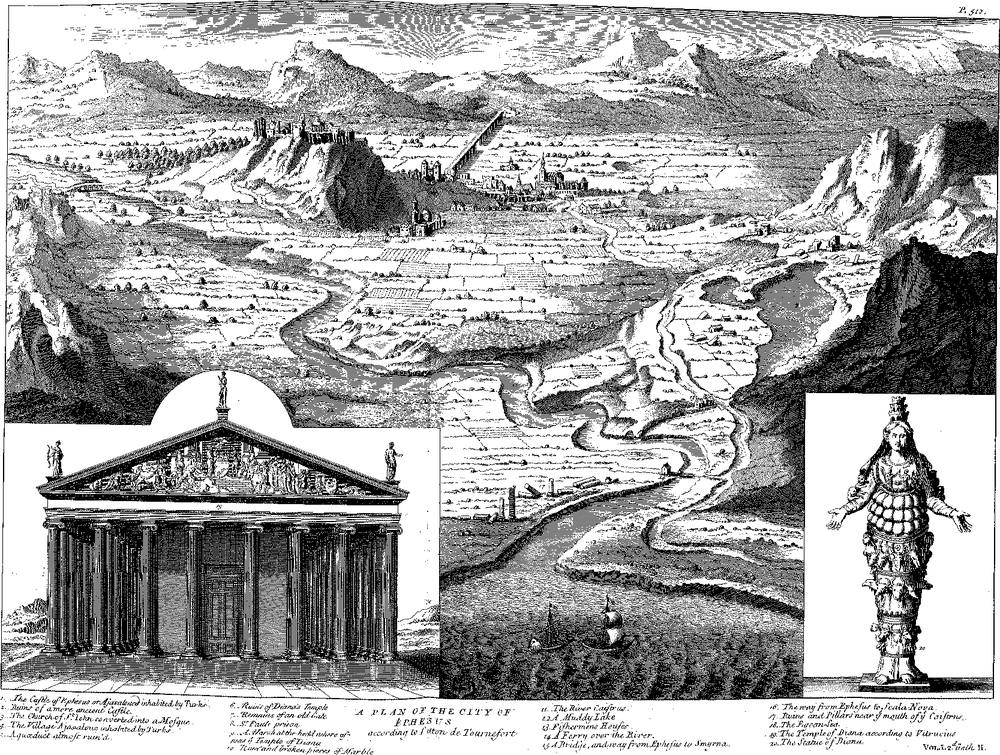
Ex. xxviii. 6.There were two sorts of Ephods, one of plain linnen for the Priests, and another embroidered for the High Priest. As there was nothing singular in that used by common Priests, Moses does not insist upon a description of it; but of that belonging to the High Priest, he gives us a large and particular account. It was distinguished thus; it was composed of gold, blue, purple, crimson, and twisted cotton; that is to say, it was a very rich composition of different colours. Upon that part of the Ephod, which came upon the two shoulders of the High Priest, were two large precious stones, upon which were engraven the names of the twelve Tribes of Israel, upon each stone six names.
There, where the Ephod crossed upon the High Priest’s breast, was a square ornament, called the Rational, in Hebrew Chos-chen, Choschen. Græc. Λογεῖον. Rationale.wherein twelve precious stones were set, with the names of the twelve Tribes of Israel engraved on them, one on each stone. Lastly, the Ephod was carried behind, girt the tunick, and was fastened in a knot before, after the manner of those great girdles worn by the Eastern people, the ends whereof touch the ground.
The Ephod worn by common Priests, which was of linnen only, was of the same extent and use, but neither so rich, nor so much adorned. This ornament was peculiar Hieron. ad Marcellan.to Priests, and St. Jerom observes, that we find no mention of it in the Scripture, but when the Priests are spoken of. Illud breviter attende, quod nunquam nisi in Sacerdotio nominetur Ephod. It was an opinion among the Jews, that no sort of worship, either true or false, could subsist without the Priesthood, or the Ephod. Judg. viii. 27. Ib. xvii. 5. Hosea iii. 5. xxx. 22.Gideon made an Ephod out of the spoils of the Midianites, and this ornament became the occasion of Israel’s offending God. Micah having made an Idol, and placed it in his house, did not fail to make an Ephod for it. God foretold in Hosea, that the Israelites should be for a long time without Kings, Princes, Sacrifices, Altar, Ephod, and Teraphim. Lastly, Isaiah speaking of the false Gods, who were worshipped by the Israelites, ascribes Ephods to them: Ye shall defile also the covering of thy graven images of silver, and the Ephod of thy Gods of gold23.
The Ephod is often taken for the Pectoral, and for the Urim and Thummim, which were fastned to it, because all this belonged to the Ephod, and made but one piece with it.
Altho’ the Ephod was an ornament peculiar to the Priests, it was nevertheless sometimes given to Laymen. David wore it in the ceremony of removing the Ark from the house of Obed-edom to Jerusalem. Samuel, tho’ he was a Levite only, and a 1 Sam. xii. 18.child, yet wore the Ephod in the Tabernacle.
The Levites regularly were not to wear the Ephod: their habit did not differ from that of Laymen; at least Moses appointed nothing particular with relation to their dress. Nevertheless at the ceremony of the dedication of Solomon’s Temple, the Levites and singing men, who were not of the Priests order, were cloathed in habits of fine linnen: 2 Chr. v. 12. 1 Chr. xv. 27. Joseph. Antiq. l. 20. c. 8.Vestiti byssinis, as David was at the ceremony of removing the Ark from the house of Obededom to the King’s palace. Josephus remarks, that in the time of King Agrippa, and a little before the taking of Jerusalem by the Romans, the Levites desired this Prince to convene the Sanhedrim, in order to establish a regulation, allowing them to wear the linnen Stole as well as the Priests. They flattered Agrippa with assurances, that this would contribute to the glory of his reign. Agrippa granted their request; but the Historian observes, that this was an innovation, contrary to the Laws of their country, which were never struck at with impunity.
Spencer24, and Cunæus25, both affirm, that the Jewish Kings had a right to wear the Ephod, and consult the Lord by Urim and Thummim. Their opinion they grounded principally upon what is said in the first
1 Sam. xxx. 7.book of Samuel, that David coming to Ziklag, and finding that the Amalekites had pillaged the city, and carried away his and his people’s wives, said hereupon to Abiathar the High Priest, Bring me hither the Ephod, and Abiathar brought thither the Ephod. Applica ad me Ephod, & applicavit Abiathar Ephod ad David. The sequel favours this opinion, verse 8. And David enquired at the Lord, saying, Shall I pursue after this troop? shall I overtake them? And he answered him, pursue; for thou shalt surely overtake them, and without fail recover all. 1 Sam. xxviii. 6.We read likewise, that Saul consulted the Lord, and that the Lord answered him not, neither by dreams nor prophets. He consulted God therefore by the Urim, consequently he put on the Ephod.
But the generality of Commentators, and the most learned of them, are of opinion, that neither David, Saul, nor Joshua, nor any other Prince of Israel, dressed themselves in the High Priest’s Ephod, in order to consult God of themselves, and that the passages we have related signify no more than, Put on the Ephod, and consult the Lord for me; literally, Bring the Ephod to me, and Abiathar caused the Ephod to be brought to David. Grotius believes, the High Priest turned the Ephod, or Pectoral, towards David, that this Prince might see with his own eyes, what God should answer to him by the stones upon the breastplate. See URIM and THUMMIM, where the manner of consulting the Lord is described.
Matth. vii. 32, 33, 34.EPHPHATHA. This is an Hebrew, or rather a Syriac word, derived from the Hebrew, Pathach, to open, be opened. Our Saviour pronounced this word, when he cured one deaf and dumb, by putting his fingers into his ears, and his spittle upon his tongue, then lifting up his eyes to heaven and sending forth a deep sigh, he said, Ephphatha, be opened; and immediately his ears were opened, and his tongue was loosed.
Gen. xlviii. 8, &c. Judg. vi. 11.EPHRA, a city of Ephraim, the place of Gideon’s birth. The true situation of it, we are not acquainted with.
I. EPHRAIM, the Patriarch Joseph’s second son, by Aseneth, Potiphar’s daughter. He was born in Egypt, about the year of the world 2293, or 2294. Ephraim was carried by his father Joseph, together with his brother Manasseh, and presented to Jacob on his death-bed. Jacob making the two brothers to come near him, laid his right hand on Ephraim the youngest, and his left on Manasseh the eldest. Joseph desirous to change his hands, and put Jacob’s right hand on Manasseh, said, Not so, my father, for this is the eldest. Jacob answered him, I knew it, my son; Manasseh shall be multiplied, 1 Chr. vii. 20, 21.and become the father of many people: but Ephraim shall be greater, and his posterity more numerous; and the time shall come, when Ephraim and Manasseh shall be a sort of form of blessing, and it shall be said, May God heap his favours on you, as he did on Ephraim and Manasseh.
Numb. ii. 18, 19.While the Israelites abode in Egypt, the sons of Ephraim having made an inroad upon Palestine, the inhabitants of Gath killed them, and Ephraim their father mourned many days for them, and his brethren came to comfort him. Afterwards he had a son whose name was Beriah, and a daughter, called Sherah, who built upper and lower Bethoron, and Uzzen-Sherah. He had other sons also, Rephah, Resheph, and Tela. The posterity of Ephraim multiplied to that degree in Egypt, that when they left that country, they amounted to the number of forty thousand and five hundred men above twenty years of age, and capable of bearing arms. Elishama, the son הפתח Ps. lxxviii. 9.of Ammihud, was their Captain.
After they were entred into the land of promise, Joshua, who was of this Tribe, gave them their portion between the Mediterranean Westward, and the river Jordan Eastward. The Half-tribe of Manasseh was placed to the North, and those of Dan and Benjamin to the South. The Ark of the Covenant, and the Tabernacle remained a long time in this Tribe at Shiloh; and after the separation of the ten Tribes, the seat of the kingdom of Israel was always in the Tribe of Ephraim. Ephraim is frequently set down to signify the whole Kingdom of the ten Tribes. Instead of Ephraim, the word Ephræm is sometimes used; Filii Ephræm intendentes & mittentes arcum. And the Canton belonging to this Tribe is called Ephratah, in Psalm cxxxii. 6. Lo, we heard of it at Ephratah. We have observed, that the Ark was at Shiloh in the division of Ephraim. Lastly, Ephratæus sometimes signifies a man of Jud. xii. 5.Ephraim; Numquid Ephratæus es? — Dic ergo Schibboleth. Elkanah, Samuel’s father, is surnamed Ephratæus, 1 Sam. i. 2.
But the word Ephrata is used also for Bethlehem, and Ephratæus for a man of Bethlehem, as will be taken notice of hereafter. The Tribe of Ephraim was led into captivity beyond the Euphrates, together with the other Tribes of Israel, by Salmaneser King of Assyria, in the year of the world 3283, before Jesus Christ 717, before the Vulgar Æra 721. Some affirm, that they still subsist, and are very numerous in The Author’s Dissertat. prefixed to the books of Chron, pag. xx, xxi, &c.Tartary, China, or the Indies; but in a Dissertation written particularly on this question, we have enquired into this matter, and endeavoured to demonstrate, that the ten Tribes returned to Palestine, some time about the reign of Alexander the Great. As to the
Cuthæans or Samaritans, who were sent into Samaria after the transplanting of the ten Tribes, our opinion of them may be seen in the Articles CUTHITES or CUTHÆANS, or SAMARITANS.
II. EPHRAIM, or Ephræm, a City in the Tribe of Ephraim, towards Jordan; perhaps the place whither Jesus retired a little before his Passion. John xi. 54.
III. EPHRAIM, a City belonging to the Tribe of Benjamin, eight miles from Jerusalem, according to Eusebius26. It was situated in the neighbourhood of Bethel27. I am afraid that these two Cities have been confounded, for instead of the eight miles in Eusebius, St. Jerom reckons twenty.
IV. EPHRAIM. The Forest of Ephraim beyond Jordan, near to which 2 Sam. xviii.6,7,8.Absalom engaged his father’s troops. In this forest he was taken hanging by his hair upon a branch; there he was killed, and there buried. It could not be far from Mahanaim, where David was.
EPHRATAH, is a word we meet with in Psalm cxxxii. 6. to denote the Lot of Ephraim. Behold we have heard of the same at Ephratah. We have said elsewhere, that the Ark was at Shilo in the country which belonged to the portion of Ephraim. By Ephratæus is meant also one of the tribe of Ephraim. 1 Sam. i. 2. Jud. xii. 5.
I. EPHRATH, Caleb’s second wife 1 Chr. ii. 19.who was the mother of Hur. From her it is believed that the City of Ephratah, otherwise called Bethlehem, took its name.
II. EPHRATH, otherwise Bethlehem, a City at two leagues distance from Jerusalem, celebrated for the birth of David, King of Israel; and infinitely more for the birth of Jesus Christ, the son of God, and Saviour of the World. By Ephratæus is meant a native of Bethlehem.
I. EPHRON, the son of Zohar. He sold the cave of Macpelah to Abraham, to be a burying-place for Sarah. Gen. xxiii. 6, 7, 8, &c.
II. EPHRON, a City situated beyond Jordan, which Judas Maccabæus took and sacked, at his return from an expedition against Timotheus, General of the Syrians. By some it is called Esdrin: but Esdrin is by others, with some probability, thought to be the name of a man. Qui cum Esdrin erant, that is to say, they who were commanded by Esdras, &c.
EPICÆRUS, a Town lying to the east of Jordan, and spoken of by Ptolemy.
EPICUREANS, Philosophers, who place their supreme happiness in pleasure; not in voluptuousness, and in irregular and ignominious pleasures28, but in sensible pleasures under proper regulations and governments. They denied Providence, and the Immortality of the Soul. When St. Paul came to Athens, he had conferences with the Epicurean Philosophers29. Acts xvii. 18.
EPIPHANES. This Greek word signifies properly something that appears with lustre, and is an epithet given to the Gods, when they shew themselves to men. Antiochus the brother of Seleucus, coming fortunately into Syria a little after the death of his brother, was looked upon as some propitious Deity, appearing in the country, and for this reason was called Epiphanes.
We call that festival Epiphany, upon which the Church celebrates the manifestation of Jesus Christ to mankind, and commemorates the adoration of the Magi or Wise-men, the baptism of our Saviour, and the first miracle which he wrought at the marriage in Cana.
EPIPHANIA, a City of Syria, upon the river Orontes, between Antioch and Apamea. Several of the ancients say30, that it was of old called Hamath, before Antiochus Epiphanes gave it the name of Epiphania. St. Jerom, and several others are of opinion, that it is the same as Hamath the great. He says, that even then in his time, the Syrians called Epiphania, Emmas. But we shall shew in the Article Hamath, that this was not Epiphania, but Emesa in Syria.
EPISTLES of St. Paul. We shall speak of them in the life of this holy Apostle, and there mark the dates of them.
EPOCH, a term in Chronology signifying particular, fixed and certain points made use of in computing the years from one time to another. The Creation of the World is the first Epoch; this is fixed at the year 710 of the Julian Period, 4000 before Jesus Christ.
The second is that of the Deluge, in the year of the World 1656, and 2344 before Jesus Christ.
The third is that of the Tower of Babel, which is set down differently. We place it about the year of the World 1800, before Jesus Christ 2200.
The fourth is at the second calling of Abraham from the city of Haran, in the year of the World 2083, before Jesus Christ 1917.
The fifth, at the departure of the Israelites out of Egypt, in the year of the
Epoch continues on the next page
Footnotes
-
Protevangel. Jacobi n. 22. Petr. Alexand. Can. 13. de pœnit. Eustat. Antioch. & Græc. Menæa. 5. Sep. ↩
-
2 Kings ii. 1, 2, 3, &c. 14, 15, 16. The double portion of his Spirit, signifies the Spirit of Prophecy and Miracles, or the Spirit of God in a double measure to what Elijah had it; or simply the Gift of Prophecy in a very high degree. ↩
-
See Bochart’s Differt. on this place, and John Andrew Quensted’s Differt. on 2 Kings v. 18. and several others: and our supplement at the end of the Revelations, p. 127. Devenere locos lætos & amœna vireta Fortu- natorum nemorum, sedesque beatas; ↩
-
Vide Doroth. & Ephiphan. & Isidor. de vita & morte Prophet. & Chronic. Paschale, p. 161. ↩
-
Translators’ note. This is the Mountain unto which, they say, the Devil took our Blessed Saviour, when he tempted him with the visionary scene of all the Kingdoms and Glories of the World. It is, as St. Matthew stiles it, an exceeding high Mountain, and in its ascent not only difficult but dangerous. It has at present a small Chappel at the top, and another about half way up, founded upon a prominent part of the rock. Near this latter are several caves and holes in the side of the Mountain, made use of anciently by Hermits, and by some at this day for places to keep their Lent in; in imitation of that of our Blessed Saviour. Maundrell’s Journey to Jerusalem. ↩
-
Translators’ note. The Reader will perhaps excuse me, if I add a beautiful description of the Elisian Fields, out of Homer’s fourth Ἀλλά σ’ ἐς Ἠλύσιον πεδίον καὶ πείρατα γαίης, Ἀθάνατοι πέμψουσιν, ὅθι ξανθὸς Ῥαδάμανθυς, Τῇ περ ῥηΐστη βιοτὴ πέλει ἀνθρώποισι· Οὐ νιφετὸς, οὔτ’ ἄρ χειμὼν πολὺς, οὔτε ποτ’ ὄμβρος, ↩
-
See the Dream of one Er, an Armenian, related by Plato, in his De Repub. l. x. p. 614, 615. ↩
-
Translators’ note. Thus Silius Italicus XIII. 474. —————— Ægyptia tellus Condit odorato post funus stantia saxo Corpora, & a mensis exsanguem haud separat umbram. Tertullian takes notice of this custom in his Treatise de Resurrect. Carn. c. 27. And Eustathius upon the first Iliad says, Ἕλληνες τοὺς νεκροὺς ἔκαιον —— Αἰγύπτιοι δὲ τοὺς νεκροὺς ἐταρίχευον ἵνα ὅλον τὸ σῶμα: or as Gataker corrects it, τὸ σῶμα, τῷ πότε ζῶντι ἔχωσιν εἰς μνήμης ζώπυρον. ↩
-
Translators’ note. Αἰγύπτιοι δὲ τὰ ἔνδερα ἐξελόντες, παριχεύουσιν αὐτὰς. And the Persians, as the same Author Sextus Empiricus observes, were used νίτρῳ παριχεύειν*. Sext. Empir. Pyrrhon. hypothes. l. 2. c. 24*. Bodies thus preserved are called Mum- mies, from the Arabick word Mum, which signifies Wax, this being an ingredient in the preparation. ↩
-
Translators’ note. The English Translators render this word by an appellative, Mules; but more concerning this may be seen in the ar- ticle ANAH. ↩
-
Ambros. Apolog. David. l. 2. c. 8. in Luc. xii. in Symbol. c. 29. de tempore Serm. 19. ↩
-
Joseph. l. 7. de Bello, c. 26. in Latino, κζ in Græco p. 983. ↩
-
Reland. Palæstin. l. 2. c. 6. p. 427, 428, &c. Vide & lib. 3. p. 758, & seq. ↩
-
Theophan. Chronog. p. 41. & Sozomen. l. 5. c. 20. & Itiner. Sancti Villibaldi. ↩
-
Translators’ note. תשב בפתח עיניםwhich in the English Bible is thus translated: She sat in an open place, which is by the way. ↩
-
Menasse Ben-Israel de fragil. human. Sect. 22. Art. 7. Calvin. Rabbini quidam. ↩
-
Irenæ. l. 4. c. 30. Aug. l. 6. Op. imperfecti contra Julian. c. 30. ↩
-
Translators’ note. M. Basnage is of opinion, that St. Jude did not cite a book which went un- der Enoch’s name, but repeated only some of his expressions, which he might have learned from a tradition preserved among the Jews, as well as that passage relating to the contest about the body of Moses. Histoire des Juifs, t. 4. c. 12. where a more particular account of this work, the author of it, and the time when it was written, may be found. ↩
-
Hieronym. Præfat. in Isai. in Nahum. & in Abacuc. Origen. l. 6. in Joan. & l. 7. contra Cels. Chrysost. & Basil. in Psal. xliv. 2. ↩
-
Translators’ note. In the Greek text, the first fruits of Achaia. St. Chrys. homil. 31. in Rom. p. 388. & Theodoret. in Rom. p. 115. read it in the same manner; and herein the English version agrees with them. ↩
-
1 Tim. c. iv. 14. & 2 Tim. i. 6. Chrysost. in 1 Tim. homil. 15. & in 2 Tim. homil. 1. ↩
-
Translators’ note. Ephah was a Mea- sure of things dry, as of barley, Ruth ii. and meal, Judges vi. and Numb. v. and was of the same capacity with the Bath in liquids. It contained three Sata or Seahs. The Chaldaic paraphrase renders the Ephah 3 Seahs, the ancient version 3 Modii, Ruth ii. Joseph. lib. 9. cap. 2. makes the Seah equal to 1½ Italick Italick Modius, the Sesquimodius containing 24 Sextarii, which multiplied by 3, makes 72, the measure of the Ephah assign’d by him. The LXX render Ephah variously, sometimes by the word itself, Οἰφὶ or Οἰφὶ, Levit. v. Numbers xv. and xviii. Judges vi. Ruth ii. 1 Samuel i. and xxv. Sometimes by the word πέμμα, Ezek. xlv. So the Latin Version has Ephah variously translated: as by Ephi, a corruption of Ephah; and by Modius, Levit. xix. and sometimes it is rendered 3 Modii, Esai. v. Ruth ii. Sometimes it is confounded with Satum or Seah: It is rendered Amphora by the old version, Zachar. v. Arbuthnot’s Tables of Ancient Coins, Weights and Measures, &c. p. 101. ↩
-
Translators’ note. So the Author translates it, keeping close to the original word ,אפרחwhich however has a more general significa- tion, according to which it is rendered by the English Bible, Ornament; by Buxtorf and the Vulgate, Amiculum, am- ↩
-
Spencer. de Urim & Thummim. ↩
-
Cunæus de Rep. Hebræor. l. 1. c. 14. ↩
-
Euseb. in Ephron. Vide & Joseph. de Bello, l. 5. c. 8. ↩
-
Epiphan. contra Hæres. l. 1. & 2 Chr. xiii. 19. ↩
-
Translators’ note. Cicero intimates the Practice of this Sect to be generally better than their Principles; for says he, Ut cæteri existimantur dicere melius quam facere, sic hi mihi videntur facere melius quam dicere. Lib. 2. de Fin. ↩
-
Translators’ note. See more particularly concerning this Sect in Lactant. l. 3. Instit. Laertius Epicur. Cicero l. 1. De Natura Deorum. Hieronym. &c. ↩
-
Hieronym. in locis Hebr. in Emath. & ad Amos vi. Aquila, Theodoret. in 2 Reg. qu. 22. & in Jerom. iv. Cyrill. Alex. in Amos. ↩