Volume I, pages 460–478 of the 1732 edition, from DOT to EGY: everything printed on these pages, in order.
Continued from Dositheus (III)
pique he embraced the Party of the Samaritans, among whom he formed a Sect1 which observed Circumcision like the Jews, and the Sabbath with so much rigour, that for the four and twenty hours of this festival’s continuance, they remained without stirring in the least from the particular place where they were when the sabbath began; they likewise fasted very rigidly, and denied themselves every thing that had life in it.
Some among them kept their virginity, and others abstained from the use of marriage when their wives were with child; or, as others say, they condemned second marriages. They received only the five Books of Moses, and held Dositheus their Head, to be the Messiah2. He himself applied the prophecies in the Pentateuch which we explain of Jesus Christ, as belonging to himself. The Samaritans who were opposite to Dositheus, made an application of them to Joshua, Moses’s successor. It is affirmed that Dositheus disappeared, and was found in a cave, gnawed with worms, and full of flies. Some have attributed his retreat to the foolish vanity of desiring to be thought immortal, as if he had been taken away from the conversation of men, and transported alive into heaven. But the discovery of his body manifested his imposture; nevertheless, without undeceiving his disciples, who gave out that he had retired in order to pursue the study of philosophy with more liberty and leisure. There were still some of his disciples remaining in the sixth Century in Egypt.
IV. DOSITHEUS, lived in the time of Jesus Christ, was a contemporary and associate Hegesip. apud Euseb. l. 4. c. 12. Hist. Eccles.with Simon the Magician. He had a mind to be the principal of the Jewish Doctors, but finding that he was not able to succeed in this design, he threw himself into the party of the Samaritans, and among them formed a sect which bore his Epiphan. Hæres. 13. Dosith.name. This sect made professions of great abstinence and purity. Dositheus having shut himself up in a cave, died there by denying himself all sort of nourishment. We do not enlarge upon this Dositheus or his sect, because there is no mention of it in the Bible.
DOTHAN, or Dothaim, a Town at the distance of twelve miles or four leagues northward from Samaria. Joseph’s Euseb. in locis.brethren were at Dothan, when they sold him to the Ishmaelitish merchants, who Genes. xxxvii. 17. Judith vii. 3.came from Gilead. Holofornes’s camp extended from Dothaim to Belmain.
DOUBLE, Duplex. This word has many significations in the Scripture. Double Gen. xliii. 12. Exod. xvi. 22, 29.the money, Pecuniam duplicem. Double the food; Cibos duplices. Twice as much money and food.
A double Garment, vestis duplex, may mean a lined Habit, such as the High-Priest’s Pectoral was. Quadrangulum & duplex: or a compleat Habit, or suit of Judg. xvii. 10. 2 Kings v. 22.clothes, a cloak, and tunick. Vestem duplicem, or vestes mutatorias duplices.
Double sometimes signifies multitude: succepit de manu Domini duplicia pro omnibus peccatis suis. He was doubly punished, Jerem. xvii. 18. Duplici contritione contere illos: Destroy them with a double destruction; punish them severely. Reddam duplices iniquitates & peccata eorum: I will doubly punish their iniquities, or I will inflict Penalties upon them proportioned to their Iniquities. Duplicia mala invenies: Thou shalt receive twice as much evil, chastisements double to thy sins.
Double heart, double tongue, double mind are opposite to a simple, honest, sincere heart; a true tongue, a just, faithful, sincere mind, &c.
DOVE, a tame bird, declared by the Law of Moses to be pure: that ordains, that Levit. xii. 8. Numb. vi. 10.when any woman went to the Temple after lying-in, she should offer to the Lord a Lamb, a Dove, or Turtle, or else a young Pigeon, or a young Turtle. The Lamb was offered as a burnt-offering, the Pigeon for a sin-offering. Or if the person could not afford a Lamb, then instead of it, she offered two Pigeons, or two Turtles. It was no matter of what sex, nor perhaps of what age they were; for pullus columbæ may signify either a Pigeon in general, or a young Pigeon. The blessed Virgin, to comply with this Law, though she were not rigorously obliged to it, offered two Pigeons, or two Turtles, because she was poor. And as it was difficult for all those who came from remote places, to bring Doves with them, to offer in the Temple, the Priests gave permission for the selling of these birds in the Courts of that holy Place, which Jesus Christ could not endure; and having one day entred the Temple, he made a scourge with cords, and drove out those who traded Matth. xxi. 12.there in Pigeons.
There were besides, other occasions, upon which birds might be made a burnt-offering to the Lord, or be offered for the expiation of some sin. They who were rich offered four-footed beasts, the poor only Pigeons. The Ceremonies performed on these sacrifices were as follow: The Priest took the Turtle-dove, and wrung its neck and head with violence. Some Expositors are of opinion, that he plucked the head off intirely;
Levit. v. 8. 2 Kings vi. 25.intirely; others, that he only wrung the neck; which appears to be most certain. See Levit. v. 8. He made a hole in it with his nails for the blood to run out upon the side of the Altar. The feathers and the crop he threw beside the east part of the Altar, in the place where the ashes were put which were taken from the Altar. After this, he broke the bird’s wings; and without dividing the burnt-offering, he put it on the fire of the Altar, where it was intirely consumed. If it were a sacrifice for sin, the same ceremonies were observed which I have been describing, excepting that the blood of the burnt-offering was poured out not on the sides only, but at the feet likewise of the Altar.
It is said in the second Book of Kings, chap. vi. 25. that during the siege of Samaria, in the reign of Ahab King of Israel, the famine was so great, that a quarter of a Cab of Dove’s dung was sold for five shekels; now a Cab held two pints, and something over. But we believe with Bochart, that this Dove’s dung was nothing else but a sort of chich-peas, which the Arabians called Usnen or Kali. Now the Hebrews call chich-peas parched upon a stove, Kali; of these, great quantities are used in the East, and there are many shops at Cairo and Damascus, where people do nothing else but fry chich-peas, for the provision of Travellers. See above CICER. Other passages of Scripture where there is mention of Doves, are not very difficult: for example, it is said Cant. ii. 14.in the Canticles, That the spouse is like a Dove in the clefts of the rock; because in the East there are many wild and even tame Pigeons, that settle in the hollow parts of the rocks.
Jerem. xxv. 38.Jeremiah, speaking of the ravages which would be committed in Judæa by Nebuchadnezzar, says, The land is desolate because of the fierceness of the Dove3. And Jerem. xlvi. 16.again, Let us go again to our own people to avoid the sword of the Dove4. And in another place, They shall flee every one for fear Jerem. l. 16.of the sword of the Dove. Some5 by the word Dove understand in this place, the Lord, who of a Dove was become a roaring Lion, armed with the sword, and ready to lay waste the country. Others6 suppose Nebuchadnezzar, King of the Chaldæans, to be meant here, who, as they say, bore a Dove in his Ensigns, in memory of Semiramis, who was said to have been metamorphosed into a Dove, or who was called Dove in the way of antiphrasis. But it is more natural and simple to translate the Hebrew Jona, an enemy, destroyer, ravager. This is an Epithet that suits admirably well with Nebuchadnezzar. The Land was made desolate by this ravager; fly from the sword of this Prince, who carries fire and terror into all places wheresoever he goes. We have no good proofs that the Chaldæans bore a Dove in their Standards.
Matth. iii. 16. Matth. x. 16. Hosea vii. 11.The Dove is the symbol of simplicity and innocency. The Holy Spirit appeared at the baptism of our Saviour in the form of a Dove. Jesus Christ recommends to his disciples the wisdom of the Serpent, and the harmlessness of the Dove. The prophet Hosea compares the Israelites to a silly Dove which hath no heart, or understanding. The Dove is a defenceless creature, without gall or cunning, exposed to the pursuit of men and beasts, which is able neither to protect itself nor its young, nor to take precaution against those who have designs upon its life and liberty. Thus the Israelites, notwithstanding the chastisements with which God afflicted them, and the captivities to which he had reduced them, still relapsed continually into their irregularities, and exposed themselves again to the same calamities.
Isaiah xxxviii. 14. and lix. 11. Nahum ii. 7. Cant. i. 15. ii. 10, 14. &c. Gen. viii. 8, 10.The Scripture in some places seems to attribute reflection and meditation to the Dove: Meditabor ut columba. And, Et quasi columbæ meditantes, &c. But this is generally understood of its cooing; Gementes ut columbæ. The Turtle and the Dove coo alike. The Spouse in the Canticles is compared often to a Dove by reason of her innocence, gentleness, candor, and fidelity. Noah sent the Dove out of the Ark, in order to get intelligence whether the waters of the Deluge were gone off. He chose the Dove, as a tame bird, an enemy to carrion and ordure; it immediately returned to him, upon its not finding where to set its foot, because the waters were not as yet retired. He sent it out a second time, and it returned with a young shoot of a green olive-tree in its beak, which had sprung out already since the Deluge. At last he sent it out a third time, and it returned no more, because the Deluge was intirely ceased.
In the East, particularly in Syria, Arabia, and Egypt, Pigeons are taught to carry letters under their wings, and bring back an answer to those who send them. The Mogul in several places appoints Pigeons to be kept for the carrying letters on particular occasions, which require very great dispatch, and they carry them from one end of his dominions to the other. The Consul of Alexandretta sends news every day to Aleppo in five hours time, tho’ these places be at the distance of three days journey for7
Tavernier. a horse from one another. In Holland this invention has sometimes been made use of upon the occasions of a siege. The Caravans which travel in Arabia, give notice of their march to the Arabian Princes, with whom they are in alliance, by Pigeons, under whose wings they put letters. These birds Relation des Caravannes, p. 114, 115.go with an extraordinary swiftness and rapidity, and return with still more haste, in order to be at the place where they were bred, and have their nests. Some of these Pigeons have been seen frequently lying upon the sand with their bellies in the air, and their beaks open, waiting for the dew to refresh them, and recover breath.
There are particular people in the cities of Egypt, who make a trade of teaching Pigeons this art; and others, whose principal business it is to steal Pigeons, and entice them from the Pigeon-houses of others to their own. The Hebrews exclude those from admission into their Sanhedrin, who employ themselves in matters of this kind.
DOVE’s DUNG. It is said in the second book of Kings, chap. vi. 25. that during the siege of Samaria, the fourth part of a cab of Dove’s dung sold for five pieces of silver, or shekels. The fourth part of a cab is half a pint and a little more. Five shekels make about twelve shillings sterling. It is very well known, that Dove’s Dung is not a proper nourishment for man, even in the most extreme famine. Josephus and Joseph. Antiq. l. 9. c. 2. & Theodoret. qu. 21. in Reg.Theodoret were of opinion, that this Dove’s Dung was bought instead of salt. The Rabbins affirm that it was not the Dung of Pigeons, but the corn in their crops, which they brought back well filled out of the fields, whither, during the siege, they went to feed. Junius and Fuller suppose the Dove’s belly to be meant here. But Bochart is of opinion, that under the name of Dove’s Bochart. de Animal. Sacr. t. 2. l. 1. art. 7.Dung in this place, we are to understand a sort of moss growing upon trees, or a kind of gravelly earth, which was of use to refresh people, and with which and honey mixed together, they made a sort of wine. The Arabians call it Chich-peas.
DRACHMA. The value of a common Drachm was seven pence English8, a Didrachm or two Drachms made very near half a shekel, and four Drachms a shekel. See above DIDRACHMA.
DRAGON. This word is frequently to be met with in the Scripture, it answers generally to the Hebrew Thannim or Thannin. LXX. Genes. i. 21. Job. xxx. 29. Isai. xxxiv. 13. xliii. 20. Jerem. xlix. 32.Thannin, which signifies a large fish, a Seadragon. The Septuagint generally translate it Dracones, rarely great fishes; sometimes Sirens or Ostriches. St. Jerom most frequently renders it dracones, but sometimes he takes it for Sirenes or Lamiæ. The same varieties almost are observable in Aquila, Gen. i. 21. Job vii. 12. Ps. lxxiii. 13. clxviii. 7. Isai. xxxviii. 1. Ezek. xxxii. 2. Ex. vii. 9, 10, 12. Deut. xxxii. 33. Ps. xc. 13. Isai. xxxv. 7. Jerem. xiv. 6. Ps. lxxiii. 13. Isai. li. 9. Ezek. xxix. 3. Dan. xiv. 22.Symmachus and Theodotion. By the word Sirenes they mean very pobably Sea-monsters; for we are not able to explain the fabulous creatures of this name, mentioned by the poets. It is certain by comparing the different passages where the word tannin or tanninim is to be met with, that it signifies sometimes large river or sea-fishes, and at other times venomous and land serpents, and, as I conjecture, more particularly the crocodile, and whales.
As to the Dragons which are talked of, and are often mentioned in books, they are for the most part only old serpents grown with age to a prodigious size. Some are described with wings, feet, claws, crests and heads of different figures. There is no question but there are winged serpents, Moses speaks of them under the name of Zaraph, Numb. xxi. 6. The Babylonians adored a Dragon, which Daniel killed. Nothing was more common in the Heathen Religion, than the worship of Serpents and Dragons.
This word is sometimes taken in Scripture for the Devil: “ St. John in the Revelations describes to us a great Dragon “ with seven heads and ten horns, and “ seven diadems upon his heads: his tail “ drew the third part of the Stars of Heaven, and cast them to the earth. The “ Dragon stood before the woman, who “ was ready to be delivered, to devour “ her child as soon as she had brought it “ forth. She brought forth a child, which “ should rule all nations with a rod of iron. “ And there was a great battle in Heaven: “ Michael and his Angels fought against “ the Dragon and his Angels; the Dragon “ was overcome, and afterwards they appeared no more in Heaven: and the great “ Dragon, that old Serpent, called the Devil and Satan, who seduceth the world, was “ cast out; he was cast into the earth, and “ all his Angels with him.” All this describes the conflict of the Devil with the Church of Christ, and his defeat by Michael, General of the Church militant.
Esther xi. 6, 7.There are several places in the Prophets wherein the name of Draco cannot be understood of an animal belonging to the water, because there is mention of their cries; for example: Behold two great Dragons came forth ready to fight one against the other. Their cry was great, whereby all the heathen were ready to fight against the righteous people. And Jeremiah xiv. 6. And the wild Asses did stand in the high places, and drew in their wind like Dragons, their eyes did fail because there was no grass. And Micah i. 18. I will make lamentation like the Dragons, and mourning as the ostriches.
In other passages where there is mention of the ruin of a city, the ravaging of a See Isa. xiii. 21. xxxiv. 13. Jerem. ix. 11. x. 32. xiv. 6. xlix. 33. l. 39. li. 34, 37.province, or of a land reduced to a wilderness, it is said to be a dwelling for Dragons. As in reality Serpents, Dragons, and venomous Beasts hide themselves in uninhabited places, in the ruins of cities, and in rubbish: for this reason the ancients supposed them to have the guard of treasures. But it must be confessed, that this word is sometimes taken for a great fish, an animal that lives in water. Serpents and Fishes were by the Hebrews ranked almost in the same Class: they were equally comprehended by them under the name of creeping things and serpents.
Among the Gentiles, the Dragon was the symbol of health. They never described Æsculapius, nor the goddess Hygieia, Health, without a serpent near them, either about their staff, or in their hand. Real Solin. c. 30.Dragons, by Solinus’s account of them, have a small mouth, and cannot bite; or if they do, their biting is not venomous. The Egyptians call them good Genius’s, and keep them tame in their houses. We are not to believe that these were the Dragons spoken of by the Prophets; these were dangerous creatures, mischievous, and deadly, wild, &c.
DRAGON. The Dragon mentioned in the book of Nehemiah, lay to the east of Jerusalem. Nehemiah going out by night by the gate of the valley, even before the Dragon’s-well, and to the dung-port. This well is still shewn in a sort of subterraneous cave, into which people descend by twenty steps. The Turks call it Mary’s well, and believe that the blessed Virgin made use of it for the occasions of her house and family.
DREAM. The Dreams which were of Chalom. Somnium Græc. Ἐνύπνιον.God’s appointing, and were prophetical or significative, are generally called by this name. The eastern people, and in particular the Jews, had a very great regard to Dreams; they observed them, and applied to those, who pretended to explain them, for the interpretation of them9. We see the antiquity of this custom among the Egyptians in the history of Pharaoh’s Butler and Gen. xl. 5, 8. Gen. xli. 15,16, &c.Baker, and in Pharaoh himself. Nebuchadnezzar is an instance of the same among the Chaldæans. God had very expressly forbidden his people to observe Dreams, and to consult those, who took Levit. xix. 26. Deut. xviii. 10. Deut. xiii. 1,2,3, &c.upon them to explain them. He condemned any one to death who pretended to have prophetick Dreams, and to foretel what was to come, tho’ what he should so foretel were to come to pass, if after this he would ingage the people in Idolatry. But they were not forbid when they thought they had any significative Dream, to address themselves to the Prophets of the Lord, or to the High-Priest dressed in his Ephod, in order to have it explained.
Wherefore in that very place, wherein God forbids the Hebrews to consult Divines, Magicians, and Interpreters of Dreams, he tells them, The people whose land ye are going to possess, consult Soothsayers and Diviners: but ye have not been so taught. The Lord shall raise up from the midst of you, and among your brethren, a Prophet like unto me; him ye shall consult and hearken to. The Israelites therefore were to address themselves to God and his Prophets to learn the explanation of their Dreams, and the prediction of things to come. Saul, a little before the battle of Gilboa, consulted a woman with a familiar Spirit, because the Lord had departed from him, and would not answer him, and discover the success of this war to him, neither by Dreams, nor by Urim, nor by Prophets.
In condescension to the Prejudices and Ideas of this People, who believed that Dreams often were significative, and sent by God, the Lord did indeed sometimes discover his will in Dreams, and raised up Persons to explain them. He informed Abimelech in a Dream, that Sarah was the wife of Abraham. He shewed Jacob the mysterious Ladder in a Dream; in a Dream he revealed to him the way of multiplying his flocks. Joseph was favoured very early with prophetick Dreams, the signification whereof was easily discovered by Jacob his father. The Dreams of the Butler and the Baker belonging to the King of Egypt, were explained by Joseph, as well as those of Pharaoh. God said, that he spake to other Prophets in Dreams, but to Moses face to face. The Midianites also gave credit to Dreams, as appears from that which a Midianite related to his Companion, whence Gideon took a happy omen of his success in Judg. vii. 13, 15.the Undertaking he was upon.
Jeremiah exclaims against the false Prophets, who pretended to have Dreams, and abused the credulity of the People, who hearkened to them. I have heard what the Prophets said, that prophesy lyes in my name, saying, I have dreamed, I have dreamed. The Prophet that hath a dream, let him tell a dream, and he that hath my
word, let him tell it faithfully; what is the chaff to the wheat? saith the Lord. Is not my word like as a fire? saith the Lord, and like a hammer that breaketh the rock in Joel iii. 1.pieces. Joel promises from God, that in the new Covenant, and in the reign of the Messiah, the effusion of the Holy Spirit shall be more copious than formerly; that the old men shall have prophetick Dreams, and the young men visions.
DREAM. By this word are to be understood likewise those vain Images, which are formed in the imagination while we are asleep, and have no relation to prophecy, or the supernatural gifts of the Holy Spirit. Job xx. 8.Job; He shall fly away as a Dream, and shall not be found; yea, he shall be chased away as a vision of the night. And Isaiah, The multitude of all the nations that fight against Ariel, against Jerusalem, shall be as a Dream of a night-vision. It shall be even as a hungry man dreameth, and behold he eateth; but he awaketh, and his soul is empty: or as when a thirsty man dreameth, and behold he drinketh, but he awaketh and behold he is faint, and his soul hath appetite: so shall the multitude of all the nations be, that fight against mount Zion. See also Psalm lxxii. 20. Eccl. v. 2, 6.
Isa. lv. 1.To DRINK. We have said something which has a relation to drinking in the Article Cup. Isaiah invites all those who thirst, to come and drink wine and milk without money and without price; he speaks of the Messiah’s time, and of those fountains of our Isa. xii. 3.Saviour, which he mentions in another place; With joy shall ye draw water out of the wells of salvation. And Jesus Christ promises the woman of Samaria living water, John iv. 11.which should for ever satisfy the thirst of those, who should drink of it. Job says, Job xv. 16. Job xxxiv. 7.the wicked drinketh iniquity like water. Elihu reproaches Job with drinking up scorning like water; and Rhabshakeh says, that Hezekiah designed to persuade the Jews into a resolution of holding out the siege of Jerusalem, that he might reduce them to the necessity of drinking their own 2 Kings xviii. 27.urine; that is to say, of exposing themselves to the utmost extremities of a siege.
Prov. v. 15.The Wise-man exhorts his disciple to drink water out of his own cistern; that is to say, to content himself with the lawful pleasures of marriage, without thinking on that which was prohibited by the Law. To eat and drink is used in Ecclesiastes to signify Eccl. v. 18.people’s enjoying themselves: It is good and comely for one to eat and drink, and to enjoy the good of all his labour; and in the Gospel for living in a common and ordinary manner. Matth. xi. 18.John came eating and drinking, and ye say he hath a devil; the Son of Man cometh eating and drinking, and ye say he is a glutton and a winebibber. In Noah’s time, when God sent the Deluge, and in Lot’s, when he destroy’d Luke xxvii. 16, 17, 18.Sodom, men eat and drank after their usual manner, without distrusting any thing. The Apostles say, they eat and drank with Jesus Christ after his resurrection, that they conversed, that they lived with him. Acts x. 41.
1 Kings xx. 12. Psal. lxix. 13.To DRINK is likewise used for entertaining, and diverting one’s self at table. Benhadad King of Syria drank in his tent with his allies. And the Psalmist, they who drank wine made songs upon me. To eat and drink before the Lord, signifies to make Job i. 13, 18. Judith xii. 72.religious feasts in the Temple. To drink wine, signifies to make a feast: for in common repasts, the company was not served Cant. vi. Isai. xxii. 13. 2 Kings xix. 24. Compare Isa. xxxvii. 25.with wine.
I have drunk strange waters, says Sennacherib, and with the the soal of my feet have I dried up all the rivers of besieged places. I have drunk up the water belonging to the people through whose country I have marched my armies; I have exhausted their wells and their cisterns. Jeremiah reproaches the Jews with having had recourse to Egypt for muddy water to drink, and with having addressed themselves to the Assyrians, that they might drink the water of their river; that is to say, with having fought for the water of Nile in Egypt, and the water of the Ezek. xxxix. 18. Jer. Lament. v. 4. Ezek. iv. 11. 2 Sam. xxiii. 16, 17.Euphrates in Assyria, thereby describing the assistance of these two people.
To DRINK Blood, signifies to be satiated with slaughter; Ye shall drink the blood of the Princes of the earth; ye shall put them to death. David refused to drink the water which three gallant men of his army went and procured for him at the hazard of their lives, saying, God forbid that I should drink the blood of these men. Jesus Christ commands us to drink his blood and to eat his flesh. We eat and drink both one and the other really; but nevertheless spiritually and mystically in the Eucharist. To drink water by measure, and buy water to drink, denote the utmost scarcity and an extreme desolation. Upon Fasts the Jews abstained from eating and drinking for the whole day, believing it to be equally of the essence of a Fast to suffer thirst as well as hunger.
DROMEDARY, a sort of Camel called Dromedary, Dromas, or Dromedarius, by reason of its running very swiftly, from a word derived from the Greek, dremo, I run. Dromedaries are smaller than common Camels, slenderer, and more nimble. Upon their backs they have a kind of natural saddle, which is composed of a great deal of hair, that stands up and forms as it were a large bunch. Persons of Quality in the East generally make use of Dromedaries when they would go with speed. We are assured that they can go an hundred miles a-day with them, which make something
above three and thirty leagues, at Vincent le Blanc, Voyag. partie 2. c. 22.three miles a league. Vincent le Blanc tells us, that there are some which will travel fifty leagues in a day. Isaiah, chap. xlvi. ver. 20. calls this creature, as Bochart believes, Biccuroth. But the word Bichrim which we meet with in the same Prophet, and is translated by St. Jerom, Dromedaries, Isa. lx. 6.Dromedarii Madian & Epha, signifies, in the opinion of several Expositors, young Camels. Nevertheless, Bichra, the feminine of Bicher, is taken for a Dromedary in Jeremiah, and is so understood by Jerem. ii. 23. קלה בקרהAquila, Symmachus and Theodotion. St. Jerom, Cursor levis, a Courser. The name of Bactrian, which the Dromedary goes by, Aq. Sym. Theod. Δρομάς.comes pretty near the Hebrew, Bikker, a Dromedary, and Bikkerah, or Bikkerath, a female Dromedary. There are two sorts of Dromedaries, one of a larger kind, with two bunches upon its back; the other lesser, with one only. Both are very common in the western parts of Asia, such as Syria and Arabia. That which has but one bunch upon its back, is more commonly called Camel, the other is named Dromedary. They are both capable of very great fatigues; their hair is soft, and short: but about the middle of their backs, Camels have a little eminence covered with hair a foot high upon their bunch, and Dromedaries have two bunches, and two eminencies of hair, which however are very small; and if we rightly consider it, Dromedaries and Camels are no more hunch-back’d than other Animals. They have no sangers and fore-teeth; they have no horn upon their feet, for they are only covered with a fleshy skin. It is said that when they drink, they disturb the water with their feet; for which, different causes are assigned by different persons: some believe they do this to make the water heavier, that it may continue longer in their stomachs. They are said to drink a great deal, and keep it a long time against their being thirsty afterwards; nay, some will have it that travellers upon pressing necessities open their stomachs, take out the water contained in them, and satisfy their thirst with it. The stomach of these creatures is composed of four ventricles, and in the second there are several mouths which open a passage into about twenty cavities made like sacks, that serve them for conservatories of water. The Dromedary is seven feet and a half high, from the ground to the top of its head.
DRUMA, Gideon’s Concubine, and the mother of Abimelech, who was chosen King or Judge by the inhabitants of Schechem, Druma’s countrymen.
DRUMOS, or Drymos, or Drymas, a Plain situated in the neighbourhood of mount Carmel, in the way towards Cæsarea in Palestine. The Septuagint sometimes translate Saron, Drymos. Judg. viii. 31. Strab. l. 16. Joseph. Antiq. l. 14. c. 24. & de Bello l. 1. c. 11.translate Saron, Drymos. Strabo speaks of Drymos and mount Carmel, as of two neighbouring places. Josephus says the same of them, and that the inhabitants of mount Carmel had hopes of making themselves masters of the Canton called Drymos.
DRUNK, DRUNKENNESS. These words are not to be always understood in Scripture in the odious sense which is commonly given them. They often signify no more than to drink as much as we can, and ought to do, at an entertainment made by some friend, where there is no want of wine. Gen. xliii. 34.For instance, it is said that Joseph’s brethren were drunk with him, the second time they came into Egypt, and knew not as yet that he was their brother; it is not credible that they should forget themselves so far upon this occasion, as to be wanting in that decency and respect which they owed to one so considerable as Joseph. The Spouse in Cant. v. 1.the Canticles says to her friends, Come, my friends, drink and be drunken: that is to say, drink, eat, and make good chear. And Haggai i. 6.Haggai; Ye have sown much, and bring in little; ye drink, but are not filled with drink: that is to say, ye have not got such a quantity of wine, as to be plentifully stocked with it. And the wise man; Qui inebriat Prov. xi. 25. John xii. 10.ipse quoque inebriabitur. The liberal and beneficent man shall be liberally rewarded. And in the Gospel, Every man first bringeth forth good wine, & cum inebriati fuerint tunc id quod deterius est. Will any one believe, that Jesus Christ waited till the guests were drunk, in order to perform the miracle which he wrought at Cana in their favour? And St. Paul; Alius quidem esurit, alius 1 Cor. xi. 22.autem ebrius est. One wants, and the other abounds.
Drunkenness is sometimes taken for oppression and affliction: Paupercula & ebria Isa. li. 21.non a vino, says Isaiah: Thou who hast been intoxicated with the Cup of God’s wrath. See CUP. Absumet ebria sitientem, says Moses, in a sort of proverbial way: The drunken will devour the thirsty. The rich Deut. xxix. 19. Deut. xxxii. 42.will consume the poor: the strong will overwhelm the weak. The same: I will make mine arrows drunk with blood; and the Psalmist, Visitasti terram, & inebriasti eam. Psalm liv. 10. Isai. xlix. 26.And Isaiah: I will feed them that oppress thee with their own flesh, and they shall be drunken with their own blood. And Ezekiel, Thou shalt be filled with Drunkenness Ezek. xxiii. 33.and Sorrow. And again, xxxix. 19. Ye shall drink blood till ye be drunken. Ye shall be drunk with the blood of my sacrifice.
DRUSILLA. Agrippa the Great’s third daughter by Cypros. She was at first promised in marriage to Epiphanes, the son of Antiochus King of Comagena, upon an assurance from this Prince, that he would be circumcised: but he refusing to
perform this condition, the marriage was broke off. Drusilla was afterwards married to Azizus King of the Emessenians: but in a little time after, she left Azizus to marry Claudius Felix, Governour of Judæa, by whom she had a son, whose name was Agrippa. Before this Drusilla Acts xxiv. 24, 25.and her husband Felix, St. Paul appeared, and evidenced the truth of Christianity. And as the Apostle discoursed with his usual strength of reason, and resolution, concerning righteousness, temperance, and future Judgment, Felix trembling, said to him, Go thy way for this time, when I have a convenient season, I will call for thee. Drusilla passed for one of the most beautiful persons of her age, but not for one of the greatest chastity.
DUDIM, or Dodaim. See MANDRAKES.
DUDIA, Captain of the four and twenty thousand men, who served near the persons of David and Solomon, in the second month of the year, 1 Chron. xxvii. 4.
DURA, a great Plain in the neighbourhood of Babylon, where Nebuchadnezzar appointed an Image of gold, of threescore cubits in height, and six in breadth, to be erected, and worshipped by all his subjects; which Shadrach, Meshech, and Abednego refusing to do, they were cast into a fiery furnace, out of which they came unhurt Dan. iii. 1, & seq.and safe.
The Hebrews believe, that the Resurrection mentioned in Ezekiel xxxvii. happened in this plain of Dura; but it is more probable, that the Resurrection here spoken of was only figurative, and seen no otherwise than in a vision. God hereby intended to declare to Ezekiel the future return of the Jews from their captivity.
DUST. The Hebrews when they mourn put Dust or ashes upon their heads. Joshua vii. 6.Miserunt pulverim super capita sua. In the Acts, some of the Jews in the height of Acts xxii. 23.their rage threw Dust into the air, as it were to shew that they would reduce to powder the Apostle St. Paul, whom they had taken in the Temple. In their afflictions they sat down in the Dust, and threw themselves with their faces upon the ground. He putteth his mouth in the Dust, if so be there Lam. iii. 29.might be hope. Isai. xlvii. 1. Genes. iii. 19. Job vii. 21.And elsewhere, Come down, and sit in the Dust, O virgin daughter of Babylon. The Dust denotes likewise the grave and death. Dust thou art, and to Dust thou shalt return; and Job, I will sleep in the Dust; and the Psalmist, Thou hast brought me Psalm. xxii. 15. Gen. xiii. 16.into the Dust of death.
The Dust signifies likewise multitude; I will make thy seed as the Dust of the earth. And Balaam, upon sight of the Israelitish camp, Who can count the Dust of Jacob? This infinite multitude of the Israelites, who are as numerous as the Dust? And the Ps. lxxviii. 27.Psalmist, He rained flesh also upon them as Dust: a great multitude of Quails, as if they were Dust.
1 Sam. ii. 8.God raiseth up the poor out of the Dust, to place him upon the throne; I exalted thee out of the Dust, and made thee Prince 1 Kings xvi. 2.over my people Israel, says a Prophet to King Baasha. And in a contrary sense, he reduces those to Dust, who rise up against him; those who presume upon their own strength, those who abuse their power. He casts them like Dust before the wind; he reduces them like the Dust of the floor, upon which corn is threshed, &c.
Our Saviour commands his disciples to shake the Dust off their feet against those Matth. x. 14. Mark vi. 11. Luke ix. 5.who would not hearken to them, nor receive them, to shew hereby, that they desire to have no commerce with them; that they abhor every thing belonging to them; that they give them up to their misery and hardness.
DYNASTIES. The Government of the first monarchs of Egypt is called by this name. The Egyptians reckon thirty Dynasties, within the space of thirty six thousand five hundred twenty-five years: but the generality of Chronologers look upon them as fabulous; and it is very certain, that these Dynasties are not continually successive, but collateral. So that although we were to admit them, the Egyptians would be far from being so ancient as they boast to be.
DYSCOLUS, comes from the Greek, Dyscolos, uneasy, froward, rough, impertinent. 1 Pet. ii. 18.St. Peter requires Christian servants to be submissive not only to their masters who are good and gentle, but likewise to the Dyscoli, the froward.
E.
EAGLE, a bird whereof there is frequent mention in Scripture. The Eagle is declared in Leviticus to be unclean, as Levit. xi. 13. Deut. xiv. 2. נשר Nescher. Aquila ᾿Αετός.are all other birds of its species; that is to say, all sorts of Eagles, as the Sea-Eagle called in Latin Haliæetus, and the Eagle named Ossifraga, because it breaks the bones in order to extract the marrow. There is likewise a black Eagle called Valeria or Melanæetus. The Hawk and the Vultur may be reckoned as different species of Eagles. All these birds are prohibited by the Law of Moses.
It is said in Psalm ciii. 5. that the Lord maketh a good man young and lusty as an Eagle; renovabitur ut aquilæ juventus tua. The conjectures of interpreters have been very various concerning the Eagle’s growing young again. Some have affirmed, that every Rab. Saadias.ten years the Eagle soars as high as the region of fire, and from thence plunges itself into the Sea, where it loses its old feathers, and gets new ones. St. Austin and EpiphaniusAug. in Psalm. cii. 5. Epiphan. Physiolog. tell us, that when this bird is old, its beak becomes so hooked, that it is no longer able to eat; but that by striking it against a rock, it breaks off this part, and so grows young again by taking fresh nourishment. Others suppose in like manner, that the Eagle’s beak becoming too hooked, as it grows old, it is unable to feed, and is therefore nourished by drinking only; from whence this proverb has its rise, Aquilæ Senectus: but this opinion is contradicted by other Philosophers, who maintain, that the Eagle does not drink at all, no more than other birds with sharp claws. Lastly,10 others believe that the Eagle grows young again no otherwise than all birds besides, which cast their feathers every year in the moulting season, and have others in their room11: and this is the best and most simple interpretation. In this sense likewise the Hebrew may be expounded; Thou shalt be renewed, and thy youth shall be like that of an Eagle. Thou shalt recover thy strength, and shall be like the Eagle in its youth.
Moses says, that God delivered his people out of Egypt, and bore them upon Eagles Exod. xix. 4. Deut. xxxii. 11.wings; and in another place, that the Lord took upon himself the care of his people, and bore them on his shoulders, as an Eagle beareth her young; that he led them out of Egypt, and let them at liberty, as an Eagle takes its young out of the nest, to teach them how to fly, by gently fluttering about them. Accordingly it is said, that when an Eagle sees its young ones so well grown as to venture upon flying, it hovers over their nest, flutters with its wings, and excites them to imitate it, and take their flight; and when it sees them weary or fearful, it takes them upon its back, and carries them so, that the fowlers cannot hurt the young without piercing through the body of the old one.
Prov. xxx. 19. Prov. xxx. 17.Solomon in his Proverbs says, that there were four things which were entirely unknown to him; the way of an Eagle in the air, the way of a Serpent upon a rock, the way of a Ship in the midst of the sea, and the way of a man with a maid. There is no difficulty in this passage as to the Eagle, the Serpent, and the Ship; it is very well known that they leave no traces behind them in the air, upon rocks, or upon the sea. And with respect to the way of a man with a maid, or in his youth, it is difficult in the Vulgate only: for the Hebrew signifies no more, than that the marks of virginity in a young woman are very ambiguous, and hard to be discerned.
Micah i. 16. seems to say that the Eagle divests itself of its feathers when it mourns, Enlarge thy baldness as the Eagle; but this signifies no more, than that they to whom the Prophet addresses himself, should cut off their hair in time of mourning, should be naked and stript like a moulting Eagle. It is said that the Eagle at that season casts almost all its feathers, and falls into a languishing condition, so as neither to be able to hunt after prey as usual, nor create terror in other Theodoret. in Mic. i. 16. Matth. xxiv. 28. Luke xvii. 37. Job xxxix. 30. Job ix. 26.birds.
Our Saviour in several places of the Gospel, repeats a sentence out of Job, Wheresoever the carcass is, there will the Eagles be gathered together. The common sort of Eagles eat no carrion, but there is a particular species which does; and not one of any kind but what eats raw flesh, tho’ not indifferently of all sorts, nor that of any creature which dies of itself, but such only as is fresh and lately killed. Which is the literal meaning of Job, in what he says concerning the Eagle; but Jesus Christ makes an allegory of it, and says, that wherever there are Jews, who deal unfaithfully with God, there will be also Romans to execute God’s vengeance on them. See our Comment on St. Matth. xxiv. 28.
I take no notice of other qualities which
are ascribed to the Eagle, because they are either false or too common, or have no relation to what is said in Scripture of this bird, and to the design of this Dictionary.
There are some likewise, who talk of the Eagle’s Stone, which is found, as they say, at the entrance of the holes, wherein these birds make their nests. They affirm that the stones here spoken of, have a particular virtue in defending the Eagle’s nest from the effects of thunder. The stones of this kind, which are most valued, are flat and blackish, with a grain like shagreen, and found if any one applies them to the ear and shakes them, because within the large stone, there is one lesser, which nature has formed in it. It is called Ætites in Latin and Pietra d’Aquila in Italian. But there are several fabulous things related of it, and the virtues which are attributed to it.
The Romans, we know, bore the Eagle in their standards, and paid divine honours to it, as they did likewise to their other Ensigns.12 Religio Romanorum tota castrensis signa veneratur, signa jurat, signa omnibus Diis præponit, says Tertullian. Several Fathers and Interpreters are of opinion, that the abomination of desolation, mentioned in Matth. xxiv. 15.these words of the Gospel, When ye shall see the abomination of desolation spoken of by Daniel the Prophet, stand in the holy place, &c. was nothing else but the Roman Eagles, and other military Ensigns, which were lodged in the Holy Place, that is to say, in the Holy Land, about Jerusalem, when Titus incamped his army there13. But we rather think, that this abomination of desolation, taken notice of in Daniel, and the Gospel, denotes the profanations of the Temple, caused by the seditious Jews, who called themselves Zealots. Here these wretches committed all the abominations, sacrileges, and murders, which are described by Josephus in his History of the Jewish Wars.
EARS. I will uncover thine Ear; this is an Hebraism, whereby is meant, I will 1 Sam. xx. 13. 1 Sam. iii. 11.reveal something to thee. The servant who renounced the privilege of being freed from servitude in the sabbatical year, had 2 Sam. vii. his Ear pierced with an awl: this was performed 27. Exod. xxi. 6. Deut. xv. 17.in the presence of the Judges, and his Ear was bored at his master’s door. This was an ignominious mark of his bondage. When any one would describe such a misfortune as would astonish all those who should be informed of it, he says, It will be such as will make the Ears of all who hear it tingle; the sound will stun them, and pierce their ears. The 2 Kings xxi. 12.Psalmist speaking in the person of the Messiah, says to God, Sacrifice and offering thou wouldest not, but mine Ears hast thou Ps. xl. 6. אזנים כרית ליopened. The Hebrew reads, Thou hast dug my Ears; thou hast opened them, and made them attentive; or otherwise, thou hast pierced them, as those servants are used, who chuse to remain with their masters after the sabbatical year. St. Paul read, But a Body hast thou prepared me; and thus the Septuagint, Hebr. x. 6. σῶμα δὲ κατηρτίσω μοι. Ita LXX. & P. P. Græci. Ps. xxxix. 13. Is. vi. 10.and generality of the antient Fathers read this passage. All which may be easily explained of the Incarnation of Jesus Christ.
To hear with one’s Ears, to incline one’s Ear to hear, are expressions which we meet with very frequently in the Sacred Writers; they would be very irksome in our language. Hear my tears, or rather hear my cries, which are accompanied with tears. To have heavy Ears, is said of natural as well as voluntary deafness; the Lord says to Isaiah, Make the Ears of this people heavy; that is to say, tell them that I will suffer them to harden their hearts, and stop their Ears against my word. The Scripture sometimes says, that the Prophets do what they foretell only. In other places the same Prophet, speaking of himself, says, that the Lord had opened his Ears, Dominus aperuit mihi aurem, ego autem non contradico: He has given me his orders, and I obey without contradiction. And, speaking to the Jews, Non audisti ea, Is. l. 5.neque aperta est auris tua: Thou hast never heard any mention made of what I am going Is. xlviii. 8. Jer. vi. 10.to tell thee. Uncircumcised Ears in Jeremiah, are Ears deaf to the words of God. What ye hear with the Ear, that preach ye upon the house-tops. This is a proverb; Declare Matth. x. 27. Matth. xiii. 43.that every where, and publickly, which I have revealed to you in private. He that hath Ears to hear, let him hear; let every one that can hear, give their attention, and hearken carefully.
EARTH. This word is taken, 1. for that gross and terrestrial element, which sustains and nourishes us. The Earth yields fruit, is barren, watered, &c. God called the Gen. i. 10.dry land Earth.
- The Earth is used to signify all that rude matter which was created in the beginning. Moses says, that God then created Gen. i. 1.the Heaven and the Earth; that is to say, the matter of all sensible beings.
Ps. xxiv. 1. Ps. cxv. 16.3. By the Earth is meant the terraqueous globe, the Earth and all that it contains, men, animals, plants, metals, waters, fish, &c. The Earth is the Lord’s, and all that therein is: all the whole Heavens are the Lord’s: the Earth hath he given to the children of men; to them he said, Go forth Gen. viii. 17.and make your selves masters of the Earth.
- The Earth is oftentimes taken for Gen. xi. 1. Gen. vi. 13.those who inhabit it, The whole Earth was of one language. The Earth is filled with
with violence. Sing unto the Lord, all the Psalm xcvi. 1.whole Earth.
- Sometimes the whole Earth, signifies no more than all Judæa, or the whole Empire of Chaldæa and Assyria. Thus Cyrus says, The Lord God of heaven hath given Ezra i. 2.me all the kingdoms of the Earth. The Psalmist invites all the Earth, that is to say, Psalm xxxiii. 8.all Israel, to praise and serve the Lord.
To demand Earth and Water, was a customary thing with the antient Persians, when they required any people to acknowledge their dominion; thus Nebuchodonosor, in Judith ii. 7.the Greek text of Judith, commands Holofernes to march against the people of the West, who refused to obey his orders, and declare to them, that they were to prepare earth and water, because he had resolved to go against them in his fury, &c. Darius in like Herod. l. 4. c. 126.manner gave orders to have Earth and Water demanded of the Scythians; and Megabysus sent to require the same of Amyntas King of Idem. l. 5. c. 17.Macedonia in the name of his master Darius. Polybius and Plutarch take notice of the same custom among the Persians. There are some who believe, that these symbolical demands denoted the Empire of the Earth and Sea; others, that they signify the two most necessary things to life, Bread and Water. By the Earth, they represented the several sorts of food which are received from it, such as Corn and Fruits; by Water, Drink, which is the second part of our nourishment.
Ecclesiasticus in much the same sense says, The Lord hath set fire and water before Ecclus. xv. 16. Ecclus. xxxix. 31.thee, stretch forth thy hand unto whither thou wilt; and in another place, Fire and Water are the most necessary things to life. Initium necessariæ rei hominum aqua, ignis, &c. Fire and Water were considered by the Ancients as the first principles of the generation, birth, and preservation of man. Proscribed Persons were debar’d the use of them; and wives in their nuptial ceremonies were obliged Ovid. Fast. l. 4.to touch them.
An quod in his vitæ causa est, hæc perdidit exul?
His nova sit conjux, hæc duo magna putant.
Ecclus. x. 9.Man is but Earth and Ashes, or dust and ashes. The Serpent is condemned to eat Earth, or dust, all the days of his life. Noah Gen. iii. 14.is called vir terræ, or vir agricola, an Husbandman, Gen. ix. 20. Naaman having been cured of his Leprosy by Elisha, desired his permission to carry so much Earth with him out of the land of Israel as would load two mules, that upon this Earth he might pay his adorations to God; believing that he could not do this as he ought upon Earth which was impure, such as he thought that of Syria to be.
God threatens his People that he will make the Earth that they were to inhabit, iron, barren, dry, hard, and unmanageable. Deut. xxviii. 23.
John iii. 31.EARTH, in the moral sense of it, is set in opposition to Heaven and the Spirit. He that is of the Earth, speaketh of the Earth; but he that cometh from heaven is above all. If ye then be risen with Christ, set not your Colost. iii. 2. 1 Cor. xv. 47,48. 2 Cor. v. 1. 2 Chron. xxvi. 19. 2 Kings xv. 5, 6.affections on things on the Earth. The terrestrial man is set in opposition to the heavenly; the earthly house to the heavenly.
EARTHQUAKE. The Scripture speaks of several natural Earthquakes. One of the most remarkable, is that which happened in the twenty-seventh year of Uzziah King of Judah, in the year of the World 3221, before Jesus Christ 779, before Joseph. Antiq. l. 9. c. 11.the Vulgar Æra 783. There is mention of this Earthquake in Amos iv. 1. and in Zechary xiv. 5. and in Josephus, who adds, that it was so violent, as to divide a mountain in halves, which lay to the west of Jerusalem, and moved one part of it from its place four furlongs, or five hundred paces; insomuch that it was stop’d only by the wall which it met with on the east side of the City, the earth having closed up the highway, and covered the King’s gardens.
Another very memorable Earthquake, Matth. xxvii. 51.was that which happened at our Saviour’s death. Many have been of opinion, that this motion was perceived by all the World. Others maintain, that it was sensible only in Judæa, or even in the Temple, the Gates whereof were shaken, and the Veil rent Cyrill. Jerosol. Cathech. comac. 13.asunder. St. Cyril of Jerusalem says, that the Rocks upon Mount Calvary were still shewn in his time, which had been split by the force of this Earthquake. It must have been attended with very terrible circumstances, since the Centurion and they who were with him, were so affected with it, and were induced by it to acknowledge the injustice of our Saviour’s condemnation. Luke xviii. 47.Phlegon, Adrian’s freed-man, related, that together with the Eclipse, which happened at noon-day in the fourth year of the two hundred and second Olympiad, which falls in with the thirty-third year of the Vulgar Æra; there was likewise a very great Earthquake, which was felt principally in Bithynia.
The Scripture under the word Earthquake very often expresses agitations of Mountains, shocks of the foundations of the Universe, the effects of God’s Power, Wrath, and Vengeance. But these expressions are not always to be understood in a literal manner, as if the Earth had really trembled, or the Mountains had been shaken. These are exaggerations, which represent the greatness, strength, and sovereign Power of God. See Psalm civ. 32. The Earth shall tremble at the look of
him. Psalm xviii. 7. The Earth trembled and quaked, the very foundations also of the hills shook. And Psalm xlvi. 2. Therefore will we not fear though the Earth be moved, and though the hills be carried into the midst of the sea … though the mountains shake at the tempest of the same. And Psalm cxiv. 4. The mountains skipped like rams, &c. Tremble thou Earth at the presence of the Lord.
EAST. The Hebrews express the East, West, North, and South, by words which signify, before, behind, left, and right, according to the situation of a man with his face turned towards the East. By the East they describe frequently not only Arabia Deserta, and the lands of Moab and Ammon, which lay indeed to the East of Palestine; but Assyria likewise, Mesopotamia, Babylonia, and Chaldæa, which lie rather to the North than to the East of Judæa. See hereafter KEDEM; where we shall shew that by the word Kedem, or East, the Hebrews often understood the countries beyond the Euphrates, and those which, rigorously speaking, are rather to the North than East of Palestine.
EATING. The ancient Hebrews did not eat indifferently with all sorts of Persons; they should have polluted and dishonoured themselves in their own opinion, if they had eaten with people of another Religion, or of a Profession that was odious and in disrepute. In the Patriarch Joseph’s time, Gen. xiii. 31. John iv. 9.they neither eat with the Egyptians, nor the Egyptians with them. In our Saviour’s time they did not eat with the Samaritans: For the Jews have no dealings with the Samaritans. And the Jews were very much scandalized to see that Jesus Christ made no scruple of eating with Publicans and Sinners: Why eateth your master with publicans and sinners? As there were several sorts of Matth. ix. 11.meats, the use whereof was not allowed them, they could not conveniently eat with those who partook of them, for fear of contracting some pollution by touching them, or lest by accident any part of them should fall upon them.
It is observed likewise, that the ancient Hebrews at their meals had each his separate table by himself. Joseph entertaining his brethren in Egypt, seated every one of them separately at his particular table, and he himself sat down separately from the Egyptians, who eat with him: and to each of his brethren he sent what was proper for them to be served with, out of the Provisions Gen. xliii. 31, & seq. 1 Sam. i. 4, 5. Homer. Odyss. xiv.which were spread before him. Elkanah, Samuel’s father, who had two wives, in like manner distributed their portions to them separately. In Homer, every one of the persons invited had his little table apart; and the master of the feast made a distribution of meat to every one of them. We are assured that the same thing is still practised at this day in China; and there are many in the Indies who never eat out of the same dish, nor upon the same table, and they Renaudot, Notes sur le Voyage des deux Arabes a la Chine, p. 123, 124.believe they cannot do so without sin. And this custom they observe, not only in their own country, but likewise when they are travelling, and are in any foreign land.
The antique manners which we see in Homer, may be remarked likewise in the Scripture with regard to eating, drinking, and entertainments. We find there great plenty, but little delicacy; great respect for the guests, making the honours they pay them to consist in serving them with what they eat and drank after a more plentiful manner. In the repast which Abraham made for the three Angels, whom he received in his tent, he served them with a fatted calf intire, with milk, butter, and bread baked under the ashes, in making of which there were used three measures of fine meal, each whereof held more than eight and twenty pints. Joseph help’d his brother Benjamin to five times a larger portion of meat than the rest of his brethren. Samuel set a whole quarter of a calf before Saul. Regularly the women did not appear at table in entertainments with men. This would have been then among these people, as it is at this day in Italy, Spain, and throughout all the East, an indecency which no one would have approved.
Their seasonings were salt, honey, oil, and cream. The generality of the spices we make use of, were unknown to them. They were acquainted with anise, ginger, saffron, and some other herbs, which are named frequently in Scripture, and there is no doubt but they made use of them in sauces. Honey is still at this day used very commonly in the ragoûts made by the people of Palestine. At their solemn Entertainments there was always singing and musick. Amos reproaches Amos vi. 5. John xii. Luke vii. 37. Gen. xliii. 25.the Debauchées of Ephraim with diverting themselves at their meals with the sound of Instruments, as if they understood as well how to play on them as David. Perfumes and sweet odours were in use at all their feasts. The woman, who in the Gospel is said to have been a sinner, poured perfumed oil upon the feet of Jesus. Mary, the sister of Lazarus, did the same. The general hour for meals, was noon. At this time, Joseph provided dinner for his brethren. The Judges of Babylon, who attempted to seduce Susannah, retired to their houses about noon, to eat. The Jewish Doctors teach, that upon Dan. xiii. 7, 8. Vide Hammond. ad Matth. xii. 8. Tract. de Sabbat. Buxtorf. Synag.festival days it is not lawful to eat before noon, at which time the ceremonies were over. The Talmud assigns eleven a-clock in the morning, as the most proper time for taking nourishment, which if longer delay’d may, they think, occasion some inconveniencies; and they believe that if the
body be then denied necessary food, it preys upon itself, and feeds upon its own substance, like Bears in winter.
The Hebrews of old sat at table as we do now; afterwards they imitated the Persians and Chaldæans, who lay down upon table-beds while they were Eating: some footsteps of these are nevertheless observed in the Proverbs of Solomon, in Amos, Ezekiel, and Tobit; but the Amos vi. 4, 7. Ezek. xxiii. 47.use of such beds was not general. We see some expressions in the sacred Authors of those very times, which prove, that they too sat at table. At Ahasuerus’s banquet, the company lay on Esth. i. 6.beds, and at that which Esther gave the King and Haman; our Saviour in like manner lay at table when Magdalen anointed his feet with a Matth. xxvi. 7.precious perfume; and when St. John the Evangelist at the last Supper rested his head upon his bosom.
We shall take notice in another place, of the distinction of meats observed by the Hebrews at their meals. They are rigid observers of the Law, which forbids the use of blood and fat, and of the sinew of the animal’s thigh. The old Hebrew Doctors prohibited the use of flesh and fish at the same meal; but at present they are above these regulations, and eat indifferently of them, provided the fish, and animals be such as Moses has permitted. This Legislator forbids the Levit. xi. 9, 12.seething a Kid or Lamb in the milk of its dam. This the Jews explain as a prohibition to eat Exod. xxiii. 19. xxiv. 26.milk, butter, or cheese with meat, and they very religiously observe it.
Before they sit down to table, they are very careful to wash their hands; they speak of this practice as a ceremony that is essential and strictly obliging. After meals they wash them again. As soon as they have washed their hands, they sit down to table, and the master of the house, or the person of best quality in the company, taking the bread, breaks it, but does not divide it; then putting his hand upon it, he recites See Buxtorf’s Synag. and Leo of Modena, part. 2. c. 10.this blessing; Blessed be thou, O Lord our God, the King of the world, who producest the bread of the earth. To which they who are present answer, Amen. Then having distributed the bread among the guests, he takes the vessel which contains the wine, and lifting it up with his right hand, he says, Blessed art thou, O Lord our God, King of the world, who hast produced the fruit of the vine. This done, they repeat the xxiiid Psalm, The Lord is my shepherd, I shall not want. He maketh me to lie down in green pastures, &c. Buxtorf and Leo of Modena, who have been very particular in their account of the Jewish Ceremonies, differ in some circumstances from one another; but the reason of this is, Buxtorf wrote principally the Ceremonies of the German Jews, and Leo of Modena, the practices of the Italian Jews.
They take care, that after meals there shall be a piece of bread remaining on the table; the master of the house orders a glass to be washed, fills it with wine, and elevating it, says, Gentlemen, let us bless him of whose benefits we have been partaking: to which the rest answer, Blessed be he, who has heaped his favours on us, and by his goodness has now fed us. Then the master recites a pretty long prayer, wherein he returns thanks to God for the many benefits which he has vouchsafed to Israel; beseeches him to have pity on Jerusalem and his Temple, to restore the throne of David, to send Elias and the Messiah, to deliver them out of their long captivity, that they may be no more under a necessity of begging alms, and borrowing of Christians, against whom they denounce maledictions under the name of carnal people, and cursed creatures. All who are present, answer, Amen. After which they recite these words of the xxxivth Psalm, ver. 9,10. Fear the Lord, O ye that are his saints, &c. Then giving the glass with the little wine in it to be drunk round, he takes off what is left, and so the table is intirely cleared.
EBAL, the son of Shobal, one of the descendants of Seir the Horite.
EBAL, a celebrated Mountain in the Tribe of Ephraim, near Schechem, over-against mount Gerizim. St. Jerom, Eusebius, and some others after them, have been of opinion, that Gerizim and Ebal were opposite to Jericho, and at a good distance from Schechem and the Tribe of Ephraim: but we shall demonstrate the contrary when we come to speak of Gerizim. These two Mountains are so near each other, that nothing but a valley of about two hundred paces wide separates them. In this valley is the town of Schechem. The two Mountains are much alike in length, height, and form. Their figure is a semicircle, and on the side of Schechem they are so steep, that there is not the least shelving in them. They are at most half a league in length. But if they are alike in the particulars afore-mentioned, in another they are very unlike; for Ebal is intirely barren, and Gerizim is a beautiful and fruitful Mountain. The Jews and Samaritans have great disputes about them. See GERIZIM.
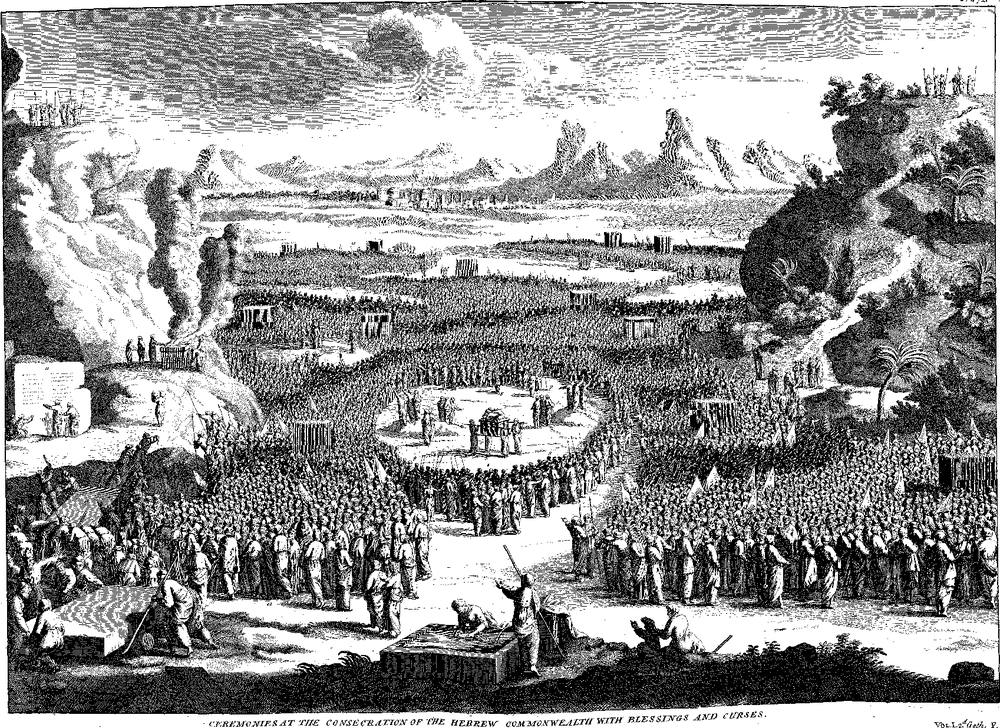
Moses commanded the Israelites, as soon as they had passed the river Jordan, to go directly to Schechem, and divide the whole multitude into two bodies, each composed of six Tribes, some whereof should be placed on Ebal, the others on Gerizim. The six Tribes that were on Gerizim were to pronounce blessings on those, who should faithfully observe the Law of the Lord;
and the six others on Mount Ebal, were to pronounce curses against those who should violate it. Joshua having entred the Land of Promise, executed punctually what Moses Josh. viii. 30, 31.had commanded, and led all the Tribes to Ebal and Gerizim, in the year of the World 2553, before Jesus Christ 1447, before the Vulgar Æra 1451. Moses had injoined them Deut. xxvii. 4, 5.in particular to erect an Altar of unhewn stones upon Mount Ebal, and plaister them over, that the words of God’s Law might be written on them: but the Samaritans, instead of Ebal read Gerizim in their Pentateuch, because their Altar, and the place where they perform the publick Offices of their Religion, are still at this day on Mount Gerizim.
As to the Ceremony of consecrating the Commonwealth of the Hebrews, it is thought to have been performed in this manner. The Heads of the six first Tribes went up to the top of Mount Gerizim, and the Heads of the six other Tribes to the top of Mount Ebal. The Priests with the Ark, and Joshua at the head of the Elders of Israel, took their station in the middle of the valley, which lies between the two mountains. The Levites ranged themselves in a circle about the Ark, and the Elders with the people placed themselves at the foot of each mountain, six Tribes on a side. When they were thus disposed into order, the Priests turned towards Mount Girizim, on the top whereof were the six Heads, whose six Tribes were at the foot of the same mountain, and pronounced, for example, these words: Blessed be the man that maketh not any graven Images. The six Princes who were upon the mountain, and the six Tribes, who were below at the foot of it, answered, Amen. Afterwards, the Priests turning towards Mount Ebal, upon which were the Princes of the six other Tribes, cried with a loud and intelligible voice, Cursed be the man that maketh any graven Images. Whereupon the six Princes, who were upon the same mountain, and the six Tribes who were below, answered Amen.
The Scripture seems at first to intimate, that there were six intire Tribes upon one mountain, and six upon the other; but, besides that it is by no means probable, that the Tribes of the Israelites, who were almost innumerable, should be able to stand upon the tops of these two mountains, it was not possible for them to see the Ceremony, nor to hear the Blessings and Curses, in order to answer to them. Moreover, the Hebrew particle in the original, signifies near, over-against, as well as at the top. Joshua viii. 33. Accordingly we may say, that neither Joshua, nor the Priests, or Tribes went up to the top of the mountains, but the Heads only, who in their persons might represent all the Tribes.
As to the great stones which were set up and plaistered over, in order to write the words of the Law upon them, Expositors are not agreed whether these stones, or this monument, are the same with the Altar upon which the Peace-Offerings were sacrificed to make a feast for all the people. Notwithstanding, upon comparing the 2d and 3d Verses with the 5th of the xxviith Chapter of Deuteronomy, it will appear, that the Altar is too well distinguished from the Stones in question, to leave room for a mistake.
I. EBED, the son of Jonathan, of Adin’s family, returned with fifty men from the Captivity. Ezra viii. 6.
II. EBED, the father of Gaal. See Judges ix. 26.
Jerem. xxxviii. 6, 7, 8, &c.EBED-MELECH, the Eunuch or Servant of King Zedekiah. He being informed that Jeremiah was imprisoned in a place full of dirt and infection, informed the King of it by the particular order of the principal persons in Jerusalem; and withal told him, that this Prophet would be starved there, because there began to be great want of bread in the City. Zedekiah therefore commanded Ebed -melech to take thirty men with him, and deliver the Prophet out of the place of his confinement. Hereupon this Officer took some old rags, and let them down with cords to Jeremiah, who placed them under his arms, to prevent any hurt which he might otherwise receive from the ropes: in this manner Ebed-melech drew him up out of the dungeon. But the Prophet was not restored to perfect liberty; for he still remained shut up in the court of the prison. God did not suffer this act of charity to pass unrewarded: for while Jeremiah was still confined in the prison-court, he said one day Jerem. xxxix. 15, 16.to Ebed-melech; Thus saith the Lord, Behold I will bring my words upon this city for evil, and not for good; and they shall be accomplished in that day before thee. But I will deliver thee in that day, saith the Lord, and thou shalt not be given into the hand of the men, of whom thou art afraid; because thou hast put thy trust in me. Accordingly, after the taking of the City by Nabuzaradan, Ebed-melech was preserved. In the year of the World 3416, before Jesus Christ 584, before the Vulgar Æra 588.
EBEN-EZER, that is to say, The Stone 1 Sam. iv. 1, & seq. In the year of the World 2883. before J. C. 1112, before the Vulg. Æra 1116. Under the HighPriest Eli. Ptol. Tab. 4. Asiæ.of Help: so the field was called, where the Israelites were, when they were defeated by the Philistines, and the Ark of the Lord fell into the hands of these Infidels.
EBER. See HEBER.
EBIASAPH, of the Tribe of Levi, was the son of Elkanah, and father of Assir. 1 Chron. vi. 23.
EBODA, a Town in Arabia-Petræa. It is probably the same as Oboda, or Oboth. Numb. xxi. 10. xxxiii. 43,44. See OBOTH.
E C-
ECBATANA, a city of Media, built by Herodot. l. 1. c. 98.Dejoces King of the Medes, and encompassed with seven walls, of unequal heights, and different colours: the largest of these walls, according to Herodotus, was equal in extent with those of Athens, that is to say, an hundred and seventy eight furlongs, or Thucyd. l. 1.three and twenty thousand three hundred paces, which make near eight leagues. The battlements of these walls were of different colours. The first were white, the second black, the third red, the fourth blue, the fifth a deep red, the sixth done over with silver, the seventh gilded. Herodotus attributes this whole work to14 Dejoces: but in the first book of Judith, Arphaxad, whom we take to be the same as Phraortes, the successor of Dejoces, is said to have built Ecbatana.
Ecbatana was situated in old Media, and is often made a part of Persia. The Kings of Persia were used to pass the summer there, because of the freshness of the air. It Ezra vi. 2. באחמתאis said in the book of Ezra, that at Ecbatana in Media there was found a copy of Cyrus’s Edict, whereby the Jews were permitted to return into their own country. But several Interpreters translate Achmeta, which is the word in the original, a strong box, a press, a pitcher. This Edict was found in a press, which lay among the old records of Media. The book of Tobit places the city of Rages in the mountains of EcbatanaTob. v. 8. 2 Macc. ix. 3.. Lastly, in the Maccabees it is said, that Antiochus Epiphanes being at Ecbatana, had intelligence there that his armies in Palestine were routed.
ECBATANA, or rather Gabbatha, a city situated at the foot of Mount Carmel, Plin. l. v. c. 19.on the side of Ptolemais. There Cambyses died of the wound, which he received in his thigh with his own Scimiter, as he was Herodot. l. 3. c. 64.mounting his horse. See our Dissertation upon Gog and Magog, prefix’d to our Comment on Ezekiel.
ECCLESIASTES. The Hebrew title of the Sacred book of Ecclesiastes, is Coheleth, which is a feminine word, the literal signification whereof is, She who speaks in publick; or, She who convenes the assembly. But the Greeks and Latins, without having any regard to the gender, have called it Ecclesiastes, that is to say, an Orator, one who speaks in publick. Solomon, who is the author of this book, describes himself in the very first verse in these words, The words of Eccl. i. 1. כהלתCoheleth. Eccl. ii. 4, 5, 6.Coheleth the son of David, King of Jerusalem. He speaks of his works, his riches, and his buildings; and in particular of his Proverbs, Eccl. xii. 9. Eccl. i. 16.or Parables. He there declares, that he was the wisest and happiest of all his predecessors in Jerusalem; which is so plain a character of himself, that there is no room to doubt his being meant by it15.
Notwithstanding these reasons, there are criticks who have disputed, whether this book was written by Solomon. Grotius is of opinion, that it was composed long after Solomon, and that Zerubabel procured it to be digested into order for his son Abihud, and with an intention of erecting an eternal monument in memory of Solomon’s repentance. The Author of a book intitled, The Thoughts of some Divines in Holland, says, that Ecclesiastes is a Dialogue, wherein a man of piety disputes against a Libertine, who favoured the opinions of the Sadducees. He believes that there are some things to be observed in it, which are directly opposite to each other, and could not proceed from the same person. But there is no proof of Zerubabel’s having this book digested into order; nor are there any footsteps appearing in it of a dialogue: and if there are opinions which seem to contradict each other, this proceeds from Solomon’s method of disputing pro and con, and proposing the objections of the Sadducees, which he replies to.
The Hebrews, St. Jerom, and the generality of Commentators believe this book to be the product of Solomon’s Repentance; that he composed it some time towards the latter end of his life, when he grew sensible of the vanity of worldly things, began to detest his follies, and return to God. Accordingly we find several marks of his repentance in this book. He tells us in it, that he had studied every thing, which might gratify his senses, had denied himself no pleasure of any kind, and in all these enjoyments had found nothing but vanity. But notwithstanding these reasons, some have made a question, whether Solomon be saved; and his repentance is still at this day a problem in the Church.
The Rabbins inform us, and St. Jerom confirms it after them, that they who collected the Sacred Writings after the captivity, and placed them in the Canon, at first made some difficulty of admitting the book of Ecclesiastes. They had it under consideration, whether or no they should suppress it, by reason of some dangerous opinions which were to be met with in it, and some particular expressions, which might infuse doubts concerning the immortality of the soul; but after deliberation on the matter, it was concluded to re
ceive it, as inspired Scripture, in consideration of some expressions towards the close of it, relating to the fear of God, and the observation Eccl. xii. 13.of his laws; and ever since this book has always been esteemed Canonical both by Jews and Christians. It is true, Vide Synod. V. Constant. act. 4.Theodorus of Mopsuesta was of opinion, that Solomon composed it without any particular inspiration; and Philastrius observes, that some Hereticks rejected it, as favouring Epicurism. But these opinions were never followed or approved: and the Church has condemned them, as contrary to the Faith received, and the respect due to the Canonical Scriptures.
Solomon in this book proposes the sentiments of the Sadducees and Epicureans in their full force. He proves excellently well the vanity of all things in this world, the little benefit of men’s restless and busy care, and the uncertainty of their knowledge. He proposes the strongest objections that can be formed against the immortality of the soul; but at last concludes in these terms: Let us hear the conclusion of the whole matter: Fear God, and keep his commandments, for this is the whole duty of man. In this all his obligations terminate, this is the only means to happiness.
ECCLESIASTICUS. The book of Ecclesiasticus is so called in Latin, perhaps to distinguish it from that of Ecclesiastes, or to show that it contains, as well as the former, precepts and exhortations to wisdom and virtue. The Greeks call it the Wisdom of Jesus the son of Sirach, or the Panaretos of Jesus the son of Sirach. This word Panaretos signifies a book that treats of all sorts of virtues. The Author has herein made a very large collection of maxims and instructions, useful in all states and conditions of life.
Some of the Ancients16 have ascribed this work to Solomon, but it is certain that the Author of it is much more modern than Solomon. He speaks in it of several persons, who lived after this Prince. He himself mentions his own name in Chap. l. verse 29.17 I Jesus the son of Sirach have written in this book the instruction of understanding and knowledge. The list chapter is inscribed, A Prayer of Jesus the son of Sirach. The Interpreter who translated it out of Syriac or Hebrew into Greek, says at the beginning, that his grand-father Jesus composed it in Hebrew.
As to the Translator, Athanasius, Epiphanius, and Joan. Damascenus were of opinion, that Jesus the son of Sirach had a son of the same name, and a grandson too, who was called Jesus, and surnamed the son of Sirach, who translated this book out of Hebrew into Greek. This is certain, that we have no authentick monument, whereby we may know the name of the Translator; for the title of the preface, which calls him Jesus, is not read so with this name in the Greek of the Roman Edition.
Some Rabbins think Ben-sira, a Jewish writer, from whom we have two alphabets of Proverbs, is the same with our Jesus the son of Sirach: this opinion was adopted by several Christian Authors; and there is indeed a great conformity to be observed in the sentences of these two writers. They who have the curiosity, may see a parallel of them drawn up by Cornelius a Lapide, and prefixed to his Comment upon Ecclesiasticus. But if it be true, as the Jews will have it, that Ben-sira was Jeremiah’s nephew, and the father of one Uziel, he cannot be said to be the same as Jesus the son of Sirach, who lived long after the Jews returned from their captivity, and since the Monarchy of the Ptolemies in Egypt.
We do not know exactly in what time the Author of this book lived. He makes an encomium on the High-priest Simon, and speaks of him as not then living. But as there were more High-priests than one of this name, the difficulty still continues in full force. Nevertheless it is very probable, that he means Simon II. after whose death all those calamities befel the Jews, which might induce the son of Sirach to say, what we read in the xxxvith and lth chapters. He who translated it into Greek, came into Egypt in the thirty eighth year of Ptolemy VII. who was surnamed Euergetes, the second of that name, as he himself tells us in his Preface. But as to the Author of the Latin translation made from the Greek, he is intirely unknown. St. Jerom did not touch this book, and we have it as it was when the Old Fathers were acquainted with it, and as they cited it, in very barbarous Latin.
As to the admittance of this Book into the Canon, whether it ever had a place there or not, has been much disputed. There are several old Catalogues of the Canonical Books, wherein we do not find this. St. Jerom18 says, the Church receives it for the edification, which may be had from it, but not with a design to authorize by it any point of doctrine in Religion. Ad ædificationem plebis, non ad authoritatem Ecclesiasticorum dogmatum confirmandam. But at present it is a received opinion in
the Catholick Church, that this book was placed in the Canon of the Holy Scriptures ; and it may be demonstrated by the testimony of several Fathers in all ages, and by the tradition of all Christian Churches, that it has at all times been reverenced and quoted by a great number of Ecclesiastical Writers, as inspired by the Holy Ghost. And if some of the Ancients did not insert it in their Catalogue, it was because they had confined themselves to place such writings only in their lists, which were not contested, and were unanimously admitted by both Jews and Christians.
ECDIPPA, otherwise Achzib. See ACHZIB.
ECHO. There is mention of an Echo in the book of Wisdom ch. xvii. 19. a rebounding Echo from the hollow mountains. The Greek word Echos signifies no more than barely noise. But Echo is the name of a Nymph who was metamorphosed into a stone, and retained nothing but her voice.
Ovid. Metam. l.3.Nec prior ipsa locui didicit resonabilis Echo,
Corpus adhuc Echo, non vox erat, & tamen usum
Garrula non alium, quàm nunc habet, oris habebat.
ECLIPSE. We do not meet with this word in Scripture. The Hebrews seem not to have philosophized much upon Eclipses. They considered them as miraculous effects, and sensible marks of God’s anger. Job seems to say, that an Eclipse is caused by Vide Joel ii. 10, 31. and iii. 15. Job xxxvi. 32. Job ix. 7.the interposition of the hand of God between us, and the Star eclipsed. In manibus abscondit lucem, & præcipit ei ut rursus adveniat. In another place he says, That God commandeth the Sun, and it riseth not, and sealeth up the Stars. Ezekiel speaks in a more particular manner, saying, that God Ezek. xxxii. 7.covers the Sun with clouds, when he deprives us of the light of it by an Eclipse.
The Eclipse which happened at our Saviour’s Matth. xxvii. 45.death, is a miracle not to be contested, since the Moon being then at the full, could not naturally cause an Eclipse. Besides, Eclipses generally last about an hour only, whereas this continued three; From the sixth hour there was darkness over all the land unto the ninth hour. Origen, with many others after him, believed this darkness to Origen. in Matth. xxvii.be particular to Judæa, which is very often described by the name of all the Earth. Others are of opinion, that our whole Hemisphere was then covered with darkness. Julius Africanus, Eusebius, and St. Jerom have cited Phlegon, the Emperor Adrian’s freed-man, who said, that in the fourth year of the two hundred and second Olympiad, Jul. African. apud Syncell. Euseb. & Hieron. in Chronic.which is the year of Jesus Christ’s death, there was the greatest Eclipse of the Sun that had been ever seen to that time, for at noon-day the Stars in the Heavens were plainly discernable. Tertullian refers the Heathens to Tertul. Apolog. c. 21. Rufin. l. 9. c. 6. Hist. Eccl.their publick records, to find there the time when it was night at noon-day.
Lucian a Priest of Antioch, who suffered martyrdom in 312, is introduced by Rufinus, speaking in this manner to the Heathens: Consult your annals, and you will find, that when Jesus Christ died, the Sun disappeared, and the day-light was interrupted by uncommon darkness. Thallus an ancient Author, is likewise named by Julius Africanus, as having taken notice of the extraordinary darkness attending the Passion of our Saviour. The spurious Dionys. Areopag. Ep. 7. ad Polycarp.Dionysius the Areopagite says, that when he was at Heliopolis in Egypt, he observed the Eclipse which happened upon this occasion; and as he knew that according to the rules of Astronomy it could not happen at that time, Allophanes, who was then his fellow-student in that city, cried out, These, dear Dionysius, are supernatural and divine changes; or, these are changes of things that are divine. Suidas makes Dionysius himself use this expression, Either the Divinity itself suffers, or compassionates some other, who is suffering.
EDEN, a Province in the East, where Genes. ii.8. גן בעדןParadise was situated. The Lord planted East-ward a garden of Delights, or according to the Hebrew text, a Garden in Eden. We shall speak of Paradise in another place, here we shall content our selves with describing only the Province of Eden. There is mention of the country of Eden or Aden in several places of the Scripture. Isaiah speaks of the xxxvii. 12.Children of Eden, or the people of this country, who were at Telassar. The same is observable in the second book of Kings xix. 12,13. where the children of Eden are joined with Gozan, Haran and Rezeph. Ezekiel Ezek. xxvii. 23.likewise mentions the merchants of Eden with those of Haran, Cannah, Ashur, and Chilmad. Now Haran is the same as Charræ in Mesopotamia upon the river Chaboras; Canneh, or Calneh, perhaps Callinicum in Mesopotamia. We are of opinion, that the country of Eden extended itself into Armenia, and included the sources of the Euphrates, Tigris, Phasis and Araxes.
יאר עדן Jor-aden.Some believe the garden of Eden was situated about Jordan, and the very name of Jordan is derived from Jor, and Aden: Jor-Aden, the stream of Aden; that the lake Gennesareth, which is at some places below the source of this river,
גנהשרהGanhasareth.comes from Gennat-Sara, the Prince’s garden, or the principal garden. Lastly, the Scripture says, that the country about Jordan, in the neighbourhood of Sodom and Gen. ii. 8.Gomorrah, was like the Paradise of the Lord. By the word Gennat-Adu, the Garden Bibl. Orient. p 36. Adu.of Eden, the Mahometans understand the Paradise of the Blessed, whither they believe Adam to have been transported, and from whence afterwards he was driven. They say, that when God made the Garden of Eden, he created there what Eye had not seen, nor Ear heard, neither hath entred into the Heart of man to conceive; that to this God gave the use of Speech, to this Paradise, and caused it to utter these words, There is no other God besides God himself. They add, that there are eight gates belonging to Paradise, whereas Hell has but seven; from whence they conclude, that the mercy of God surpasses his justice, and that it is more easy to be saved than to be damned.
EDEN, a town upon Mount Libanus, situated in a very delicious place; the river Adonis is not far from it, and a little more to the South are the Cedars of Libanus. It is our opinion, that the Prophet Amos speaks of this town of Eden, or Aden, in these terms; I will destroy him who holds the Sceptre of the house of Eden, or, according to the Vulgate, of the house of pleasure.
EDEN, the son of Joah, 2 Chr. xxix. 12.
EDER, a town in Judah, Josh. xv. 21.
Mich. iv. 8. Beda, Remig. Haimo. Grotius.EDER, Tower of Eder, Tower of the flock, near Bethlehem, according to several Interpreters. Others are of opinion that Micah hereby intended to describe the city of Jerusalem. The Hebrew text imports, And thou tower of the flock of Ophel. There was a tower in Jerusalem called Ophel.
EDER, the son of Mushi, and the Eufeb. l. 1. c. 1. Hist. Eccl.brother of Mahli, 1 Chr. xxiii. 23.
EDESSA, a city of Mesopotamia, built about four hundred years before Jesus Hieron. in Chronico.Christ, by the great Seleucus King of Syria, in that part of Mesopotamia, called Osrhoëne, and remarkable in Church History for the Letter which Jesus Christ wrote to King Abgarus or Agabarus, or Abagarus, who reigned at Edessa. Count Darius in Apud Aug. Ep. 230. Nov. Edit. Evagr. l. 4. c. 27. Hist. Eccles.St. Austin says, our Saviour promised Abgarus, that the city of Edessa should be impregnable; and Evagrius remarks, that altho’ this was not in our Lord’s Letter, it was nevertheless the common belief of the Faithful; which was much confirmed, when Cosrhoes King of Persia, having sat down before it, was forced to raise the siege19. St. Thaddæus, one of the Seventy Disciples, and different from the Apostle of the same name, was sent by St. Thomas to instruct the people of Edessa; he converted them to Christianity, together with Abgarus their King, who upon the reputation only of Jesus Christ’s doctrine and miracles, had begun already to believe in him.
EDNA, the wife of Raguel, cousin to old Tobit, of the same Tribe, and Captivity as he. She and Raguel were carried captives to Rages, a city of the Medes. She was the mother of Sara, who became the wife of Tobias, as we shall relate under the articles Tobias and Sara.
EDOM, otherwise Esau, the Son of Isaac, and brother of Jacob. The name of Edom, which signifies red, was given him, either because he sold his birth-right to Gen. xxv. 25, 30.Jacob for a mess of red pottage, or by reason of the colour of his hair and complexion. See the Article ESAU. Idumæa derives its name from Edom, and is often called in Scripture the Land of Edom. See IDUMÆA.
Josh. xiii. 31.EDOMIA, a village in Palestine. Hieronym. ad Abdiam, c. 1.
I. EDREI, a town beyond Jordan, in the Tribe of Manasseh. It is called likewise Edræa and Adræa, and perhaps also Edera in Ptolemy, when he speaks of the towns in the Batanæa. Eusebius places Edrei at four or five and twenty miles Euseb. in locis.distance from Bostri, a town in Arabia, situated northward.
II. EDREI, a town in the Tribe of Nephtali, Josh. xix. 37.
EDUMA, a village situated twelve Idem in Astaroth.miles from Schechem eastward.
EFFEMINATI. There is mention of them in several places of Scripture, and in a sense very different from that, wherein this term is understood in our language. Effeminate in the style of the Sacred Writings, signifies corrupt persons; consecrated to some profane God, and prostituting themselves in honour of him. The word Kadesh translated effeminatus, signifies properly one consecrated, but by a קדשKadesch. Effeminatus.mistaken use of it, it has been attributed to those of either sex, who publickly prostituted themselves, particularly in honour of Baal and Astarte. These ignominious victims of immodesty had cells in forests of tall trees, where they exercised their infamous imployment, Ædiculas effeminatorum. Deut. xxiii. 18. 2 Kings xxiii. 7. Job xxxvi. 14. 1 Kings xiv. 24. xv. 12. xxii. 47. Hos. iv. 14. Isai. iii. 4. עלוליםMoses expressly forbad these irregularities among the Israelities, but the history of the Jews shews, that they were frequently practised by them.
We find likewise the word Effeminati in Isaiah iii. 4. but the Hebrew reads parvuli in this place, people without understanding and experience. We read also
in the Proverbs xviii. 8. Pigrum dejicit timor, animæ autem effœminatorum esurient. But this verse is not in the Hebrew; and the Greek word Androgynos signifies a person, who partakes of both sexes, both of the man and woman.
EGLAH, the sixth wife of David, and 2 Sam. iii. 5. Ita Rabb. & Auth. Tradit. Hebr. in 2 Sam. Bibl. Orient. p. 716. עגלהJuvenca.mother of Ithream. Many are of opinion, that Eglah and Michal are the same person, and that she died in labour of Ithream. But from what is said in 2 Sam. vi. 23. that Michal had no children, this particular of Eglah’s being Michal is much questioned. Eglah signifies an Heifer.
EGLAIM. See AGALLA.
I. EGLON, King of the Moabites, oppressed the Israelites for eight years. Eglon Judges iii. 12, 13, 14.being in league with the Ammonites and Amalekites, advanced as far as the City of Palm-trees, that is to say, Jericho, or En-gedi, whereof he made himself master. His general residence was at Jericho, and the Lord raised up Ehud to deliver his people from the oppression of the Moabites. In the Article of EHUD, we shall relate the particular manner, wherein he put Eglon to death. The servitude of the Israelites under the Moabites continued from the year of the World 2591 to 2599, before Jesus Christ 1401, before the Vulgar Æra 1405.
II. EGLON, a City in the Tribe of Judah. Joshua xv. 39.
EGYPT, a Country in Africk, called in Hebrew, Mezor, or Mezraïm20, or Mizraïm, and in Greek, Aiguptos, whence the Latin, Ægyptus, and the English, Egypt, and Copt are derived. Mizraïm was the son of Ham; and Ægyptus was, they say, an ancient King of this Country, the son of Belus, and brother of Armaïs. Gen. x. 13.The sons of Mizraïm were Ludim, Anamim, Sehabim, and Naphtuhim, Pathrusim, and Casluhim, who peopled several Cantons of Egypt, or the Countries adjacent. The old Geographers placed one part of Egypt in Asia, the other in Africk. The part in Asia lay eastward of the Nile, the other westward of the same river. The Ancients likewise described that part of lower Egypt, which lies eastward of the Nile, as belonging to Arabia; and the same is in the Scripture made part of the land of Cush, which is so frequently translated Ethiopia.
Egypt was divided into Nomæ, or Cantons, whereof there were reckoned to be two and forty, which were as it were so many little Provinces. Egypt was distinguished into the Upper and Lower. The Upper was likewise called Thebaïs, because of the city Thebes, which was the Capital of it. It extended itself a great way towards the south as far as the frontiers of Ethiopia. Lower Egypt contained principally the Delta, and the Country lying upon the Coasts of the Mediterranean. Every one knows, that Egypt has properly but one river, which is the Nile, by the inundations whereof all the fertility of the Country is produced21.
The Arabians call that part of Egypt which extends from Cairo to the Mediterranean, Rib, or Rif. Upper Epypt is called Rif.Sais, or Thebaïs, and the part between both, Souf. The word Rib or Rif is mentioned in Scripture, Memor ero Rahab, & Psalm lxxxvi. 4.Babylonis scientium me; where Rahab and Rib are the same thing. We find it again in this sense, Psalm lxxxix. 11. and Isaiah xxx. 7. and li. 9. The word Souf is likewise to be met with in the sacred Books written in Hebrew, Moses calls what we term the Red Sea, the Sea of Souf. It is amazing that Sais, which is the name of Thebes, the famous Capital of Upper Egypt, should no where be found in Scripture. Some are of opinion, that Thebes is there called No-Ammon, or the dwelling of Jupiter. M. D’Herbelot says, that Said in Arabic signifies an high ground, and that they call the upper part of Egypt, which is Thebaïs, Saïd Mesr. Now the Thebaïs is again divided into Upper, Lower, and Middle. The Upper comprehends the Cities of Arment, Arsouan, (or Siena) Asna, probably Latopolis, and Soïouth: to these some join the towns of Kist, Coss, and Acsour.
Lower Thebaïs includes the Cities of Abousig, Aschmounim, Manraloux, and Fioum. The middle part of it contains the City of Akonin.
Bibl. Orient. p. 579. Mesr.The name of Mesr, Misor, or Misraim, son of Ham, is preserved in the City of the same name, which has been successively called Misor, Memphis, Moph, Babylon, and Cairo. It went by the name of Moph or Memphis, till the time of Alexander the Great; then it was called Babylon, by reason of its situation, and the relation it had to Babylon of Chaldæa. This City was conquer’d by the Arabians in the 18th or 19th year of the Hegira. Amrou-Ben-As, who took it, built another very near it, which was called Fusthath, by reason of this General’s tent, which was set up for a long time in the same place. The Fatimite Caliphs having made themselves masters of Egypt, added besides another City, which they named Caberah, that is to say, the Victorious, which is known to us at this day by the name of Grand Cairo.
The Mameluc Sultans of the Dynasty of the Circassians, having afterwards built a Castle very high, and very well fortified on the eastern shore of the Nile, drew thither most of the inhabitants of Cairo, so that this City insensibly changed its situation, and the Cairo built by the Fatimites was no more known by any other name than that of Old Cairo. Cairo is built upon the eastern shore of the Nile, but the ancient Misor or Mesr, was built on the western shore of the same river.
As to the name of Egypt, it comes from Kibt, or Kibthi, which is the ancient city of Coptos in High Egypt, distant from the Nile Bibl. Orient. p. 1003. Kibt.about seven Parasangs, which make about fourteen Leagues. From this town of Coptos, the Cophti or present Egyptians derived their name, who are all Christians, and speak a language compounded of Greek and old Egyptian. The Turks call the old Egyptians, who are natives of the Country, and not Mussulmen, Kibs. Their Authors mention Egypt as one of the best and most beautiful Countries in the world: one of them says, the Soil of this Country is for three months in the year white and sparkling like a pearl, for three months black like musk, for three more green like emeralds, and for three months more as yellow as amber. He enumerates all the particular things which are to be found only in Egypt; the principal whereof are these, a mine of oriental Emeralds, red Barley, Opium, Balm of Mataræa, Joseph’s Wheat, the art of hatching Chickens in ovens, Honey of the Bees of Baenza, the Egyptian Bean, fine Flax, Cassia, the Fish called Scinchur, several sorts of Woods and Marbles singular in their kind, the plant Papyrus, &c. It should not therefore appear so surprizing, to find the Israelites in the Wilderness regretting their departure out of so excellent and fine a Country.
Odyss. xiv. v. 258. Στῆσα τ’ ἐν ‘Αιγύπτῳ ποταμῷ νέας ἀμφιελίσσας.Homer calls the Nile, Ægyptus. Several of the Ancients have asserted in their writings, that Egypt was no more than a large tract of land produced by the Nile; and of this the Ethiopians were so persuaded, that they made use of this argument to prove, that they were more ancient than the Egyptians. Bochart has confuted this opinion in his Phaleg. l. 4. c. 24.
Egypt is divided into two parts by a great ridge of Mountains, which lies between the Nile and the Red Sea; and extends from North to South. The space between these Mountains and the Red Sea is in the possession of the Arabians, and almost intirely a desart; but so much as lies between the Nile and these Mountains, is the most fertile Country in the world. They are forced to throw sand upon their lands, to lessen the excessive fruitfulness of them, which proceeds from the inundations of the Nile, this river regularly overflowing the Plin. l. 18. c. 18.Country hereabouts in the beginning of the summer solstice, and so continuing there during the whole time of the sun’s passage through the sign Leo: it decreases when the sun cometh to Virgo, and when it is at Libra, the Nile sinks intirely into its channel. The old Egyptians had two crops of corn every year from the same ground; at present they are content with one. After barley-harvest they sow in the same field rice, melons, and cucumbers. Egypt is said to have furnished Rome with corn to the quantity of twenty millions of bushels.
Plin. ibid. Cassian. collat. 15. c. 4. Exod. ix. 31, 32. Joseph. Antiq. l. 3. c. 10.Pliny says, they set about sowing in the beginning of November; that the first of their harvest is in April, and that in May they finish it. Moses observes, that in the middle of March, when the Israelites departed out of Egypt, the barley and flax, which were already far advanced, were spoiled by the hail; but that the wheat, which is backwarder, was preserved. The Egyptians sowed their barley and flax before winter, that is to say, in the beginning of November, after the waters of the Nile had retired. Winter in this Country is very moderate, and the inhabitants put their horses to grass in January and February. The wheat-harvest was compleatly ended by Pentecost in Palestine and Egypt: the whole harvest must certainly have been over when the Nile began to overflow.
The Egyptians boasted in being the most ancient people in the world: they have been thought to be the Inventors of Arts and Sciences: they communicated to the Greeks the names of the gods, and their false Theology: they carried Superstition and Idolatry farther than any other people, worshipping stars and men, animals, and even plants, if the Heathens themselves may be believed in this particular, who have ridiculed their excessive Superstition. In imitation of them, the Hebrews adored the golden Calf in the Exod. xxxii. 6.wilderness; and Jeroboam set up the like Figures, which he recommended to his subjects, as objects of their worship. Moses informs us, that the Hebrews sacrificed beasts, the death whereof was looked upon by the Egyptians as an abomination, and something Exod. viii. 26. Gen. xlvi. 34. Maneth apud Joseph. l. 1. contra Apion. Euseb. præpar. l. x. c. 13.detestable. He tells us likewise, that they would not eat with the Hebrews, because they had an abhorrence for all shepherds.
As to the motives of this aversion, opinions are much divided. Some believe it to be founded on the invasion of Egypt by the Kings surnamed Shepherds, who came from Arabia, made an irruption into this Country, and reigned there for a long time, according to Manetho’s relation. Others think, that the Egyptians, from the time of their King Sesostris having been accustomed to a soft and idle life, detested shepherds, whose profession was more active and laborious.
Egypt continues on the next page
Footnotes
-
Vide Nicetam, l. 1. c. 35. Euseb. præpar. l. xi. c. 2. & l. xii. c. 1. Δευτερώσεις, Deuteroses. Δευτερωταί, the Deuterotes, who busied themselves in explaining the Deuteroses. ↩
-
Epiphan. loco citato. Μετὰ τὸ βιῶσαι, lege, μετὰ τὸ κυῶσαι*, or* μετὰ τὸ ἡῶσαι. Le Moine. Varia Sacra, t. 2. p. 1102. ↩
-
Translators’ note. So the Vulgate translates it; but in our English Version it is, Because of the fierceness of the Oppressor. ↩
-
Translators’ note. In the English translation, The oppressing Sword: the radix of ,יונה ↩
-
Dove, being ,ינהwhich signifies Oppressit. ↩
-
Hieronym. in Jerem. xxv. 38. & in Ezek. xxix. Bochart. Maldon. Sanct. Tirin. &c. ↩
-
Greg. Mag. l. 32. Moral. c. 6. Thom. Hugo, &c. ↩
-
Translators’ note. The Attick Drachm, says Dr. Arbuthnot, is commonly reputed equal in value to the Denarius, which he has stated in his Tables, at seven pence three farthings. See his Chapter of the Grecian Coins, p. 25. ↩
-
Translators’ note. The ancient Greeks and Romans had the same opinion of them, as appears from their most eminent writers. Ἀλλ’ ἄγε δὴ τινα μάντιν ἐρείομεν ἢ ἱερῆα, Ἢ καὶ ὀνειροπόλον, καὶ γάρ τ’ ὄναρ ἐκ Διός ἐστιν. Hom. Il. α’. 63. See likewise what Apollonius says to the same purpose, l. ii. c. 37. Maximus Tyrius Serm. xviii. Synesius de Insomn. See also Cicero de Divinat. l. 1. The Romans indeed were of opinion that Dreams proceeded from others besides Jupiter, as Persius intimates in these lines of his second Satyr. ——Nam fratres inter ahenos Somnia pituita qui purgatissima mittunt Præcipui sunto. ↩
-
Vide Bochart. de Animal. Sacr. part. 2. l. 2. c. 1. Grot. Menoch. ↩
-
Translators’ note. Aquila longam ætatem ducit, dum vetustis plumis fatiscentibus, novâ pennarum successione juvenescit. Ambros. Serm. LIV. ↩
-
Tertull. vide & Tacit. Fulgentibus aquilis, signis & simulachris Deorum, in modum Templi. ↩
-
Vide Origen. Chrysost. Maldonat. Grot. Scult. Hammond, Le Clerc, Lud. de Dieu, &c. in Matth. xxiv. ↩
-
Translators’ note. Arphaxad*, in the opinion of* Dr. Prideaux*, is the same as* Dejoces*; he repaired, enlarged, and beautified* Ecbatana*, there-* fore by the Greeks is thought to be the Founder of it. This City was taken and miserably defaced by Nebuchadnezzar. ↩
-
Translators’ note. It appears certainly from hence how much the Talmudists were mistaken, who made Hezekiah to be the Author of this Book, for none of these marks are applicable to him; and much less to Isaiah*, who was thought by* Rabbi Moses Kimchi to be the composer of it. See Huet. Demonstr. Evang. Prop. IV. ↩
-
Innoc. I. Ep. ad Exuper. Concil. Carth. 3. Origen. homil. 4. in Num. & homil. 1. in Ezech. Chrys. in Psalm. 134. Hilar. in Psal. 144. Cyprian. l. 3. Ep. 4. Optat. lib. 3. contra Donat. Leo Mag. Ser. 2. de Quadrag. & alii. ↩
-
Translators’ note. F. Calmet reads ἐχάρεσξα, but the Greek of the Complutensian Edition is ἐχάρεσξες, and the English translation follows this reading. ↩
-
Hieronym. Præf. in lib. 6. Salom. ↩
-
Translators’ note. Edessa was situated upon the river Scyrtus, which overflowing its banks, did great mischief to the city, and drowned many of the inhabitants, in the reign of the Emperor Justinus, who repaired the town, and called it Justinopolis. It goes at present by the name of Ourfa. ↩
-
Translators’ note. Plutarch de Iside & Osiride, testifies, that Χημία was an ancient name of Egypt, and that it was called so, long af- ter, by the most skilful of the Egyptian Priests; that is, the Country of Cham: as also, the Scripture terms it, Psal. cv. Et Jacob peregrinus fuit in terra Cham. From whose son, says my Author, it was afterwards named Misraïm, and by the Arabians, Mesre to this day. ↩
-
Translators’ note. With a regard to this advantage, it is said in Lucan, that Egypt hath no need of Jupiter. ——Non indiga mercis, Aut Jovis, in solo tanta est Fiducia Nilo. L. 8. ↩