Volume I, pages 442–459 of the 1732 edition, from DEV to DOS: everything printed on these pages, in order.
Continued from Devoting
brought me from Syria, from the mountains of the east, saying, Come and curse Jacob, make haste, and defy Israel. How shall I curse whom the Lord hath not cursed? or how shall I defy whom the Lord hath not defied? For from the top of the rocks I see him, and from the hills I behold him: lo the people shall dwell alone, and shall not be reckoned among the nations. Who can count the dust of Jacob, and the number of the fourth part of Israel? Let me die the death of the righteous, and let my last end be like his.
As Balaam, instead of cursing, blessed the Israelites, Balak desired him to be silent, and having conducted him to another place, from whence he could see some part only of the Israelitish camp, he erected new Altars there, and offered sacrifices. But Balaam began again to bless Israel, saying, God is not a man that he should lye, neither the son of man that he should repent. Hath he said, and shall he not do it? or hath he spoken, and shall he not make it good? He hath not beheld iniquity in Jacob, neither hath he seen perverseness in Israel*: the Lord his God is* with him, and the shout of a king is among them: surely there is no enchantment against Jacob, neither is there any divination in Israel, &c. or otherwise, there is no Diviner nor Soothsayer against Israel. You endeavour in vain to devote them, and have them cursed: no devoting, no cursing can be of any effect against them: their God is above all the art of Magicians, and all the malice of Devils.
This is the only example of this sort of devoting that we find in Scripture.
Joseph. Antiq. l. 14. c. 4. & de Bell. l. 1. c. 5.Josephus has furnished us with another. During the troubles which happened in Judæa between the two brothers Hircanus and Aristobulus, who disputed for the High -priesthood and Dominion over the Jews, Aristobulus with his people being shut up in the temple by Hircanus, who was in Jerusalem with those of his party; the latter sent for one Onias into their army, who was reputed a great saint, and was said to have obtained rain in a time of drought by the efficacy of his prayers: they imagined that his curses would be sufficient to draw down the vengeance of heaven upon Aristobulus and those of his faction.
Onias resisted their importunities for a long time; but at length, finding that they would never cease tormenting him, he lifted up his hands to heaven in the midst of the army, and pronounced these words; O Lord God, who art Governour of the Universe, since they who are with us are thy people, and they who are besieged are thy priests, hearken not unto the prayers of either the one or the other against the opposite party. They who invited him to come were so enraged to see themselves frustrated in their expectation, that they stoned him upon the spot, and so cruelly murdered him.
Deut. xx. 16, 17.Several Devotings of another sort are taken notice of in sacred History, as when any people, city, country, or family were devoted to the curse; for example, the Lord devoted the nation of the Canaanites and 1 Sam. xv. 3. Numb. xxi. 3. Joshua vii. 13, 24, 25. Joshua vi. 17.Amalekites. The Israelites devoted the town of Hormah, the family of Achan, and the city of Jericho. Upon these occasions they generally destroy’d every thing that was in these provinces and cities. As they were not to undertake any war without first consulting God, who was as it were the General and Chief Leader of the Israelitish Armies, in whose name the priests sounded the charge and gave the signal of battle, they were as it were sure of success, provided they were faithful to him, and under such a protection they despised the strange Gods of the enemies: indeed they were not taken for Gods, nor did people condescend to call them forth, or use any the least precautions against them.
Q. Curt. l. 4.But the Heathens who admitted a plurality of Gods, and believed them to be subordinate in power to one another, made use of Inchantments and Devotings to bring mischief upon their enemies, their cities and armies. They sometimes called forth the tutelary Deities of cities to deprive their enemies of their protection and defence. It is said, for example, that the Syrians chained the Statue of Apollo, and fastened him to the Altar of Hercules tutelar deity of their city, lest he should forsake them and retire out of the city. Aurea catena devinxere simulachrum, araeque Herculis, cujus numini urbem dicaverant, inseruere vinculum, quasi Macrob. Saturnal. l. 3. c. 9.illo deo Apollinem retenturi.
The Romans, says Macrobius, being persuaded that every city had its tutelary Deities, used certain verses to call them forth, believing it impossible to make themselves masters of the town without it; and even when they had it in their power to take the place, they thought always that it would be a great crime to take the Gods captives with it: for this reason the Romans ever kept the real and concealed name of their cities very private, this being very different from that they generally gave Plin. l. 3. c. 5. l. 28. c. 2. Plutarch. Problem. 2. Macrob. Saturnal. l. 3. c. 9. Solin. c. 2.them among the people, as likewise the name of the tutelary God of their cities. Pliny informs us, that the secret name of Rome was Valentia, and that Valerius Soranus was severely punished for revealing it. Now the form made use of in calling forth the tutelary God of any city was as follows: “ If it be God or Goddess under whose “ guard are the city and people of Carthage, “ I beseech thee, O Great God, who hast “ taken this town and people under thy “ tuition, I conjure and entreat thee graciously to abandon the city and people “ of
“ of Carthage, to forsake all their dwellings, “ Temples and sacred Places, to cast them “ off, to inspire them with fear, terror, “ and forgetfulness, and to retire to Rome “ among our people; let our Habitations, “ our Temples, our Things Sacred, and our “ City be more agreeable to thee; demonstrate to us that thou art my Protector, “ the Protector of the Roman people, and “ of my soldiers. If thou dost this, I engage myself by a solemn vow to found “ Temples and institute Games in honour “ of thee.” We may see in Livy the evocation of the Gods of Tit. Liv. Decad. 1. l. 5. Plin. l. 2. c. 53.Veia. The Tuscans called forth the thunder, when they thought they had occasion for it. Numa Pompilius did so often with success. Tullus Hostilius attempting it without making use of the accustomed rites, was himself struck with thunder.
As to the Devoting hostile armies, or besieged places, we have here an example of it Macrob. Saturnal. l. 3. c. 9.from Macrobius: “ Dis-Pater (this was Pluto) “ Jupiter, ye Manes, or by what “ other name ye will be called, I earnestly “ beseech you to spread fear and terror in “ the army I shall mention to you, and “ throughout the city of Carthage. May “ ye look upon all as devoted and accursed, may ye deprive them of light, “ and remove at a distance from this country “ all those who shall bear arms against us, “ and shall attack our legions and our armies; may all their armies, fields, cities, “ heads, and lives be comprized within “ this wish, as far as they may be comprized in it by the most solemn Devoting. “ Wherefore I devote them, I charge them “ with all the mischief that may happen “ to myself, our Magistrates, the Roman “ People, our Armies and our Legions; that “ ye may preserve me myself and those “ who employ me, the Empire’s legions, and “ our army which is concern’d in this war. “ If you please to do these things, as I “ know and understand them, I promise “ you, O Earth, mother of all things, and “ you, Great Jupiter, a sacrifice of three “ black sheep.”
DEUTERONOMY, the last of Moses’s five Books. The Greeks gave it the name of Deuteronomy, or the second Law, or repetition of the Law; because Moses therein makes a kind of recapitulation of what he had ordained and done in the preceding Books. The Hebrews call it Elle-haddebarim, which are the first words of this Book in the Hebrew Text. Some Rabbins call it Mishnah, that is to say the second Law; others the Book of Reprehensions, by reason of the Reproaches wherewith Moses loaded the Israelites in Chap. i. viii. ix. xxviii. xxx. xxxii. This Book contains the history of what passed in the wilderness from the beginning of the eleventh month, to the seventh day of the twelfth month, in the fortieth year after their departure out of Egypt; that is to say, the history of about six weeks.
Some have questioned whether this Book were written by Moses, because there is mention in it of the death of this Legislator, and the Author speaks of the land beyond Jordan, like one who had written on this side westward of that river. As to the first argument, we allow that the relation of Moses’s death was added to this book; and for the second, we believe that the Hebrew עבר trans, or cis בעבר in transitu. Chap. i. ii. iii. iv.word Heber, which is translated trans Jordanum, beyond Jordan, may likewise be translated on this side.
In the book of Deuteronomy, Moses immediately harangues the people, and refreshes their memory with a recital of what had passed ever since their coming out of Egypt, till their arrival in the plains of Moab. He speaks to them a second time in the fifth and following chapters, and lays before them the laws of God which he had received at Sinai, adds some others that were new to them, and explains the old. In the xxviii, xxix, and xxx Chapters, he continues to exhort the people to observe faithfully the laws of God. He afterwards declares, that Joshua was by God appointed to succeed him in the government of the multitude. He wrote down what he had been Deut. xxxi. 9, 10—14.saying to them, put this writing into the hands of the Levites and Elders of the nation, and charged them to read it every seven years in a general Assembly of the people at the Feast of Tabernacles.
Some few days after, he repeated an excellent Song in the presence of the people, wherein he foretold their future Infidelities. He enjoined them to take copies of it, and to preserve the memory of it, that by this means they might be excited to continue constantly faithful to the Lord. Lastly, God having commanded him the same day to go up mount Nebo, there to die, he convened all the people, and like a good father, gave his Blessing to all the Tribes, and foretold to them separately what should happen to them. After which, he ascended the mountain, and there died. This is a summary account of what is related in the book of Deuteronomy.
משנה Mishnah.DEUTEROSIS. Thus the Jews call their Mishnah, or second Law. Deuterosis in Greek has the same signification almost as Mishnah in Hebrew: both signify second, or Eufeb. in Isai. i. 22. p. 362. Epiphan. Hæres. 33. num. 9.rather iteration. Eusebius accuses the Jews with corrupting the true sense of Scripture with the trifling explanations of their Deuteroses. St. Epiphanius says, that there were four sorts of them quoted: the first under the name of Moses; the second under that of Akiba; the third under that of Adda or Judah; and the fourth under the name of the sons of the Asmonæans or Maccabees. It is not easy to say
whether the present Mishnah is the same with these, whether it contains them all, or only some part, or whether it be different Hieron. in Isa. viii.from them. St. Jerom says, that the Hebrews referr’d their Deuteroses to Shammai and Hillel; if it were well proved that they were of this antiquity, it would be considerable, Joseph. l. 14. Antiq. & l. 15. c. 1.since Josephus speaks of Sammeas, who is the same with Shammai in the beginning of Herod’s reign. St. Jerom speaks always of the Deuteroses with the utmost contempt; he looked upon them as a collection of fables, childish stuff, and obscenities. He says, the principal Authors of these fine decisions, according to the Jews, are Bar-Akiba, Simeon, and Helles. Bar-Akiba is probably the grandfather or father of the famous Akiba: Simeon and Shammai are the same persons, so are Helles and Hillel. See the Article MISHNAH.
DEW. Dews in Palestine are very plentiful. Hushai compares an army falling upon the enemy to the Dew descending on 2 Sam. xvii. 12.the ground. It was as it were a small shower of rain, which fell every morning. Gideon filled a bason with the Dew which fell by Judg. vi. 38. Cant. v. 2.night upon a fleece of wool. The Spouse in the Canticles says, that his hair was moisten’d with the Dew. Isaac blessing Jacob, wished him the Dew of heaven which fattens Gen. xxvii. 28.the fields. In these warm Countries, and in places where it rains but seldom, the night-dews supply in some sort the want of rain. The wise man says, that the clouds are formed of the Dew; Nubes rore concrescunt. Prov. iii. 20.Or rather, according to the Hebrew, the clouds produce or distill the Dew. And in another place, that the good humour of the Prince is like the Dew upon the grass: Sicut ros super herbam, ita hilaritas ejus. Isaiah speaks of rain as if it were a Dew, because in Isa. xviii. 4.reality it was almost as copious; like a cloud of Dew in the heat of Harvest. The same Prophet says, that the Dew which God Isa. xxvi. 19. טל אורות טלךcauses to fall upon the people, is a bright Dew, ros lucis, ros tuus: Thy Dew is a Dew which revives, enlightens, and restores liberty to thy captives. He speaks of the captivity of Babylon, as of a state of death. He compares his captive people to withered and dying grass. The Dew refreshes and strengthens it. In like manner, God’s visitation of his people will recover them in some sort to life and light. Others translate the Hebrew, Thy Dew is as the Dew of herbs, instead of a Dew of light and dawn. This comparison of God’s visitation to the Dew is remarkable in several places of the Scripture. See Hosea vi. 4. xiii. 1. xiv. 6. Micah v. 7.
DIA, a Town beyond Jordan, in the Emperor Leo’s Notitia set down as a place in Arabia.
DIABOLUS. This word comes from the Greek, Diabalos, which signifies a Calumniator. We very rarely meet with it in the Old Διάβολος, Calumniator. Accusator.Testament. Sometimes it answers to the Hebrew, Belial; and at other times to the word Satan. The first signifies one who is good for nothing, a Libertine; and the second, an Adversary, or an Accuser in a Court of Justice. The Author of the Vulgate has likewise made use of Diabolus in Habbakuk. Egredietur Diabolus ante pedes ejus, instead of the Hebrew Rescheph, which signifies a coal. The translation therefore should be, Death or the Pestilence shall go before him, and Coals shall go forth at his feet. In the Books of the Old Testament which were written in the Greek, Diabolus is taken for the Devil, or simply for the Enemy: but in the New Testament it signifies always the Devil, the grand Enemy of Mankind.
We have spoken at large in the Article Demons, of the fall of Lucifer and his followers. We have seen that Eblis, according to the Mahometans, was the same with him whom we call Lucifer. It may be proper to add a word or two farther in this place of Eblis, whose name comes pretty near that of Diabolus. The Mussulmen call him likewise Azazel, which is the name in Scripture for the Scape-goat; and is probably the same with that Azazel, whom the Book of Enoch mentions by this name, as one of the chief of the revolted Angels. They maintain that Eblis was called by this name, which signifies refractory, by reason of his rebellion against God; and that having received orders to prostrate himself before Adam, he would not comply, under pretence that he being of the nature of fire, ought not to bend the knee to Adam, who was formed only of earth. They say the Angels were created many thousand years before Adam, and that the fire whereof they were composed, was of a much greater activity than ordinary fire; that it was of the nature of lightning.
We have already observed, that they were capable of ingendering, and in reality did ingender other Genius’s of the same nature with themselves, and imitators of their disobedience and rebellion. They believe that Eblis desired of God to have some respite allowed him, before he was to be tormented in hell. God granted the delay he asked, but without declaring to him for what term of time. They add, that it will continue till the sounding of the first trumpet before the day of Judgment; that then Eblis will die, and remain dead forty years, that is to say, to the sounding of the second trumpet, and then will rise again with all men. They never pronounce the word Eblis without adding to it, the Cursed of God, or al-Regim, the stoned, the person driven away with stones.
In the books of the Old Testament, Diabolus signifies sometimes the Devil, as in this place: Invidiâ Diaboli mors introivit Wisd. ii. 24.in orbem terrarum. Through envy of the Devil came death into the World. Sometimes it is taken for an accuser, and adversary who prosecutes us before the Judges; for example, Diabolus stet a dextris ejus; Psalm cviii. 6.let him appear in judgment; let his accuser be at his right hand, and when he is to be judged, let him be condemned. And elsewhere, Ecclus. xxi. 30.Cum maledicit impius Diabolum, maledicit ipse animam suam. When the wicketh curseth his adversary, he curseth himself: He drew this enemy upon himself by his own bad conduct; had he been wise, he would have had no enemy. Others understand it as signifying the Devil: he that curseth the Devil who tempts him, and occasions his falling into sin, should complain only of himself; he has indeed incurred the guilt of sin, but should impute it to his own will only.
Sometimes Diabolus is taken for a wicked man, a libertine, a man who is under no restraints of law or honesty; a child 1 Kings xxi. 13.of Belial; for example, Adductis duobus viris filiis diaboli: they brought two false witnesses, two of the Devil’s children, two forgers of lyes, two sons of Belial. Lastly, in the first book of Maccabees, it is said that 1 Macc. i. 38.the strangers put a garrison into the citadel of Jerusalem, and that this was a snare, and an evil Devil in Israel1; that is to say, it was an occasion of divisions, quarrels, wars, and profanations; it was as it were a snare, and matter of falling, to many.
DIADEM. See CROWN.
DIAL. There is no mention of a Dial in He began to reign in the year of the World 3262, and died in 3278, before J. C. 722, before the Vulg. Æra 726.Scripture before the reign of Ahaz; and we do not clearly see, that even after the reign of this Prince, the Jews generally divided their time by hours: they continued to reckon still after their usual manner. The first time that we meet with the word Hour, is in Tobit; where it is said that Tobit and his son Tobias, continued prostrate on the earth for three Hours, which likewise is the reading of the Chaldee. This may serve to confirm their opinion, who maintain, that the invention of Dials came from beyond the Euphrates. Others believe, that this invention Herod. l. 2. c. 109.came from the Phœnicians, and that the first footsteps of it in antiquity are what Homer says of it:2 There is, says he, an Island called Syria, lying above Ortygia, where the revolutions of the Sun are observed: that is to say, in this Island they see the returns of the Sun, the Solstices. As the Phœnicians are thought to have inhabited this Island, it is presumed, that they were the people, who left this monument of their skill in Astronomy.
About three hundred years after Homer, Pherecydes in the same Island set up a Sun-dial to distinguish the hours. Lastly, the Laert. in Greeks confess that Anaximander was the Pherecyd. first who divided the time by hours, and Laert. l. that he introduced Sun-dials among them 2. vide3. Usher fixes the death of Anaximander in &
Suidam the year of the world 3457, under the reign & Euof Cyrus, and during the captivity of Baby- seb.
Præpar. lon, five hundred forty three years before l. x. the birth of Jesus Christ, and five hundred forty seven years before the Vulgar Æra. As this Philosopher had travelled into Chaldæa, he might have brought with him the Dial and the Needle, which were both in use there.
2 Kings xx. 2, &c.To return to Ahaz’s Dial, the account the Scripture gives us of it, is this: Hezekiah falling dangerously ill, Isaiah came and declared to him, that he should recover, and in three days time would be in a condition to go up to the Temple. Hezekiah said to him, what shall be the sign that the Lord will heal me? Isaiah answered, shall the shadow go forward ten degrees or go back ten degrees? The King said, nay but let the shadow return backward ten degrees. And Isaiah the prophet cried unto the Lord, and he brought the shadow ten degrees backward, by which it had gone down in the dial of Ahaz. This happened in the year of the world 3291, about twelve years after the death of Cyrill. in Isai. l. 3. t. 4. p. 496. Hieron. in Isai. xxxviii.Ahaz.
Interpreters disagree among themselves concerning the form of Ahaz’s Dial: St. Cyril of Alexandria, and St. Jerom believe, that it was a stair-case disposed with so much art, that the Sun at his rising shewed the hours upon it by the shadow; and thus Pagn. Munst. Sanct. Vatab.the generality of Expositors understand it. Others believe that it was a pillar erected in the middle of a very smooth pavement, upon which the hours were engraved. The lines marked on this pavement, are, according to those Authors, what the Scripture has expressed by the word Degrees. Grotius described it thus, after Rabbi Elias Chomer. It was a concave Hemisphere, in the midst whereof was a globe, the shadow of which fell upon several lines, engraved in the concavity of the Hemisphere: These lines, say they,
were eight and twenty in number. Which description comes pretty near the Dial, by the Greeks called Scapha, a boat, or Hemispherion, the invention whereof VitruviusVitruv. l. 9. c. 9. attributes to a Chaldæan, whose name was Berosus.
This is what has been said concerning the form of Ahaz’s Dial. As to the shadow of retrogradation on this Dial, and the manner of it, whether the Sun did really go backwards, or whether the reflexion of its rays occasioned by some cloud formed suddenly and supernaturally produced this effect, is what opinions are likewise very much divided about. The Reader may consult our Dissertation concerning the Sun’s retrogradation on Ahaz’s Dial, prefixed to our Comment upon the second book of Kings4.
We have shewn in the article Hours, that they are distinctly taken notice of in Daniel, Tobit, and Judith; there must have been Dials therefore at that time of some kind or other, whether the hours were measured by feet upon the shadow of one’s body, or by the shadow of a gnomon, pillar, stair-case, or any other manner; for all these ways were formerly in use. Sun-dials are still very common at this day; and the country people still judge pretty right what a clock it is by the shadow of their body, or their house.
1 Kings xx. 11. and Isai. xxxviii. 8. מעלותMahaloth. LXX. ἀναβαθμός. Gradus, Vulg. Linea, & Gradus.The Hebrew word Maaloth, which in the Vulgate is translated horologium, linea, and gradus, signifies literally a stair-case, stairs; and consequently nothing can be from thence concluded as to the form of Ahaz’s Dial. Was it a stair-case made purposely to shew the hours, or did it serve for this use by chance only and occasionally? Was it a common stair-case or Sun-dial, with the name of degrees, by reason of the lines traced out and engrav’d upon it?
Another question as difficult to resolve as the first, is, to know whence the use of Clocks and Dials comes, in what manner soever they are understood; for it is easy to perfect an invention which is once found out. The use of them in Judæa, is, we see, particularly taken notice of in the reign of Ahaz, and in that of Manasseh, as we learn from the book of Judith. We observe the same use of it a good while after this in Chaldæa, beyond the Euphrates, as may be seen in the books of Tobit and Daniel: and we have no reason to believe, that the invention of it was new either in Judæa or Chaldæa, when these Authors spoke of it. The Egyptians glory in having begun the custom of dividing the day into twelve equal hours, and consequently in introducing the use of Dials; Tull. apud Victorin. a Macrob. citat. l. c. 21.since, as we have observed already, one can scarce go without the other. Some say, that Mercury Trismegistus, having made it his remark that the Cynocephalis urines twelve times a-day, and always at an equal distance, and howls regularly at particular times, divided the day into twelve equal parts, which we call Hours. Mercury Trismegistus is much more ancient than either Ahaz, Tobit, or Daniel, if it be true that he lived soon after Moses’s time.
Others maintain, that the invention of Dials comes from beyond the Euphrates, as it above mentioned. See our Dissertation on the retrogradation of the Sun in Ahaz’s Dial, prefixed to the second Book of Kings.
The Retrogradation of the Sun ten degrees in Ahaz’s Dial further requires a serious Pereira & Spinoza.examination. Some Authors believe the retrogradation was not real, but apparent only, and in people’s opinion; that the change which happened was only in the shadow, which fell on Ahaz’s Dial, and not in the motion of the Sun: this Luminary was in motion as usual, but the rays of it being reflected in an extraordinary manner by the opposition of a cloud, or some other way, naturally produced all that change in Ahaz’s dial, which was taken for a miracle. And supposing the thing had so happened, as they believe, can it at any time be thought otherwise than a miracle, to change the direction and determination of the Sun’s rays to some fixed point, in order to make the shadow in Ahaz’s Dial return back ten degrees?
They who hold the Sun to be in the center of the world which we inhabit, have no more trouble in disengaging themselves from any perplexities in this respect, than they who are of opinion that the Sun turns about the Earth. Without suspending at all the motion of the Sun or stopping it, it is easily conceivable, that its rays might be so reflected, as to make the shadow of the Sun appear ten degrees backwarder than it should be, according to the common course of it.
But whether these ten degrees denoted so many hours, is what we are no ways able to decide. There might be many degrees for one hour only, or one for every hour. The Scripture does not say, that this day was longer than any other. And in effect, if the miracle consisted only in changing the determination of the Sun’s rays to a particular point, and for a short time, the day must not have been longer than ordinary; and supposing the Sun to have stopped in its course, as the Text seems to say, it would not follow that the day would have been ten hours longer
than any others, because, as has been observed, it is not certain, that every degree denoted an hour.
DIANA, a celebrated Goddess of the Heathens, who was honoured principally at Ephesus. She was of the number of the twelve superior Gods; she was called likewise by the several names of Hebe, Trivia, Hecate. In the Heavens she was the Moon, upon Earth she was called Diana, and in Hell Hecate. In the time of women’s lying in she was invoked under the name of Lucina. She was painted with a crescent upon her head, and a bow in her hand, in a hunting habit. She passed for a Virgin, for which reason Bees were consecrated to her. The Diana adored at Ephesus was represented after another manner. Her statue was covered with breasts, sometimes from head to foot, and sometimes her bosom only and her belly were covered with them, and all besides was a kind of pedestal adorned at particular distances with stags heads, with the heads of dogs and oxen, described with half their bodies. The breasts were an emblem of her fertility, and shewed that she was a nurse to men and beasts. The heads of Dogs and Stags denoted her to be the Goddess of hunting.
Vide Hieronym. Prolog. in Epist. ad Ephes.Diana was said to be the daughter of Jupiter and Latona, and born at the same birth with Apollo. She was worshipped in Palestine in the times of Isaiah and Jeremiah under the name of Meni, that is to say, the Goddess of months, or the Moon. Bread and liquors were offered to her upon altars, at the corners of the streets, in the beginning Isai. lxviii.of every month. She was acknowledged to be the Goddess of the streets, together with her brother Apollo, who was looked upon as the God of good fortune. She was adored Aristophan. in Pluto, & in Thesmophorias.likewise under the name of the Queen of Heaven, and cakes were offered to her upon plat-forms on the tops of houses, at the corners of the streets, or doors of houses. The children gather wood, and the fathers kindle the fire, and the women knead their dough to make cakes to the Queen of Heaven, says Jeremiah.
We have seen above in the article Demetrius, what happened at Ephesus upon the occasion of St. Paul’s preaching, who Jerem. vii. 18. See likewise Jerem. xi. 13. xliv. 17, 18. Ezek. xvi. 25.proved there the vanity of Idols, and was destroying the worship of Diana, and other false Gods. Demetrius who got his livelihood by making little silver chapels, or niches, or even medals, upon which Diana of Ephesus was represented with her famous Temple, raised a tumult there, which had almost produced a sedition in the city. See Acts xix. 24. and the following verses.
DIBLAIM, the father of Gomer, who was wife to the Prophet Hosea. Hos. i. 3.
Numb. xxxii. 3, 33, 34. Josh. xiii. 9.DIBLATHA, Deblathaim, or Helmon- Deblathaim. A town beyond Jordan at the foot of mount Nebo or Pisgah.
DIBON, a City given to the Tribe of Gad by Moses, and afterwards yielded up to that of Reuben. Eusebius says, that Dibon was a large town upon the river Arnon. It is probably the same as Dibon-Gad, Numb. xxxiii. 45. which was one of the incampments of the Hebrews under Moses. St. Jerom says, that in his time it was still called indifferently Dibon or Dimon, by reason of the resemblance of the letters.
Nehem. xi. 25.DIBON-GAD, the same as Dibon, which we have been speaking of.
DIBON, in the Tribe of Judah, the same perhaps as Debir or Kirjath-Sepher. The Septuagint call that place Dibon, which in the Hebrew is named Debir. Joshua xii. 26.
DIBRI, the father of Shelomith, of the Tribe of Dan. Shelomith was the mother of that Israelite, who was stoned in the wilderness for having blasphemed the name of the Lord. Levit. xxiv. 11,12,13.
Matth. xvii. 23. Δίδραχμα.DIDRACHMA, a Greek word, signifying a piece of money of two drachms in value. A Didrachm was worth about fourteen pence English; two Didrachms, two shillings and four pence5, which made an Hebrew shekel. The Jews were by the law obliged to pay every one half a shekel to the Exod. xxx. 13.Temple. It is said in St. Matthew, that they who received the Tribute or Capitation of two drachms, or half a shekel, came and demanded it of our Saviour, and that he, having sent St. Peter to fish in the Lake, told him, that the first fish which he should take, would have a piece of money in its mouth, of four drachms in value; that he should take it and give it to the receivers of this tribute for both of them. See CAPITATION.
DIDYMUS, that is to say, Gemellus, a twin. This is the signification of the Hebrew or Syriack word Thomas, who is called John xi. 16. xx. 24.Didymus. See THOMAS.
DIGIT, is a measure, in Hebrew Etzbah, contains ⁶⁷⁄₈₉ of an inch. There are אצבע Digitus,four digits in a palm, and six palms in a cubit: a cubit is almost twenty inches and an half.
DIKLAH, the seventh son of Joktan. The descendants of Diklah are placed either in Arabia the Happy, which abounds in palm-trees, called Dikla in Chaldee and Syriack; or in Assyria, where the town of Degla is to be met with.
To DILATE, Dilatare. This word is principally set apart to signify, the dilatadilatation
of the Heart, which happens in occasions of prosperity and joy, opposite to that contraction and oppression of the heart which happens in adversity. In tribulatione Psalm. iv. 2. 2 Cor. vi. 11.dilatasti mihi. And St. Paul, Cor nostrum dilatatum est. Dilatare is used likewise for extending one’s limits, and carrying one’s conquests into a foreign country. Dilatet Dominus Japhet: May God give him a Gen. ix. 27. Exod. xxxiv. 24.large inheritance. Cum dilatavero terminos tuos: When I shall have enlarged thy borders.
Dilatare os, to open one’s mouth, is If. lvii. 4.taken in a good and bad part, Against whom hast thou opened thy mouth? Whom Ps. xxxiv. 21.hast thou humbled? Dilataverunt super me os suum: they opened their mouth against me, they affronted me with their words. Ps. lxxx. 11.And in another sense, Dilata os tuum & implebo illud. Open thy mouth and I will fill it, like a child who requires to eat, and receives nourishment from his mother or Prov. xx. 19.nurse. The wise man says, Meddle not with him that openeth his lips, with the babbler; in the Hebrew, with him who deceiveth with his lips.
Hell hath enlarged herself, and opened If. v. 14. Habak. ii. 5.her mouth without measure; to receive the bravest and most powerful of my people: the grave hath opened its mouth, it is ready to swallow up an infinite number of the dead: it desires no more than to devour, and absorb them.
Ps. xviii. 36.Thou hast enlarged my steps, thou hast rescued me from the perplexity, the oppression I was under, thou hast set me at liberty.
DIMAS, or Dismas, or Desmas, is the name which is by some given to the penitent Thief, who was crucified with Jesus Christ. Others call him Titus; others Vicimus; and others again Matha. But in this there is nothing certain.
DIMNAH, a city in the Tribe of Zebulun, Josh. xxi. 35. It was given to the Levites of Merari’s family for their habitation.
DIMONA, a town in the southern part of Judah, Jos. xv. 22.
DINAH, the daughter of Jacob and Genes. xxx. 21.Leah. Dinah was born after Zebulun, about the Year of the World 2250, before Jesus Christ 1750, before the Vulgar Æra 1754. When her father Jacob returned into the land of Canaan, Dinah, who was then about the age of fifteen or sixteen, had the curiosity to go to some festival of the Shechemites, and see the women of the Genes. xxxiv. 1, 2.country. But Schechem, the Son of Hamor the Hivite, who was Prince of the City, having seen her, conceived a great affection for her, carried her away by force and ravished her; and observing her to be melancholy, he endeavoured to ingage her by his caresses. Afterwards he went to his father Hamor, and desired him to procure this young woman for his wife. Hamor and his son therefore made a visit to Jacob, and discoursed with him about it. At the same time Dinah’s brothers returned out of the fields, and having understood what had passed, they were strangely exasperated at it.
When Hamor therefore and Schechem spoke to Dinah’s father and brothers, and demanded her in marriage; the Sons of Jacob answered them deceitfully, and said, we cannot give our daughter to one uncircumcised; nor can we give her to you upon any other condition, than that of receiving circumcision, as we have done. Hamor and Schechem agreed to this proposition, and persuaded the inhabitants of the city to be satisfied with it too. Whereupon all the men of Schechem were circumcised; and three days after, when the pain of their wounds was most violent, Simeon and Levi, the sons of Jacob, and Dinah’s brothers, came into the City, and killed all the males in it. They dispatched Hamor and Schechem, and carried their sister Dinah with them to their father’s house: they plundered the town, took away all the cattle, and made all the women and children their captives. Thus they revenged the affront offered to their sister, without the knowledge or consent of their father Jacob.
Ezra iv. 9.What became of Dinah after this affair, we cannot tell. The Hebrews assert, that she was married to the Holy man Job; whereof there is not the least proof. And certainly if Job and Jobab, the fourth son of Esau, Jacob’s brother, be the same person, there is no probability that Dinah could live so long as to become the wife of this religious man.
DINAITES, a people so called in the book of Ezra, who opposed the rebuilding of the Temple of Jerusalem.
DINHABAH, a city of Edom, wherein Bela reigned, who was the son of Beor, of the race of Esau, Gen. xxxvi. 32.
DIOCÆSAREA, otherwise Sephoris in Galilee. See SEPHORIS.
DIODOTUS, otherwise called Tryphon, had been a Captain in the troops of Alexander Balas. He observing Nicanor King of Syria to be fallen into contempt, and to have incurred the hatred of the soldiers, undertook to place Antiochus upon the throne, who was son to his master Balas, and a child then living in the court of 1 Macc. xi. 39, 40. In the Year of the World 3860, before J.C. 140, before the Vulg. Æra 144.Elmachuel King of the Arabians. He prevailed with the King of the Arabians to trust the young Prince to his care; and procured him to be acknowledged King of Syria by the troops, and people of the country. In the mean time, Diodotus governed absolutely in the young Prince’s name: but he grew weary of having only
the authority of a King without the title. He pretended therefore that the young Prince was tormented with the stone, and corrupted some Physicians, who killed him, while they made a 1 Macc. xiii. 31, 32. Liv. l. 55. Strab. l. 16. Justin. l. 36.shew of cutting him. Thus he took the diadem, and changed his name from Diodotus into that of Tryphon.
Being desirous to secure the protection of the Romans, he sent a golden Statue of Fortune to the Senate, which weighed ten thousand pieces of gold. But the Senate, without refusing the present, eluded the request which he made of being owned as King by them. They received the golden image of Fortune, and set forth in the Inscription, that it was given by young Antiochus, the same who had Diodor. Sicul. Legat. 31.been killed by Tryphon.
On the other side, Simon Maccabæus seeing that there was nothing but robberies every where committed by Tryphon, separated from 1 Macc. xiii. 34, 37. In the year of the World 3864, before J. C. 136, before the Vulgar Æra 140. Joseph. Antiq. l. 13. c. 12. In the year of the World 3866, before J. C. 134, before the Vulgar Æra 138. Joseph. Antiq. l. 13. c. 12. Strabo, l. 14. p.668. Syncell. in Chronico. Acts xvii. 14, &c.him, and embraced the party of Demetrius Nicanor; even Tryphon’s own soldiers deserted him, and went over to Cleopatra the wife of Demetrius, who was gone beyond the Euphrates to make war against the Parthians: wherefore Tryphon was constrained to retire to Dora, a city of Phœnicia, where he was very soon besieged by Antiochus Sidetes, brother to Demetrius Nicanor. Tryphon found means to save himself from Dora, and retreat to Orthosia, whither he was again pursued by Antiochus; from thence he fled to Apamæa, the place of his birth, where he was overpowered, and put to death. Strabo says, that he was pressed so close in a castle, where he had shut himself up, that he was obliged to kill himself. George Syncellus relates, that he threw himself into the fire.
DIONYSIUS the Areopagite. We read in the Acts of the Apostles, that St. Paul being obliged to depart from Beræa, a city in Macedonia, for fear of falling into the hands of the Jews, who were come from Thessalonica to stir up the people against him, went into Achaia, and from thence to Athens. While he was there waiting for Silas his companion, and Timothy his disciple, his spirit was moved, and as it were enraged within him, to see so celebrated a city so passionately addicted to idolatry. He had many conferences with several of the Philosophers upon matters of Religion, particularly with the Epicureans and Stoicks. The former ridiculed his discourses; the others said, it seemed to be his design to introduce a new Religion, and declare new Gods to them, because he preached Jesus Christ and the Resurrection. They took him therefore and led him to the Areopagus, saying, you tell us things so new and extraordinary, that we should be glad to know the meaning of them; for the Athenians were taken up intirely with hearing and repeating news.
Paul therefore being come to the Areopagus, told them, that as he passed through their city, and observed the Statues of their Gods, he took notice of an Altar with this Inscription, To the unknown God: I come therefore to publish that to you, which you do not know; the God who made the Universe, and every thing included in it, being Lord of Heaven and Earth. He dwelleth not in Temples built by men; he is not honoured by the works of human hands, as if he stood in need of his creatures, who gives life, and breath, and all things to all. He with one word only produced the whole race of Mankind; he gave them the whole extent of the earth for their abode, having determined the times and seasons, and set forth the limits of every people’s habitation: to the end that they might seek him and come to the knowledge of him by those very things which fall under their senses, being otherwise not far from every one of us; for in him and by him we have life, motion and being; and as some of their own Poets have said, We are the offspring of God.
Since therefore we are his Children, and descended from him, we should not believe his Divinity to be like gold and silver, or precious stones, wherewith the art and industry of men have formed images of him. But God in his anger having permitted these times of ignorance to pass, has now caused it to be published to all men in all places, that they should repent, because he hath appointed a day wherein he will judge the World in righteousness by him whom he hath ordained Judge of it, whereof he hath given a certain proof to all men, by raising him from the dead.
In the year of J. C. 53, of the Vulgar Æra 56.When they heard the resurrection of the dead mentioned, some mocked, and others said they would hear him some other time upon this point; wherefore St. Paul departed out of their assembly. Nevertheless some adhered to him, and embraced the faith; among whom was Dionysius a Senator of the Areopagus, a woman whose name was Damaris, and with them several others. This is what St. Luke relates to us in the Acts, and is almost all we know of St. Dionysius the Areopagite. Some have been of opinion that Damaris was his wife, but of this we have no certain proof. St. Chrysostom declares Dionysius to have been a Chryf. l. 4. de Sacerdotio, c. 7. Chryf. de Sacerdot. l. 4. c. 7. Cæsar. Dialog. qu. 112.citizen of Athens, which is very credible, because the Judges of the Areopagus were not generally chosen out of any others. There are Authors who tell us that he was of Thrace, but of this one witness only is cited, and he not very capable of persuading us. The great reputation of the justice, integrity, and wisdom for which the Judges of the Areopagus are said to have been remarkable, is a strong prejudice in favour of the virtue and merit of Dionysius. After his conversion he was made the first Bishop
of Athens, and having labour’d much in the defence and propagation of the Gospel, and suffered a great deal in the same cause, he crowned his life and confession with a glorious martyrdom. He is said to have been burnt at Athens in the year of Jesus Christ 95. The Greeks keep his festival on the third day of October. The Latins, since the time of Lewis the Debonnaire, are persuaded, that Dionysius the Areopagite, first Bishop of Athens, is the same with Dennis first Bishop of Paris. A great deal was written on this subject in the last Age; at present indeed those disputes seem to have ceased, and the distinction of the two Saints has been acknowledged. I say nothing here of the works whereof Dionysius the Areopagite is supposed to be the Author; they have no relation to my subject, and besides they are reputed among learned men at present to be intirely spurious.
DIORIX, or Dioryx. We find this word in Ecclesiasticus xxiv. 41. Ego quasi Raban. in Eccles. xxiv. 41. Complut. Sixt. V. Fluvius Dorix. cix. 29. מעיל Alii Fluvius vorax. Διπλοΐς.fluvii Diorix. Some have taken it for the proper name of a river. But it is a Greek word which signifies a channel, a rivulet. In the same Chapter, v. 43. this term is translated trames. Factus est mihi trames abundans.
DIOSPOLIS. We do not meet with this name in the sacred Writings; but we have observed in our Comment upon Nahum, that in all probability the Prophet intended this City under the name of No- Ammon, which St. Jerom commonly Nahum iii. 8.translates Alexandria. Nahum describes No-Ammon to be a populous City, situated among rivers, with waters round about it, which were its walls and ramparts. Ethiopia and Egypt were her strength, and it was infinite. Put and Lubim were thy helpers: yet was she carried away captive into a strange land. It appears to us, that these Characters agreed so well with no other City as Diospolis, situated in the Delta, upon one of the arms of the Nile, between Busiris to the south, and Mendes to the north: it lies at the extremity of two arms of the Nile; each whereof discharges itself into the Mediterranean, which is at a small distance from Diospolis. There were Strabo l. 17. Laert. l. 5. Suid. in Demetrio Phaler.great Lakes about it, which the Scripture frequently calls Seas. The name of it, Diospolis, the City of Jupiter, comes from that of No-Ammon, the dwelling of Jupiter-Ammon. It was within reach to receive the assistance mentioned by Nahum; the waters were its strength and its ramparts, &c.
Notwithstanding, as there are very learned men of opinion, that No-Ammon was the City of Thebes, the capital of the Thebais, we shall under that title propose the reasons which may be brought in favour of it.
DIOTREPHES. Who Diotrephes was, we cannot tell, nor of what Church he was Bishop, nor whether he were a Bishop or not. Grotius believes that Gaius, to whom St. John wrote his third Epistle, and who lived in the same place as Diotrephes, was of one of the seven Churches which are named in the Revelations. Lightfoot is of opinion, that he lived at Corinth. But let this be as it will, Diotrephes was one who did not receive those with hospitality whom St. John sent to him, and would suffer no one else to do so. Oecumenius, Bede, and some modern Commentators will have it, that Diotrephes was an Heretick. Others think he was a Judaizing Christian, who would not admit the Gentile Converts to his table. But others affirm the quite contrary, and that Diotrephes would not receive those who were converted to Judaism. See 3 John, v. 9.
DIPLOIS. This is a Greek word, which signifies a garment or cloak lined. The Psalmist prays to God that he would confound those, who spoke evil of him, and cover them with shame, as with a cloak. Operiantur sicut diploïde confusione sua. But the Hebrew Mehil signifies properly a cloak or upper coat. As the Cynick Philosophers wore no tunicks, or under garments, they were generally contented with a Diploïs, or double cloak.
Contra quem duplici panno patientia velat.
Horat. l. 1. Ep. 17. de Diogene Cynico. Luke xii. 6.Baruch has also used the word Diploïs, chap. v. ver. 2. But as we have not this Book in Hebrew, we cannot tell what he meant by it.
DIPONDIUS. Saint Luke makes use of the word Dipondius to signify a sort of coin, which was of very little value. Nonne quinque passeres væneunt dipondio? In St. Matt. x. 29.Matthew, who relates the same thing, we read, Nonne duo passeres asse væneunt? Are not two sparrows sold for a farthing? The Greek reads assarion instead of as. Now assarion, as some say, was worth half an as, that is to say, four deniers and ⅛, and according to others two deniers and 5/16. Dipondius seems rather to signify half an As6.
Heb. צמאון Tzimaon Greek Διψάς.DIPSAS, a sort of Serpent, the biting whereof produces such a thirst as proves mortal; whence it is called Dipsas7, which in Greek signifies thirsty. In Latin it is called situla, a pail. Moses speaks of it in Deut. viii. 15. Ductor tuus fuit in solitudine, … in qua erat Scorpio ac Dipsas. The Hebrew word Tzimaon answers very well to the Greek, Dipsas, and expresses the thirst occasioned by the biting of this
Serpent. Some by the Hebrew Tzimaon understand a desart and dry place.
DISCERNING of Spirits. This is one of the gifts of God, mentioned by St. Paul, 1 Cor. xii. 10. It consists in discerning among those who say they are inspired by God, whether they are animated or inspired by a good or evil spirit; whether they are true or false Prophets. This gift was of very great importance both in the Old Testament, wherein we find that false Prophets often rose up, and seducers who deceived the people; and in the New, in the primitive ages of the Church, when supernatural gifts were common; when the Messenger of Satan was sometimes transformed into an Angel of light, and false Apostles under the outward appearance of sheep, concealed the sentiments of ravening wolves. Wherefore St. John cautioned Believers, saying, Believe John iv. 1.not every Spirit, but try the Spirits, whether they be of God. See in Deuteronomy xviii. 20, 21, 22. the marks which are given by God to distinguish true from false Prophets.
DISCIPLE. Every one knows the proper signification of this word. The word Disciple absolutely taken, signifies, in the New Testament, a Believer, a Christian, a Scholar, a Follower of Jesus Christ or his Acts vi. 1.Apostles. For example, The number of the Disciples being multiplied, there arose a murmuring of the Grecians against the Hebrews, &c. And in another place, There was a certain Acts ix. 10.Disciple at Damascus named Ananias: and Paul breathing out slaughter against the Disciples of the Lord, that is to say, against the Christians.
The name of Disciple is often set down for that of Apostle; particularly in the Matth. v. 1. viii. 23, 25, &c. Luke vi. 13. Matth. x. 2, &c.Gospel; but in other places the Apostles are distinguished from Disciples. The Apostles were chosen particularly by Jesus Christ out of the number of his Disciples, to be the Stewards of his most secret Mysteries, and the principal Ministers of his Religion. They were twelve in number.
But the Disciples, who followed our Saviour from the beginning, and are called simply Disciples, were seventy-two in number. Luke x. 1—17.He appointed them by their names, and sent them two and two before his face into every city, and place, whither he himself would come, and said unto them, The harvest truly is great, but the labourers are few: pray ye therefore the Lord of the harvest, that he would send forth labourers into his harvest. Go your ways; behold I send you forth as lambs among wolves: carry neither purse, nor scrip, nor shoes: and salute no man by the way; and into whatsoever house ye enter, first say, Peace be to this house; and if the Son of peace be there, your peace shall rest upon it: if not, it shall turn to you again. And in the same house remain, eating and drinking such things as they give; for the labourer is worthy of his hire. And into whatsoever city ye enter, heal the sick that are therein, and say unto them, the kingdom of God is come nigh unto you: and if they receive you not, wipe off the dust against them which cleaveth on you… He that heareth you, heareth me; and he that despiseth you, despiseth me. I give unto you power to tread on serpents and scorpions, and over all the power of the enemy; and nothing shall by any means hurt you. Notwithstanding in this rejoice not, that the Spirits are subject unto you: but rather rejoice, because your names are written in heaven, &c. These are the Precepts and Admonitions which our Saviour gave his seventy Disciples, when he sent them to preach in the Cities of Judæa8. We find, particularly among the Greeks, lists of the seventy Disciples, but they are neither ancient nor certain. There was not as yet any Catalogue Euseb. l. 1. c. 12. Hist. Eccl. Vide Euseb. l. 1. c. 12. Apud Euseb. l. 3. c. 39. Hist. Eccl. Vide Epiphan. de Christo, c. 4. Rom. xvi. 7. Acts xxi. 16.of them in Eusebius’s time, that is to say, in the fourth Age. The Latins keep the Festival of the seventy Disciples (for they are reckoneda seventy or seventy-two indifferently) on the 15th of July; and the Greeks on the 4th of January.
In the number of the seventy Disciples we may reckon St. Barnabas, Sosthenes, St. Matthias, Joseph Barsabas, Thaddæus the brother of St. Thomas, the seven Deacons, viz. Stephen, Philip, Prochorus, Parmenas, Nicanor, Timon, Nicholas of Antioch, St. Mark, St. Luke, Andronicus and Junius, St. Paul’s relations; Judas surnamed Barsabas, Silas, Simon the Black, Luke of Cyrene, Manahem, Mnason, who is called the old Disciple; Ananias, who baptized St. Paul; Aristion and John, whom Papias speaks of.
DISEASES. There are many Diseases mentioned in Scripture. The Hebrews attributed the greatest part of their Diseases to the operation of the Devil. Concerning the Diseases of the Scripture, the Reader may consult Francis Vallesius, de Sacra Philosophia; Thomas Bartolinus, de Morbis Biblicis; William Adenus on the same subject; Christianus Warlizius, in his Treatise intitled, De morbis Biblicis, è prava diæta, animique affectibus resultantibus; lastly, our Dissertation on the Physick of the Hebrews, printed before our Comment upon the book of Ecclesiasticus. See hereafter the Article PHYSICIANS.
Diseases and Death are the consequences and effects of sin; this is the idea which we have of them from Scripture. The
ancient Hebrews, who were very little versed in the study of natural Philosophy, and not much accustomed to recur to physical Causes, and consult Physicians, when they were sick, imputed them generally to evil Spirits, the executioners of divine vengeance. If their Infirmities appeared to be beyond what was usual, and the cause of them were not known to them, they did not fail to say, that it was a blow from the avenging hand of God; to him the wisest and most religious had recourse for 2 Chron. xvi. 12.cure; and King Asa is blamed for placing his confidence in Physicians, when he had a very painful fit of the gout in his feet, and not applying himself to the Lord: In his disease he sought not to the Lord, but to the physicians. Job’s friends immediately ascribed all the distempers with which this holy man was afflicted, to God’s justice. Leprosies, which were so common among the Jews, were treated as Diseases sent by God; the Priests were the persons who judged of the nature and qualities of this evil, shut up the diseased, and declared that they were healed, or had their leprosy upon them; and after their recovery, they offered sacrifices as it were to expiate for their faults. Miriam, Gehazi, and King Uzziah were smitten suddenly with a leprosy; the first as a punishment for her detracting discourses; the second for his avarice; and the third for his presumption. The whole people of Israel were afflicted with the plague, in order to punish David’s vanity, and many examples of the like nature, fomented and increased the people’s prepossession in this particular.
In the Gospel, the cause of the generality of Diseases is attributed to the Devil. It is said there, that the Devil had bound the woman, who had been bent down for eighteeen years: Luke xiii. 16.Ought not this woman, who is a daughter of Abraham, whom Satan hath bound, lo these eighteen years, to be loosed from this bond on the sabbath-day? The same person is mentioned as having a spirit of Infirmity. Mulier Luke xiii. 11.quæ habebat spiritum Infirmitatis. We are told there of a dumb Devil, and of another that could scarce speak; that is to say, which caused these Infirmities in those who were possessed by them: and whenever Jesus Christ or his Apostles had a mind to restore these indispos’d Persons to their health, they began with driving out the Devils, for the cure immediately followed.
In other cases our Saviour began with forgiving their sins, and then proceeded to cure them: Datur nobis intelligentia propter peccata plerasque evenire corporum debilitates; & idcirco forsan dimittuntur prius peccata, ut causis debilitatis ablatis, sanitas restituatur, Hieron. in Matth. ix. 4.says St. Jerom. St. Paul delivers up the incestuous Corinthian unto Satan for the destruction of his flesh, 1 Cor. v. 5. 1 Cor. xi. 30.ad interitum carnis, that the evil Spirit might torment him, and afflict him with Diseases. The same Apostle attributes the Death and Diseases of many to their Communicating unworthily: For this cause many are weak and sickly among you, and many sleep. The same Apostle ascribes the Infirmities wherewith he was afflicted to an evil Angel: Datus est mihi 2 Cor. xii. 7.stimulus carnis meæ, Angelus Sathanæ qui me colaphizet. It was an Angel of Death that destroy’d the first-born of the Egyptians; it was the destroying Angel which made such havock of Sennacherib’s army; it was the avenging Angel that drew his sword against the people, and smote them with the Pestilence, as a punishment for David’s sin. Saul fell into a fit of deep melancholy, and it is said that the Devil laid hold of him. No sooner had Abimelech, King of Gerar, taken Sarah forcibly away, the wife of Abraham, but he was threatned with death, (Gen. xx. 3, 4.) Er and Onan, the sons of Judah, were carried off by unknown Diseases, for having committed actions of an infamous and detestable nature. The Philistins were smitten with an ignominious Disease, for not treating the Ark with all the respect which it deserved. We should never have done, if we would collect all the examples of Diseases sent by God in the way of punishment for sins that have been committed.
Plin. l. 28. c. 1. Ægypti peculiare hoc malum Elephantiasis.The DISEASES of Egypt, from which God promised to defend his People. And the Lord will take away from thee all sickness, and will put none of the evil Diseases of Egypt (which thou knowest) upon thee. These Diseases are either the Plagues with which God afflicted Egypt before the departure of the Israelites, or the Diseases which were most common in the Country, such as Blindness, Ulcers in the Legs, Consumptions, and the Leprosy, called Elephantiasis, which was peculiar to this Country. Travellers speak of these distempers. See the Sieur de Joinville, in his Life of St. Lewis. Thevenot, Voyage d’Orient. l. 2. c. 8. Juvenal. Satyr. 13. v. 92, &c.
DISHAN, and DISHON, both sons of Seir, the Horite.
1 Pet. i. 1. and Jam. i. 1.DISPERSION. St. Peter and St. James wrote to the Jews of the Dispersion, that is to say, who were dispersed in the different Countries of the East, such as Pontus, Galatia, Bithynia, Asia, and Cappadocia; and St. James in a manner still more uncertain, To the twelve Tribes which are scattered abroad. Not that all the Tribes were then dispersed into the different parts of the world: we know that Judæa was as yet filled with Jews; for these two Epistles were wrote before the war between the Jews and Romans: but after the several Captivities caused by the Kings of Assyria and Chaldea, there was always, particularly
in the East, an infinite number of Jews of all the Tribes dispersed here and there. This was called The Dispersion. For example; Nehemiah prays to God to collect together the Dispersion of his people, Congrega Dispersionem nostram. And the Jews said of Jesus Christ, who threatned to leave them: Will he John vii. 35.go unto the dispersed among the Gentiles? See the Articles CAPTIVITY and TRANSPLANTING.
DISSOLUTION, to Dissolve, Dissolutio, Dissolvo. These Latin words are differently understood. St. Paul desires to be disengaged from the fetters of the body, Cupio Philip. i. 23.dissolvi & esse cum Christo. Paralyticks, and they who are seized with any great fright, have no strength, and can make no resistance; they cannot support themselves, 1 Macc. ix. 55. Ezek. vii. 17. and xxix. 7.their Nerves are relaxed. Dissolutus est Paralysi. And Ezekiel, Omnes manus dissolventur. And again, Dissolvisti omnes renes eorum. And Ecclus. xxv. 32. Manus debiles & genua dissoluta; and Joshua, v. 1. Dissolutum est cor eorum: their heart failed them. Isa. viii. 22.Isaiah makes use of dissolutio as synonymous to angustia. And Nahum speaks of the Dissolution, Nahum ii. 10. Prov. xviii. 9.the weakness of his knees. In the Proverbs, mollis and dissolutus denote a man who is remiss and lazy at his work. And in another place, xix. 15. Anima dissoluta esuriet: The slothful, idle soul shall languish with hunger. And Dissolvere templum Dei, or Dissolvere opus, in the New Testament signifies to ruin, to destroy it.
TO DIVIDE, is taken for to cut, to tear in pieces, to cut in two. The punishment of sawing and cutting the body asunder in the middle, was common enough among the ancients. We shall say something of it under the Article PUNISHMENTS. St. Matth. xxiv. 51.Matthew alludes to it in this passage; And shall cut him asunder, and appoint him his portion with the hypocrites. Dividet eum partemque ejus ponet cum hypocritis. And Daniel xiii. 15. Angelus Dei scindet te medium. See likewise 2 Sam. xii. 31. Divisitque cultris. And 2 Macc. i. 16. Diviserunt membratim. The other significations of the word Divido are well known.
DIVINATION. The eastern people, and particularly the Israelites, were always very fond of Divinations, Magick, and the curious Arts of interpreting dreams, and enquiring by unlawful methods into the knowledge of what was to come: this was a consequence of their timorous and superstitious Genius. When Moses publish-ed the law of God, this evil was and had been for some time very common in Egypt, and the neighbouring Countries; and to cure the Israelites of their inclination to consult diviners, fortunetellers, augurs, and interpreters of dreams, &c. he promised them that the spirit of Prophecy should not depart from among them, and forbad them under very severe penalties to consult diviners, astrologers, and other persons of this Levit. xx. 27.kind. He commanded them to be stoned who pretended to have a familiar Spirit, or the Deut. xviii. 9, 10, 15.Spirit of Divination. When thou art come into the land which the Lord thy God shall give thee, thou shalt not learn to do after the abominations of those nations. There shall not be found among you any one that maketh his son or his daughter pass through the fire, or that useth divination, or an observer of times, or an enchanter, or a witch, or a charmer, or a consulter with familiar spirits, or a wizard, or a necromancer… God will raise up unto thee a Prophet from the midst of thee, of thy brethren, like unto me, and to him ye shall hearken. The writings of the Prophets are full of Invectives against the Israelites, who consulted Diviners, and against the false Prophets, who set up to foretell things future, and by this means seduced the people.
There were several sorts of Divinations, by water, fire, earth, air, by the flight of birds, and their singing; by lots, dreams, and by the wand. We have said something of Divination by water in the Article of Joseph’s Cup. The observations of Thunder, Lightning, and Meteors, may be referr’d to Divinations by Fire, or Pyromancy; as also the operations of the Magi about the Fire which they kept up in their Inclosures or Temples, called Pyratheia. Into these, says Strabo, l. 15. they enter every day, and there continue for an hour practising enchantments, having a bundle of small rods in their hands, and wearing bonnets or tiara’s of hair, so large that they fall down to their very lips.
DIVINATION by the Earth, or Geomancy, is common among the Persians. They impute the invention of it to Edris, who is the same with the Patriarch Enoch, or the Prophet Daniel. It consists in making several Points upon a Table prepared for this purpose, Bibl. Orient. p. 709.which they call Raml. These Points disposed in a certain number on many unequal lines, are likewise described with a pen on paper; he who takes upon him to divine by the help of this Art, is called Rummal. He derives his pretended knowledge of futurity from the combination of these Points and Lines. This alone shews sufficiently the vanity of this sort of Divination.
DIVINATION by the Wand, is taken notice of in Ezekiel xxi. 22. See what is said of it in the Article WAND. Strabo, l. 4. speaks of Wands or Rods which the Magi held in their hands during the religious Ceremonies performed by them about their pretended sacred Fire.
DIVINATION by the flight, singing, or eating of Birds, is sufficiently known; I cannot tell however whether it were in
use among the Hebrews. See above the Article AUGUR.
Plin. l. 5. c. 17.It appears that formerly they drew omens from Serpents. The Hebrew word Nachash, נחשSerpens. Item augurari, conjectare.which is frequently taken for Divining, and drawing Omens, signifies likewise a Serpent. Bochart has collected some examples of Divination Bochart. Hierozoïc. l. 1. c. 3. part. 1.by the way of Serpents. The Egyptians had Serpents which they called good Demons, or good Genii. Ægyptios dracunculos Lamprid. in Elagabalo.Roma habuit, quos illi agatho-dæmones vocant. Nothing is more common than to see Serpents in Abraxas’s, which, as we know, were Talismans, magical Figures.
DIUM, a City which Ptolemy makes a part of Cœle-Syria, and places in the sixtyseventh degree and an half of Latitude, and in the thirty first and an half of Longitude. Pliny fixes it in the neighbourhood of Pella beyond Jordan, and reckons it among the Cities of Decapolis. The old accounts taken by the Emperors, join it to Arabia. Josephus Joseph. Antiq. l. 14. c. 8.says, that Pompey restored it to its ancient inhabitants. Stephens the Geographer says, that Alexander built it9.
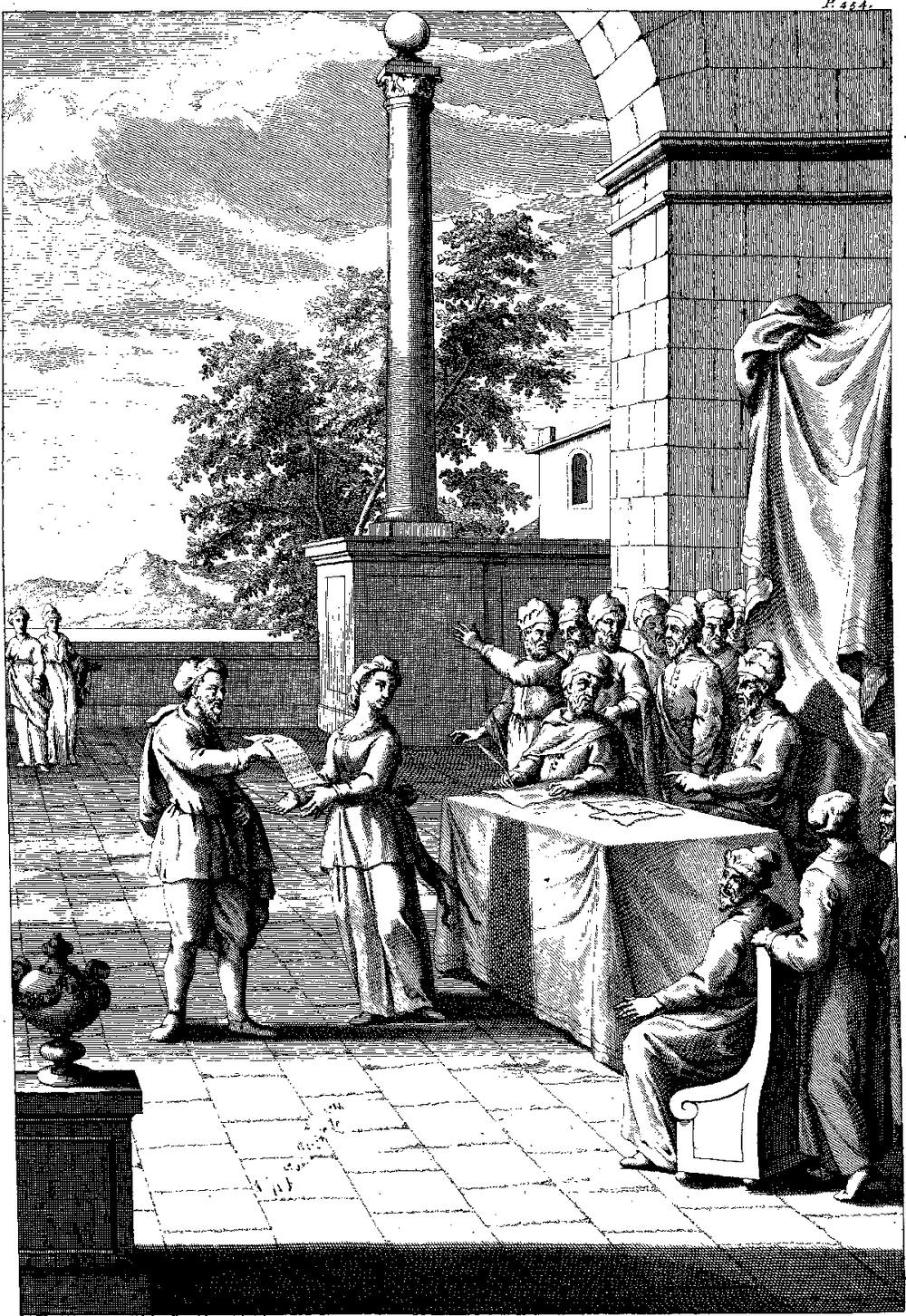
ערות דברἌχημον χρῆμα. Deut. xxiv. 1, 2, 3, &c.DIVORCE, or Repudiation. Moses tolerated Divorces for very good reasons. Here are his words: “ When a man hath “ taken a wife and married her, and it “ come to pass that she find no favour in “ his eyes, because he hath found some uncleanness in her; then let him write her “ a bill of divorcement, and give it in her “ hand, and send her out of his house. “ And when she is departed out of his house, “ she may go and be another man’s wife. “ And if the latter husband hate her, and “ write her a bill of divorcement, and giveth it in her hand, and sendeth her out “ of his house; or if the latter husband die, “ which took her to be his wife, her former husband which sent her away, may “ not take her again to be his wife, after “ that she is defiled, for that is abomination before the Lord.” The Commentators are very much divided concerning the sense of these words, because he hath found some uncleanness, or as the Hebrew has it, matter of nakedness in her.
The school of Shammah, who lived a little Vide Selden. Uxor Hebraïca, l. 3. c. 18. & 20.before our Saviour, taught that a man could not lawfully be divorced from his wife, unless he had found her guilty of some action which was really infamous, and contrary to the rules of virtue. But the school of Hillel, who was Shammah’s disciple, taught on the contrary, that the least reasons were sufficient to authorize a man to put away his wife: for example, if she did not dress his meat well, or if he found any other woman whom he liked better. He translated Moses’s text thus, If he hath found any thing in her, or an uncleanness. * Steph. Δίον πόλις κοιλῆς Συρίας, κτίσμα Ἀλεξάνδρου.Akiba, another famous Rabbin, was still more indulgent than Hillel; for he affirmed, that it was sufficient cause for a man to put away his wife, if she were not agreeable to her husband. After this manner he explained the text of Moses; If she find no favour in his eyes; this was the first reason: the second was, If he find any uncleanness in Joseph. Antiq. l. 4. c. 8. & lib. de vita sua ad finem. Philo de Special Legib. præcept. 6. & 7. Leo Mutin. cerem. Jud. parte 4. c. 6. Matth. v. 31, 32. Origen. Homil. 7. in Matth.her. Josephus and Philo shew sufficiently, that in their time the Jews believed Divorce to be lawful upon very trivial causes. The Hebrews at this day hold the same principles. Although a woman, says Leo of Modena, were to give her husband no occasion of complaint, he may put her away, if he be ever so little displeased with her.
But our Lord Jesus Christ has limited the permission of divorce to the single case of Adultery. It hath been said by them of old time, says he, whosoever shall put away his wife, let him give her a writing of divorcement. But I say unto you, that whosoever shall put away his wife, saving for the cause of fornication, causeth her to commit adultery; and whosoever shall marry her that is divorced, committeth adultery. Words which have been interpreted many different ways. Some by the word Adultery or Fornication have understood all sorts of great crimes, such as Idolatry, Infidelity, &c. which are sometimes mentioned in Scripture under the name of Fornication. Others have determined the meaning of this word to the single crime of real Adultery and Infidelity.
Origen is of opinion, that the Son of God named Fornication, not as the only case wherein Divorce is lawful, but as an example of those other crimes and instances, wherein this power may be used. But almost all the other Fathers and Interpreters have taken our Saviour’s words in their strict and rigorous meaning, and the practice of the Church, which is the truest Expositor of the Law, has always been agreeable to this last opinion. As to the crime of Infidelity, see St. Paul’s explanation 1 Cor. vii. 12, 13, 15.of it: As to what relates to those who are converted to Christianity, not the Lord, but I speak, If any brother hath a wife that believeth not, and she be pleased to dwell with him, let him not put her away. And the woman which hath an husband, that believeth not, and she be pleased to dwell with her, let her not leave him. But if the unbelieving depart, let him depart; a brother or a sister is not under bondage in such cases.
Another difficulty formed upon the subject of Divorce, consists in knowing whether persons separated by divorce, are at full liberty to marry again. The Law of Moses did not forbid the parties separated to marry again; and the Laws of the first Christian Emperors expressly did allow it.
Ter-
Tertull. l. 4. contra Marcion. & lib. de Monogamia, &c.Tertullian believes the bond of marriage to be dissolved by Adultery, and that the woman, who is put away, may marry another man. Origen says, that in his time some Bishops Origen. Homil. 7. in Matth.gave such permission to those who were under their government. And several Councils, particularly of the Gallican Churches10, are cited, which suppose or authorize the same Custom.
But though these things have sometimes been practised, they have been almost always Concil. Eliber. c. 8, 9. Canon. Apost. 48.condemned. The Council of Elvira owns this abuse, disapproves and censures it. The Canons ascribed to the Apostles expressly enjoin, that no man who has put away his wife, shall marry another in the former wife’s life-time. The several Popes Siricius, Innocent I. Leo, Stephen, and Zachary, in their decretal Epistles do plainly proscribe these marriages, and treat them as adulteries. Lastly, the Latin Church hath always taught, that the bond of marriage still subsists, notwithstanding the most legal divorce; and the Council of Concil. Trident. Sess. 24. can. 7.Trent hath pronounced an Anathema against all those, who shall dare to say, that the Church errs, when it teaches, that the bond of marriage is not dissolved by the adultery of either party ; that the party which is innocent is obliged to live single, during the life of the other ; and that he or she who marries, after being divorced, committeth adultery. See our Dissertation on Divorces, prefixed to our Comment upon Deuteronomy.
There is all the probability imaginable, that Divorces were in use among the Hebrews before the Law, since the Son of God Matth.xix. 8. Mark x. 5.says, that Moses permitted them by reason only of the hardness of their hearts; that is to say, because they were accustomed to this abuse, and to hinder or prevent greater evils. In effect, we see that Abraham dismissed Hagar on the score of her insolence, and at the request of Sarah. Onkelos, and the Jerusalem Paraphrast, and several of the Rabbins, believe the cause of Aaron and Numb. xii. 1.Miriam’s murmuring against Moses, to have been founded on Moses’s divorcing Zipporah, as some say; or, as others, Tharbis, daughter to the King of Ethiopia. Others are of opinion, that their murmuring proceeded not from his having divorced her, but from his receiving her again after having been once divorced from her. But the truth is, that he only sent her back to Jethro, his father-in-law, for a time, and without any design of separating altogether from her. We find no example of a Divorce in all the Books of the Old Testament written since the time of Moses. The Jews them Judges xv. 2. Judges xix. 2, 3. Matth. xiv. 3. Mark vi. 17. Joseph. Antiq. l. 15. c. 11. Joseph. Antiq. l. 18. c. 7. Joseph. lib. de vita sua.selves tell us, that David was not permitted to divorce any of his wives, to marry Abishag; and that he was obliged to take her under the title of concubine, or wife of the second rank, because he had already eighteen wives, the number which by custom was allowed. The same Prince kept as long as he lived all those of his wives who had been publickly dishonoured by his son Absalom. He did not dismiss, but was content with shutting them up till their death. It is certain however, that they made too frequent use of that indulgence which the law allowed them, and that they separated from their wives upon too trifling occasions. Sampson’s father-in-law understood his daughter to have been divorced by him, since he gave her to another. The Levite’s young wife, who was dishonoured at Gibeah, had forsaken her husband, and never would have returned, if he had not gone in pursuit of her. Solomon speaks of a libertine woman, who had forsaken her husband the director of her youth, and forgotten the covenant of her God. The Prov. ii. 16, 17. Mal. ii. 15. Micah ii. 9.Prophet Malachi commends Abraham for not divorcing Sarah though she was barren; and inveighs against the Jews, who had abandoned and despised the wife of their youth; and Micah reproaches them with having cast out their wives from their pleasant houses, and taken away the glory of God from their children for ever. Ezra and Nehemiah obliged a great number of the Jews to dismiss the foreign women whom they had married, contrary to the disposition of the Law; and Solomon declares, That he who divorces Ezra xi. Nehem. xiii. 23, 24—26, 30. Prov.xviii. 22.an honest woman, deprives himself of an happiness; and that he who retains an adulteress, is a fool and a mad man11. All which proves that Divorces were not so uncommon at that time.
Josephus the Historian was of opinion, that the Laws of Moses did not permit women to divorce themselves from their husbands, and prohibited those who had so separated themselves from marrying others, without first receiving letters of divorce from their former husband. This Author believes Salome, sister to Herod the Great, to be the first who took the liberty to put away her husband. Herodias, who is mentioned in the Gospel, did likewise dismiss her husband, as is infer’d from the relation of Josephus. This Author tells us, that his own wife forsook him some little time after he had been made free by the Emperor Vespasian. The three sisters of young Agrippa, who was first King of Chalcis, and afterwards of the Trachonitis and Batanæa,
used the privilege of divorcing their husbands. Berenice the Eldest put away Polemo King of Pontus, some time after she had married him. Mariamne, her sister, quitted Archelaus her first husband, to marry Demetrius, Alabarch of the Jews in Alexandria. Lastly, Drusilla the Third forsook Aziz King of Emesa, to marry Felix Joseph. Antiq. l. 20. c. 15.Governour of Judæa.
It has been a question in the Christian Church, whether women have the same privilege as men in this point, and are permitted to put away their husbands in cases of adultery. St. Basil in his Canonical Letter Basilii Ep. ad Amphiloc. c. 9.to Amphilochus owns, that the Law which permits men to put away their wives for adultery, is observed religiously; but that custom required the women to continue with their husbands, tho’ they were guilty of the same disorder. The Greeks, who have explained In Canonem 8. Apostolorum.the Apostolical Canons, pretend it is a custom which has always been observed amongst them, that the wife cannot leave her husband for adultery. We have before taken notice, that Josephus the Historian did not believe the women to have any liberty from the law of Moses to forsake their Husbands. In consequence of these principles, some of the primitive Christians12 allowed a man, who had put away his wife, to marry another, but they did not grant the woman the same privilege.
But others13 indulge the same liberty to both the man and woman of divorcing, and even of proceeding to a second marriage. St. Justin the Martyr speaks of a Christian woman who sent letters of divorce to her husband, who lived in a disorderly manner. St. Jerom mentions Fabiola a Roman Lady, who forsook her Husband on the score of his irregularities. The Greeks still at this day have a custom of divorcing in the particular case intimated in the Gospel, and even after Matth. v. 32.this to marry, as if the bond of marriage were dissolved by adultery; and the Fathers of the Trentin Council, upon the remonstrances Concil. Trident. Can. 6. Vide Fra. Paolo Hist. Concil. Trident. l. 8.of the Venetians, who had many Greeks in their dominions that observed this custom, condescended to prepare their Canon in such a manner, as, without approving marriages of this kind, salves the doctrine of the Latin Church, which follows a contrary usage. Anathema to all such as dare affirm, that the Church errs in teaching according to the doctrine of the Gospel, and the Apostles, that the band of marriage is not dissolved by the adultery of either of the parties; and that each of the parties, even the innocent one, is obliged to continue single during the life of the other, and that he or she who marries after a divorce, committeth adultery.
Prov. xviii. 22. Concil. Neocæsar. c. 8.The wise man seems to make a precept of Divorce in cases of adultery, saying, He who lives with an adulteress, that is to say, who does not procure to be divorced from her, is a fool and a mad man. The Council of Neocæsarea enjoins a Priest to put away his wife, if she is guilty of adultery after her husband’s ordination. St. Austin seems to Aug. l. 2. Retract. c. 19.have understood the same passage in the Proverbs, as containing a precept. St. Jerom explains himself much in the same sense, in his Comment on St. Matthew. But St. Paul in advising the wife to be reconciled 2 Cor. vii. 10, 11.to her husband, shews sufficiently what the intention of our Saviour was, and the generality of the Fathers have always dissuaded divorcing, and recommended reconciliation.
Among the Jews, Divorces have become much more uncommon, since their dispersion among nations, which do not permit the dissolution of marriages upon light occasions: Leon. de Modene, partie 4. c. 4, & 6. See likewise Basnage Hist. des Juifs, l. 7. c. 22. art. 20.nevertheless, there are still at this day some Divorces to be observed among the Jews and their wives. A jealous husband at first requires his wife to forbear seeing the man of whom he is suspicious; if after this there is a current report that she continues to converse with her gallant, and they are found together, particularly in the fact, then the Rabbins enjoin him to divorce her for ever, whether he is willing or not: notwithstanding, the woman is at liberty to marry again, as she shall think proper; provided it be not with the person who gave occasion for the Divorce.
A young girl under ten years of age, whether she has or has not a father, after she has married a husband, if this husband be not agreeable to her, may be unmarried, till she comes to the age of twelve years and a day, at which time she is reputed a woman. It is sufficient for her to declare, that she is not willing to have such an one for her husband, and takes two witnesses of this declaration, who set it down in writing; after which, she may marry whom she pleases.
To prevent the abuses which the Jewish men might make of this liberty of divorcing, the Rabbins have appointed many formalities to be observed, which waste much time, and give the married couple leisure to be reconciled, and live well together. Where there is no hope of accommodation, a woman, a deaf man, or a Notary draws the letter of divorce. He writes it in the presence of one or more Rabbins; it must be written on vellum ruled, containing only twelve lines in square letters, and abundance of little trifling particulars are to be observed, as well in the characters as in the manner of writing, and in the names and surnames of the husband
and wife. Besides, he who pens it, the Rabbins and the witnesses ought not to be relations, either to the husband or wife, or to one another.
The substance of this Letter, which they call Gheth, is as follows: On such a day, month, year, and place, I N. divorce you voluntarily, put you away, restore you to your liberty, even you N. who were heretofore my wife, and I permit you to marry whom you please. The Letter being written, the Rabbi examines the husband closely, in order to learn whether he is voluntarily inclined to do what he has done. They endeavour to have at least ten persons present at the action, without reckoning the two witnesses who sign, and two other witnesses to the date. After which, the Rabbi commands the wife to open her hands, and bring them close to one another, in order to receive this deed, left it fall to the ground; and after having examined her over again, the husband gives her the parchment, and says to her, Here is thy divorce, I put thee away from me, and leave thee at liberty to marry whom thou pleasest. The wife takes it, and gives it to the Rabbi, who reads it once more, after which she is free. Many little circumstances are omitted, which were invented only to make this action more difficult. Afterwards the Rabbi cautions the Woman against marrying within three months, lest she should be with child. From this time the man and woman are not to continue alone in any place, and each of them may marry again.
DOCTORS, Jewish. See RABBINS.
DOCUS, otherwise Dagon; a castle near Jericho. See DAGON.
DODAIM, or Dudaim. See MANDRAKES.
DODANIM, the youngest son of Javan. Several in the Hebrew read Rhodanim, and believe that he peopled the Island of Rhodes. We have endeavoured to show in our Comment upon Gen. x. 4. that Dodanim is the father of the Dodonians, inhabitants of Dodone, and the places adjacent.
DODAVAH, the father of the prophet Eliezer, mention’d 2 Chron. xx. 37.
DOEG, an Edomite14, Saul’s chief herdsman, being at Nob, at the time when David came thither, to desire a supply of provision from Abimelech, he gave notice of it to Saul, and was the cause of this Prince’s sending for all the Priests, who were at Nob, and of the orders which he gave to have them all massacred in his presence, as accomplices with David in the pretended conspiracy, with 1 Sam. xxii. 16, 17, 18.which Saul charged him. When the Priests, to the number of fourscore and five, were brought before the King, and he commanded his people to dispatch them, none of them were so hardy as to lay their hands upon persons so particularly dedicated to God’s Service. But Doëg having received this order, executed it without scruple or reluctancy.
DOG, a domestick animal, with which we are very well acquainted. By the law it was declared unclean, and was very much despised among the Jews. The most offensive expression they could use, was to compare a man to a dead Dog. David, in order to make Saul sensible that the unjust persecution which he carried on against him, did 1 Sam. xxiv. 14.himself no honour, said to him, After whom is the King of Israel come out? after whom dost thou pursue? after a dead Dog? And when David did Mephibosheth the honour 2 Sam. ix. 8.to receive him at his Table, Mephibosheth making his acknowledgements, used this expression, What is thy servant, that thou Job xxx. 1.shouldst look upon such a dead Dog as I am. Job says, that in his misfortunes the young people had the impudence to insult him, whose fathers he would have disdained to have set with the Dogs that kept his flocks.
The name of Dog is sometimes put for one, who has lost all modesty15, for one who prostitutes himself by committing any abominable action; for in this manner several understand the injunction delivered by Moses of not offering in the Tabernacle of the Lord the hire of a whore, or the price of a Dog; and what is said in Ecclesiasticus, What fellowship is there between a pure and sanctified person16, and a dog? Jesus Christ in the Revelations, excludes dogs, sorcerers, whoremongers, murderers, and idolaters, &c. from his House. St. Paul calls the false Apostles Dogs, by reason of their impudence, and greedy love of sordid gain. Lastly, Solomon and St. Peter compare sinners, who continually relapse into their sins, to Dogs returning to their vomit. David compares his enemies to Dogs, that were continally barking at him with their slanders, and biting him with their persecutions and evil treatment.
I do not observe that the Hebrews made use of hounds. Any sort of game killed by Dogs, would have been unclean, and no one could have made any use of it. I do not find any mention of Dogs, when hunting is spoke of, nor of hunting when any thing is said of Dogs. In the East they rather make use of Lions, or some other such like animals, which a man on horse-back may carry either before or behind him, and as soon as he perceives the game, he takes away a sort of blind, which the creature has upon his eyes, and pointing out his prey to him, he springs upon it with very great
agility. Notwithstanding, I would not absolutely deny, but that they might make use of Dogs, provided they prevented them from killing the creatures, which they were pursuing : for a Dog is not unclean as long as he is alive.
The Arabians as well as Jews hold Darvieux Mœurs des Arabes, c. 8. p. 182.Dogs to be unclean ; they speak kindly to them, and feed them well, but do not touch them : particularly if they should happen to be wet, they would not suffer them to come near them, lest a drop of water should fall upon their clothes, which would incapacitate them to say their prayers. But they who love sports, do notwithstanding keep Gray-hounds and setting Dogs : alledging, that these Dogs being always tied up, and eating nothing that is unclean, are exempted from the common rule. The same they plead for little Lap-Dogs ; no one among them does any harm to Dogs, and if any person were to kill one of them deliberately and with design, he would be punished in a judicial way.
DOMITIAN. The Emperor Domitian, son of Vespasian, brother to Titus, and the last of the twelve Cæsars, succeeded his brother Titus in the Year of Jesus Christ 81, on the 13th of September, and was in great disesteem for his debaucheries and cruelty. He persecuted the Church, and, as is said, put to death Pope St. Cletus. The Apostle St. John, being at Rome, was put Tertull. præscrip. c. 36. Hieronym. de Scriptorib.into a Caldron of boiling oil near the Latin Gate, but suffered no harm by it. He was afterwards banished into the Isle of Patmos, which is one of the Sporades in the Archipelago. In the same persecution, Domitian knowing that there were some Christians of the race of David, and related to Jesus Christ, was apprehensive of their undertaking something against the state ; the persons whom he was thus afraid of, were grandsons to Judas, brother to our Lord after the flesh, and in all probability Hegesip. apud Euseb. l. 3. c. 20. Hist. Eccles.son to Joseph by a former wife. They were carried to Domitian by a Soldier ; the Emperor asked them if they were of David’s family? they confessed they were. He farther enquired of them, how much land they were possessed of, and what money they had? they answered, that for themselves, who were two in number, they had to the value of nine thousand deniers, not in money, but in lands, containing only nine and thirty plethra, which make about seven acres, and four perches ; that for these they paid taxes, cultivated them themselves and subsisted on them ; at the same time they shewed their hands, which were all callous, and their bodies which were hardned with labour.
The Emperor asked them, what the Kingdom of Jesus Christ was, when, and in what place he was to reign ? They answered, that his kingdom was not earthly and of this world, but heavenly and angelical, that it would appear at the end of the world, when he would come with majesty to judge both the quick and dead. Domitian despising them as vile persons, sent them away without doing any harm to them. He moreover gave orders to put a stop to the persecution, at least in Judæa. These two Confessors governed afterwards the Churches, and lived to the time of Trajan. Domitian died in the year of Jesus Christ 96, on the 17th of September, in the fifteenth of his Reign.
Matth. i. 25. 1 Tim. iv. 13. Ps. cx. 1.DONEC, a Latin particle, which generally signifies until, as long as, and shews that such a thing ends within a certain time, and that it lasts but till such a time. But in Scripture Donec17 is not always construed in this manner : it often signifies simply what is doing, or shall be doing till such a time, without our being able to conclude from thence, that it shall not be doing any longer. For example, St. Matthew says, that Joseph knew not the blessed Virgin till she had brought forth her first-born. Et non cognoscebat eam, donec peperit filium suum primo-genitum. We cannot from hence conclude, that he knew her after the birth of our Saviour. In like manner St. Paul says to Timothy, Till I come, give attendance to reading. Will any one understand by this that he was to employ himself no more this way after the arrival of St. Paul ? And the Psalmist speaking in the person of the Father, says to the Messiah, Set thou on my right hand, until I make thine enemies thy footstool. Is this saying, that then Jesus Christ shall cease to reign, and to sit at the right hand of his Father ? See Gen. xxviii. 15. and 1 Sam. xv. 35. Isai. xlvi.6. Matth. xii. 20. and Psalm cxxii. 13.
DOORS. See GATES.
Numb. xxxiii. 12.DOPHKAH, the ninth or tenth encampment of the Israelites in the wilderness. From the wilderness of Sin they went to Dophkah, and from Dophkah to Allush.
Josh. xii. 23. Josh. xvii. 11.DOR, or Dora, the capital of a certain country in the land of Canaan, called in Hebrew Nephat-Dor. Joshua conquered it, and killed the King of it. He gave the city Dor to the half Tribe of Manasseh on this side Jordan. Dor is situated upon the Mediterranean, with a very bad port belonging to it ; it lies between Cæsarea in Palestine, and mount Carmel, nine miles or three leagues from Cæsarea. It is often placed in Phœnicia. Antiochus Sidetes besieged Tryphon in it, the Usurper of the 1 Macc. xv. 11.kingdom of Syria.
Some young people of Dor having of Joseph. Antiq. l.xix. c. 5, 6.their own motion, and without the consent of the Magistrates, placed a statue of the Emperor in the Synagogue belonging to the Jews in this Town; King Agrippa, upon intelligence of what was done, immediately went to Petronius, Governour of the Province, and complained of the attempt made by those of Dor, laid before him the Emperor’s Ordinances, whereby the Jews were allowed not only the free exercise of their Religion and Laws throughout the whole extent of the Empire, but likewise had a grant of the privilege of freedom in Towns and Corporations; and withal desired him to put a stop to the insolence of those of Dor, and oblige them to remove the Emperor’s statue from the place where they had set it up. Petronius hereupon wrote a Letter in very strong terms to the Magistrates of this City, commanding them to send to him the authors of this innovation, and to take care that nothing of the like nature should happen for the future: that they should not seek any occasion of quarrelling with the Jews, and should leave every one at liberty to worship God in his own way.
DORCAS. This word in Greek signifies a Goat, and Tabitha does the same in Syriac.
Antiq. l.17. c.6.DORIS, Herod the Great’s first wife, whom he married, while he was yet a private man. By her he had Antipater, of whom we have spoken at large in the Article relating to him. Doris having entred into a conspiracy with this wicked son, against his father, was disgraced by Herod, and banished from his palace. There is some probability, that Doris was an Idumæan. Josephus speaks of Theudio, who was her brother.
I. DOSITHEUS, who pretended to be a Priest, and of the Stock of Levi, brought Esth. xi.1.into Egypt the Epistle named Purim, that is to say, the Book of Esther translated into Greek18. We cannot well tell who this Dositheus was. Usher believes him to be the same person, to whom Ptolemy Philometor, King of Egypt, gave the command of his Joseph. contra Appion. l. 2.troops, together with another Jew, whose name was Onias. Dositheus brought the Book of Esther to Alexandria, in the year of the Julian Period 4537, of the World 3827, before Jesus Christ 173, before the Vulgar Æra 177.
II. DOSITHEUS, an Officer in Judas 2 Macc. xii. 19, 20,21,&c.Maccabæus’s troops, was sent to force the garrison which Timotheus had left in the fortress of Characa, in the Country of the Tubienians. We do not know whether he is the same Dositheus, who is named in the same chapter of the second book of
2 Macc. xii. 35.Maccabees, and who is there said to belong to Bacenor; and that having seized on Gorgias, as he was attempting to take him alive, a Thracian on horse-back fell upon him, cut off his shoulder, and gave Gorgias an opportunity to fly to Marisa.
III. DOSITHEUS. Dositheans. The Jews pretend, that Dosthai, or Dositheus the son of Janneus, lived in the reign of Sennacherib, and was one of the Priests sent by this Prince to instruct the colony of Cuthæans, planted by him 2 Kings xvii. 24, 25, 27, &c. Epiphan. de Hæres. l. 1. Photius Cod. 130.in Samaria, and devoured by lions. St. Epiphanius will have it, that the Dositheans were a fourth branch of Hereticks at Samaria; but he does not say enough of them to inform us, who they were, and whence these Hereticks came. Photius relates, that after our Saviour’s conversation with the Samaritan woman, near the well of Sichem, there arose two considerable parties in Samaria, one whereof maintained Jesus Christ to be the true Messiah foretold Deut. xviii. 15, 18.by Moses, in these words; God will raise you up a Prophet like unto me: the other maintained, that Dositheus, who was born at Samaria, and was contemporary with Simon the Magician, was the true Messiah.
Hegesip. apud Eus. Hist. Eccl. l. 4. c.22. Clem. Constit. Apost. l. 6. c.8.Hegesippus, who lived in the second Century, places Dositheus and his Followers at the beginning of Christianity, with those of Simon the Magician. There is a Treatise against Heresies ascribed to St. Hippolytus which began with the Dositheans. Origen sets Jesus Christ, whose Gospel was preached over the whole earth, in opposition to Simon and Dositheus, whose Sects were already quite destroy’d, tho’ they had boasted of performing Miracles, and Dositheus would have passed for the Messiah, when our Saviour appeared. The Author of the Apostolical Constitutions asserts, that Cleobius and Simon the Magician were Disciples to Dositheus, but that they drove him away, and deprived him of the first Rank, which he attempted to assume among them.
This is all very remote from what the Jews tell us, who make Dositheus to live in Sennacherib’s time; and from St. Jerom’s opinion, who declares him to be the head of the Sadduces. It seems to be out of all question, that this man was living in the time of Simon the Magician, and that his Party was already formed in the Country of Samaria, when our Saviour appeared. We are assured, that he was by birth a Jew, and that being desirous to distinguish himself by some new explanations among the Doctors of his nation, who studied the mystical Interpretations of the Law, and the Traditions of their Elders, and affecting the first Rank among these Rabbins, he was rejected by them; and that out of
Dositheus (III) continues on the next page
Footnotes
-
Translators’ note. The Author here, according to his usual method, keeps close to his Vulgate, which reads the passage thus; Et factum est hoc ad insidias sanctificationi & in diabolum malum in Israel. Very different from the Greek, which runs thus, Καὶ ἐγένετο κατοικεία ἀλλοτρίων. Καὶ ἐγένετο ἀλλοτρία τοῖς γεννήμασιν αὐτῆς. Which is literally render’d by our English Version, Whereupon the City was made an habitation of strangers, and became strange to those that were born in her. ↩
-
Homer. Odyss. XV. v. 402. Νῆσός τις Συρίη κικλήσκεται (εἴπου ἀκούεις) Ὀρτυγίης καθύπερθεν, ὅθι τροπαὶ ἠελίοιο. ↩
-
Translators’ note. Pliny gives the honour of this invention to Anaximenes, so by mistake confounding the Disciple with the Master. For as M. Basnage observes, it is more reasonable to think that Pliny was mistaken than Diogenes Laertius. ↩
-
Translators’ note. The Reader may likewise, if he pleases, consult M. Basnage’s History of the Jews, T. 6. p. 213. and M. Benoit’s Letters at the end of the same Tome, wherein he shows, that the Retrogradation of the Sun prolonged the Day not above two thirds of an Hour. ↩
-
Translators’ note. Dr. Arbuthnot tells us, in his Tables of the Grecian Coins, that a Drachma is 7d. ¾*, and consequently a* Tetradrachma, which is answerable to a Shekel, 2s. 7d. Dr. Prideaux*, as has been remarked, values a shekel at* three shillings. ↩
-
Translators’ note. Dr. Arbuthnot differs in opinion from our Author. He says that this coin was at first libralis, or of a pound weight, and even when it was diminished retained the name of libella. So Dupondius denoted two Asses. See his Tables of ancient Coins, &c. c. iii. ↩
-
Translators’ note. See Lucian. περὶ τῶν Διψάδων. ↩
-
The Greek of St. Luke in the printed Copies reads only 70. but the Latin and several Greek Manuscripts read 72. The generality of the Fathers read 70. but several of them when they explain themselves more distinctly, own them to be 72. See Mill. in Luc. x. i. and Tillemont. Not. 24. on J. C. ↩
-
Steph. Δῖον πόλις κοιλῆς Συρίας, κτίσμα Ἀλεξάνδρου. ↩
-
Concil. Arelat. 1. Can. 10. Concil. Aurelian. 2. c. 11. Vermer. c. 5, 6, 11, 17, 20. Compendiens. c. 16. Synod. Hibern. S. Patricii an. 314. c. 16. ↩
-
Translators’ note. The Passage here cited by the Author is taken from the Vulgate; we find it in this Version and the Septuagint, but in the Hebrew original there is not one word of it; consequently it is not to be sought for in our English translation, which keeps punctually to the Hebrew. ↩
-
See St. Basil to Amphilochus, c. 9. Ambrosiast. in 1 Cor. viii. 10, 11. Concil. Eliberit. c. 9. ↩
-
Const. Apost. l. 3. c. 1. Epiphan. hæres. 59. Origen. in Matt. xix. 8. Pollent. apud Aug. l. 1. de adulterin. conjug. c. 6. ↩
-
1 Sam. xxi. 7. Josephus reads Arami in the Text, instead of Edomi. He says, Doëg was an Aramite, or Syrian, instead of an Edomite. He fell into this mistake by copying the Septuagint. ↩
-
Translators’ note. Thus Achilles in his passionate ex- postulation with Agamemnon, says, Κυνὸς ὄμματ’ ἔχων: which, as the Scholiast observes, is, ἀντὶ τοῦ ἀναιδέστατε, ὡς Κύων. ↩
-
Translators’ note. So the Vulgate reads it: the Greek and English Version, the Hyæna. ↩
-
Translators’ note. See more particularly concerning this particle, and the Greek and Hebrew of it. ἕως עד אשרin Huetius’s explanation of the celebrated Prophecy relating to the Messiah in Gen. xlix. 10. Demonstr. Evangel. Prop. IX. § vi. ↩
-
Translators’ note. The Hebrew Original of this Book ends with the third verse of the tenth chapter, which in the Greek copies of it is continued; and from these the Latin Vulgate was translated, which our Author refers to in this Citation. ↩