Volume II, pages 338–357 of the 1732 edition, from PAC to PAS: everything printed on these pages, in order.
Continued from Pacorus
not possible for him to subdue Tyre, where-in the Ruins of the Roman Army had taken Shelter.
Having taken Sidon and Ptolemais1, he sent a Detachment into Judea, with Orders to set Antigonus the Son of Aristobulus upon the Throne. This Party was commanded by his chief Cup-bearer, who was call’d Pacorus as well as himself. Antigonus had promised the Parthians a thousand Talents, and five hundred Jewish Women; and having got some Troops together, he enter’d into Judea, supported by the Parthians that attended him. He subdued the first that made any Opposition to him, and pursued them directly to Jerusalem, into which he enter’d, and entrenched himself in the Temple. Herod and Phasael, who supported the Interests of Hyrcanus, took Possession of the Palace.
The Feast of Pentecost being come, the two Parties began to treat of an Accommodation, to prevent that Disorder which the Confluence of such a Multitude of Strangers was likely to produce. Antigonus proposed to Herod and Phasael, to take for Arbitrator of the Difference the chief Cup-bearer Pacorus, who was incamp’d near the City; in which they acquiesced. He therefore entered Jerusalem with his Troops, and persuaded Hyrcanus and Phasael to appear before Barzapharnes, who was Governor of Syria for the Parthians, in hopes to obtain some Regulations that might be beneficial to the Province. Thither they went conducted by Pacorus, who then returned to Jerusalem.
When Barzapharnes thought that Pacorus might be got back to Jerusalem, he arrested Phasael and Hyrcanus, and laid them in Irons. Pacorus had Orders to do the same by Herod; but he got some Notice of the Design, and made his Escape to Massada. The Parthians plunder’d Jerusalem, set Antigonus upon the Throne, and delivered up to him Phasael and Hyrcanus in Chains. Phasael put himself to Death, and Antigonus caused Hyrcanus’s Ears to be cut off, to make him incapable of performing the Functions of the High-priesthood. After which he delivered him again to the Parthians, who carried him along with them beyond the Euphrates.
The Parthians did not long hold the Kingdom of Syria. Ventidius General of the Roman Troops having beaten their Armies, obliged Pacorus to return back over the Euphrates2. The Year after Pacorus having again got a great Army together, came again into Syria3, but was there beaten and kill’d by Ventidius.
PADON, or Phadon, one of the Fathers or Chief of the Nethinims. Ezra ii.44 vii.48.
PAGIEL, or Phegiel, Son of Ocran, Head of the Tribe of Asher; he offer’d to the Tabernacle of the Lord, in the Name of his Tribe, a Silver Bason and Plate full of fine Flour mixed with Oyl; a Golden Vessel full of Incense, an Ox, a Ram, and a Lamb for a Burnt-offering; a Goat for a Sin -offering; and two Oxen, five Rams, five Goats, & five Lambs for the Peace-offerings4.
PAHATH-MOAB, or Phahath-Moab, is the Name of a Place in the Land of the Moabites. Ezra ii. 6. viii. 4. x. 30.
PALÆTYRUS,ancient Tyre. See TYRE.
PALAL, or Phalel, Son of Uzai. Nehem. iii. 25.
PALESTINE. This Name may be taken either in a more general or more limited Sense. Palestine taken in a limited Sense stands for the Country of the Philistines or Palestines, which took up that Part of the Land of Promise which was extended along the Mediterranean Sea,from Gaza southwards as far as Lydda to the North. It seems that the Seventy were of Opinion, that the Hebrew Word Philistiim signified Strangers, since they generally translate it by Allophyli5, Strangers, or Men of another Tribe.
When the Word Palestine is taken in a more general Sense, it signifies the whole Country of Canaan, the whole Land of Promise, as well beyond as on this side Jordan; though pretty frequently it is restrained to the Country on this side that River: so that in the later Times the Words Judea and Palestine were synonymous Terms. We find also the Name of Syria Palestina given to the Land of Promise, and even sometimes this Province is comprehended in Cœle-Syria, or the Lower Syria. Herodotus6 is the most ancient Writer we know, that speaks of Syria-Palestina. He places it between Phenicia and Egypt. See Reland. Palestinæ, l. i. c. 7, 8. See also what we have said upon the Word JUDAH.
Moses speaks of Palestine as of the best and finest Country of the World, as of a Land flowing with Rivers of Milk and Honey. Profane Authors also speak of it much in the same Manner. Hecatæus
7 who had been brought up with Alexander the Great, and who wrote in the Time of the first Ptolemy, mentions this Country as very fruitful and well-peopled, an excellent Province, that bore all Kinds of good Fruit. Pliny8 gives us a like Description of it; he says that Jerusalem was not only the most famous City of Judea, but even of the whole East. He describes the Course of the Jordan, as of a delicious River; he speaks with Advantage of the Lake of Genesareth, of the Balm of Judea, of its Palm-Trees. Tacitus9, Ammianus Marcellinus, and most of the Ancients, who had Occasion to mention Palestine, have spoke of it with the same Commendations.
The Mahometans10, who could not but know it much better than most others, speak of it in a very extravagant Manner, which proves however its exceeding great Fertility. They tell us, that besides the two principal Cities of the Country, which are Elia and Ariba, that is Jerusalem and Jericho, there were in this Province a thousand Villages, each of which had many very fine Gardens. That the Grapes were so large, that five Men could hardly carry a Cluster of them, and that five Men might hide themselves in the Shell of one Granate. That this Country was anciently inhabited by the Giants of the Race of Amalek, who were of a very extraordinary Size.
Notwithstanding all these Testimonies of the Ancients, we find People very incredulous as to the Fruitfulness of the Holy Land. Travellers that go to visit it, generally speak after a Manner, that is but little to its Advantage. The Country, they say, appears to be dry and barren, is but ill water’d, and has but few cultivated Plains. Strabo11 is one of the Ancients who speaks of it with most Contempt. He says that this Province is so barren, that it moves no body’s Envy, and that there is no need of fighting for it, in order to obtain it, and that Jerusalem stands upon a dry and barren Spot.
St. Jerome12 was an Eye-witness of it, and very well acquainted with those Qualities which the Scriptures ascribe to it. He says that Palestine is full of Mountains, that Dryness and Drought are very common here, that they had only Rain-water, which they caught, and preserved in Cisterns, which supplied to them the Want of Fountains. But the same St. Jerome elsewhere speaks of the Fertility of Palestine with great Advantage, and owns that there was no other Country that could dispute with it in point of Fruitfulness. The Modern Travellers that speak of the present Sterility, do not deny but that it still preserves some Footsteps of its antient Fecundity in some Places, where are found all sorts of Fruits almost without any Culture. In other Places the Herbs grow with great Profusion, and to an extraordinary Height. If the Mountains of some Plains are barren, ‘tis because they are but little cultivated for want of Inhabitants. How many other Countries, heretofore renown-ed for their Fertility, are at this Day reduced to barren and dreadful Wildernesses?
PALIURUS, signifies a Thistle according to some13, according to others a White Thorn. The Hebrew Word made use of by Isaiah14, and which in the Vulgate is render’d by Paliurus, properly signifies Thorns, or Thistles, or Hooks.
PALLAS, one of the Wives of Herod the Great, by whom he had a Son called Phazael. Joseph. Antiq. l. xvii. c. 1.
PALLIUM, is taken in Scripture, First, for an upper Garment. Secondly, for any sort of Stuff or Covering. For Example, the Curtains of the Tabernacle which Moses made in the Wilderness, are called Pallium15. Ut unum pallium ex omnibus sagis fieret. They made a great Veil or Covering of all the Curtains of Goats-hair, that covered the Tabernacle. And at their Decampments they wrapped up the Ark and the Table of Shew-bread, and other Things, in the costly Veil of the Colour of Sky-blue. Involvent hyacinthino pallio, &c. The Sword of Goliah was laid up in the Tabernacle, folded up in a Numb. iv. 7, 8. 1 Sam. xxii. 9. 1 Cor. xi. 10.Veil. Involutus pallio post Ephod.
The Pallium, or the Cloak, in Hebrew Mahil, was a Garment belonging to both Men and Women. When Rebekkah saw her future Spouse Isaac at a distance, she presently cover’d herself with her Cloak16, or Veil. The Hebrew Word is Zaiph, which signifies a Veil with which Women us’d to cover their Head and Face. The Spouse in the Canticles says, that the Watchmen of the City had found her, and took away her Veil or Cloak17. The Hebrew Word Redid signifies a costly Veil, which was peculiar to Women. It may be derived from the Hebrew Word Radah, to govern, and then it will have the same Signification as potestas, which St. Paul orders that Women should wear upon their Heads. Debet mulier potestatem habere
super caput propter Angelos18. This Veil, this Power, is the Token of the Authority of the Husband over the Wife. Ruth also wore a Veil or Mantle19, into which Booz put six Measures of Barley, and the Scripture gives it the Name of Mitpheat, different from those we took notice of before.
As to the Pallium or Cloak of Men, it appears from Scripture every where, that they wore it over their Coat, and that it was not cut. It was a plain piece of Cloth, or of other Matter, which they folded about them in several Manners, as Occasion requir’d, and according to the present Circumstances. It was lapp’d about them backwards and forwards on all Sides; they folded it about their Heads, or their Shoulders, they fastned it at their Breast, or on their Shoulder, or about their Neck with a kind of Clasp. The Wife of Potiphar pull’d off Joseph’s Cloak. The Sons of Noah took a Cloak, and going backward, they covered their naked Father with it. The Hebrews at their quitting Egypt had not Time to bake their Bread, but carried the Dough along with them in their Cloaks. When Saul had a mind to stop Samuel, who 1 Sam. xv. 27.was going away from him, he took him by the Cloak and tore it. The Prophet Abijah 1 Kings xi. 2).tore the Cloak he had on into twelve Pieces, to intimate the future Separation of the ten Tribes from that of Judah. When Elisha gathered up Elijah’s Cloak, he roul’d it up into a kind of Staff; wherewith 2 Kings xi. 13.he struck the Waters of Jordan, and divided them into two Parts.
The Matter of their Cloaks was commonly Wool, or Leather, or some other Stuff of Value. When Joseph was made Governor of Egypt, he was cloathed with the finest Cotton, or with some fine Linnen Cloth20. At the Solemnity of bringing the Ark to Jerusalem21, David wore a Cloak of fine Linnen. When Mordecai was advanced to Honour by King Ahasuerus, he wore a Robe of fine Cloth, or of Silk of a Esth. viii. 15.purple Colour. Amictus serico pallio atque purpureo. The false Prophets and Hypocrites wore Cloaks of Hair-cloth, to make themselves reverenced for their seeming Austerity of Life, pretending thereby to imitate the Lives of the true Prophets. The Cloak was a kind of Badge of Dignity. When the Zech. xiii. 4.Witch of Endor was consulted by Saul, she pretended to see a venerable Man appear, cloathed with a Robe or Cloak. To distinguish the Hebrews from other Nations, even by their Habits also, God commanded them to wear Tufts or Fringes of blue or hyacinth at the four Corners of Num. xv. 38. Deut. xxii. 12.their Garments, and a Border or Galloon of any Colour, Breadth, or Matter, at the Hembs of their Garments. Jesus Christ himself wore these Fringes to his Cloak, as appears from Matt. ix. 20. Si tetigero tantum fimbriam vestimenti ejus, salva ero, said the Woman with the Issue of Blood. Our Saviour upbraided the Pharisees, who out of Affectation wore large Fringes at the Bottom of their Cloaks, or longer Tassels than ordinary at the Corners of their Garments. Magnificant fimbrias. Matt. xxiii. 5.
That the Modern Jews may not make themselves ridiculous by the Singularity of their Habits, they have left off wearing these Tufts and Fringes outwardly at the Hembs of their Cloaks. But under their Cloaths they have a Piece of square Silk or Linnen, with four little Tufts at the four Corners. This kind of Garment is double; one Part is put before, and the other behind, and the two Pieces are fastned by Strings which reach to the two Shoulders22, and which they call Harbacanephoth, the four Wings, or the four Corners. This is their ancient Cloak reduced to a smaller Size. In the Scripture frequent mention is made of the Wings of the Cloak, which probably were nothing else than the four Corners of which we have been speaking. Saul tore off the Wing of Samuel’s Cloak, and David cut off the Wing of Saul’s Cloak in the Cave.
PALM, Palmus, a Measure of four Fingers Breadth, or of 337/89 Inches23. It is called in Hebrew Tophach24. Also the Hebrew Word Zereth25 is often translated by Palmus, and in Greek by Spithame, though it signifies a Half-cubit, and contains three ordinary Palms; which ought to be observed, that two Measures so unequal may not be confounded. St. Jerom sometimes translates Tophach by four Fingers, and sometimes by a Palm; but he always renders Zereth by Palmus, and the Septuagint by Spithame. Goliah was in Heighth six Cubits and a Zereth, that is to say, six Cubits and an half, making eleven Feet one Inch and something more26. We find in Isaiah an Expression that proves the Zereth, or Palm, to signify the Extent of the Hand from the End of the Thumb to the End of the little Finger. Quis mensus est pugillo
aquas, aut cælos palmo ponderavit? Who hath measured the Waters in the Hollow of his Hand, and meted out Heaven with the Span?
PALM-TREE. This was a Tree very common in Palestine. The Hebrews called it Thamar, and the Greeks Phœnix27. The finest and best Palm-Trees were about Jericho and Engeddi. There were many also along the Banks of the Jordan, and towards Scythopolis. Jericho is sometimes called the City of Palm- Deut. xxxiv. 3.Trees. Besides Dates the Palm-Tree produces also a kind of Honey, which was little inferior to the common Honey28; and they likewise drew a Wine from it, which was much used in the Eastern Countries. St. Chrysostom and Theodoret think it was this Palm-Wine that Moses mentions by the Name of Sicera. See SICERA afterwards.
It is said in Job xxix. 18. Vulgat. Sicut palma multiplicabo dies. I shall multiply my Days as the Palm-Tree. Some Ancients read, I shall live as long as the Phœnix, But the Hebrew has29, I shall multiply my Days as the Sand. We have taken notice above, that the Greek Word Phœnix signifies a Palm-Tree; it is also put for a Phœnix or a Phenician. See our Dissertation, upon this Passage, printed before the Commentary upon Job.
The Palm, or a Branch of the Palm-Tree, is a Symbol of Victory, and was carried before the Conqueror in Processions and Rejoycing for having obtained a Victory. They also used to 1 Macc. xiii. 51. 2 Macc. x. 7. John xii. 13. 1 Macc. xiii. 37. 2 Macc. xiv. 4.send a golden Branch of a Palm-Tree to the Kings of Syria, as a kind of Tribute or Present. This they call baina in Greek. They also offered them in the Temple of Jerusalem. I conceive that all these Customs were derived from the Greeks; for I can find nothing of them in the Old Testament before the Maccabees.
The City of Palms30 is Jericho, as may be seen by the second Book of Chronicles; the Palm-trees of the Plain of Jericho are famous throughout the whole Scripture, and even in profane Authors. In the Temple of Jerusalem Solomon caused Pillars or Pillasters to be made, in the Form of Palm-trees; probably in Imita- 1 Kings vi. 29, &c. tion of the Egyptians, who had such Pillars in their Temples31.
Palm-trees from the same Root produce a great Number of Suckers, which form upwards a kind of Forest by their Spreading32: Procerioribus sylva, arbore ex ipsâ. ‘Twas under a little Wood of Palm-trees of this Kind, that the Prophetess Deborah Judg. iv. 5. Ps. xcii. 12.dwelt between Ramah and Bethel. ‘Twas probably to this Multiplication of the Palm-tree, that the Prophet makes Allusion when he says; The Righteous shall flourish like a Palm-tree.Eccl. l. 14. And Ecclesiasticus represents the Priests, the Sons of Aaron, round about the High-priest Onias, as so many young Palm-trees, that proceed from the Root of an old Palm-tree.
Jer. x. 5.Jeremiah says, speaking of the Idols of the Heathen which were carried in Procession, that they were made in the Shape of Palm-trees: In similitudinem palmæ fabricatæ sunt. The Cant. vii. 7. Cant. v. 11.Spouse in the Canticles is compared to a Palm-tree as to Stature. Statura tua assimilata est palmæ. This was a noble Comparison. The Palm-tree is upright and tall. The Antients, before the Art of Carving was carried to its Perfection, made their Images all of a Thickness, strait, having their Hands hanging down and close to their Sides, the Legs joined together, the Eyes shut, with a very disagreeable Attitude, and not unlike to the Body of a Palm-tree. Such are the Figures of those antique Egyptian Statues that still remain. ‘Twas the famous Architect and Carver, Dedalus that set their Legs at Liberty, opened their Eyes, and gave them a freer and easier attitude33.
The Spouse in the Canticles compares the Hair of her Lover to the Fruit of the male Palm-tree, and to the Blackness of the Raven. Comæ ejus quasi elatæ palmarum, nigræ quasi corvus. The Palm-tree produces its Leaves, or if you please its Hair, at the Top of its Trunk: Coma omnis in cacumine, says Pliny34. The Male Palm-tree makes the Female fruitful, by Means of a Flower which is inclosed in its Fruit. ‘Tis this Fruit of the Male Palm-tree which in Greek is called Elatæ35. The Comparison of a Head of Hair to the Branches of the Palm-tree is so much the more just, as these Leaves turn round like Curls, and their Extremities hang down towards the Ground. They are long, double, and strait like a Sword; its Flowers are fastened by a very small Stalk, they grow in Clusters, and resemble those of Saffron, except that they are smaller and white.
PALMYRA, a City of Syria built by King Solomon. In Hebrew it was called Tadmor or Thamor36. It was situated in a Wilderness of Syria, upon the Borders of Arabia deserta, inclining towards Euphrates. Josephus37 places it two Days Journey from the upper Syria, one Days Journey from the Euphrates, and six Days Journey from Babylon. He says there is no Water any where else in the Wilderness, but in this Place. At this Day there are to be seen vast Ruines of this City. There was nothing more magnificent in the whole East. M. Halifax gives us a Description of it, which M. le Brun has inserted at Pag. 342 of his Voyages. There are still found a great Number of Inscriptions, the most of which are Greek, and the others in Palmyrenian Characters. Nothing relating to the Jews is seen in the Greek Inscriptions; and the Palmyrenian Inscriptions are intirely unknown, as well as the Language and the Characters of that Country. Albufeda places it to the East of Emesa, three Days Journey from this City, and three Days from Salamis. Alazizi reckons fifty nine Miles from Tadmor to Damascus.
The City of Palmyra preserved the Name of Tadmor to the Time of the Conquests of Alexander. Then it had the Name of Palmyra given it38, which it preserved for several Ages. About the Middle of the third Century it became famous, because Denatus and Zenobia his Queen made it the Seat of their Empire. When the Saracens became Masters of the East, they restored its antient Name of Tadmor to it again, which it has always preserved since. Its Situation is just the same as that of Ammon in Lybia, being in the midst of Deserts; for it is built in a kind of Island in the main Land, in the midst of an Ocean of Sand, and surrounded by sandy Deserts on all Sides. Its Situation between two powerful Empires, that of the Parthians to the East, and that of the Romans to the West, exposed it often to the utmost Danger in their Quarrels. But in Time of Peace it soon recovered it self again, by the Trade it had with both the Empires. For the Caravans of Persia and of the Indies, which now unload at Aleppo, then used to stop at Palmyra. From thence they carried the Merchandizes of the East, which came to them by Land, to the Ports of the Mediterranean, from whence they were spread through all the West; and the Merchandizes of the West returned to them again after the same Manner. The Caravans of the East carried them along with them at their Return.
It is surprizing that History gives us no Account, neither when, nor by whom Palmyra was reduced to the Condition it is in at this Day.
PALSIE, Paralysis. This Distemper is a Preclusion or Stoppage of one or more of the Limbs, which deprives them of Motion, and makes them useless to the Patient. There are some Palsies that are very painful, and others not so much, from the Nature of the Humours that cause them. Our Saviour cured several Paralyticks by his Word alone. See Matth. iv. 24. viii. 6. ix. 2. Mark ii. 3, 4, &c. Luke v. 18, &c. The sick Man that was lying near the Pool at the Sheep-market, for thirty-eight Years was a Paralytick, John v. 5. The Word Paralytick is derived from the Greek Word Paraluo, which signifies to resolve or relax; as if it was to shew, that the Palsie is a Relaxation of the Nerves. But it may be produced by other Causes.
I. PALTI, or Phalti, Son of Raphu; he was one of the twelve Spies who were sent to examine the Land of Promise. Numb. xiii. 9. In the Year of the World 1996, before Christ 2004, before the vulgar Æra 2008.
II. PALTI. Mention is made of Palti as of a City, 2 Sam. xxiii. 26. Helez the Palthite. So 1 Chron. xii. 27. But we know nothing of this City of Palti.
PALTIEL, or Phaltiel, Son of Azzan, of the Tribe of Issachar. He was one of the Commissioners that were appointed to make the Distribution of the Land of Promise. Numb. xxxiv. 26.
PAMPHYLIA, a Province of Asia, having Cilicia to the East, Caria to the West, the Provinces of Asia to the North, and the Mediterranean to the South. It is mentioned in the first Book of the Maccabees xv. 23. and in the Acts xxvii. 5. St. Paul and St. Barnabas preached at Perga in Pamphylia. Acts xiii. 13. xiv. 24.
PAN. The God Pan is not known in the sacred Books. But it is pretended39 that the Heathen have taken many Circumstances of the Life of Moses, and applied them to the God Pan. This false Deity was represented with Horns, like Moses; he carried a Wand in his Hand; he was the God of the Shepherds, of Hunters, of the Country People, as Moses was Head of a People of Shepherds, of Labourers, and of Country Men. Pan taught Apollo the Art of Divination, and that of playing upon the Flute. Moses gave to his Brother Aaron the Oracle of Urim and Thummim, and appointed the Levites to play upon Instruments in the Tabernacle of the Lord. Pan, we are told, commanded Armies, and formed Sieges; Moses was at the Head of a prodigious Army of Israelites. Pan upon the Mountains of Arcadia was in great Danger of being starved with Hunger, if he had not found Ceres,
then who was seeking her Daughter Proserpine, and who furnished him with Provisions, and saved his Life.
The Scripture sometimes speaks of the Worship that the Hebrews had paid to shaggy Goats40. They shall no more offer their Sacrifices unto Devils; the Hebrew says, They shall no more offer their Sacrifices to Goats. ‘Tis known that the Egyptians worshipped the Goat in the City and Canton of Mendes. Herodotus41, Strabo42, and Diodorus Siculus43 give Testimony to this; Strabo also says, that they worshipped the God Pan, and a living Goat. What Moses adds, that they should no longer sacrifice to Goats, after whom they have gone a Whoring, agrees to that impure and abominable Worship which was paid to that shameful Deity. Prostitutions, the most contrary to Nature, were there exercised; and such was the God Pan of the Greeks, or the Mendes of the Egyptians. He was generally represented with the Body and Head of a Man, and the lower Parts from the Thighs downwards were those of a Goat, having a Staff in his Hand, and Horns upon his Forehead.
Ecclesiastical Authors44 have thought, that at the Birth of Jesus Christ, the God Pan, or the Demon which was adored under his Name, then died, or rather that his Power was then at an End. ‘Tis thus that Eusebius explains himself. “ It is “ worth while to take Notice of the Time, “ at which the Devil died. It happened “ under the Reign of Tiberius, during “ which the holy Scripture relates, that “ Jesus Christ lived, and began to drive “ out Devils, and to expel them from human Society, insomuch that some of “ them threw themselves at his Feet, and “ intreated him not to cast them into that “ Hell that was ready to receive them. “ Therefore you see here the determined “ Time for the Expulsion of Demons, “ which had never been driven out before.
This is all founded upon a Notion that some of the Antients had entertained, that after a certain Time the Demons might die; and upon a Story of Plutarch’s45, that some Merchants that were making a Voyage at Sea, heard a Voice crying out to them, that the great Pan was dead. But there is no Need to vouch for the Truth of this Piece of History, or much less for that Opinion that makes the Demons or Demi-gods mortal; this may be concluded on, that after the Birth and Death of our Saviour, the Empire of the Devil, and the Errors of Paganism, very sensibly declined, and at last are come to an intire Dissolution.
Judg. xviii. 1, 2, 3, &c. Josh. xix. 47.PANEAS, a City of Syria; formerly called Leshem, then Dan, after the Conquest that was made of it by some Israelites of the Tribe of Dan, afterwards Paneas from Mount Paneus, at the Foot of which it was situate; then Cæsarea Philippi in Honour of the Emperor Augustus, to whom Philip Son of Herod the Great consecrated it46. His Father Herod had a good while before built a magnificent Temple there to the Honour of Augustus47. Lastly, young Agrippa changed the Name of Cesarea into that of Neronias, in Honour of Nero48. In the Time of William of Tyre it was called Belinas, Hist. l. xv. Some make a Doubt whether Paneas be the same as Dan. Eusebius and St. Jerome make a manifest Distinction49, since they affirm that Dan is four Miles from Paneas on the Road to Tyre. But most Writers confound them together, and St. Jerome himself says50, that Dan or Leshem was afterwards called Paneas. It was situate about the Place where Jordan issues out of the Ground; for this River has its Source in the Lake called Phiala, an Hundred Furlongs from Paneas. See the Article JORDAN before.
PANEUS, or Panius, a Mountain, otherwise called Hermon, making Part of Mount Libanus, at the Foot of which was situate the City Paneas51, of which we have now spoke. ‘Tis said there was an antient Temple upon this Mountain52, which was so high, that the Snow might be seen on it the whole Summer long53. See HERMON.
PANION. This was a Cavern in the Mountain Paneus, near the Source of Jordan, where Herod the Great built a Temple of white Marble in Honour of Augustus54.
PANTHER. The Jews, and after them some of the Fathers55, have owned one by the Name of Panther among the Ancestors of Jesus Christ; but they are not agreed about the Place he should possess in this Genealogy. The surest Way is absolutely to reject it, as being contrary to the Evangelists, who make no Mention of him; and as being maliciously introduced by the Jews into the Genealogy of our Saviour, to make it the more precarious and contemptible.
See our Dissertation before St. Luke’s Gospel, wherein we reconcile St. Matthew and St. Luke in their Genealogies of Jesus Christ.
PAPER, Papyrus. The Papyrus is a Plant or kind of Bulrush, which grows in Egypt upon the Banks of the Nile. The Egyptians applied it to several Uses, as to make Baskets, Shoes, Cloaths56, little Boats to swim in upon the Nile57, and Paper to write on. ‘Tis also said, that the Part of the Papyrus that is near the Root, is good to eat58. Isaiah59 speaks of a kind of Vessel or little Bark of Paper, made in Form of a Head, wherein the Egyptians put a Letter, by which they gave Notice to the People of Biblos of the Discovery of the God Adonis, whom they bewailed as dead. They put this Machine upon the Mediterranean, and made the People believe that it came of it self in the Space of seven Days to Biblos, upon the Coasts of Phœnicia, which was more than four Score Leagues from Egypt60. The Hebrew Word Gome, made Use of by Isaiah, signifies a Rush or Reed; and Moses makes Use of the same Word to denote the Materials of that little Ark, in which his Parents exposed him upon the Banks of the Nile61.
As to the Writing-paper made Use of by the Antients, it was very different from that in Use amongst us, and was composed of the Leaves of the Papyrus now mentioned, from whence it has the Name of Paper. This was their Manner of working it. The Trunk of the Papyrus is composed of several Leaves or Films, placed one over another, which were peeled off, and separated with a Needle. They were afterwards stretched out upon a wet Table, to the Length and Breadth of the intended Leaf of Paper. Over the first Layer of the Leaves of Paper they put some thin Past, or only some of the muddy Water of the Nile a little warmed, upon which they spread a second Layer of the Leaves of the Papyrus. Then they let it dry by the Sun. The Leaves that are nearest the Heart of the Plant are the finest, and make the most valuable Paper. Of this they made the finest Sort of Paper, called Papyrus Augusta, because of the Emperor Augustus. The Leaves that were next before these made a Paper not so fine as the former, which was called Papyrus Julia, because of the Empress Julia. Lastly, the Emperor Claudius having invented another Kind coarser than the former, this had the Name of Papyrus Claudia. This whole Matter may be seen fully treated of in Guillandinus.
Isai. viii. 1. Jerem. xxxvi. Exek. ii. 9. iii. 1, 2, 3. 2 Kings xxii. 11. Job. xxxi. 35, 36.There is great Probability that ‘tis this Paper of Egypt, which is expressed in several Passages of [the Vulgate] Scripture by the Words Charta and Liber; and that the antient Volumes were only Egyptian Paper. The Use of Vellum and Parchment was introduced very late62. ‘Twas the Kings of Pergamus that brought them first into Use, being constrained thereto by pure Necessity. For the Kings of Egypt having forbid the Transportation of Paper out of the Kingdom, those of Pergamus were compelled to make Use of the Skins of Beasts prepared to write upon, and to compose the Library they were collecting, in Imitation of that of the Ptolemys. Of this Egyptian Paper they made Books of two Sorts; some in Rolls made of several Skins sewed together End to End, and only written on one Side; others were several Leaves bound together one after another, and both Sides written upon, in the Manner of our ordinary Books. Yet I doubt much whether the Thing were so or no. I no where find that they made long Rolls of mere Paper. This Matter was not solid enough no firm enough to be sewed thus together from End to End. It is much more probable, that these Rolls were made of Skins or of Vellum, as they are now made. Diodorus Siculus63 relates, that the Persians formerly wrote their Registers upon Skins; and Herodotus64 speaks of the Skins of Sheep and Goats made Use of by the antient Ionians to write upon. The Prophets Isaiah, Jeremiah, and Ezekiel, expressly mention these Rolls. The Book of the Law that was found in the Time of Hilkiah was also very probably wrote upon Vellum; as also was that which is mentioned by Job in these Words. O that one would hear me! behold my Desire is, that the Almighty would answer me, and that mine Adversary had written a Book. Surely I would take it upon my Shoulder, and bind it as a Crown to me.
We must therefore admit, that the King of Pergamus only improved the dressing of Skins, and caused them to be prepared in so convenient a Manner, that he had no longer any Occasion for the Paper of Egypt. And indeed Vellum is of much
better Use than the Egyptian Paper. All the most antient Manuscripts we have, whether Greek or Latin, are wrote upon Vellum, and there hardly remains any Thing of the Egyptian Paper in our Archives, but some old Titles, and they are almost worn out and gone to Decay. Vossius thinks the Use of Vellum was much more antient than the Kings of Pergamus65.
Lastly, as to the Paper that we make Use of at this Day, and which is composed of Linnen Rags, macerated and beaten to a Pulp, and then spread and reduced into thin Leaves, or Sheets; the Use of this is not very antient. It is not expressly mentioned by any that we know of, before the Time of Petrus Venerabilis, Abbot of Cluny, who lived about five Hundred Years ago66. So that we cannot understand of this Kind of Paper, what is mentioned by the Scripture under the Name of Charta. Our Dissertation upon the antient Books may be seen, which is printed before our Commentary upon Genesis.
PAPHOS, a famous City of the Isle of Cyprus, where St. Paul converted to Christianity the Proconsul Sergius Paulus67, and struck with Blindness a Jewish Sorcerer, and false Prophet, called Bar-jesus, who would have hindered this Coyersion. Paphos was at the Western Extremity of the Isle of Cyprus.
PAPYRION. This signifies a Plantation or Place filled with the Plant or Bulrush called Papyrus. St. Jerome gives this Name to the Place where the little Moses was exposed upon the Banks of the Nile, among the Reeds, Exod. ii. 3, 5.
PARABLE68. This Word is formed from the Greek Parabole, which comes from the Verb Paraballein, signifying to compare Things together, or to make a Parallel or Similitude of them with any Thing else. In Scripture are often confounded Comparison, Simile, Parable, the sententious Manner of speaking by Proverbs, Sentences, or Similitudes. What we call the Proverbs of Solomon, which are moral Maxims and Sentences, are by the Greeks called the Parables of Solomon. And when St. Jerome would express the poetick and sententious Style of the false Prophet Balaam, he says he began to speak in a Parable. Assumptâ Numb. xxiii. 7. 18, &c. Job. xxvii. 1. xxix. 1.parabolâ, dixit. And in like Manner when Job makes Answer to his Friends, ‘tis said he began to take up his Parable: Assumens parabolam suam, dixit. The parabolical, enigmatical, figurative, and sententious Way of speaking was the Language of the Eastern Sages and learned Men; and nothing was more insupportable than to hear a Fool utter Prov. xxvi. 7.Parables. The Legs of the Lame are not equal; so is a Parable in the Mouth of Fools.
2 Sam. xii. 2, 3, &c. 2 Sam. xiv. 2, 3, &c. Judg. ix. 7, 8, &c.The Prophets made Use of Parables, to give a stronger Impression to Prince and People, of the Threatnings or of the Promises they made to ‘em. Nathan reproves David under the Parable of a rich Man that had taken away and killed the Lamb of a poor Man. The Woman of Tekoah, that was hired by Joab to reconcile the Mind of the same Prince towards his Son Absalom, proposed to him the Parable of her two Sons that fought together in the Field, and one of which having killed the other, they were going to put the Murtherer to Death, and so to deprive her of both her Sons at once. Jotham, Son of Gideon, proposed to the Men of Shechem the Parable of the Bramble of Libanus, whom the Trees had a Mind to choose for their King. The Prophets often reprove the Infidelity of Jerusalem under the Parable of an adulterous Wife. They describe the Violence of such Princes as are Enemies to the People of God, under the Representations of Lions, Eagles, Bears, &c.
Matth. xiii. 10. Isai. vi. 9.Our Saviour in the Gospel seldom speaks otherwise to the People but in Parables. He made Use of ‘em to verify the Prophecy of Isaiah, who foretold, that the People should see without knowing, and hear without understanding, and should continue in their Blindness and Hardness of Heart, in the Midst of the Instructions they should receive. St. Jerome69 observes, that this Manner of instructing and speaking by Similitudes and Parables was very common among the Syrians, and especially among the People of Palestine. It is certain that the antient Sages made Use of this Stile, if I may so say, even to Affectation.
There are some Parables in the New Testament which are supposed to be true Histories. As that of Lazarus and the wicked rich Man, that of the good Samaritan, who found on the Road to Jericho the Man wounded by Thieves, that of the Prodigal Son. There are others in which our Saviour seems to allude to some Points of the History of those Times; as that wherein it is said, that a King went into a far Country, there to receive a Kingdom. This may hint at the History of Archelaus, who after the Death of his Father Herod the Great went to Rome, to receive from Augustus the Confirmation of his Father’s Will, by which he had the Kingdom of Judæa left to him.
Lastly, the Word Parable is sometimes used in Scripture in a Sense of Reproach and Contempt. God threatens his People to scatter them among the Nations, and to make them a Parable or a Fable to the People. He says he will make his Temple 2 Chron. vii. 20.a Parable to all People, if Israel does not continue faithful to him70. When any one would express a Nation hated of God, and which has suffered the utmost Degree of his Anger, he shall say, May you become like to the Israelites!
PARACLETUS, a Comforter. In Greek, Paracletos71, or Paraclitus, according to another Pronunciation of the Word by changing the Eta into an Iota. This Word signifies one that exhorts, defends, comforts, that prays or intercedes for another. The Name Paracletus is commonly given to the Holy Ghost, and our Saviour himself has often given it him. Jesus Christ calls him the Comforter, or Paracletus,John xiv. 16. when he says, And I will pray the Father, and he shall give you another Comforter, that he may abide with you for ever. 1 John ii. 1.And St. John the Evangelist says, we have an Advocate (in Greek, Paracletus) with the Father. And this Advocate, this Paracletus, this Defender, this Mediator, is Jesus Christ the Righteous, who is the Propitiation for our Sins. But as is said before, the Name Paracletus is chiefly ascribed to the Holy Ghost. See St. John xiv. 26. xv. 26. xvi. 7.
PARADISE. This Word comes from the Hebrew, or rather from the Chaldee, Pardes72, of which the Greeks have made Paradisos, and the Latins, Paradisus. According to the Force of the Original, it should properly signifie an Orchard, a Plantation of Fruit-trees, and sometimes a Forest. This Word is found in three Places of the Hebrew Text of the Old Testament. First in Nehem. ii. 8. where Nehemiah desires King Artaxerxes, that Letters may be made out for him to Asaph the Keeper of the King’s Forest, that he might have what Timber was necessary for the Buildings he was about to undertake. In this Place Paradisus is put for a Forest of Trees fit to build with. Secondly, Solomon in Ecclesiastes ii. 5. says, he made him Gardens and Paradises, or Orchards. Thirdly, in the Song of Solomon, iv. 13. he says that the Plants of the Spouse are as an Orchard of Pomegranates, or a Paradise. The Greeks have acknowledged that the Word Paradisus came to them from the Orientals, or Persians, who gave the Name of Paradise to their Fruit-gardens, and their Parks, where they kept all Sorts of wild Creatures. Xenophon and other Greek Authors often made Use of this Word in this Sense.
The Septuagint make Use of the Word Paradisus73 when they speak of the Garden of Eden, which the Lord planted at the Beginning of the World, and placed Adam and Eve therein: And this famous Garden is commonly known by the Name of the Terrestrial Paradise. There have been many anxious Enquiries about its Situation. Some have thought74 that it never existed at all, and that whatever is said of it in Scripture ought to be taken allegorically. Others believed75 it was out of the Confines of this World. Others have pretended76 that it was only in the Beginning, or before the Creation of other material Beings. It has been placed in the third Heaven, in the Orb of the Moon, in the Moon it self, in the middle Region of the Air, above the Earth, under the Earth, in a distant Place concealed from the Knowledge of Men, in the Place which is now possessed by the Caspian Sea, under the Arctick Pole, and to the utmost Southern Regions.
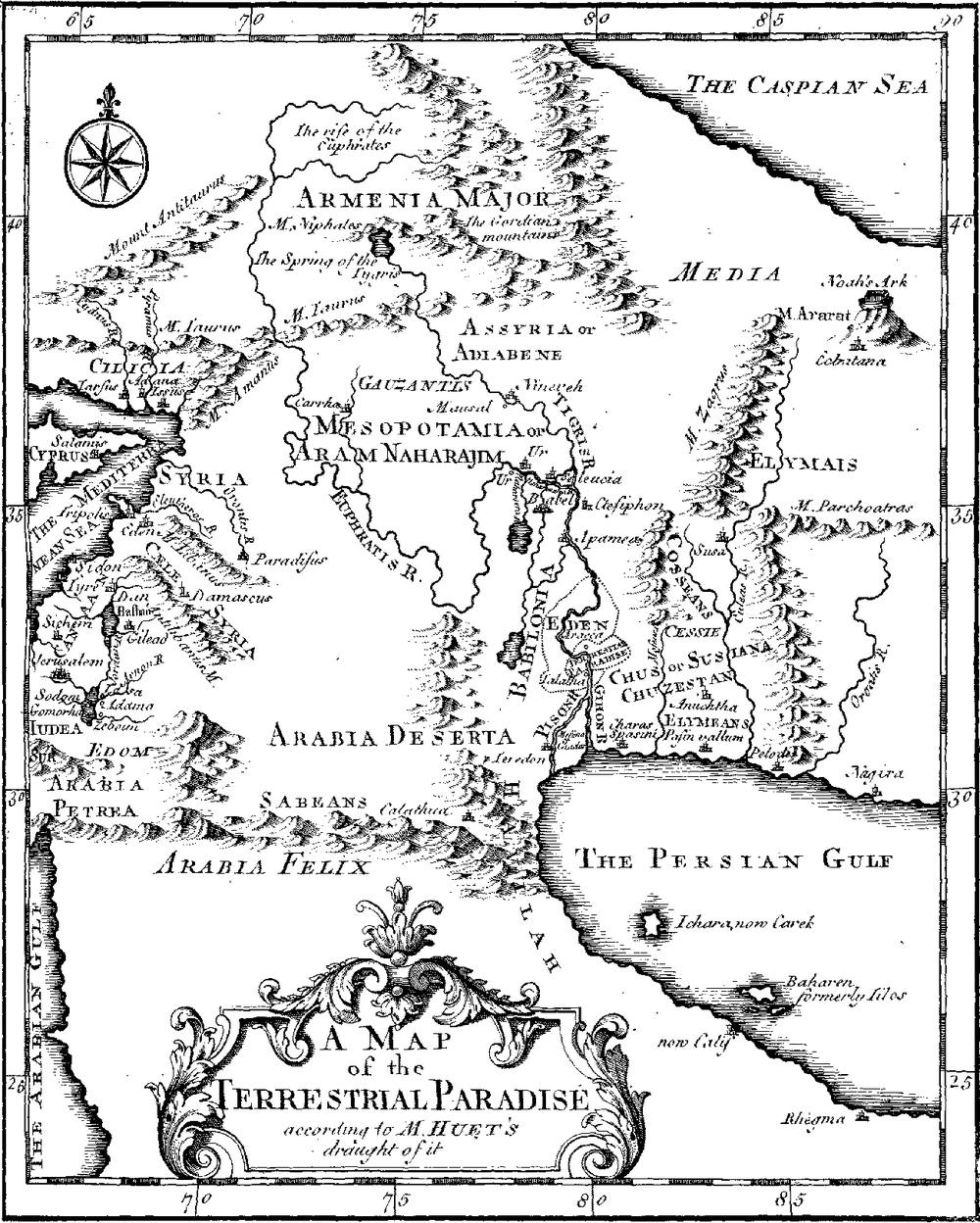
There is hardly any Part of the World, in which it has not been sought for; in Asia, in Africa, in Europe, in America; in Tartary, upon the Banks of the Ganges, in the Indies, in China, in the Island of Ceilon, in Armenia, under the Equator; in Mesopotamia, in Syria, in Persia, in Babylonia, in Arabia, in Palestine, in Ethiopia, where the Mountains of the Moon are; near the Mountains of Libanus, Antilibanus, and Damascus77. M. Huet places it upon the River that is produced by the Conjunction of the Tigris and Euphrates, which now is called the River of the Arabs; between this Conjunction and the Division made by the same River, before it falls into the Persian Sea. He puts it upon the Eastern Shore of this River, which being considered (says he) according to the Disposition of its Channel, and not according to the Course of its Stream, was divided into four Heads, or four different Openings. These four Branches make four Rivers; two upwards, which are Tigris and Euphrates, and two below, which are Pison and Gibon. The Pison, according to him, is the Western Channel, and the Gibon is the Eastern Channel of the Tigris,
which discharges it self into the Persian Gulph. ‘Tis said that M. Bochart was pretty much of the same Opinion, as may be gathered from some Passages in his Writings78.
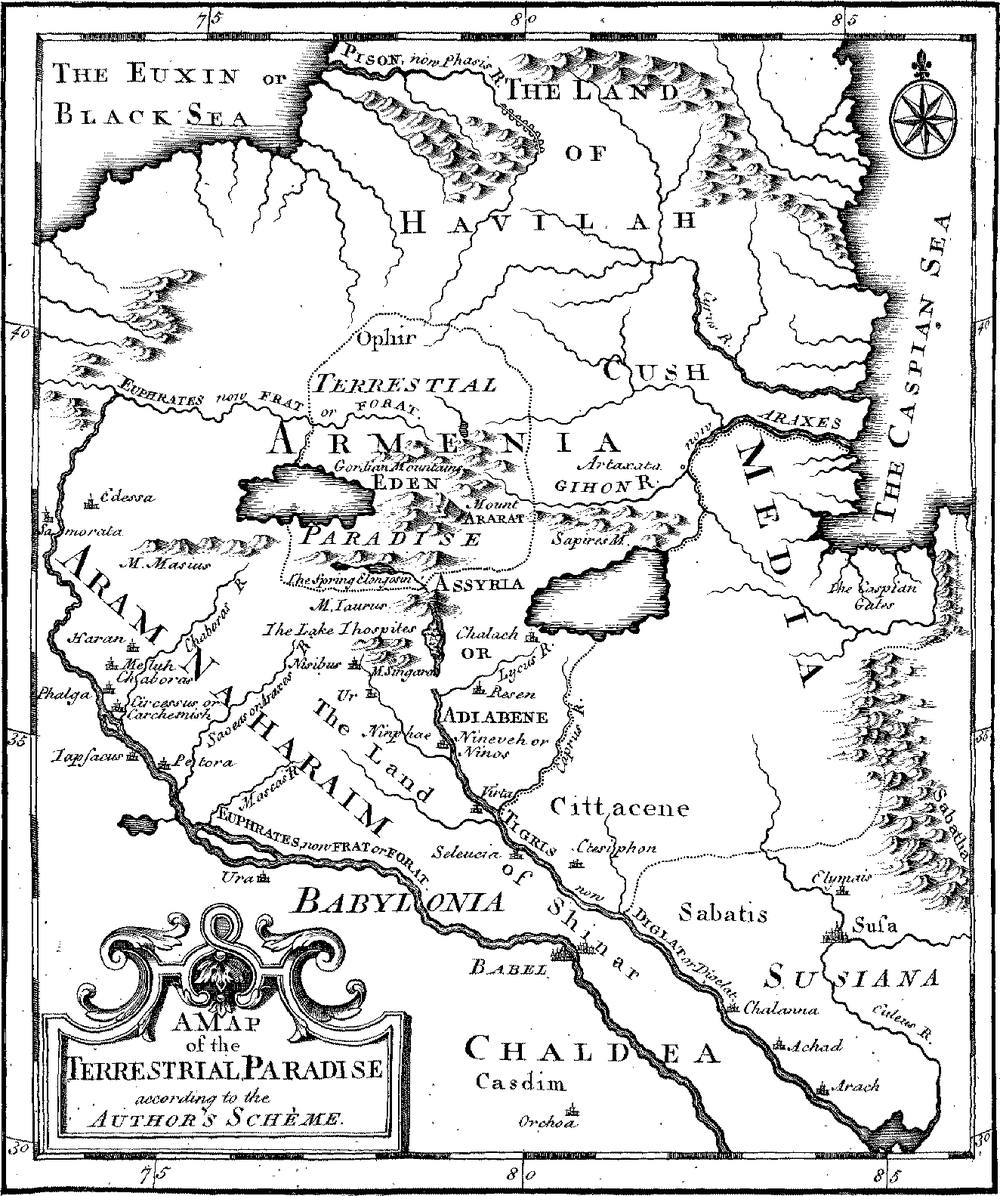
Other skilful Men have placed the terrestrial Paradise in Armenia, between the Sources of the Rivers Tigris and Euphrates, Araxis and Phasis, which we take to be the four Rivers described by Moses. Euphrates is expresly mentioned; the Hiddekel is the Tigris, which is still called Diglito. The Phasis is Pison, in which the Resemblance of the Words is apparent. The Gibon is the Araxes. Araxes in Greek signifies rapid or impetuous, just as Gibon in Hebrew; and there is no River known in the World more rapid than the Araxes. The Land of Eden was in this Country, as far as can be judged by some Traces of it, that are to be found in the holy Scriptures. The Land of Cush is the antient Scythia situate upon the Araxes. Havilah is plainly Cholchis, a Country very famous for its Gold. Our Commentary upon Gen. ii. 8. may be consulted, where we have endeavoured to establish this Hypothesis by all the Proofs that we could gather. Travellers that have visited this Country give sufficient Testimony of its great Fruitfulness, and there is still a Tradition among the Inhabitants, that the earthly Paradise was in their Province.
Ecclus. xliv. 16The Author of Ecclesiasticus says, that Enoch being found agreeable to God was translated into Paradise. Henoch placuit Deo, & translatus est in Paradisum, ut det gentibus pænitentiam. The Latin Fathers, who have read the Word Paradise in the Text of the Vulgate, thought that this Patriarch was transported into Paradise, that is, into Heaven according to some79 or into the earthly Paradise according to others80. But the Greek Fathers, who have not read the Word Paradisus in the Greek Text of Ecclesiasticus, have not determined the Place to which Enoch was translated81. St. Jerome has often put the Word Paradisus into the Vulgate, in Imitation of the Septuagint; but it is not to be found in the Hebrew Text of the Old Testament, except in the four Places that we have mentioned in the Beginning. Generally he translates the Hebrew Word Gan by Paradisus; but Gan only signifies a Garden, whether it be understood of a Kitchen-garden, an Orchard, or a Park.
In the Books of the New Testament the Word Paradise is put for a Place of Delight, where the Souls of the blessed enjoy Luke xxiii. 43.everlasting Happiness. Thus Jesus Christ tells the Penitent Thief upon the Cross, To Day shalt thou be with me in Paradise, that is, in the State of the Blessed And St. Paul speaking of himself in the third Person says, 2 Cor. xii. 4.I knew a Man that was caught up into Paradise, and heard unspeakable Words, which it is not lawful for a Man to utter. Lastly, Jesus Christ in the Revelations says, To him Rev. ii. 7.that overcometh will I give to eat of the Tree of Life, which is in the midst of the Paradise of God: Where Allusion is made to the Tree of Life that grew in the terrestrial Paradise. The Jews commonly call Paradise the Garden of Eden; and they imagine, that at the coming of the Messiah they shall here enjoy an earthly Felicity, in the midst of all Sorts of Delights; and till the Resurrection and the coming of the Messiah, they think their Souls shall abide here in a State of Rest
PARADISE TERRESTRIAL. The Orientals think82, that the Terrestrial Paradise was in the Island of Serendib, or Ceilan; and that when Adam was drove out of Paradise, he was sent to the Mountain of Rakoun in the same Island, two or three Days Journey from the Sea. The Portuguese call this Mountain Pico de Adam, or the Mountain of Adam, because it is thought that this first of Men was buried under this Mountain, after he had lived in Repentance an Hundred and thirty Years.
The Mussulmen do not believe that the Paradise, in which Adam was placed after his Creation, was at all Terrestrial, but that it was raised up to one of the seven Heavens; and that it was from this Heaven that Adam was thrown down into the Island of Ceilan, where he died after having made a Pilgrimage into Arabia, where he visited the Place appointed for the building of the Temple of Mecca. They say also83, that when God created the Garden of Eden, he created there what the Eye had never seen, the Ear has never heard, and what has never entered into the Heart of Man to conceive. That this delicious Garden has eight Doors, whereas Hell has but seven, and that the Porters which have the Care of them are to let none enter before the Learned, who make a Profession of despising earthly Things, and of desiring those of Heaven.
The same Orientals reckon84 up four Paradises in Asia. First about Damascus in Syria. Secondly, about Obollah in Chaldæa. Thirdly, about the Desert of Naoubendigian in Persia, in a Place called Scheb-Baovan, watered by the Nilabe. And
lastly in the Isle of Ceilan, or Serendib, of which we have spoke before.
We may perceive from hence, that the Opinion which places the terrestrial Paradise about Damascus, and near the Sources of the Jordan, is no novel Opinion, nor is it peculiar to European Writers. Heidegger in the Life of the Patriarchs, Mr. le Clerc, Father Abram, and Father Hardouin, both Jesuits, have maintained this Opinion. Father Hardouin has lately published his Hypothesis on this Subject in a copious Manner in his new Pliny; and he has owned to me, that he had much to object against it, and much to say in its Vindication. The Reader may consult this Author himself, for the Limits of this Dictionary do not allow me to enlarge too much on this Article.
PARALIPOMENA. This Name is given to two Historical Books of the Scripture, which the Hebrews call85 Dibrejamim, the Words of Days, Diaries or Journals. Others cite these Books by the Name of Chronicles86. The Name Paralipomena is taken from the Greek, and signifies Things omitted; as if these Books were a kind of Supplement to inform us what had been omitted, or too much abridged, in the Books of Kings, and the other Books of Scriptures. And indeed we find in them many Particulars which are not to be met with elsewhere. But it must not be thought that these are the Records or Books of the Acts of the Kings of Judah and Israel, so often referred to in the Books of the Kings and of the Chronicles themselves. Those antient Registers were much more extensive than what we have here, and the Books of Chronicles themselves refer to these original Memoirs, and make long Extracts from them.
The Author of these Books is unknown. Some have thought it to be the same as the Author of the Books of Kings; but if this were true, whence is that Variety in the Dates, in the Narratives, in the Genealogies, in the proper Names? Why these Repetitions of the same Things, and very often in the same Words? The Hebrews commonly ascribe the Chronicles to Esdras, who they say composed them after the Return from the Captivity, assisted by Zechariah and Haggai, who were then alive. This Opinion is proved, first from the Similitude of Style, from the Recapitulations and general Reflections which are sometimes made upon a long Series of Events. Secondly, the Author lived after the Captivity, since in the last Chapter of the second Book he recites the Decree of Cyrus, which granted their Liberty to the Jews. Besides he carries the Genealogy of David down to Zerubbabel, who was the Head of those that returned from the Captivity. Thirdly, there are certain Terms and Expressions found in these Books, which they think to be peculiar to the Person and Times of Esdras.
But if these Marks seem to prove for Esdras being the Author of these Books, here are others that seem to prove the contrary. First, the Author continues the Genealogy of Zerubbabel as far down as the Twelfth Generation. But Esdras did not live late enough for that. Secondly, in more Places than one he supposes the Things, of which he makes Mention, to be then in the same Condition as they were, for Example, before Solomon, and before the Captivity87. Thirdly, he that wrote these Books was neither a Contemporary nor Original, but a Compiler and Abridger. He had before him a great Number of antient Memoirs, Genealogies, Annals, Registers, and other Pieces, which he often quotes, and sometimes gives Extracts from, and sometimes only the Substance of them. Sometimes he inserts large Fragments from them, without changing any Thing, and without taking the Trouble to reconcile disagreeing Matters. From hence it is that we sometime find the Genealogy of the same Person given more than once.
It seems to us that his chief Design was exactly to exhibit the Genealogies, the Rank, the Functions, and the Order of the Priests and Levites; that at the Return from the Captivity they might the more easily assume their several Ranks, and re-enter upon their Ministries. He had also in View to shew, how the Lands had been distributed among the Families before the Captivity, that at the Return from Babylon each Tribe, as far as was possible, might obtain the ancient Inheritances of their Fathers. The Author quotes old Records by the Name of ancient Things. He recites four several Rolls or 1 Chron. iv. 22.Numberings of the People, one taken in the Time of David, another in the Time of Jeroboam, the third in the Time of Jotham, and the fourth in the Time of the Captivity of the ten Tribes. He speaks elsewhere of the Numbers taken by Order of King David, and which Joab did not finish. Hence we may see the extreme Accuracy affected by the Jews in their Genealogies and Historical Monuments.
The Commentators have pretty much neglected the Books of Chronicles, induced thereto by a false Persuasion, that they
contained few Things but what had been illustrated in the Books of Samuel and the Kings. But true it is, as St. Jerome observes88, that these Books contain a very great Number of important Things for the Explication of Scripture, and that all the Scriptural Traditions are contained therein. Omnis traditio scripturarum in hoc continetur; and that it is deceiving our selves to imagine, that we have any Knowledge of the Holy Books, if we are ignorant of these. Absque illo, si quis scientiam scripturarum sibi voluerit arrogare, seipsum irrideat89. Finally he advances, that in the Chronicles we may find the Solution of an infinite Number of Questions, that concern the Gospel. Innumerabiles Evangelii explicantur quæstiones.
No body disputes the Authority or Canonicalness of the Chronicles. The ancient Hebrews made but one Book of them90; but in the modern Hebrew Bibles they have two Books as well as we. There are a good Number of Variations, as well in Facts as Dates, between the Books of Kings and those of the Chronicles, which may be seen explained and reconciled in the Commentators. The first Book contains a kind of Recapitulation of the sacred History, by Genealogies, from the beginning of the World to the Death of David, which happened in the Year of the World 2289, before Christ 1711, before the vulgar Æra 1715. The second Book contains the History of the Kings of Judah, and Part of those of Israel, from the beginning of Solomon only, in the Year of the World 2290, to the Return from the Captivity of Babylon, in 3468, before Christ 532, before the Vulgar Æra 536. See our Preface to the Books of Chronicles.
PARAN, El-paran, or Pharan, a Desart of Arabia Petrea, to the South of the Land of Promise, and to the North-East of the Gulph Elanitis. Chedor-laomer and his Allies coming to make War with the Kings of Pentapolis, ravaged the Country as far as the Plains of Paran91. Hagar being sent away from the House of Abraham, retired into the Wilderness of Paran, where she lived with her Son Ishmael92. The Israelites having decamped from Sinai, came into the Desart of Paran93. ‘Twas from hence that Moses sent out Spies, to bring Intelligence concerning the Land of Promise; and consequently Numb. xiii. 3. Numb. xiii. 26.Kadesh is in the Wilderness of Paran, since it was from Kadesh these Men were sent. Moses seems Deut. xxxiii. 2.to place Mount Sinai in the Country of Paran when he says, that the Lord appeared to the Israelites upon the Mount of Paran. Habbakuk seems to say the same Hab. iii. 3.thing: Deus ab Austro veniet, & sanctus de monte Pharan. When David was persecuted by Saul, he withdrew into the Wilderness of Paran, near Maon and Carmel. Hadad Son of the King of Edom 1 Sam. xxv. 1, 2. 1 Kings xi. 18.was carried when a Child into Egypt. Those that conducted him came from the Eastern Parts of Idumea (or Edom) into the Country of Midian, from thence into the Country of Paran, and then into Egypt. The greatest Part of the Habitations of this Country were dug in the Rocks94, and ‘twas there that Simon of Gerasa gathered together all that he took from his Enemies.
Paran was a City of Arabia Petrea, situate at three Days Journey from the City of Elab or Ailat towards the East95. ‘Twas this City that gave Name to the Desart of Paran.
PARANYMPHUS. This Word, according to the Force of the Greek Paranymphos, signifies, he that is near the Bridegroom, the Friend of the Bridegroom, he that performs the Solemnities of the Wedding, and conducts the Bride to the Bridegroom. The Rabbins say96, that the principal Office of the Paranymphus was, to observe that the Bridegroom and Bride committed no Fraud in relation to the Blood, which was the Mark of the Bride’s Virginity, of which Moses speaks, Deut. xxii. 14. for fear the Bridegroom should conceal the Linnen whereon the Blood appeared, or that the Bride should foist a false one upon him. John the Baptist says, that there is a great Difference between the Bridegroom and the Paranymphus. The Bridegroom is he that has the Bride, and for whom the Marriage is made; the Paranymphus, or the Friend of the Bridegroom, is contented to perform the Orders of the Bridegroom, and rejoyces to obey him. Qui habet sponsam sponsus est; amicus autem sponsi, qui stat & audit eum, gaudio gaudet propter vocem sponsi. Among the Grecians97 the Paranymphus kept the Door of the Nuptial Bed, and had the Care and Management of the Feast, and all the other Rejoycings. There are some that think the Architriclinus mentioned in the Gospel at the Solemnity of John ii. 8.the Marriage of Cana was the same as the Paranymphus. Gaudentius Brixiensis assures us98, from the Tradition of the Ancients, that
commonly the President of the nuptial Feast was chosen from among the Priests, that he might take care nothing was transacted contrary to the Law, or against the Rules of Decency. ‘Twas he that regulated the Order of the Officers, and the whole Disposition of the Feast. See the Article of MARRIAGE.
PARAPHRASE, Chaldee. See TARGUM.
PARASANG. A sort of Measure or Length of Way, among the Persians. A Parasang had thirty Stadia or Furlongs, or three thousand seven hundred and fifty Paces, according to Herodotus99; or forty, or even sixty Stadia, according to Strabo n. Pliny observes100, that the Measure of a Parasang was not regular among the Persians. The Word Parasang is not to be read in Scripture, but it will be of use to know these sort of Measures, which are to be met with in old Authors.
PARASCEUE is a Greek Word which signifies Preparation. The Jews gave the Name of Parasceue to Friday, because being Exod. xvi. 23. xxxv. 2, 3.not allowed on the Sabbath to prepare their Food, they provided the Day before. St. John says, that Friday on which our Saviour John xix. 14, 31, 41.suffered was the Preparation of the Passover, because the Passover was to be celebrated the Day following. St. Matthew marks out the Matth. xxvii. 62.Sabbath Day by these Words: The Day that followed the Parasceue. All the Evangelists observe, that they were in a great Hurry to take down Christ from the Cross, and to put him in the nearest Tomb, because it was the Evening of the Parasceue, and that the Sabbath was to begin immediately after the setting of the Sun, or the rising of the Stars.
PARENTS. This Word is properly said of the Father and Mother, but is extended also to all others that are related by Blood, especially in a direct Line upwards. The Exod. xx. 12.Scripture commands Children to honour their Parents; that is, to obey them, to succour them, to have an inward and outward Respect for them, to give them all sorts of Assistance that Nature, and their and our Circumstances shall require. This is the Extent and Signification of the Word to honour. Christ in the Gospel condemns that corrupt Explication that the Doctors of the Law gave to this Matth. xv. 5, 6.Precept; teaching that a Child was then disengaged from the Obligation of supporting his Parents, and giving them necessary Assistance, when he said, It is a Gift by whatsoever thou mightst be profited by me. As if they had said, I am no longer Master of my own Estate, it is consecrated to the Lord: But you will have your Share in the Merit of the Offering. See the Article CORBAN before.
Marriages among Parents and Relations were forbid within certain Degrees.
A Man was not allowed, for Example, to marry, First, his Mother; Secondly, his Mother-in-Law; Thirdly, his Sister by Father or Mother; Fourthly, his Granddaughter; Fifthly, the Daughter of his Father’s Wife; Sixthly, the Sister of his Father or Mother; that is, his Aunt; Seventhly, the Wife of his Unkle by the Father’s Side; Eighthly, his own Daughter-in-Law. Ninthly, the Wife of his Brother, or his own Sister-in-Law. Tenthly, It is forbid an Hebrew to marry at one Time or successively the Mother and the Daughter, the Mother and the Grand-daughter, or the Sister of his own Wife while she is alive. Here are four Verses that include all the Degrees of Relation now mentioned.
Nata, soror, neptis, matertera, fratris & uxor,
Et patrui conjux, mater, privigna, noverca, Uxorisque soror, privigni nata, nurusque, Atque soror patris conjungi lege vetantur.
PARIUS LAPIS, or Parium Marmor, a white Marble of much Esteem, which was called Parium, because it was got in the Isle of Paros, one of the Cyclades in the Archipelago. It is said in the Chronicles101, that David had prepared a vast Quantity of Parian Marble for the building of the Temple; and in Esther102, that the Pavement of the Place where King Abasuerus made the famous Feast for his Nobles, was paved with Emeralds and Parian Marble. ‘Tis well known that the Marble of Paros was of an excellent Whiteness, and that the greatest Part of the most beautiful Works of Antiquity were made of this Marble. Josephus says103, that the Temple of Jerusalem was built with great Stones of white Marble; so that at a Distance this vast Pile of Building appeared like a Mountain of Snow. The Seventy had probably the same Notion, when they rendered the Hebrew Word Sis, or Sais, or Shish, by Parian Marble; and St. Jerome has followed them in this. But we must own, that the Stone of Sis or Shish is intirely unknown to us. We cannot tell whether it is a Marble or a precious Stone. David mentions it in the Enumeration that he makes, of the precious Stones he had collected for the Works of the Temple; though we do not perceive the Use that Solomon employed it to; unless he made Use of it to adorn the Vessels of the Temple,
or perhaps for some Ornaments of the High Priest.
As to the Passage in the Book of Esther, we read there Shish, or Sis, as in the Book of Kings; and the Septuagint and St. Jerome have in like manner rendered it by the Marble of Paros; but other Interpreters render it by plain Marble. I should rather think it to be a sort of precious Stone unknown to us, than a kind of Marble. The Ancients sometimes made Pavements, wherein were set very valuable Stones. Eò deliciarum pervenimus, ut nisi gemmas calcare nolimus, says Seneca104. And Apuleius thus describes the Pavement of the Apartments of Psyche: Pavimenta ipsa lapide pretioso cæsim diminuto, in varia pictura genera discriminabantur.
PARMASHTA, or Phermesta, the seventh Son of Haman, the Enemy of the Jews. He was put to Death by the Jews with his Father105.
PARMENAS, one of the seven first Deacons who were chosen with St. Stephen106. The Scripture gives them all seven a great Commendation, saying, they were Men of honest Report, full of the Holy Ghost and Wisdom. St. Epiphanius thinks107, that they were of the Number of the seventy Disciples. As to Parmenas, we have nothing certain either as to his Life or Death. The Greeks say he fell asleep before the Eyes of the Apostles. Adon places his Martyrdom at Philippi in Macedonia the 23d of January. The Martyrology takes notice of his Death under Trajan, in the same City.
PARNACH, or Pharnac, Father of Elizaphan, of the Tribe of Zebulun. Numb. xxxiv. 25.
PAROSH, or Pharosh, or Pharos. The Children of Parosh return’d from the Captivity of Babylon, to the Number of two thousand one hundred and seventy two. Ezra ii. 3. viii. 3. x. 25.
PARSHANDATHA, or Pharsandatha, the eldest Son of Haman, put to Death, and hang’d upon a Gibbet, as was his Father, the great Enemy of the Jews. See Esther ix. 7. In the Year of the World 3496, before Christ 504, before the Vulgar Æra 508.
Psal. xvi. 5. Ps. cxlii. 5.PART, Portion. The Lord is the Portion of mine Inheritance. Thou art my Refuge and my Portion in the Land of the Living. And on the contrary, Israel is the Part or Portion of the Lord, his peculiar Deut. xxxii. 9.People. The Lords Portion is his People, Jacob is the Lot of his Inheritance. But with this Difference, that God makes and constitutes the Happiness of his People, but his People cannot contribute any thing to his Happiness or Glory.
Job xx. 29. Psal. lxiii. 10. Psal. xi. 6.Part or Portion also signifies Recompence, or Correction. This is the Portion of a wicked Man from God, and the Heritage appointed unto him by God. They shall be a Portion for Foxes. Upon the Wicked shall reign Snares, Fire, and Brimstone, and an horrible Tempest; this shall be the Portion of their Cup. This is their Part or Portion, and the just Punishment of their Iniquity. The Lord shall appoint him his Portion with the Hypocrites. God will treat him as he does the Hypocrites.
Part or Portion is also used for the Share that a Son may claim in the Inheritance of Luke xv. 12. Eccl. ii. 10. Eccl. iii. 22.his Father. Father, give me the Portion of Goods that falleth to me. And Solomon, This was my Portion of all my Labour. And elsewhere, There is nothing better than that a Man should rejoice in his own Works; for that is his Portion.
Eccl. xiii. 22. 2 Sam. xx. 1.Quæ pars diviti ad pauperem? What has the Rich to do with the Poor? Non est nobis pars in David. We have no Share in David, we have nothing to do with him. And elsewhere, Quæ nobis pars in David? What have we to do with David?
PARTHIANS, are the same as the ancient Persians. They were called Persians in the Time of the Prophets, and Parthians in our Saviour’s Time. The Name Persians in Hebrew Paraschim, signifies Horsemen. The proper Name of the Persian Nation is Ælam. Probably they had the Name Peraschism given them, because of their great Inclination to Horsemanship, which continues to this Day. Neither Moses, nor any other of the sacred Writers, make any Ezek. xxvii. 10.mention of the Persians till towards the Time of Cyrus. Ezekiel puts the Persians among the Troops of the King of Tyre. He Ezek. xxxviii. 5. Acts ii. 9 Judith xvi. 10.also put some of them in the Army of Gog Prince of Magog. Judith said, that the Persians admired her Courage. Daniel often speaks of the King of the Persians, who was to destroy the Chaldean Monarchy. From the Time of Cyrus the Persian Name is known in Scripture. The Name of Parthians is only read in the Acts of the Apostles, where they appear as if distinct from the Elamites, tho’ they make originally but one People. See the Article ÆLAM before Elymais was the Capital of Ælam, and Susa the Capital of the Persians. The first Epistle of St. John in several Manuscripts has the Title of the Epistle to the Parthians.
PARTRIDGE. The Partridge is a Bird very good to eat, whose Flight is low, and of little Compass. The grey Partridges
are the more common, but the red ones are the larger. There are white Partridges in the Alps, which have hairy Feet. St. Austin says108, that the Partridge is a quarrelsome Animal, and loves Contention. In order to catch it, the same Inclination is made use of, that moves it to quarrel; by which Means it throws itself greedily into the Nets of the Fowler. Perdix nimis contentiosum animal, notum est quanta aviditate ipsius contentionis currat in laqueum. He compares Hereticks to them, who are greedy of Dispute, always striving for Victory to lead away the Simple. He applies to them this Passage of Jeremiah, As Jer. xvii. 11.the Partridge sitteth on Eggs, and hatcheth them not, so he that getteth Riches, and not by Right, shall leave them in the midst of his Days, and at his End shall be a Fool. St. Ambrose109 and St. Jerome a inform us, that the Partridge carries away the Eggs of another Partridge, and sits upon them as her own; but when she has hatched them, and the young ones are able to flie, they flye away, and follow the Voice of their true Dam. Commentators explain it after the same Manner. See Vatablus, Sanctius, Munster, Tirinus, Menochius, &c. But it will be difficult to give good Proofs of this from such Authors as treat of Natural History.
Eccl. ix. 30.The Septuagint reads, The Partridge cry’d, it gathered together what it had not produced. Upon which Theodoret observes110, that Fowlers make use of tame Partridges, by which they catch others; and doubtless this is what St. Austin means when he says, that the Partridge is taken by his Obstinacy, in pursuing the tame Partridge into the Net. Elian observes the same thing111, as also the Author of Ecclesiasticus, Like as a Partridge taken and kept in a Cage, so is the Heart of the Proud; and like as a Spy, watcheth he for thy Fall. The tame Partridge makes as it were its Sport and Diversion of the Destruction of other Partridges.
Some translate the Hebrew of Jeremiah after this Manner112, The Partridge lays many Eggs, but does not hatch them all. Because she makes her Nest upon the Ground, and is therefore often obliged to quit her Eggs, for fear of Cattle, Dogs, or Sportsmen, which chills her Eggs, and makes them unfruitful. Rain and Moisture also may spoil them, and sometimes the He-Partridge breaks them.
Others think that the Hebrew Word Kore, here translated a Partridge, rather signifies a Cuckow; Kore signifies that which cries, and the Cuckow is little known but by its crying. ‘Tis said not to sit upon its own Eggs, but to lay its Eggs in other Birds Nests. This agrees well enough with what is said by Jeremiah. Nothing is more uncertain than the Signification of the Hebrew Names of Birds. We have no other Proof that the Hebrew Word signifies a Partridge, but the Testimony of the Septuagint, who thus translate it. Bochart thinks it rather signifies a Woodcock, Rusticula.
PARUAH, or Pharue, Father of Jehoshaphat, of the Tribe of Issachar. This Jehoshaphat was made Head or Governor of the Tribe of Issachar by Solomon.
1 Kings iv. 17.PASEAH, or Phesse, Son of Ephton, and Grandson of Caleb. 1 Chron. iv. 12.
I. PASHUR, or Phassur, a Descendant of Immer, &c.
II. PASHUR, Phashur, or Pheshur; his Children returned from Babylon to the Number of one thousand two hundred and forty seven. Ezra ii. 38. Neh. vii. 41.
Acts i. 3.PASSION. This Word has several Significations, very different from one another. First, it signifies the Passion or Suffering of Jesus Christ. To whom also he shewed himself alive after his Passion. It is also put for the Sufferings of the Saints.113 Magnum certamen sustinuistis passionum. Ye have suffered great Afflictions.114 Et non sunt condignæ passiones hujus temporis ad futuram gloriam. Secondly, it signifies Rom. i. 26.shameful Passions, passiones ignominiæ, to which they are given up, whom God abandons to their own Desires. And the Rom. vii. 5.Passions of Sin, passiones peccatorum, which act in our Members, to bring forth the Fruit of Death. The Passions of Desires, 1 Thess. iv. 5.passio desiderii, our evil Inclinations, the Motions of Concupiscence, to which the Heathen without any Scruple abandoned themselves.
PASSOVER, or Pascha. This Word in Hebrew signifies Passage. The Jews pronounce it Pesach. Some have thought to derive it from the Greek Verb pascho, patior, I suffer; as if in Allusion to the Passion of Jesus Christ; but its true Etymology is from the Hebrew Verb pasach, to pass, to leap or skip over. They gave the Name of Passover to the Festival which was established in Commemoration of the coming forth out of Egypt115, because the Night before their Departure, the destroying Angel who put to Death the First-born of the Egyptians, passed over the Houses116
of the Hebrews without entering therein, because they were marked with the Blood of the Lamb, which was kill’d the Evening before, and which for this Reason was called the Paschal Lamb.
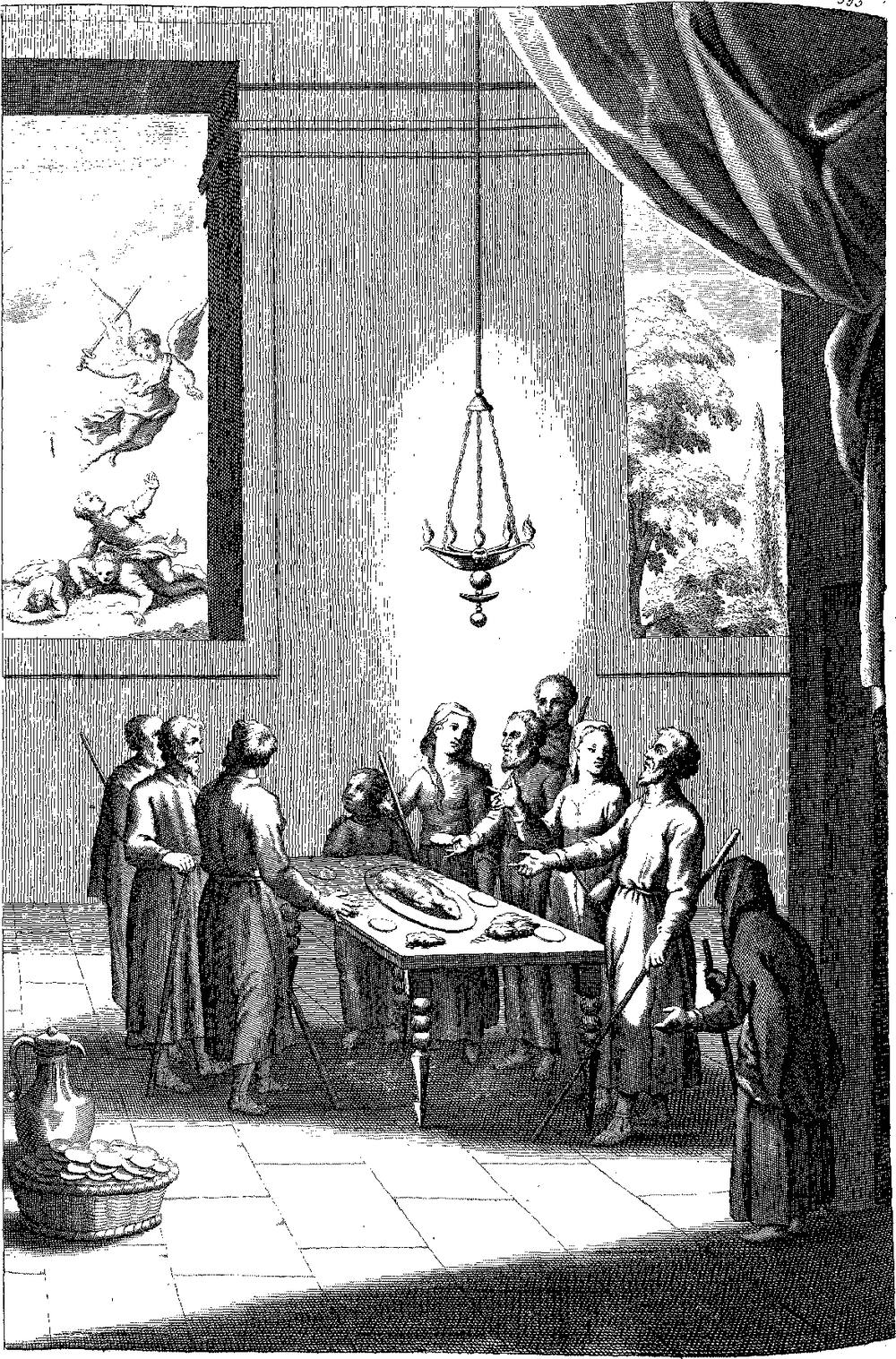
This is what God ordained concerning Exod. xii.the Passover of the Jews. The Month of the coming forth from Egypt117 was look’d upon from this Time to be the first Month of the Sacred or Ecclesiastical Year, and the fourteenth Day of this Month, between the two Vespers, that is, between the Sun’s Decline and his Setting; or rather according to our manner of reckoning, between Two a-clock in the Afternoon and Six a-clock in the Evening at the Equinox, they were to kill the Paschal Lamb, and to abstain from leavened Bread. The Day following being the fifteenth, counting from Six a-clock of the foregoing Evening which concluded the fourteenth, was the grand Feast of the Passover, which continued seven Days. But ‘twas only the first and the seventh Day that were solemn. The Lamb that was kill’d ought to be without any Defect, a Male, and yean’d that Year. If no Lamb could be found, they might take a Kid. They kill’d a Lamb or a Kid in every Family; and if the Number of those that lived in the House was not sufficient to eat a Lamb, they might join two Houses together.
With the Blood of the Paschal Lamb they sprinkled the Door-posts and Lintel of every House, that the destroying Angel at the Sight of the Blood might pass over them, and save the Hebrew Children. They were to eat the Lamb the same Night that followed the Sacrifice; they eat it roasted, with unleavened Bread, and a Sallad of wild Lettices. The Hebrew says literally, with bitter Things, as suppose Mustard, or any thing of this Nature to give a Relish. It was forbid to eat any Part of it raw, or boiled in Water, nor were they to break a Bone; but it was to be eaten intire, so much as the Head, the Feet, and the Exod. xii. 46. Numb. ix. 12. John xix. 36. Numb. ix. 13.Bowels; and if any thing remained to the Day following, it was thrown into the Fire. They that eat it were to be in the Posture of Travellers, having their Reins girt, their Shoes on their Feet, their Staves in their Hands, and eating in a Hurry. But this last part of the Ceremony was but little observed, at least it was of no Obligation, but only upon that Night they came forth out of Egypt. For the whole eight Days of the Passover no leavened Bread was to be used; and whoever should eat any, was threatned to be cut off from his People. They kept Exod. xii. 16.the first and last Day of the Feast, yet so as that it was allowed to dress Victuals, which was forbidden on the Sabbath-day.
The Obligation of keeping the Passover was so strict, that whoever should neglect to do it was condemned to Death. Exterminabitur anima illa de populis suis. But those who had any lawful Impediment, as a Journey, Sickness, or any Uncleanness, voluntary or involuntary; for Example, those that had been present at a Funeral, or by any other Accident had been defiled, were to defer the Celebration of the Passover till the second Month of the Ecclesiastical Year, or to the fourteenth Day of the Month Jiar, which answers to April and May. ‘Twas thus the Lord ordered Moses, upon the Occasion of the Enquiry of some Israelites, who had been obliged to pay their last Offices to some of their Relations, and who being thus polluted, were not capable of partaking of the Paschal Sacrifice. We see an Example of the Execution of this Law under Hezekiah118. This holy King having resolved to cause a solemn Passover to be celebrated by all his Subjects, it was remonstrated to him, that the Priests had not had Leisure to purify themselves in so great a Number, as was necessary for this Solemnity. Therefore it was resolved that the Celebration of it should be put off till the Month following, when it was celebrated accordingly.
We may add to what has been said above concerning the last Passover, that the Oriental Christians119, and especially the Syrians, insist, that on the Year that Christ died the Feast was celebrated on the thirteenth of the Month Adar, being Saturday, and that it began at the Conclusion of the Friday before; and that our Saviour forestall’d it by a Day, and celebrated it on the Friday, beginning from the Evening of the Thursday before, because he was to suffer on the Friday. Calvisius also places the same Passover on the Saturday the fourth of April, in the thirty-third Year of the Vulgar Æra, the thirty-fifth of Jesus Christ, which falls in the 344th Year of Alexandra.
The Ceremonies with which the modern Jews celebrate their Passover, are such as these120. The Feast continues a Week, but the Jews that live out of Palestine extend it to eight Days, according to an ancient Custom, by which the Sanhedrim sent two Men on purpose to observe the first Appearance of the new Moon, and immediately to give Notice of it to the chief of the Council. For fear of failing in what they ought to do, they121
kept two Days of the Festival. One was called dies latentis lunæ, and the other dies apparentis lunæ. So that the two first Days of the Passover, and the two last also are solemn; insomuch that on these two Days they were not to labour, or treat of any Business. But it is allowed to prepare Victuals, and to remove from Place to Place, whatever they have occasion for. For the four intervening Days it is only forbid to work; but they may manage their Money, and these Days are distinguished from Working-days only by some particular Things.
During the eight Days of the Feast, the Jews eat only unleavened Bread, and it is not allowed them so much as to have in their Custody any Leaven or Bread leaven’d. And the better to observe this Rule, they examine all over the House with a very scrupulous Care, to take away whatever may have any Ferment in it. For this End they search into all the Holes and Corners of their Apartments, their Boxes and Repositories, and then having well cleared their Houses, they cause them to be white-wash’d; and they either furnish them with Goods that are quite new, or with such at least for that Day. If they have been used before, and are made of Metal, they make them pass again through the Forge, and polish them. At Evening before the Vigil of the Feast, the Master of the House searches all the House over, to see if he can find any leavened Bread. Towards eleven a-clock the Day following, they burn Bread, to shew that the Prohibition of leavened Bread is then begun; and this Action is accompanied with a Form of Words, declaring that they have no Leaven in their Custody, at least that they believe so, and have used their utmost Care that it may be so.
Presently after they set about making unleavened Bread, which they call Mazzoth; and make enough of it to serve all the eight Days of the Feast. They take care that the Flour they use has not been wet, or warm’d, for fear it may have been fermented. They make it into large and thick Cakes, of different Figures; and that they may not rise, they bake them immediately in the Oven, and when they take it out, they keep it with great Cleanliness. Some make their Cakes with Eggs and Sugar, for Persons that are nice and sick; these they call Mazza aschiras, that is to say, rich Cake without Leaven.
On the fourteenth Day of Nisan the First-born of every Family are used to fast, in Memory of what happen’d the Night following, when God smote the First-born of Egypt. At Evening they go to Prayers, and at their Return they sit down to Table, which is prepared in the Day-time, and as well furnished out as their Circumstances will allow. And in order to observe the Command, that the Lamb must be eaten with unleavened Bread, and with bitter Herbs, they have in a Dish, or in a Basket, some Part of the Lamb or the Kid ready prepared with bitter Herbs, such as Sellary, Succory, or Lettuce, and a little Plate of Sauce. This Basket, and this little Equipage, is to put them in mind of the Lime and the Bricks that their Ancestors were forced to make in Egypt; and holding Glasses of Wine in their Hands, they tell of the Hardships their Forefathers endured there, and of the Wonders that God performed to deliver them from thence. Lastly, they return Thanks to God for these Mercies, and repeat Psal. cxii. Benedic anima mea Domino, & omnia quæ intra me sunt nomini sancto ejus, and those that follow, beginning with Hallelujah; after which they go to Supper. When they have supp’d, they go on to say and sing the rest of these Psalms, and other Thanksgivings proper for the Day; and then go to Bed. The Day following they do the same things over again.
The Morning Prayers are the same as those which are said upon other Festivals, unless they add what is peculiar to this, with the Psalms before-mentioned, from cxii, to cxviii. inclusive. They take the Roll of the Pentateuque out of the Chest, and read as far as the twelfth Chapter of Exodus, which contains the Institution of the Passover; and what is contained in the eighteenth Chapter of Numbers, relating to the Sacrifices proper to this Feast. Then the Prayer Mussaph; and afterwards they read out of the Prophets whatever has any Relation to what has been read out of the Pentateuque122. Then after Dinner they make a Commemoration of the Festival, and they give a Blessing for the Prince under whose Dominion they live, and pray to God that he would preserve him in Peace and Happiness, and that his Undertakings may be prosperous, that his Dominions may be enlarged, and that he may cherish their Nation. According to that Advice of Jeremiah, Seek the Peace of the City, whither I have caused you to be carried away Captives, and pray unto the Lord for it; for in the Peace thereof shall ye have Peace.
The same Things are put Practice the two following Days. This Festival is concluded by the Ceremony Habdala, or Distinction. This Ceremony is performed at the closing of the Sabbath-day, at which Time the Master of the House pronounces
certain Words, and certain Benedictions, to desire that every thing may succeed well the Week that is coming. At going out of the Synagogue they go to eat leavened Bread for the last Time.
From the second Evening of the Passover they reckon nine and forty Days to the Feast of Weeks, or Pentecost. And from the Day after the Passover they reckon thirty three Days, during which they nei-ther marry, not cut out new Cloaths, nor cut their Hair, nor celebrate any publick Rejoycing; but they spend this Time in a kind of Mourning, because of a great Mortality which happened as they say, a-mong the Disciples of the Rabbin Akiba. The thirty-third Day is kept with Joyful-ness, and is observed as a Festival, because on this Day the Mortality ceased. This Day is called Lag, because the two Hebrew Letters L and G stand for 33, according to their numerical Value.
The Rabbins inform us of other Parti-culars, which are omitted by Leo of Mo-dena. As for Example; that if any one neglects to remove the Leaven out of his House, he incurs the Penalty of the Whip. He that eats it by Mistake, and without knowing of it, is to pay a Fine. They may either burn the Leaven that they find, or reduce it to Crumbs, and cast it into the Water. When the Women have made their unleavened Bread, they take great Care that it may not grow sour, they make haste to set it in the Oven, that it may not have Time for that, they sprinkle Water over it to keep it from burning. Some carry their Scrupulosity so far, as not to name the Word Leaven before their Chil-dren, for fear they should have a mind to it; in like manner, as they do not call Pork by its Name123, that they may not make it too well known.
To search the more narrowly for lea-vened Bread, they light a Candle at Noon-day, and examine every Hole and Corner, to discover the least Crumb of leavened Bread; and that the Matter may not seem to be either affected or ridiculous, they hide a bit of Bread in some Corner, of which they make the Discovery with great Joy. When all this is over, the Master of the House reserves so much leavened Bread as may suffice for his Family to the fourteenth of Nisan, and burns the rest, saying, that all the leavened Bread in his House, as well what he has found as what he has not, may become as the Dust of the Earth, and come to nothing. They are careful in choosing the Wheat or Barley that is to be used in making the unleavened Bread; and they take all possible Caution to hinder it from growing sour, or fermenting, whether be-fore or after the Grinding. They take care of the Bag it is put in, and will not carry it to the Mill on any Horse’s Back, that it may not heat. They mingle neither But-ter nor Salt, nor Oil with the unleavened Bread, for fear they should cause any Fer-mentation. It must be a Jew that is to knead it, and the most famous Rabbi’s have not disdained to take this Trouble upon them.
While the Temple was in being the Jews sacrificed a Lamb in the Temple, be-tween the two Evenings, that is, after the Noon of the 30th of Nisan, from about Two a-clock to Six in the Evening. Each private Person brought them to the Tem-ple, and there slew them; then they of-fered the Blood to the Priests, who poured it out at the Feet of the Altar. The Per-son himself, or the Levite upon this Oc-casion, might cut the Throat of the Vic-tim, but the Effusion of the Blood at the Foot of the Altar was appropriated to the Priest alone. Philo says P, that at this Feast the Levite, and even a Jewish Layman, might perform the Priests Function; which is to be understood in the Sense we have now explained it.
On the Vigil of the Feast the Matron of the Family sets out the Table in the neatest Manner She can; on which are set two unleavened Cakes, two Pieces of the Lamb, a Shoulder roasted, to put them in mind that God delivered them with a stretched-out Arm. The other Piece is boiled, in Memory of the Sacrifice. To this they add, as is said124, some small Fishes, because of the Leviathan; a hard Egg, because of the Bird Ziz; some Meat, be-cause of the Behemoth. (The Leviathan, the Behemoth, and the Ziz, are three Ani-mals appointed for the Feast of the Elect in the other Life.) Nuts and Pease for the Children, to provoke their Curiosity to ask Reasons for this Ceremony. They have a kind of Mustard that has the Ap-pearance of Mortar, which was heretofore made of Dates, and dried Figs, and at present is made of Chesnuts and Apples, to represent the Labour of making Bricks: They call it Charoteth125. The Father of the Family sits down to Table along with his Children and Slaves; because on this Day all are free. Being sat down, the chief of the Family takes of the bitter Herbs about the Bigness of an Olive, which he dips in the Charoteth, eats it, and distri-butes to the rest.
When they have done eating, they withdraw a little from Table, and then a young Lad, whose Business it is to give out the126
Hymn, proposes several Questions concerning the Original of these Ceremonies. Why on this Night they must eat none but unleavened Bread? Why they make use of none but bitter Herbs? &c. They sit again to the Table, and the Father of the Family explains the History and the Ceremony of the Paschal Lamb, and of all the Ceremonies that accompany it. He concludes with Prayer, and by exhorting the rest to pray for the Restoration of Jerusalem, and of the ancient Sacrifices, that they may there eat the Paschal Lamb, and make God propitious to them by his Blood. He gives Thanks to the Lord, for having procured their Ancestors such a glorious Deliverance. When Prayer is ended, he washes his Hands, and taking one of the unleavened Loaves, he breaks it and blesses it. He does not bless the other Loaves upon the Table, because that Night they are to be contented with a little bit of Bread. For it is the Bread of Affliction, Bread appointed for Slaves and miserable Wretches.
He mingles this Bread with the bitter Herbs, and the Charoseth, and eats it, praising God for having given this Ordinance to his People. Then he takes a bit of the Lamb, which he eats, giving Thanks to God in the same Manner. Afterwards he takes another little bit of Bread, and then he must eat no more. But they drink a third and a fourth Cup of Wine, in which some Water is mix’d. They thunder out Psalms and Thanksgivings, while this Action is performing. Heretofore, and before the Destruction of the Temple, the Paschal Lamb was to be intirely roasted; but at present they think it is not allowed them to make use of the Lamb either intirely roasted, or intirely boiled; because that would be to offer Sacrifices, and to eat them out of Jerusalem and the Temple. But they roast one Part of it, and boil another, or they take away a Part of the Animal, that it may not be intire, and so cannot pass for a Sacrifice.
To fix the Beginning of the Lunar Month, and consequently of the Feast of the Passover, which was celebrated on the 14th Day of the Moon of March, the Rabbins inform us127, that their Ancestors placed Centinels upon the Tops of Mountains, to observe the Moment of the Appearance of the new Moon, and that as soon as they had seen it, they ran in all haste to give notice to the Sanhedrim, who dispatch’d Messengers to the neighbouring Cities, to inform them that the Neomenai was begun. But it is very likely that the ancient Jews never made use of these Precautions, being subject to such great Inconveniencies, especially as to distant Cities: And we can observe no Footsteps of this either in Josephus or Philo, and much less in Scripture. Besides it appears to us as certain, that the old Hebrews did not use Lunar Months, which overthrows this whole System of the Rabbins. See the Articles MONTHS and YEARS.
1 Cor.v.8.As to the Christian Passover, it was instituted by Jesus Christ, when at the last Supper he eat with his Apostles, he gave them his Body to eat, and his Blood to drink, under the Species of Bread and Wine; and when the Day after he gave up his Body to the Jews, who condemned it to Death, and caused it to be crucify’d by the Hands of the Executioners. The Paschal Lamb that the Jews kill’d, tore to pieces, and eat, and whose Blood preserved them from the Hand of the destroying Angel, was only a Type and Figure of our Saviour’s Death and Passion, and of his Blood spilt for the Salvation of the World. This Passover is celebrated every Year with great Solemnity in the Christian Church, the Sunday after the fourteenth of the Moon of March, or Easter-day; but it ought to be celebrated in Sincerity, in Innocence, and in Truth, which are represented by Bread without Leaven. There is offered the holy Sacrifice of the Altar, which is the Memorial as well as the Substance of that which Jesus Christ offered upon the Cross, and of which the Sacrifice of the Paschal Lamb was only the Symbol. Every Day the same Sacrifice is repeated in a great many Places; so that we may say the Church celebrates the Christian Passover every Day .
Even from the Beginning there was a Diversity of Sentiments, and of Practice, about the Celebration of this Passover. From the Time of St. Polycarp the Churches of Asia kept the Passover, or Easter-Day, on the fourteeth Day of the Moon of March, whatsoever Day that might happen upon, in Imitation of the Jews; and the Romish Church kept it, as they do still, on the Sunday that followed the fourteenth Day of the Moon of March. Polycarp came to Rome in the Pontificate of Anicetus, and conferred with him upon this Subject; but neither of them being able to persuade the other to depart from their Custom, they thought they ought not to disturb the Peace of the Church
about a Matter that was meerly of Custom. The Dispute upon this Subject growing warm under the Pontificate of Pope Victor, about the Year 188, the Asiaticks continued obstinately fix’d to their Practice, and Polycrates Bishop of Ephesus, with the other Bishops of Asia, having writ to the Pope a long Letter to support their Opinion, Victor sent Letters through all the Churches, by which he declared them excommunicate. The other Churches did not approve of this Rigour of Victor, and notwithstanding his Sentence, they continued united in Communion with those who still went on to keep Easter on the fourteenth Day of the Moon of March.
Things continued in this Posture till the Council of Nice, held in 325, with this Difference however, that the greatest part of the Churches of Asia were insensibly fallen into the Practice of the Romans, and no longer kept Easter-Day on the fourteenth Day of the Moon of March, but on the Sunday following. The Council of Nice made a general Determination, which ordained, that all the Churches should celebrate Easter- Day on the Sunday that followed the fourteenth Day of the Moon of March; and the Emperor Constantine caused this Decree to be published through the whole Roman Empire. Those that continued in their old Practice, notwithstanding this Decree, were look’d upon as Schismaticks in the Church, and had the Name of Quartodecimans given them, or Partisans of the fourteenth Day; and in Greek they call’d them Tessares-decatites. The Ecclesiastical Histories may be consulted for this, to which this Affair properly belongs. ‘Tis a famous Question among Commentators, whether or no our Saviour kept the Legal and Jewish Passover the last Year of his Life. Some have thought that our Saviour did not keep the Passover the last Year of hisLife, but that the Supper he eat with his Disciples on the Thursday Evening, when he instituted the Sacrament of his Body and Blood, was an ordinary Meal, where there was no Paschal Lamb eaten. Others have said128, that our Saviour had anticipated the Passover, that he kept it the Thursday in the Evening, and the other Jews only on the Friday. Others have advanced that the Galileans kept the Passover on Thursday, as Jesus Christ did; but that the other Jews kept it on Friday. Lastly, it is the most general Opinion of the Christian Church at this Day, as well Greek as Latin, that our Saviour kept the Legal Passover on the Thursday Evening, as well as the rest of the Jews.
The Evangelists St. Matthew, St. Mark, and St. Luke, seem favourable enough to the Opinion which would have it, that he kept the Passover on the Thursday Evening, as also the other Jews. But we must own, that St. John seems to contradict it, since he says that Jesus being at Table with his Disciples, John xiii. 1, 2, &c.before the Feast of the Passover, when Jesus knew that his Hour was come,&c. And afterwards when the Jews had led Jesus to Pilate, that he might condemn him and put John xviii. 28.him to Death, he observes, that they themselves went not into the Judgment-Hall, lest they should be defiled, but that they might eat John xix. 14.the Passover. Lastly, he says, that Friday was the Preparation of the Passover, and that the Saturday following was the great John xix. 31.Day of the Feast, the Sabbath-day, for that Sabbath-day was an high Day; and why so, if not because it was the Passover? And ‘twas for this that the Friday before was the Parasceue, or Preparation of the Passover, which was to be celebrated the Day following.
In the Dissertation upon our Saviour’s last Passover, which we have published before our Commentary upon St. Matthew, we have endeavoured to shew, that our Saviour did not celebrate the Passover the last Year of his Life; at least that the Jews did not celebrate it but upon Friday, the Day of his Death, and that he died upon Calvary at the same Hour that the Jews offered the Paschal Sacrifice in the Temple; so that the Substance and the Shadow coincided, and were executed at the same Time as it were by Concert. We have quoted several of the Ancients who have thought as well as we, that the true Day of the legal Passover fell this Year upon the Friday, the Day on which our Saviour suffered. For this Opinion may be consulted Tertullian against the Jews, c. 8. Hilarius Diaconus, or the Author of the Questions upon the Old and New Testament, qu. 55. p. 63. and qu. 94. p. 83. t. 3. oper. S. Aug. nov. edit. The Author of Questions for the Orthodox, under the Name of St. Justin, qu. 65. St. Chrysost. homil. 82. in Joan. p. 414. and St. Cyril of Alexandria, l. xii. in Joan. p. 1032. Theophylact upon St. John, Victor of Antioch, Caten. in Marc. xiv. 1. Apollinar. Caten. in Joan. xviii. 28. apud Toynard. Harmon. not. p. 151. Epiphan. hæres. 52. Euthym. Zygaben. l. 19. Bibl. Patr. p. 577. Petr. Alex. in Chronico Alex. præfat. Apollinar. Hierapolit. ibid. Philopon. Metridor. alii duo apud Photium. Cod. 115, 116. Cedren. alii quidam Græci apud Michael. le Quian. Differt. de Pasch. t. 1. p. lxxi. Edit. S. Joan. Damasc. &c. This Question also may be seen fully discuss’d by F. Lamy, and by M. Toynard; and to examine this Matter to the Bottom, all
Passover continues on the next page
Footnotes
-
Joseph. Antiq. l. xiv. c. 24, 25. In the Year of the World 3964, before Christ 36. ↩
-
Joseph. Antiq. l. xiv. c. 27. Dio. Cass. l. xlix., &c. ↩
-
In the Year of the World 3965, before Christ 35. ↩
-
Numb. vii. 72. In the Year of the World 2514, before Christ 1486, before the Vulgar Æra 1490. ↩
-
פלשתיםPhilistiim Ἀλλόφυλοι. ↩
-
Herodot. l. vii. c. 89. & l. ii. c. 6. 7 tæus ↩
-
Hecatæus apud Joseph. contr. App. p. 1049. ↩
-
Plin. l. v. c. 14, 15. ↩
-
Tacit. Hist. l. xv. c. 6. ↩
-
D’Herbelot, Bibl. Orient. p. 336. ↩
-
Strab. l. xvi. ↩
-
Hieron. Ep. ad Dardan. ↩
-
Salmat. ad Solin. p. 270, 271. ↩
-
Isai. xxxiv. 13. חוחChoath, spina, carduus, hamus. ↩
-
Exod. xxxvi. 19. Vulgat. ↩
-
Gen. xxiv. 65. צעיףZaiph. ↩
-
Cant. v. 7. רדידRedid. ↩
-
Translators’ note. The Word in the Original is ἐξουσίαν*, and in our Translation we read it*: For this Cause ought the Woman to have Power on her Head, because of the Angels. ↩
-
Ruth iii. 15. מטפחת אשר עלין ↩
-
Gen. xli. 42. Byssо. שש ↩
-
1 Chron. xv. 27. מעיל בון ↩
-
Leo of Modena, Cerem. of the Jews. p. 1. c. 5. 11. ↩
-
Translators’ note. This is Paris Measure, and reduced to English Measure makes 381/127 Inches, or Decimally 3,648 Inches. ↩
-
טפח Tophach, palmus, Παλαιστής. Exod. xxv. 25. xxxvi. 12. 1 Kings vii. 26, &c. ↩
-
זרתZereth, palmus. 70. Σπιθαμή. Exod. xxviii. 16. ↩
-
Translators’ note. In our Measure this is something more than 11 Feet 10 Inches. ↩
-
תמרThamar, φοῖνιξ, Phœnix, Palma. ↩
-
Joseph. de Bello, l. v. c. 4. ↩
-
Job xxix. 18. 70 .כחול ארבר כמים Ἡ ἡλικία μου γηράσει ὥσπερ στέλεχος φοίνικος. ↩
-
Deut. xxxiv. 3. Judg. i. 16, iii. 13. 2 Chron. xxviii. 15. Jericho civitatem palmarum. ↩
-
Herodot. l. ii. c. 169. ↩
-
Plin. l. xii. c. 4. ↩
-
Diodor. Sicul. l. iv. Bibl. p. 192. ↩
-
Plin. l. xiii. c. 4. ↩
-
Theodoret. in Cant. v. Οἱ γὰρ ἐλαῖαι καρπός εἰσι Φοινίκων ἀρσένων. ↩
-
2 Chron. viii. 4. תדמורThadmor. 1 Kings ix. 18. תמורThamor. ↩
-
Joseph. Antiq. l. viii. c. 2. ↩
-
Plin. l. v. c. 25. ↩
-
Huet. Demonst. prop. 4. ↩
-
Levit. xvii. 7. לא יזבחו לשעיר ים ↩
-
Herodot. l. ii. c. 46. ↩
-
Strab. l. xvii. ↩
-
Diodor. Sicul. l. i. &c. ↩
-
Eufeb. præpar. Evang. l. v. c. 17. ↩
-
Plut. de defectu Oracul. ↩
-
Joseph. Antiq. l. xviii. c. 3. p. 618. ↩
-
Joseph. Antiq. l. xv. c. 13. p. 541. ↩
-
Joseph. Antiq. l. xx. c. 8. ↩
-
Hieronym. & Eufeb. in Dan. ↩
-
Hieron. in Ezek. xlviii. ↩
-
Hieronym. in Hermon, seu Ærmon. ↩
-
Eufeb. ad vocem Ærmon. ↩
-
Vide Hieronym. Onomast. in Ærmon. ↩
-
Joseph. Antiq. l. xv. c. 13. p. 541. ↩
-
Origen. l. i. contra Celsum. p. 25. Epiphan. hæres. 78. Joan. Damascen. l. iv. c. 15. de fide orthodox. ↩
-
Herodot. l. ii. c. 37. ↩
-
Ita Theophrast. Hist. Plant. l. iv. Plin. l. vi. c. 22. l. vii. c. 56. l. xiii. c. 11. ↩
-
Ex ipsa papyro navigia texunt, & ex libro vela. Strabo, l. xvii. Lucan. l. iv. &c. Herodot. l. ii. c. 92. ↩
-
Isai. xviii. 2. בכלי גמאp Lucian. Arca Junci. ↩
-
Lucian. de Dea Syr. Vide & Cyrill. Alex. T. ii. l. ii. & Procop. in Isai. ↩
-
Exod. ii. 3. תבת גמא Arca Junci. ↩
-
Tit. Liv. l. xiii. c. 11. Isidor. Origin. l. vi. Hieronym. Ep. ad Chromat. The first that had the Title of King of Pergamus de Dea Syr. Vide & Cyrill. Alex. T. ii. l. ii. & Procop. in Isai.q Exod. ii. 3. תיבת was Attalus, who began to reign in the Year of the World 3763, before Christ 237, befere the vulgar Æra 241. ↩
-
Diodor. Sicul. l. ii. ↩
-
Herodot. l. v. ↩
-
Voss. origin. & lib. i. de arte Grammat. c. 38. ↩
-
Petr. Venerab. contra Judæos, Bibliot: Cluniac. Pag. 1070. Vide Mabillon. de re diplomat. l. i. c. 8. p. 38. ↩
-
Acts xiii. 6. In the Year of Christ 44. ↩
-
Parabola. Παραβολαι משלים ↩
-
Hieronym. in Matth. xviii. ↩
-
Translators’ note. What the Latin Vulgate here translates by Parabola in our English Version is rendered by Proverb. ↩
-
Παράκλητος, derived from παρακαλέω, exhortor, consolor, defendo, intercedo. ↩
-
פרדסΠαράδεισος, Paradisus. ↩
-
Gen. ii. 8. ויטע יהוה אלהים גן בעדןΠαράδεισον ἐν Ἐδέν. Vulg. Paradisum voluptatis. ↩
-
The Seleucians, Origen, Philo. See St. Austin. l. viii. c. 1. de Genesi ad literam. ↩
-
See the several Opinions collected together in M. Huet’s Dissertation concerning the Situation of the earthly Paradise. ↩
-
Hebræi apud Hieronym. Quæst. Hebr. in Genes. ↩
-
See M. le Clerc’s Commentaries upon Genesis. ↩
-
Bochart. Phaleg. l. i. c. 4. de anim. sacr. parte ii. l. v. c. 6. ↩
-
Hieronym. in Amos viii. Ambros. l. de Paradiso, c. 3. Doroth. in Synopsi. ↩
-
Iren. l. v. c. 5. Auth. Quæst. ad Orthodox. qu. 85. Aug. contra Julian. l. vi. operis imperfecti, n. 30. ↩
-
Vide Chrysostom. homil. 21. in Genes. Theodor. qu. 25. in Genes. &c. ↩
-
D’Herbelot. Bibliot. Orient. p. 708. ↩
-
Idem. p. 63. ↩
-
Idem. p. 378. ↩
-
דברי ימיםVerba dierum, παραλειπόμενα. ↩
-
Translators’ note. They are known by this Name in the English Transla- tion. ↩
-
2 Chron. v. 9. and 1 Kings viii. 8. Item 1 Chron. iv. 41, 43. v. 22. 26. z Chron. viii. 8. & xxi. 10. ↩
-
Hieronym. Epist. ad Dommionem. ↩
-
Idem Epist. ad Paulin. ↩
-
Hieronym. Ep. ad Dommion. & Rogatian. ↩
-
Gen. xiv. 6. In the Year of the World 2079, before Christ 1911, before the Vulgar Æra 1925. ↩
-
Gen. xxi. 21 In the Year of the World 2113, before Christ 1887, before the Vulgar Æra 1891. ↩
-
Numb. x. 12. In the Year of the World 2514, before Christ 1486, before the Vulgar Æra 1490. ↩
-
Joseph. de Bello, l. v. c. 7. ↩
-
Euseb. in Pharan. ↩
-
Vide Gemar. Hierosol. Cithuboth. c. 1. ↩
-
Vide Pollucem. ↩
-
Gaudent. Brix. tract. 9. ↩
-
Herodot. l. ii. c. 6. & l. v. c. 53. ↩
-
Plin. l. vi. c. 26. ↩
-
1 Chron. xxix. 2. אב שישןn Strabo, l. x. ↩
-
Esth. i. 6. על רצ בשבחת ושש ↩
-
Joseph. de bello l. vi. c. 6. ↩
-
Senec. Epist. 86. ↩
-
Esth. ix. 9. In the Year of the World 3496, before Christ 504, before the Vulgar Æra 508. ↩
-
Acts vi. 5, 6. In the Year of Christ, or the Vulgar Æra 33. ↩
-
Epiphan. de Christo. are ↩
-
St. Aug. Tom. V. Serm. 46. de pastorib. in Ezek. xxxiv. p. 239, 240. nov. edit. & Tom. 8. p. 258. ↩
-
Ambros. l. vi. Hexaemer. c. 3. & ep. 32. n. 6. nov. edit. ↩
-
Theodoret. in Jer. xvii. ↩
-
Ælian. l. iv. c. 16. de Animal. ↩
-
Jerem. xvii. 11. קרא דגר ולא ילד ↩
-
Heb. x. 32. vulg. ↩
-
Rom. xviii. 18. vulg. ↩
-
Vide Exod. xii. In the Year of the World 2513, before Christ 1487, before the Vulgar Æra 1491. ↩
-
Hieronym. in Jer. xvii. ↩
-
This Month is call’d Abib in Moses; afterwards it was call’d Nisan. In the Year of the World 2514, before Christ 1486, before the Vulgar Æra 1490. ↩
-
2 Chron. xxx. 2, 3, &c. In the Year of the World 3278. ↩
-
D’Herbelot. Bibl. Orient. p. 349. ↩
-
Leo of Modena, part. 3. c. 3. ↩
-
Numb. ix. 10, 11. ↩
-
This last Lesson is called Aftara, which is as much as to say Dismission; because after this they go away. ↩
-
They call it דבר אחרalia res, another thing. ↩
-
Machazer Bonor. 1. part. Paschas. apud Bartolocci Bibl. Rabb. ↩
-
חרושת Charoteth. ↩
-
Philo de Vita Mosis, l. iii. ↩
-
Maimon. Tract. t. 1, 2. ↩
-
Of this Opinion may be reckoned St. Cyrillus of Alex. l. xii. in Johan. St. Chrysost. homil. 82. in Johan, St. Epiphanius, Euthym. Zygaben. and several Moderns, as Paul of Bruges, Paul of Middelbourg, Henten. Onuphr. Grot. Jansen. Maldon. Scalig. Calvis. and several others. ↩