Volume II, pages 238–257 of the 1732 edition, from MOU to NAK: everything printed on these pages, in order.
Continued from Moses
and had it not been for him, all Egypt had died for Hunger. For he foretold a great Famine that happened, the Distress of which was prevented, by hoarding up all the Corn of Egypt for several Years, by his Advice. Moses was his Son, and Inheriter of all his Secrets. But besides his Knowledge, he was valued likewise for the extraordinary Beauty of his Person. But the Egyptians being much vexed with Leprosies, and fearing this Evil might be farther communicated, they consulted the Gods about it, who commanded that all those should be driven out of the Country who were infected with this Distemper; Moses therefore was driven out, and all the other Lepers. At going away, they stole the Gods of the Egyptians; who being desirous to recover them again, pursued the Lepers with Weapons in their Hands. But they were soon obliged by Tempests to return home again.
Moses therefore being at the Head of the Exiles, conducted them to the Country of Damascus, which was the Country of their Ancestors Abraham and Israel. They made themselves Masters of Mount Sinai, after seven Days marching and fasting. In Memory of this seventh Day they observed the Sabbath, and dedicated it to Fasting. And fearing lest the Leprosy, which still infested them, should make them odious to the neighbouring People, they resolved to have no Correspondence with any other Nation, which by Degrees became a Principle of their Religion. After Moses his Son Arrat, who was Priest of the Egyptian Gods, was created King of the Jews; from which Time the Royalty and the Priesthood have always been united in the same Person. This is what was related of Moses by Trogus, whose History Justin has abridged; in which there are almost as many Errors as Words. Under the Word JEWS may be seen some other Passages of the Ancients, who speak of Moses, and the Origin of the Hebrews.
MOTHER. This Word is sometimes used for a Metropolis, the capital City of a 2 Sam. xx. 19.Country, or of a Tribe; and sometimes for a whole People. The Synagogue is the Mother of the Jews, as the Church is of the Christians. Isaiah says, l. 1. Where is the Bill of your Mother’s Divorcement whom I have put away? That is, of the Synagogue. And St. Paul says, Galat. iv. 26. But Jerusalem which is above, is free, which is the Mother of us all. The great Babylon, the Heathen City of Rome, is called in the Revelations, the Mother of Harlots and Abominations of the Earth, that is, of Idolatry.
A Mother in Israel signifies a brave Woman, of whom God makes use to deliver his People. This Name the Scripture gives Judg. v. 7.to Deborah. Wisdom calls her Mater pulchræ dilectionis, the Mother of chaste Love. The Earth, to which at our Death we must all return, is called the Mother of all Men: Mater omnium. To the Day that Ecclus. xl. 1.they return to the Mother of all Things. Before a Child is able to call his Father or Isai. viii. 4. 1 Sal. xxii. 10.his Mother, before he can speak. Thou art my God from my Mother’s Belly. I was thine before I was born.
MOUNTAINS. Judæa was a mountainous Country, but the very Mountains were generally beautiful, fruitful, and well -cultivated. They bore Fruits, Olives, Vines, Deut. xxxii. 13.Pasturage. Moses says, that the Rocks of its Mountains produce Oil and Honey, by a Figure of Speech, which elegantly Deut. viii. 7, 9.shews their Fertility. He says elsewhere, that the Mountains of Palestine are the Heads of excellent Fountains, and that in their Bowels are Iron and Brass. And indeed we are informed by History, that heretofore there were very good Mines in Palestine and Mount Libanus. Aristeas in the History of the seventy Interpreters assures us, that these Mines were in Being down to the Empire of the Persians, and that then the Governors of this Province acquainting the King, that the Charges of working the Mines exceeded the Profit, they were left off. Moses desires earnestly of the Lord, that he might see these fine Mountains of Judæa and Libanus. Deut. iii. 25. Videbo montem istum egregium, & Libanum.
Here are the Names of the chief Mountains mentioned in Scripture, of each of which we say something in particular, under their respective Heads.
A Catalogue of the most famous Mountains mentioned in Scripture,
Mount Seir, in Idumæa, Gen. xiv. 6.
Mount Horeb, near to Sinai, in Arabia Petræa, Deut. i. 2.
Mount Sinai in Arabia Petræa, Deut. xxxiii. 2.
Mount Hor in Idumæa, Numb. xx. 22.
Mount Gilboa, to the South of the Valley of Israel, 2 Sam. i. 21.
Mount Nebo, Part of the Mountains of Abarim, Numb. xxxii. 3.
Mount Tabor in the lower Galilee, to the North of the great Plain, Judg. iv. 6.
The Mountain of En-gedi, near the Dead-Sea, Josh. xv. 62.
Mount Libanus and Anti-libanus, Deut. iii. 25.
Mount Calvary, whereon Jesus Christ was crucified, North-West from Rev. xvii. 5.Jerusalem, Luke xxiii. 33.
Mount Gerizim, whereon was afterwards the Temple of the Samaritans, Judg. ix. 7.
Mount Ebal near to Gerizim, Josh. viii. 30.
Mount Gilead beyond Jordan, Gen. xxxi. 21, 23, 25.
Mount Amalek in the Tribe of Ephraim, Judg. xii. 15.
Mount Moriah, where the Temple was built, 2 Chron. iii. 1.
Mount of Paran in Arabia Petræa, Gen. xiv. 6. Deut. i. 1.
Mount Gabash in the Tribe of Ephraim, Josh.
The Mount of Olives, otherwise called the Mount of Scandal, Luke xxi. 37.
Mount Pisgah beyond Jordan, Num. xxi. 20. Deut. xxxiv. 1.
Mount Hermon beyond Jordan, near Libanus, Josh. xi. 3.
Mount Carmel near the Mediterranean Sea, between Dora and Ptolemais, Josh. xix. 26.
There are many other Mountains, which are famous only for having Cities on their Tops; as Hebron, Samaria, Nazareth, Gibeon, Shophim, Shilo, &c.
The Mountains of Judah are chiefly to the South of the Country belonging to this Tribe, inclining towards Idumæa.
The Mountains of Ephraim are spread through the whole Extent of this Tribe, except what is situated upon Jordan to the East, and upon the Mediterranean Sea to the West.
The Mountains of Gilead stretch out North and South, from Libanus, or Mount Hermon, as far as the Mountains of Seir, or of Idumæa.
The Mountains Abarim, Pisgah, and Nebo, make but one Chain of Mountains, stretching from East to West, from the Mountains of Gilead or Seir, far into the Plains of Moab, to the East of Jordan.
In the Article of Jerusalem may be seen what Mountains were in or near this City. The Hebrews frequently give to the Gen. xlix. 26. Deut. xxxiii. 15.Mountains the Epithet of Eternal, because they are as old as the World it self.
Some Philosophers have doubted, whether before the Deluge there were any Mountains in the World. They pretend that Mountains were first produced by the sinking and tumbling of Earth, caused by the Openings made by the Waters under the Earth in several Places, to overflow the Globe of the Earth. Then the Surface of the Earth being unequally raised and sunk by the Shocks and Motions that the Waters caused, Mountains and Vales must of Necessity be produced. This is the System proposed by the Author of Telluris Theoria Sacra: The Reader may consult what we have said before, upon the Article DELUGE.
MOURNING. The Hebrews, at the Death of their near Friends and Relations, gave all possible Demonstrations of Grief and Mourning. They wept, tore their Cloaths, smote their Breasts, fasted and lay upon the Ground, went barefoot, pulled off their Hair and Beards, or at least cut them, and made Incisions upon their Breasts, or tore them Levit. xix. 28. xxi. 5. Jerem. xvi. 6.with their Nails. The Time of Mourning was commonly seven Days; but sometimes this was lengthened or shortened, according to the State or Circumstances in which they found themselves. Jesus the Son of Sirach says, the Days of Mourning are seven; and Ecclus. xxviii. 16, 17. 1 Sam. xxxi. 13. Judith xvi. 24. Numb. xx. 3. Deut. xxxiv. 8.elsewhere, My Son, let Tears fall down over the Dead, and begin to lament, as if thou hadst suffered great Harm thy self; and then cover his Body according to the Custom, and neglect not his Burial. Weep bitterly, and make great Moan, and use Lamentation as he is worthy, and that a Day or two, lest thou be Evil spoken of; and then comfort thy self for thy Heaviness. The Rabbins also admit of several Degrees in their Grief and Mourning. For the three first Days it was allowed to give up themselves to Tears, and to the most sensible Grief. The seven Days following their Trouble was more moderate. But if the Time of Mourning was extended to a whole Month, it was to be managed with a great deal of Moderation. The Mournings for Saul, Judith, and Herod the great1, lasted but seven Days. Those for Moses and Aaron were prolonged to thirty Days. Josephus says2, that a thirty Days Mourning ought to be sufficient for any wise Man, in the Loss of his nearest Relation, or his dearest Friend.
For the whole Time of their Mourning the near Relations of the deceased, as Father, Mother, Husband, Brother, Sister, Children, continued sitting in their Houses, and eat upon the Ground. The Food they took was thought unclean, and even themselves were judged impure; at least it was so before the Destruction of the Temple by the Romans. Their Sacrifices shall be unto them as the Bread of Mourners; Hos. ix. 4. Ezek. xxiv. 17.all that eat thereof shall be polluted, says Hosea. Their Faces were covered, and for all that Time they could not apply themselves to any Labour, nor read the Book of the Law, nor say their usual Prayers. They did not dress themselves, nor make their Beds, nor uncovered their Heads, nor shaved themselves, nor cut their Nails, nor went into the Bath, nor saluted any Body.
Prov. xxxi. 6, 7.No Body spoke to them unless they spoke first. Their Friends commonly went to visit and comfort them, bringing them something to eat, according to that of the Proverbs: Give strong Drink unto him that is ready to perish, and Wine to those that be of heavy Hearts. Let him drink and forget his Poverty, (or Affliction) and remember his Misery no more.
Leo of Modena says3, that after they come back from the Funeral, the Relations of the deceased sit down upon the Ground, and after they have taken off their Shoes, they have Bread, Wine, and hard Eggs set before them. In some Places they make a great Entertainment for the Relations, and those that assisted at the Funeral. Josephus says4, that after Archelaus had kept a Mourning of seven Days, for his Father Herod the Great, he made a magnificent Treat for the People; and that it was a Custom among the Jews upon these Occasions, to make great Feasts for the Relations; which was very inconvenient to many Persons, who could not well bear that Expence. Antiently they set Bread and Meat at the Tombs of the Dead, that the Poor might have the Benefit of it, and might pray for the Repose of the deceased Person. The Reader may see our Dissertation upon the Funerals of the Hebrews, before our Commentary upon Numbers.
Isai. xv. 3. Isai. xxii. 1.Antiently in Times of publick Mourning, the Hebrews went up to the Roof, or upon the Platforms of their Houses, there to bewail their Misfortune. Through all the Cities of Moab, says Isaiah, They shall gird themselves with Sack-cloth; on the Tops of their Houses, and in their Streets, every one shall howl, weeping abundantly. And elsewhere, speaking to Jerusalem, he says; What aileth thee now, that thou art wholly gone up to the House-tops?
They hired Women to weep and mourn, and Players upon Instruments, as well at the Funerals of the Hebrews, as anciently among the Romans. But this Custom is not to be observed in the East, till after the Romans got footing there. They introduced also this Custom there. Persons in Years were carried to their Graves by Sound of Trumpet, as Servius says, and younger People by the Sound of the Flute. In St. Matth. ix. 23.Matthew we may observe a Company of Players upon the Flute, invited to the Funeral of a young Girl of twelve Years of Age. Among the Romans the Kings had fixed the Number of Players upon the Flute at Funerals; it was not allowed to have more than ten. The Rabbins have determined among the Hebrews, that a Husband could not have fewer than two at the Burial of his Wife5, without reckoning the two He-mourners and the She-mourner that were hired, who were always to be there. If a Woman of Condition should marry a Man of inferior Quality, he was not to bury her according to his Condition, but according to hers. For according to the Rabbins6, the Wife ascends with her Husband, but she descends not with him, even at her Death.
Rom. xii. 15. Luke vii. 32. Matth. xi. 17.All those that meet a Funeral Procession, or a Company of Mourners, out of Civility were to join them, and to mingle their Tears with those that wept7. St. Paul seems to allude to this Custom, when he says; Rejoice with them that do rejoice, and weep with them that weep. And our Saviour in the Gospel; The Men of this Generation are like unto Children sitting in the Market-place, and calling one to another, and saying, We have piped unto you, and ye have not danced; we have mourned to you, and ye have not wept. When Jesus Christ was led away to his Crucifixion, the Women of Jerusalem followed him, and made great Luke xxiii. 27.Lamentations: When the Daughter of Jephthah was devoted by her Father to be sacrificed, she went with her Companions upon the Mountains, to make her Lamentations for her own Death, and for being obliged to leave the World before she was Judg. xi. 38.married. A Custom which was afterwards observed in the Country, where the young Women used to go upon the Mountains, to bewail the Virginity of Jephtha’s Daughter. In Palestine and in Syria, the Women go out also into the burying Places at certain Times, there to mourn for the Death of their near Relations.
The Habit or Suit of Mourning among the Hebrews is not fixed either by the Law or by Custom. We only find in Scripture, that in these Circumstances they used to tear their Garments. A Custom that is still observed to this Day, but they only tear a small Part of it, and that only for Form’s Sake. We see also that in Times of Mourning they cloathed themselves in Sack-cloth, or Hair-cloth, that is, in coarse or ill made Clothes, of brown or black Stuff8. At this Day, that they may not become ridiculous, they wear Mourning after the Fashion of the Countries they
Levit. xi. 29.live in, without being constrained to it by any Law.
MOUSE, or Rat. In Greek and Latin, Mus, in Hebrew Gnachbar, or Acbar9. This little Animal is known by every Body. Moses has declared it to be unclean, which insinuates that it was eaten sometimes. And in Truth ‘tis affirmed, that the Jews were so oppressed with Famine during the Siege of Jerusalem by the Romans, that they were compelled to eat Dogs, Mice, and Rats10. And Isaiah reproaches the Jews with eating Isai. lxvi. 17.the Flesh of Mice, and other Things that were impure and abominable. The Rabbins11 say, that one of the Reasons why the Law has forbid the eating of Mice, is, because their Flesh causes the Loss of Memory. And hence it comes to pass, as they say, that Cats have no Memory. Herodotus a imputes the Ruine of the Army of Sennacharib to Mice. These Creatures, he says, having gnawed the Leather of their Bucklers one Night, and the Strings of their Bows, Sennacharib was obliged to retire. ‘Tis known what Spoil was made by Mice in the Fields of the Philistines, after this People had brought into their Countrey the Ark of the 1 Sam. v. 6, 7, &c.Lord; and the Resolution that was then taken by the Lords of the Philistines, to send back the Ark with Mice and Emerods of Gold, as an Attonement for the Irreverence they had committed, and to avert from their Land the Vengeance that pursued them. The Assyrians that besieged Bethulia, when they saw the Hebrews come out of the City in Order of Battle, compared them to Mice, saying, See the Mice are coming forth out of their Holes, Judith xiv. 12. Vulgat.
MOUTH. We have observed upon the Verb to adore, that to kiss ones Hand, and to put it to ones Mouth, was a Mark of Adoration. The Hebrews, by Way of Pleonasm, often are used to say; he opened his Mouth, and spoke, sung, cursed, &c. They say also, that God opens the Mouth of the Prophets, that he puts Words into their Mouth, that he bids them speak and say what he inspires to them. To inquire of the Mouth of the Lord, Josh. ix. 14. Exod. iv. 15.is to consult him. God says, that he will be the Mouth of Moses and of Aaron. We will call the Damsel, and enquire at her Mouth; let us know what Rebecca thinks of the Gen. xxiv. 57. 2 Sam. xvii.Matter. Let us hear what is in the Mouth of Achitophel; let us consult him about this Affair.
To open the Mouth, is often used by Way of Emphasis, instead of speaking aloud, boldly, and freely, 1 Sam. ii. 1. Dilatum est os meum super inimicos meos, says HannahPsal. cvi. 42. Psal. lxxiii. 9. the Mother of Samuel. Ezek. xxiv. 27. In die illa aperietur os tuum, loqueris, & non silebis And Isaiah lvii. 4. Super quem dilatasti os. And in a contrary Sense, to shut the Mouth, to impose Silence, is a Mark of Humiliation and Affliction. Omnis iniquitas oppilabit os suum. And Psal. xxxvii. 14. Factus sum sicut mutus, non aperiens os suum, & non habens in ore suo redargutiones. To set their Mouth against the Heavens, is when they speak arrogantly, insolently, and without the Fear of God.
Exod. xiii. 9.God appoints, that his Law may be always in the Mouth of his People, that the Israelites may commune frequently with one another about it. He forbids them so much as to pronounce the Name of strange Gods; Exod. xxiii. 13. Gen. iv. 11.neque audietur ex ore vestro. God says, that the Earth opened her Mouth, to receive the Blood of Abel. The Hebrews generally say; to cause to pass by the Mouth of the Sword, whereas we say, the Edge of the Sword. To speak Mouth to Mouth, is an usual Way of speaking among the Hebrews, which we Numb. xii. 8. Heb. Numb. xxii. 28. Judg. xviii. 19. Wisd. viii. 12. Isai. lii. 15. Esdr. ix. 12. Esth. xiii. 17. xiv. 9. Dan. iii. 51. Judith. xiii. 25. Eccles. viii. 2. 1 Sam. xv. 24.render by Face to Face. Moses tells us, that God opened the Mouth of Balaam’s Ass, that is, he made him speak to his Master. To lay one’s Hand upon one’s Mouth, signifies to keep Silence out of Respect, Admiration, or Fear. To fill from one Mouth to the other, from one Extremity to the other; as a Sack that is full from the Bottom to the Top. Shut not up the Mouths of those that praise thee; let them not be oppressed, or prevented from publishing thy Praise. The Scripture often says, that God does what he barely permits, or even what he foretels shall be done. With one Mouth, is with one common Consent. To observe the Mouth of the King, is to hear his Words with Attention. To walk by the Mouth of any one, is to be obedient to his Orders. To transgress against the Mouth of the Lord, is to disobey his Commands. You shall be justified by your own Mouth, you shall be condemned out of your own Mouth, by the good or ill Use of your own Tongue.
Hos. vi. 5.Hosea says, that the Lord has put the People to Death by the Words of his Mouth. Occidi eos in verbis oris mei. That is to say, that he foretold Death or Captivity to them by the Mouth of his Prophets. Isaiah Isai. xi. 4.says of the Messiah; He shall smite the Earth with the Rod of his Mouth, and with the Breath of his Lips shall he slay the wicked. These Expressions denote the absolute Power of God, and that it requires only one Breath to destroy his Enemies. The same Prophet Isai. lix. 2.says; He hath made my Mouth like a sharp Sword. And St. Paul says, that the Word of the Lord is like a12
two-edged Sword. All these Ways of speaking are very energetical to express the sovereign Authority of God, as well over the Mind as the Body.
From the Abundance of the Heart the Mouth speaketh, says Jesus Christ. Our Discourses are the Eccho of the Sentiments of our Hearts. ‘Tis not what enters into the Matth. xv. 11.Mouth that defileth the Man; ‘tis neither Meat nor Drink that makes us unclean in 2 Tim. iv. 17.the Sight of God. St. Paul says, that he was delivered out of the Jaws of the Lion, that is, he had escaped the Cruelty of Nero. Metite in ore misericordiæ, says Hosea; that is, take Care that you may reap in Proportion to your Mercies, and the Alms that you have bestowed. This Expression in ore, or ad os, often signifies, pro ratione, proportione servatâ. For Example, They shall take of their Neighbours according to what shall be wanting for the eating of the Lamb, Exod. xii. 4. You shall redeem it according to the Number of the Years; ad os multitudinis annorum, Levit. xxv. 16. You shall distribute their Lot according to the Report of the Deputies; ad os visitatorum, Numb. xxvi. 54, &c.
I. MOZA, or Mosa, Son of Caleb and his Concubine, or Wife of the second Rank, Ephah, 1 Chron. ii. 46.
II. MOZA, Son of Zimri, and Father of Binea, of the Tribe of Benjamin, 1 Chron. viii. 36.
MULBERRY-TREE, in Latin Morus. The Author of Psalm lxxviii. at Verse 47, says, that among other Plagues with which the Lord visited Egypt, he destroyed their Vines with Hail, and their Mulberry-trees with Frost. [So the Vulgate; the English Translation in our Bibles reads Sycomore-trees.Heb.] The Hebrew Word made use of in this Place, according to the Generality of Interpreters, signifies Sycomores. He killed their Sycomore-trees with Frost, or great Hail-stones. The Sycomore is frequent in Egypt, and has a Leaf near resembling that of a Mulberry-tree, and Fruit something like Figs; hence the Word Sycomore, from Sycos a Fig or Figtree, and Morus a Mulberry-tree. The Hebrew Word Skikamah is evidently the Radix of Sycaminus, which signifies also a Sycomore.
It is said in the first Book of the Maccabees1 Macc. vi. 34., that the young King Antiochus Eupator coming into Judæa with a powerful Army13, in which were a good many Elephants; those that had the Care of these Animals shewed them the Blood of Grapes and Mulberries, that they might provoke them to fight. The Elephant of its own Nature is not at all cruel; to make him fierce he must be vexed, urged, made drunk, or shewed some Blood, or something like Blood. We read in the third Book of the Maccabees, that to provoke the Elephants to tread under Foot, or under their Knees, those Jews of Egypt that Ptolemy Philopator had a Mind to put to Death, they gave them to drink a medicated Wine, to intoxicate their Brain, and to stifle that Sentiment of Pity and Compassion that is natural to them. It must indeed be allowed, that we do not find in any profane Author, that they used to shew these Creatures the Juice of Grapes or Mulberries, in Order to make them fierce. Plutarch14 and Seneca15 tell us, that Bulls are provoked by seeing red Colours, and Elephants by seeing white. But we cannot doubt of what is here related in the Maccabees; and since Experience shews us, that there are few Animals but what are provoked at the Sight of Blood, or even at the Sight of any lively red Colour, as Vallesius16 affirms; why may not the same happen to Elephants also?
MULE, An Animal produced between two Animals of different Species, a Horse and a She-Ass, or an He-Ass and a Mare.
There is great Likelihood that the Jews did not breed Mules, because it was forbid them to couple together two Creatures of different Species, Levit. xix. 19. Thou shalt not let thy Cattle gender with a divers Kind. 2 Sam. xiii. 29. xviii. 9. 1 Kings i. 33, 38, 44. x. 25. xviii. 5, &c.But they were not forbid to make Use of ‘em. Thus we may observe, especially since David’s Time, that He and She-Mules were common among the Hebrews: Formerly they used only He and She-Asses.
Some17 have thought, that Anab Son of Zibeon, one of the Posterity of Seir18, being in the Desart, had found out the Manner of breeding Mules, by coupling together Animals of different Kinds. This Opinion has been much espoused by the Ancients. But St. Jerome, who takes Notice of it in his Hebraical Questions upon Genesis, does however translate, that Anah found hot Waters in the Desart, as he was feeding the Asses of his Father Zibeon. The Greek Translators have preserved the Hebrew Word Jamim. The Syriac says, he found a Fountain. Others believe that Jemim or Jamim signifies a sort of People that Anab found, whom he set upon and defeated. These Jemims might perhaps be the same as the Emim, mentioned by Moses, Deut. ii. 10, 11.
MULTIPLICATION. We find in Scripture several Examples of a miraculous Multiplication of several Species of Food.
That for Instance performed by Elijah in Favour of the Widow of Zarephath, whose Meal and Oil was so multiplied or increased, that from a small Quantity which she had at first, it became sufficient for her self and Son, and for her Guest Elijah, during the whole 1 Kings xvii. 10, 11.Time of a grievous Famine. The second Example of this Kind of Multiplication is that of Elisha, in Favour of a Widow, who had 2 Kings iv. 1, 2, &c.been the Wife of a Prophet: She being pursued by her Husband’s Creditors, addressed her self to Elisha for Relief. He asked her what she had in her House; she answered, she had only a little Oil. Elisha bid her borrow of her Neighbours what empty Vessels she could, and fill them up with Oil, then sell as much as would pay her Creditors, and she and her Son to live upon the rest. This she did, and the Event answered the Promises of the Prophet. The Oil did not cease to run, as long as she had any Vessels to receive it. The same Prophet multiplied twenty Barley-Loaves that were brought him, so as to be sufficient for the feeding of an hundred Prophets that were gathered together, with some Remainder afterwards.
2 Kings iv. 42.We read in the New Testament, that Jesus Christ fed five Thousand Men, without reckoning Women and Children, with only five Barley-Loaves and two Fishes; so that Matth. xiv. 17, &c. John vi. 5, &c. Matth. xv. 32.there remained over and above twelve Baskets full. At another Time he satisfied four Thousand Men, besides Women and Children, with seven Loaves and a few small Fishes. St. Austin19 compares this Multiplication of the Bread by Jesus Christ, to that which God brings to pass every Day, in a Manner not less to be admired, of a few Grains of Seed, which produce an immense Quantity of Fruits and Grains, for the Support of Men and other Creatures. But these natural Miracles being familiar to us, we give little Attention to ‘em; and therefore God has reserved to himself the exerting of this miraculous Power, to awaken our Attention, and to make us admire his Works. Quia miracula ejus assiduitate viluerunt, ita ut penè nemo dignetur attendere opera Dei mira & stupenda in quolibet seminis grano; secundum suam ipsam misericordiam, servavit sibi quædam quæ faceret opportuno tempore, præter usitatum cursum ordinemque naturæ, ut non majora; sed insolita videndo stuperent, quibus quotidiana viluerunt. We are entirely ignorant of the Manner by which this Multiplication was effected; whether it be by a new Creation, or by a sudden Change of the Parts of the adjacent Matter; or lastly by a sudden and imperceptible Transportation of Parts of the same Nature, which joined themselves to those that were already in the Hands of the Apostles, and so augmented their Quantity. St. Austin20 and St. Jerome21 believed, that the Multiplication of the Loaves was performed in the Hands of Jesus Christ; St. Chrysostom, Leontius, and Euthymius, in the Hands of the Apostles. But St. Hilarius would not decide the Question.
MUPPIM, or Mophim, Son of Benjamin. Gen. xlvi. 21.The same as is called Shupham, Numb. xxvi. 39.
Numb. xxxv. 28MURDER. Voluntary Murder was always punished with Death, but involuntary Murder among the Hebrews was only punished by Banishment. Cities of Refuge were appointed for involuntary Manslaughter, whither they might retire, and continue in Safety, till the Death of the High-priest. Then the Offender was at Liberty to return to his own City and his own House, if he pleased. But as for the voluntary Murderer, he was put to Death without any Remission, and the Kinsman of the murdered Person might kill him with Impunity. Money Ibid. 27. Ibid. 31. Exod. xxi. 14.could not redeem his Life, he was dragged away even from the Altar, if he had taken Refuge there.
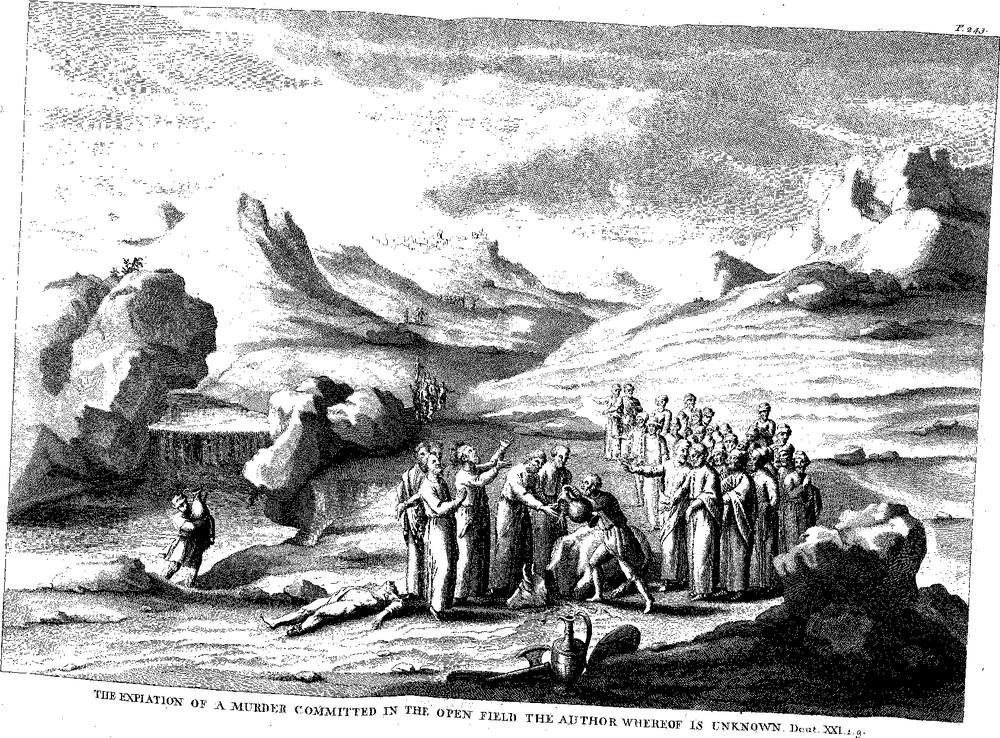
When a dead Body was found in the Fields, of a Person that had been slain by a Murderer unknown, Moses commanded, Deut. xxi. 1, 2,—8.that the Elders and Judges of the neighbouring Places should resort to the Place, and examine what City was nearest to it. The Elders of this City were to take a Heifer, which had never yet bore the Yoke, and were to lead it into some rude and uncultivated Place, which had not been plowed or sowed, where they were to cut the Throat of the Victim; after which the Priests of the Lord, with the Elders and Magistrates of the City, were to come near the dead Body, and washing their Hands over the Heifer that had been slain, they were to say: “ Our Hands have not shed “ this Blood, nor have our Eyes seen it “ shed. Lord be favourable to thy People “ Israel, and impute not to us this Blood, “ which has been shed in the midst of our “ Countrey.” This whole Ceremony may inform us, what Idea they had of the Heinousness of Murder, and how much Horror they conceived at this Crime; and also the Fear they were in, that God might take Vengeance for it on the whole Countrey: And of the Pollution that the Countrey was supposed to contract, by the Blood that was spilt in it, unless it were expiated, or revenged upon him that was the Occasion of it; if he should happen to be discovered.
MURMURING. A Complaint made for some Wrong pretended to have been received. St. Paul forbids all Murmuring, which was so fatal to the Israelites that murmured in the Wilderness. Neither murmur ye, as some of them murmured, and were destroyed of the Destroyer. And the Wise-man, Therefore beware of Murmuring, Wisdom i. 11.which is unprofitable, and refrain your Tongue from Backbiting; for there is no Word so secret that shall go for nought, and the Mouth that belyeth slayeth the Soul. And indeed God severely punished the Hebrews that murmured in the Desart. He was more than once upon the Point of forsaking them, and even of destroying them, had not Moses stood in the Gap, and appeased his Anger by earnest Prayer. They murmured at The Graves of Lust, and God sent them Quails for Food; but hardly was this Meat out of their Mouths, but the Wrath of the Lord was kindled against them, and he destroyed three and twenty Numb. xi. 33, 34. Ps. lxxviii. 30.Thousand of them. They murmured again after the Return of the Spies, that were sent to explore the promised Land; and the Lord punished them by depriving them of the Happiness of ever seeing that Land, and condemned them to die in the Wilderness. They were again punished for murmuring Numb. xiv. 30, 31, &c.again, by the winged Serpents that God sent against them, which killed a great Number of them. The Murmuring of Miriam, the Sister of Moses, was punished Numb. xxi. 4, 5, 6, &c.by a Leprosie that seized her whole Body, and obliged her to abide seven Days without Numb. xii. 1, 2, 3, &c.the Camp. Lastly, the Murmuring and Rebellion of Korah, Dathan and Abiram, was chastised in a still more terrible Manner: The Earth opening and swallowing up the Authors of the Sedition, and Fire consuming their Accomplices.
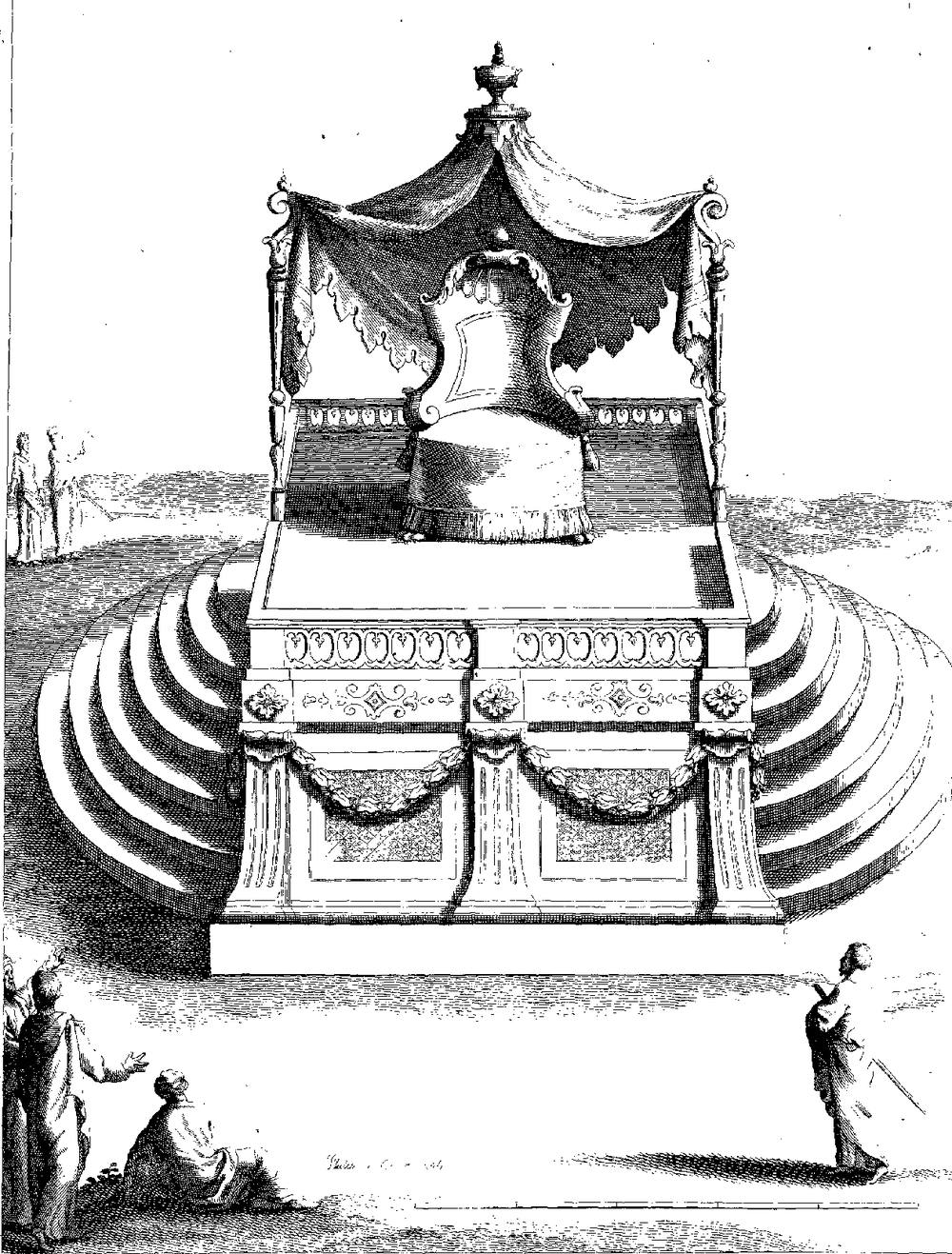
MUSACH. This Term signifies literally a Veil or CoveringNumb. xvi. 3, &c., or a Work of cast Metal22. There is a great Variety of Opinions concerning the proper Signification of Musach of Judah, that Manasseh caused to be uncovered at the Approach of the King of Babylon; and of the Musach of the Sabbath that Ahaz caused to be turned towards the Temple, for Fear of the King of Assyria. Some have thought it was a Veil, that covered the Courts of the Temple; others that it was a Tent, wherein the Priests rested themselves in the Temple, when their Week was out; others that it was a Chest wherein they threw their Offerings for the Repairs of the Temple. Our Opinion is, that it was the Scaffold of Brass made by Solomon, and placed in the Temple, upon which he stood 2 Chron. vi. 13.upon Festival 1 Cor. x. 10.Days. The same Name was given to the Scaffold upon which a Priest ascended on great Solemnities, to read the Law to the People.
2 Kings xi. 4.Abaz fearing that King Tiglath-pileser should come to Jerusalem, and take away this Scaffold, which was very valuable both for its Matter and Form, he caused it to be taken away from its Place, and put into some secret Part of the Temple. Manasseh upon a like Occasion tore off the Plates of Brass with which it was covered. The High -priest Jehoiada, desiring to have young Joash acknowledged as King, caused Guards to be set about him in the Musach that was in the Temple. The Prince was seated upon the Scaffold, and the Guards placed round about.
MUSHI, or Musi, Son of Merari, Chief of the Family of the Levites named Mushites. 1 Chron. vi. 19. Numb. iii. 33.
MUSICK. The antient Hebrews had a strong Inclination to Musick and musical Instruments. They used it in their Ceremonies of Religion, in their publick and private Rejoycings, at their Feasts, and even in their Mourning. We have in Scripture Canticles of Joy, of Thanksgiving, of Praise, of Mourning; Epithalamiums, or Songs composed on the Occasion of some famous Marriages; as the Song of Songs, and Psalm xlv, which are thought to have been composed to celebrate the Marriage of King Solomon. Also mournful Songs, as those that David composed upon the Death of Saul and Abner, and the Lamentations of Jeremiah upon the Death of Josiah; Psalms to celebrate the Accession of a Prince to his Crown, as Psalm lxxii. Deus judicium tuum Regi da. Songs of Victory, Triumph, and Thanksgiving, as that which Moses sung after passing the Red-Sea, that of Deborah and Barak, and some others. Lastly, the Book of Psalms is an ample Collection of different Pieces of Musick, composed upon all Sorts of Subjects by inspired Authors. We shall say nothing here of the Hebrew Poetry, nor of the Nature of the Verse of these divine Hymns, because we shall speak of it elsewhere. See Poetry.
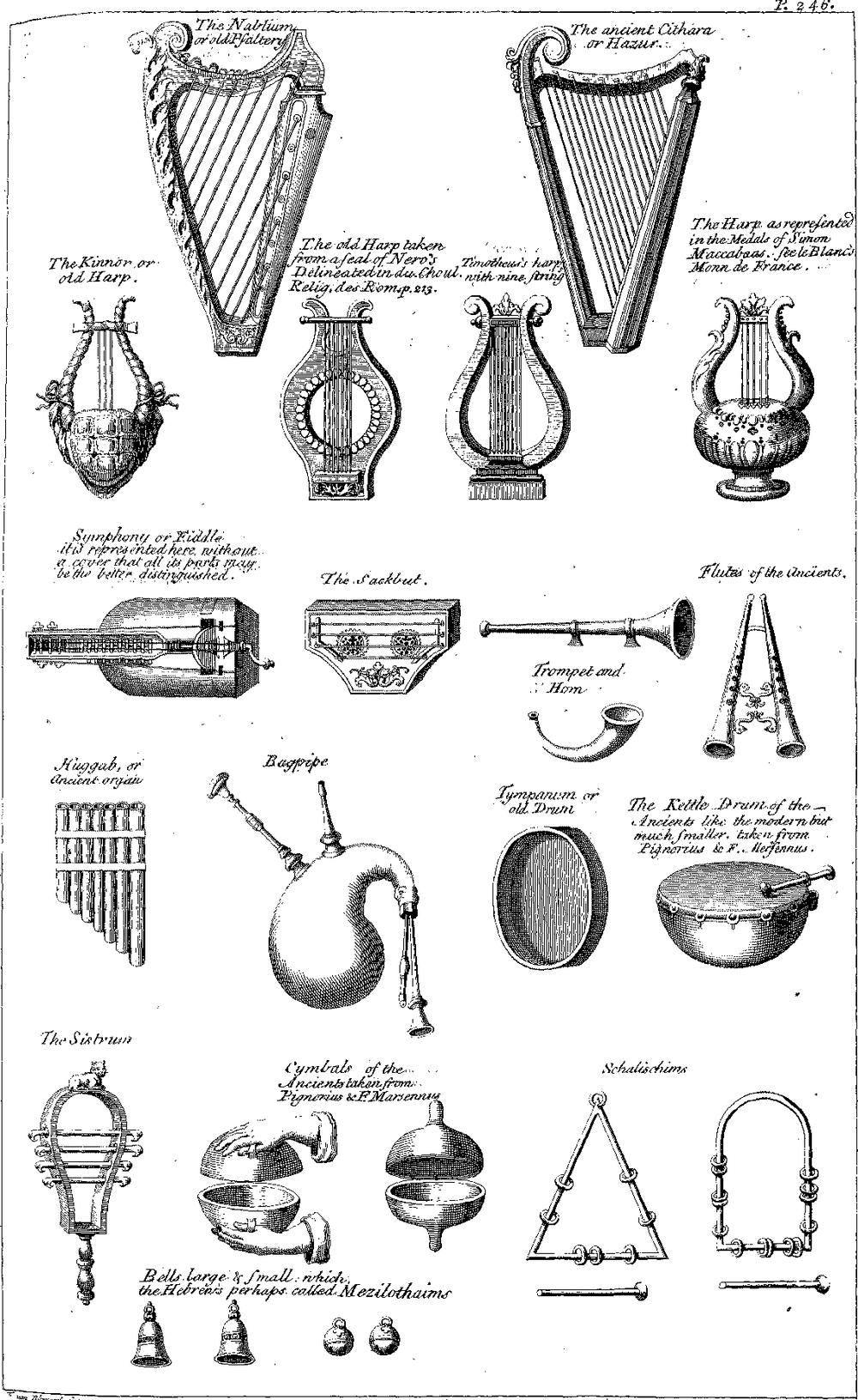
Gen. iv. 21.Musick is very antient in the World. Moses tells us of Jubal, who lived before the Deluge, and was the Father or Master of those who played upon the Kinnor, and the Hugab. Now the first of these manifestly signifies the Harp, and the other the antient Organ, that is, a kind of Flute composed of several Pipes of a different Bigness, joined to one another. Laban complains that his Son-in-Law Jacob had left him, without bidding him farewell, and
without giving him an Opportunity of sending him away, with Mirth and with Songs, Gen. xxxi. 27.with Tabret and with Harp. Moses having passed over the Red-Sea, composed a Song, and sung it with the Men, while Miriam his Sister sung it with Dancing, and playing upon Instruments, at the Head of the IsraelitishExod. xv. 1,—20. Numb. x. 2. Women. This Legislator caused Silver Trumpets to be made, to be sounded upon solemn Sacrifices, and on religious Festivals. David, who had a great Taste for Musick, seeing that the Levites were numerous, and were no longer employed as formerly, in carrying the Boards, the Veils, and Vessels of the Tabernacle, its Aboad being fixed at Jerusalem; he appointed a great Part of ‘em to sing and play upon Instruments in the Temple.
Asaph, Heman, and Jeduthun were the Chief of the Musick of the Tabernacle under David, and of the Temple under Solomon. Asaph had four Sons, Jeduthun six, and Heman fourteen. These twenty four Levites, Sons of the three great Masters of the Musick of the Temple, were at the Head of twenty four Bands of Musicians, which were very numerous, and served in the Temple by Turns. Their Number there was always great, but especially at the great Solemnities. They were ranged in Order about the Altar of Burnt-Sacrifices. Those of the Family of Kohath were in the Middle, those of Merari at the left, and those of Gershom’s Family on the right Hand. As the whole Business of their Lives was to learn and practise Musick, it must be supposed that they understand it perfectly well; whether it were vocal or instrumental Musick. The Lord had abundantly provided for their Maintenance, and nothing could hinder them from being perfect in their Art, and compleat Masters of it.
The Kings also had their particular Musick. Asaph was chief Master of Musick to King David. He was, as the Scripture says, A Prophet at the King’s Hand. And 1 Chron. xxv. 2. Vulgat.Barzillai said to David23, Can I hear any more the Voice of singing Men and singing Women? Even in the Temple, and in the Ceremonies of Religion, Female Musicians were admitted as well as Male, who generally were the Daughters of the Levites. Heman had fourteen Sons and three Daughters, 1 Chron. xxv. 5.who all understood Musick. The ninth Psalm is addressed to Benaiah, Chief of the Band of young Women that sang in the Temple. Ezra in his Enumeration of those whom he brought back with him from the Captivity, reckons up two Hundred singing Ezra ii. 65. Nehem. vii. 67.Men and singing Women. The Chaldee Paraphrast upon Chap. ii. v. 8. of Ecclesiastes, where Solomon says that he gat Singing-Men and Singing-Women, understands it of singing Women of the Temple. In the first Book of Chronicles xv. 20. it is said, in the Hebrew, that Zechariah, Aziel, and Shemiramoth, presided over the seventh Band of Musick, which was that of the young Women.
As to the Nature of their Musick, we can judge of it only by Conjecture, because it has been a long Time lost, and out of Use. But this is very probable, that it was only a Mixture of several Voices, of which all sung together in the same Tune, every one according to his Strength and Skill; and that there was not among them those different Parts, and that Combination of several Voices and Tunes, which constitute our Concerts, or compounded Musick. It is very probable also, that generally the Voices were accompanied by the Instrumental Musick. But if we may draw any Conclusions in Favour of the Excellence of their Musick, from its wonderful Effects, its Magnificence, Majesty, and the fine Sentiments contained in their Songs; we must allow that their Musick was very excellent and perfect. Every one knows, that David by his Skill upon the Harp used to dispel the melancholy Vapours to which Saul was subject, and drove away the Evil Spirit that disturbed him. The same Saul, having sent Messengers to apprehend David, who had withdrawn himself to Naioth in Ramah, and was there in the midst of a Company of Prophets; the Messengers had no sooner heard the Sound of the Instruments of the Prophets, who were there singing and playing, but they were immediately transported (as it were) by a divine Enthusiasm, and began to do the same themselves. Saul sent a 1 Sam. xvi. 23. 1 Sam. xix. 23, 24.second and a third Company after them, who did in the same Manner. Lastly this Prince came thither himself, was seized in the same Manner by the divine Spirit, and began to have all the Motions of those that are inspired, even before he came to the Place where the Prophets were assembled. The Prophet Elisha finding himself a little disturbed, caused a Minstrel to be sent for to calm his Spirits, and to put him into a Temper fit to receive the Impression of the divine Spirit. The Reader may have Recourse to 2 Kings iii. 15.our Dissertation upon the Musick of the Hebrews, at the Beginning of the second Tome upon the Psalms.
The Musical Instruments of the antient Hebrews are, perhaps, what has been hitherto least known, of any Thing in the Text of the holy Scriptures. The Rabbins themselves know no more in this Matter, than such Commentators as were least acquainted with the Affairs of the Jews.
One can hardly read without Pity and Contempt, what they generally say upon certain unknown Terms, that are found in the Titles of some of the Psalms, and which at all Adventures they take for Instruments of Musick. Such are for Example, the Words Neginoth, Sheminith, Nebiloth, Shiggaion, Gittith, Muth-labben, Michtam, Aijeleth, Shahar, Shothannim, Alamoth, &c. But if we take a nearer View of this Matter, we shall find that the Hebrews had a much smaller Number of musical Instruments, and which may all be reduced to one of these three Heads. 1. Stringed-Instruments. 2. Wind-Instruments, or several Sorts of Flutes, and 3. different Sorts of Drums or Tabours.
Stringed-Instruments were the Nebel24, the Psaltery, or Psanneterim; and probably these three Instruments were much the same Thing. They have some Relation to the Harp and the antient Cithara, or the Hashur25, that is to say, an Instrument with ten Strings. Both of ‘em were pretty near of the Figure of a Capital Δ; but the Psalterion or Nablium was hollow above, and was played upon below; whereas the Cithara, or Instrument of ten Strings, was played upon above, and was hollow below. Each of ‘em was played upon with a Bow, and with the Fingers.
The Chinnor26, or antient Lyra, had sometimes three, sometimes six, and sometimes nine Strings. These Strings were strained from Top to Bottom, and sounded upon a hollow Belly that was at Bottom. It was played upon with the Fingers, or with a Bow.
The antient Symphony, or Dulcimer, was an Instrument very nearly approaching to our old one.
The Sackbut, or Sambuca, was a stringed Instrument, which we believe was very near of the Form of the modern Psaltery. And these are all the stringed Instruments, that we find mentioned in Scripture.
There may be also several Sorts of Trumpets and Flutes, of which it is very difficult to ascertain the exact Form. What is most observable of this Kind, is the antient Organ, called in Hebrew, Huggab27, which is probably nothing else than those antient Flutes, composed of several Pipes of unequal Thickness and Length, which gave an harmonious Sound when they were blown in, by moving them successively under the lower Lip.
The Drums were of several Sorts. The Hebrew Word Tuph28, from whence comes Tympanum, is taken for all Sorts of Drums, Tabors, or Kettle-Drums. The Word Tzaltzelim29 is commonly translated in the Septuagint, and in the Vulgate, by Cymbala, which was an Instrument of Copper, of a very shrill Sound, made in Form of Caps, which were held in each Hand one, and struck against each other. Later Interpreters by Tzaltzelim understand the Sistrum, which was an Instrument formerly much used in Egypt. It was of an oval Figure, or a Semicircle extended in Form of a Belt, crossed by some Brass Rods or Wires that moved in Holes, in which they were stopped by their Heads or Knobs.
The Hebrew Text speaks of an Instrument called Shalishim30, which the Seventy have translated by Cymbala, and St. Jerome by Systra. ‘Tis found only in one Place of Scripture, viz. 1 Sam. xviii. 6. The Word Shalishim should insinuate, that it was of a triangular Form, and might very well be that antient triangular Instrument, in which were several Rings moved about with a Stick, and which gave a shrill Sound.
Lastly, there is Mention made of Metzilothaim31 which was an Instrument of Copper, and gave a sharp and shrill Sound. ‘Tis commonly translated by Cymbala, but others translate it by Tintinnabula, or little Bells. The Prophet Zechariah says32, that the Time should come when they should write upon the Metziloth [or Bells] of the Horses, Holiness to the Lord: Which may incline one to think, that this Word signifies a Bell; since we know that formerly they used to put Bells upon Horses that went to Battle, in Order to accustom them to Noise. We have treated of the Instruments of Musick of the antient Hebrews, before the second Volume of the Commentary upon the Psalms. We have also said something of each of the principal Instruments under their respective Articles.
Matth. iii. 31, 32.MUSTARD, Sinapi. Jesus Christ compares the Kingdom of Heaven to a Grain of Mustard-Seed, which is the least of all Grains, and which being sown upon good Land, becomes a great Tree; so that the Birds of the Air come and sit upon its Branches. This would seem to be incredible, if we did not know, that in Palestine there grew Plants and Shrubs, very much larger than in most other Countries. The Talmuds of Jerusalem and Babylon make Mention33, that one Simon had a Stock or Stem of Mustard, which grew so high and strong, that a Man might climb
up into it without breaking it. Mention is there made also of another Mustard Plant, which had three Branches, one of which served as a Shade to some Potters, who worked under it in the Summer. This Branch alone, as they say, afforded three Barrels of Mustard.
MYA, a Town belonging to the Tribe of Gad, beyond Jordan. Joseph. Antiq. l. xx. c. i. p. 642..
Perhaps this may be the same as Zia mentioned by Eusebius,34 and which he places to the West of Philadelphia, and five Miles from it.
Acts xxvii. 5.MYNDUS, a Maritime City of Caria, 1 Macc. xv. 23.
MYRA, a City of Lycia, where St. Paul embarked on Board a Vessel of Alexandria, in Order to go to Rome. The Latin Text of the Acts has Lystram instead of Myram, as it is in the Greek. But this must be a Fault; for Lystra is in Lycaonia, and not in Lycia. Besides Lystra was no Sea-port Town.
MYRICA. Jeremiah35 makes Use of this Term in two Places. Quasi myrica in deserto36. The Hebrew reads Aroer, which signifies an useless Weed, that grows of it self in uncultivated Places. But they are not agreed about its Nature. Myrica, or Agrio-myrica, signifies wild Tamarisk. Others translate it by Juniper, others by Rosemary. Symmachus, an useless Shrub. The Tamarisk, or Myrica, is a Tree of a moderate Height, whose Leaves are small, long, round, thin, approaching to those of a Cypress, of a pale green Colour. Its Flowers grow in Clusters, small, purple without, white when they are blown, each composed of five Leaves. Its Fruit is downy, and contains blackish Seeds
MYRRHE, Myrrha, in Hebrew, Mor37, a Sort of Gum, which comes from a Shrub that is common in Arabia, of about the Height of five Cubits, of a hard Wood, the Trunk of which is defended by Thorns. The Scripture distinguishes two Sorts of Myrrhe; one is Myrrha electa, literally, Myrrhe of Liberty, which distils of it self, and without Incision. This Sort is the best of all. Pliny38 speaking of the Tree that produces Myrrhe, says, Sudant sponte, priusquam incidantur, stacten dictam, cui mella praefertur. This is the Myrrhe which is also called Stacte, the other is simple and common Myrrhe. It was employed in Perfumes, and embalming dead Bodies, to prevent their Corruption. The Magi that came from the East, to worship our Saviour at Bethlehem, made him a Present of Myrrhe.
Matth. ii. 11. Mark xv. 23.Mention is made in the Gospel of Myrrhatum Vinum, Wine mingled with Myrrhe, which they offered to Jesus Christ at his Passion, to take from him, as ‘tis thought, the too quick Sence of Pain. Among the Hebrews they were used to give to those that were executed, such Sorts of stupifying Liquors39. Some think that the Myrratum Vinum of St. Mark, is the same as the Vinum felle mixtum, the Wine mingled with Gall, mentioned by St. Matthew; but others distinguish between them. They gave our Saviour Wine mingled with Myrrhe, out of a Sentiment of Compassion, to take away from him a too lively Sense of Pain: But the Soldiers out of mere Cruelty and Inhumanity, mixed Gall with the Wine they offered him; for which Reason he refused to drink it. Or lastly, St. Matthew writing in Syriack, made Use of the Word Marra, which signifies Myrrhe, Bitterness, or Gall. The Greek Translator may have taken it for Gall, and St. Mark for Myrrhe. But however, the Vinum Myrrhatum was in much Esteem among the Antients. Pliny says40, Laudatissima apud priscos vina erant, Myrrhae odore condita. The Laws of the twelve Tables forbad to pour it upon the Dead. Ne murrhata potio mortuo inderetur.
MYRTLE, in Latin, Myrthus, in Hebrew, Chadas, is taken for the Shrub that bears the Myrtle Flowers, and for the Flower it self, and for the Perfume that is extracted from thence. Myrtetum is a Place planted with Myrtles. This Shrub was common in Judaea. Ezra41 sent the People into the Fields to fetch Myrtle-branches, Palm, and Olive-branches, to make Tents at the Feast of Tabernacles.
MYRUM. This Word is Greek, and signifies a Perfume in General, or an Oil wherewith they perfumed themselves, Judith x. 3. Unxit se myro optimo. The Chrism used by the Romish Church in Baptism, is by the Greeks called Myrum.
MYSIA, a Province of Asia minor, between Bithynia to the North, Troas to the South, Phrygia to the East, and the Hellespont to the West. St. Paul preached in this Countrey, Acts xvi. 7, 8.
MYSTERY. A Word which comes from the Greek, Mysterion, and which in this Language signifies properly a Secret. And this is derived from Myo, I shut up, and Stoma, the Mouth, as much as to say, our Mouths should be shut about these Matters. Or it may be derived from the He brew,
Satar, to hide, whence Mystar, a Thing concealed. Denudare amici mysteria, desperatio animæ, says the wise Man, Ecclesiasticus xxvii. 16. When a Man has betrayed the Secret of his Friend, he is unworthy of any Credit for the Time to come. Ei, qui revelat mysteria, & ambulat fraudulenter, — ne commiscearis. Have no Correspondence with him that betrays the Secrets of his Friends, and who walks deceitfully, Prov. xx. 19.
All Religions true or false have their Mysteries, that is, certain Things that are not to be divulged, or exposed indifferently to every Body; certain Secrets, which are known only to those who have been initiated into that Religion. The Pagans had their Mysteries, but they were Mysteries of Iniquity, shameful Mysteries, that were concealed only because they would have rendered their Religion contemptible, ridiculous, and odious. If Men of Sense and Honour had known what was practised in the secret Mysteries of certain false Deities, they would have abhorred them. Daniel discovered the Secrets of the Babylonian Priests, who made the People believe, that Bel could eat, and that the Dragon was a God. The sacred Books often speak of the infamous Mysteries of Astarte, Adonis, Priapus, wherein a Thousand infamous Actions were committed, and where the most shameful Crimes were concealed under the Veil of Religion. Baruch speaks of Prostitutions that Baruch vi. 42, 43.were practised in Honour of Venus at Babylon. The whole Religion of the Egyptians was mysterious. But these pretended Mysteries were invented afterwards, to conceal the Folly and Vanity of it. They could not vindicate, for Example, the Adoration that they paid to Brutes but by saying, that the Gods had sometimes concealed themselves under these Shapes. In the Maccabees Mention is 1 Macc. vi. 7. 2 Macc. vi. 7.made of the Mysteries of Bacchus, and of the Ivy that was imprinted upon every one that was initiated therein, and of the Garlands of Ivy that were wore by those that assisted at these Ceremonies. Asa King of Juda would 1 Kings xv. 13.not suffer the Queen his Mother to continue to preside over the Mysteries of Priapus. No Doubt can be made but that they gave mysterious and secret Reasons for the Worship that was paid to Moloch, and for the human Sacrifices that were offered to him. ‘Twas perhaps a perverse Imitation of Abraham’s intended Sacrifice of his Son Isaac. The Phœnicians assign a Reason not unlike this, for those cruel Sacrifices that they made to Hercules and to Saturn. See Porphyry in Eusebius’s Preparatio Evangelica.
The Religion of the Jews was full of Mysteries. The whole Nation was a Mystery, according to St. Austin42. It represented the People of Christ, and the Christian Religion. Whatever happened to them, whatever they put in Practice, all that was commanded or forbidden them, 1 Cor. x. 11.was figurative according to St. Paul. Their Sacrifices, their Priesthood, their Purifications, their refraining from certain Sorts of Food, included Mysteries which have been explained by Jesus Christ and his Apostles. The Passage over the Red-Sea was a Symbol of Baptism. The brazen Serpent was a Mystery that represented the Cross and Death of Christ. Sarah and Hagar, Isaac and Ishmael, denoted the two Covenants. The Tabernacle and its Vessels insinuated the Worship that God was to receive in the Christian Church. The Priesthood of Aaron has been admirably explained by St. Paul of the Priesthood of Jesus Christ, and of that of his Church. St. Barnabas has unfolded the Secrets contained in the Prohibition of certain Foods. Jesus Christ himself has discovered the Mystery to us, of Jonas’s being confined for three Days in the Whale’s Belly. And that of lifting up the Brazen Serpent in the Wilderness. That of Manna that represented the Sacrament of his Body and Blood. That of the Union of Adam and Eve, which contained the Mystery of the Christian Marriage. That of the Temple of Jerusalem, to be destroyed and rebuilt in three Days, prefigured his Death and Resurrection. The Reprobation of the Jews, and the Adoption of the Gentiles, was intimated in an hundred Passages of Scripture; for Example, by Agar and Sarah, by Ishmael and Isaac, by Ephraim and Manasseh, by Saul and David, by David and his Brethren, by Absalom and Solomon, and even by Moses and Aaron, who were not permitted to enter into the Land of Promise.
The Prophecies concerning the Person, the Coming, the Characters, the Death and Passion of the Messiah, are to be found in a Multitude of Places in the Old Testament, but after a figurative and mysterious Manner. The Actions, the Words, the Life of the Prophets, were a continual and general Prophecy, which was concealed from the Eyes of the People, and sometimes from the Prophets themselves, and was not explained and discovered, till after the Birth and Death of Jesus Christ; and these Mysteries were dispensed in so wonderful an Œconomy, and by so wise a Providence, that the first served as a Foundation for the second, and the succeeding gave new Light to those that went before. They still improved in Clearness and Evidence, and the Holy Ghost dispensed them by Measure,
and in due Degrees. Daniel is more explicite than the Prophets before him; Haggai, Zechariah, and Malachi, speak of the Coming, of the Death, and of the Priesthood of Jesus Christ, and of the Calling of the Gentiles, after a more plain and distinct Manner than the other Prophets before them.
The Mysteries of the Christian Religion, as the Incarnation of the Word, his hypostatical Union, with his human Nature, his miraculous Birth, his Death, Resurrection, Ascension, his real Presence in the Eucharist, the Predestination and Reprobation of Men, the Grace of Jesus Christ, and the Manner of its Operation in our Hearts, the Virginity of the Virgin Mary, both before and after her bringing forth, the Resurrection of the Dead: In a Word, the Articles of Faith contained in the Apostles Creed, and the Mysteries revealed to us both in the Old and New Testament, are the Objects of the Faith of all true Christians.
The Word Mystery is also taken for Secrets of an higher Order, and which are Supernatural; as those the Knowledge of which God has reserved to himself, and of which he has sometimes communicated the Knowledge to his Prophets and Friends. Thus Daniel gives to God the Name of Revealer of Mysteries: Dominus Regum, & revelans mysteria. He tells King Nebuchadnezzar, that there is none but God that reigns in Heaven, who can reveal hidden Mysteries, and Things to come. And our Saviour says to his Disciples in the Gospel of St. Matthew, that they are happy because God has revealed to them the Mysteries of the Kingdom of Heaven. St. Paul often speaks of the Mystery of the Gospel, of the Mystery of the Cross of Christ, of the Mystery of Christ which was unknown to former Ages, of the Mystery of the Resurrection to come, &c. Mystick Babylon, the great Harlot, had written upon her Forehead, Mystery, to shew that she did not represent any particular City, nor any Woman, but a corrupted and idolatrous People.
Lastly, the Word Mystery in the Greek is equivalent to Sacramentum in Latin. It expresses the Sacraments and Mysteries of the Christian Church, and chiefly the Eucharist, which is the most sacred and the most sublime of all our Mysteries. In Scripture Sacramentum is put barely for a Secret43, a Thing that is hidden: But it is often put for Mystery in the New Testament. God has made known unto us the Mystery of his Will; his Incarnation, his Coming, his Gospel; Sacramentum voluptatis suæ. St. Paul says, that the Mystery of the Vocation of the Gentiles was revealed to him; and speaking of Christian Marriage, he says, it is a great Mystery in Jesus Christ and his Church. Sacramentum hoc magnum est, (the Greek says Mysterium magnum) ego autem dico in Christo & in Ecclesiâ.
These then were called Mysteries, the Doctrine of the Gospel, the Tenets of Christianity, and the Sacraments of the Church; not only because they included Secrets which had not been known, if the Son of God and his Holy Spirit had not revealed them to Believers, but also because they were not revealed indifferently to every Body. The Advice of Jesus Christ to his Apostles was in this Case put in Practice; Give not that which is holy unto the Dogs, neither cast ye your Pearls before Swine. They preached the Gospel only to those, who seriously desired to be instructed in it; nor did they presently discover to ‘em all the Mysteries of Religion, but in Proportion as they became capable to receive them, and when they had intirely resolved to be baptized. The Preachers in their Sermons, and the Ecclesiastical Writers in their Books, did not fully express themselves upon all the Mysteries. They said enough to be understood by the Faithful, but the Pagans could not comprehend their Discourses. This wise Precaution continued a long while in the Church. The Pagans also put in Practice the same Reserve, in Respect of many of the shameful and ridiculous Mysteries of their false Religion. But the Secrecy that was observed concerning our Mysteries, was chiefly founded upon their superior Excellence and Sublimity, which made them inaccessible to the human Understanding, unless it was assisted by the Light of Faith.
MYSTICK. The mystical Sense of the Scriptures is that which is derived from the Terms or Letter of the Scripture, after and besides their literal Signification. For Example, Babylon signifies literally a City of Chaldæa, the Habitation of Kings that were Persecutors of the Hebrew, and overwhelmed in Idolatry and Wickedness. According to the mystical Sense, Babylon signifies a corrupted World, Sinners, wicked Persons persecuting good Men. St. John in the Revelations gives the Name of Babylon to the City of Rome, then Pagan and an Enemy to the Truth. So Jerusalem is literally put for Jerusalem a City of Judæa; but mystically it signifies the heavenly Jerusalem, which is the Habitation of the Saints. The Word Serpent as to the Letter, signifies a venomous Reptile; and in a mystical Sense it signifies the Devil, the old Serpent that tempted Eve.
NAAM, or Nahām, Son of Caleb, 1 Chron. iv. 15.
I. NAAMAH, or Noema, Daughter of Lamech and Zillah, and Sister of TubalcainGen. iv. 22.. ‘Tis believed that she found out the Art of spinning Wool, and of making Cloth and Stuffs. She is thought to be the same as Minerva, who is sometimes called Nemanoum by the Greeks44.
II. NAAMAH, an Ammonitess, Wife of Solomon, and Mother of Rehoboam, 1 Kings xiv. 21.
III. NAAMAH, a City of the Tribe of Judah, Josh. xv. 41.
IV. NAAMAH, or Naamath, a City from whence came Zophar, one of Job’s Friends, Job ii. 11.
I. NAAMAN, Son of Benjamin, Gen. xlvi. 21.
II. NAAMAN, Son of Bela, and Grandson of Benjamin, 1 Chron. viii. 4. He was Head of the Family of the Naamites, in the Tribe of Benjamin, Numb. xxvi, 40.
III. NAAMAN, General of the Army of Ben-hadad, King of Syria; he was in great Credit in the Court of the King his Master, because by his Means the Lord had saved Syria. Naaman had in his House a young Israelitish Woman, who happened to say to her Mistress, “Would to God “that my Lord had been with the Prophet “Elisha, who is at Samaria; he would “soon have cured him of his Leprosie.” For Naaman was a Leper, and there was then no natural Remedy found out for this Distemper. Naaman having heard these Words, went immediately to Ben-hadad, and desired Leave of him to go to Samaria, to see the Prophet Elisha. The King consented to it, and writ a Letter by him to the King of Israel in these Terms. “When “you shall have received this Letter, you “will know, that my Desire is you should “cure Naaman the General of my Army “of his Leprosie k.” Jehoram King of Israel, Son of Ahaziah, having received this Letter, rent his Clothes and said, “Am “I a God, that I can kill and make alive?” You see how Ben-hadad seeks a Pretence to fall out with me. But Elisha being informed of what had happened, sent Word to Jehoram; “Let “this Man come to me and he shall know “that there is a Prophet in Israel.” Naaman came therefore with this Chariot and Horses, and stopped at the Door of Elisha’s House; whether it were out of Respect to his Person, or that having the Leprosie he was impure, and not fit for the Conversation of sound Persons. Elisha without going out of his House sent to tell him, that he must go wash himself seven Times in Jordan, and he should be cured. Naaman being very angry, began to go his Way, saying, “I thought he would have “come out to me, that he would have “called upon the Name of his God, that “he would have touched me, and so have “cured me. Have we not at Damascus “the Rivers Abana and Pharpar45, that “are better than all the Rivers of Israel, “that I may wash in and be healed?” As he was turning away in great Wrath, his Servants said to him; “Had the Prophet “enjoined you some hard Thing, you would “readily have obeyed him; how much “rather should you do it, when he only “bids you wash and be clean? Naaman was persuaded, went to Jordan, washed himself seven Times, and was perfectly cured.
Then he came back again to the Man of God, and told him; “Now I know “certainly that there is no other God but “the Lord: I intreat you to receive a Present at my Hand.” But Elisha would not take any Thing from him, how importunate soever he was. Naaman seeing that he could not prevail with him, said to him; I beseech you then to permit me to carry home with me, two Mules Loading of the Earth of this Country; for from henceforward I shall offer Sacrifice to no other God, but the God of Israel. Elisha readily permitted him, seeing his great Faith and Regard for the Lord, which made him think that the Earth of Syria was defiled, and that he could not offer any Sacrifices agreeable to God, but upon Earth that was holy, and taken out of the Land46
of Israel. This Piece of Devotion is antient among the Jews, and even among Christians. Benjamin de Tudela says, that the Jews of Nahardea, in the Kingdom of Persia, built their Synagogue with Earth and Stones, that were fetched on Purpose from Jerusalem. We are assured that the Empress Helena, Mother of Constantine the Great, caused a great Quantity to be brought to Rome, which she put in the Church of the Holy Cross, surnamed in Jerusalem. St. Austin47 and Gregory of Tours48 may supply us with several other Examples of the same Kind.
But to return to Naaman; speaking to Elisha, he added these Words. In this Thing the Lord pardon thy Servant, that when my Master goeth into the House of Rimmon to worship there, and he leaneth on my Hand, and I bow my self in the House of Rimmon: When I bow down my self in the House of Rimmon, the Lord pardon thy Servant in this Thing. And he said unto him, go in Peace. This Passage has given Occasion to many Scruples. The greatest Part of Commentators are of Opinion, that Naaman having sufficiently declared he intended to worship the God of Israel only, he asks Leave from Elisha to continue those external Offices to his Master Ben-hadad, that he had been used to render him, when he entered into the Temple of Rimmon; but not to adore Rimmon, whose idolatrous Worship he now abhorred: And that Elisha suffered him to continue to accompany the King his Master into the Temple of this Idol, provided however that he should pay him no Worship. The Rabbins pretend, that a Proselyte of Habitation, such as Naaman was, was not obliged to refrain from Idolatry out of the Land of Israel; and that if he should fall into the Worship of false Gods in a strange Land, this would not be imputed to him as a Fault.
Others49 in great Numbers translate the Hebrew50 by the Time past, in this Manner. In this Thing the Lord pardon thy Servant, that when my Master went into the House of Rimmon to worship there, and he leaned on my Hand, and I bowed my self in the House of Rimmon: When I bowed down my self in the House of Rimmon, the Lord pardon thy Servant in this Thing. And he said unto him, go in Peace. Where it may easily be perceived, that Naaman does not ask Leave to accompany his Master, when he shall go hereafter into the House of Rimmon, but he asks Pardon for having done it heretofore. He mentions only this Sin, and asks Pardon for it, because Idolatry in some Measure includes all other Crimes; and he chiefly insists upon this, in the Declaration that he makes to the Prophet, that from henceforward he would only worship the God of Israel. We have treated on this Matter at full Length in a particular Dissertation before our Commentary on the second Book of Kings, and in the Supplement to the same Book, p. 127. at the End of our last Tome upon the New Testament.
Naaman returned into his own Country very joyful at the Answer given him by the Prophet; but hardly was he got out of Sight, or had gone the Length of one Hundred and twenty Feet51, but Gehazi displeased that his Master would take nothing from Naaman, runs after him to ask him for something. Naaman seeing him, presently alights from his Chariot, and asked him what he wanted with him. Gehazi tells him, My Master has sent me to acquaint you, that two young Men of the Sons of the Prophets are just now come to him from Mount Ephraim; he desires you to give him a Talent, and two Changes of Raiment for them. The Talent (of Silver) is worth of our Money about 342 Pounds Sterling. Naaman answered him; you had better take two Talents, and constrained him to receive them, and also sent two of his Servants to carry them for him. Towards Evening he took the two Talents into the House, and sent back Naaman’s Servants. Gehazi then coming to attend Elisha, the Prophet asked him where he had been. Gehazi answered, that he had not been out any where. But Elisha said to him, Went not mine Heart with thee, when the Man turned again from his Chariot to meet thee? You intend to buy Fields, and Vines, and Olive-trees with this Money, but you shall also have the Leprosie of Naaman, which shall cleave to you and your Race for ever. And immediately Gehazi became all over white with the Leprosie. See Gehazi. The Scripture after this makes no further Mention of Naaman.
NAARAI, or Hezrai, one of the valiant52
Men of David’s Army, 1 Chron. xi. 37.
NAARAN, or Naarath, or Noran, a City of Ephraim. See 1 Chron. vii. 28.
NAARATH, a City of the Tribe of Ephraim, Josh. xvi. 7. Eusebius53 places the City of Naarath about five Miles from Jericho. This is probably the same as Neara, mentioned by Josephus54, and from whence he says they brought the Waters which watered the Palm-Trees of Jericho. Perhaps this also may be the same as Naaran just now mentioned.
NABAL, a very rich but very churlish Man, of but little Understanding, of the Tribe of Judah, and of the Race of Caleb, whose ordinary Dwelling was probably at Maon, one of the most southern Cities of Judah, and who had a great Number of Flocks upon Mount Carmel, not far from Maon. This Carmel is very different from the other Mount Carmel, upon the Coast of the Mediterranean Sea, between Dora and Ptolemais. Whilst David was out of Favour with Saul55, he was obliged to withdraw into the Wilderness of Paran, and near to Carmel; where he always took great Care, that none of his Followers should do Nabal any Injury, but rather that they should assist his Shepherds and Herdsmen as much as they could. Being therefore informed that Nabal was come thither to shear his Sheep, he sent ten young Men of his Company to him, to make his Compliments to him, and to ask him civilly for something to refresh himself and Followers. But Nabal answered them, ” Who is ” David, and who is the Son of Jesse? ” We are pestered every Day with Servants ” that run away from their Masters. Shall ” I take the Flesh of my Sheep, and the ” Provisions I have brought for my own ” Servants, and shall I give it away to ” Strangers?” The Men that David had sent went back, and acquainted him with Nabal’s churlish Answer.
Then David in Anger caused four Hundred of his People to arm themselves, and went with a Resolution to put Nabal and all his Family to the Sword. But in the Interim one of Nabal’s Servants having acquainted his Wife Abigail with what had passed, who was a very wise and prudent Woman; and told her also that David’s People had been very useful to ‘em while they were in the Desart of Paran, and that they well deserved that at least Nabal should not affront them, and that it was much to be feared that David, who had the Power in his own Hands, would soon take Revenge for this Insult. Abigail presently prepared Provisions and Refreshments, which she sent to David; and she her self got up upon an Ass, unknown to Nabal, and went to make Excuses to David. She met him coming with his Men armed, with a Resolution of putting the whole Family of Nabal to the Sword; but she found Means by her prudent Discourse so far to work upon him, that he gave Thanks to God for sending her to appease his Anger.
Abigail then returned to Nabal, and found him in his House making a Feast as it were for a Prince. His Heart swelled with Joy, and he had drank so much as to be quite drunk. Abigail said nothing to him till Morning; but after he had slept, she told him of the Danger he had been in. This Account had such Effect upon him, that he became as immovable as a Stone, and his Heart was so possessed with Fear, that he died of it in ten Days. David having heard of his Death, said; ” Thanks ” to the Lord, who has revenged me on ” Nabal, for the outrageous Manner in ” which he has treated me; and who has ” not suffered me to revenge my self, for ” the Injury that had been done me.” Some Time after he sent to demand Abigail in Marriage, which she not refusing, he took her to Wife. Nabal in the Original signifies a Fool or Madman.
NABALLO, a City of Arabia, which the Jews conquered from the Arabians, Joseph. Antiq. l. xiv. c. 2.
NABARA, a Village in Batanea, Euseb. in Nebra.
Isai. lx. 7.NABATHEANS, or Nabathenians, Arabians Descendants from Nabajoth. Their Country is called Nabathæa, and extends from the Euphrates to the Red- Sea56. Not that the Nabatheans are the only Inhabitants of this vast Tract of Land, but they are the principal. Their chief Cities are, Petra the Capital of Arabia Deserta, Medaba, and some others. For the Country may be said to be intirely Desart, and the Nabatheans are at no Trouble in building Houses, or dwelling in Cites, nor any of the other Inhabitants of Arabia Deserta. They look upon this as a kind of Servitude and Baseness, to be tied down to the Earth. The wandering Manner of Life that they lead, with their Wives, Children and Cattle, and the Liberty they enjoy without being accountable to any Body, appears to them to be one of the greatest Blessings of Life. Their chief Substance consists in Cattle. Isaiah promises Jerusalem, that the fat Rams of Kedar and Nebaioth should be brought into the Temple of the
Lord, and offered upon his Altar.
The Nabatheans are hardly known in Scripture, but from the Time of the Maccabees. During the several Wars that the Jews maintained against the Syrians, and while almost all the other Nations about them were against the Hebrews, the Nabatheans alone shewed them Friendship. Judas Maccabæus going to the Assistance of his Brethren in the Country of Gilead, was very well received by the Nabathites57. Some Time after58 Jonathan Maccabæus sent his Brother John to the Nabatheans, to conduct and deposite with them the heavy Baggage of his Army, which was an Incumbrance to him; but the Inhabitants of Medaba, or Nadabatha, took John as he went, slew him, and seized his Carriages. Diodorus Siculus59 places among the Nabatheans the Lake Asphaltites, the Palm-trees and Gardens of Balm that are near there, and the City of Petra. Their Country extended Northward as far as Libanus. Dionysius the Geographer places the Nabatheates at the Foot of Libanus. Josephus says60 that Jonathan Maccabæus being in the Country of Emath, and having drove his Enemies beyond the River Eleuthera, he penetrated into Arabia, beat the Nabatheans, and came to Damascus. Epiphanius61 says, that the Ebionites came chiefly out of the Country of the Nabatheans, and from Paneas.
NABLUM, in Hebrew, Nebel62, an Instrument of Musick among the Hebrews. The Seventy and the Vulgate translate it sometimes by Nablum, and at other Times by Psalterion, or Lyra, or even Cithara. The Nablum was a stringed Instrument, very near of the Form of a Δ, which was played upon by both Hands, and with a kind of Bow. It sounded by Means of a Belly that was hollow above, and was touched below. Our Dissertation may be read, concerning the Instruments of Musick of the antient Hebrews, before the second Tome of the Commentary upon the Psalms.
NABONASSAR, King of Babylon, the same as Baladan, Berodach, or Merodach-baladan, Isai. xxxix. 1. and 2 Kings xx. 12. He is also called Belesis, or Belessus, in Agathias and Alexander Polyhistor. But lastly he is most known by the Name of Nabonassar, given him by Hipparchus, Ptolemy, and Censorinus. He reigned fourteen Years at Babylon, from the Year of the World 3257, to 3272, and had Nabius for his Successor. The Epocha or Æra of Nabonassar, so famous among Chronologers, falls upon the Year 3967 of the Julian Period, 3257 from the Creation of the World, 747 Years before the Vulgar Æra, and 743 Years before the Birth of Christ. See BALADAN.
NABONADIUS, or Nabonides, called Labynetus by Herodotus, Nabannidoch by Abydenus, and Belshazzar by Daniel. He succeeded Laborosoarchod, who is probably the same as Evilmerodach, King of Babylon, in the Year of the World 3449, before Christ 551, before the Vulgar Æra 555. He reigned seventeen Years according to Berosus, and according to the Canon of Ptolemy. ‘Twas under him that Babylon was taken by Cyrus, in the Year of the World 3466, before Christ 534, and before the Vulgar Æra 538. The Articles BELSHAZZAR and NERIGLISSOR may be consulted, in which we have stated the different Opinions of the Antients about the Successors of Nebuchadnezzar.
NABOPOLASSAR, See NEBUCHADNEZZAR II.
NABOTH, an Israelite of the City of Jezreel, who lived under Ahab King of the Ten Tribes, and had a fine Vineyard in Jezreel, near the King’s Palace63. This Prince required of him, that either he would sell him his Vineyard, in Order to make a Kitchen Garden of it, or that he would accept of a better Vineyard instead of it. But Naboth answered him, God forbid that I should sell the Inheritance of my Fathers64. This Answer provoked Ahab, and returning into his House, he threw himself upon his Bed, turned towards the Wall, and refused to eat. Jezebel his Wife coming to him, asked him what was the Matter? Which he acquainting her with, she replied, Surely your Authority, I see, is great in Israel. Rise and eat, and set your Heart at Rest; I’ll take it upon my self, to give you Naboth’s Vineyard. At the same Time she writ Letters in Ahab’s Name, sealed them with the King’s Seal, and sent them to the Elders of Jezreel, where Naboth lived.
The Contents of which Letters were these. Publish a Fast, make Naboth sit among the Chief of the People, suborn against him two Sons of Belial, or two false Witnesses, who may depose, that Naboth has blasphemed against God and the King. The Text has it, that Naboth has blessed God and the King; but it is agreed, that to bless is here put for to curse, as likewise in several other Passages. See Job i. 5. ii. 9. The holy Text, out of Respect, avoids even the Mention of the Word Curse, when it is to be applied to God. The Matter was performed as the Queen had ordered it, Naboth appeared among the chief Men of Jezreel, was accused of having uttered injurious and blasphemous Words, both against God and the King, was presently condemned, taken without the City, and stoned.
These corrupt Judges presently sent Word to Jezebel that Naboth was dead, and that being found guilty of High-treason, all his Goods were forfeited to the King. Jezebel immediately went to the King, and bid him take Possession of Naboth’s Vineyard, for he was dead. Ahab immediately departed from Samaria, and came to Jezreel to take Possession of Naboth’s Estate. But the Lord commanded the Prophet Elijah to give him the Meeting, and to say to him; Have you then put Naboth to Death, and have you seized upon his Inheritance? But hear what the Lord says; in the same Place that the Dogs licked the Blood of Naboth, shall they also lick your Blood. If Ahab dies in the City, he shall be eaten up by the Dogs; and if he dies in the Country, he shall be devoured by the Birds of the Air. Jezebel shall also be eaten up of the Dogs in the Field of Jezreel. These Threats of the Prophet had some Effect upon Ahab, for he humbled himself, and put on Sack-cloth; but his Repentance was not sincere enough to repair the Evil he had committed. His Punishment was respited for a while, but not revoked. See the Articles of AHAB and JEZEBEL; and 2 Kings ix. x.
NACHON. Mention is made of the Floor of Nachon in the second Book of Samuel, vi. 6. So that Nachon must be the Name of a Man, who is known by no other Passage of Scripture, except that when the Oxen which brought the Ark were arrived at his Threshing-Floor, they began to stumble; this put the Ark in Danger of being overturned, which made Uzzah put his Hand to it to hold it up. But for this Piece of officious Irreverence, the Lord struck him dead. Others translate the Hebrew65 by the prepared Floor, the Floor of Obed-edom, which was near, prepared to place the Ark therein. The first Book of Chronicles, xiii. 9. reads the Floor of Chidon, instead of the Floor of Nachon. The Chaldee has only in the Place prepared. This Place, wherever it was, either was in Jerusalem, or very near to Jerusalem, and the House of 2 Sam. vi. 10. Levit. ix. 24.Obed-edom, which was in this City.
I. NADAB, Son of Aaron, and Brother of Abihu. He offered Incense to the Lord with strange Fire, that is, with common Fire, and not with that which had been miraculously lighted upon the Altar of Burnt-Offerings. Therefore he was slain by the Lord, together with his Brother Abihu66. ‘Tis guest, that perhaps these two Brothers had suffered themselves to be surprized with Wine, because that presently after this Accident the Use of Wine is forbid by the Lord to the Priests, during the Time that they are officiating in the Tabernacle.
Levit. x. 8, 9, &c. 1 Kings xv. 25, 26, &c.II. NADAB, Son of Jeroboam I. King of Israel. He succeeded his Father in the Kingdom of the Ten Tribes, in the Year of the World 3050, before Christ 950, before the Vulgar Æra 954. He reigned but two Years. He was assassinated while he was at the Siege of Gibbethon, by Baasha Son of Abijah, of the Tribe of Issachar, who usurped his Kingdom. The Scripture says of Nadab, that he did Evil in the Sight of the Lord, and that he imitated the Wickedness of his Father Jeroboam, who made Israel to sin.
III. NADAB, Son of Shammai, and Father of Seled and Appaim, 1 Chron. ii. 29, 30.
NAHALAL, or Naalol, or Nachalal67, a City of Zebulon, Josh. xix. 15. It was yielded up to the Levites, and given to the Family of Merari, Josh. xxi. 35. The Children of Zebulon did not make themselves compleat Masters of it, but permitted the Canaanites to dwell in it, Judg. i. 30. Its Situation is not exactly known.
NAHALIEL, an Encampment of the Israelites in the Wilderness. From Mattanah they went to Nahaliel, and thence to Bamoth, Numb. xxi. 19. Eusebius says, that Nahaliel is upon the Arnon, and that Mattanah is beyond the Arnon towards the East, twelve Miles from Medaba. Nahaliel signifies, My River is the Lord.
NAHARAI, a Native of Beeroth, a Man of great Valour, and Armour-bearer to Joab, 2 Sam. xxiii. 37.
I. NAHASH, or Naas, King of the Ammonites. He came upon Jabesh-Gilead
a Month after the Election of Saul to be King of Israel68. The Hebrews of Jabesh finding themselves not strong enough to resist Nahash, said to him, capitulate with us, and we will be Subjects to you. Nahash answered them; The Terms I intend to allow you are these, to pull out every one’s right Eye, and to make you a Reproach in Israel. Perhaps his Intention in this was, to make them unserviceable in War, and uncapable of making Use of the Bow. The Elders of Jabesh answered him, Grant us a Truce of seven Days, and if in that Time our Brethren do not come to our Relief, we will surrender our selves upon your Conditions. They sent therefore to Gibeah, where Saul resided, and their Messengers declared the Distress that Jabesh was in, before all the People; who no sooner had heard of it, but they fell a-weeping. But Saul happening to return just then out of the Fields, where he had been to take Care of his Oxen, and seeing the People to weep thus, he enquired into the Reason of it. They then acquainted him with the Message they had received from the Inhabitants of Jabesh, at which being moved by the Spirit of God, he cut his two Oxen in Pieces, and sent them by Express through all the Coasts of Israel; telling them, that so should the Cattle of all those be treated, who did not come presently to follow Saul and Samuel.
The People struck with Consternation, appeared all at the Place appointed to a Man; and Saul taking a Review of his Army, found he had three hundred Thousand Israelites, without reckoning the Men of Judah, who were thirty Thousand. Then Saul sent back the Messengers to Jabesh-Gilead, and bid them acquaint those that sent them, that to Morrow when the Sun should be in its full Strength they should be releived. The Messengers returned, but took Care to conceal the Success of their Expedition from Nahash. On the contrary they told him, that to Morrow we will surrender our selves into your Hands, and then do with us as you please. In the mean Time as soon as it was Evening, Saul took all his Army over Jordan; and marching all Night, he came by Break of Day to the Camp of the Ammonites, who expected no such Thing. This might be about the fourth Day of the Cessation granted to Jabesh. He divided his Army into three Bodies, and charged the Ammonites with so much Fury, that he intirely routed them. Those that escaped were only a few Straglers, and not so much as two of ‘em could be found together. Thus was this War finished at once, and Josephus69 says, that Nahash himself was killed in the Battle.
II. NAHASH, King of the Ammonites, and a Friend to David; probably 2 Sam. x. 2.Son to him just now mentioned. We know nothing of the Circumstances of his Life, nor upon what Occasion a Friendship was commenced between him and David. ‘Tis likely however, that this might happen during Saul’s Persecution of him, when he was forced to abscond on the other Side Jordan. It is probable also, that Shobi, Son 1 Sam. xxii. 3, 4, &c. 2 Sam. xvii. 27.of Nahash, of Rabbah the capital City of the Ammonites, is the same with him we now speak of. But however this be, Nahash being newly dead70, David sent to make his Compliments of Condolence to Hanun his Son and Successor. But instead of returning this Civility, he affronted and insulted David’s Ambassadors, which drew a War upon him, as is mentioned under the Article HANUN.
III. NAHASH, Father of Abigail and Zeruiah. He is thought to be the same as 2 Sam. xvii. 25.Jesse, the Father of David. Compare 2 Sam. xvii. 25. and 1 Chron. ii. 13, 15, 16. Nahash, or Nachash71, signifies a Serpent, a crafty Fellow. This perhaps might be the Surname of Jesse the Father of David. Others think that Nahash is the Name of Jesse’s Wife; but the first Explication seems to be best, and is most followed.
IV. NAHASH, Father of Shebi the Friend of David, 2 Sam. xvii. 27. Probably the same as Nahash II. King of the Ammonites.
V. NAHASH, or Ir-nahash, a City of the Tribe of Judah, peopled by the Descendants of Tebinnah.
NAHATH, Son of Ruel, and Grandson of Esau, Gen. xxxvi. 13.
NAHBI, or Nahabi, Son of Vophsi, one of the Spies sent by Moses to view the Land of Canaan, Numb. xiii. 14.
NAHLAT, the Name of the Wife of Ham, Son of Noah, according to the Orientals.
I. NAHOR, or Nachor, Son of Serug. He was born in the Year of the World 1849, before Christ 2151, before the Vulgar Æra 2155. He died at the Age of one Hundred and forty eight Years; his Son was Terah the Father of Abraham, whom he begat at the Age of twenty-nine Years, Gen. xi. 22, 24.
II. NAHOR, Son of Terah, and Brother of Abraham, Gen. xl. 26. The Year of his Birth is not exactly known, nor that of his Death. Nabor married Milcah the
Gen. xi. 29.Daughter of Haran, by whom he had several Gen. xxii. 20, 21, 22.Sons, Huz, Buz, Kemuel, Kesed, Hazo, Pildash, Jidlaph, and Bethuel. Nabor fixt his Habitation at Haran, which is therefore called the City of Nabor, Gen. xxiv. 10.
NASHON, or Nabasson, Son of Aminadab; Head of the Tribe of Judah, at the Time of the coming out of Egypt. He was the first that made his Offering to the Tabernacle of the Lord72, in the second Year from their leaving Egypt. He offered a Bason, the Weight of which was one hundred and thirty Shekels of Silver, a Plate weighing seventy Shekels, and a Cup of ten Shekels of Silver. He offered also a Bull, a Ram, and a Lamb, for Burnt-Offerings; a Goat for a Sin-Offering, two Oxen or two Bulls, five Sheep, five Kids, and five Lambs, for a Peace-Offering.
NAHUM, the seventh of the twelve lesser Prophets, a Native of Elkoshai73, a little Village of Galilee, whose Ruins were still in Being in the Time of St. Jerome. However there are some74, who think that Elkoshai is rather the Name of his Father, and that the Place of his Birth was Begabor, or Bethabara, beyond Jordan. Heretofore they used to shew the Tomb of this Prophet at a Village called Bethogabre, now called Giblin, near Emmaus. The Chaldee calls him Nahum of Beth-koshi75, or of Beth-ketzi: But the Situation of this Place is as much unknown as of that of Elkoshai. The particular Circumstances of Nahum’s Life are altogether unknown. His Prophecy consists of three Chapters, which make up but one Discourse, wherein he foretels the Destruction of Niniveh. He describes it in so lively and pathetick a Manner, that he seems to have been upon the Spot, to declare it to ‘em.
Opinions are divided as to the Time in which he prophesied. Josephus76 will have it, that he foretold the Fall of Niniveh one Hundred and fifteen Years before it happened, which will bring the Time of Nahum to that of King Abaz. The Jews77 say, that he prophesied under Manasseh: Clemens Alexandrinus78 puts him between Daniel and Ezekiel, and consequently during the Captivity. But we are inclined to be of St. Jerome’s Opinion, that he foretold the Destruction of Niniveh79 in the Time of Hezekiah, and after the War of Sennecharib in Egypt, mentioned by Berosus80. Nahum speaks plainly of the taking of Noamon, a Nahum iii. 8.City of Egypt, of the Haughtiness Nahum ii. 13. Nahum ii. 11. i. 9. 11. 13. 15.of Rabshakeh, of the Defeat of Sennecharib; and he speaks of ‘em as Things that were passed. He supposes that Judah was still in their own Country, and that they there celebrated their Festivals. He speaks of the Captivity, and of the Dispersion of the Ten Tribes. All these Marks convince us, that Nahum cannot be placed before the fifteenth Year of Hezekiah, since the Expedition of Sennecharib against this Prince was in the fourteenth Year of his Reign.
And as the taking of Niniveh foretold by him, cannot be the first Siege of this Place, which happened under Sardanapalus a long Time before; (that is, in the Year of the World 3257) it must be necessarily understood of the second Siege of the same City, formed by Nabopolassar and Astyages, in the Year of the World 3378, before Christ 622, before the Vulgar Æra 626, which comes to the sixteenth Year of King Josiah, under whom St. Jerome places the Destruction of Niniveh. Tobit says, that this City was taken by Nebuchadnezzar and Ahasuerus, giving the Name of Nebuchadnezzar to Nabopolassar, and to Astyages that of Ahasuerus.
This Prophet gives us a fine Description of the Destruction of Niniveh. He says that this City should be ruined by a Deluge of Waters, which should overflow it, and demolish Nahum i. 8. ii. 6. 8.its walls. Diodorus Siculus and Athenæus relate81, that during the Time that this City was besieged by Belesis, and by Arbaces under Sardanapalus, the River Tigris swelled in such a manner, that it overthrew twenty Furlongs of the Walls of Niniveh. But as the Siege here mentioned by Nahum happened after the taking of Niniveh under Sardanapalus, it must needs be, that the same Thing happened to Niniveh at the second and last Siege under Nebuchadnezzar and Astyages. Probably the Besiegers at this second Siege determined the Course of the Waters, and brought on the same Fate to the City, which had been so favourable at the first Siege.
Nahum thus describes the March of the Troops against the City. “ The Bucklers “ of these Warriors cast forth Flames of “ Fire, they themselves are clothed in Purple, the Bridles of their Horses sparkle “ as they march to fight, their Chiefs are “ like those whom Wine makes intrepid. “ In the City all is in Confusion; their Chariots are perplexed, they break in the “ Streets as they drive against one another.
“ The Fury, Rage, and Despair, with “ which they are transported, make their “ Eyes flame like Lamps, and their Faces “ seem to dart out Thunder and Lightning. They encourage one another to “ fight, by the Remembrance of so many “ brave Soldiers, which Nineveh had produced. They shall make vain Attempts “ to defend themselves, to mount upon “ their Walls, to prepare their Engines; “ the Gates of the Tigris are unlocked, its “ Banks are burst open, its Bridges are “ thrown down, the Temple is demolished to its very Foundations. Nineveh lies “ all under Water like a great Lake, its “ Citizens fly away; it cries out, stop, stop, “ but no Body returns. O ye Conquerors, “ plunder its Silver, pillage its Gold, its “ Riches are infinite, its Vessels and costly “ Furniture are inestimable. Nineveh is “ taken, is overthrown, is torn to Pieces. Nothing can be seen there but “ Men whose Hearts melt with Fear, “ whose Knees tremble, whose Bodies “ faint away, whose Countenances are “ ghastly and disfigured.
“ Where is now that Den of Lions? “ Where is the Nursery of young Lions? “ That Cave where the Lion retired with “ her Young, where no one came to disturb her? I came to you, says the Lord “ of Hosts, I shall burn your Chariots, and “ convert them to Smoke. The Sword “ shall destroy your young Lions. I will “ take from you what you have taken from “ others, and the insolent Voices of your “ Ambassadors shall be heard no more. “ Wo to thee, thou City of Blood, full of “ Rapine, of Robbery and Injustice. I “ hear already the Whips which sound “ from afar, the Wheels which hurry on “ with a great Noise, the Horses that “ proudly neigh, the Chariots that fly like “ a Tempest, and the Horses that rush “ with full Speed. I see the Swords glitter, the Darts sparkle, a Multitude of “ Men fallen by their Swords, a bloody “ and cruel Defeat, a Slaughter that has “ no End, Heaps of Bodies fallen upon “ each other, &c.” See Nineveh afterwards.
By this Sketch the Reader may judge of the Stile of Nahum, of the Liveliness of his Figures, of the Force of his Expression, and of the Boldness of his Drawing. I cannot be persuaded, that any Thing like it is to be met with in profane Authors. The Time of his Death is not known. The Greek Meneologies, and the Latin Martyrologies, place his Festival on the first of December. Petrus Natalis however places it on the twenty fourth of the same Month, which he says was the Day of his Death; without acquainting us from whence he had learned this Circumstance.
I. NAIN, or Naim, a City of Palestine, wherein Jesus Christ restored the Widow’s Son to Life, as they were carrying him out to bury him. Eusebius82 says, that this City was in the Neighbourhood of Endor and Scythopolis. Elsewhere83 he says it was two Miles from Tabor towards the South. The Brook Kishon ran between Tabor and Nain.
II. NAIN, a City or Town of Idumea where Simon Son of Gioras fortified himself84.
NAIOTH, or Najoth, near to Ramah, where David withdrew to avoid the Violence of Saul, who sought after him to put him to Death85. Samuel with the Sons of the Prophets dwelt at Naioth near Ramah, 1 Sam. xix. 23.
NAIS, a City in the great Plain86, probably the same as Nain.
Exod. xxxiii. 5.NAKEDNESS, Nudity. These Terms, besides their ordinary and literal Meaning, sometimes stand for being deprived of Succour, or disarmed. For Example, after the worshipping of the Golden Calf, the Israelites found themselves naked in the midst of their Enemies. God had quitted them, and withdrawn his Protection from them. He took Vengeance of their Perfidy by the Hands of the Levites, who killed twenty three Thousand of them. And the Day following, when Moses went up to Mount Sinai, God said to him; Bid the People put off their Ornaments, their Cloaths, their usual Arms; Jam nunc depone ornatum tuum, the People obeyed, Nullus ex more indutus est cultu suo.
Exod. iii. 5.The Nakedness of the Feet was a Token of Respect. Moses put off his Shoes when he came near the burning Bush. The greatest Part of the Commentators are of Opinion87, that the Priests served in the Tabernacle with their Feet naked, and afterwards in the Temple. In the Enumeration that Moses makes of the Habit and Ornaments of the Priests, he no where mentions any Dress for the Feet. The Thalmudists88 teach, that if they had but stept with their Feet upon a Cloth, a Skin, or even upon the Foot of one of their Companions, their Service would have been unlawful. That as the Pavement of the Temple was of Marble, the Priests used to
Nakedness continues on the next page
Footnotes
-
Joseph. Antiq. l. xvii. c. 10. ↩
-
Joseph. Antiq. l. iv. c. 8. ↩
-
Leo of Mod. Ceremonies of the Jews. ↩
-
Joseph. de bello, l. ii. c. 1. ↩
-
Misna. Tit. Chetuboth. ↩
-
Gemar. Babyl. ad Tit. Chetuboth. ↩
-
Joseph. l. ii. cont. Appion. p. 1075. a. ↩
-
2 Sam. iii. 31. 1 Kings xx. 31, 32. xxi. 27. 2 Kings xix. 1, 2. Nehem. ix. 1. Esther iv. 1, 2, 3. Job xvi. 16. Psal. xxix. 12. Isai. xv. 3. xx. 3. xxii. 12. xxxvii. 1, 2. lviii. 5. Baruch iv. 20. Dan. ix. 3. Joel i. 8, 13. Amos viii. 10. Jon. vi. 5, 6. Rev. xi. 3. ↩
-
עכברAchbar, Μῦς, Mus. 181. ↩
-
Hist. Hebr. templi secundi. p. 241. ↩
-
Beth. Jacob. Fol. ↩
-
Herodot. l. ii. c. 142. ↩
-
In the Year of the World 3841, before Christ 159, before the Vulgar Æra 163. ↩
-
Plut. l. de fortun. Alexand. ↩
-
Senec. l. iii. c. 30. de Irâ. ↩
-
Franc. Vallef. Philosoph. sacr. c. 82. ↩
-
Vide Hieronym. Quæst. Hebr. in Genef. & alios plures. ↩
-
Gen. xxxvi. 24. It seems as if St. Jerome had read Chamaim, Baths of Hot -Waters. ↩
-
Aug. tract. 24 in Johan. ↩
-
Aug. in Johan. tract. 24. ↩
-
Hieron. in Matth. ↩
-
Exod. xxxii. 4. עגל מסכהVitulus fusionis. Isai. xxv. 7. המסכה הנסוכהVelamen velatum. 4 Reg. xvi. 18. מוסך השבתMusach Sabbati. Et מוסך הפתחVelum ostii. Exod. xxxv. 15. Item Isai. xxii. 8. מוסך יהודה Musach Juda. without ↩
-
2 Sam. xix. 35. See also Ecclesiastes ii. 8. I gat me Men-Singers and Woman-Singers. ↩
-
Nebel, Nablum, vel Psalterium. ↩
-
Hashur, decachordum. ↩
-
Chinnor, cithara. ↩
-
Huggab, Organum. ↩
-
Tuph, Tympanum. ↩
-
Tzaltzelim, cymbala, or Systra. ↩
-
Shalishim, cymbala, vel systra. ↩
-
Metzilothaim, cymbala. ↩
-
Zech. xiv. 20. The Bells which were at the Bottom of the High-priest’s Garment are called Phaamon, LXX. Tintinnabulum. ↩
-
Talmud teras, c. 7. Peach; & Talmud Babyl. c. Chetub. ↩
-
Euseb. in Ζημ, in locis Hebraicis. ↩
-
Jerem. xvii. 6. xlviii. 6. ערערAroer. ↩
-
Translators’ note. Eng. Like the Heath in the Desart. ↩
-
Exod. xxx. 25. מורMor, Myrrha. ↩
-
Plin. l. xii. c. 15. ↩
-
Prov. xxxi. 6. Vide Talmud Tract. Sanhedrin. c. 6. ↩
-
Plin. l. xiv. c, 13. ↩
-
Nehem. viii. 15. חרםChades, myrthus. See Zech. i. 8, 10, 11. ↩
-
Aug. l. xiii. cont. Faust. & alibi non semel. ↩
-
Tob. xii. 7. Sacramentum Regis abscondere bonum est. Sap. ii. 22. Nescierunt sacramen- tum Dei. Vide & vi. 24. Dan. ii. 19, 30, &c. Sff NAAM, ↩
-
Plutarch. lib. de Iside & Osiride. ↩
-
The Græcians called the River of Damascus by the Name of Chrysorroas, or the River of Gold. The Syrians for a long Time have called it Barradi. Stephanus the Geographer gives it the Name of Bardine. This River takes its Rise in Libanus, and is divided into two Arms, one of which passes through the City, and the other waters the Fields and the Country. Travellers give the Name of Pharphar, or Farfar, to that which goes through the Town, and the Name of Abana to that which goes through the Country. Benjamin de Tudela called that Farfar that runs into the Country, and the other Abana or Am- ma. ↩
-
About the Year of the World 3114, before Christ 886, before the Vulgar Æra 890. ↩
-
Aug. de Civit. l. xxii. c. 8. Vide & Ep. 52. ↩
-
Greg. Turon. l. i. c. 7. de gloria Martyr. ↩
-
Vide, si lubet, Gregor. de Valentia, tract. fide & fidei profes. disput. 1. qu. 3. punct. 2. ad 3 Joan. Andr. Queensted. Differt. singul. in 4 Reg. v. 18. Saubert. Vivarienses Paraphrasta in Bibl. Nuremberg. Valter. centur. Miscell. Theolog. Art. vi. Glassius ab Hakspanhac de re consultus. Dorschaeus Theolog. par. vi. Danhaver. Consciential. T. i. p. 2. Calor. Annot. Antigrot. in 4 Reg. v. 18. Dilher. disput. Academ- ant ic. T. i. disput. 16. & 22. Vantil. medull. p. 436. Boch. Differt. in 4 Reg. v. 18. T. ii. Oper. ejus edit. Lugd. Batav. An. 1692. p. 892. Cene Project of Translation, p. 471. ↩
-
הזה יסלח יהוה לעבדך בבוא אדני בית רמון להשתחות שמה והוא נשען על ידי והשתחויתי בית רמון בהשתחויתי בית רמון יסלח נא יהוה לעבדך בדבר הזה ↩
-
4 Reg. v. 18. Vulg. Abiit electo terrae tempore. He went at the finest Season of the Year. Compare Gen. xxxv. 16. The Letter of the Hebrew is, He went about a Land’ ↩
-
Length, that is, about one Hundred and twenty Feet. See before Kiberath-arets, ↩
-
Eusеb. in Ναζαρὰθ. Hieronym. qu. Heb. in Genes. xxv. 13. ↩
-
Antiq. l. xvii. c. 15. ↩
-
1 Sam. xxv. 2, 3, &c. In the Year of the World 2947, before Christ 1053, before the Vulgar Æra 1057. ↩
-
Joseph. Antiq. l. i. c. 13. ↩
-
1 Macc. v. 24, 25. In the Year of the World 3841, before Christ 150, before the Vulgar Æra 361, ↩
-
1 Macc. xix. 35. Towards the Year of the World 3843, before Christ 157, before the Vulgar Æra 161. ↩
-
Diodor. Sicul. l. ii. ↩
-
Joseph. Antiq. l. xiii. c. 9. ↩
-
Epiphan. heres. l. x. vel xxx. ↩
-
נבלNebel, Lyra, vel Cythara, vel Psalterium, vel Nablum. ↩
-
1 Kings xxi. 1, 2, 3, &c. In the Year of the World 3105, before Christ 895, before the Vulgar Æra 899. ↩
-
Moses forbids the Israelites to alienate their Lands, except on the utmost Necessity, Levit. xxv. 23, 24. And even then he permitted them to redeem them continually: He ordered moreover that in the Sabbatical Year, and the Year of Jubilee, every one should re-enter upon their Inheritance, which could not have been in this Case, if Naboth had parted with his Vineyard to the King. Lastly, it was a kind of Infamy for an Israelite to sell the Lands of his Fathers. Naboth therefore chose rather to expose himself to the King’s Resentment, than to do so shameful a Thing unworthy of a Man of Honour. See St. Ambrose, l. iii. de Officiis, c. 9. The ↩
-
עד גרן נכון ↩
-
Levit. x. 1, 2, 3. In the Year of the World 2514, before Christ 1486, and before the Vulgar Æra 1490. ↩
-
נחללNachalal. ↩
-
In the Year of the World 2909, before Christ 1091, before the Vulgar Æra 1095. See 1 Sam. xi. 1, 2, 3, &c. ↩
-
Joseph. Antiq. l. v. c. 7. ↩
-
In the Year of the World 2967, before Christ 1033, before the Vulgar Æra 1037. ↩
-
נחשSerpens. ↩
-
Numb. vii. 12, 13. In the Year of the World 2514, before Christ 1486, before the Vulgar Æra 1490. ↩
-
Hieronym. Comment. in Nahum, ↩
-
Vide Epiphan. de vita & morte Prophet. quidam apud Hieron. Chronic. Pascal. ↩
-
נחום מבית קושי ↩
-
Joseph. Antiq. l. ix. c. 11. ↩
-
Seder. Otam. Sixt. Senens. Grot. Vat. Genebr. Mont. ↩
-
Clem. Alex. l. i. Strom. p. 92. ↩
-
Hieronym. præfat. in Jonam. ↩
-
Apud Joseph. Antiq. l. x. c. 1. ad finem, p. 330. ↩
-
Diodor. l. ii. Athen. l. xii. “ The ↩
-
Euseb. Onomast. in Endor. ↩
-
Idem in Naim. ↩
-
Joseph. de Bello l. v. c. 7. ↩
-
In the Year of the World 2944, before Christ 1056, before the Vulgar Æra 1060. ↩
-
Joseph. Antiq. l. xx. c. 5. ↩
-
Theodoret. in Exod. iii. & alii passim. ↩
-
Mishna l. v. de sacrificio jugi, Cap. i. & Tit. Middot. c. i. & Lightfoot, l. ii. horæ Hebr. in Matth. x. incur ↩