I. BABYLON. The City of Babylon, the Capital of Chaldæa, was built by Nimrod in the place where the Tower of Babel was begun. It was the Capital of Nimrod’s Empire; so that its Antiquity is not to be questioned. Profane Authors1, who know nothing of the History of the Jews, make the Son of Belus to be the Founder of it, who lived two thousand years before Semiramis. Others ascribe the Foundation of it to Belus2 the Assyrian, Father of Ninus; others to Semiramis. Marsham3 postpones the beginning of it to the time of Nabonassar. But the opinion most generally followed, and best grounded, is this, that Nimrod founded it, Belus inlarged it, and that Semiramis added so many great works, and adorned it so many several ways, that she might be called not improperly the Foundress of it; at least with as much reason as Constantin is said to be the Founder of Constantinople.
The Scripture speaks of Babylon in very many places, particularly after the reign of Hezekiah, who upon his recovery from his indisposition was visited by the Ambassadors of Berodach-baladan King of 2 Kings xx. 12.Babylon. Isaiah, who lived at the same time, speaks often of the calamities which the Babylonians should bring upon Palestine, of the captivity of the Hebrews, of their return from Babylon, of the fall of this great City, and the taking it by the Persians and Medes. The Prophets, who lived after Isaiah’s time, as Jeremiah, Ezekiel, and Daniel, who were living in the reign of Nebuchadnezzar, and saw the extreme misfortunes of Jerusalem, and the desolation of the Kingdom of Judah, are still more taken up with the grandeur of Babylon, and its cruelty, and the evils with which God at last would overwhelm it.
Dan. iv. 30.The sacred Authors speak of it as one of the greatest and most powerful Cities in the world. Is not this great Babylon that I have built for the house of the King-dom, by the might of my Power, and for the honour of my Majesty? said Nebuchadnezzar. Berosus and Abydenus 1 ascribe to this Prince the Walls of Babylon, and those prodigious Gardens, raised upon arches, which some attribute to Semiramis. Historians are not agreed concerning the extent and height of the Walls of Babylon. Clitarchus, who is cited by Diodorus of Sicily, says, the circuit of the Walls was three hundred and sixty eight furlongs; Quintus Curtius, sixty thousand paces; Herodotus, three hundred and fourscore furlongs; Ctesias in Diodorus Siculus, three hundred and sixty furlongs4; Strabo, three hundred fourscore and five; Quintus Curtius and Strabo make them to be sixty five foot high, and thirty two wide; Pliny and Solinus, two hundred foot high and fifty broad. Quintus Curtius says that these Walls were built in a year; that the workmen finished a furlong in a day, that is to say, an hundred and five and twenty paces. But Berosus and Abydenus inform us, that this whole wonderful work was compleated in fifteen days.
Altho’ the Babylonish Monarchy is perhaps the most ancient in the world, supposing as we have said, that Nimrod began his reign at Babylon; nevertheless we do not see either in Scripture, or in profane Writers, that this Empire was of any great consequence in the world. In Abraham’s time we observe, that there Gen. xiv. 1, 2, &c.was a King of Shinar. Babylon was in the land of Shinar; but it may be made a question, whether the King of Shinar was King of Babylon; and supposing he was, the figure which he made in Chedor-laomar’s Army, where he was only as an auxiliary, does not give us any great idea of him.
Julius Africanus says, that Evechoüs, who is probably the same as Jupiter Belus, began to reign over the Chaldæans two hundred and twenty four years before the Arabians, that is to say, in the year 2952 of the Julian Period, of the World 2242, in the time of the Patriarch Isaac, 1762 before our vulgar Æra. The Arabians having declared war against Chinizitus King of Babylon, deprived him of his Crown, and Mardocentius reigned there in his stead, in the year of the Julian Period 3176, of the world 2466, before the vulgar Æra 1538, and before Belus the Assyrian two hundred and sixteen years, about the fortieth year of Moses.5
Belus the Assyrian began to reign in Babylon in the year of the Julian Period 3392, of the World 2682, before the vulgar Æra 1322, in the time of Shamgar Judge of Israel. Belus was succeeded by Ninus, Semiramis, Ninyas, and others whose names we find in the common catalogues. Of all these Princes there is no notice taken in Scripture, at least under the title of In the year of the Julian Period 3447, of the World 2737, before the vulgar Æra 1267.Kings of Babylon. Ninus, according to Herodotus, founded the Assyrian Empire6; and this Empire subsisted in upper Asia for five hundred and twenty years. During this interval the City and Province of Babylon were under a Governour appointed by the King of Assyria. Of all the great number of Assyrian Monarchs, who reigned at Nineveh, the Scripture speaks only of Pul, who was probably the Father of Sardanapalus the last of the Assyrian Kings, who were the Successors of Ninus.
Under the reign of this last, in the year of the Julian Period 3966, of the World 3257, Arbaces Governour of the Medes, and Belesus, or Baladan7, or Nabonassar Governour of Babylon, having revolted against Sardanapalus, besieged him in Nineveh, and there obliged him to burn himself, with all that was most dear and valuable to him; after which they divided the Monarchy between them. Arbaces set the Medes at liberty, and Belesus founded the Kingdom of Babylon. Young Ninus, called 2 Kings xv. 29. xvi. 7, 10. and 1 Chr. x. 6. and 2 Chron. xxviii. 20.in Scripture Tiglath-pileser, reigned at Nineveh, and continued the Succession of the Assyrian Kings, but the extent of the Kingdom was very much lessened. He was succeeded by Salmaneser, Sennacherib, and Esar-haddon, whose names are celebrated upon too many sad occasions, in the sacred Writings, for the calamities which they brought upon the Hebrews.
Belesus or Baladan was Father or Grandfather to Berodach-Baladan, who sent to visit Hezekiah after the miracle of 2 Kings xx. 12.the Sun’s retrogradation; which happened at the time of his cure. The names and actions of his Successors weare not inform’d of; but we know that Esar-haddon King of Assyria conquered the Kingdom of Babylon8, and that he and his Successors Saosduchinus and Chynaladanus, otherwise called Seracus, possessed it, till Nabopolassar Governour of Babylon, and Astyages the Son of Cyaxares King of Media, took arms against Chynoladanus9, killed him, divided his dominions, and intirely destroyed the Assyrian Empire, in the year of the World 3378, of the Julian Period 4088, before the vulgar Æra 626.
Dan. v. 31. xiii. 35.Nabopolassar was Father to the Great Nebuchadnezzar, the destroyer of Jerusalem, and the most magnificent King of Babylon, that we know of. We have observed, that by some Authors those great works are said to be his, the honour whereof by others is given to Semiramis. Evilmerodach succeeded Nebuchadnezzar, and Belshazzar Evilmerodach10: But Daniel says expressly, that Darius the Mede succeeded Belshazzar, and Cyrus We fix the death of Belshazzar to the year of the World 3448, and the first year of Cyrus’s reign at Babylon, to the year of the world 3457.Darius the Mede, otherwise called Astyages.
The Successors of Cyrus are very well known; Cambyses, the seven Magi, Darius the Son of Hystaspes, Xerxes, Artaxerxes Longimanus, Xerxes II. Secundianus, or Sogdianus, Ochus, or Darius Nothus, Artaxerxes Mnemon, Ochus, Arses, Darius Codomannus, who was overcome by Alexander the Great, in the year of the Julian Period 4383, of the World 3673, before the vulgar Æra 331.
The Greek Fathers11, adhering to the Text of the Septuagint in Isai. x. 9. were of opinion, that the Tower of Babel was built at Chalane; they read it thus12, Have I not taken the country which is above Babylon and Chalane, where the Tower was built? whereas the import of the Hebrew is Calenne, or Calno, is it not as Carchemish? is not Hamath as Arpad? is not Samaria as Damascus? have I not reduced all these Cities under my obedience? So that no advantage can be taken from this passage in the Septuagint, towards fixing the place where the Tower of Babel was erected: it is scarce questionable but that it either was within or very near old Babylon.
The Persians13 attribute the Foundation of Babylon and Nineveh to Thahamurath, one of their most ancient Monarchs: This Prince allowed his subjects an intire liberty of Conscience, so that under his reign idolatry spread itself in several branches, and got footing over all the East; which some understand of the time preceding the Deluge, answerable to what Moses says, that in the life of Enos, men began to profane the name of God, by giving it to idols14. In effect, the Eastern people will many of them have it, that Mahalaleel the Son of Canaan founded this City before the deluge; but the generality maintain, that Nimrod was the principal Author of erecting the Tower of Babel: and give this turn to the thing after their particular manner, which has always something miraculous in it15. Nimrod, say they, having observed that Abraham came unhurt out of the fire, into which he had been cast by his orders, told his Courtiers, that he had a great mind to climb up to Heaven, in order to behold there the mighty God whom Abraham preached to them. They remonstrated in vain, that this undertaking was impossible; for notwithstanding, he commanded a Tower to be built as high as they could carry it. They had been employed three years about it, when Nimrod, ascending to the top of this edifice, was surprized to see, that Heaven still appeared at as great a distance from them as before. His surprize was still farther encreased, when news was brought him the next day, that his Tower was fallen.
He commanded another to be built higher and more solid than the first; but the same fate attended it as that which had been before raised. At last he resolved he would be carried up to Heaven by four monstrous Birds, called Kerkez. These Birds for some time flew about with him in the air, and at length threw him upon the earth against a mountain which was shaken with his fall. Strange Fables!
A German Traveller, whose name was Renwolf, passed through the place in 1574, where formerly old Babylon stood; he speaks of the ruins of this famous City as follows16. “ The Village of Elugo now “ lyes where heretofore Babylon of Chal- “ dæa was situated. The harbour is a “ quarter of a league’s distance from it; “ people go ashore in order to proceed „ by land to the celebrated City of Bag- “ dad, which is a day and a half’s journey from thence Eastward on the Tigris. “ The Soil is so dry and barren, that they “ cannot till it, and so naked, that I “ could never have believed, that this “ powerful City, once the most stately “ and renowned in all the world, and situated in the fruitful country of Shinar, “ could have ever stood there, if I had not “ discerned by the situation, and many “ antiquities of great beauty, tho’ intirely “ neglected, which are to be seen round “ about, that it certainly had been there; “ and first by the old Bridge over the Eu- “ phrates, whereof some piles and arches “ of brick are still remaining, so strong “ that they are a great wonder… The “ whole front of the village Elugo is the “ hill upon which the Castle stood, and “ the ruins of its fortifications are still visible, tho’ demolished and uninhabited. “ Behind, and some little way beyond, “ was the Tower of Babylon… It is “ still to be seen, and is half a league in “ diameter; but so ruinous, so low, and “ so full of venomous creatures, which “ lodge in holes made by them in the rubbish, that no one durst approach nearer “ to it than within half a league, except “ during two months in the Winter, when “ these animals never stir out of their “ holes. There is one sort particularly, “ which the inhabitants in the language of “ the country, which is Persian, call Eg- “ lo, the poison whereof is very searching: they are larger than our lizards.
The Reader may compare Isaiah’s description, of the condition to which Babylon was reduced after its fall, with what is Isai. xiii. 19, 22.said by this Traveller. And Babylon the glory of the Kingdoms, the beauty of the Chaldees excellency shall be as when God overthrew Sodom and Gomorrah; it shall not be inhabited, neither shall the Arabian pitch tent there, neither shall the shepherds make their fold there. But wild beasts of the desart shall lye there, and their house shall be full of doleful creatures, and the owls shall dwell there, and satyrs shall dance there. And the wild beasts of the island shall cry in their desolate houses, and dragons in their pleasant palaces.
The following is an account of Babylon in its greatest splendor, whether it were the work of Semiramis or of Nebuchadnezzar; for the ancients are not agreed among themselves as to this article: we shall borrow this description principally from Herodotus17, who had been upon the spot, and is the oldest Author, that has treated of this matter. The City was square an hundred and twenty furlongs every way, that is to say, fifteen miles or five leagues square, and the whole circuit of it 480 furlongs or twenty leagues. The walls of it were built with large bricks cemented with bitumen, a thick glutinous liquor, which issues out of the earth in the country hereabouts; it binds stronger than mortar; and becomes harder than the brick itself for which it is made use of as a cement. These walls were 87 feet thick, 350 high, and 480 furlongs in circumference. They who allow them to have been no more than fifty cubits high, speak of them according to the condition they were in after Darius the Son of Hystaspes, who commanded the walls to be demolished to the height we are mentioning, as a punishment for the rebellion of the Babylonians.
The City was encompassed with a vast ditch filled with water, and brick-work carried up on both sides. The earth which was dug out was imployed in making the bricks wherewith the walls of the City were built, so that one may judge of the depth and largeness of the ditch by the extream height and thickness of the walls. There were an hundred gates belonging to the City, five and twenty on each of the four sides. All these gates with the posts and upper parts of them were of massy brass. Between every two of these gates at particular distances were three Towers, and three between each angle of this great square; the Towers were raised ten feet higher than the walls, which is to be understood of those places only where they were necessary; for the City being encompassed in several places with marshes which were always full of water, and defended the approach to it18, there was no need of Towers on these sides; so that their number did not consist of above two hundred and fifty, whereas if they had been carried on throughout, there must have been many more of them.
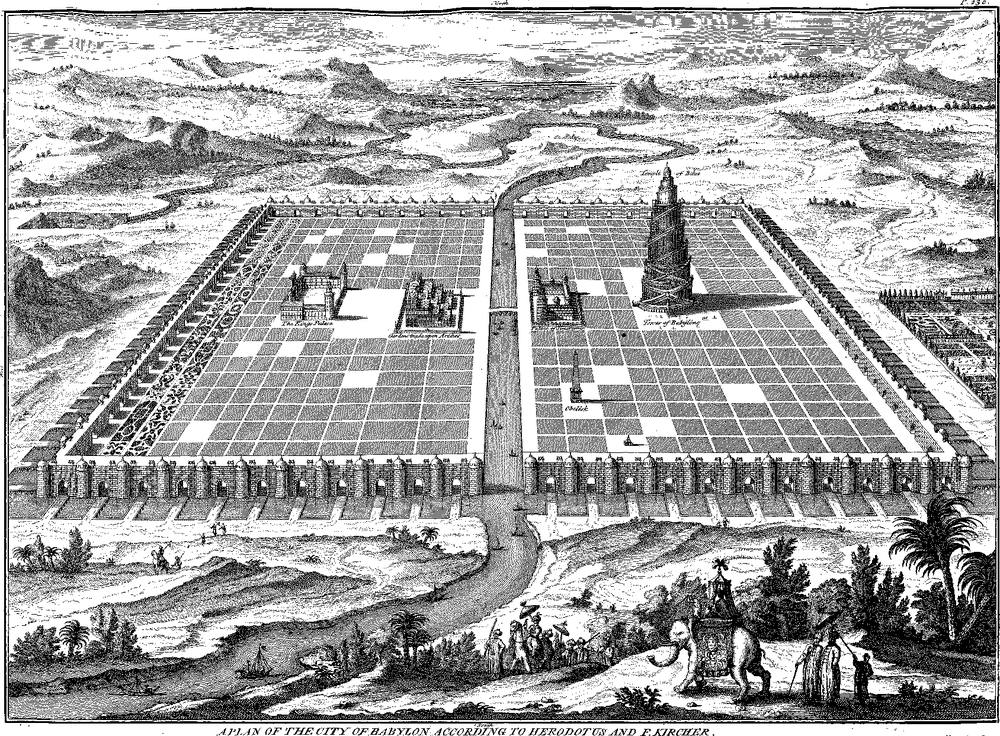
There was a Street answering to every gate, so that there were fifty Streets in all, which led from one gate to another, cut one another at right angles, and were each fifteen miles or five good leagues in length, and 151 feet wide. There were four other Streets which were adorned with houses only on one side, having the ramparts on the other. They made the whole compass of the City along the walls, and were each two hundred feet wide. As the Streets of Babylon went cross one another, they formed six hundred seventy six squares, each whereof had four furlongs and an half on every side, which made two miles and a quarter in circuit. These squares were surrounded without by houses three or four stories high19, the front whereof was adorned with all sorts of embellishments; the inner space was taken up with courts and gardens.
The Euphrates cut the City into two equal parts from North to South. A Bridge of admirable structure of about a furlong or 125 paces in length, and thirty wide, continued a communication from one part of the City to the other; at the two extremities of the Bridge were two palaces, the old on the East side of the river, and the new on the opposite Western side20. The first contained four of the squares we have been just speaking of, the other took up nine. Diodorus makes the first to be thirty furlongs in circumference, and the second sixty. The Temple of Belus which was near the old Palace, filled another of these squares. The City intire was situated in a vast plain, the soil whereof was extremely fat and fruitful. To people this vast City, Nebuchadnezzar transplanted thither an infinite number of Captives out of the several nations subdued by him. The sacred Books relate many particulars concerning the Captivity of the Jews at Babylon. We have inserted here the Plan of this famous City, in the draught whereof we have followed F. Kircher.
We have already mentioned the Temple of Belus, which many confound with the Tower of Babel. We shall in another place speak of the Statue which Nebuchadnezzar appointed to be erected in the plain of Dura in the Province of Babylon. It remains that we should say something of those famous hanging Gardens, which passed for one of the wonders of the world. They contained a space of four hundred feet square21; within this space these celebrated Gardens were raised, composed of several large terrasses, placed like amphitheaters, and the highest platform belonging to them equalled the walls of Babylon in height, that is to say, was three hundred and fifty feet high. They went up from one terrass to another, by stairs ten feet wide: this whole mass was supported by large vaults built upon one another, and strengthned with a wall two and twenty feet thick, incompassing it every way: upon the top of these vaults were laid large flat stones sixteen feet long and four wide.
Over these was placed a layer of rushes done over with a great quantity of bitumen, upon which were two rows of bricks bound fast together with mortar. All this was covered with plates of lead; and upon these the Earth of the Garden was disposed. All these precautions were taken to prevent the water and moisture from making way, and running through the vaults. There was so large a quantity of earth heap’d together, that the greatest trees might take root in it. Here was every thing to be seen that could please the sight and curiosity; very beautiful and large trees, flowers, plants, and shrubs. Upon the highest of the terrasses there was an Aquæduct supplied with water from the river by a pump probably, and from thence the whole Garden was watered. It is affirmed, that Nebuchadnezzar undertook this wonderful and famous Edifice out of complaisance to his Wife Amytis, the Daughter of Astyages, who being a native of Media, retained strong inclinations for mountains and forests.
Psalm cxxxvii. 2. Isai. xv. 7. Isai. xxi. 1.The Scripture no where takes notice of these celebrated Gardens, but speaks of Willows planted upon the banks of the rivers of Babylon, or Babylonia, upon which the Priests or Levites Ministers of the Temple hung their instruments of Musick during the Captivity. We hanged our harps upon the willows in the midst thereof. And Isaiah designing to make mention in a prophetick style of the Captivity, to which the Moabites were to be reduced by Nebuchadnezzar says, They shall be carried away to the valley of Willows. And the same Prophet, describing in another place the calamities which Babylon was to suffer from Cyrus, calls this City the Desart Jer. li. 36, 42.of the Sea. And Jeremiah, I will dry up the Sea of Babylon, and make her springs dry. And again, The Sea is come up upon her: she is covered with the multitude of the waves thereof. And Megasthenes assures us22, that Babylon was built in a place which before abounded so with water, that it was called Is. xiii. 1, 2, &c.the Sea. Isaiah prophesies against Babylon in the terms following, Lift up a banner upon the high mountain, upon Media, a mountainous country, exalt the voice unto them, shake the hand, that they may go into the gates of the nobles, their rendezvous in order to march against Babylon. I have commanded my sanctified ones, I have also called my mighty ones: the noise of a multitude in the mountains like as of a great people, a tumultuous noise of the Kingdoms of nations gathered together. Haste ye, for the day of the Lord is at hand: the hearts of the Babylonians shall melt, they shall be afraid, they shall be amazed at one another, their faces shall be as flames. I will take vengeance for the crimes which the Babylonians have committed against the rest of the world, I will put an end to their pride, and humble their insolence. A man shall be more precious ( and more rare ) *than gold… *. Babylon shall be as the chased roe, and as a sheep that no man taketh up. Whoever shall be found within her walls, shall be put to death, and they who shall offer themselves for its defence shall be put to the sword. Their children shall be dashed to pieces before their eyes, their houses shall be spoiled and their wives ravished. I will stir up the Medes against them, which shall not regard silver, and as for gold they shall not delight *in it… *. Babylon the glory of Kingdoms, the beauty of the Chaldees excellency, shall be as when God overthrew Sodom and Gomorrah. It shall never be inhabited, neither shall it be dwelt in from generation to generation.
See likewise Isai. xiv. xxi. xlv. xlvi. xlvii. xlviii.The predictions of the Prophets against Babylon were by degrees accomplished. Berosus23 relates, that Cyrus having made Jerem. l. i. Exek. xxi. 30, 31, 32. Hab. ii, &c.himself master of this City, demolished the outward walls of it; because the City seemed to be too strong, and he was apprehensive that it would revolt. Darius the Son of Hystaspes24 having taken Babylon, destroyed the gates and walls of it, hereby intending to chastise the pride of this City. Alexander the Great had formed a design for rebuilding it; but his sudden death prevented the execution of it, and his Successors neglected it25. Seleucus Nicator, one of Alexander’s Successors, having built Seleucia upon the Tigris, the neighbourhood of this place, which Seleucus proposed to make a great City, insensibly robb’d Babylon of its inhabitants26. Strabo assures us27, that in his time, that is to say, under the Empire of Augustus, Babylon was almost intirely deserted. He applies to it the expression of an old Poet concerning Megalopolis, that it was no longer any thing more than a great Desart. Diodorus of Sicily28, who lived in the same Age, assures us, that there was but a small part of the City inhabited.
Pausanias, who lived in the second Age of the Church, says29, that there was nothing but waste walls standing. Theodoret remarks, that in his time it was inhabited only by some Jews. Eusebius writing upon the xiii. Chapter of Isaiah, says, that it was then entirely deserted, as they declared, who came from that part of the world. Lastly, S. Jerom upon the same Ch. xiii. of Isaiah, relates upon the testimony of a Monk, who was an Elamite, and dwelt at Jerusalem, that the Kings of Persia made a great park of Babylon, and kept abundance of wild creatures in it for the diversion of hunting. Benjamin of Tudela, a Jew, who lived in the twelfth Age, says, he found Babylon all in ruins, and that the remains of Nebuchadnezzar’s palace were still remarkable there, but that no one could go near it, by reason of the Serpents which were there in great numbers. At present all marks of this proud City are so intirely lost, that there is no telling with any certainty, where it stood formerly. So that they who confound the City of Bagdat with old Babylon are grossly mistaken.
There have been great boasts made of the antiquity of the Astronomical Observations made by the Babylonians. They reckon four hundred seventy three thousand years from the Observations of their first Astrologers, to the arrival of Alexander the Great30. Cicero31 makes a round number of four hundred and seventy thousand years. Pliny32, as he is corrected by Perizonius and F. Hardouin, reports, that Epigenes allowed their Observations to have been for seven hundred and twenty thousand years, and that Berosus and Critodemus, who lessen the antiquity of them more than any others, yet confessed, that these Observations had been made four hundred and fourscore thousand years: This number of years is excessive, and extends not only much farther than the flood, but even than the beginning of the world according to the account of it by Moses. If the Babylonians had been in reality so ancient, we should have had some remains sure of their ancient history. Josephus tells us33, that Berosus agreed with Moses in what he said concerning the corruption of mankind, and the deluge: and Aristotle34, who was curious in enquiring into the truth of what was published relating to these Observations, desired Callisthenes to send him the most certain accounts that he could find of this particular among the Babylonians. Callisthenes sent him Observations of the Heavens, which had been made for one thousand nine hundred and three years, computing from the original of the Babylonish Monarchy to the time of Alexander35. And the printed copies of Pliny, instead of the seven hundred and twenty thousand years, according to Epigenes’s reckoning, imply no more than seven hundred and twenty; and instead of the four hundred and fourscore thousand, said to be allowed by Berosus and Critodemus, they read only four hundred and fourscore. But, notwithstanding we have no design to vindicate the common reading of Pliny, which indeed appears to be faulty, we cannot however admit of their opinion, who make the Chaldeans so very ancient. This pretended Antiquity is contradicted by the sacred Writings, which are of an infinitely superior authority. The computation even of Callisthenes seems to be a little inlarged; for according to our Chronology, we reckon no more than about eighteen hundred years from Nimrod and the Tower of Babel, to the reign of Alexander at Babylon.
Read this article in its place on the printed pages
Footnotes
-
Herennius apud Stephen. in Babylon. ↩
-
Doroth. Sidonius Poeta. Item Abiden. apud Eufeb. Præp. l. ix. c. 41. ↩
-
Marsham. Can. Chron. Secul. xiii. ↩
-
The 360 furlongs make 44600 paces, that is to say, near fifteen leagues, at three miles to the league. ↩
-
Vide Joseph. l. x. Antiq. c. 11. & lib. i. contra Appion. & Euseb. l. ix. Præpar. c. ult. ↩
-
Herodot. l. i. c. 95. ↩
-
Isai. xxxix. collatum cum 2 Reg. xx. 12. ↩
-
Vide Usher. ad ann. 3323. ↩
-
Alex. Polyhistor. apud Syncell. Usher. ad an. Mund. 3328. & Is. xxiii. 13. l. i. contra Appion. p. 1045. ↩
-
Beros. apud Joseph. ↩
-
Cyril. Alex. Basil. Gregor. Nazian. ↩
-
Is. x. 9. Οὐκ ἔλαβον τὴν χώραν τὴν ἐπάνω Βαβυλῶνος καὶ Χαλάνης, οὗ ὁ πύργος ᾠκοδομήθη. ↩
-
Bibl. Orient. p. 1016. & 159. Babel. ↩
-
Gen. iv. 26. according to the Hebrew, אז הוחל לקרא בשם יהוהVide Hieronym. in qu. Hebr. in Genes. ↩
-
Bibl. Orient. p. 668. Nimrod. ↩
-
Ranwolf’s Voyage. c. 8. ↩
-
Herodot. l. i. ↩
-
Diodor. Sicul. l. ii. l. i. Diodor. Sicul. l. ii. ↩
-
Herodot. l. i. ↩
-
Berosus apud Joseph. Antiq. l. x. c. 11. Herodot. Strabo, l. xvi. c. 2. Curt. l. v. c. 1. ↩
-
Diodor. Sicul. l. ii. ↩
-
Megasth. apud Euseb. Præp. l. ix. c. 41. ↩
-
Beros. apud Joseph. l. i. contra Appion. p. 1045. l. i. fol. 307. & l. ii. fol. 320. ↩
-
Herodot. l. iii. c ult. ↩
-
Strabo. l. xvi. ↩
-
Plin. l. vi. c. 27. ↩
-
Strabo. l. xvi. ↩
-
Diodor. l. ii. c 9. ↩
-
Pausan. Arcad. c. 33. ↩
-
Diodor. l. ii. ↩
-
Cicero de Divinat. ↩
-
Plin. l. vii. c. 56. ↩
-
Berof. apud Joseph. contra Appian. l. i. p. 1044. ↩
-
Vide Simplicium. l. iii. de Cœlo. ↩
-
Translators’ note. This carries up the account as high as the one hundred and fifteenth year after the Flood, which was within fifteen years af- ter the Tower of Babel was built. For the confusion of tongues, which followed immediately after the building of that Tower, hap- pened in the year wherein Peleg was born, which was an hundred and one years after the Flood, and fourteen years after that these Observations began. Prid. Connect. Part. I. Book 2. ↩