Volume I, pages 221–240 of the 1732 edition, from ATH to BAH: everything printed on these pages, in order.
Continued from Athar
from Sebasta, or Samaria; but this is too remote from the Tribe of Simeon. It is my opinion, that Athar is the same as Ether, or Jether, which was at first given to the Tribe of Judah, and afterwards yielded to that of Simeon. Ethar and Asan are joined together, Josh. xv. 42. as are Athar and Asan, Josh. xix. 7. Now Ether, or Jether, or Pethira, was in the times of Eusebius and St. Jerom1, a large Town, eighteen miles from Eleutheropolis, in the Southern part of Judah, towards Malatis.
ATHENOBIUS, Son of Demetrius, was sent by Antiochus Sidetes King of 1 Macc. xv. 28.Syria, to Simon Maccabæus, to command him to surrender the Cities of Joppa, Gazara, and the Fortress of Jerusalem, which were in his possession; to pay him tribute for the Cities which he held out of Judæa, and to indemnify him for the great waste which he had made upon the lands belonging to the Dominions of the King of Syria. He demanded five hundred talents of Silver, to repair these damages; and five hundred more for tribute which he pretended was due. Simon answered Athenobius, that he had robb’d the King of none of his Patrimony; and that for the places which the King required to have restored to him, they had been taken by the Jews, with an intention to secure themselves from the continual mischiefs which they did them: that notwithstanding, he was ready to give the King an hundred talents for these places. Athenobius hereupon returned with great indignation to the siege of Dora, where Antiochus was, and reported Simon’s answer. Antiochus sent Cendebeus against him, who did nothing very remarkable. He was defeated and put to flight by the two Sons of Simon the High Priest, 1 Macc. xvi. 1, 2, & seq.
Acts xvii. 15, 16, & seq.ATHENS, a celebrated City of Greece, formerly a very powerful Commonwealth, which distinguished itself very much in war; but acquired still more glory, by the learning, eloquence and politeness, whereof its inhabitants made profession. It would be to little purpose to give here an historical account of Athens. We shall only observe, that St. Paul coming thither in the year of J.C. 52. found it deeply plunged in idolatry, taken up in hearing news, and spreading it, extremely curious to know every thing, and very much divided in opinions concerning true Religion, and supreme Happiness. St. Paul having taken an opportunity there to preach JESUS CHRIST, was carried before the Judges of the Areopagus, where he gave an illustrious testimony to Truth, and the Unity of God. There he converted Dionysius the Areopagite, and Damaris, who according to some of the Ancients2, was this Senator’s Wife. Dionysius was ordained first Bishop of Athens; and it is believed that he ended his life there by an honourable Martyrdom.
ATHLAI, the Son of Belai, divorced his Wife because she was not an Israelite, Ezra x. 28.
1 Cor. ix. 25.ATHLETA. There is frequent mention of Wrestlers, in the Books of Scripture, composed after the establishment of the Grecian Monarchy in the East. Before this time neither Wrestlers, nor any Sports with which they exercised themselves, were known there. Wrestlers were men who used this exercise either for their diversion, or for the sake of health; or lastly, that they might appear in the publick Games with reputation, and obtain the Crowns and Prizes which were proposed at such times as these diversions were held. There were many sorts of Games, but there were reckoned six principally, which were Wrestling, Running, Leaping, Quoits, Boxing, and Boxing and Kicking both together. The life of Wrestlers was very laborious; they abstained from all manner of delicacy and softness, and particularly from the use of Marriage3. To this way of living St. Paul alludes, when he says that every man when he striveth for the mastery is temperate in all things. And he farther alludes frequently to their exercises and rewards, 1 Cor. ix. 24. Know ye not that they which run in a race, run all, but one receiveth the Prize? Every man that striveth for the mastery is temperate in all things. Now they do it to obtain a corruptible Crown. See likewise Philip. iii. 14. The Athletæ who made profession of learning and exercising what was commonly practised in the publick Games, whether Running, Wrestling, Quoiting, Darting, or Leaping, lived in a very severe manner; entered young upon their exercises, endured cold and heat, lived in almost continual labour, abstained from pleasures, wine and cool drinks; eat by rule and measure, and denied themselves several sorts of food, which were thought apt to weaken them4.
Qui studet optatam cursu contingere metam. Multa tulit fecitque puer, sudavit & alsit, Abstinuit venere & Baccho, &c.
The reward of these Athletæ was a Crown of Oak, Pine, Laurel or Olive; but there were other prerogatives besides this, which consisted in exemption from publick Offices, in certain Honours, as in being led about in Triumph, and having
Statues erected for them in Cities. But originally the honour of the Victory was the only Prize of the Conquerors; and it is observed, that the first Athletæ lived in a manner much more frugal and laborious than they who came after them; which may serve to reconcile those who speak of Athletæ as people put out to fatten, homines altiles, as Tertullian says, with those who commend their abstinence and temperance.
ATHON, a frontier City of Arabia, taken by Alexander Jannæus, from Aretas King of Arbia5.
Job ix. 13.ATLAS. Some make Atlas to be the Son of Japhet, or Japetus, and Clymene6. They say that this Hero having offended Jupiter, was condemned to bear the Heavens upon his Head and Shoulders, in a very remote Country, over-against the Hesperides. St. Jerom seems to point at the punishment of Atlas, when he says in Job, God whose anger no one can resist, and under whose weight they bend who bear the world; sub quo curvantur qui portant orbem. The Septuagint, The Fish or Sea-monsters which are under Heaven, bend under the weight of his Majesty. Ovid7, who likewise makes him to be the Son of Japetus, says that he had a garden filled with excellent trees, one whereof bore golden Apples. Themis had foretold him, that a certain Son of Jupiter should carry off his Apples. He trusted the keeping of them to a great Dragon, and inclosed his garden with a strong wall. Perseus came to desire shelter of him; which he refusing, Perseus, to punish him, shewed him Medusa’s head, and metamorphosed him into a Mountain. This gave occasion for the report of Atlas’s bearing up Heaven, because Mount Atlas is so high that Heaven seems to rest upon the top of it. Eupolemus cited in Eusebius8, thought Atlas was the same as Enoch, whom the Ancients relate to be the inventor of Arts, and of the Science of the Heavens.
ATTALUS, King of Pergamus. There were many Kings of this name in Pergamus. He who is mentioned in the first Book of 1 Macc. XV. 22.Maccabees, and to whom the Romans wrote in favour of the Jews, is Attalus, firnamed Philadelphus, who governed the Kingdom in the room of his Nephew Attalus III. Philometor, Son of Eumenes King of Pergamus. This last Attalus was he who left the People of Rome heirs to all his riches9; which, as they pretended, was to be understood as including his Kingdom too10. The arrival of the Jewish Ambassadors at Rome, to renew their alliance, in consequence whereof the Roman Senate wrote to Attalus, is fixed to the year of the World 3865. and Attalus Philadelphus began to govern in 3845. He governed for one and twenty years, and in 3866. put the Kingdom into the hands of his Nephew Philometor, to whom of right it belonged. Attalus Philometor died without Children, in the year of the World 3871. before J.C. 129. before the vulgar Æra 133.
Acts xiv. 25. Lev. xx. 6. Deut. xviii. 10, 11.ATTALIA, a City of Pamphylia, whither St. Paul and Barnabas went to preach the Gospel, in the year of J.C. 45.
AUGUR. The name of Augur is taken principally for those who concern themselves in foretelling what is to come, by the flight, the crowing, singing, or the feeding of Birds. I do not observe any presages made after this manner in the Scripture; but there are others in great number. The name of Augurs has been understood in a comprehensive sense, to signify all those who foretell what is to come by the view of Birds, the Heavens and Elements, of Animals, Lightning, the Entrails of Victims, Water, Wands, &c. and in this enlarged sense we sometimes find auguror & augurium11 in Scripture; signifying all sorts of Magick or Divination. God had commanded his people, upon pain of death, to forbear consulting of Magicians; and had expresly forbidden them to suffer any Magicians or Diviners in the land belonging to the Hebrews.
Gen. xliv. 5. Heb. 70.We read in Genesis, that Joseph ordered the Cup which he made use of in divining, to be concealed in Benjamin’s sack. Josephus ipse est in quo bibit Dominus meus, & in quo augurari solet. No one pretends to say, that Joseph made use of the art of divining in a superstitious manner; he was too wise and religious to practise any thing so vain, and so contrary to Religion, as Divinations, of what nature soever they might be; but his people might speak to Joseph’s Brethren according to the opinion of the Egyptians, who held Joseph to be a great Soothsayer a. Or the word Augurari in this place may
be understood to mean foretelling what is to come: thus the Cup here mentioned is that which Joseph used in offering libations to God, when he had a mind to consult him about any thing future12. The Eastern people have always been very superstitious; they brought the generality of Divinations into vogue. Some of them have pretended to understand the language of Birds; upon which the art of Augury is founded. Notwithstanding the Romans made use of it in their most serious undertakings, the most sensible of them in their hearts laughed at it13.
Luke xi. 1.AUGUSTUS, Emperor of Rome, and Successor to Julius Cæsar. The battle of Actium, which he fought with Mark Antony, and which made him master of the Empire, happened fifteen years before the Birth of Jesus Christ, in the year of the world 3985. Augustus lived seventeen years after it. He died in the 14th year of the common Æra, and seventeen years after the Birth of our Saviour. This was the Emperor who appointed the Enrolment mentioned by S. Luke, which obliged Joseph and the Virgin to go to Bethlehem, the place where Jesus Christ was born.
Augustus procured the Crown of Judæa for Herod from the Roman Senate. After the defeat of Mark Antony, Herod adhered to Augustus, and was always very faithful to him. Augustus loaded him with honours and riches; and when this Monarch undertook to subject Arabia to the Roman Empire, Herod gave Ælius Gallus, who had the charge of this expedition, five hundred of his guards. Augustus was pleased to undertake the care of Alexander’s and Aristobulus’s education, Herod’s Sons, and gave them apartments in his palace. When he came into Syria, Zenodorus and the Gadarens waited on him with their complaints against Herod, accusing him of violence, rapine, and tyranny. But Herod by his presence cleared himself of these accusations, and obliged his accusers to lay violent hands upon themselves to prevent their falling into his; and Augustus was so far from having any regard to what was charged upon him, that he heaped new honours on him, and augmented his Kingdom with the addition of Zenodorus’s Tetrarchy14. He was so kind as to examine into the quarrels between Herod and his Sons, and reconciled them.
Syllæus Minister to Obadas King of the Nabatheans having accused Herod of making an irruption into Arabia with a powerful Army, and destroying abundance of people there15, Augustus wrote to Herod about it in an angry manner, but he justified his conduct so well, that the Emperor restored him to his good graces, and continued them to him ever after. But this did not prevent his disapproving very much the rigours exercised by Herod towards his Sons, he having put to death Alexander and Aristobulus, and last of all Antipater; whereupon the Emperor observed, that it were better a great deal to be Herod’s Hog than his Child16.
Augustus after the death of Lepidus assumed the office of High Priest among the Romans17. This dignity gave him an inspection over Ceremonies, and matters relating to Religion. One of his first concerns was, to order an examination of the Sybils Books, which were then very common, and occasioned great disorders among the People, and in the Government, every one taking the liberty of interpreting them, and giving such a turn to them as was agreeable to his fancy and inclinations. Augustus directed search to be made after them, and, as it is said, burnt near two thousand Copies of them. He preserved none but such as bore the name of some particular Sybils, and were esteemed to be their genuine works; and even these he submitted to a severe examination. Those which he preserved as authentick, were put into two little gold boxes under the pedestal of Apollo’s statue, whose Temple was built within the inclosure of the palace. See hereafter the article Sybils.
AVIM, a City in the Tribe of Benjamin. Josh. xviii. 23.
Deut. xi. 23. Josh. xiii. 4. Josh. xi. 19. Josh. xi. 3. Genes. xxxiv. 29AVIMS, People descended from Hevæus the Son of Canaan. This people dwelt at first in the country which was afterwards possessed by the Caphtorims or Philistines. The Scripture says expressly, that the Caphtorims drove out the Avims, who dwelt in Hasserim even unto Azzah. There were also Avims or Hivites at Schechem or Gibeon, and consequently in the center of the promised land; for the inhabitants of Schechem and the Gibeonites were Hivites. Lastly there were some of them beyond Jordan, at the foot of mount Hermon. Bochart thinks that Cadmus, who conducted a colony of Phœnicians into Greece, was a Hivite. His name Cadmus comes from the Hebrew, Kedem, the East, because he came from
the Eastern part of the land of Canaan. The name of his Wife Hermione was taken from mount Hermon, at the foot whereof the Hivites dwelt. The metamorphosis of Cadmus’s companions into serpents, is founded upon the signification of the name of Hivites, which in the Phœnician language signifies Serpents.
Genes. xxxiv. 35.AVITH, the capital City of Hadad King of Edom.
AULON. This is the name which in Eusebius’s and S. Jerom’s time18 was given to that vast Valley which reaches along the river Jordan, from Libanus to the wilderness of Paran. This name seems to be derived from the Greek Aulos, which is taken for a Valley. The great plain and valley which lies between Libanus and Antilibanus is likewise called Aulon19.
AUSITIDA. This is Job’s country. See Uz, the land of Uz.
AUSTER, the South. Negeb, the South, in Scripture denotes Arabia Petræa, or the Southern part of Edom or Deut. xxxiii. 23.Judah. Sometimes the Hebrews express it by the right hand. Eusebius and S. Jerom frequently make use of the word Daroma, to signify the South. This term is to be met with in many places of the Hebrew in the same sense.
AZA. The cities of Gaza and Azoth Eccl. vi. 6. Ezech. xl. 24, &c.are sometimes so called20. Josephus farther takes notice of a mountain of this name, near unto which Judas Maccabæus fought against Bacchides, in the last encounter which he had with him, wherein he died21. In the first book of Maccabees ix. 15. this same place is called Mount Azotus.
AZALIAH, the Father of Shaphan. 2 Kings xxii. 3.
1 Chr. vi. 9.I. AZARIAH, High-Priest of the Jews. He succeeded Ahimaar, and was himself succeeded by Johanan. Perhaps he and Amariah, who lived under Jehoshaphat2 Chron. xix. 11. 1 Chr. vi. 10. King of Judah, about the year 3092 are one and the same person.
II. AZARIAH, the Son of Johanan High-Priest of the Jews. He is perhaps the same as Zechariah the Son of Jehoiada, 2 Chron. xxiv. 20, 22.killed in 3164.
III. AZARIAH, High-Priest also of the Jews, in the reign of Uzziah King of Judah. This Prince having undertaken to offer incense to the Lord, Azariah opposed 2 Chron. xxvi. 17.him with vigour; and the hand of God fell heavily on King Uzziah, and smote him with a leprosy. They carried him immediately out of the Temple, and he dwelt without the City, separated from the conversation of mankind to the day of his death.
2 Chron. xxxi. 10.IV. AZARIAH, High-Priest of the Jews in the reign of Hezekiah. He was the Father of Hilkiah. See the Catalogue of the High-Priests.
V. AZARIAH, lived under the last Kings of Judah. He was the Father of Seraiah the last High-Priest of the Jews before the Captivity.
VI. AZARIAH, Son to the High-Priest Zadok. We do not read, that he succeeded his Father.
VII. AZARIAH, the Son of Nathan, Captain of Solomon’s Guards.
VIII. AZARIAH, or Uzziah, King of Judah, Son of Amaziah, began to reign at the age of sixteen years, and reigned two and fifty years at Jerusalem. His Mother’s name was Jecholiah. He did that which was right in the sight of the Lord; nevertheless he did not destroy the high places, and the people, against the express prohibition of God, continued to sacrifice there. This Prince is called Uzziah in the Chronicles. He having taken upon him to offer incense in the Temple, which office was reserved peculiarly to the Priests, was struck with a leprosy, and continued without the City separated from other men to his death.
Josephus says22, that upon this occasion a great earthquake was felt, and that the Temple opening at the top, a ray of light darted upon the King’s forehead, and he appeared instantly to have a leprosy. The earthquake was so violent as to divide in half the mountain which lies to the West of Jerusalem, and the earth having moved along for the space of four furlongs, or five hundred paces, without ever stopping till it met with the mountain, which lies Eastward of the City, closed up the high way, and covered the King’s gardens. This is what Josephus adds to the History related in the Chronicles. We know indeed that there was a very great earthquake in the reign of Uzziah. Amos and Zachary make mention of it, the Kings and Chronicles speak expressly of it; but it is not certain that it happened at the very time, when Uzziah took upon him to offer incense.
The beginnings of Uzziah’s reign were very happy. He obtained great advantages over the Philistines, Ammonites, and Arabians. He made additions to the fortifications of Jerusalem, and always kept an Army on foot of three hundred and seven thousand, and five hundred men; and he had great Magazines very well furnished with all sorts of arms, as well for attacking as defending. As he was a great lover of agriculture, he had a great number of husbandmen in the plains, vinedressers in the mountains, and shepherds in the valleys. He died in the year of the world 3246, before J. C. 754, before the
vulgar Æra 758. He was not buried in the royal Sepulchers, because he was a leper; but in the field where these monuments were.
IX. AZARIAH, the Son of John, and Father of Heber. 1 Chr. xi. 29.
X. AZARIAH, the Son of Uriel, otherwise called Zephaniah. 1 Chr. vi. 36.
2 Chron. xv. 1, &c.XI. AZARIAH, a Prophet, the Son of Oded, went by God’s appointment to meet Aza King of Judah, as he returned after his succes against Zerah King of Ethiopia. Azariah addressed himself to Asa and his people, saying, The Lord hath assisted you, because you adhered to him. If ye seek him, ye will find him; but if ye forsake him, he will abandon you. Israel for a long time shall be without the true God, without Priests, Teachers, or Law. If they return to the Lord in their affliction, they will find him. At this time terror shall overspread all the inhabitants of the Earth, nation shall rise up against nation, and city against city. But for your part, take courage; let not your hands be weakened, and your perseverance shall be rewarded. These words inspired Asa with new zeal, and he began to destroy all the remaining idols in his Dominions. This is all we know of this Prophet. The particular we have related happened in the year of the world 3126, before J. C. 974, before the vulgar Æra 978.
XII. AZARIAH, the Son of Obed, one of those to whom the High-Priest Jehoida discovered, that the young Prince Joash was living; whom likewise he sent thro’out all the land to gather the Levites together, in order to place this young Prince upon the Throne of his Ancestors. In the year of the world 3126, before J. C. 974, before the vulgar Æra 978.
XIII. AZARIAH. This is the name of 2 Chron. xxiii. 1, 2, &c. 2 Chron. xxi. 1, 2. Jerem. xiii. 2.two of Jehoshaphat’s Sons, who was King of Judah.
XIV. AZARIAH, the Son of Hoshaiah, accused the Prophet Jeremiah of deceiving the people, because he advised the Jews that remained behind after the Captivity against going into Egypt. Azariah supported by Johanan the Son of Kariah and some others, carried away Jeremiah and Baruch into Egypt with the rest of the people.
XV. AZARIAH, otherwise called Abednego, one of the three Israelites cast into the fiery furnace by Nebuchadnezzar, for refusing to adore the Statue which he Dan. iii. 19.had erected. In the year of the world 3444, before J.C. 556, before the vulgar Æra 560. took this name, when he ingaged to conduct 1 Macc. v. 60.Tobias to Rages. Tob. vi. 6.
II. AZARIAS. He was left by Judas Maccabæus with another Captain, whose name was Joseph, to guard Jerusalem: when they both heard how successful Judas had been, they had a mind to distinguish themselves by ingaging with the Enemy. They marched therefore with this design, but were defeated by Gorgias near Jamnia, and lost two thousand men, in the year of the world 3841, before J. C. 159, before the vulgar Æra 163.
AZAR, the Son of Shemab of the Tribe of Reuben. 1 Chr. v. 8.
AZAZEL, or Hazazel23; in Greek, Apopompaios; in Latin, Emissarius. This is what we commonly call the Scape-goat, Levit. xvi. 5, 7, 8, &c.and shall speak of it under this title. Upon the day of solemn expiation, the Elders of the people presented two Goats for the sins of all Israel. It was determined by lot which of the two should be sacrificed, and which set at liberty. This last was the Azazel, or Scape-goat, and Let-go. Thus the Septuagint, Aquila, Symmachus, Theodoret, Cyril of Alexandria, and many other Interpreters explain it. They think that this Goat thus set at liberty, and loaded with the imprecations of the High-Priest and the sins of all the people, was like those animals, which the Heathens consecrated to some of their Deities, and left at liberty24. Az-azel in Hebrew may signify the Goat that goes away or escapes.
Others think that Azazel is the name of a Mountain; which some of the Rabbins25 assert to be ninety furlongs, or eleven thousand nine hundred and five and twenty paces, distant from Jerusalem. Bochart will have it, that this word signifies Departure or Removal. Spencer says, it signifies some Demon, and that when the Scripture tells us of sending a Goat to Hazazel, it means that it was given to the Devil. Mark, the Head of the Marcosian Hereticks26, called the Devil, whose name he made use of in forming his juggling tricks, Azazel. The same Spencer cites the Cabalists, and Julian the Apostate, as favouring his opinion27. M. Le Clerc translates Azazel, præcipitium. He believes that the Scape-goat was sent to some steep and inaccessible place, where it perished. He grounds his translation upon the 21st verse, where it is said, that the Goat Azazel was sent into the Wilderness, and in the 22d verse into some inaccessible place, in terram præruptam. He derives Azazel from two Arabick words Aza to be hard, and Azala to be in pain. But
we had better keep to the version of the old Greek Interpreters, who derived Azazel from the Hebrew Haz or Hez, a Goat, and Azal, he went away. See Spencer’s Dissertation on the Scape-goat. Bochart, De animal. sacr. part. i. l. ii. c. 54. & seq. Marsham, Canon. Chronol. Egypt. Sæcul. ix.
You have here the Ceremonies, which, as the Hebrews tell us28, were observed in the several particulars relating to the Scape-goat. Two Goats were led into the inner-court of the Temple, and presented to the High-Priest on the North side of the Altar of Burnt-offerings : these two Goats were placed one on the right, the other on the left hand of the High-Priest. After this an urn was brought and placed between two, and two lots cast into it of wood, silver, or gold: but under the second Temple they were always of gold. Upon one of these lots was engraven, for the Lord, and upon the other for Azazel. After the urn had been well shook, the High-Priest put both his hands at once into it, and in each drew out a lot: that in his right hand decided the sate of the Goat placed on his right, that in his left of the Goat on his left hand. The Jews tell us, that during the whole Pontificate of Simon the Just, the lot which he drew with his right hand was always that on which was written for the Lord, which was understood as a happy Omen ; whereas after his death this varied, and sometimes the lot on the right hand, sometimes that in the left was for the Lord.
Isai. i. 18.After this the High-Priest fastned a long fillet, or narrow piece of scarlet to the head of Azazel, or the Scape goat ; which piece under the Pontificate of Simon the Just appear’d always to be white, which was a particular favour of Heaven, and a sign that God granted the People the remission of their sins ; whereas under other High-Priests it appeared sometimes white and sometimes of its natural colour, scarlet. To this the following words of Isaiah are applied, Tho’ their sins were as scarlet, yet shall they be white as snow, &c.
After the sacrifice of the Goat which was for the Lord, the Scape-goat was brought to the High-Priest, who put both his hands upon the head of this animal, and confessed all his own sins, and those of the people ; then it was conducted into the wilderness by some person chosen for this office, and left upon the brinks of a precipice at twelve miles distance from Jerusalem ; thus it was supposed to carry away with it all the sins of the people of Israel. Under the Pontificate of the same Simon the Just above mentioned, before the Scape-goat or Azazel had got half way down the precipice from whence he was cast, he was broken in pieces ; whereas after the death of this High-Priest he fled alive into the desart, and was there met with by the Saracens, who took and eat him. See hereafter Solemn Expiation.
AZAZIAH, a Levite zealous for the law of the Lord. 2 Chr. xxxi. 13.
AZBUK, the Father of Nehemiah. He lived at Jerusalem in the time of Nehemiah. Nehem. iii. 16.
AZEKAH, a City in the Tribe of Judah. Josh. xv 35. The Philistines, in whose Army was Goliath, were incamped at Shocoh and Azekah. 1 Sam. xvii. 1. Eusebius and S. Jerom say, that in their time there was still a City of this name in being between Jerusalem and Eleutheropolis.
AZEL, the Son of Elasah, of Kish’s Family. 1 Chr. viii. 37.
AZEM or Ezem, a City in the Tribe of Simeon. Josh. xix. 3. the same perhaps as Esmona or Asmona.
AZIMA or Hazimah. See above Ashimah.
Nehem. xii. 29. Nehem. vii. 28.I. AZMAVETH, or Azmoth, or Bethazmoth, a City probably in the Tribe of Judah, adjacent to Jerusalem and Anathoth.
II. AZMAVETH, the Son of Beroni, one of the thirty gallant men belonging to David’s Army. 2 Sam. xxiii. 31.
III. AZMAVETH, the Son of Adiel, 1 Chr. xi. 32. xxvii. 25.
IV. AZMAVETH, the Son of Jehoadah, of the Tribe of Benjamin, and Saul’s Family. 1 Chr. viii. 30.
AZMON, or Asmon, or Asmona. See Assemon.
AZNOTH-TABOR. Josh. xix. 34. or simply Azanoth, or Aznoth. Eusebius places it in the plain not far from Diocæsarea.
AZOR, the Son of Eliakim. His name is to be found in the Genealogy of Jesus Christ as Man. Matth. i. 13.
Josh. xv. 47.AZOTH, or according to the Hebrew reading Ashdod29, was assigned by Joshuah to the Tribe of Judah, but was possessed a long time by the Philistines. This was a maritime City, and had a Port upon the Mediterranean. It was situated between Askelon and Akron ; or between Jamnia and Askelon, as it is said in Judith iii. 2. in Græco ; or between Gaza and Jamnia, as Josephus says, Antiq. xiii. 23. All this may be easily reconciled by saying, that it lay between these Cities, but not immediately, nor in the same sense. See the Map. Azoth or Azotus was one of the five Governments belonging to the Philistines. Herodotus says30, that Psammetichus
chus King of Egypt, lay nine and twenty years before Azoth, and that of all the Cities we know of, none ever maintained so long a siege. The Text of the Maccabees informs us, that Judas Maccabæus was killed on Mount Azotus.
I. AZRIEL of the Tribe of Manasseh, 1 Macc. ix. 18.one of the brave Officers in David’s service. 1 Chr. v. 24. He was made Intendant of the Tribe of Dan. 1 Chron. xxvii. 22.
II. AZRIEL, the Father of Seraiah. Jerem. xxxvi. 26.
III. AZRIEL, the Father of Jerimoth. 1 Chr. xxvii. 19.
I. AZRIKAM, the Son of Neariah, David’s relation. 1 Chr. iii. 23.
II. AZRIKAM, the Son of Azel, Saul’s relation. 1 Chr. viii. 38.
III. AZRIKAM, of the Tribe of Ephraim, massacred by Zichri. 2 Chron. xxviii. 7.
IV. AZRIKAM, the Son of Hachabiah, a Levite. 1 Chr. ix. 14.
I. AZUBAH, the Wife of Caleb. 1 Chr. ii. 18.
II. AZUBAH, the Wife of Asa King of Judah, and Mother to King Jehoshaphat. 1 Kings xxii. 42.
I. AZUR, Father to the false Prophet Hananiah. Jerem. xxviii. 1.
II. AZUR, the Father of Jaazeniah, Prince of the people. Ezech. xi. 1.
AZURA was, as the Eastern people tell us, the Daughter of Adam31.
AZYMUS. This word comes from the Greek Azymos32 which signifies unleavened. The Hebrews in one of their principal Festivals, which was the Passover, used unleavened Bread for seven days, and this custom they observed in memory of what Deut. xvi. 8. Exod. xii. 8, &c.their Ancestors did, who when they went out of Egypt were obliged to carry meal with them, and make bread in haste; the Egyptians so much pressing them to be gone, that they had no leisure to make up their Bread, and leaven their meal. They began to cleanse their houses of every thing Exod. xii. 39.leavened upon the 13th of the month Nisan, every place was carefully examined, lest any thing leavened should be left in corners and cupboards: so that on the 14th of Nisan about noon, there was to be none in the house. The Jews at this day very religiously observe this practice33, and S. Paul in some places alludes to it, saying, a little leaven leaveneth the whole lump: that is to say, if there were ever so little 1 Cor. v. 6. and Galat. v. 9.leaven in any quantity of Bread or Paste, during the time the Passover lasted, it was thereby corrupted, and for that season rendred unclean. It was to be thrown away and burnt. They were no more permitted to use it. He says elsewhere, 1 Cor. v. 7, 8.that the Christian Passover consists, not in abstaining from leavened Bread, but in living with purity, sincerity, and innocency; Matt. xvi. 11.and our Saviour in the Gospel warns his Apostles to take care of the leaven of the Pharisees, Sadducees, and Herodians, meaning their doctrine.
The Practice of the Jews at this day with relation to the use of unleavened Bread, is this34. They are forbid to eat, or have in their houses, or any place belonging to them either leavened Bread or any thing else that is leavened. That they may the better observe this rule, they search into all the corners of their houses with the most scrupulous exactness for all Bread or Paste or any thing like them that is leavened. After they have thus well cleansed their houses, they whiten them, and furnish them with kitchen and table-utensils all new, and with others which are to be used only on that day. If they are moveables, which have served for something else, and are made of metal, they have them polished and put into the fire to take away all the impurity which they may have contracted by touching any thing leavened. All this is done on the thirteenth day of Nisan, on the Vigil of the Feast of the Passover, which begins with the 15th of the same month, on the 14th day in the evening; for the Hebrews reckon their day from one evening to another.
On the 14th of Nisan at eleven a clock, they burn the common Bread, to shew, that the prohibition of eating leavened Bread is then commenced; and this action is attended with words, whereby the Master of the house declares, that he has no longer any thing leavened in his keeping; that at least he believes so, and has done all he could, that it might be so. Immediately after this, they set about making unleavened Bread, and they make as much as they shall have occasion for during the whole Octave of the Passover. They take care that the meal, which they use has been neither heated nor moistened; and lest their Bread should rise, they put it speedily into the oven, and when they take it out, they keep it in a very clean place. Thus their Bread is made in flat, heavy Cakes, of different figures. They sometimes provide finer for their sick, or for their friends, ttho’ they are Christians. They knead them together with milk, sugar and eggs: but always
take particular care to have no leaven in them.
As to the question, whether Jesus Christ at his last Supper instituted the Eucharist with unleavened or leavened Bread, it depends chiefly upon knowing whether he observed the Passover like other Jews, or whether he anticipated it, or lastly whether he did more or not than barely sup with his Apostles. This is an enquiry which belongs not to this Dictionary. The Reader may consult those who have written expressly on this Subject, and our Dissertation upon the last Passover observed by our Lord, prefixed to our Comment on S. Matthew.
AZZAN, the Father of Paltiel, Numb. xxxiv. 26.
BAAL or Bel, the God of the Phœnicians or Canaanites. Baal and Astaroth are commonly joined together; and as it is believed that Astaroth denotes the Moon, we may with good reason say that Baal is put for the Sun. The name of Baal is used in a generical sense, for the great God of the Phœnicians, Chaldæans, Moabites, &c. Baal in Hebrew signifies Master, Lord, Husband. It is joined often with the name of some other false God; as Baal-peor, Baal-zebub or Beelzebub, Baal-gad, Baal-zephon, Baal-berith. Baal is the most ancient God of the Jerem. xxxii. 35. xix. 5. 2 Kings xvii. 16. 2 Kings xxiii. 4, 5, 12. 1 Kings xviii. 22. 2 Kings x. 19. 1 Kings xiv. 24. xv. 12. and xii. 47. 2 Kings xxiii. 7. Hosea iv. 14.Canaanites. The Hebrews too often imitated the Idolatry of the Canaanites, in adoring Baal. They offered human Sacrifices to him, they erected Altars for him in groves, upon high places, and upon the terrasses of houses. Baal had Priests and Prophets consecrated to his Service. All sorts of infamous and immodest actions were committed in the Festivals of Baal and Astarte.
Some learned Men have asserted, that the Baal of the Phœnicians was no other than Saturn; and there was indeed a great conformity between the human Sacrifices offered to Saturn, and what the Scriptures tell us of the Sacrifices of Baal. Others are of opinion, that Baal was the Phœnician or Tyrian Hercules, a God of great antiquity in Phœnicia. But we have endeavoured to shew in our Dissertation on the Phœnician Deities, that Baal was the Sun, and that upon this suppossition, all the marks we find in Scripture of this God may be easily explained.
This great Luminary was adored over all the East, and is the most ancient Deity, the worship whereof is acknowledged among the Heathens35. The Greeks paid divine honours to Men, and spread their false Religion among the Romans, and almost throughout the whole Earth, ; but the Eastern people adored the Stars and Elements. The very Egyptians, who were afterwards so lavish of their worship to men, animals, and things insensible, in the beginning had no other Deities but the Heavens, the Stars, and Elements. Their lo. Religion, which to us appears, and in reality is, so monstrous and ridiculous, becomes so principally by their endeavouring to blend the Theology of the Greeks with theirs: and at last the Egyptians, Greeks and Latins, who were made ashamed of such an extravagant Religion, and of their vicious and mortal Gods, bethought themselves of returning to the simplicity of the Ancients, who worshipped the Air, Sun, Moon, Earth and Elements, and under these names meant nothing more than Nature the Mother of all things.
But it is impossible to excuse the absurdities of the Heathen Religion, whatever colours may be given it, or with what pretences soever it may be covered. The worship of a Star or Element is no more reasonable than that of any other Creature; and if the Heathens instead of making vicious and corrupt men and women the objects of their adorations, had chosen persons venerable for their innocency and virtue, they would have been condemned only for having worshipped the creature, and not reproached with having deified sin and lewdness.
They who held that the Stars were pure intelligences, or believed them to be animated and directed by Angels, were less inexcusable. Supposing this, they saw nothing in nature more perfect than the Sun, Stars and Planets: they were blameable only in that they did not rise from the Creature to the Creator, and did not pay to Rom. i. 21. 2 Chron. xxxiii. 3, 5.God the Honour which was due to him.
The Hebrews sometimes described the Sun by the name of Baal Shemesh, Baal the Sun. Manasseh adored Baal, planted groves, and worshipped all the Host of 2 Kings xxiii. 5, 11.Heaven : and Josiah desirous to repair the evil wrought by Manasseh, put to death the idolatrous Priests that burnt incense unto Baal, to the Sun, and to the Moon, and to the Planets, and to all the Host of Heaven. He commanded all the vessels that were made for Baal, and for the Grove, and for all the Host of Heaven, to be brought forth out of the Temple. Lastly, he took away the horses that the Kings of y Plato in Cratyof
Judah had given to the Sun, and burnt the chariots of the Sun with fire. Here the Worship of the Sun is particularly described, and the Sun itself represented by the name of Baal.
The Temples and Altars of the Sun, or Baal, were generally upon eminences: As the Temple of the God of Israel was situated on a mountain. Manasseh placed in the two courts of it Altars to all the host of 2 Kings xxi. 5, 7.Heaven, and in particular the Idol of Astarte or the Moon. Jeremiah threatens those of Judah who had sacrificed to Baal Jerem. xxxii. 29. 2 Kings xxiii. 12.upon the house-top. Josiah destroyed the Altars which Ahaz had erected on the terrass of his palace.
Human Victims were offered to Baal, as they were likewise to the Sun. Mithrah, who was the same as the Sun, was honoured with the like Sacrifices36. Apollo sometimes required Victims of the same nature37. Moloch the God of the Ammonites is celebrated throughout the Scripture, for the Children which were made to pass through the fire in honour of him. Jeremiah reproaches the Inhabitants of Judah and Jerusalem with building the high places of Baal to burn their Sons with fire for burnt-offerings unto Baal.
We shall not examine in this place whether these Victims were really burnt, or made to pass only through the fire. The Reader may consult if he please the Article Moloch, and our Dissertation concerning this false Deity.
The Scripture has a particular term for describing the Temples consecrated to the Levit. xxvii. 30. Isai. xvii. 8. xxvii. 9. and 2 Chr. xxxiv. 4.Sun or Baal: it calls them Chamanim38: these were places enclosed with walls wherein there was kept up a perpetual fire. They were very frequent in the East, particularly among the Persians; and the Greeks called them Pyreia, or Pyratheia, from a word derived from the Greek, Pyr, Fire, or Pyra, a Funeral-pile. There was, as Strabo says, an Altar in them, abundance of ashes, and a fire which was never suffered to go out39. Maundrel in his journey from Aleppo to Jerusalem observed likewise some footsteps of these enclosures in Syria. In most of them there were no Statues; in others there were some, but there was nothing uniform in the figure of them.
Several Criticks have thought, the Belus of the Chaldæans and Babylonians to be no other than Nimrod their first King: whereas others have taken him for Belus the Assyrian, Father of Ninus40; and others again for one of Semiramis’s Sons41. Lastly, many have supposed Belus to be the same with Jupiter. But we adhere to what we have said, that Baal was worshipped for the Sun among the Phœnicians and Canaanites; and that he was often taken in general for the great God of the Eastern people. And as to the Chaldæans and Babylonians, it is very credible that Belus was one of their first Kings, but whether Ashur, or Nimrod, or Thuras, or Belus the Father of Ninus, or Belus the Son of Semiramis, no one knows.
BAAL. There were many Cities in Palestine joined with the name of Baal: whether the God Baal were adored in them, or whether these places were looked upon as the capital Cities of their respective Provinces.
Josh. xv. 9. 1 Chron. xiii. 6.BAALAH, otherwise called Kirjath-jearim or Kirjath-Baal, or plain Baal, or Baalim of Judah, or Sede-jearim, and Campi Silvæ in Psalm cxxxiv. 6. are one and the same City, situated in the Tribe of Judah not far from Gibeah and Gibeon. The Ark was removed to Kirjath-jearim, when the Philistines sent it back from 1 Sam. vi. 21. Josh. xix. 32. and 1 Chr. iv. 28. Josh. xv. 29.their Country. There it remained in the house of Amminadab, till David gave orders for the carrying it to Jerusalem.
I. BAALATH, in the Tribe of Simeon. It is that probably, which is mentioned in the enumeration of the Cities of Judah; and was yielded afterwards to the Tribe of Simeon. It is placed between Azem or Asemon, and Chasar-Sual; and so advanced very far towards Arabia Petræa.
II. BAALATH, a City in the Tribe of Josh. xix. 44. and 1 Kings ix. 18. Josh. xix. 8. Judg. viii. 33. ix. 4.Dan. Josephus speaks of Baleth not far from Gazara. Joseph. Antiq. l. viii. c. 2.
III. BAALATH, a City which was built by Solomon. 2 Chron. viii. 6.
BAALATH-BEER, a City lying to the South of the Tribe of Simeon.
BAAL-BERITH, that is to say, Lord of the Covenant, the God of the Schechemites. After the death of Gideon, the Israelites forsook the Lord, and prostituted themselves to the Idolatry of Baal, and made Baal-Berith their God. There was a Temple at Schechem consecrated to Baal- Berith, where they laid up that Money, which they gave afterwards to Abimelech the Son of Gideon. Diodorus of Sicily42 speaks of a Goddess of the Cretans, named Britomartis, which is probably the same as Baal-Berith. Britomartis comes from Marath-Berith, Mistress of the Covenant.
Philo Biblius43 says, that Elion and Beruth, are two Phœnician Deities, who had a Son and a Daughter called Heaven and Earth. The beauty of these two Children was the reason of denominating from them the Heaven and Earth which
we see. If we might depend at all upon the recital of this Author, there would be no occasion to seek elsewhere for the Original of Baal-Berith. But both Porphyry and Sanchoniathon are at present in so little credit with Men of Learning, that none will venture any more to quote them; at least there can be no relying upon their Testimony.
Bochart44 is of opinion, that Berith might be very probably the same as Beroe the Daughter of Venus and Adonis, desired in marriage by Neptune, and given to Wife to Bacchus ^45, that she gave her name to the City of Berith in Phœnicia, and became afterwards the Goddess of it. This is Bochart’s conjecture; for there is no proof of the Goddess Berith’s having been adored in this City.
The most simple and natural manner of explaining the name of Baal-Berith, is to take it in general, for the God who presides over Alliances and Oaths. In this sense the true God may be termed the God of the Covenant; and if the Scripture had not added the name of Baal to that of Berith, it might be understood of the true God. But the most barbarous nations, as well as the most superstitious, the most religious and the most knowing, have always taken God to witness their Oaths and Covenants. The Greeks had their Jupiter the witness and arbitrator of Oaths, Zeus Horkios, and the Latins their Deus Fidius or Jupiter Pistius, him they looked upon as the God of Honesty and Plaindealing, who presided at all treaties and alliances: they swore sometimes even by Jupiter the Stone, per Jovem lapidem, because the Victim appointed for the ratification of the alliance, was struck with a Stone, or because Jupiter was besought to throw him headlong down some precipice, who should fail in the performance of his promise, in like manner as the Stone which the High-Priest held in his hands was cast from the top of the Capitol.
Josh xi. 17. xii. 7.BAAL-GAD, a City situated at the foot of mount Hermon, which lies to the South of Libanus and Damascus, and to the North of mount Libanus. It seems to be said in Joshua, that mount Hermon is on this side Jordan; but we know very certainly from other passages, that mount Hermon, and consequently Baal-Gad, was beyond Jordan, Josh. xii. 1, and 5. Gad was a false God, and probably represented Genef. xxx. 11.the Sun or Good Fortune. Baal-Gad derived its name from this Deity, which was there adored.
BAAL-HANAN, the Son of Achbor, succeeded Shaül in the Kingdom of Edom, and was the seventh King of it.
BAAL-HAZOR, a City in the Tribe of Ephraim, where Absalom kept his flocks. 2 Sam. xiii. 23.
BAAL HERMON, is generally placed Northward of the Tribe of Issachar, and the great Plain. See 1 Chr. v. 23.
I. BAALIM of Judah. This is Baalah or Kirjath-jearim. See above.
II. BAALIM. This is the plural number of Baal, and signifies false Gods in general.
BAALIS, King of the Ammonites, who sent Ishmael the Son of Nethaniah to kill Gedaliah, who had been set over the Remnant of the Jews, who were not sent captives to Babylon.
BAAL-MEON, a City in the Tribe of Reuben. Numb. xxxii. 38. 1 Chron. v. 8.
It is sometimes called Beth-Baal-Meon. The Moabites took it from the Reubenites, and they were masters of it in the time of Ezekiel. Eusebius and S. Jerom place Beel -Meon or Beel-Maus nine miles from Esbus or Esebon, at the foot of mount Baaru or mount Abarim.
BAAL-PEOR, or the God Peor. We have produced several conjectures concerning this false God, in a Dissertation wrote particularly for this purpose, and inserted before the Book of Numbers, p. 20. Herein we have endeavoured to demonstrate, that Adonis or Orus adored by the Egyptians, and the generality of the Eastern people, and this God, are the same. The Scripture tells us, that when the Israelites were incamped in the wilderness of Sin, they were prevailed with to worship Baal-Peor46, that they partook of his Sacrifices, and committed whoredom with the Daughters of Moab; and the Psalmist relating the same event, says, that the Hebrews were initiated into the Mysteries of Baal-Peor, and ate the Offerings of the dead. Peor is the same as Or or Orus, if we cut off the article Pe, which is of no signification. Orus is the same as Adonis or Osiris. The Feasts of Adonis were celebrated after the manner of Funerals; and the people who observed them, at that time committed a thousand dissolute actions, particularly when they were told that Adonis, whom they had mourned for as dead, was alive.
Origen47 believed Peor, or Baal-Peor, the God of the Moabites, to be the same with Priapus, or the Idol of Turpitude which was adored principally by the Women, and that Moses fearing to pollute the ears of the Hebrews, did not think
proper to distinguish in a clearer manner what kind of Turpitude he meant. S. Jerom48 says, that this Idol was represented in an obscene manner, as it was the custom to describe Priapus. It is his opinion, that effeminate men and women, who prostituted themselves in honour of Idols, whereof there is such frequent mention in the Scripture, were consecrated to Baal- Peor or Priapus. He seems to think, that this infamous Deity had that in its mouth, with which the Figures of Priapus are usually represented49.
Maimonides asserts, that Baal-Peor was adored by discovering that before him, which modesty obliges people to conceal with greatest care; and Solomon Jarchi, that Excrements were offered to him. There is no question to be made of Baal- Peor’s being the God of Impurity: we know with what impudence the Daughters of Moab engaged the Israelites in lasciviousness; Numb. xxv.and the Prophet Hosea speaking of this crime, says, They went unto Baal-Peor, and separated themselves unto that shame, and their abominations were according as they loved. Hosea ix. 10.
Others50 have asserted, that Baal-Peor was Saturn, a Deity adored in Arabia. The adventure related of this Deity, and his castration by his own Son, may have made way for the obscenities practised in the worship of Baal-Peor, whereof we have taken notice. Further, there may be some marks of resemblance discovered between Saturn and Lot, the Father of the Moabites, who were worshippers of Baal- Peor.
Some have believed, that in Baal-Peor they discovered the God worshipped by the Heathens, under the name of Crepitus º; the word Peor is derived from a Root, which signifies to be loose. Others were of opinion, that the Moabites adored their God under the name of Baal-Reem, the God of Thunder, but that the Hebrews in derision called him Baal-Peor, the God Fart. Vossius51 thinks the Moabites worshipped the Sun and Priapus under the name of Baal-Peor. Selden52 will have it, that Baal-Peor is the God Pluto. He founds his conjecture upon what is said in the Psalms: They joined themselves unto Baal-Peor, and ate the offerings of the Dead. The Sacrifices here intimated are those, says Selden, which were offered to appease the manes of the Dead. Apollinarius in his Paraphrase upon this Psalm says, that the Hebrews polluted themselves in the Sacrifices of Baal-Peor, by eating hecatombs offered to the Dead. Some affirm53, that Saturn ranked his Son Moth, whom he had by Rhea among the Gods, and that he was adored by the Phœnicians sometimes under the name of Death, and sometimes by that of Pluto.
But these several opinions seem all to be less probable than that which we have proposed and supported in our Dissertation on Baal-Peor; viz. that this false Deity was no other than Adonis, or Osiris. To what we have said elsewhere on this matter it may be added, that Adonis, as some believe, was the Father of Priapus; that funeral entertainments were made in honour of him, which may be very well understood Baruch vi. 32.by the name of Sacrifices: The Priests roar and cry before their Gods as men do at the Feast when one is dead, in cœna mortui. The Psalmist expresses himself in the plural number: Comederunt sacrificia mortuorum; for the Sacrifices of Baal-Peor were not like those of other Deities: they were repasts like those in use at the funerals of dead persons, with this difference, that the latter were often accompanied with real and sincere sorrow; whereas on the contrary in those of Adonis, the tears were all feigned, and the debauchery then indulged real. The Reader may see our Dissertation, and, if he pleases, Selden, De Diis Syris, and the Commentators upon Numb. xxv.
BAAL-PERAZIM, the place wherein 2 Sam. v. 20.David put to flight the Philistines. It could not be very far from Jerusalem, since it lay in the Valley of Rephaim.
2 Kings iv. 42.BAAL-SHALISHA. S. Jerom and Eusebius place it at fifteen miles distance from Diospolis Northward.
BAAL-TAMAR. The place, where the Children of Israel ingaged those of the Judg. xx. 33.Tribe of Benjamin. Eusebius says Baal- Tamar was near Gibeah.
BAALTIS, the same as Astarte or the Moon, next to Baal, the God most honoured by the Phœnicians.
בעל צפוןBAAL-ZEPHON. The Hebrews having left Egypt, after three days march came to Baal-Zephon, where they passed Exod. xix. 2, 9.through the Sea: Baal-Zephon therefore was near Clysma or Colsum; for there the Ancients tell us, that the Hebrews passed the Red Sea. See our Dissertation on their passage, prefixed to the Book of Exodus, p. xl. and the Supplement, p. 54. It is thought
Ezek. viii. 14.thought that Sephon or Zephon was an Egyptian Deity, from whom the City of Baal-Zephon took its name; but what he was we do not exactly know. Zephon in Hebrew signifies the North, or the Concealed. Adonis with respect to the Egyptians was the God of the North; for he was killed in mount Libanus, and was principally adored at Biblos in Phœnicia. He was likewise the concealed God; and the Egyptians call’d him Tammuz54, which signifies hidden; because of the celebration of his mysteries. He was kept shut up like one dead in a coffin, and afterwards, as it is pretended, revived; or because he is said to have passed six months on Earth with Venus, and six in Hell with Proserpine55. The Rabbins say, Baal- Zephon was an idol or figure covered with Stars, placed here by Pharaoh in order to stop the Hebrews, and hinder them from going out of his Country.
Some describe him in the shape of a Dog, as the Egyptians their God Anubis with a Dog’s Head; perhaps that he might have a vigilant eye over this place, and give notice by his barking of the Enemies arrival, and that he might guard the coast of the Red Sea on that side56. It is said he was placed there principally to stop all slaves that fled from their masters. The Jerusalem Targum assures us, that all the Statues of the Egyptian Gods having been destroyed by the exterminating Angel, Baal-Zephon was the only one that made resistance. Whereupon the Egyptians conceived a great idea of his power, and redoubled their devotion to him. Moses observing that the people flocked in crowds thither, petitioned Pharaoh that he too might make a journey thither with the Israelites. Pharaoh permitted them to go; but as they were employed upon the shore of the Red Sea in gathering up the precious stones which the river Phison had carried into theGihon, and from thence were conveyed into the Red Sea, whereby they had been thrown upon the dry land, Pharaoh surprized them like people destitute of counsel and out of their senses; he offered his Sacrifices to Baal-Zephon, waiting till the next day to attack the Israelites, whom he believed his God had delivered into his hands. But in the mean time they passed the Red Sea, and escaped from him, and his pretended God Baal-Zephon was not capable of rescuing him from death. These are Rabbinical Fables that deserve no credit.
M. Basnage57 is of opinion, that Baal- Zephon signifies the Sun; Zephon in Hebrew signifies one who contemplates, as much as to say the observing Deity, the Sun, the great Eye of nature, which knows, sees, and enlightens all things. The Poet Ezekiel cited in Eusebius58, believes Baal-Zephon to have been a City, and the construction in the Text Moses, is very favourable to this opinion. See hereafter Colsum.
1 Kings iv. 12. 2 Sam. iv. 2. & seq.BAANA, the Son of Abilud, Governour of Taanach, Megiddo, and Bethshean.
BAANAH and Rechab, Officers belonging to Ishbosheth the Son of Saul, who having secretly entred this Prince’s house, while he was sleeping at noon day, cut off his head, and carried it to David; who instead of rewarding them for so base an action, gave orders for the cutting off their hands and feet, and hanging them over the pool of Hebron.
BAARA, the Wife of Shaaraïm, who was divorced by him. 1 Chr. viii. 8.
BAARAS, or Baaris, or Baru. Eusebius59 and S. Jerom make mention of a place called Baru or Baris near Cariatha. Now Cariatha according to their account, is ten miles West of Medaba. And elsewhere60 they tell us, that Beelmaüs, or Beelmeon, is two miles from Esbus near Baaru. Lastly, Josephus61 says, that to the North of Machærus there is a Valley called Baaras, where a wonderful Root of the same name was found, which was of the colour of fire, and towards the evening cast forth rays like those of the Sun. He relates many particulars concerning this Plant, which seem very extraordinary, and which many look upon as fabulous. Nevertheless F. Eugenius Rogers speaks of them, as one who was an Eye-witness of them, and fully convinced of what Josephus says.
BAASEIAH, the Son of Malchiah, a Levite. 1 Chr. vi. 40.
BAASHA, the Son of Abijah, Commander in chief of the Armies belonging to Nadab, the Son of Jeroboam King of IsraelIn the Year of the World 3051, before J. C. 994, before the vulgar Æra 953. 1 Kings xxv. 1. & seq.. He killed his master treacherously at the Siege of Gibbethon, a City of the Philistines, and usurped the Kingdom which he possessed for four and twenty years. He rooted out the whole race of Jeroboam, as God had commanded him; but by his bad conduct and idolatry, he incurr’d God’s indignation. Wherefore the Lord sent the Prophet Jehu, the Son of Hanani to him, to tell him, that he had exalted him out of the dust, and made him Prince over his people Israel, after which he had walked in the way of Jeroboam, and made his people Israel to sin. That therefore he would take away the posterity of Baasha, and the posterity of his house
house, and would make his house like the house of Jeroboam the Son of Nebat; that him, who died of Baasha, should the dogs eat, and him that died of his in the fields, should the fowls of the air eat. Baasha, instead of making good use of these admonitions, and becoming seriously converted, was transported with rage against the Prophet, and killed him. Baasha died, and was buried at In the Year of the World 3074, before J. C. 926, before the vulgar Æra 930.Tirzah, which was then the Capital of the Kingdom of the ten Tribes. Elah his Son reigned in his stead. We read a circumstance of Baasha’s reign in the Chronicles, which is not to be met with in the Books of Kings; and this is the attempt which Baasha made, 1 Kings xvi. 7, 8. 2 Chron. xvi. 1. & seq.to fortify Ramah against Asa King of Judah, who, in order to disengage him from this undertaking, prevailed with Benhadad King of Damascus to make an irruption upon the lands belonging to Baasha; which succeeded according to his expectation.
BABAS, of the Asmonæan Family. Herod put to death the Sons of Babas, who opposed his entrance into Jerusalem, in the time of Antigonus62.
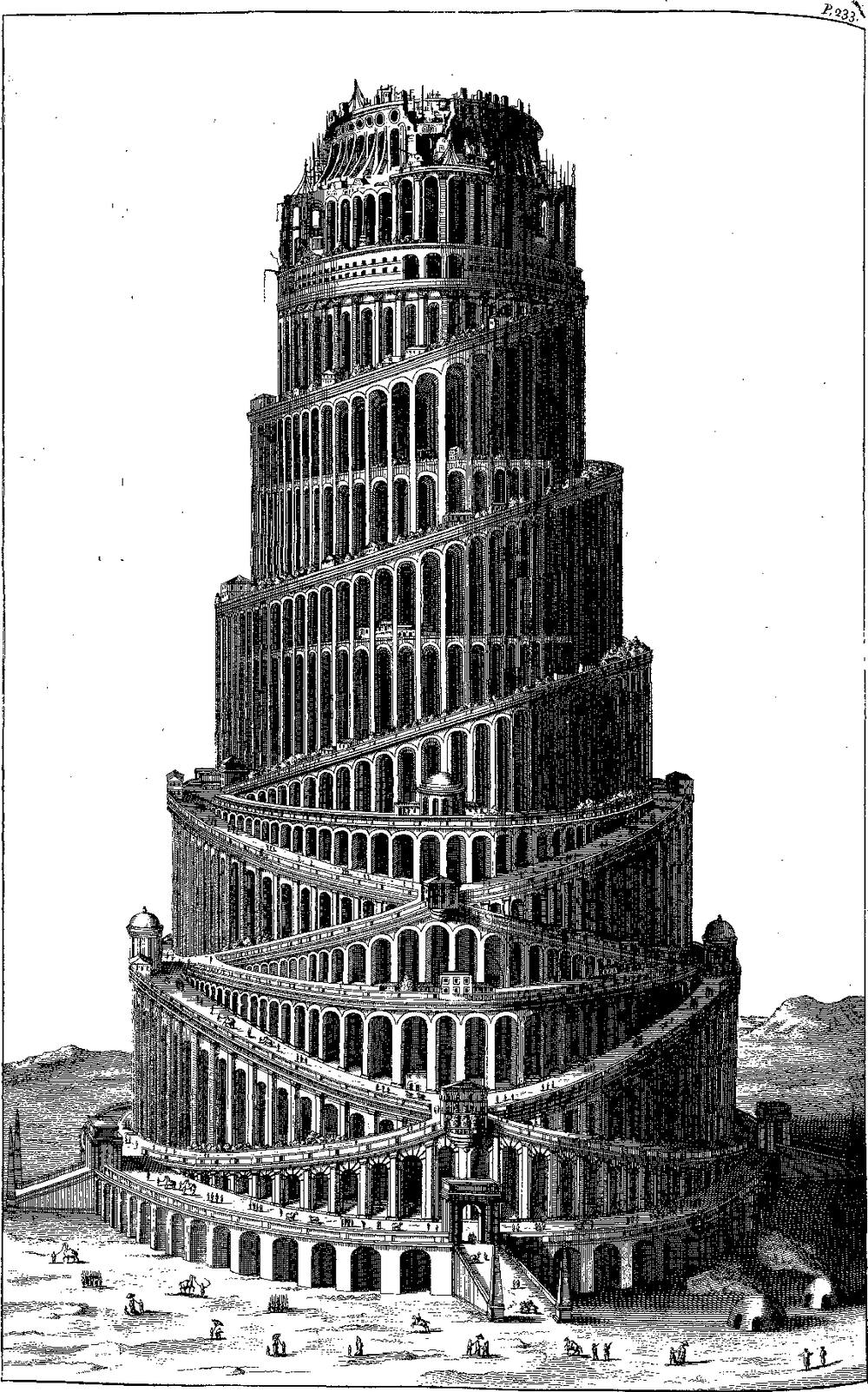
BABEL, or Babylon. This term signifies Confusion; and the City and Province of Babylon were called by this name; because when the tower of Babel was building, God confounded the languages of those men, who were employed about this edifice, so that they could no longer understand one another. Several conjectures have been Gen. xi. 7.started concerning the manner of producing this confusion of languages at Babel, which have no relation to our subject. The Reader may consult the Commentators, what M. Simon has written on this matter, in his critical History of the Old Testament, l. i. c. 14, & 15. and what is said by the Author of Les Sentimens de quelques Theologiens de Hollande, Lettre 19. The construction of the Tower of Babel, and the confusion of Languages are fixed to about the year of the World 1775, an hundred and twenty years after the Deluge.
It is thought63 that Nimrod the Son of Cush was the principal Author of this attempt to build the Tower of Babel. He designed, says Josephus, to raise a Tower so high, as might secure him from a new deluge, and put him in a condition to revenge the death of his Ancestors, caused by a general inundation over the World. It is scarce possible to think, that he could Gen. xi. 4.conceive so foolish an imagination. The Scripture says no more, than that the undertakers coming from the East into the land of Shinar, said to one another, Let us make a City and a Tower, the top whereof may reach to Heaven, and let us make our names celebrated before we are dispersed over all the earth. Now God observing that they had begun this work, and were resolved not to quit it, till they had finished it, descended from Heaven, and confounded their language; so that they were compell’d to scatter themselves throughout the Earth, and abandon their undertaking.
We do not know how high this Tower had been raised, and all that we find in Authors concerning it deserves no credit. Many have thought, that the Tower of Belus mentioned by Herodotus64, and which was still in his time to be seen in Babylon, was the Tower of Babel; or at least was built upon the old foundations. This last opinion seems the more probable, by reason that this Tower was compleated, and raised to its full height. It was composed, says Herodotus, of eight Towers placed one upon another, decreasing gradually in their size from the first to the last. Above the eighth was the Temple of Belus. This Author does not tell us what the height was of the whole edifice; but only that the first of the eight Towers, which served as a basis to the other seven, was a furlong, or an hundred and fifty paces high, and wide, or square; for his text is not very clear65. Some Writers are of opinion, that this was the height of the whole edifice; and in this sense Strabo understood him66. Others maintain, that each of the eight Towers was a furlong in height, and that the whole fabrick was eight furlongs, or a thousand paces high; which seems impossible. Nevertheless S. Jerom67 says, upon the report of others, that it was four thousand paces in height; and others affirm that it was still higher.
Belus King of Babylon, by whose directions the building of the Tower, which Herodotus speaks of, is said to have been undertaken, lived long after Moses, whether by Belus we suppose the Father of Ninus to be meant, or Belus the Son of Semiramis. Belus, the Father of Ninus is set down by Usher under the judicature of Shamgar, about the year of the world 2682, of the Julian Period 3392, long after Moses.
Modern Travellers vary in the description they give us of the remains of the Tower of Babel. Fabricius says, it might have been about a mile in circumference. Guion says the same. Benjamin, who is much more ancient, informs us, that the foundations were two thousand paces in length. The Sieur de la Boulaye le Gouz, a Gentleman of Anjou, who says he made a long stay at Babylon or Bagdat, declares, that about three leagues from this City, there is a Tower called Megara, situated between the Tigris and Euphrates in an open field. This Tower is all solid within, and is more like a Mountain than a
Genef. x. 10.Tower. The compass of it is about five hundred paces; and as the rains and winds have very much ruined it, it cannot be more than about an hundred and thirty eight foot high. It is built of bricks four inches thick; and between every seven courses of bricks, there is a course of straw three inches thick mixed with pitch or bi-tumen; from the top to the bottom there are reckoned about fifty courses. The Reader may see, if he pleases, what we have said in our Comment upon Genesis, Ch. x. v. 4. It is highly probable, that all which is related of this Tower, except what we find concerning it in Scripture, is fabu-lous; and that the remains of some Towers, which are shewn in Babylonia, are far from being those of the Tower of Babel, but are only ruins of old Babylon, built by Nebuchadnezzar.
I. BABYLON. The City of Babylon, the Capital of Chaldæa, was built by Nimrod in the place where the Tower of Babel was begun. It was the Capital of Nimrod’s Empire; so that its Antiquity is not to be questioned. Profane Authors68, who know nothing of the History of the Jews, make the Son of Belus to be the Founder of it, who lived two thousand years before Semiramis. Others ascribe the Foundation of it to Belus69 the Assyrian, Father of Ninus; others to Semiramis. Marsham70 postpones the beginning of it to the time of Nabonassar. But the opinion most generally followed, and best grounded, is this, that Nimrod founded it, Belus inlarged it, and that Semiramis added so many great works, and adorned it so many several ways, that she might be called not improperly the Foundress of it; at least with as much reason as Constantin is said to be the Founder of Constantinople.
The Scripture speaks of Babylon in very many places, particularly after the reign of Hezekiah, who upon his recovery from his indisposition was visited by the Ambassadors of Berodach-baladan King of 2 Kings xx. 12.Babylon. Isaiah, who lived at the same time, speaks often of the calamities which the Babylonians should bring upon Palestine, of the captivity of the Hebrews, of their return from Babylon, of the fall of this great City, and the taking it by the Persians and Medes. The Prophets, who lived after Isaiah’s time, as Jeremiah, Ezekiel, and Daniel, who were living in the reign of Nebuchadnezzar, and saw the extreme misfortunes of Jerusalem, and the desolation of the Kingdom of Judah, are still more taken up with the grandeur of Babylon, and its cruelty, and the evils with which God at last would overwhelm it.
Dan. iv. 30.The sacred Authors speak of it as one of the greatest and most powerful Cities in the world. Is not this great Babylon that I have built for the house of the King-dom, by the might of my Power, and for the honour of my Majesty? said Nebuchadnezzar. Berosus and Abydenus 1 ascribe to this Prince the Walls of Babylon, and those prodigious Gardens, raised upon arches, which some attribute to Semiramis. Historians are not agreed concerning the extent and height of the Walls of Babylon. Clitarchus, who is cited by Diodorus of Sicily, says, the circuit of the Walls was three hundred and sixty eight furlongs; Quintus Curtius, sixty thousand paces; Herodotus, three hundred and fourscore furlongs; Ctesias in Diodorus Siculus, three hundred and sixty furlongs71; Strabo, three hundred fourscore and five; Quintus Curtius and Strabo make them to be sixty five foot high, and thirty two wide; Pliny and Solinus, two hundred foot high and fifty broad. Quintus Curtius says that these Walls were built in a year; that the workmen finished a furlong in a day, that is to say, an hundred and five and twenty paces. But Berosus and Abydenus inform us, that this whole wonderful work was compleated in fifteen days.
Altho’ the Babylonish Monarchy is perhaps the most ancient in the world, supposing as we have said, that Nimrod began his reign at Babylon; nevertheless we do not see either in Scripture, or in profane Writers, that this Empire was of any great consequence in the world. In Abraham’s time we observe, that there Gen. xiv. 1, 2, &c.was a King of Shinar. Babylon was in the land of Shinar; but it may be made a question, whether the King of Shinar was King of Babylon; and supposing he was, the figure which he made in Chedor-laomar’s Army, where he was only as an auxiliary, does not give us any great idea of him.
Julius Africanus says, that Evechoüs, who is probably the same as Jupiter Belus, began to reign over the Chaldæans two hundred and twenty four years before the Arabians, that is to say, in the year 2952 of the Julian Period, of the World 2242, in the time of the Patriarch Isaac, 1762 before our vulgar Æra. The Arabians having declared war against Chinizitus King of Babylon, deprived him of his Crown, and Mardocentius reigned there in his stead, in the year of the Julian Period 3176, of the world 2466, before the vulgar Æra 1538, and before Belus the Assyrian two hundred and sixteen years, about the fortieth year of Moses.72
Belus the Assyrian began to reign in Babylon in the year of the Julian Period 3392, of the World 2682, before the vulgar Æra 1322, in the time of Shamgar Judge of Israel. Belus was succeeded by Ninus, Semiramis, Ninyas, and others whose names we find in the common catalogues. Of all these Princes there is no notice taken in Scripture, at least under the title of In the year of the Julian Period 3447, of the World 2737, before the vulgar Æra 1267.Kings of Babylon. Ninus, according to Herodotus, founded the Assyrian Empire73; and this Empire subsisted in upper Asia for five hundred and twenty years. During this interval the City and Province of Babylon were under a Governour appointed by the King of Assyria. Of all the great number of Assyrian Monarchs, who reigned at Nineveh, the Scripture speaks only of Pul, who was probably the Father of Sardanapalus the last of the Assyrian Kings, who were the Successors of Ninus.
Under the reign of this last, in the year of the Julian Period 3966, of the World 3257, Arbaces Governour of the Medes, and Belesus, or Baladan74, or Nabonassar Governour of Babylon, having revolted against Sardanapalus, besieged him in Nineveh, and there obliged him to burn himself, with all that was most dear and valuable to him; after which they divided the Monarchy between them. Arbaces set the Medes at liberty, and Belesus founded the Kingdom of Babylon. Young Ninus, called 2 Kings xv. 29. xvi. 7, 10. and 1 Chr. x. 6. and 2 Chron. xxviii. 20.in Scripture Tiglath-pileser, reigned at Nineveh, and continued the Succession of the Assyrian Kings, but the extent of the Kingdom was very much lessened. He was succeeded by Salmaneser, Sennacherib, and Esar-haddon, whose names are celebrated upon too many sad occasions, in the sacred Writings, for the calamities which they brought upon the Hebrews.
Belesus or Baladan was Father or Grandfather to Berodach-Baladan, who sent to visit Hezekiah after the miracle of 2 Kings xx. 12.the Sun’s retrogradation; which happened at the time of his cure. The names and actions of his Successors weare not inform’d of; but we know that Esar-haddon King of Assyria conquered the Kingdom of Babylon75, and that he and his Successors Saosduchinus and Chynaladanus, otherwise called Seracus, possessed it, till Nabopolassar Governour of Babylon, and Astyages the Son of Cyaxares King of Media, took arms against Chynoladanus76, killed him, divided his dominions, and intirely destroyed the Assyrian Empire, in the year of the World 3378, of the Julian Period 4088, before the vulgar Æra 626.
Dan. v. 31. xiii. 35.Nabopolassar was Father to the Great Nebuchadnezzar, the destroyer of Jerusalem, and the most magnificent King of Babylon, that we know of. We have observed, that by some Authors those great works are said to be his, the honour whereof by others is given to Semiramis. Evilmerodach succeeded Nebuchadnezzar, and Belshazzar Evilmerodach77: But Daniel says expressly, that Darius the Mede succeeded Belshazzar, and Cyrus We fix the death of Belshazzar to the year of the World 3448, and the first year of Cyrus’s reign at Babylon, to the year of the world 3457.Darius the Mede, otherwise called Astyages.
The Successors of Cyrus are very well known; Cambyses, the seven Magi, Darius the Son of Hystaspes, Xerxes, Artaxerxes Longimanus, Xerxes II. Secundianus, or Sogdianus, Ochus, or Darius Nothus, Artaxerxes Mnemon, Ochus, Arses, Darius Codomannus, who was overcome by Alexander the Great, in the year of the Julian Period 4383, of the World 3673, before the vulgar Æra 331.
The Greek Fathers78, adhering to the Text of the Septuagint in Isai. x. 9. were of opinion, that the Tower of Babel was built at Chalane; they read it thus79, Have I not taken the country which is above Babylon and Chalane, where the Tower was built? whereas the import of the Hebrew is Calenne, or Calno, is it not as Carchemish? is not Hamath as Arpad? is not Samaria as Damascus? have I not reduced all these Cities under my obedience? So that no advantage can be taken from this passage in the Septuagint, towards fixing the place where the Tower of Babel was erected: it is scarce questionable but that it either was within or very near old Babylon.
The Persians80 attribute the Foundation of Babylon and Nineveh to Thahamurath, one of their most ancient Monarchs: This Prince allowed his subjects an intire liberty of Conscience, so that under his reign idolatry spread itself in several branches, and got footing over all the East; which some understand of the time preceding the Deluge, answerable to what Moses says, that in the life of Enos, men began to profane the name of God, by giving it to idols81. In effect, the Eastern people will many of them have it, that Mahalaleel the Son of Canaan founded this City before the deluge; but the generality maintain, that Nimrod was the principal Author of erecting the Tower of Babel: and give this turn to the thing after their particular manner, which has always something
miraculous in it82. Nimrod, say they, having observed that Abraham came unhurt out of the fire, into which he had been cast by his orders, told his Courtiers, that he had a great mind to climb up to Heaven, in order to behold there the mighty God whom Abraham preached to them. They remonstrated in vain, that this undertaking was impossible; for notwithstanding, he commanded a Tower to be built as high as they could carry it. They had been employed three years about it, when Nimrod, ascending to the top of this edifice, was surprized to see, that Heaven still appeared at as great a distance from them as before. His surprize was still farther encreased, when news was brought him the next day, that his Tower was fallen.
He commanded another to be built higher and more solid than the first; but the same fate attended it as that which had been before raised. At last he resolved he would be carried up to Heaven by four monstrous Birds, called Kerkez. These Birds for some time flew about with him in the air, and at length threw him upon the earth against a mountain which was shaken with his fall. Strange Fables!
A German Traveller, whose name was Renwolf, passed through the place in 1574, where formerly old Babylon stood; he speaks of the ruins of this famous City as follows83. “ The Village of Elugo now “ lyes where heretofore Babylon of Chal- “ dæa was situated. The harbour is a “ quarter of a league’s distance from it; “ people go ashore in order to proceed „ by land to the celebrated City of Bag- “ dad, which is a day and a half’s journey from thence Eastward on the Tigris. “ The Soil is so dry and barren, that they “ cannot till it, and so naked, that I “ could never have believed, that this “ powerful City, once the most stately “ and renowned in all the world, and situated in the fruitful country of Shinar, “ could have ever stood there, if I had not “ discerned by the situation, and many “ antiquities of great beauty, tho’ intirely “ neglected, which are to be seen round “ about, that it certainly had been there; “ and first by the old Bridge over the Eu- “ phrates, whereof some piles and arches “ of brick are still remaining, so strong “ that they are a great wonder… The “ whole front of the village Elugo is the “ hill upon which the Castle stood, and “ the ruins of its fortifications are still visible, tho’ demolished and uninhabited. “ Behind, and some little way beyond, “ was the Tower of Babylon… It is “ still to be seen, and is half a league in “ diameter; but so ruinous, so low, and “ so full of venomous creatures, which “ lodge in holes made by them in the rubbish, that no one durst approach nearer “ to it than within half a league, except “ during two months in the Winter, when “ these animals never stir out of their “ holes. There is one sort particularly, “ which the inhabitants in the language of “ the country, which is Persian, call Eg- “ lo, the poison whereof is very searching: they are larger than our lizards.
The Reader may compare Isaiah’s description, of the condition to which Babylon was reduced after its fall, with what is Isai. xiii. 19, 22.said by this Traveller. And Babylon the glory of the Kingdoms, the beauty of the Chaldees excellency shall be as when God overthrew Sodom and Gomorrah; it shall not be inhabited, neither shall the Arabian pitch tent there, neither shall the shepherds make their fold there. But wild beasts of the desart shall lye there, and their house shall be full of doleful creatures, and the owls shall dwell there, and satyrs shall dance there. And the wild beasts of the island shall cry in their desolate houses, and dragons in their pleasant palaces.
The following is an account of Babylon in its greatest splendor, whether it were the work of Semiramis or of Nebuchadnezzar; for the ancients are not agreed among themselves as to this article: we shall borrow this description principally from Herodotus84, who had been upon the spot, and is the oldest Author, that has treated of this matter. The City was square an hundred and twenty furlongs every way, that is to say, fifteen miles or five leagues square, and the whole circuit of it 480 furlongs or twenty leagues. The walls of it were built with large bricks cemented with bitumen, a thick glutinous liquor, which issues out of the earth in the country hereabouts; it binds stronger than mortar; and becomes harder than the brick itself for which it is made use of as a cement. These walls were 87 feet thick, 350 high, and 480 furlongs in circumference. They who allow them to have been no more than fifty cubits high, speak of them according to the condition they were in after Darius the Son of Hystaspes, who commanded the walls to be demolished to the height we are mentioning, as a punishment for the rebellion of the Babylonians.
The City was encompassed with a vast ditch filled with water, and brick-work carried up on both sides. The earth which was dug out was imployed in making the bricks wherewith the walls of the City were built, so that one may judge of the depth and largeness of the ditch by the extream height and thickness of the walls. There were an hundred gates belonging to the City, five and twenty on each of the
four sides. All these gates with the posts and upper parts of them were of massy brass. Between every two of these gates at particular distances were three Towers, and three between each angle of this great square; the Towers were raised ten feet higher than the walls, which is to be understood of those places only where they were necessary; for the City being encompassed in several places with marshes which were always full of water, and defended the approach to it85, there was no need of Towers on these sides; so that their number did not consist of above two hundred and fifty, whereas if they had been carried on throughout, there must have been many more of them.
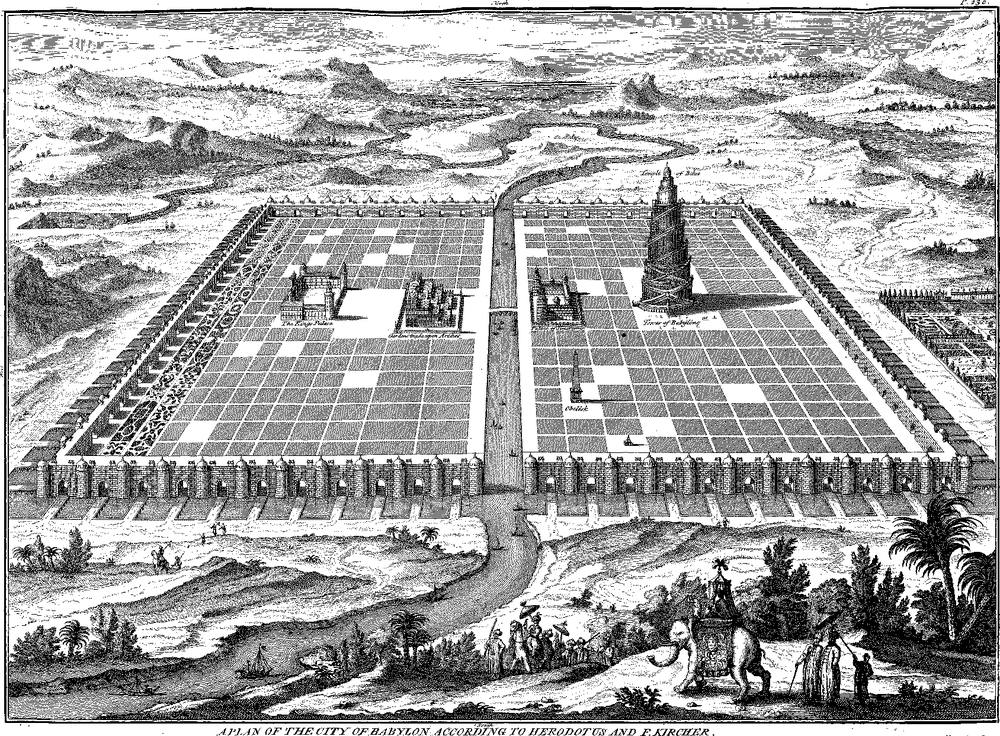
There was a Street answering to every gate, so that there were fifty Streets in all, which led from one gate to another, cut one another at right angles, and were each fifteen miles or five good leagues in length, and 151 feet wide. There were four other Streets which were adorned with houses only on one side, having the ramparts on the other. They made the whole compass of the City along the walls, and were each two hundred feet wide. As the Streets of Babylon went cross one another, they formed six hundred seventy six squares, each whereof had four furlongs and an half on every side, which made two miles and a quarter in circuit. These squares were surrounded without by houses three or four stories high86, the front whereof was adorned with all sorts of embellishments; the inner space was taken up with courts and gardens.
The Euphrates cut the City into two equal parts from North to South. A Bridge of admirable structure of about a furlong or 125 paces in length, and thirty wide, continued a communication from one part of the City to the other; at the two extremities of the Bridge were two palaces, the old on the East side of the river, and the new on the opposite Western side87. The first contained four of the squares we have been just speaking of, the other took up nine. Diodorus makes the first to be thirty furlongs in circumference, and the second sixty. The Temple of Belus which was near the old Palace, filled another of these squares. The City intire was situated in a vast plain, the soil whereof was extremely fat and fruitful. To people this vast City, Nebuchadnezzar transplanted thither an infinite number of Captives out of the several nations subdued by him. The sacred Books relate many particulars concerning the Captivity of the Jews at Babylon. We have inserted here the Plan of this famous City, in the draught whereof we have followed F. Kircher.
We have already mentioned the Temple of Belus, which many confound with the Tower of Babel. We shall in another place speak of the Statue which Nebuchadnezzar appointed to be erected in the plain of Dura in the Province of Babylon. It remains that we should say something of those famous hanging Gardens, which passed for one of the wonders of the world. They contained a space of four hundred feet square88; within this space these celebrated Gardens were raised, composed of several large terrasses, placed like amphitheaters, and the highest platform belonging to them equalled the walls of Babylon in height, that is to say, was three hundred and fifty feet high. They went up from one terrass to another, by stairs ten feet wide: this whole mass was supported by large vaults built upon one another, and strengthned with a wall two and twenty feet thick, incompassing it every way: upon the top of these vaults were laid large flat stones sixteen feet long and four wide.
Over these was placed a layer of rushes done over with a great quantity of bitumen, upon which were two rows of bricks bound fast together with mortar. All this was covered with plates of lead; and upon these the Earth of the Garden was disposed. All these precautions were taken to prevent the water and moisture from making way, and running through the vaults. There was so large a quantity of earth heap’d together, that the greatest trees might take root in it. Here was every thing to be seen that could please the sight and curiosity; very beautiful and large trees, flowers, plants, and shrubs. Upon the highest of the terrasses there was an Aquæduct supplied with water from the river by a pump probably, and from thence the whole Garden was watered. It is affirmed, that Nebuchadnezzar undertook this wonderful and famous Edifice out of complaisance to his Wife Amytis, the Daughter of Astyages, who being a native of Media, retained strong inclinations for mountains and forests.
Psalm cxxxvii. 2. Isai. xv. 7. Isai. xxi. 1.The Scripture no where takes notice of these celebrated Gardens, but speaks of Willows planted upon the banks of the rivers of Babylon, or Babylonia, upon which the Priests or Levites Ministers of the Temple hung their instruments of Musick during the Captivity. We hanged our harps upon the willows in the midst thereof. And Isaiah designing to make mention in a prophetick style of the Captivity, to which the Moabites were to be reduced by Nebuchadnezzar says, They shall be carried away to the valley of Willows. And the same Prophet, describing in another place the calamities which Babylon was to
suffer from Cyrus, calls this City the Desart Jer. li. 36, 42.of the Sea. And Jeremiah, I will dry up the Sea of Babylon, and make her springs dry. And again, The Sea is come up upon her: she is covered with the multitude of the waves thereof. And Megasthenes assures us89, that Babylon was built in a place which before abounded so with water, that it was called Is. xiii. 1, 2, &c.the Sea. Isaiah prophesies against Babylon in the terms following, Lift up a banner upon the high mountain, upon Media, a mountainous country, exalt the voice unto them, shake the hand, that they may go into the gates of the nobles, their rendezvous in order to march against Babylon. I have commanded my sanctified ones, I have also called my mighty ones: the noise of a multitude in the mountains like as of a great people, a tumultuous noise of the Kingdoms of nations gathered together. Haste ye, for the day of the Lord is at hand: the hearts of the Babylonians shall melt, they shall be afraid, they shall be amazed at one another, their faces shall be as flames. I will take vengeance for the crimes which the Babylonians have committed against the rest of the world, I will put an end to their pride, and humble their insolence. A man shall be more precious ( and more rare ) *than gold… *. Babylon shall be as the chased roe, and as a sheep that no man taketh up. Whoever shall be found within her walls, shall be put to death, and they who shall offer themselves for its defence shall be put to the sword. Their children shall be dashed to pieces before their eyes, their houses shall be spoiled and their wives ravished. I will stir up the Medes against them, which shall not regard silver, and as for gold they shall not delight *in it… *. Babylon the glory of Kingdoms, the beauty of the Chaldees excellency, shall be as when God overthrew Sodom and Gomorrah. It shall never be inhabited, neither shall it be dwelt in from generation to generation.
See likewise Isai. xiv. xxi. xlv. xlvi. xlvii. xlviii.The predictions of the Prophets against Babylon were by degrees accomplished. Berosus90 relates, that Cyrus having made Jerem. l. i. Exek. xxi. 30, 31, 32. Hab. ii, &c.himself master of this City, demolished the outward walls of it; because the City seemed to be too strong, and he was apprehensive that it would revolt. Darius the Son of Hystaspes91 having taken Babylon, destroyed the gates and walls of it, hereby intending to chastise the pride of this City. Alexander the Great had formed a design for rebuilding it; but his sudden death prevented the execution of it, and his Successors neglected it92. Seleucus Nicator, one of Alexander’s Successors, having built Seleucia upon the Tigris, the neighbourhood of this place, which Seleucus proposed to make a great City, insensibly robb’d Babylon of its inhabitants93. Strabo assures us94, that in his time, that is to say, under the Empire of Augustus, Babylon was almost intirely deserted. He applies to it the expression of an old Poet concerning Megalopolis, that it was no longer any thing more than a great Desart. Diodorus of Sicily95, who lived in the same Age, assures us, that there was but a small part of the City inhabited.
Pausanias, who lived in the second Age of the Church, says96, that there was nothing but waste walls standing. Theodoret remarks, that in his time it was inhabited only by some Jews. Eusebius writing upon the xiii. Chapter of Isaiah, says, that it was then entirely deserted, as they declared, who came from that part of the world. Lastly, S. Jerom upon the same Ch. xiii. of Isaiah, relates upon the testimony of a Monk, who was an Elamite, and dwelt at Jerusalem, that the Kings of Persia made a great park of Babylon, and kept abundance of wild creatures in it for the diversion of hunting. Benjamin of Tudela, a Jew, who lived in the twelfth Age, says, he found Babylon all in ruins, and that the remains of Nebuchadnezzar’s palace were still remarkable there, but that no one could go near it, by reason of the Serpents which were there in great numbers. At present all marks of this proud City are so intirely lost, that there is no telling with any certainty, where it stood formerly. So that they who confound the City of Bagdat with old Babylon are grossly mistaken.
There have been great boasts made of the antiquity of the Astronomical Observations made by the Babylonians. They reckon four hundred seventy three thousand years from the Observations of their first Astrologers, to the arrival of Alexander the Great97. Cicero98 makes a round number of four hundred and seventy thousand years. Pliny99, as he is corrected by Perizonius and F. Hardouin, reports, that Epigenes allowed their Observations to have been for seven hundred and twenty thousand years, and that Berosus and Critodemus, who lessen the antiquity of them more than any others, yet confessed, that these Observations had been made four hundred and fourscore thousand years: This number of years is excessive, and extends not only much farther than the flood, but even than the beginning of the world according to the account of it by Moses. If the Babylonians had been in reality so ancient, we should have had some remains
sure of their ancient history. Josephus tells us100, that Berosus agreed with Moses in what he said concerning the corruption of mankind, and the deluge: and Aristotle101, who was curious in enquiring into the truth of what was published relating to these Observations, desired Callisthenes to send him the most certain accounts that he could find of this particular among the Babylonians. Callisthenes sent him Observations of the Heavens, which had been made for one thousand nine hundred and three years, computing from the original of the Babylonish Monarchy to the time of Alexander102. And the printed copies of Pliny, instead of the seven hundred and twenty thousand years, according to Epigenes’s reckoning, imply no more than seven hundred and twenty; and instead of the four hundred and fourscore thousand, said to be allowed by Berosus and Critodemus, they read only four hundred and fourscore. But, notwithstanding we have no design to vindicate the common reading of Pliny, which indeed appears to be faulty, we cannot however admit of their opinion, who make the Chaldeans so very ancient. This pretended Antiquity is contradicted by the sacred Writings, which are of an infinitely superior authority. The computation even of Callisthenes seems to be a little inlarged; for according to our Chronology, we reckon no more than about eighteen hundred years from Nimrod and the Tower of Babel, to the reign of Alexander at Babylon.
II. BABYLON of Egypt. Diodorus Siculus fixes the original of it to the time of Sesostris103. He says, that the captives carried by this Prince from Babylon, fortified themselves in this place, and built a City of the same name with that, where they were born. Ctesias, who is cited in the same Diodorus, relates, that the Babylonians who came with Semiramis into Egypt, founded Babylon; but Josephus v is much more credible when he says, that this City was not built till the time of Cambyses, and that it owes its original to some Persians, to whom this Prince gave the ground hereabouts, and permitted them to settle there. Some modern Criticks have supposed, that S. Peter wrote his first Epistle from this Babylon in Egypt; which opinion we have confuted in a particular Dissertation, prefixed to the last Tome of our Commentary.
BABYLONIA, a Province of Chaldæa or Assyria, whereof Babylon was the Capital. It is called at this day Ierak.
BACA, a place which separates the lands belonging to the Tyrians from Galilee w.
BACATHA, a City or Town which Epiphanius104 places in Arabia, in the neighbourhood of Philadelphia, on the other side of Jordan. In the subscriptions of some Councils105, we find a Bishop of Bacatha. Charles de S. Paul, and after him F. Labbé, take Bacatha and Bazcata in the Tribe of Judah, to be the same place.
BACCHIDES, General of the Troops belonging to Demetrius Soter King of Syria1 Macc. xii. 8. In the Year of the World 3843, before J. C. 157, before the vulgar Æra 161., and Governour of Mesopotamia. He was sent by Demetrius together with the High Priest Alcimus, to examine into the depredations which Judas Maccabæus was accused of committing in the Country. He came therefore with a great Army to Jerusalem, and sent a deputation of some persons to Judas Maccabæus and his Brothers, with fraudulent propositions of peace. But neither Judas nor his Brethren had any confidence in them. A Priest with some Assideans coming to Bacchides, he put to death sixty of them. After which he left Jerusalem, and incamping at Bethzekah, he gave directions to apprehend some of those who had deserted the party of the Syrians, and having murdered them threw them into a well. This done, he put the whole Province into the hands of Alcimus, whom he left with Troops for his defence, and so returned to Antioch, where the King was.
1 Macc. ix. 1.Some time after, towards the end of the same year, Bacchides returned again into Judæa with some of the King’s choicest Troops, to put a stop to the progress, which Judas was making, who had obtained a signal Victory over Nicanor. Bacchides went directly to Jerusalem, thinking to find Judas there; but he had retreated to Laïsa or Lesen; whither Bacchides went in search of him. Judas’s Army consisted of no more than three thousand men, whereas in that of Bacchides there were twenty thousand foot, and two thousand horse. Judas’s forces were intimidated by the great numbers of their Enemies, and insensibly stole away from him, so that not above eight hundred men were left; with these he encountered Bacchides
chides, broke his right wing, and pursued him as far as mount Azotus. But Bacchides’s left wing having hem’d in Judas and his little Army, this Hero was born In the Year of the World 3843, before J. C. 157, before the vulg. Æra 161. במתניוdown by multitudes, and killed by the Enemy.
The whole Country after this submitted to Bacchides; and he gave the government of it to a set of wicked men, who exercised their cruelty upon all Judas’s friends. But all the people having chosen Jonathan to 1 Macc. xi. 24. & seq.succeed his Brother Judas Maccabæus, Bacchides used his utmost endeavours to lay hold of him and put him to death: which Jonathan being informed of, retired to Tekoe near Jerusalem, and from thence passed the Jordan. Bacchides pursued him, and inclosed him in a place, where behind him he had the river Jordan, and woods on each side of him; so that there was a necessity either to conquer or die. He gave battle, and fought valiantly with his Troops, but being overpowered by the great number of his Enemies, he threw himself into the river, and swam over it with his people. Bacchides left a thousand of his men dead upon the spot, and afterwards returned to Jerusalem. He fortified several places in the Country, took the children of the chief men in Israel for hostages, secured them in the fortress of Jerusalem, and, Alcimus dying some time In the year of the World 3846, before J. C. 154. before the vulg. Æra 159.after, left Judæa, and returned to Antioch.
Two years after, Bacchides was recalled by a wicked party of the Jews, accordingly he came with an Army, and solicited those in his interest to seize Jonathan. But he avoided the ambuscades they laid for him, 1 Macc. xi. 57, 58, 59, &c.and retired; he fortified Bethbesen, and there abode with his Brother Simon. Bacchides upon notice of this, besieged him; but Jonathan after he had defended himself for a long time, left his Brother Simon in the place, and himself took the field at the head of some Troops. Simon in the mean time on his part made several successful sallies on the Enemy, burnt their machines, and compell’d them to raise the siege. In short, Jonathan having sent to demand peace of Bacchides, it was granted, the prisoners were restored, and he returned to Antioch; from whence he made no more expeditions into Judæa. This is all we know relating to the history of Bacchides. There is mention in 2 Macc. viii. 30. of some conflicts between Judas and Bacchides; but we know no particulars of them, nor of their date, unless they happened after the year of the world 3840.
BACENOR, the Father of Dositheus, spoken of in 2 Macc. xii. 35.
BACHUR, or Bahurim, Bachor, Bachora, Choraba, Choramon, for this place is described by all these several names106. It was a village near Jerusalem, in the way towards Jordan, where Shimei the Son of Gera met David, and loaded him with imprecations and abuses. 2 Sam. xvi. 5.
2 Sam. xxii. 41. and Ps. xvii. 41. Ps. cxviii. 3. Ps. lxviii. 24. 1 Kings xii. 10. Exek. ix. 11. Ps. lxv. 11. Prov. x. 13.BACK, Dorsum. Thou hast shewn me the Backs of mine Enemies, thou hast put them to flight before me: Inimicos meos dedisti mihi dorsum. Bow down their Backs: Dorsum eorum semper incurva. Overwhelm them with burthens, reduce them to servitude: Posuisti tribulationes in dorso nostro. Thou hast loaded us like beasts of burden, thou hast overwhelmed us with evils. I will shew them the Back and not the face in the day of their destruction, says the Lord in Jerem. xviii. 17. And Sinners have ploughed upon my back: Supra dorsum meum fabricaverunt, the Hebrew, araverunt. My little finger is heavier than my Father’s loins, said Rehoboam imprudently to the Israelites: I have more power and authority than he ever had. The rod is upon the back of him that wanteth understanding; the idle and the foolish deserve to be punished with scourgings. Ezekiel saw in Spirit a Man, or an Angel, carrying an inkhorn upon his back, or rather, upon his loins according to the Hebrew. In the same sense we are to understand what Rehoboam said of his little finger’s being greater than his Father’s back or loins.
BAGDAD, or Bagdet, a celebrated City upon the Tigris. It is by several called Babylon, but it is at a good distance from the place, where the ancient City of this name stood. Bagdad is the Capital of the Province of Terach.
BAGOAS, Holofernes’s Chamberlain, who introduced Judith into his master’s tent, with hopes, that she would gratify his brutal passion. The word Bagoas is used for all sorts of Eunuchs in general107.
Quem penes est Dominam servandi cura Bagoë108. And is often to be met with in the histories of the East. In the Hebrew, Eunuchs are called Bagata, and in the Greek, Bugaioi.
1 Macc. xiii. 37.BAHEM. It is said in the first Book of Maccabees, that King Demetrius wrote to the High Priest Simon in these terms, Coronam auream & Bahem quam misistis, suscepimus. Some think that Bahem signifies pearls, others an habit109. The Greek instead of Bahem reads Baïnan, which Grotius derives from Baïs, the branch of a palm-tree. This opinion seems to be the best. It was common to send crowns, and branches of palm-trees in gold, in the way of presents to Kings, who were conquerors.
BAHURIM. See Bachur.
BAKBAKKER,
Bakbakker continues on the next page
Footnotes
-
Euseb & Hieronym. in Jether & Ether. See the Comment on 1 Sam. xxx. 27. Josh. xv. 42, 43, 47. xix. 7. ↩
-
Chrysost. de Sacerdot. l. iv. c. 7. & After. homil. 8. p. 162. ↩
-
Plato l. viii. de legib. Plin. l. 34. c. 18. ↩
-
Horat de Arte Poet. ver. 412. ↩
-
Joseph. Antiq. l. xiv. c. 2. ↩
-
Hesiod. ver. 509, 515. ↩
-
Ovid. Metam. l. iv. ver. 630, &c. ↩
-
Euseb. Præpar. l. 9. ↩
-
Livius l. lix. ↩
-
Translators’ note. Videas etiam Epistolam Mithridatis Regis Ponti ad Arsacen, Regem Parthiæ inter fragmenta Sallustii, l. 4. in quâ epistolâ vocat hoc testamentum simulatum & impium testamentum. Aristonicus the next Heir, Son of Eumenes, and Brother of Attalus by another Mother, claim’d the Crown of Pergamus as his inheritance, took possession of it, defeated Licinius Crassus the Consul, cut off him and his Army, and was not reduced till after four years continuance of this war. See Prid. Connect. &c. Part II. Book V. ↩
-
Translators’ note. The Hebrew words thus translated in the Latin Vulgate are, אובand ,אבחwhich differ pretty much in significa- tion from Augur and Augurium. The Πνεῦμα Πύθωνος, in Acts xvi. 16. seems to come nearer the meaning par- ticularly of ,אובwhich by Buxtorf is rendred Pytho and Utres. Hinc, says he, Pythonis significatio juxta Aben Ezram, quod ex tumido ventre, quasi Utre oracula deponent inde ἐγγαστρίμυθος dictus fuit. But we know of no sort of Divination among the Hebrews, like that expressed properly by the word Augurium. ↩
-
Grot. in Gen. xliv. ↩
-
Translators’ note. And not only ridiculed it tacitly within themselves, but more explicitely and expresly. Cicero in his Book de Senectute takes notice of Fabius Maximus’s Contempt of this Art, Augurque cum esset, says he, dicere ausus est; optimis auspiciis ea geri. quæ pro Reipublicæ salute gererentur: quæ contra Rempublicam fierent, contra auspicia fieri. Ennius ranks Augurs among other publick Cheats and Impostors who are named by him. Non enim sunt ii aut arte Divini, aut scientiâ, sed superstitiosi Vates, impudentesque Arioli, &c. And Accius, Nihil credo Auguribus, qui aures verbis divitant alienas, suas ut auro locupletent domos. ↩
-
Joseph. Antiq. l. xv. c. 13. ↩
-
Idem Antiq. l. xvi. c. 14, 15. ↩
-
Macrob. Saturn. l. ii. c. 4. ↩
-
Sueton. in Octav. Dio. Cassius l. liv. ↩
-
Euseb. & Hieronym. Onomastic. in Αὐλὼν. ↩
-
Vide Reland. Palæst. t. i. p. 364, 365, & 372. ↩
-
Stephan. in Gaza & Azotos. ↩
-
Joseph. Antiq. lib. xii. c. 19. ↩
-
Joseph. Antiq. l. ix. c. 11. ↩
-
Haz-azel. 70. Hieronym. Emissarius. Theodoret. qu. 22. in Levit. Sym. Abeuntem. Aq. Dimissum, solutum. ↩
-
Vide Spencer. Dissert. de Hirco Emissario. Bochart. de Animal. sacr. p. 1. l. ii. t. 55. Marshem sæculo I. & p. 204, 207. ↩
-
Jonath. R. Saad. Gaon. Kimchi. R. Salomon. Abenezra, &c. ↩
-
Epiphan. hæres. 34. ↩
-
Julian. apud S. Cyril. l. ix. contra Julian. ↩
-
Misna in Joma. Maimonid. Jom Haccipurim. ↩
-
אשרודAshdod. Gr. Ἄζωτος. ↩
-
Herodot. lib. ii. c. 157. ↩
-
Joel in limine Chronograph. ↩
-
Ἄζυμος. Azymus infermentatus. Heb. מצה Matza. ↩
-
Translators’ note. There are many cases of Conscience relating to this matter which are stud- ied by the Talmudists. Some of their principal decisions may be seen in the Mishnah, Ordo Festorum, T. 2. p. 138. Maimon. de Solemnit. Paschatis, c. 1. Fascic. 7. p. 839. ↩
-
Leo of Mo- dena, his Ceremonies of the Jews. part 3. c. 3. ↩
-
Plato in Cratylo. ↩
-
Vide Euseb. l. iv. præparat. ↩
-
Dionys. Halicarnass. apud Euseb. ↩
-
חמניםChamanim. ↩
-
Strabo. l. xv. ↩
-
Vide Marsham. Can. Chronolog. Secul. i. Cedren. p. 16, &c. ↩
-
Vide Syncell. p. 97. ↩
-
Diod. l. v. p. 236. ↩
-
Phil. Bibl. apud. Euseb. Præpar. l. i. ↩
-
Bochart. Chanaan. l. ii. c. 17. ↩
-
Nonnus Dionys. Art. 41, 42. ↩
-
Translators’ note. It is the opinion of an ingenious Author, that Baal-Peor was the Sun, the same with Moloch of the Ammonites, and Chemosh of the Moabites; and that he was denominated Baal-Peor from the particular place of his Worship, as Jupiter Capitolinus. ↩
-
Origen. in Num. c. xxv. Homil. 20. Beelphegor, quod est, Idolum turpitudinis. ↩
-
Hieronym. in Osee iv. Colentibus maxime fœminis Beelphegor, ob obscœni magnitudinem, quem nos Priapum possumus appellare. ↩
-
Idem in Osee ix. Denique interpretantur Beelphegor idolum tentiginis, habens in ore, id est, summitate pellem, ut turpitudinem membri virilis ostenderet. ↩
-
Theodoret in Ps. cv. Apollinar. Caten. in Ps. Suidas, Masius, in Josue. Hottinger. Hist. Orient. c 7, &c. º Minutius in Octaviano. Nec Serapidem magis Ægyptii quam strepitus per pudenda corporis expressos contremiscunt. Origen. contra Celsum, p 255. Hieronym. in Isai. xiii. Ut taceam de formidoloso, & horribili cœpe, & crepitu ventris inflati, quæ Pelusica Religio est. ↩
-
Gerard. & Voss. de Origine & Progressu Idolatr. l. ii. c. 7. ↩
-
Selden. de Diis Syris Syntagm. 1. c. 5. ↩
-
Sanchon. apud Euseb. Præpar. l. i. c. 8. ↩
-
Vide Hieronym. in eum locum. ↩
-
Vide Theocriti Scholiasten. ↩
-
Basnage Antiquit. des Juifs. t. ii. p. 669, 670. ↩
-
Loco citato, p. 671. ↩
-
Ezechiel Poeta apud Euseb. demonstr. l. ix. c. 29. p. 444. ↩
-
Euseb. in Kariathaim. Hieronym. ibidem. ↩
-
Idem in Beelmeon. ↩
-
Joseph. de Bello, l. vii. c. 25. ↩
-
Joseph. Antiq. l. xv. c. 11. p. 532. ↩
-
Antiq. l. i. c. 5. ↩
-
Herodot. l. i. c. 381. Nov. Edit. ↩
-
Στάδιυ καὶ τὸ μῆκος, καὶ τὸ εὖρος. ↩
-
Strabo. l. xvi. initio. ↩
-
Hieronym. in Isai. lib. v. p. 114. ↩
-
Herennius apud Stephen. in Babylon. ↩
-
Doroth. Sidonius Poeta. Item Abiden. apud Eufeb. Præp. l. ix. c. 41. ↩
-
Marsham. Can. Chron. Secul. xiii. ↩
-
The 360 furlongs make 44600 paces, that is to say, near fifteen leagues, at three miles to the league. ↩
-
Vide Joseph. l. x. Antiq. c. 11. & lib. i. contra Appion. & Euseb. l. ix. Præpar. c. ult. ↩
-
Herodot. l. i. c. 95. ↩
-
Isai. xxxix. collatum cum 2 Reg. xx. 12. ↩
-
Vide Usher. ad ann. 3323. ↩
-
Alex. Polyhistor. apud Syncell. Usher. ad an. Mund. 3328. & Is. xxiii. 13. l. i. contra Appion. p. 1045. ↩
-
Beros. apud Joseph. ↩
-
Cyril. Alex. Basil. Gregor. Nazian. ↩
-
Is. x. 9. Οὐκ ἔλαβον τὴν χώραν τὴν ἐπάνω Βαβυλῶνος καὶ Χαλάνης, οὗ ὁ πύργος ᾠκοδομήθη. ↩
-
Bibl. Orient. p. 1016. & 159. Babel. ↩
-
Gen. iv. 26. according to the Hebrew, אז הוחל לקרא בשם יהוהVide Hieronym. in qu. Hebr. in Genes. ↩
-
Bibl. Orient. p. 668. Nimrod. ↩
-
Ranwolf’s Voyage. c. 8. ↩
-
Herodot. l. i. ↩
-
Diodor. Sicul. l. ii. l. i. Diodor. Sicul. l. ii. ↩
-
Herodot. l. i. ↩
-
Berosus apud Joseph. Antiq. l. x. c. 11. Herodot. Strabo, l. xvi. c. 2. Curt. l. v. c. 1. ↩
-
Diodor. Sicul. l. ii. ↩
-
Megasth. apud Euseb. Præp. l. ix. c. 41. ↩
-
Beros. apud Joseph. l. i. contra Appion. p. 1045. l. i. fol. 307. & l. ii. fol. 320. ↩
-
Herodot. l. iii. c ult. ↩
-
Strabo. l. xvi. ↩
-
Plin. l. vi. c. 27. ↩
-
Strabo. l. xvi. ↩
-
Diodor. l. ii. c 9. ↩
-
Pausan. Arcad. c. 33. ↩
-
Diodor. l. ii. ↩
-
Cicero de Divinat. ↩
-
Plin. l. vii. c. 56. ↩
-
Berof. apud Joseph. contra Appian. l. i. p. 1044. ↩
-
Vide Simplicium. l. iii. de Cœlo. ↩
-
Translators’ note. This carries up the account as high as the one hundred and fifteenth year after the Flood, which was within fifteen years af- ter the Tower of Babel was built. For the confusion of tongues, which followed immediately after the building of that Tower, hap- pened in the year wherein Peleg was born, which was an hundred and one years after the Flood, and fourteen years after that these Observations began. Prid. Connect. Part. I. Book 2. ↩
-
Diodor. l. i. v Joseph. Antiq. l xxi. c 5. w Joseph. l. iii. de Bello, c. 2. ↩
-
Epiphan. advers. hæres. l. ii. p. 397, & 489. ↩
-
Vide Reland. Palæst. l. iii. p. 612. ↩
-
Joseph. Antiq. l. vii. c. 8, 9. Macc. xiii. 37. ↩
-
Plin. l. xiii. c. iv. ↩
-
Ovid. Amor. l. ii. ↩
-
Vide Syr. ad ↩