ARK. The Latin word Arca signifies properly a Coffer, and this is the true meaning of the Hebrew, Aran, which Moses makes use of to denote the Coffer, or Chest wherein the Tables were deposited, upon which the words of the Covenant or the principal Commandments of the Law were written. This Coffer was of Shittim wood, covered with plates or leaves of gold, being two cubits and an half in length, a cubit and an half wide, and a cubit and an half high. Upon the top of it there was all round it a kind of gold Crown, and two Cherubims were fastned to the cover. On the two sides of this coffer there were four rings of gold, two on each side, thro’ which staves were put, by the help whereof they carried it as they marched thro’ the Wilderness. This was the Ark of the Covenant, a Chest or Coffer of great value, wherein the two Tables of Stone were placed, written by the hand of God.
After the passage of Jordan, the Ark continued for some time at Gilgal, from thence it was removed to Shiloh. Here it was when the Israelites took it thence to carry it to their camp. They gave battle to the Philistines, and the Ark of the Lord fell into the Enemy’s hands. The Philistines oppressed by the hand of God, which lay heavy upon them, sent back the Ark, and it was lodged at Kirjath-jearim. It was afterwards, in the reign of Saul, at Nob. David conveyed it from Kirjath-jearim to the House of Obededom, from thence to his Palace at Sion; and last of all, Solomon brought it into the Temple which he had built at Jerusalem.
It remained in the Temple with all suitable respect, till the times of the last Kings of Judah, who gave themselves up to Idolatry, and were so daring as to put their Idols in the very Holy Place itself. The Priests being unable to endure this prophanation, took the Ark, and car ried it from place to place, that so they might preserve it from the fury of these impious Princes. Josiah commanded them to bring it 2 Chron. xxxv. 3.back to the Sanctuary, and forbad them to carry it as they had hitherto done, into the Country.
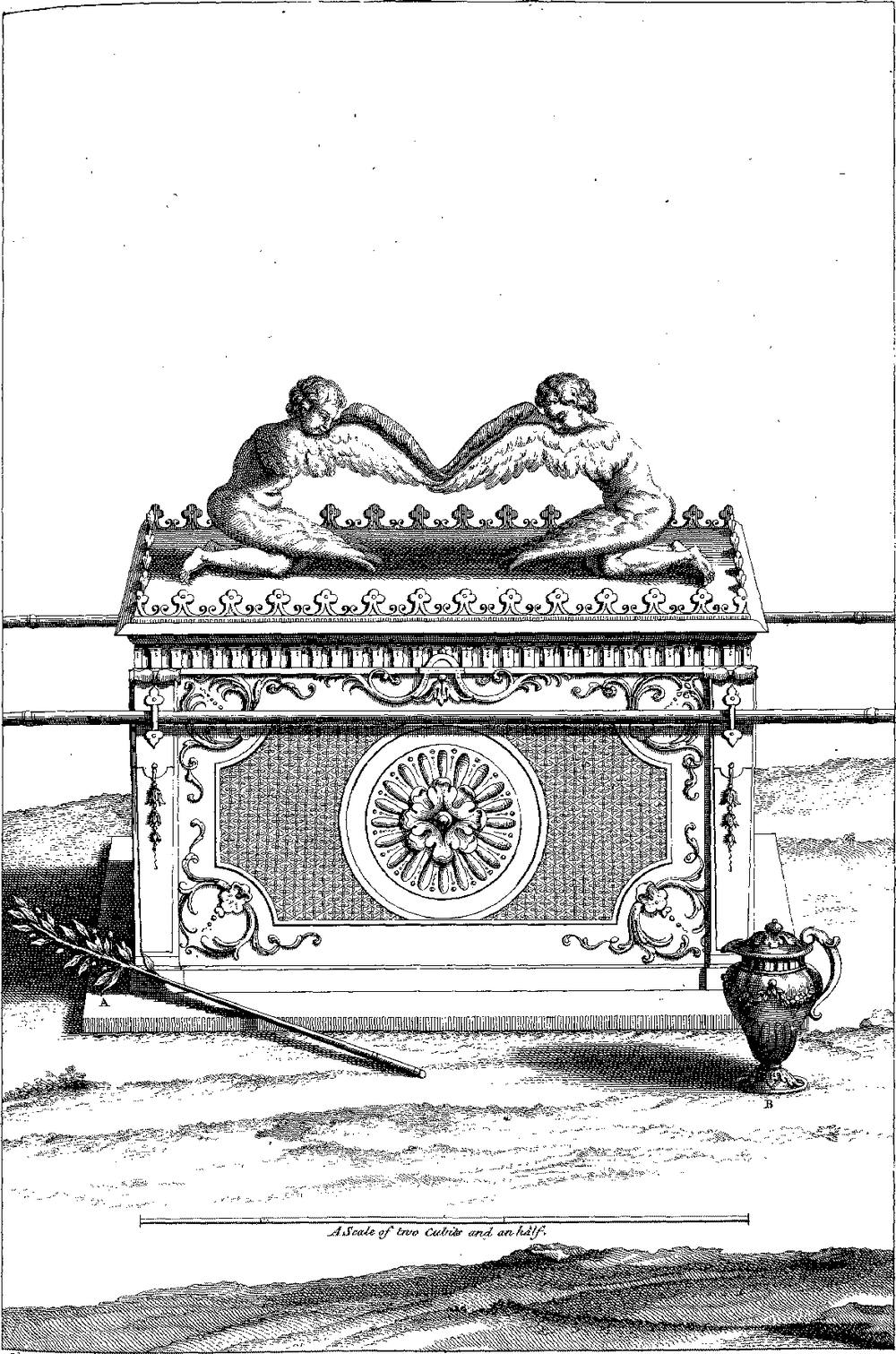
Some time before the Captivity of Babylon, Jeremiah foreseeing the calamities which would happen to his Nation, and enlightened in a supernatural manner, removed the Tabernacle and the Ark of 2 Macc. ii. 4—9.the Covenant into a Cave of that Mountain, which Moses ascended some little time before his death, and saw from thence the heritage of God. To this Mountain Jeremiah went, and in a hollow Cave of it concealed this sacred Depositum: the Priests who accompanied him, had a mind to set a mark upon the place, in order to remember it, but were never able afterwards to find it. The Prophet reproved them for their curiosity, and declared to them that this place should continue unknown, till the Lord should gather together once more his people that were dispersed, and should be reconciled with them. It is questioned, with good reason, whether the Ark was placed again in the Temple after the return of the Jews from the captivity of Babylon1. See our Dissertation on this matter, inserted before the Books of Maccabees.
The Talmudists2 relate, that Solomon having learned by revelation, that the Assyrians would one day burn the Temple lately built by him, and carry away all the rich materials which he had placed there, took care to have a private hole made under ground, where, in case of necessity, he might conceal the most precious ornaments and sacred things belonging to the Temple from the knowledge of any Enemies. Josiah having a foresight of the calamities which were upon the point of falling on the Hebrew Nation, hid here the Ark of the Covenant, together with Aaron’s Rod, the Pot of Manna, the High Priest’s Pectoral, and the Holy Oil. But during the Babylonish Captivity, the Priests having lost all knowledge of the place where these things had been concealed, they were never afterwards seen more, and were not in the second Temple.
Others affirm, that Nebuchadnezzar conveyed the Ark to Babylon, and that it was among the rest of the rich vessels which were carried off by him from the Temple. Some are of opinion, that King Manasseh having set up Idols in the Temple, took away the Ark, which was not settled there again during his reign. The 2 Esdr. x. 22.Author of the fourth Book of Esdras represents the Jews lamenting that the Ark of the Covenant was taken by the Chaldæans in the plunder of the Temple.
Jer. iii. 16.The Gemara of Jerusalem3, and that of Babylon4, both acknowledge that the Ark of the Covenant is one of the things which were wanting in the second Temple, after the return from the Captivity of Babylon. The Jews flatter themselves5 that it will appear again with the Messiah, who is expected by them. But Jeremiah, speaking of the time of the Messiah, and the calling of the Gentiles to the Faith, says that they shall neither talk nor think of the Ark, nor remember it any more. Esdras, Nehemiah, the Maccabees, and Josephus, never make any mention of the Ark in the second Temple; and Josephus6 tells us expressly, that when Jerusalem was taken by Titus, there was nothing at all in the Sanctuary.
S. Epiphanius7 relates, without doubt from some ancient tradition of the Jews, that Jeremiah foreseeing the approaching ruin of the Temple, carried the Ark of the Covenant into a Cave, and by his prayers prevail’d that it might be sunk and swallow’d up in the rock, so that it never more was seen. This done, he addressed himself to the Priests and Elders who accompanied him in the following words. ” The Lord is ascended from Sion ” into Heaven, from whence he must one ” day descend with his celestial Host; and ” it shall be a sign of his coming, when ” all Nations shall adore the Cross. No ” one shall discover the Ark except Moses ” the Prophet of the Lord; and no Priest ” nor Prophet shall open the Tables which ” are enclosed in it, except Aaron the ” Elect of God. But at the second Resurrection the Ark shall be raised and ” come forth out of the Rock, it shall be ” placed on Mount Sinai, and all the ” Saints shall be assembled about it, waiting for the Lord’s return, and endeavouring to defend themselves from the ” Enemy who would take it. Jeremiah ” at the same time sealed the stone, writing with his own fingers the name of ” God upon the place, in like manner as ” if it had been cut with iron. From ” this moment a dark cloud was spread ” over ” over the name of God, and has kept it ” concealed to this very day; so that no ” one has been able to discover the place, ” nor read this divine Name. This cloud ” appears every night with great brightness over the Cave, to shew as it were ” that the glory of the Lord does not forsake his Law. And the Rock abovementioned lies between the two Mountains where Moses and Aaron died.
Josephus the Son of Gorion, who had seen the Books of the Maccabees, having first related that Jeremiah had concealed the Ark, and the veils of Moses’s Tabernacle, puts these words into the mouth of Jeremiah, to the Priests who followed him, and desired to know where these things were hidden, The Lord hath sworn, that no man should know this place, nor discover it, till the Prophet Isaiah and my self return into the world; then we will lodge the Ark again in the Sanctuary, and under the Cherubims wings. Lastly, the Rabbins agree in saying that the Ark no more was seen after the Captivity of Babylon, and that the Foundation-Stone, which they believe to be the center of the Holy Mountain, was placed in the Sanctuary in its room. The Fathers, and Christian Commentators agree generally with the Jews in this point, that the Ark was never found again after the Captivity. See our Dissertation on this matter before the Book of Maccabees, and that by Frischmuth, de non speranda Arcæ fœderis restitutione.
Besides the Tables of the Covenant placed by Moses in the sacred Coffer, God appointed the blooming Rod of Aaron to Numb. xvii. 10. Exod. xvii. 33. Heb. ix. 3, 4. Josh. iv. 4, 5.be lodged there8, and the Omer of Manna which was gathered in the Wilderness. Tertullian9 will have it that the twelve Stones taken from the bottom of Jordan, when the Israelites passed this River dry-shod, were likewise put there. The Mahometans10 assure us, that Moses’s Shoes were likewise preserved there, which he pull’d off before the burning Bush; that besides Exod. iii. 5.these Aaron’s Pontifical Tiara was kept there, and a piece of Wood called Alouah, which Moses made use of when he sweetned the Waters of Mara. They add, that the Ark was given by God to Adam ready made, and that it passed from hand to hand, and from Patriarch to Patriarch, down to Moses: That all the Portraitures of the Patriarchs and Prophets were represented about the Ark; and that Shekinah, or the Majesty of God rested upon it: That in times of war an impetuous wind rushed out of the Ark, which blew fiercely upon the Enemies of Israel, and intirely defeated them: And that for this reason they often carried the Ark of the Covenant at the head of their Armies.
The Heathens likewise had in their Religion little Chests, or Cistæ, wherein they locked up the most sacred things they had11. Apuleius12 says, that in certain profane Processions made in Egypt, there was a person whose office it was to be Chest-bearer. He held a Box including the richest things for their religious uses. Plutarch, in his Book intitled, Of Isis and Osiris, tells us almost the same thing. Pausanias13 speaks of a Chest in which the Trojans locked up their mysteries; and that being taken at the siege of Troy it fell to Euripilus’s share. The ancient Hetrurians14 had also Cistæ among their sacred Vessels. There was the same custom among the Greeks and Romans. But these Boxes inclosed often things of a lewd, profane, superstitious and ridiculous nature15; whereas the Ark of God contained the most sacred and serious things in the world, such as the Tables of God’s Law, &c.
Read this article in its place on the printed pages
Footnotes
-
Translators’ note. Dr. Prideaux is of opinion, that as the Jews found it nec- essary for the carrying on their worship in the second Temple, to have a new Altar of Incense, a new Shew-Bread Table, and a new Candlestick, so they had likewise a new Ark. That since the Holy of Holies, and the veil drawn be- fore it, were wholly for the sake of the Ark, what need had there been of these in the second Temple, if there had not been the other also? &c. Hist. of the Connect. &c. P. I. p.117. ↩
-
Galatin. l. iv. de Arcanis c. 9. Genebr. Chronol. l ii. Rab. Juda & Abarbanel. in Daniel. Maimonid. &c. ↩
-
Gemar. Jerosolym. tit. Maccoth. ↩
-
Gemar. Babil. tit. c. I. ↩
-
Abarbanel. in Daniel. ix. ↩
-
Joseph. de Bello, l. v. c. 14. in Græco. ↩
-
Epiphan. vita Jerem. Prophetæ. ↩
-
Arcam Testamenti in qua urna aurea & virga Aaron. ↩
-
Tertull. ↩
-
Bibl. Orient. p. 1022, & 834. ↩
-
Vide Spencer. de legib. Hebræorum. ↩
-
Apul. de Asino aureo, l. ix. & l. xi ↩
-
Pausan. l. vii. p. 435. ↩
-
Clem. Alex. in protreptico. Euseb. præpar. Evang. l. ii. c. 5. ↩
-
Vide Clem. Alex. admonit. ad Gentes, p. 12, 14. ↩