Works › The Mariale: Questions on “Missus est”
Volume 37 · pp. 308–310
Question 221. Whether, when it is said: The Lord will give him the throne of David his father, by the throne of David a bodily or spiritual kingdom is understood?
A marker with ≈ is an approximate page boundary, placed by measure of the text; the page photographs remain the authority. In the paired views, clicking a page marker brings that page into view.
QUAESTIO CCXXI. Utrum quando dicitur: Dabit illi Dominus sedem David, patris ejus, per sedem David intelligatur regnum corporale, vel spirituale?
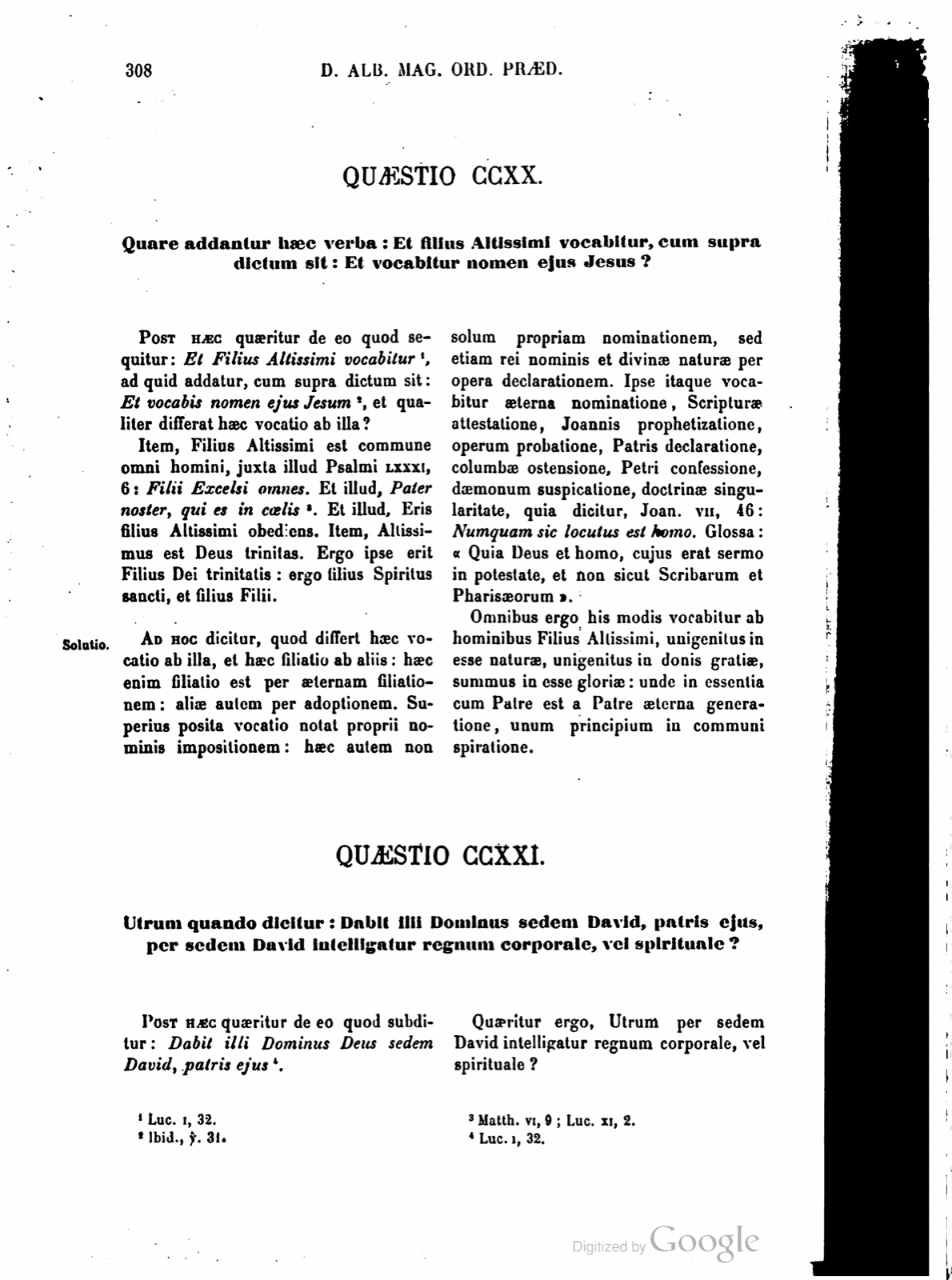
Post haec quaeritur de eo quod subditur: Dabit illi Dominus Deus sedem David, patris ejus 1.
Quaeritur ergo, Utrum per sedem David intelligatur regnum corporale, vel spirituale?
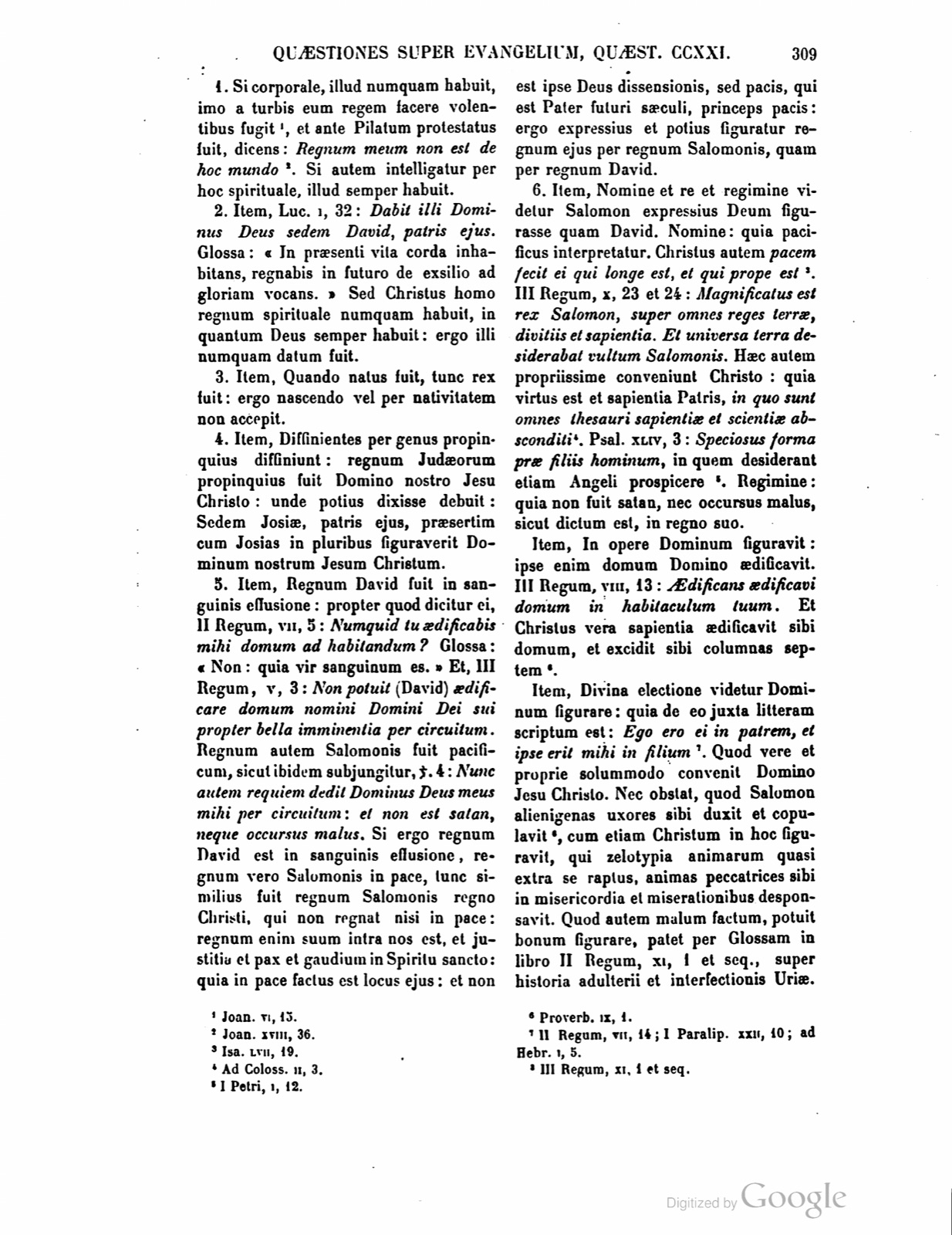
1. Si corporale, illud numquam habuit, imo a turbis eum regem facere volentibus fugit 2, et ante Pilatum protestatus fuit, dicens: Regnum meum non est de hoc mundo 3. Si autem intelligatur per hoc spirituale, illud semper habuit.
2. Item, Luc. I, 32: Dabit illi Dominus Deus sedem David, patris ejus. Glossa: "In praesenti vita corda inhabitans, regnabis in futuro de exsilio ad gloriam vocans." Sed Christus homo regnum spirituale numquam habuit, in quantum Deus semper habuit: ergo illi numquam datum fuit.
3. Item, Quando natus fuit, tunc rex fuit: ergo nascendo vel per nativitatem non accepit.
4. Item, Diffinientes per genus propinquius diffiniunt: regnum Judaeorum propinquius fuit Domino nostro Jesu Christo: unde potius dixisse debuit: Sedem Josiae, patris ejus, praesertim cum Josias in pluribus figuraverit Dominum nostrum Jesum Christum.
5. Item, Regnum David fuit in sanguinis effusione: propter quod dicitur II Regum, VII, 5: Numquid tu aedificabis mihi domum ad habitandum? Glossa: "Non: quia vir sanguinum es." Et, III Regum, V, 3: Non potuit David aedificare domum nomini Domini Dei sui propter bella imminentia per circuitum. Regnum autem Salomonis fuit pacificum, sicut ibidem subjungitur, v. 4: Nunc autem requiem dedit Dominus Deus meus mihi per circuitum: et non est satan, neque occursus malus. Si ergo regnum David est in sanguinis effusione, regnum vero Salomonis in pace, tunc similius fuit regnum Salomonis regno Christi, qui non regnat nisi in pace: regnum enim suum intra nos est, et justitia et pax et gaudium in Spiritu sancto: quia in pace factus est locus ejus: et non est ipse Deus dissensionis, sed pacis, qui est Pater futuri saeculi, princeps pacis: ergo expressius et potius figuratur regnum ejus per regnum Salomonis, quam per regnum David.
QUESTION 221. Whether, when it is said: The Lord will give him the throne of David his father, by the throne of David a bodily or spiritual kingdom is understood?
After these things inquiry is made concerning what is added: The Lord God will give him the throne of David his father 1.
Therefore it is asked whether by the throne of David a bodily kingdom or a spiritual one is understood.
1. If bodily, he never had that; indeed he fled from the crowds wishing to make him king 2, and before Pilate he bore witness, saying: My kingdom is not of this world 3. But if by this a spiritual kingdom is understood, he always had that.
2. Likewise, Luke 1:32: The Lord God will give him the throne of David his father. The Gloss says: "In the present life inhabiting hearts, you will reign in the future by calling from exile to glory." But Christ as human never had the spiritual kingdom, and insofar as God he always had it; therefore it was never given to him.
3. Likewise, when he was born, then he was king; therefore he did not receive it by being born or through nativity.
4. Likewise, those defining define by the nearer genus; the kingdom of the Jews was nearer to our Lord Jesus Christ. Whence it ought rather to have said: The throne of Josiah, his father, especially since Josiah in many things figured our Lord Jesus Christ.
5. Likewise, the kingdom of David was in the shedding of blood, on account of which it is said in 2 Kings 7:5: Will you build me a house to dwell in? The Gloss says: "No, because you are a man of bloods." And 3 Kings 5:3 says: David could not build a house to the name of the Lord his God because of the wars pressing around him. But the kingdom of Solomon was peaceful, as is added in the same place, verse 4: But now the Lord my God has given me rest all around, and there is no Satan nor evil encounter. Therefore, if the kingdom of David is in the shedding of blood, but the kingdom of Solomon in peace, then the kingdom of Solomon was more similar to the kingdom of Christ, who reigns only in peace; for his kingdom is within us, and justice and peace and joy in the Holy Spirit; because his place was made in peace; and he is not himself God of dissension, but of peace, who is Father of the future age, prince of peace. Therefore his kingdom is figured more expressly and more fittingly by the kingdom of Solomon than by the kingdom of David.
6. Item, Nomine et re et regimine videtur Salomon expressius Deum figurasse quam David. Nomine: quia pacificus interpretatur. Christus autem pacem fecit ei qui longe est, et qui prope est 4. III Regum, X, 23 et 24: Magnificatus est rex Salomon, super omnes reges terrae, divitiis et sapientia. Et universa terra desiderabat vultum Salomonis. Haec autem propriissime conveniunt Christo: quia virtus est et sapientia Patris, in quo sunt omnes thesauri sapientiae et scientiae absconditi 5. Psal. XLIV, 3: Speciosus forma prae filiis hominum, in quem desiderant etiam Angeli prospicere 6. Regimine: quia non fuit satan, nec occursus malus, sicut dictum est, in regno suo.
6. Likewise, in name and in reality and in rule Solomon seems to have figured God more expressly than David. In name, because he is interpreted peaceful. But Christ made peace for the one who is far away and for the one who is near 4. 3 Kings 10:23 and 24: King Solomon was magnified above all kings of the earth in riches and wisdom. And the whole earth desired the face of Solomon. But these things most properly belong to Christ, because he is the power and wisdom of the Father, in whom are hidden all treasures of wisdom and knowledge 5. Psalm 44:3: Beautiful in form above the sons of men, into whom even the Angels desire to look 6. In rule, because there was no Satan nor evil encounter, as has been said, in his kingdom.
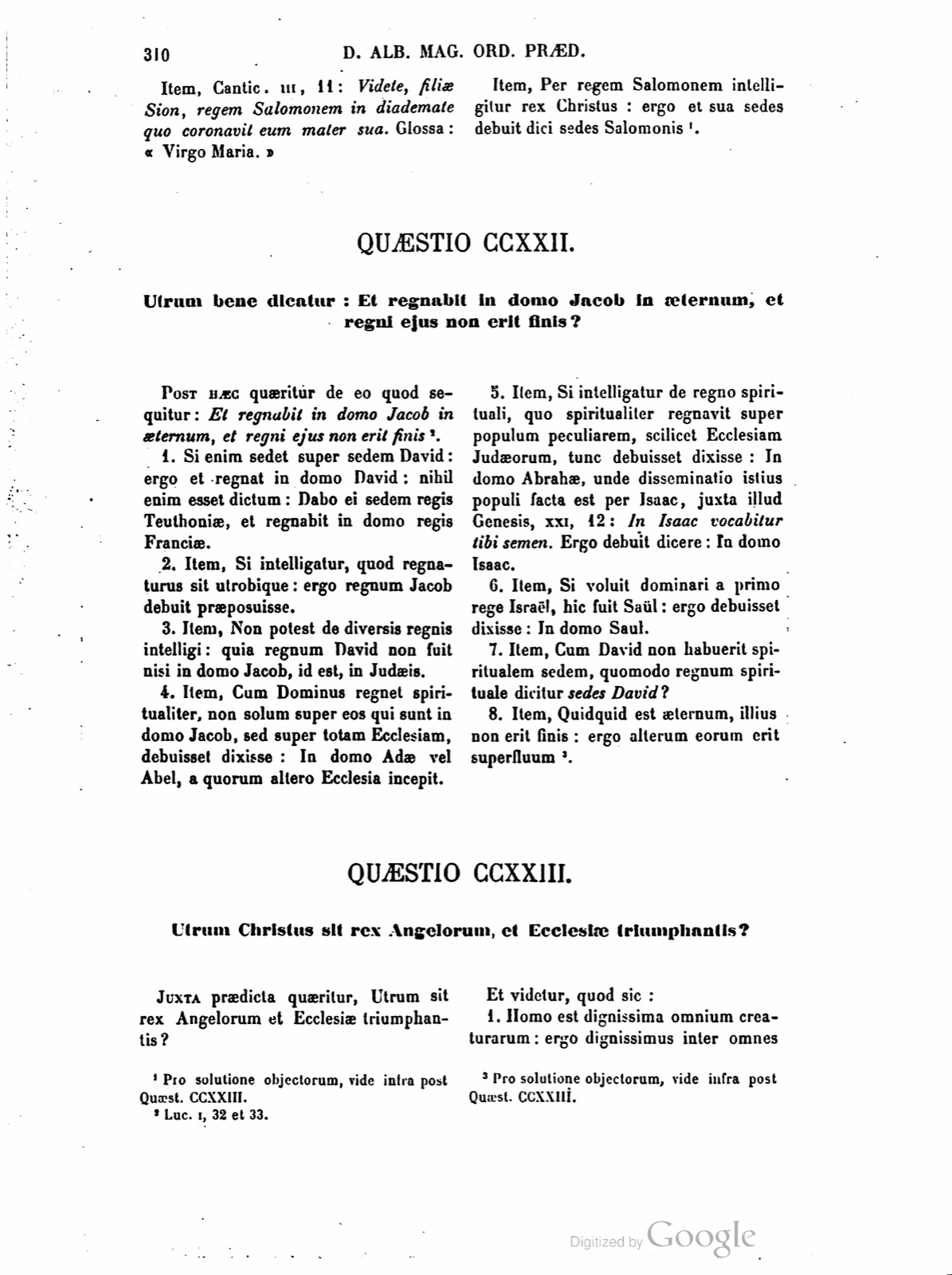
Item, In opere Dominum figuravit: ipse enim domum Domino aedificavit. III Regum, VII, 13: Aedificans aedificavi ei, domum in habitaculum tuum. Et Christus vera sapientia aedificavit sibi domum, et excidit sibi columnas septem 7.
Item, Divina electione videtur Dominum figurare: quia de eo juxta litteram scriptum est: Ego ero ei in patrem, et ipse erit mihi in filium 8. Quod vere et proprie solummodo convenit Domino Jesu Christo. Nec obstat, quod Salomon alienigenas uxores sibi duxit et copulavit, cum etiam Christum in hoc figuravit, qui zelotypia animarum quasi extra se raptus, animas peccatrices sibi in misericordia et miserationibus desponsavit. Quod autem malum factum, potuit bonum figurare, patet per Glossam in libro II Regum, XI, 1 et seq., super historia adulterii et interfectionis Uriae 9.
Item, Cantic. III, 11: Videte, filiae Sion, regem Salomonem in diademate quo coronavit eum mater sua. Glossa: "Virgo Maria."
Item, Per regem Salomonem intelligitur rex Christus: ergo et sua sedes debuit dici sedes Salomonis 10.
Likewise, in work he figured the Lord; for he built a house for the Lord. 3 Kings 7:13: Building I built for him a house for your dwelling. And Christ, true Wisdom, built a house for himself and hewed out seven columns for himself 7.
Likewise, by divine election he seems to figure the Lord, because of him according to the letter it was written: I will be to him for a father, and he will be to me for a son 8. This truly and properly belongs only to the Lord Jesus Christ. Nor is it an obstacle that Solomon took and joined foreign wives to himself, since even in this he figured Christ, who, as if carried outside himself by jealousy for souls, espoused sinful souls to himself in mercy and acts of pity. But that an evil deed could figure a good thing is clear through the Gloss in the book of 2 Kings 11:1 and following, on the story of the adultery and killing of Uriah 9.
Likewise, Song of Songs 3:11: See, daughters of Zion, King Solomon in the diadem with which his mother crowned him. The Gloss says: "The Virgin Mary."
Likewise, by King Solomon King Christ is understood; therefore his throne too ought to have been called the throne of Solomon 10.
Notes
- Luke 1:32. (Luc. I, 32.) ↩
- John 6:15. (Joan. VI, 15.) ↩
- John 18:36. (Joan. XVIII, 36.) ↩
- Isaiah 57:19. (Isa. LVII, 19.) ↩
- Colossians 2:3. (Ad Coloss. II, 3.) ↩
- 1 Peter 1:12. (I Petri, I, 12.) ↩
- Proverbs 9:1. (Proverb. IX, 1.) ↩
- 2 Kings 7:14; 1 Chronicles 21:10; Hebrews 1:5. (II Regum, VII, 14; I Paralip. XXI, 10; ad Hebr. I, 5.) ↩
- 3 Kings 11:1 and following. (III Regum, XI, 1 et seq.) ↩
- For the solution of the objections, see below after Question 223. (Pro solutione objectorum, vide infra post Quaest. CCXXIII.) ↩
If a page does not appear, its photograph has not been uploaded yet.