Works › The Mariale: Questions on “Missus est”
Volume 37 · pp. 310–312
Question 223 and Response to Questions 221, 222, 223
A marker with ≈ is an approximate page boundary, placed by measure of the text; the page photographs remain the authority. In the paired views, clicking a page marker brings that page into view.
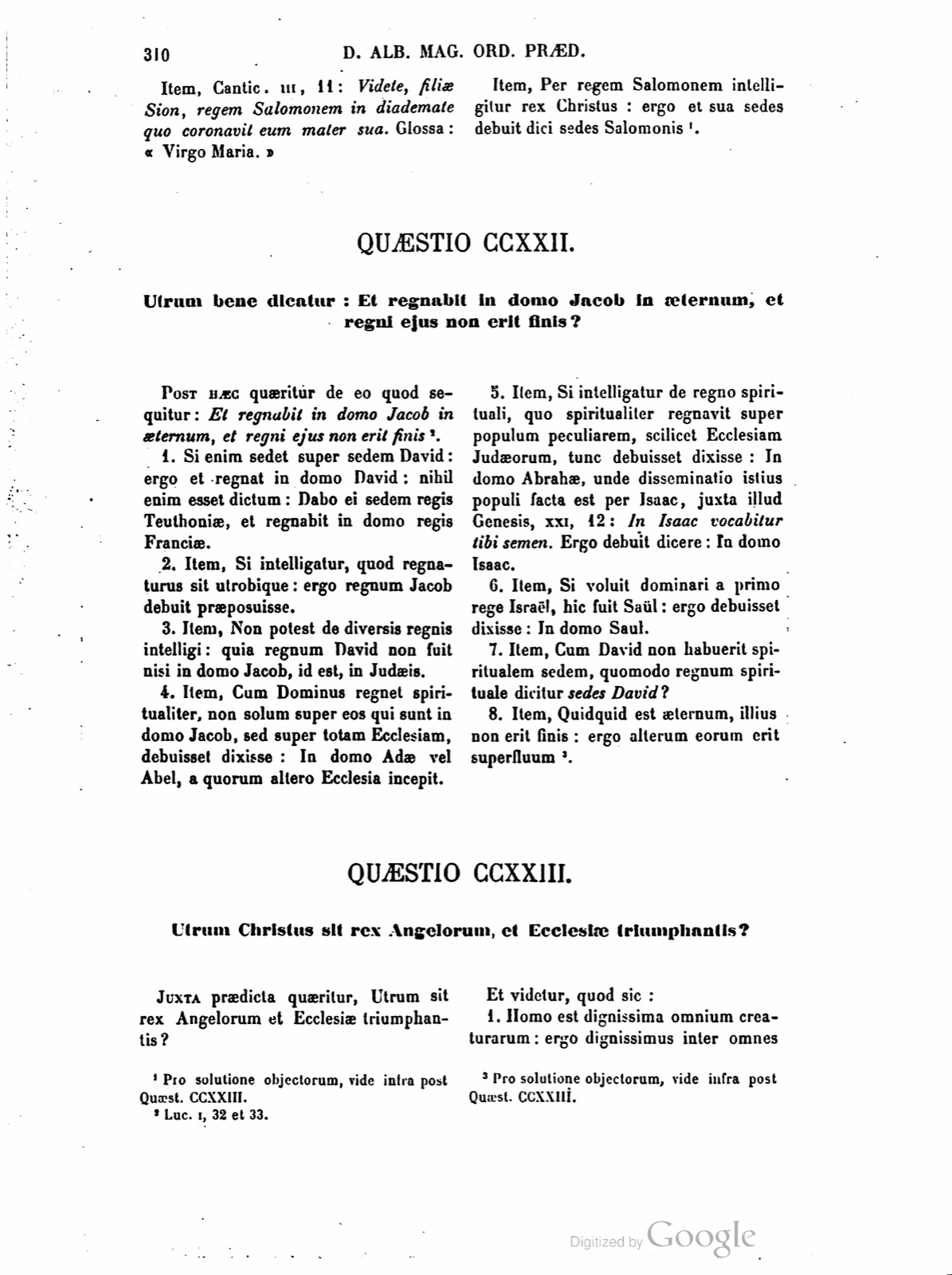
QUAESTIO CCXXIII. Utrum Christus sit rex Angelorum, et Ecclesiae triumphantis?
Juxta praedicta quaeritur, Utrum sit rex Angelorum et Ecclesiae triumphantis?
Et videtur, quod sic:
1. Homo est dignissima omnium creaturarum: ergo dignissimus inter omnes homines erit omnium creaturarum dignissima: ergo rex.
2. Item, Mater sua est regina Angelorum: ergo ipse Angelorum rex.
3. Item, Mater sua exaltata est super choros Angelorum, ut dicit Hieronymus: quod sibi soli convenit, et matri et Filio: ergo ipsa regina et ipse rex Angelorum.
4. Item, Charitas ordinat statum patriae: sed Dominus improportionabiliter habuit charitatem super Seraphim: ergo et statum: ergo et rex Angelorum.
5. Item, Matth. IV, 11: Ecce Angeli accesserunt, et ministrabant ei.
6. Item, Ipse est in quem desiderant Angeli prospicere 1.
7. Item, Apocal. XIX, 10: Conservus tuus sum, et fratrum tuorum, dicit Angelus ad Joannem.
8. Item, Apocal. IV, 10, viginti quatuor seniores mittunt coronas suas ante pedes sedentis in throno: quia omnes sancti confitentur, quod per humanitatem Christi coronati sunt.
9. Item, Filii resurrectionis aequales erunt Angelis: sed ipse est illorum rex: ergo et Angelorum: ipse enim est primogenitus mortuorum et princeps regum 2.
10. Item, Luc. XIX, 12: Homo quidam nobilis abiit in regionem longinquam accipere sibi regnum, et reverti. Ergo Christus accepit regnum Ecclesiae triumphantis.
11. Item, Isidorus: "Trinitas sibi soli nota est et homini assumpto."
12. Item, Anima Christi scivit omnia, quae Deus: ergo ipse superior Angelorum in cognitione: ergo et in dilectione.
13. Item Dionysius dicit in libro de Ecclesiastica hierarchia: "Lex quidem haec est divinitatis sacratissima per prima secunda ad divinissimam suam reducere lucem 3." Et sic per superiora reguntur inferiora: ergo ipse rex est Angelorum.
14. Item, Apocal. XIX, 16: Habet in vestimento et in femore suo scriptum: Rex regum, et Dominus dominantium. Item, Dionysius in libro de Caelesti hierarchia: "Quasdam illarum caelestes essentias introducunt a prioribus sacre eruditas, Dominum esse caelestium virtutum et regem gloriae in caelos humanitus receptum. Quasdam vero apud ipsum Jesum quaerentes, et pro nobis suae divinae actionis scientiam discentes, et eas ipsum Jesum immediate docentem, et praelargiens eis manifestantem suam humanam benignitatem. Ego, inquit, disputo justitiam et judicium salutaris 4." Ex his patet, quod Angeli illuminantur et perficiuntur in quibusdam immediate a Domino nostro Jesu Christo in quantum homo: ergo in quantum homo est rex Angelorum.
QUESTION 223. Whether Christ is king of the Angels and of the Church triumphant?
Next to the aforesaid it is asked whether he is king of the Angels and of the Church triumphant.
And it seems that he is:
1. A human being is the most worthy of all creatures; therefore the most worthy among all human beings will be the most worthy of all creatures; therefore king.
2. Likewise, his mother is queen of the Angels; therefore he is king of the Angels.
3. Likewise, his mother was exalted above the choirs of Angels, as Jerome says; this belongs to her alone, both to the mother and to the Son; therefore she is queen and he king of the Angels.
4. Likewise, charity orders the state of the homeland. But the Lord had charity beyond proportion above the Seraphim; therefore also the state; therefore also he is king of the Angels.
5. Likewise, Matthew 4:11: Behold, Angels came and ministered to him.
6. Likewise, he is the one into whom Angels desire to look 1.
7. Likewise, Apocalypse 19:10: I am your fellow-servant and that of your brothers, the Angel says to John.
8. Likewise, Apocalypse 4:10, the twenty-four elders cast their crowns before the feet of the one sitting on the throne, because all the saints confess that they have been crowned through the humanity of Christ.
9. Likewise, the sons of the resurrection will be equal to the Angels; but he is their king; therefore also king of the Angels. For he himself is the firstborn of the dead and prince of kings 2.
10. Likewise, Luke 19:12: A certain noble man went away into a far country to receive a kingdom for himself and to return. Therefore Christ received the kingdom of the Church triumphant.
11. Likewise, Isidore says: "The Trinity is known only to itself and to the assumed human being."
12. Likewise, the soul of Christ knew all things that God knew; therefore he is superior to the Angels in knowledge; therefore also in love.
13. Likewise Dionysius says in the book On the Ecclesiastical Hierarchy: "This indeed is the most sacred law of divinity, to lead secondary things back through primary things to its most divine light 3." And thus lower things are ruled through higher things; therefore he is king of the Angels.
14. Likewise, Apocalypse 19:16: He has written on his garment and on his thigh: King of kings and Lord of lords. Likewise, Dionysius in the book On the Celestial Hierarchy says: "They introduce certain of those celestial essences as sacredly instructed by the prior ones that the Lord of the heavenly powers and king of glory has been humanly received into the heavens. But others are presented as asking from Jesus himself, and learning for us the knowledge of his divine action, and Jesus himself immediately teaching them and, in giving beforehand to them, manifesting his human kindness. I, he says, discuss justice and the judgment of salvation 4." From these things it is clear that the Angels are illuminated and perfected in certain things immediately by our Lord Jesus Christ insofar as he is human; therefore insofar as he is human he is king of the Angels.
Contra:
1. Caelestis hierarchia est supra humanam: ergo infimus de caelesti est super supremum de humana: sed inferiora non regunt superiora: ergo nullus homo potest esse rex Angelorum.
2. Item, Simile est simplum simplo et optimum optimo: sed Angelus est superior et melior homine: ergo optimus Angelus optimo homine.
3. Item, Dionysius: "Regnum est omnis finis et ornatus et legis et ordinis distributio 5." Sed Christus in quantum homo non distribuit Angelis fines et ornatus et legem: ergo non est rex eorum in quantum homo.
4. Item, Psal. VIII, 6: Minuisti eum paulo minus ab Angelis. Ergo non est rex Angelorum.
5. Item, Christus aut est superior Angelis in quantum homo, aut non. Si non: ergo non est rex Angelorum. Si sic et in quantum homo: ergo omnis homo, quod est falsum.
6. Item, Rex debet esse ejusdem naturae cum eis quorum est rex, et e converso: asinus enim non ponetur rex avium, nec aquila rex animalium gressibilium: sed Christus homo non est ejusdem naturae cum Angelis: ergo in quantum homo non est rex Angelorum.
7. Item, In Angelis non est proprie lex: ergo non est rex.
8. Item, Anima est substantia intellectualis illuminationum a primo ultima delatione recipiens: ergo Angelus prior: ergo naturaliter superior anima: et anima est supremum hominis: ergo superior omni homine: ergo non est rex Angelorum.
9. Item, Spiritus unibilis corpori, propinquior est quam non unibilis: et spiritus non unibilis, propinquior est spiritui increato quam unibilis: ergo spiritus Angelicus propinquior est Deo quam humanus: ergo nobilior et melior: ergo homo non potest esse rex Angelorum.
10. Item, Luc. XXII, 43: Apparuit illi Angelus de caelo confortans eum. Item, Dionysius in libro de Caelesti hierarchia: "Video enim, quod et ipse Jesus supercaelestium essentiarum superessentialis essentia, ad id quod secundum nos immutabiliter veniens, non resilit a se ordinata et assumpta humana ordinatione, sed obediens subditur Patris et Dei per Angelos dispositionibus, et per medios ipsos nuntiatur Joseph a Patre disposita Filii ad Aegyptum recessio, et item ad Judaeam ex Aegypto transductio, et per Angelos ipsum videmus sub Patris legislationibus ordinatum. Insto enim dicere ut scienti nostris sacerdotalibus traditionibus expressa, et de Angelo ipsum Jesum confortante 6."
To the contrary:
1. The celestial hierarchy is above the human; therefore the lowest of the celestial is above the highest of the human. But lower things do not rule higher things; therefore no human being can be king of the Angels.
2. Likewise, the simple is like the simple and the best like the best; but an Angel is superior to and better than a human being; therefore the best Angel is above the best human being.
3. Likewise, Dionysius says: "Kingdom is the distribution of every end and adornment and law and order 5." But Christ insofar as human does not distribute ends and adornments and law to the Angels; therefore he is not their king insofar as human.
4. Likewise, Psalm 8:6: You made him a little less than the Angels. Therefore he is not king of the Angels.
5. Likewise, Christ is either superior to the Angels insofar as human, or not. If not, then he is not king of the Angels. If so, and insofar as human, then every human being is, which is false.
6. Likewise, a king ought to be of the same nature with those of whom he is king, and conversely; for an ass will not be placed as king of birds, nor an eagle as king of walking animals. But Christ as human is not of the same nature with the Angels; therefore insofar as human he is not king of the Angels.
7. Likewise, in Angels there is not properly law; therefore he is not king.
8. Likewise, the soul is an intellectual substance receiving illuminations from the first by the last transmission; therefore the Angel is prior; therefore naturally superior to the soul; and the soul is the highest thing of a human being; therefore superior to every human being; therefore he is not king of the Angels.
9. Likewise, a spirit unible to a body is nearer than a non-unible one; and a non-unible spirit is nearer to the uncreated spirit than a unible one; therefore an angelic spirit is nearer to God than a human spirit; therefore nobler and better; therefore a human being cannot be king of the Angels.
10. Likewise, Luke 22:43: An Angel from heaven appeared to him, strengthening him. Likewise, Dionysius in the book On the Celestial Hierarchy says: "For I see that Jesus himself, the superessential essence of the supercelestial essences, coming immutably to what is according to us, does not leap back from himself in the ordered and assumed human ordering, but obediently is subjected to the dispositions of the Father and God through Angels, and through those mediators the Son's departure to Egypt, disposed by the Father, is announced to Joseph, and likewise the transfer back to Judea from Egypt; and through Angels we see him ordered under the Father's laws. For I insist on saying, as to one who knows the things expressed in our priestly traditions, also concerning the Angel strengthening Jesus himself 6."
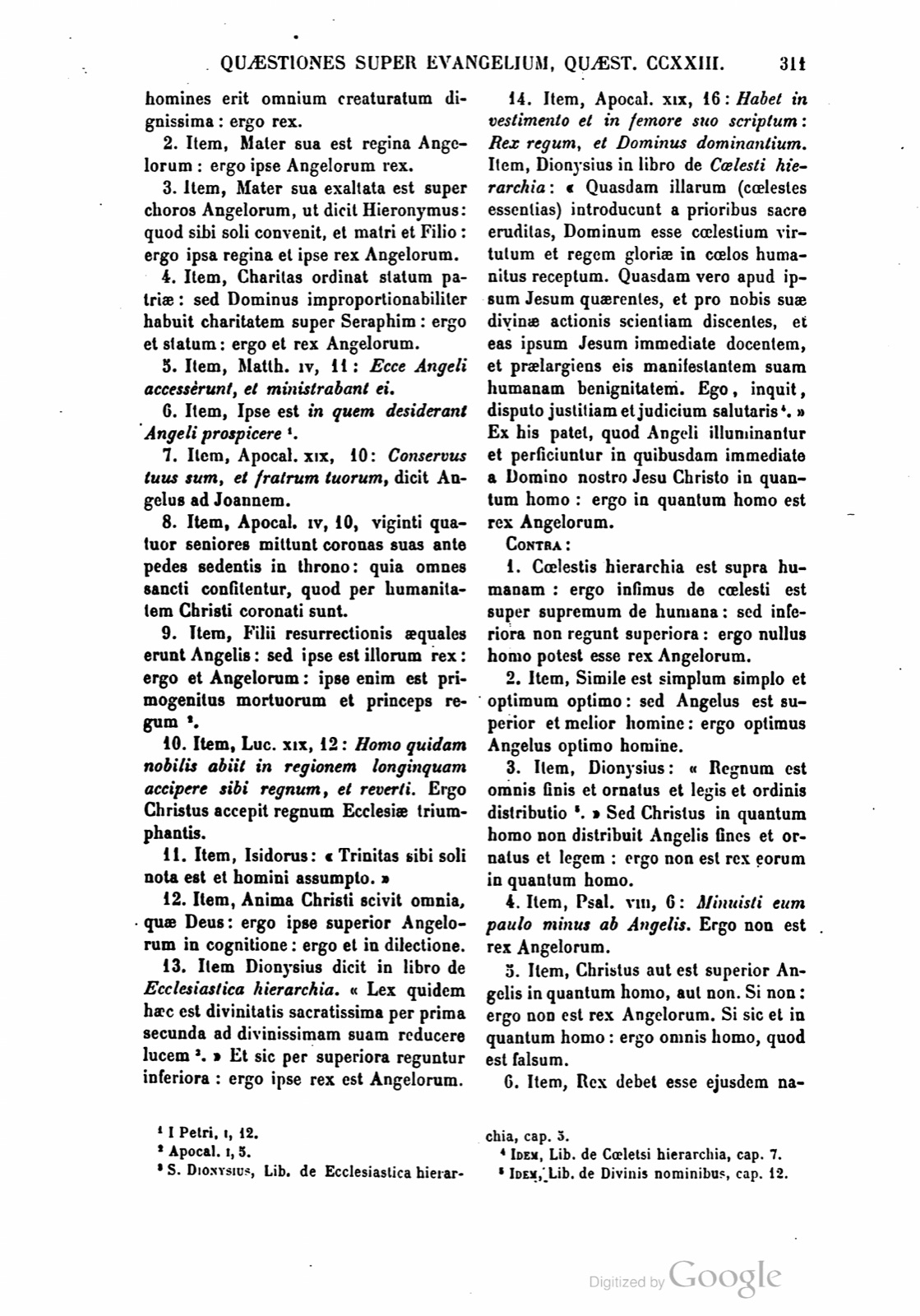
Ex his autem omnibus videtur, quod Dominus noster Jesus Christus in quantum homo sit sub Angelis: ergo non est rex Angelorum.
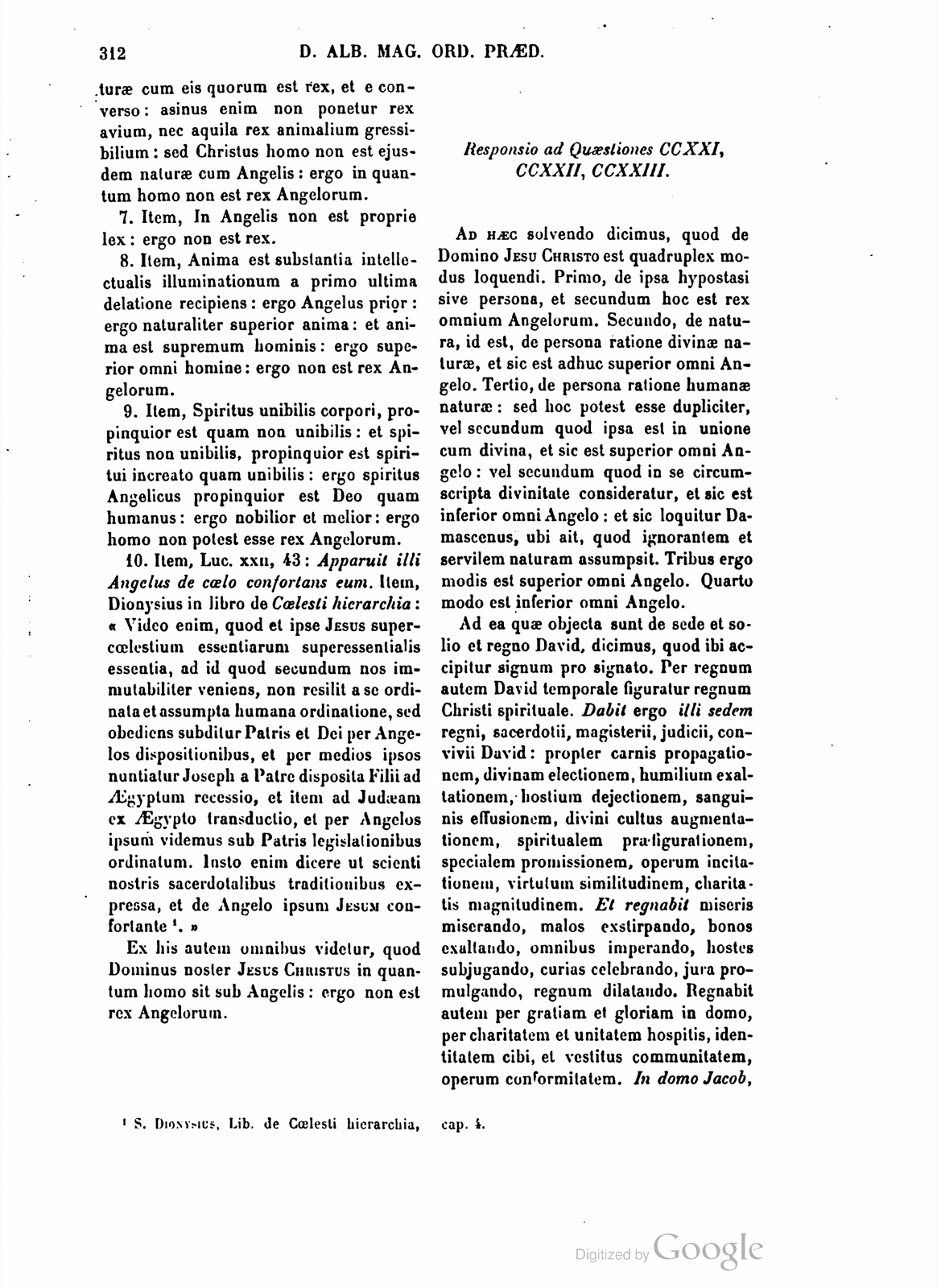
Responsio ad Quaestiones CCXXI, CCXXII, CCXXIII.
Ad haec solvendo dicimus, quod de Domino Jesu Christo est quadruplex modus loquendi. Primo, de ipsa hypostasi sive persona, et secundum hoc est rex omnium Angelorum. Secundo, de natura, id est, de persona ratione divinae naturae, et sic est adhuc superior omni Angelo. Tertio, de persona ratione humanae naturae: sed hoc potest esse dupliciter, vel secundum quod ipsa est in unione cum divina, et sic est superior omni Angelo: vel secundum quod in se circumscripta divinitate consideratur, et sic est inferior omni Angelo: et sic loquitur Damascenus, ubi ait, quod ignorantem et servilem naturam assumpsit. Tribus ergo modis est superior omni Angelo. Quarto modo est inferior omni Angelo.
Ad ea quae objecta sunt de sede et solio et regno David, dicimus, quod ibi accipitur signum pro signato. Per regnum autem David temporale figuratur regnum Christi spirituale. Dabit ergo illi sedem regni, sacerdotii, magisterii, judicii, convivii David: propter carnis propagationem, divinam electionem, humilium exaltationem, hostium dejectionem, sanguinis effusionem, divini cultus augmentationem, spiritualem praefigurationem, specialem promissionem, operum incitationem, virtutum similitudinem, charitatis magnitudinem. Et regnabit miseris miserando, malos exstirpando, bonos exaltando, omnibus imperando, hostes subjugando, curias celebrando, jura promulgando, regnum dilatando. Regnabit autem per gratiam et gloriam in domo, per charitatem et unitatem hospitis, identitatem cibi, et vestitus communitatem, operum conformitatem. In domo Jacob,
But from all these things it seems that our Lord Jesus Christ, insofar as he is human, is under the Angels; therefore he is not king of the Angels.
Response to Questions 221, 222, 223.
In solving these things, we say that there is a fourfold mode of speaking about the Lord Jesus Christ. First, concerning the hypostasis itself or the person, and according to this he is king of all Angels. Second, concerning the nature, that is, concerning the person by reason of the divine nature, and thus he is still superior to every Angel. Third, concerning the person by reason of the human nature. But this can be in two ways: either according as it is in union with the divine nature, and thus he is superior to every Angel; or according as it is considered in itself with the divinity circumscribed, and thus he is inferior to every Angel; and thus Damascene speaks where he says that he assumed an ignorant and servile nature. Therefore in three modes he is superior to every Angel. In the fourth mode he is inferior to every Angel.
To those things which are objected concerning the seat and throne and kingdom of David, we say that there the sign is taken for the thing signified. But through the temporal kingdom of David the spiritual kingdom of Christ is figured. Therefore he will give him the throne of the kingdom, priesthood, teaching office, judgment, and banquet of David: because of the propagation of flesh, divine election, exaltation of the humble, casting down of enemies, shedding of blood, increase of divine worship, spiritual prefiguration, special promise, incitement of works, likeness of virtues, greatness of charity. And he will reign by having mercy on the miserable, by rooting out the evil, by exalting the good, by commanding all, by subjugating enemies, by holding courts, by promulgating laws, by enlarging the kingdom. But he will reign through grace and glory in the house, through charity and unity of the host, identity of food, commonality of clothing, conformity of works. In the house of Jacob,
Notes
- 1 Peter 1:12. (I Petri, I, 12.) ↩
- Apocalypse 1:5. (Apocal. I, 5.) ↩
- St. Dionysius, Book On the Ecclesiastical Hierarchy, chapter 5. (S. Dionysius, Lib. de Ecclesiastica hierarchia, cap. 5.) ↩
- The same, Book On the Celestial Hierarchy, chapter 7. (Idem, Lib. de Caelesti hierarchia, cap. 7.) ↩
- The same, Book On the Divine Names, chapter 12. (Idem, Lib. de Divinis nominibus, cap. 12.) ↩
- St. Dionysius, Book On the Celestial Hierarchy, chapter 4. (S. Dionysius, Lib. de Caelesti hierarchia, cap. 4.) ↩
If a page does not appear, its photograph has not been uploaded yet.