Works › The Mariale: Questions on “Missus est”
Volume 37 · p. 308
Question 220. Why are these words added: And he will be called Son of the Most High, when above it was said: And his name will be called Jesus?
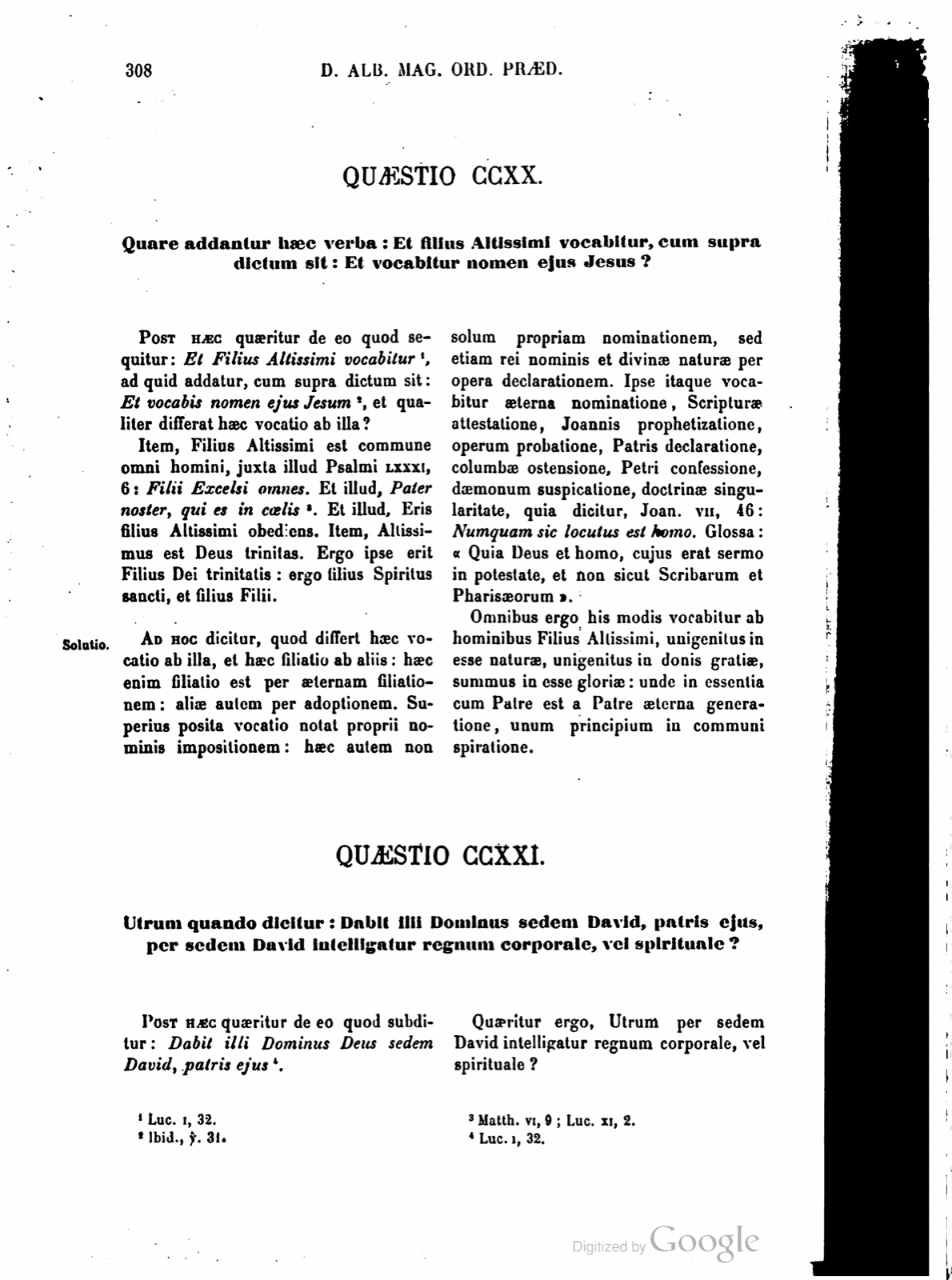
QUAESTIO CCXX. Quare addantur haec verba: Et filius Altissimi vocabitur, cum supra dictum sit: Et vocabitur nomen ejus Jesus?
Post haec quaeritur de eo quod sequitur: Et Filius Altissimi vocabitur 1, ad quid addatur, cum supra dictum sit: Et vocabis nomen ejus Jesum 2, et qualiter differat haec vocatio ab illa?
Item, Filius Altissimi est commune omni homini, juxta illud Psalmi LXXXI, 6: Filii Excelsi omnes. Et illud, Pater noster, qui es in caelis 3. Et illud, Eris filius Altissimi obediens. Item, Altissimus est Deus trinitas. Ergo ipse erit Filius Dei trinitatis: ergo filius Spiritus sancti, et filius Filii.
Solutio. Ad hoc dicitur, quod differt haec vocatio ab illa, et haec filiatio ab aliis: haec enim filiatio est per aeternam filiationem: aliae autem per adoptionem. Superius posita vocatio notat proprii nominis impositionem: haec autem non solum propriam nominationem, sed etiam rei nominis et divinae naturae per opera declarationem. Ipse itaque vocabitur aeterna nominatione, Scripturae attestatione, Joannis prophetizatione, operum probatione, Patris declaratione, columbae ostensione, Petri confessione, daemonum suspicatione, doctrinae singularitate, quia dicitur, Joan. VII, 46: Numquam sic locutus est homo. Glossa: "Quia Deus et homo, cujus erat sermo in potestate, et non sicut Scribarum et Pharisaeorum."
Omnibus ergo his modis vocabitur ab hominibus Filius Altissimi, unigenitus in esse naturae, unigenitus in donis gratiae, summus in esse gloriae: unde in essentia cum Patre est a Patre aeterna generatione, unum principium in communi spiratione.
QUESTION 220. Why are these words added: And he will be called Son of the Most High, when above it was said: And his name will be called Jesus?
After these things inquiry is made concerning what follows: And he will be called Son of the Most High 1, for what reason it is added, when above it was said: And you shall call his name Jesus 2, and in what way this calling differs from that one.
Likewise, Son of the Most High is common to every human being, according to that of Psalm 81:6: All are sons of the Most High. And that, Our Father, who are in heaven 3. And that, You will be an obedient son of the Most High. Likewise, the Most High is God the Trinity. Therefore he will be Son of God the Trinity; therefore son of the Holy Spirit and son of the Son.
Solution. To this it is said that this calling differs from that one, and this sonship from the others; for this sonship is through eternal sonship, but the others are through adoption. The calling placed above marks the imposition of the proper name; but this marks not only proper naming, but also declaration through works of the reality of the name and of the divine nature. And so he will be called by eternal naming, by the attestation of Scripture, by the prophesying of John, by proof of works, by the declaration of the Father, by the showing of the dove, by the confession of Peter, by the suspicion of demons, by the singularity of teaching, because it is said, John 7:46: Never has a man spoken in this way. The Gloss says: "Because God and man, whose speech was in power, and not as that of the Scribes and Pharisees."
Therefore in all these ways he will be called by human beings Son of the Most High, only-begotten in the being of nature, only-begotten in the gifts of grace, highest in the being of glory; whence in essence with the Father he is from the Father by eternal generation, one principle in common spiration.
If a page does not appear, its photograph has not been uploaded yet.