Works › The Mariale: Questions on “Missus est”
Volume 37 · p. 310
Question 222. Whether it is well said: And he will reign in the house of Jacob forever, and of his kingdom there will be no end?
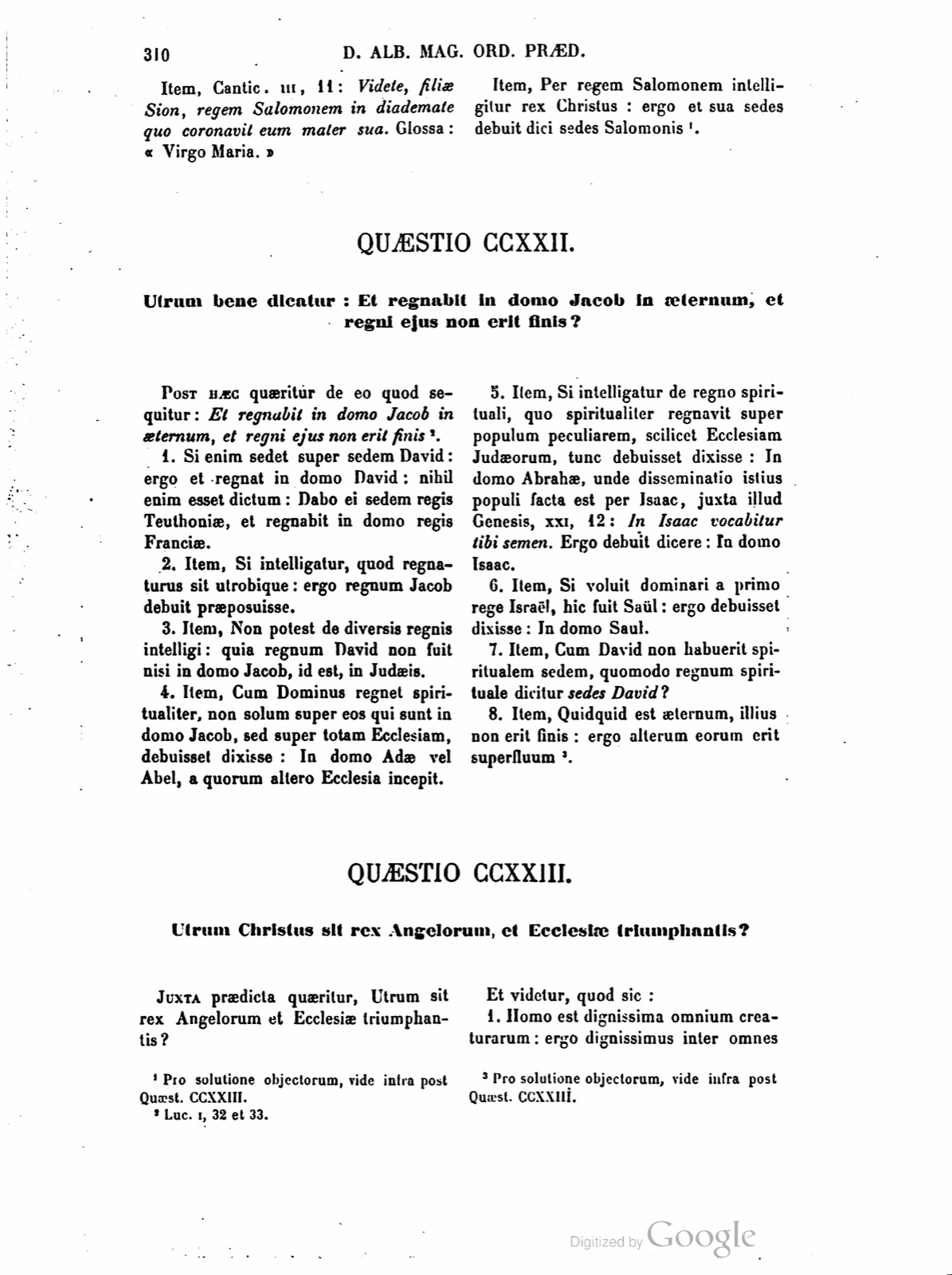
QUAESTIO CCXXII. Utrum bene dicatur: Et regnabit in domo Jacob in aeternum, et regni ejus non erit finis?
Post haec quaeritur de eo quod sequitur: Et regnabit in domo Jacob in aeternum, et regni ejus non erit finis 1.
1. Si enim sedet super sedem David: ergo et regnat in domo David: nihil enim esset dictum: Dabo ei sedem regis Teuthoniae, et regnabit in domo regis Franciae.
2. Item, Si intelligatur, quod regnaturus sit utrobique: ergo regnum Jacob debuit praeposuisse.
3. Item, Non potest de diversis regnis intelligi: quia regnum David non fuit nisi in domo Jacob, id est, in Judaeis.
4. Item, Cum Dominus regnet spiritualiter, non solum super eos qui sunt in domo Jacob, sed super totam Ecclesiam, debuisset dixisse: In domo Adae vel Abel, a quorum altero Ecclesia incepit.
5. Item, Si intelligatur de regno spirituali, quo spiritualiter regnavit super populum peculiarem, scilicet Ecclesiam Judaeorum, tunc debuisset dixisse: In domo Abrahae, unde disseminatio istius populi facta est per Isaac, juxta illud Genesis, XXI, 12: In Isaac vocabitur tibi semen. Ergo debuit dicere: In domo Isaac.
6. Item, Si voluit dominari a primo rege Israel, hic fuit Saul: ergo debuisset dixisse: In domo Saul.
7. Item, Cum David non habuerit spiritualem sedem, quomodo regnum spirituale dicitur sedes David?
8. Item, Quidquid est aeternum, illius non erit finis: ergo alterum eorum erit superfluum 2.
QUESTION 222. Whether it is well said: And he will reign in the house of Jacob forever, and of his kingdom there will be no end?
After these things inquiry is made concerning what follows: And he will reign in the house of Jacob forever, and of his kingdom there will be no end 1.
1. For if he sits upon the throne of David, then he also reigns in the house of David. For nothing would be said by this: I will give him the throne of the king of Germany, and he will reign in the house of the king of France.
2. Likewise, if it is understood that he is going to reign in both, then he ought to have put the kingdom of Jacob first.
3. Likewise, it cannot be understood of diverse kingdoms, because the kingdom of David was only in the house of Jacob, that is, in the Jews.
4. Likewise, since the Lord reigns spiritually not only over those who are in the house of Jacob but over the whole Church, he ought to have said: In the house of Adam or Abel, from one of whom the Church began.
5. Likewise, if it is understood of the spiritual kingdom by which he spiritually reigned over the peculiar people, namely the Church of the Jews, then he ought to have said: In the house of Abraham, whence the spreading abroad of that people was made through Isaac, according to Genesis 21:12: In Isaac your seed will be called for you. Therefore he ought to have said: In the house of Isaac.
6. Likewise, if he wished to rule from the first king of Israel, this was Saul; therefore he ought to have said: In the house of Saul.
7. Likewise, since David did not have a spiritual throne, how is the spiritual kingdom called the throne of David?
8. Likewise, whatever is eternal, of that there will be no end; therefore one of these two will be superfluous 2.
Notes
- Luke 1:32 and 33. (Luc. I, 32 et 33.) ↩
- For the solution of the objections, see below after Question 223. (Pro solutione objectorum, vide infra post Quaest. CCXXIII.) ↩
If a page does not appear, its photograph has not been uploaded yet.