Works › The Mariale: Questions on “Missus est”
Volume 37 · p. 303
Question 215. Whether the incarnate Word has only one name?
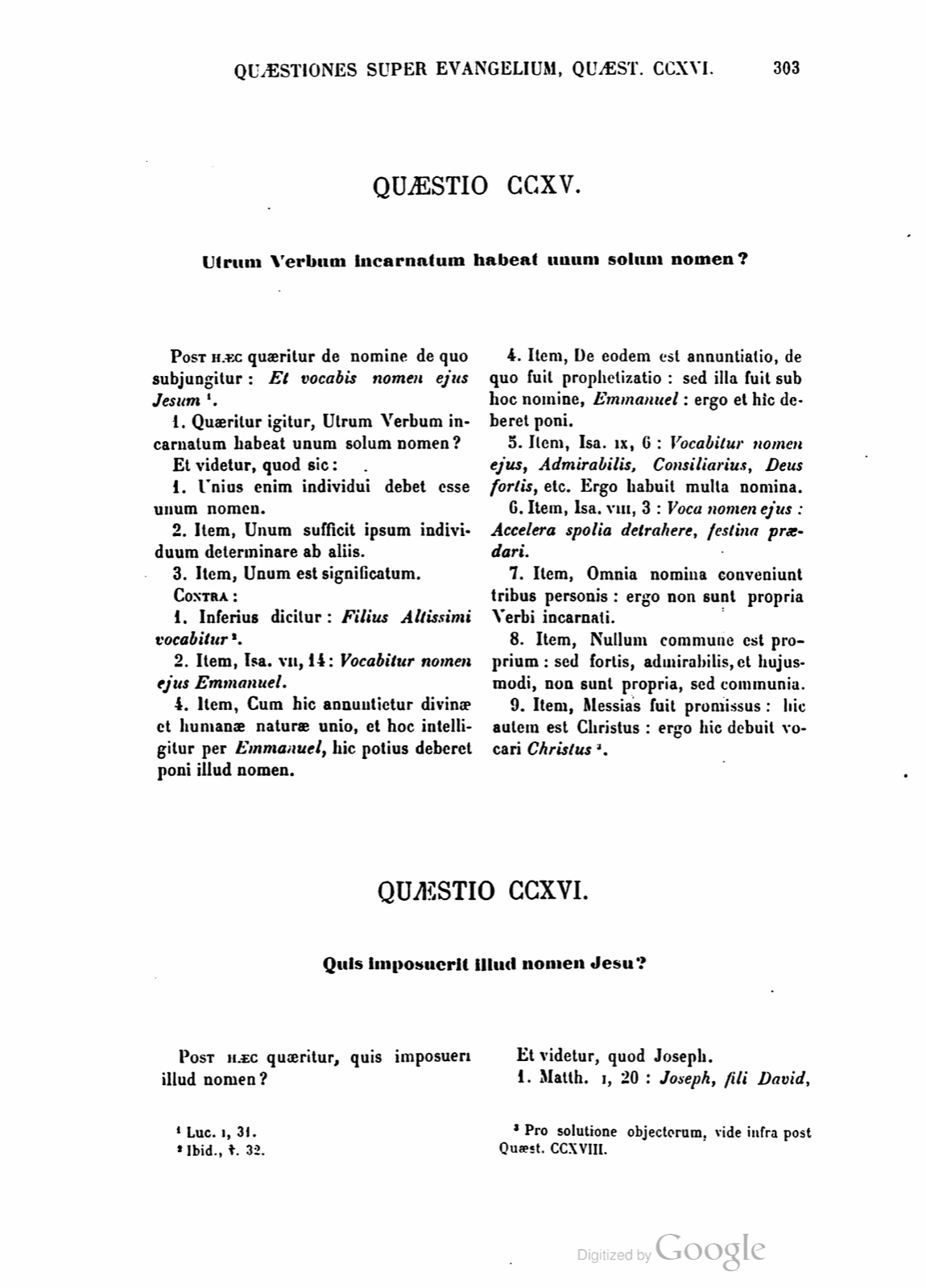
QUAESTIO CCXV. Utrum Verbum incarnatum habeat unum solum nomen?
Post haec quaeritur de nomine de quo subjungitur: Et vocabis nomen ejus Jesum 1.
1. Quaeritur igitur, Utrum Verbum incarnatum habeat unum solum nomen?
Et videtur, quod sic:
1. Unius enim individui debet esse unum nomen.
2. Item, Unum sufficit ipsum individuum determinare ab aliis.
3. Item, Unum est significatum.
Contra:
1. Inferius dicitur: Filius Altissimi vocabitur 2.
2. Item, Isa. VII, 14: Vocabitur nomen ejus Emmanuel.
4. Item, Cum hic annuntietur divinae et humanae naturae unio, et hoc intelligitur per Emmanuel, hic potius deberet poni illud nomen.
4. Item, De eodem est annuntiatio, de quo fuit prophetizatio: sed illa fuit sub hoc nomine, Emmanuel: ergo et hic deberet poni.
5. Item, Isa. IX, 6: Vocabitur nomen ejus, Admirabilis, Consiliarius, Deus fortis, etc. Ergo habuit multa nomina.
6. Item, Isa. VIII, 3: Voca nomen ejus: Accelera spolia detrahere, festina praedari.
7. Item, Omnia nomina conveniunt tribus personis: ergo non sunt propria Verbi incarnati.
8. Item, Nullum commune est proprium: sed fortis, admirabilis, et hujusmodi, non sunt propria, sed communia.
9. Item, Messias fuit promissus: hic autem est Christus: ergo hic debuit vocari Christus 3.
QUESTION 215. Whether the incarnate Word has only one name?
After these things inquiry is made concerning the name about which it is added: And you shall call his name Jesus 1.
1. Therefore it is asked whether the incarnate Word has only one name.
And it seems that he does:
1. For of one individual there ought to be one name.
2. Likewise, one name suffices to determine the individual itself from others.
3. Likewise, there is one thing signified.
To the contrary:
1. Below it is said: He will be called Son of the Most High 2.
2. Likewise, Isaiah 7:14: His name will be called Emmanuel.
4. Likewise, since the union of the divine and human nature is announced here, and this is understood by Emmanuel, that name ought rather to be placed here.
4. Likewise, the announcement is concerning the same one concerning whom there was prophecy; but that was under this name, Emmanuel; therefore here too it ought to be placed.
5. Likewise, Isaiah 9:6: His name will be called Wonderful, Counselor, Mighty God, etc. Therefore he had many names.
6. Likewise, Isaiah 8:3: Call his name: Hasten to take away spoils; make haste to plunder.
7. Likewise, all names belong to the three persons; therefore they are not proper to the incarnate Word.
8. Likewise, nothing common is proper; but mighty, wonderful, and things of this sort are not proper but common.
9. Likewise, the Messiah was promised; but this one is Christ; therefore here he ought to have been called Christ 3.
Notes
- Luke 1:31. (Luc. I, 31.) ↩
- In the same place, verse 32. (Ibid., v. 32.) ↩
- For the solution of the objections, see below after Question 218. (Pro solutione objectorum, vide infra post Quaest. CCXVIII.) ↩
If a page does not appear, its photograph has not been uploaded yet.