Works › The Mariale: Questions on “Missus est”
Volume 37 · pp. 304–305
Question 218 and Response to Questions 215, 216, etc.
A marker with ≈ is an approximate page boundary, placed by measure of the text; the page photographs remain the authority. In the paired views, clicking a page marker brings that page into view.
QUAESTIO CCXVIII. Cui conveniat illud nomen?
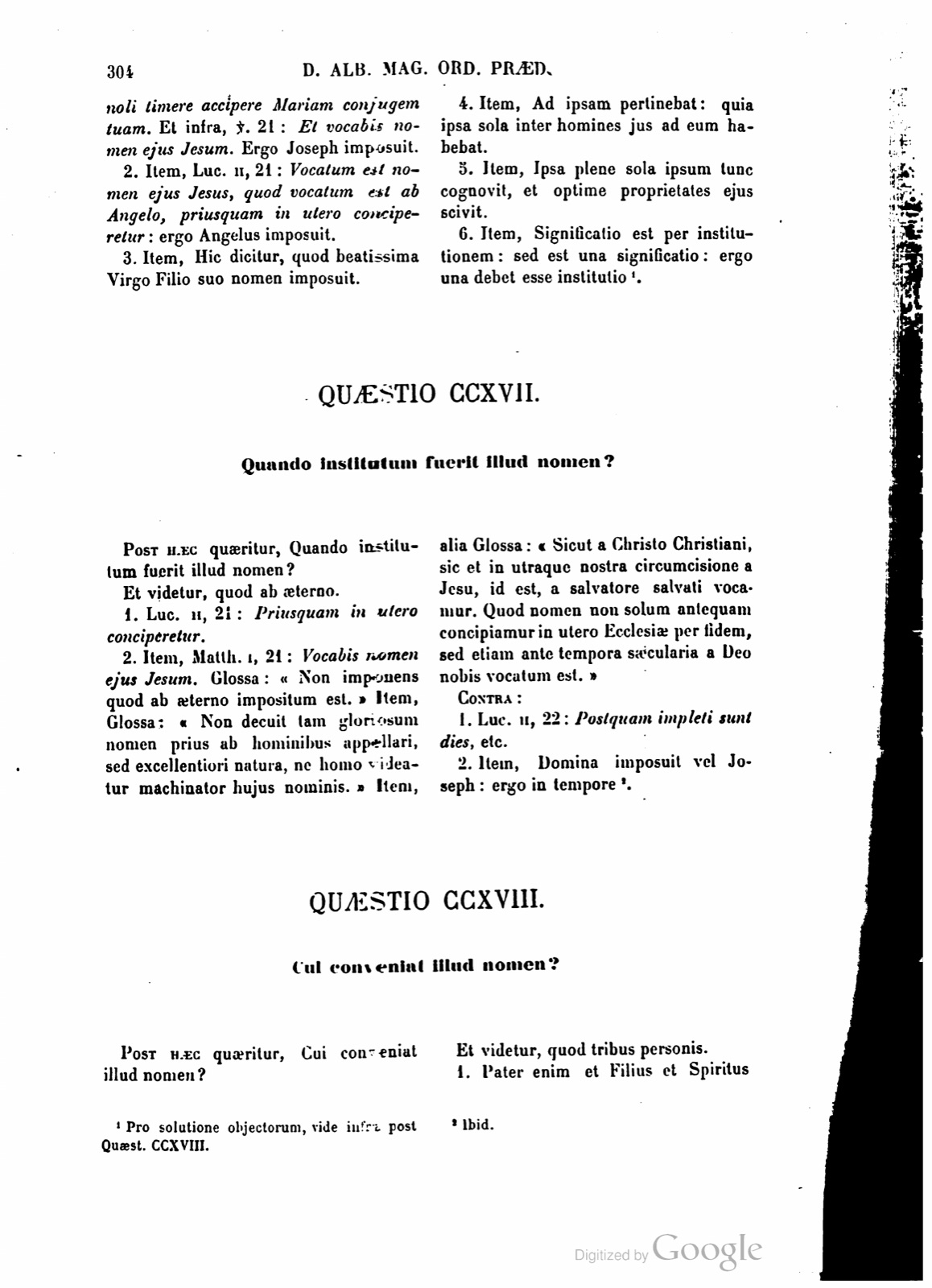
Post haec quaeritur, Cui conveniat illud nomen?
Et videtur, quod tribus personis.
1. Pater enim et Filius et Spiritus sanctus salvant a peccatis: ergo salvator: ergo Jesus.
2. Item, Opera Trinitatis sunt indivisa.
3. Item, Est aeternum, et non est personale: ergo convenit tribus.
4. Item, Connotat effectum: ergo convenit tribus.
Contra: Illud est proprium nomen Verbi incarnati: ergo non convenit Trinitati 1.
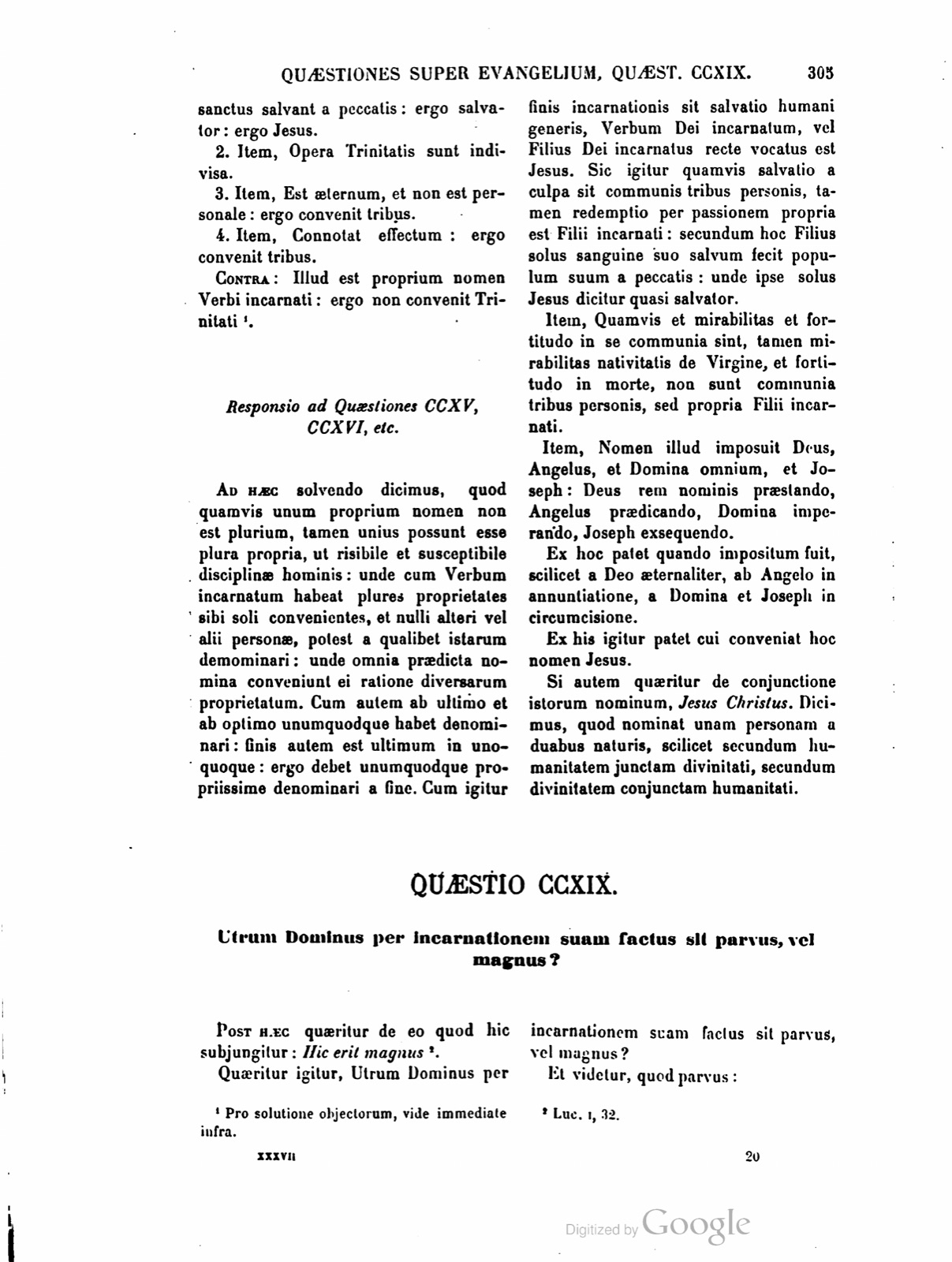
Responsio ad Quaestiones CCXV, CCXVI, etc.
Ad haec solvendo dicimus, quod quamvis unum proprium nomen non est plurium, tamen unius possunt esse plura propria, ut risibile et susceptibile disciplinae hominis: unde cum Verbum incarnatum habeat plures proprietates sibi soli convenientes, et nulli alteri vel alii personae, potest a qualibet istarum denominari: unde omnia praedicta nomina conveniunt ei ratione diversarum proprietatum. Cum autem ab ultimo et ab optimo unumquodque habet denominari: finis autem est ultimum in unoquoque: ergo debet unumquodque propriissime denominari a fine. Cum igitur finis incarnationis sit salvatio humani generis, Verbum Dei incarnatum, vel Filius Dei incarnatus recte vocatus est Jesus. Sic igitur quamvis salvatio a culpa sit communis tribus personis, tamen redemptio per passionem propria est Filii incarnati: secundum hoc Filius solus sanguine suo salvum fecit populum suum a peccatis: unde ipse solus Jesus dicitur quasi salvator.
QUESTION 218. To whom does that name belong?
After these things it is asked to whom that name belongs.
And it seems that it belongs to the three persons.
1. For the Father and the Son and the Holy Spirit save from sins; therefore they are Savior; therefore Jesus.
2. Likewise, the works of the Trinity are undivided.
3. Likewise, it is eternal and is not personal; therefore it belongs to the three.
4. Likewise, it connotes an effect; therefore it belongs to the three.
To the contrary: That is the proper name of the incarnate Word; therefore it does not belong to the Trinity 1.
Response to Questions 215, 216, etc.
In solving these things, we say that although one proper name is not of several, nevertheless several proper things can belong to one, such as risible and capable of discipline to a human being. Whence, since the incarnate Word has several properties belonging to him alone and to no other thing or other person, he can be denominated from any of these; whence all the aforesaid names belong to him by reason of diverse properties. But since each thing has to be denominated from the last and the best, and the end is the last thing in anything, therefore each thing ought to be denominated most properly from its end. Therefore, since the end of the incarnation is the salvation of the human race, the incarnate Word of God, or the incarnate Son of God, was rightly called Jesus. Thus therefore, although salvation from fault is common to the three persons, nevertheless redemption through passion is proper to the incarnate Son. According to this the Son alone saved his people from sins by his blood; whence he alone is called Jesus, as though Savior.
Item, Quamvis et mirabilitas et fortitudo in se communia sint, tamen mirabilitas nativitatis de Virgine, et fortitudo in morte, non sunt communia tribus personis, sed propria Filii incarnati.
Item, Nomen illud imposuit Deus, Angelus, et Domina omnium, et Joseph: Deus rem nominis praestando, Angelus praedicando, Domina imperando, Joseph exsequendo.
Ex hoc patet quando impositum fuit, scilicet a Deo aeternaliter, ab Angelo in annuntiatione, a Domina et Joseph in circumcisione.
Ex his igitur patet cui conveniat hoc nomen Jesus.
Si autem quaeritur de conjunctione istorum nominum, Jesus Christus. Dicimus, quod nominat unam personam a duabus naturis, scilicet secundum humanitatem junctam divinitati, secundum divinitatem conjunctam humanitati.
Likewise, although both wonderfulness and fortitude in themselves are common, nevertheless the wonderfulness of birth from a Virgin and fortitude in death are not common to the three persons, but proper to the incarnate Son.
Likewise, God, the Angel, the Lady of all, and Joseph imposed that name: God by furnishing the reality of the name, the Angel by proclaiming, the Lady by commanding, Joseph by carrying out.
From this it is clear when it was imposed: by God eternally, by the Angel in the annunciation, by the Lady and Joseph in the circumcision.
Therefore from these things it is clear to whom this name Jesus belongs.
But if inquiry is made concerning the conjunction of these names, Jesus Christ, we say that it names one person from two natures, namely according to the humanity joined to the divinity, and according to the divinity conjoined to the humanity.
Notes
- For the solution of the objections, see immediately below. (Pro solutione objectorum, vide immediate infra.) ↩
If a page does not appear, its photograph has not been uploaded yet.