Works › The Mariale: Questions on “Missus est”
Volume 37 · p. 291
Question 202. Whether God himself had shamefastness?
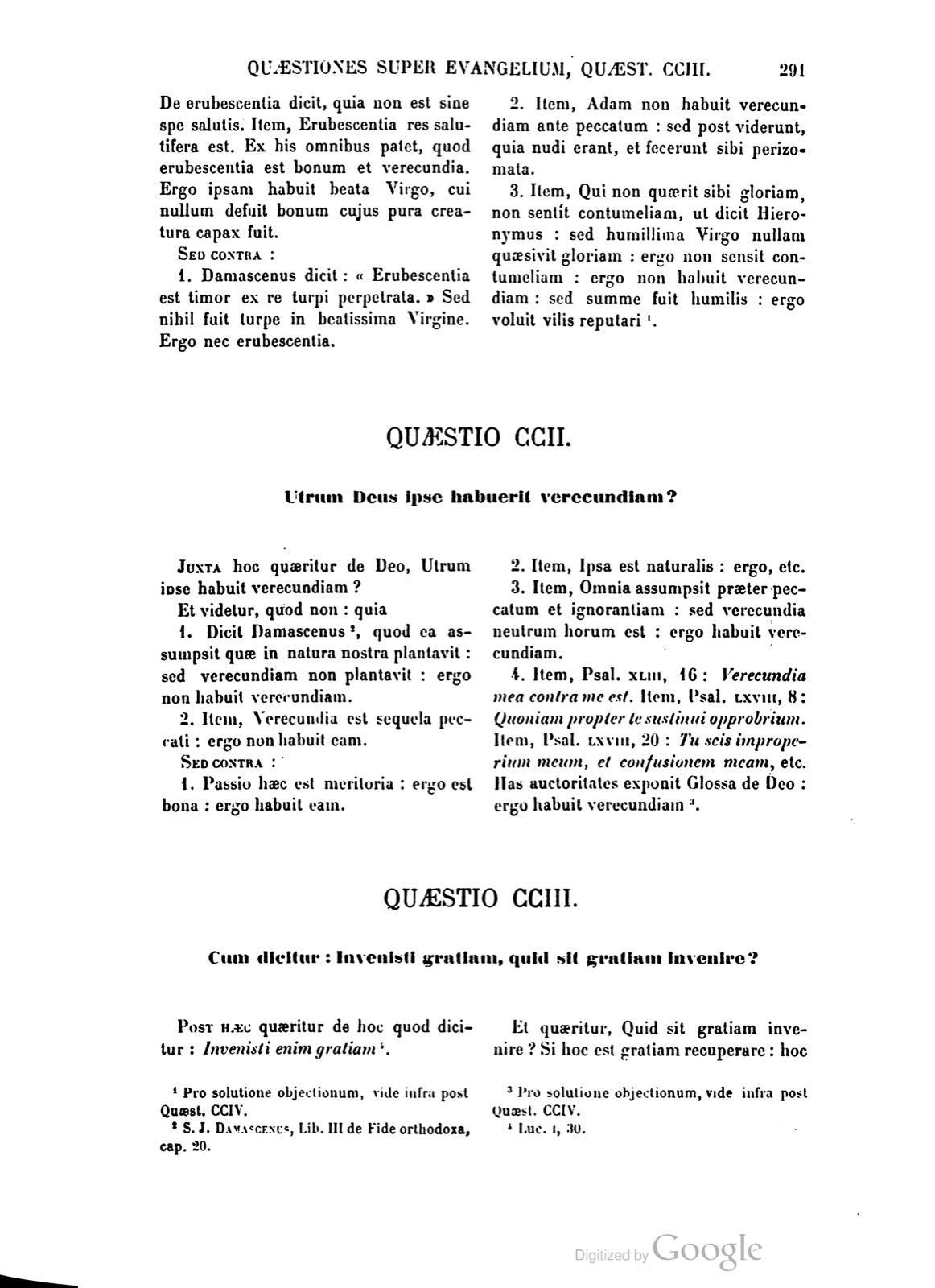
QUAESTIO CCII. Utrum Deus ipse habuerit verecundiam?
Juxta hoc quaeritur de Deo, Utrum ipse habuit verecundiam?
Et videtur, quod non: quia
1. Dicit Damascenus 1, quod ea assumpsit quae in natura nostra plantavit: sed verecundiam non plantavit: ergo non habuit verecundiam.
2. Item, Verecundia est sequela peccati: ergo non habuit eam.
Sed contra:
1. Passio haec est meritoria: ergo est bona: ergo habuit eam.
2. Item, Ipsa est naturalis: ergo, etc.
3. Item, Omnia assumpsit praeter peccatum et ignorantiam: sed verecundia neutrum horum est: ergo habuit verecundiam.
4. Item, Psal. XLII, 16: Verecundia mea contra me est. Item, Psal. LXVIII, 8: Quoniam propter te sustinui opprobrium. Item, Psal. LXVIII, 20: Tu scis improperium meum, et confusionem meam, etc. Has auctoritates exponit Glossa de Deo: ergo habuit verecundiam 2.
QUESTION 202. Whether God himself had shamefastness?
Next to this inquiry is made concerning God, whether he himself had shamefastness.
And it seems that he did not, because:
1. Damascene says 1 that he assumed those things which he planted in our nature. But he did not plant shamefastness. Therefore he did not have shamefastness.
2. Likewise, shamefastness is a consequence of sin; therefore he did not have it.
But to the contrary:
1. This passion is meritorious; therefore it is good; therefore he had it.
2. Likewise, it is natural; therefore, etc.
3. Likewise, he assumed all things except sin and ignorance; but shamefastness is neither of these; therefore he had shamefastness.
4. Likewise, Psalm 42:16: My shamefastness is against me. Likewise, Psalm 68:8: Because for your sake I have borne reproach. Likewise, Psalm 68:20: You know my reproach and my confusion, etc. The Gloss expounds these authorities concerning God; therefore he had shamefastness 2.
Notes
- St. John Damascene, Book 3 On the Orthodox Faith, chapter 20. (S. J. Damascenus, Lib. III de Fide orthodoxa, cap. 20.) ↩
- For the solution of the objections, see below after Question 204. (Pro solutione objectionum, vide infra post Quaest. CCIV.) ↩
If a page does not appear, its photograph has not been uploaded yet.