Works › The Mariale: Questions on “Missus est”
Volume 37 · pp. 292–294
Question 204. Whether these words are well added: With God?
A marker with ≈ is an approximate page boundary, placed by measure of the text; the page photographs remain the authority. In the paired views, clicking a page marker brings that page into view.
QUAESTIO CCIV. Utrum bene addantur haec verba: Apud Deum?
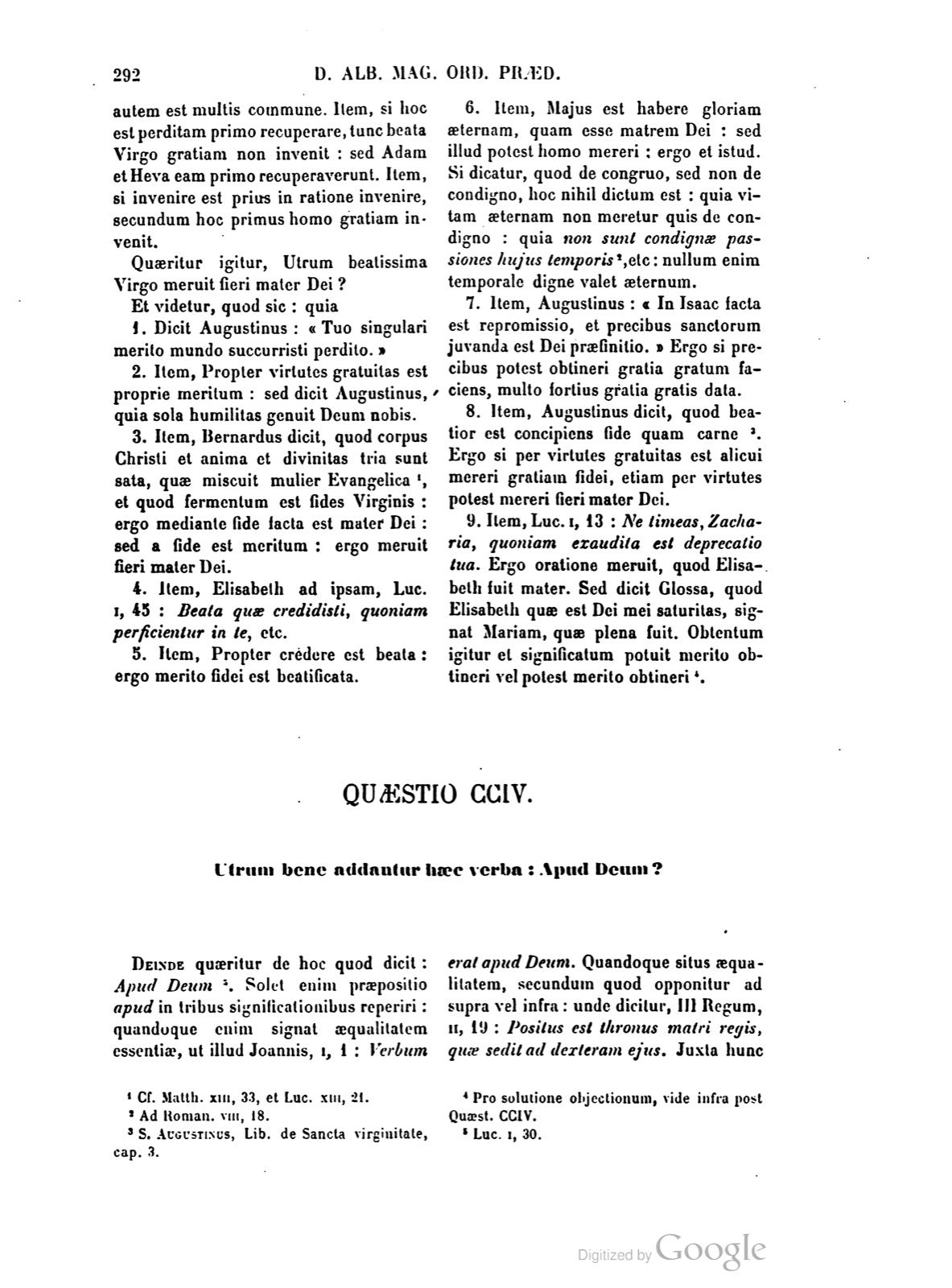
Deinde quaeritur de hoc quod dicit: Apud Deum 1. Solet enim praepositio apud in tribus significationibus reperiri: quandoque enim signat aequalitatem essentiae, ut illud Joannis, I, 1: Verbum erat apud Deum. Quandoque situs aequalitatem, secundum quod opponitur ad supra vel infra: unde dicitur, III Regum, II, 19: Positus est thronus matri regis, quae sedit ad dexteram ejus. Juxta hunc modum dicitur mater Jesus et discipulus quem diligebat Jesus stare juxta crucem 2. Quandoque apud vel juxta dicitur respective, secundum quem modum dicuntur aliae mulieres stare juxta crucem, non juxta crucem absolute, sed respectu turbae quae longius stabat: unde et dicuntur a longe stare respectu matris et discipuli, qui prope stabant sive juxta. Medium enim in comparatione est inter duo extrema.
Quaeritur igitur, quo istorum modorum hic sumatur?
Et videtur, quod ultimo: ipsa enim invenit gratiam propinquiorem quam aliqua alia creatura, non tamen simpliciter aequalis situs potuit esse cum Deo: impossibile enim est in situ vel in aliquo creaturam aequari Deo: oportet ergo si dicitur quoad aliquid esse apud Deum, quod hoc sit respectu aliarum creaturarum.
Quod autem secundo modo sumatur, videtur: quia proprium est reginae apud regem esse, juxta illud Psalmi XLIV, 10: Adstilit regina a dextris tuis. Unde etiam mulier facta fuit de latere viri 3. Similiter etiam matris proprium est esse apud filium, juxta illud, Positus est thronus matri regis, quae sedit ad dexteram ejus 4.
Item, Quod etiam primo modo hoc sumi possit, videtur. Una est majestas regia a qua rex est rex et regina regina: ergo coaequantur illa: ergo apud potest dicere aequalitatem in illa. Vel, sicut dicitur filius esse apud patrem propter identitatem naturae, sic etiam dici potest esse apud filium propter identitatem naturae in qua unum est cum matre, sicut et alia natura unum est cum patre. Et sic potest ibi sumi primo modo apud.
Item, Quaeritur quae sit differentia inter apud et coram, secundum quod in aliis reperitur, quod invenerunt gratiam coram Domino, vel in oculis ejus 5: et, Utrum gratiam habere apud Deum proprium possit esse Virginis gloriosae?
QUESTION 204. Whether these words are well added: With God?
Then inquiry is made concerning this which he says: With God 1. For the preposition with is accustomed to be found in three significations. For sometimes it signifies equality of essence, as that of John 1:1: The Word was with God. Sometimes it signifies equality of position, according as it is opposed to above or below; whence it is said, 3 Kings 2:19: A throne was placed for the mother of the king, who sat at his right hand. According to this mode the mother of Jesus and the disciple whom Jesus loved are said to stand beside the cross 2. Sometimes with or beside is said relatively, according to which mode the other women are said to stand beside the cross, not beside the cross absolutely, but with respect to the crowd which stood farther away; whence they also are said to stand from afar with respect to the mother and the disciple, who stood near or beside. For the middle in comparison is between two extremes.
Therefore it is asked in which of these modes it is taken here.
And it seems that it is taken in the last mode; for she herself found grace nearer than any other creature, yet equality of position simply could not exist with God. For it is impossible for a creature to be equaled to God in position or in anything. Therefore, if it is said that she is with God as regards something, this must be with respect to other creatures.
But that it is taken in the second mode seems so, because it is proper to a queen to be with a king, according to that of Psalm 44:10: The queen stood at your right hand. Whence also the woman was made from the side of the man 3. Similarly also it is proper to a mother to be with her son, according to that, A throne was placed for the mother of the king, who sat at his right hand 4.
Likewise, that this can also be taken in the first mode seems so. There is one royal majesty from which the king is king and the queen queen; therefore they are co-equaled in that; therefore with can express equality in that. Or, as the son is said to be with the father because of identity of nature, so also she can be said to be with the son because of identity of the nature in which he is one with the mother, just as also the other nature is one with the Father. And thus with can be taken there in the first mode.
Likewise, it is asked what is the difference between with and before, according as it is found in other places that they found grace before the Lord, or in his eyes 5; and whether having grace with God can be proper to the glorious Virgin.
Responsio ad Quaestiones CC, CCI, etc.
Ad praedicta solvendo dicimus, quod beata Virgo commemorans praeteritam humilitatem, et admirans praesentis salutationis sublimitatem, speransque futurae impletionis veritatem, quae cum audisset humiliter, diligenter, prudenter, reverenter, laetanter, credendo, sperando, turbatur, admirans Dei potentiam, sapientiam, misericordiam, charitatem, veritatem, humilitatem, nuntii dignitatem, salutationis novitatem, rerum immensitatem, sui parvitatem, propter cautelae timorem, propter verecundiam virginalem, cogitabat lecta dictis comparando, Hevae deceptionem recordando, locutionis praecipitium fugiendo, consuetudinem meditationis exhibendo, usum prudentiae exercendo, modum responsionis ordinando, se fallibilem recognoscendo, nos ad prudentiam invitando. Cogitabat, inquam, qualis, quam admirabilis, quam venerabilis, quam salubris, quam sublimis, quam subtilis, quam familiaris, quam generalis, quam specialis esset ista salutatio. Ista dico, a Deo Patre dictata, a Filio scripta, a Spiritu sancto nuntiata, ab Angelo portata. Ista, inquam, salutatio, quae fuit salutis operatio, inchoatio, portatio, perfectio, augmentatio, confirmatio, perpetuatio. Cui Angelus: Ne timeas regis magnitudinem, tui parvitatem, sermonis falsitatem, rerum incomprehensibilitatem, sententiae ambiguitatem, promissi protractionem, salutis amissionem, retenti diminutionem. Ne timeas, inquam: quia invenisti, non creasti ut Deus, non semper habuisti ut Filius tuus, non rapuisti ut primus Angelus, non perdidisti ut primus parens, non emisti ut Simon magus: sed invenisti, quia quaesivisti ubi fuit ut virgo prudentissima, non abscondisti ut doctrix fidelissima, sed reddidisti ut mater mundissima. Invenisti enim, inquam, Dei miserantis charitate, promittentis veritate, hominis necessitate, tui ad hoc idoneitate. Invenisti, inquam, gratiam increatam, et in illa et cum illa omnem creatam. Venerunt enim tibi omnia bona pariter cum illa 6. Creatam autem spiritualem et corporalem: spiritualem generalem, specialem, singularem: generalem summitatem omnium quae singulariter fuerunt in aliis, specialem summitatem charitatis, singularem summitatem quae comprehensa est duodecim privilegiis. Corporalem similiter generalem, specialem, singularem: generalem corporis resurrectionem, specialem virginitatis integritatem, singularem virginalis uteri foecunditatem. Haec autem omnia invenisti apud Deum. Apud dico propinquissima similitudine, dignitate, familiaritate, naturae unitate: et hoc apud Deum creatorem, recreatorem, justificatorem, glorificatorem.
Response to Questions 200, 201, etc.
In solving the aforesaid, we say that the blessed Virgin, recalling past humility, and admiring the sublimity of the present salutation, and hoping for the truth of future fulfillment, when she had heard these things humbly, diligently, prudently, reverently, joyfully, by believing, by hoping, is troubled, admiring the power, wisdom, mercy, charity, truth, humility of God, the dignity of the messenger, the newness of the salutation, the immensity of the things, her own smallness; because of the fear of caution, because of virginal shamefastness, she was thinking, comparing things read with things said, recalling Eve's deception, fleeing the precipice of speech, exhibiting the practice of meditation, exercising the use of prudence, ordering the mode of response, recognizing herself as fallible, inviting us to prudence. She was thinking, I say, what sort, how admirable, how venerable, how salutary, how sublime, how subtle, how familiar, how general, how special this salutation was. I say this salutation was dictated by God the Father, written by the Son, announced by the Holy Spirit, carried by an Angel. This salutation, I say, which was the operation of salvation, its beginning, carrying, perfection, increase, confirmation, perpetuation. To her the Angel says: Fear not the greatness of the king, your smallness, the falsity of the speech, the incomprehensibility of the things, the ambiguity of the sentence, the delay of the promise, the loss of salvation, the diminution of what has been retained. Fear not, I say, because you have found; you did not create it as God, you did not always have it as your Son did, you did not seize it as the first Angel did, you did not lose it as the first parent did, you did not buy it as Simon Magus did; but you found it, because you sought where it was as the most prudent virgin, you did not hide it as the most faithful teacher, but you rendered it back as the cleanest mother. For you found, I say, by the charity of God showing mercy, by the truth of him promising, by the necessity of humanity, by your fitness for this. You found, I say, uncreated grace, and in it and with it every created grace. For all good things came to you equally with it 6. Created grace, however, spiritual and bodily: spiritual grace general, special, and singular; general, the summit of all things which were singularly in others; special, the summit of charity; singular, the summit which is comprehended in the twelve privileges. Bodily grace likewise general, special, and singular: general, the resurrection of the body; special, the integrity of virginity; singular, the fecundity of the virginal womb. But all these things you found with God. I say with by nearest similitude, dignity, familiarity, unity of nature; and this with God the creator, recreator, justifier, glorifier.
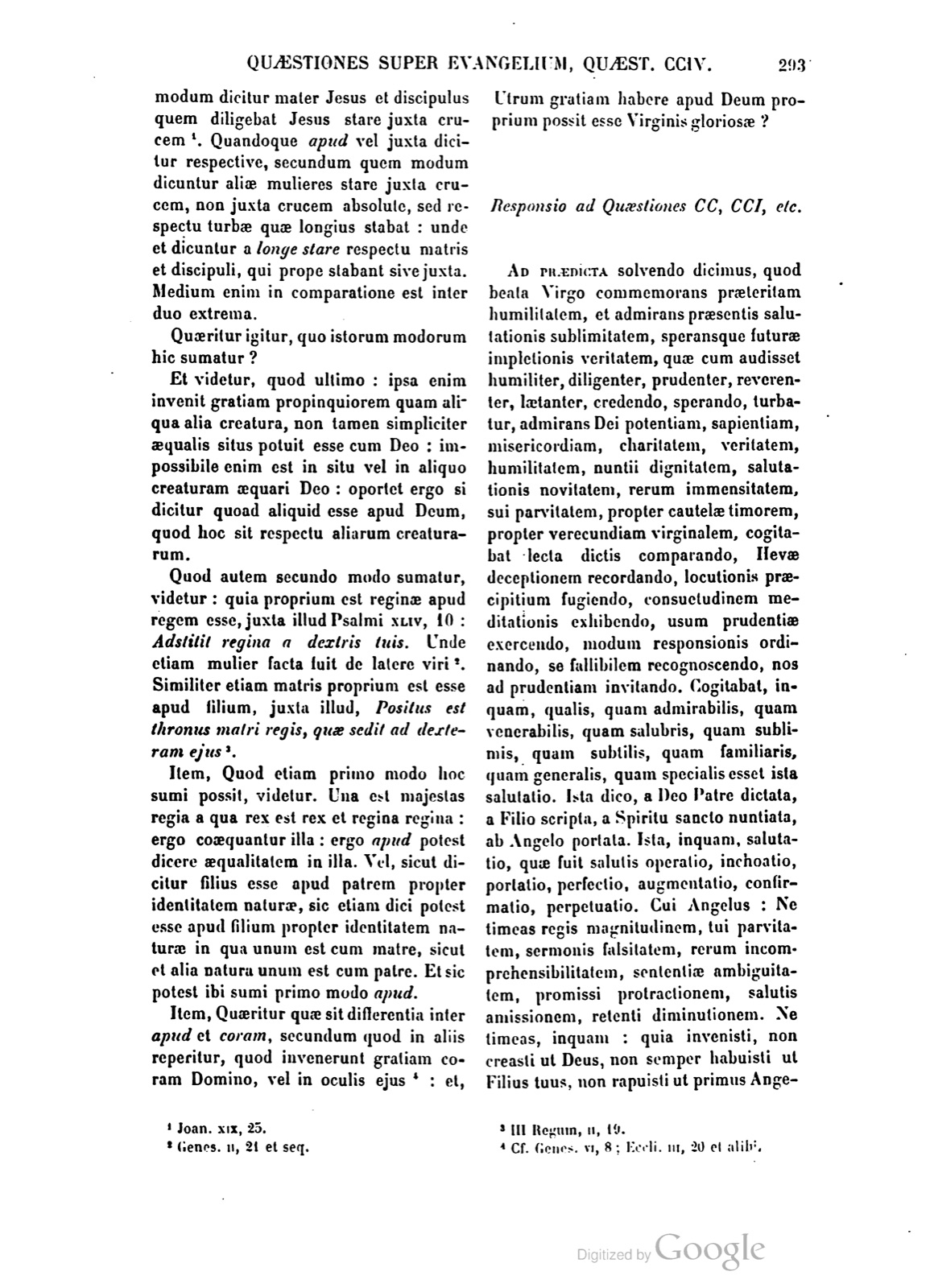
Illis visis et intellectis, patet solutio ad objecta.
Concedimus enim, quod beata Virgo in sermone salutatorio, laudabilissimo, consolatorio, instructorio, credibili, delectabili, utili, honorabili, admirabili: sermone, inquam, quem veritas misit, qui a veritate numquam recessit, qui falli non potuit, nec fallere voluit: in isto, inquam, sermone fuit beata Virgo omnifariam mirata, in sensu per verecundiam virginalem de Angelica visione in specie viri, in ratione per timorem cautelae de deceptione, in intellectu per laudes annuntiationis de promissorum et nuntiatorum magnitudine in sermone.
Patet etiam, quod non est turbatio tantum de malo, sed etiam de magno. Item, non est timor tantum mali, sed etiam magni. Unde, Damascenus: "Stupor est timor ex magna imaginatione: terror vero, timor ex imaginatione inconsueti mali."
Patet igitur qualis fuerit turbatio, qualis cogitatio, qualis timor, qualis salutatio, qualis et quae gratia quam invenit. Invenit autem: quia humano generi perditam primo recuperavit. Hoc Abraham non fecit nec Adam. Ideo per ipsam omnes gratiam rehabuerunt, ut patet in privilegio, mater omnium, et privilegio, porta caeli.
Concedimus etiam, quod apud ibi potest sumi quolibet illorum trium modorum, sicut dictum est in opponendo.
With these things seen and understood, the solution to the objections is clear.
For we grant that the blessed Virgin, in the salutary speech, the most praiseworthy, consoling, instructive, credible, delightful, useful, honorable, admirable speech; in the speech, I say, which Truth sent, which never withdrew from truth, which could not be deceived, nor wished to deceive; in this speech, I say, the blessed Virgin marveled in every way: in sense through virginal shamefastness at the angelic vision in the appearance of a man, in reason through fear of caution concerning deception, in intellect through the praises of the announcement concerning the greatness of the promised things and of those announcing them in the speech.
It is also clear that disturbance is not only concerning evil but also concerning what is great. Likewise, fear is not only of evil but also of what is great. Whence Damascene says: "Stupor is fear from a great imagining; terror, however, is fear from the imagining of an unaccustomed evil."
Therefore it is clear what sort of disturbance there was, what sort of thinking, what sort of fear, what sort of salutation, and what sort and what grace she found. But she found it because she was the first to recover grace lost for the human race. Abraham did not do this, nor Adam. Therefore through her all recovered grace, as is clear in the privilege, mother of all, and in the privilege, gate of heaven.
We also grant that with can be taken there in any of those three modes, as was said in opposing.
If a page does not appear, its photograph has not been uploaded yet.