Works › The Mariale: Questions on “Missus est”
Volume 37 · pp. 291–292
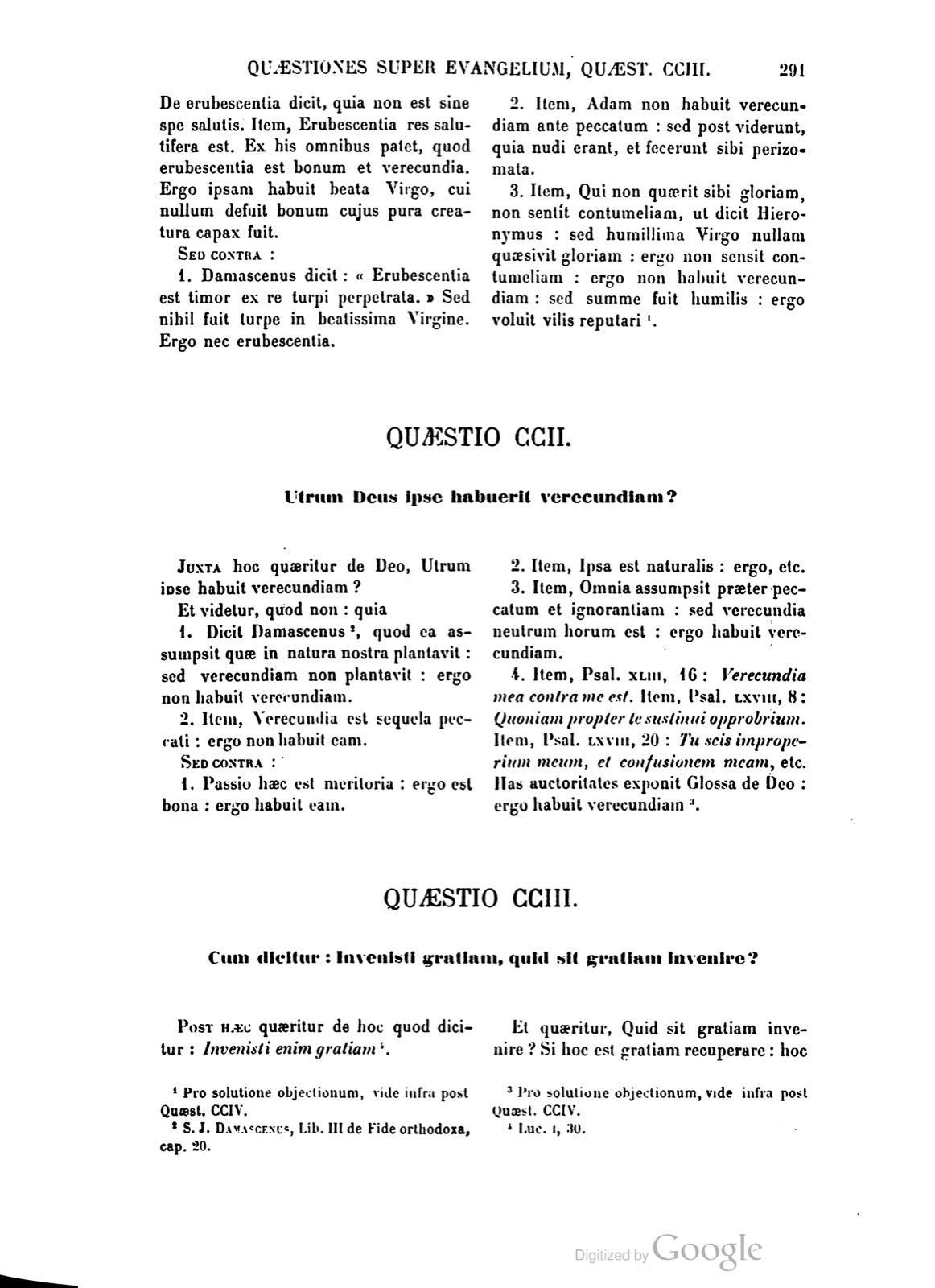
Question 203. When it is said: You have found grace, what is it to find grace?
A marker with ≈ is an approximate page boundary, placed by measure of the text; the page photographs remain the authority. In the paired views, clicking a page marker brings that page into view.
QUAESTIO CCIII. Cum dicitur: Invenisti gratiam, quid sit gratiam invenire?
Post haec quaeritur de hoc quod dicitur: Invenisti enim gratiam 1.
Et quaeritur, Quid sit gratiam invenire? Si hoc est gratiam recuperare: hoc autem est multis commune. Item, si hoc est perditam primo recuperare, tunc beata Virgo gratiam non invenit: sed Adam et Heva eam primo recuperaverunt. Item, si invenire est prius in ratione invenire, secundum hoc primus homo gratiam invenit.
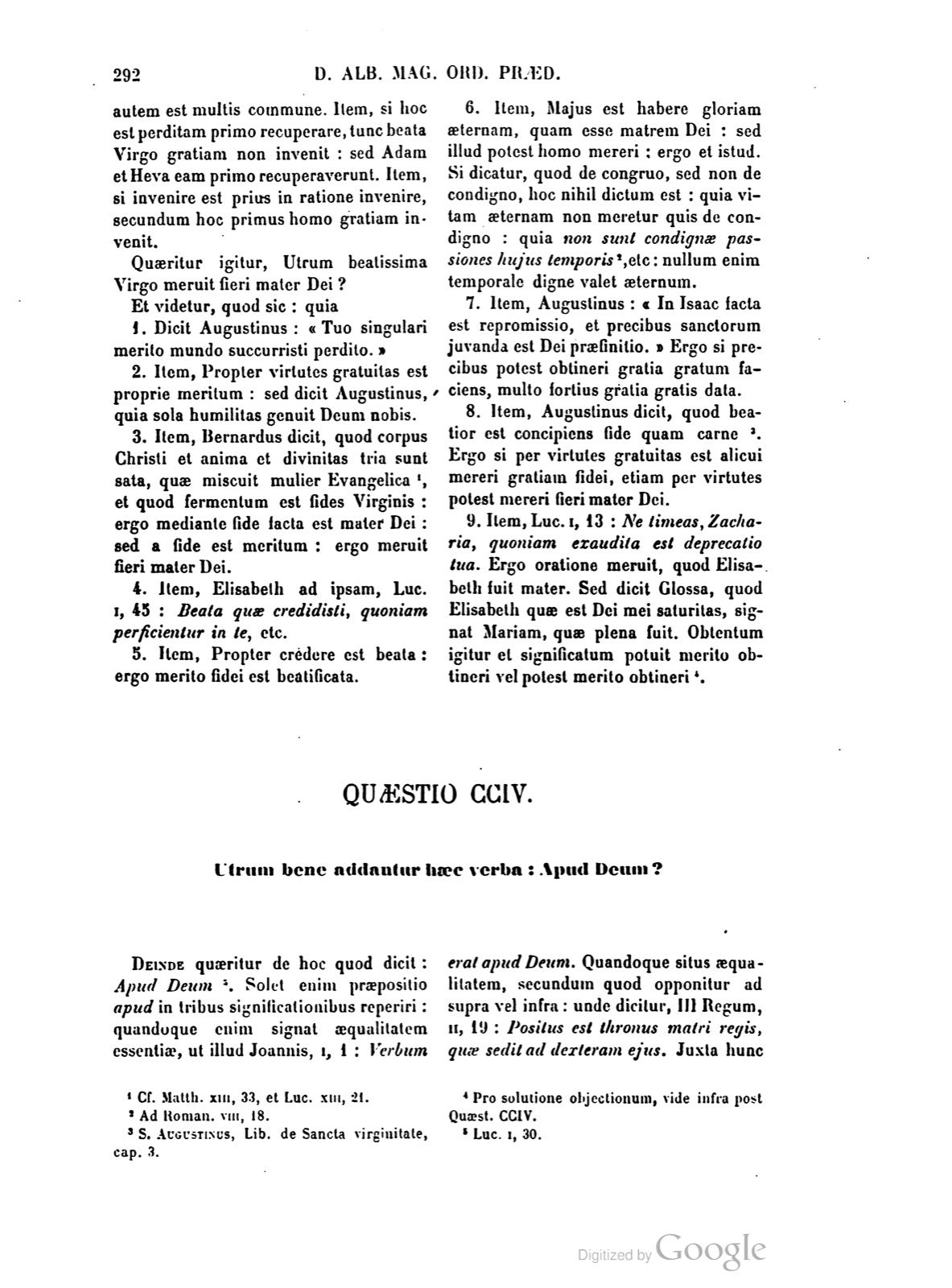
Quaeritur igitur, Utrum beatissima Virgo meruit fieri mater Dei?
Et videtur, quod sic: quia
1. Dicit Augustinus: "Tuo singulari merito mundo succurristi perdito."
2. Item, Propter virtutes gratuitas est proprie meritum: sed dicit Augustinus, quia sola humilitas genuit Deum nobis.
3. Item, Bernardus dicit, quod corpus Christi et anima et divinitas tria sunt sata, quae miscuit mulier Evangelica 2, et quod fermentum est fides Virginis: ergo mediante fide facta est mater Dei: sed a fide est meritum: ergo meruit fieri mater Dei.
4. Item, Elisabeth ad ipsam, Luc. I, 45: Beata quae credidisti, quoniam perficientur in te, etc.
5. Item, Propter credere est beata: ergo merito fidei est beatificata.
QUESTION 203. When it is said: You have found grace, what is it to find grace?
After these things inquiry is made concerning this which is said: For you have found grace 1.
And it is asked what it is to find grace. If this is to recover grace, this is common to many. Likewise, if this is first to recover lost grace, then the blessed Virgin did not find grace, but Adam and Eve first recovered it. Likewise, if to find is to find what is prior in account, according to this the first human being found grace.
Therefore it is asked whether the most blessed Virgin merited to become Mother of God.
And it seems that she did, because:
1. Augustine says: "By your singular merit you came to the aid of the lost world."
2. Likewise, properly there is merit on account of gratuitous virtues; but Augustine says that humility alone bore God for us.
3. Likewise, Bernard says that the body of Christ and the soul and the divinity are the three measures of meal which the Gospel woman mixed 2, and that the leaven is the faith of the Virgin. Therefore through faith as means she was made Mother of God. But merit is from faith. Therefore she merited to become Mother of God.
4. Likewise, Elizabeth says to her, Luke 1:45: Blessed are you who have believed, because the things will be perfected in you, etc.
5. Likewise, she is blessed because of believing; therefore she was beatified by the merit of faith.
6. Item, Majus est habere gloriam aeternam, quam esse matrem Dei: sed illud potest homo mereri: ergo et istud. Si dicatur, quod de congruo, sed non de condigno, hoc nihil dictum est: quia vitam aeternam non meretur quis de condigno: quia non sunt condignae passiones hujus temporis 3, etc.; nullum enim temporale digne valet aeternum.
7. Item, Augustinus: "In Isaac facta est repromissio, et precibus sanctorum juvanda est Dei praefinitio." Ergo si precibus potest obtineri gratia gratum faciens, multo fortius gratia gratis data.
8. Item, Augustinus dicit, quod beatior est concipiens fide quam carne 4. Ergo si per virtutes gratuitas est alicui mereri gratiam fidei, etiam per virtutes potest mereri fieri mater Dei.
9. Item, Luc. I, 13: Ne timeas, Zacharia, quoniam exaudita est deprecatio tua. Ergo oratione meruit, quod Elisabeth fuit mater. Sed dicit Glossa, quod Elisabeth quae est Dei mei saturitas, signat Mariam, quae plena fuit. Obtentum igitur et significatum potuit merito obtineri vel potest merito obtineri 5.
6. Likewise, it is greater to have eternal glory than to be Mother of God; but a human being can merit that; therefore also this. If it is said that this is by congruity, but not by condignity, this says nothing, because no one merits eternal life by condignity, because the sufferings of this present time are not worthy 3, etc.; for no temporal thing is worthily equal to an eternal thing.
7. Likewise, Augustine says: "In Isaac the promise was made, and the predetermination of God is to be helped by the prayers of the saints." Therefore, if grace making one pleasing can be obtained by prayers, much more grace given gratis.
8. Likewise, Augustine says that one conceiving by faith is more blessed than one conceiving by the flesh 4. Therefore, if by gratuitous virtues it belongs to someone to merit the grace of faith, also by virtues she can merit to become Mother of God.
9. Likewise, Luke 1:13: Fear not, Zachary, because your prayer has been heard. Therefore by prayer he merited that Elizabeth was a mother. But the Gloss says that Elizabeth, which is "the satiety of my God," signifies Mary, who was full. Therefore the thing obtained and signified could be obtained by merit, or can be obtained by merit 5.
Notes
- Luke 1:30. (Luc. I, 30.) ↩
- Compare Matthew 13:33 and Luke 13:21. (Cf. Matth. XIII, 33, et Luc. XIII, 21.) ↩
- Romans 8:18. (Ad Roman. VIII, 18.) ↩
- St. Augustine, Book on Holy Virginity, chapter 3. (S. Augustinus, Lib. de Sancta virginitate, cap. 3.) ↩
- For the solution of the objections, see below after Question 204. (Pro solutione objectionum, vide infra post Quaest. CCIV.) ↩
If a page does not appear, its photograph has not been uploaded yet.