Works › The Mariale: Questions on “Missus est”
Volume 37 · pp. 287–288
Question 198. Why was the Blessed Virgin troubled?
A marker with ≈ is an approximate page boundary, placed by measure of the text; the page photographs remain the authority. In the paired views, clicking a page marker brings that page into view.
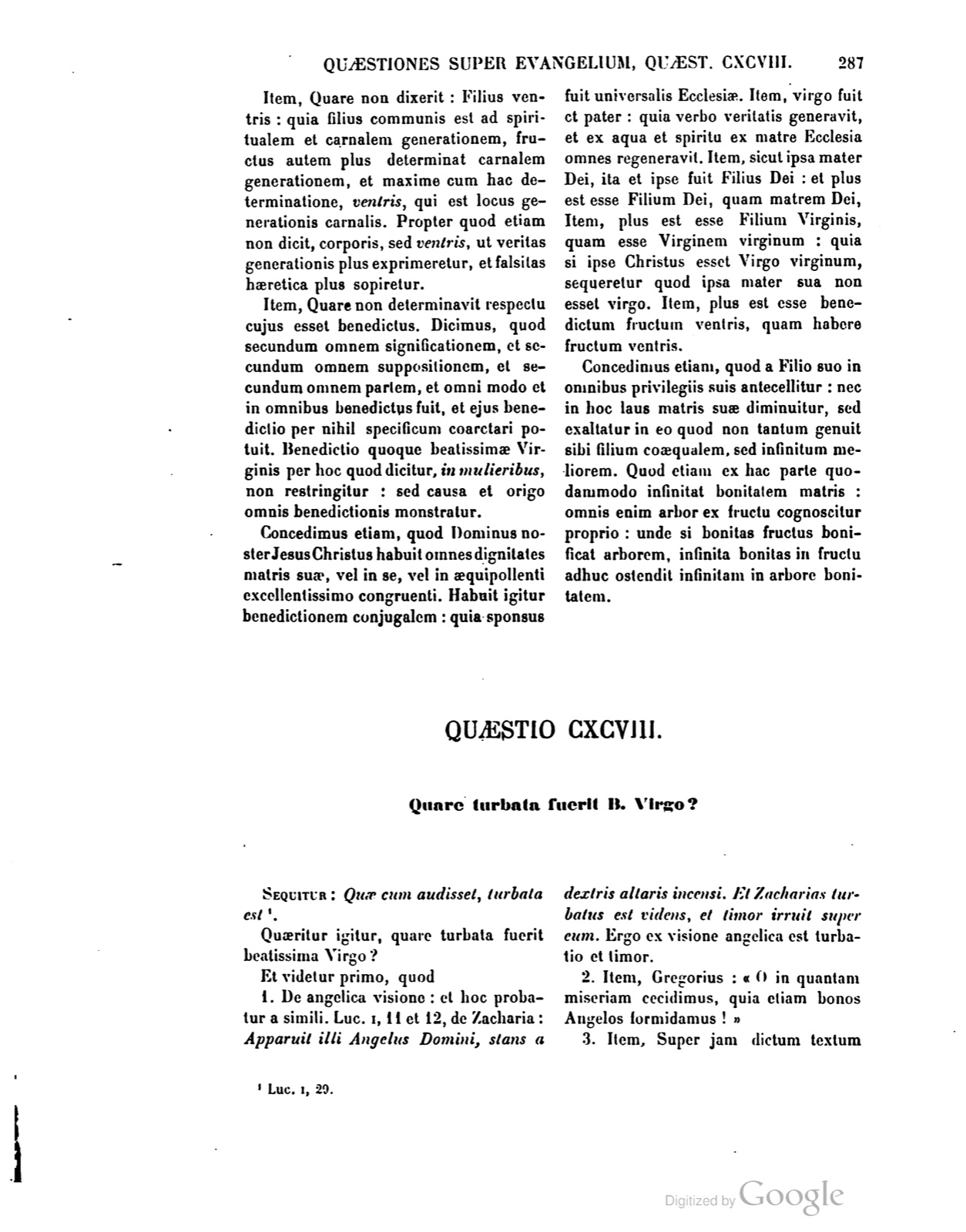
QUAESTIO CXCVIII. Quare turbata fuerit B. Virgo?
Sequitur: Quae cum audisset, turbata est 1.
Quaeritur igitur, quare turbata fuerit beatissima Virgo?
Et videtur primo, quod:
1. De angelica visione: et hoc probatur a simili. Luc. I, 11 et 12, de Zacharia: Apparuit illi Angelus Domini, stans a dextris altaris incensi. Et Zacharias turbatus est videns, et timor irruit super eum. Ergo ex visione angelica est turbatio et timor.
2. Item, Gregorius: « O in quantam miseriam cecidimus, quia etiam bonos Angelos formidamus! »
3. Item, Super jam dictum textum Lucae, Glossa: « Sicut humani defectus est terreri, ita angelicae benignitatis est paventem de suo adspectu blandiendo consolari. » Ergo pavor est de Angelorum adspectu.
4. Item, Luc. II, 9: Angelus Domini stetit juxta illos, et claritas Domini circumfulsit illos. Et sequitur: Timuerunt timore magno.
5. Item, Matth. XXVIII, 3, dicitur, quod adspectus Angeli erat sicut fulgur. Et dicitur post: Prae timore autem ejus exterriti sunt custodes. Ergo ex visione Angeli est timor et turbatio.
6. Item, Judicum, XIII, 6: Vir Dei venit ad me habens vultum angelicum terribilem nimis. Ergo ex visione vultus Angeli est terror.
Contra objicitur:
1. Luc. I, 29: Quae cum audisset, turbata est in sermone ejus, id est, Angeli: ergo non in visione.
2. Item, Alii datur discretio spirituum 2, ut dictum est supra. Ergo turbatur non ex visione.
3. Item, Ipsa Angelos cognovit per speciem.
4. Item, Aut cognovit, et non fuit turbata: aut non cognovit, et sic fuisset dubia, quod est ridiculosum dicere.
5. Item, Abraham, Lot, Josue, et alii patres Veteris Testamenti viderunt Angelos: nec fuerunt turbati: ergo nec ipsa: quia a nullo illustrium vincitur.
QUESTION 198. Why was the Blessed Virgin troubled?
There follows: When she had heard, she was troubled 1.
Therefore it is asked why the most blessed Virgin was troubled.
And first it seems that:
1. It was from the angelic vision; and this is proved from a similar case. Luke 1:11 and 12, concerning Zachary: An Angel of the Lord appeared to him, standing at the right side of the altar of incense. And Zachary was troubled at seeing him, and fear rushed upon him. Therefore trouble and fear are from angelic vision.
2. Likewise, Gregory says: “O into how great a misery we have fallen, because we fear even good Angels!”
3. Likewise, on the already mentioned text of Luke, the Gloss says: “Just as it belongs to human defect to be terrified, so it belongs to angelic kindness to console by soothing one frightened by its appearance.” Therefore fear is from the appearance of Angels.
4. Likewise, Luke 2:9: An Angel of the Lord stood beside them, and the brightness of the Lord shone around them. And it follows: They feared with great fear.
5. Likewise, Matthew 28:3 says that the appearance of the Angel was like lightning. And afterward it is said: But from fear of him the guards were terrified. Therefore fear and trouble are from the vision of an Angel.
6. Likewise, Judges 13:6: A man of God came to me, having an angelic face, exceedingly terrible. Therefore terror is from the vision of the face of an Angel.
To the contrary it is objected:
1. Luke 1:29: When she had heard, she was troubled at his speech, that is, the Angel's; therefore not at the vision.
2. Likewise, To another is given discernment of spirits 2, as was said above. Therefore she is not troubled from the vision.
3. Likewise, she knew Angels by species.
4. Likewise, either she knew him, and was not troubled; or she did not know him, and thus she would have been doubtful, which is ridiculous to say.
5. Likewise, Abraham, Lot, Joshua, and other fathers of the Old Testament saw Angels and were not troubled; therefore neither was she, because she is surpassed by none of the illustrious.
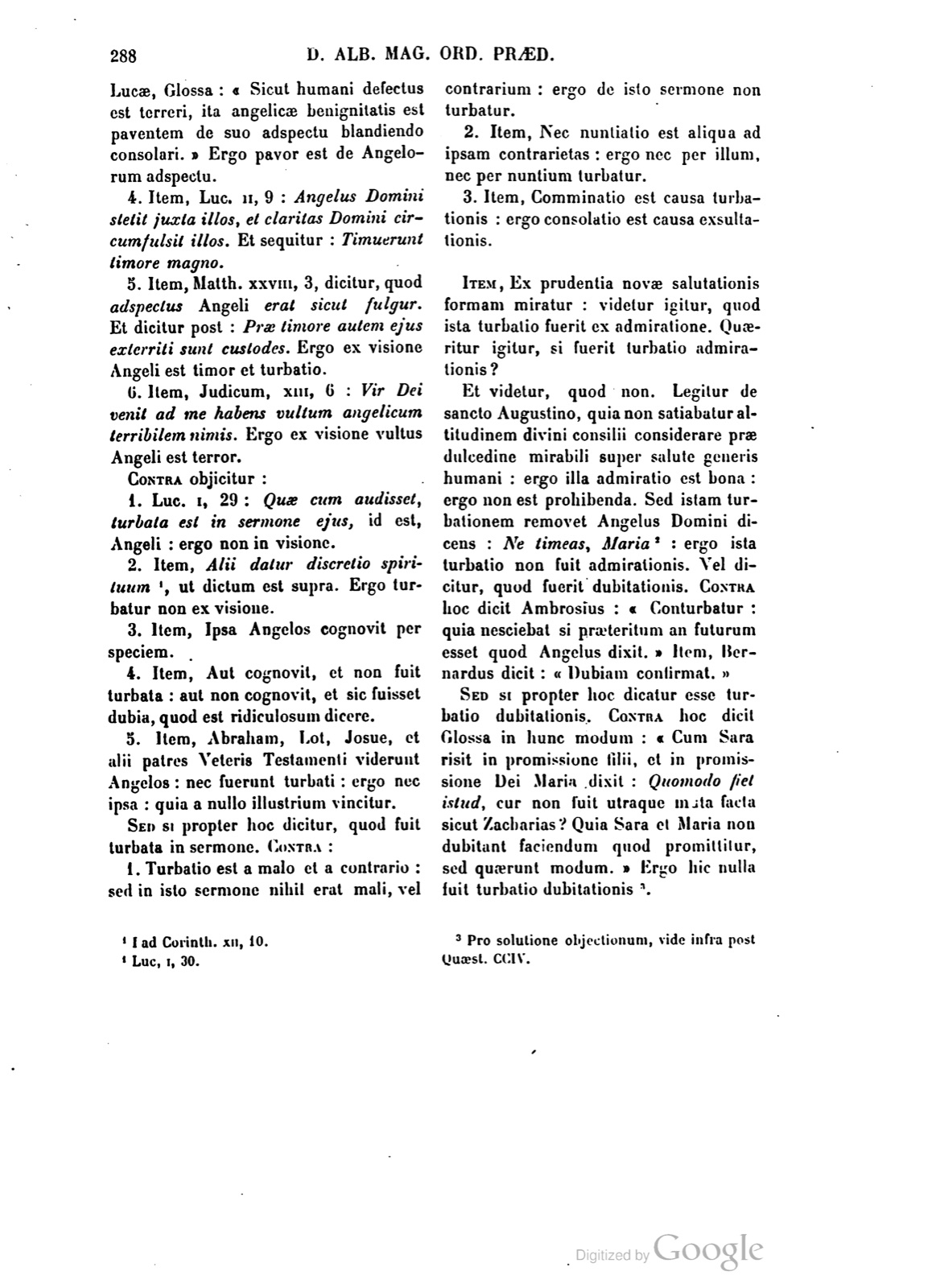
Sed si propter hoc dicitur, quod fuit turbata in sermone. Contra:
1. Turbatio est a malo et a contrario: sed in isto sermone nihil erat mali, vel contrarium: ergo de isto sermone non turbatur.
2. Item, Nec nuntiatio est aliqua ad ipsam contrarietas: ergo nec per illum, nec per nuntium turbatur.
3. Item, Comminatio est causa turbationis: ergo consolatio est causa exsultationis.
Item, Ex prudentia novae salutationis formam miratur: videtur igitur, quod ista turbatio fuerit ex admiratione. Quaeritur igitur, si fuerit turbatio admirationis?
Et videtur, quod non. Legitur de sancto Augustino, quia non satiabatur altitudinem divini consilii considerare prae dulcedine mirabili super salute generis humani: ergo illa admiratio est bona: ergo non est prohibenda. Sed istam turbationem removet Angelus Domini dicens: Ne timeas, Maria 3: ergo ista turbatio non fuit admirationis. Vel dicitur, quod fuerit dubitationis. Contra hoc dicit Ambrosius: « Conturbatur: quia nesciebat si praeteritum an futurum esset quod Angelus dixit. » Item, Bernardus dicit: « Dubiam confirmat. »
Sed si propter hoc dicatur esse turbatio dubitationis. Contra hoc dicit Glossa in hunc modum: « Cum Sara risit in promissione filii, et in promissione Dei Maria dixit: Quomodo fiet istud, cur non fuit utraque muta facta sicut Zacharias? Quia Sara et Maria non dubitant faciendum quod promittitur, sed quaerunt modum. » Ergo hic nulla fuit turbatio dubitationis 4.
But if on account of this it is said that she was troubled at the speech. To the contrary:
1. Trouble is from evil and from a contrary; but in that speech there was nothing evil or contrary; therefore she is not troubled by that speech.
2. Likewise, neither is the announcement any contrariety toward her; therefore she is troubled neither by him nor by the message.
3. Likewise, threatening is a cause of trouble; therefore consolation is a cause of exultation.
Likewise, from prudence she marvels at the form of the new salutation; therefore it seems that this trouble was from admiration. Therefore it is asked whether it was a trouble of admiration.
And it seems that it was not. It is read concerning Saint Augustine that he was not sated with considering the height of the divine counsel, because of the marvelous sweetness concerning the salvation of the human race; therefore that admiration is good, and therefore is not to be forbidden. But the Angel of the Lord removes this trouble when he says: Do not fear, Mary 3; therefore that trouble was not of admiration. Or it is said that it was of doubt. Against this Ambrose says: “She is troubled because she did not know whether what the Angel said was past or future.” Likewise, Bernard says: “He confirms the doubtful one.”
But if on account of this it is said to be a trouble of doubt. Against this the Gloss speaks in this way: “When Sarah laughed at the promise of a son, and at the promise of God Mary said: How will this happen, why was not each made mute like Zachary? Because Sarah and Mary do not doubt that what is promised will be done, but they ask the mode.” Therefore here there was no trouble of doubt 4.
Notes
- Luke 1:29. (Luc. I, 29.) ↩
- 1 Corinthians 12:10. (I ad Corinth. XII, 10.) ↩
- Luke 1:30. (Luc. I, 30.) ↩
- For the solution of the objections, see below after Question 204. (Pro solutione objectionum, vide infra post Quaest. CCIV.) ↩
If a page does not appear, its photograph has not been uploaded yet.