Works › The Mariale: Questions on “Missus est”
Volume 37 · p. 289
Question 199. Whether it is suitably said: And she was thinking?
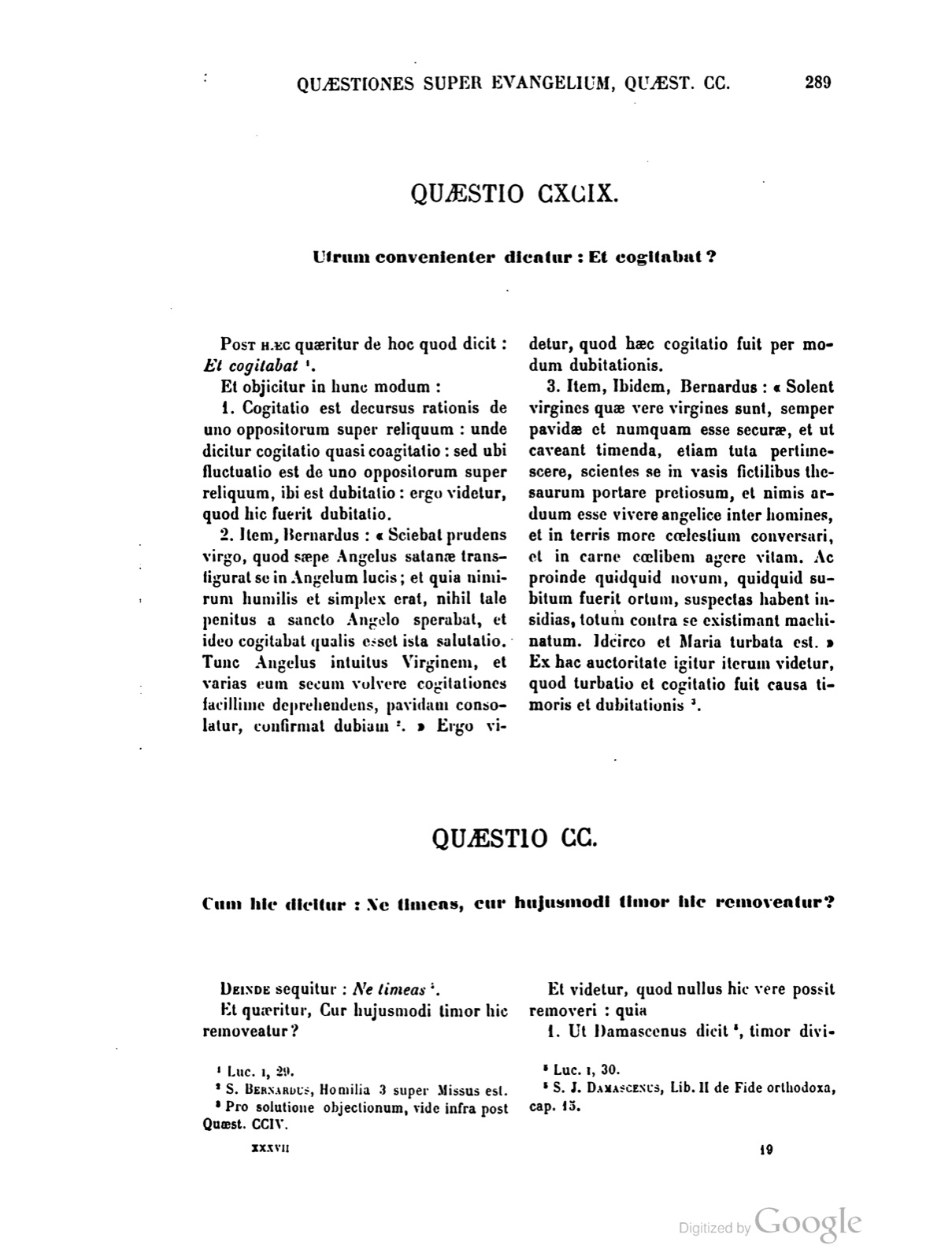
QUAESTIO CXCIX. Utrum convenienter dicatur: Et cogitabat?
Post haec quaeritur de hoc quod dicit: Et cogitabat 1.
Et objicitur in hunc modum:
1. Cogitatio est decursus rationis de uno oppositorum super reliquum: unde dicitur cogitatio quasi coagitatio: sed ubi fluctuatio est de uno oppositorum super reliquum, ibi est dubitatio: ergo videtur, quod hic fuerit dubitatio.
2. Item, Bernardus: "Sciebat prudens virgo, quod saepe Angelus satanae transfigurat se in Angelum lucis; et quia nimirum humilis et simplex erat, nihil tale penitus a sancto Angelo sperabat, et ideo cogitabat qualis esset ista salutatio. Tunc Angelus intuitus Virginem, et varias eum secum volvere cogitationes facillime deprehendens, pavidam consolatur, confirmat dubiam 2." Ergo videtur, quod haec cogitatio fuit per modum dubitationis.
3. Item, Ibidem, Bernardus: "Solent virgines quae vere virgines sunt, semper pavidae et numquam esse securae, et ut caveant timenda, etiam tuta pertimescere, scientes se in vasis fictilibus thesaurum portare pretiosum, et nimis arduum esse vivere angelice inter homines, et in terris more caelestium conversari, et in carne caelibem agere vitam. Ac proinde quidquid novum, quidquid subitum fuerit ortum, suspectas habent insidias, totum contra se existimant machinatum. Idcirco et Maria turbata est." Ex hac auctoritate igitur iterum videtur, quod turbatio et cogitatio fuit causa timoris et dubitationis 3.
QUESTION 199. Whether it is suitably said: And she was thinking?
After these things inquiry is made concerning this which he says: And she was thinking 1.
And objection is made in this way:
1. Thinking is a running of reason from one of opposites over the other; whence thinking is said as though a driving-together. But where there is wavering from one of opposites over the other, there is doubt. Therefore it seems that here there was doubt.
2. Likewise, Bernard says: "The prudent virgin knew that often an angel of Satan transforms himself into an angel of light; and because she was indeed humble and simple, she hoped for nothing of this sort at all from a holy Angel, and therefore she was thinking what sort this salutation was. Then the Angel, gazing upon the Virgin and very easily perceiving that she was revolving various thoughts with herself, consoles the fearful one and confirms the doubtful one 2." Therefore it seems that this thinking was by way of doubt.
3. Likewise, in the same place Bernard says: "Virgins who truly are virgins are accustomed always to be fearful and never secure, and, so that they may beware things to be feared, to fear even safe things, knowing that they carry a precious treasure in earthen vessels, and that it is very arduous to live angelically among human beings, and on earth to converse after the manner of heavenly beings, and in the flesh to lead a celibate life. And therefore whatever new thing, whatever sudden thing shall have arisen, they regard as suspected ambushes; they suppose the whole thing to have been contrived against themselves. For this reason Mary too was troubled." Therefore from this authority again it seems that disturbance and thinking were a cause of fear and doubt 3.
Notes
- Luke 1:29. (Luc. I, 29.) ↩
- St. Bernard, Homily 3 on Missus est. (S. Bernardus, Homilia 3 super Missus est.) ↩
- For the solution of the objections, see below after Question 204. (Pro solutione objectionum, vide infra post Quaest. CCIV.) ↩
If a page does not appear, its photograph has not been uploaded yet.