Works › The Mariale: Questions on “Missus est”
Volume 37 · pp. 284–287
Notes for the solution of Questions 194, 195, 196, and 197. Solution of the aforesaid questions.
A marker with ≈ is an approximate page boundary, placed by measure of the text; the page photographs remain the authority. In the paired views, clicking a page marker brings that page into view.
Notanda ad solutionem Quaest. CXCIV, CXCV, CXCVI et CXCVII.
His visis, videndum est ad ea quae de fructus benedictione sunt objecta. Notandum igitur, quod de benedictione illa possumus loqui secundum tres vias. Primo, quantum ad significationem. Secundo, quantum ad suppositionem. Tertio, quantum ad substantiam. Quantum ad significationem, utrum scilicet benedictio unam habuit significationem, vel plures? Et si plures, secundum quam hic sumatur? Vel, si omnis ratio benedictionis salvetur in ista benedictione? Quantum ad suppositionem, ut si scilicet benedictio sit communis ad plura, pro qua sumatur hic, et utrum pro omnibus suis suppositis? Quantum ad suam substantiam, ex quibus et quantis integratur ista benedictio?
Quantum igitur ad significationem benedictio quatuor habet in se significata, quorum omnium ratio salvatur in ista benedictione. Est enim benedictio maledicti evacuatio, et est benedictio omnis boni possessio, et est benedictio foecunditatis exaltatio, et est benedictio congratulantium collaudatio. Et quaelibet istarum triplex. Est enim benedictio triplicis maledicti evacuatio: inciderat enim homo per peccatum triplex maledictum. Primum est punctio fomitis. Secundum est labor inveniendae veritatis. Tertium est necessitas incinerationis. Primum intelligitur per hoc: Cum operatus fueris terram 1, etc. Secundum per id quod dicitur: In sudore vultus tui, etc. Tertium per id, Pulvis es, et in pulverem reverteris 2. Istius triplicis maledicti evacuatio fuit in isto fructu benedicto. Primum: quia puncturam fomitis non habuit. Secundum: quia omnia scivit. Tertium: quia corruptionem non vidit. Secunda benedictio fuit omnis boni possessio, et haec triplex fuit. Habuit enim bonitatem humanae naturae in summo. Item, bonitatem divinae naturae in summo. Item, bonitatem quae est ex conjunctione utriusque habuit: et sic omne bonum possedit in summo. Tertia benedictio fuit foecunditatis superexaltatio, et haec quoque triplex fuit. Fuit enim pater per creationem in esse naturae, per recreationem in esse gratiae, per glorificationem in esse gloriae. Quarta benedictio fuit congratulantium collaudatio, et haec triplex, scilicet Angelorum, hominum, et corporum. Omnes hi benedicunt ipsam: quia genuit Angelorum restauratorem, redemptorem hominum, corporalium renovatorem.
Quantum ad suppositionem tria habet appellata, et pro omnibus illis reddetur locutio vera: est enim fructus benedictio naturae, benedictio gratiae, benedictio gloriae. Et quodlibet istorum tripliciter. Benedictio naturae tripliciter: habuit enim corpus benedictum, animam benedictam, deitatem benedictam. Corpus fuit benedictum tripliciter: in materia, in forma, in harmonia. In materia: quia purum; in forma: quia pulchrum; in harmonia: quia eucraticum. Pulchrum etiam fuit tripliciter: in congruentia quantitatis, in elegantia dispositionis, in venustate colorum: et sic est in statura, figura, et colore. Item, anima fuit benedicta in se, et in comparatione. In se dupliciter: a malo, et in bono. A malo tripliciter: a peccato, a fomite, ab ignorantia. Item, in bono tripliciter: omnium naturarum naturali conditione, politicarum virtutum perfectione, suprema naturali Dei dilectione. In comparatione benedicta fuit dupliciter: ad Deum, et ad corpus. Ad Deum summa imagine et similitudine, ad corpus sine contrarietate. Item, benedictam tripliciter habuit deitatem: benedictam in seipsa, benedictam in operibus suis, benedictam in donis suis. Item, habuit benedictionem gratiae, et hanc quoque triplicem, increatam cum Patre, creatam cum matre, conjunctam propter utrumque. Cum Patre triplicem gratiam habuit a patre, quod est Deus, quod est Dei Filius, quod est spirator Spiritus sancti. Cum matre quoque triplicem habuit gratiam. Unam: quia omnem gratiam habuit. Secundam: quia omnem dedit gratiam. Tertiam, quod dedit ultra id quod habuit. Dedit enim gratiam, virtutem, remissionem peccatorum quam non habuit. Unde spiritus in Eliseo duplex fuit. Item, ex conjunctione propter utrumque triplicem habuit gratiam. Unam, quod Filius plurium fuit. Secundam, quod redemptor hominum fuit. Tertiam, quod beatitudo hominum est. Et quodlibet istorum tripliciter est: quia enim Filius plurium fuit, ex hoc sequitur triplex gratia. Mater enim sua habuit patrem et matrem, sed non Deum. Pater suus nec habuit patrem nec matrem nec Deum nec hominem: ipse autem habuit patrem et matrem, et Deum et hominem. Quia redemptor hominum fuit, ex hoc habuit tria, quia sponsus animarum, sacerdos fidelium, judex vivorum et mortuorum. Quod beatitudo hominum fuit, ex hoc etiam habuit tria, quia est beatitudo Angelorum, hominum, et corporalium. Item, benedictionem gloriae similiter habuit triplicem: habuit enim gloriam comprehensoris, gloriam creatoris, gloriam redemptoris. Et quaelibet istarum triplex. Comprehensoris triplex: summam aureolam in summo: super omnes aureolas in summo: accidentalia praemia in summo. Item, primo est homo viator et non comprehensor, postea comprehensor et non viator, ipse autem non aliquando viator: aliquando comprehensor, sed simul viator et comprehensor. Item, viatorum doctor, comprehensorum coronator, viatorum et comprehensorum adunator. Item, gloria redemptoris triplex fuit, quia hominum liberator, daemonum superator, naturae exaltator. Item, gloria creationis triplex fuit: misericordia in sanctis, justitia in damnatis, gloriosus in seipso. Item, habuit gloriam creatoris, justificatoris, glorificatoris.
Notes for the solution of Questions 194, 195, 196, and 197.
With these things seen, one must see to those things which have been objected concerning the blessing of the fruit. Therefore it must be noted that we can speak of that blessing according to three ways. First, as regards signification. Second, as regards supposition. Third, as regards substance. As regards signification, namely whether the blessing had one signification or several; and if several, according to which is it taken here; or whether every account of blessing is preserved in this blessing. As regards supposition, namely if blessing is common to several things, for what is it taken here, and whether for all its supposita. As regards its substance, from what and from how many things is that blessing integrated?
Therefore as regards signification, blessing has four significates in itself, the account of all of which is preserved in this blessing. For blessing is evacuation of curse, and blessing is possession of every good, and blessing is exaltation of fecundity, and blessing is the praising-together of those congratulating. And each of these is threefold. For blessing is the evacuation of a threefold curse: for through sin the human being had fallen into a threefold curse. The first is the pricking of the tinder of sin. The second is labor in finding truth. The third is the necessity of being reduced to ashes. The first is understood through this: When you have worked the earth 1, etc. The second through what is said: In the sweat of your face, etc. The third through this: You are dust, and into dust you shall return 2. The evacuation of this threefold curse was in this blessed fruit. The first: because he did not have the pricking of the tinder. The second: because he knew all things. The third: because he did not see corruption. The second blessing was possession of every good, and this was threefold. For he had the goodness of human nature in the highest degree. Likewise, the goodness of divine nature in the highest degree. Likewise, he had the goodness which is from the conjunction of both; and thus he possessed every good in the highest degree. The third blessing was the super-exaltation of fecundity, and this also was threefold. For he was father by creation in the being of nature, by recreation in the being of grace, by glorification in the being of glory. The fourth blessing was the praising-together of those congratulating, and this was threefold, namely of Angels, human beings, and bodies. All these bless her because she gave birth to the restorer of Angels, the redeemer of human beings, and the renewer of bodies.
As regards supposition it has three things named, and for all those the expression will be rendered true: for the fruit is a blessing of nature, a blessing of grace, and a blessing of glory. And each of these in three ways. The blessing of nature in three ways: for he had a blessed body, a blessed soul, and blessed deity. The body was blessed in three ways: in matter, in form, in harmony. In matter, because pure; in form, because beautiful; in harmony, because well-tempered. It was also beautiful in three ways: in fittingness of quantity, in elegance of arrangement, in charm of colors; and thus this is in stature, figure, and color. Likewise, the soul was blessed in itself and in comparison. In itself in two ways: from evil and in good. From evil in three ways: from sin, from the tinder, from ignorance. Likewise, in good in three ways: by the natural condition of all natures, by the perfection of political virtues, and by supreme natural love of God. In comparison it was blessed in two ways: toward God and toward the body. Toward God by the highest image and likeness; toward the body without contrariety. Likewise, he had deity blessed in three ways: blessed in itself, blessed in its works, blessed in its gifts. Likewise, he had the blessing of grace, and this also threefold: uncreated with the Father, created with the mother, conjoined because of both. With the Father he had threefold grace from the Father: that he is God, that he is the Son of God, that he is spirator of the Holy Spirit. With the mother also he had threefold grace. One: that he had every grace. The second: that he gave every grace. The third: that he gave beyond what he had. For he gave grace, virtue, and remission of sins, which he did not have. Whence the spirit in Elisha was double. Likewise, from the conjunction because of both he had threefold grace. One, that he was Son of several. The second, that he was redeemer of human beings. The third, that he is the beatitude of human beings. And each of these is threefold: because, since he was Son of several, from this follows a threefold grace. For his mother had father and mother, but not God. His Father had neither father nor mother nor God nor human being; but he himself had father and mother, and God and human being. Because he was redeemer of human beings, from this he had three things, because he is spouse of souls, priest of the faithful, judge of the living and the dead. Because he was the beatitude of human beings, from this also he had three things, because he is the beatitude of Angels, human beings, and bodies. Likewise, he similarly had a threefold blessing of glory: for he had the glory of a comprehensor, the glory of a creator, and the glory of a redeemer. And each of these is threefold. The glory of a comprehensor is threefold: the highest aureole in the highest degree; above all aureoles in the highest degree; accidental rewards in the highest degree. Likewise, first the human being is a wayfarer and not a comprehensor, afterward a comprehensor and not a wayfarer; but he was not at one time a wayfarer and at another time a comprehensor, but at the same time wayfarer and comprehensor. Likewise, teacher of wayfarers, crowner of comprehensors, uniter of wayfarers and comprehensors. Likewise, the glory of the redeemer was threefold, because liberator of human beings, conqueror of demons, exalter of nature. Likewise, the glory of creation was threefold: mercy in the saints, justice in the damned, glorious in himself. Likewise, he had the glory of creator, justifier, and glorifier.
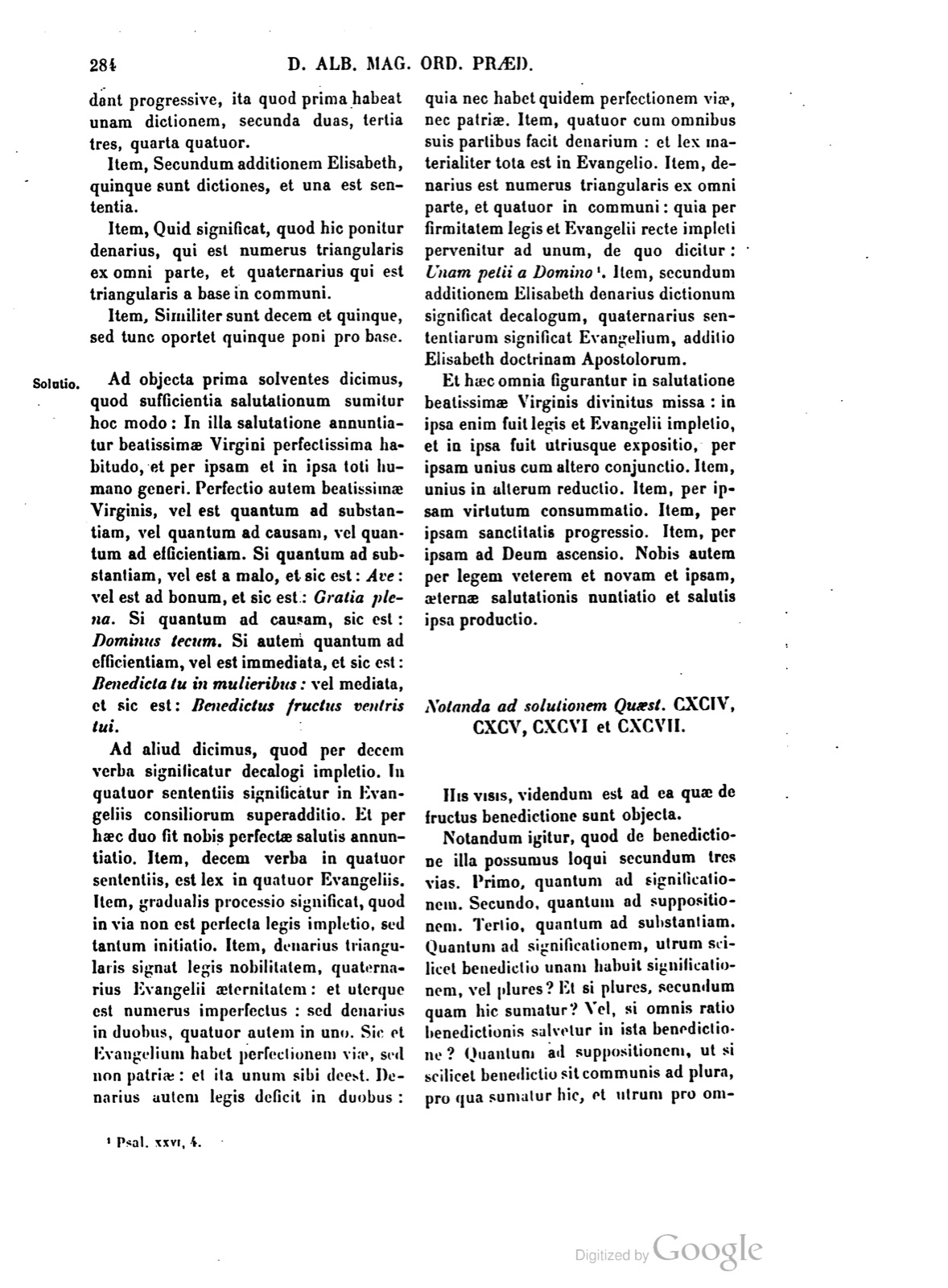
Si autem consideretur benedictio ista quantum ad partes integrales, tunc est benedictio vel quantum ad essentiam, vel quantum ad principium. Iste fructus benedictus triplicem habuit originem: habuit benedictam Trinitatem per creationem, benedictam matrem per nativitatem, benedictum patrem quantum ad generationem. Quantum ad essentiam benedictus fuit tripliciter secundum Bernardum: odore, sapore, specie. Odore implens cognoscitivam in quantum verum, sapore reficiens affectivam in quantum bonum, specie beatificans comprehensivam in quantum summum fuit et arduum. Addamus et nos odori et sapori speciei valorem: valet enim in medicamentum contra omne malum, in cibum habentem omne delectamentum, in pretium comparans omne bonum. Item, quantum ad efficientiam duplex est benedictio, activa scilicet, et passiva. Activa tripliciter: quia benedixit nos in esse naturae, gloriae, et gratiae. Unde, Psal. LXVI, 7: Benedicat nos Deus, Deus noster, benedicat nos Deus 3. Item, benedixit nos benedictione corporali, spirituali, et caelesti. Passiva tripliciter: quia nos benedicimus eum corde: unde, Psal. CII, 1: Benedic, anima mea, Domino, et omnia quae intra me sunt, etc. Benedicimus eum ore: unde, Psal. XXXIII, 2: Benedicam Dominum in omni tempore, semper laus ejus in ore meo. Benedicimus eum opere: unde, Psal. LXII, 5: Benedicam Dominum in vita mea.
But if this blessing is considered as regards its integral parts, then blessing is either as regards essence or as regards principle. This blessed fruit had a threefold origin: he had the blessed Trinity through creation, the blessed mother through nativity, the blessed Father as regards generation. As regards essence, he was blessed in three ways according to Bernard: by scent, by taste, by appearance. By scent filling the cognitive power insofar as true; by taste refreshing the affective power insofar as good; by appearance beatifying the comprehensive power insofar as he was supreme and arduous. Let us also add to scent and taste the value of appearance: for he is worth as medicine against every evil, as food having every delight, as a price buying every good. Likewise, as regards efficiency there is twofold blessing, namely active and passive. Active in three ways: because he blessed us in the being of nature, glory, and grace. Whence Psalm 66:7: May God, our God, bless us; may God bless us 3. Likewise, he blessed us with bodily, spiritual, and heavenly blessing. Passive in three ways: because we bless him in heart; whence Psalm 102:1: Bless the Lord, my soul, and all things within me, etc. We bless him by mouth; whence Psalm 33:2: I shall bless the Lord at every time; his praise is always in my mouth. We bless him by work; whence Psalm 62:5: I shall bless the Lord in my life.
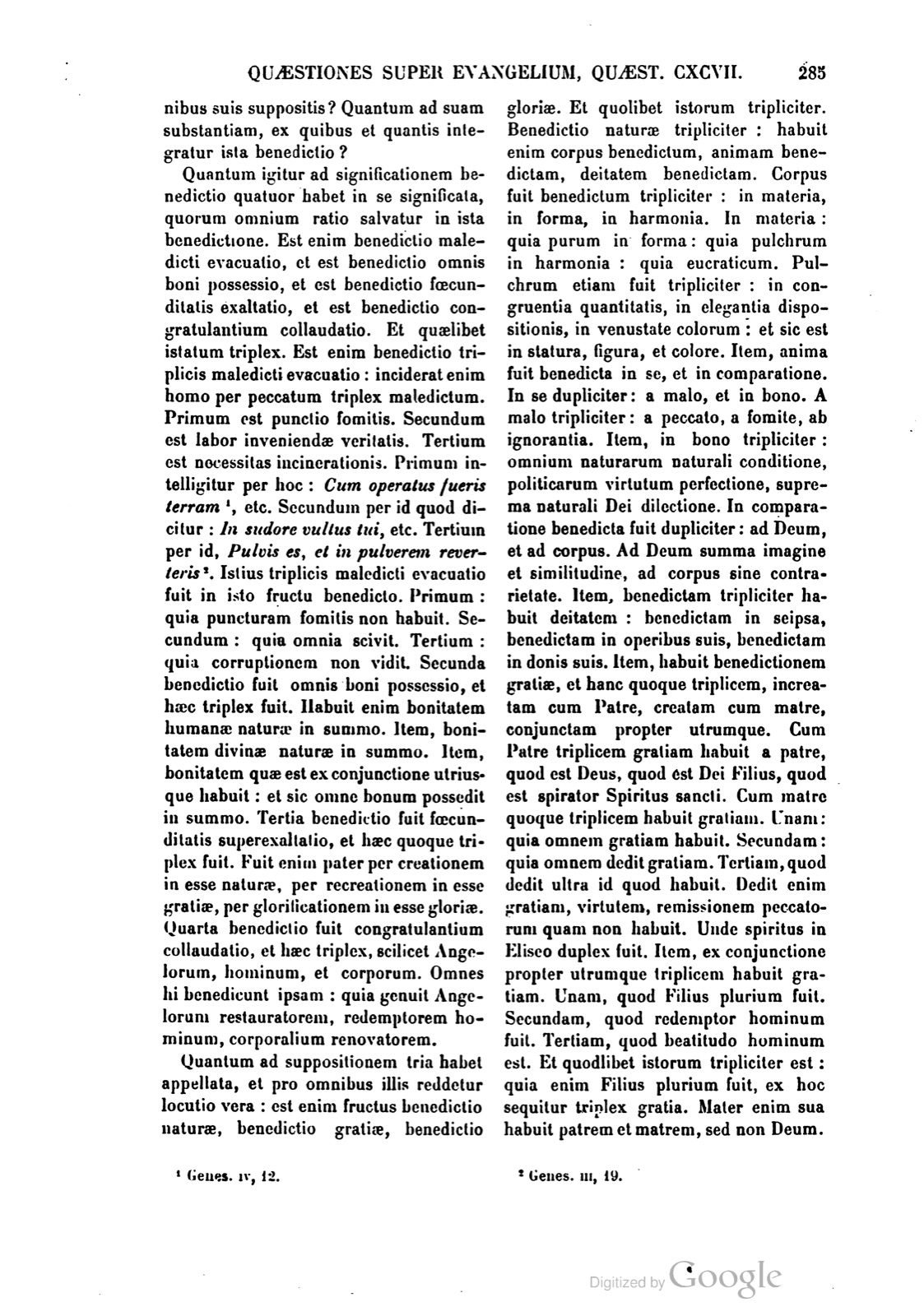
Solutio praedictarum quaestionum.
His visis, respondemus ad objecta: Quod igitur quaeritur de copulatione, dicendum quod hic ponitur copulatio, quae continet alterius finem et alterius inceptionem ad angelicam salutationem et ad personam Filii pertinentem: et etiam ut notet inter Filii benedictionem et matris dilectionem aliquam: quamvis tamen secundum allegoriam ad aliam pertineant rationem: ipsa enim est benedicta per benedictionem fructus: unde sua benedictio descendit a benedictione Filii.
Solution of the aforesaid questions.
With these things seen, we respond to the objections. Therefore as to what is asked concerning the conjunction, it must be said that the conjunction is placed here because it contains the end of the one and the beginning of the other, pertaining to the angelic salutation and to the person of the Son; and also so that it may mark some love between the blessing of the Son and that of the mother. Nevertheless, according to allegory they pertain to another account: for she is blessed through the blessing of the fruit; whence her blessing descends from the blessing of the Son.
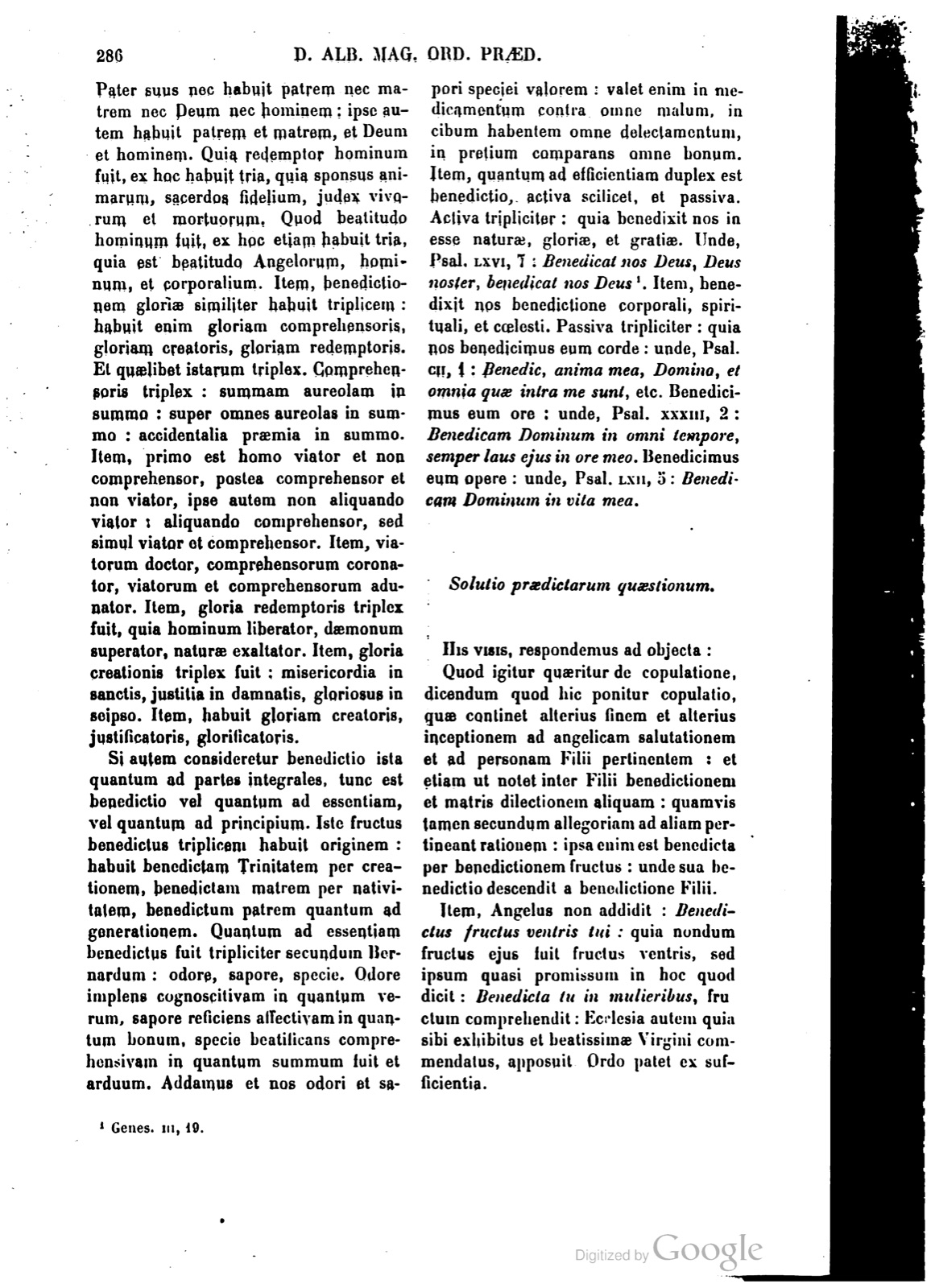
Item, Angelus non addidit: Benedictus fructus ventris tui: quia nondum fructus ejus fuit fructus ventris, sed ipsum quasi promissum in hoc quod dicit: Benedicta tu in mulieribus, fructum comprehendit: Ecclesia autem quia sibi exhibitus et beatissimae Virgini commendatus, apposuit. Ordo patet ex sufficientia.
Item, Quare non dixerit: Filius ventris: quia filius communis est ad spiritualem et carnalem generationem, fructus autem plus determinat carnalem generationem, et maxime cum hac determinatione, ventris, qui est locus generationis carnalis. Propter quod etiam non dicit, corporis, sed ventris, ut veritas generationis plus exprimeretur, et falsitas haeretica plus sopiretur.
Item, Quare non determinavit respectu cujus esset benedictus. Dicimus, quod secundum omnem significationem, et secundum omnem suppositionem, et secundum omnem partem, et omni modo et in omnibus benedictus fuit, et ejus benedictio per nihil specificum coarctari potuit. Benedictio quoque beatissimae Virginis per hoc quod dicitur, in mulieribus, non restringitur: sed causa et origo omnis benedictionis monstratur.
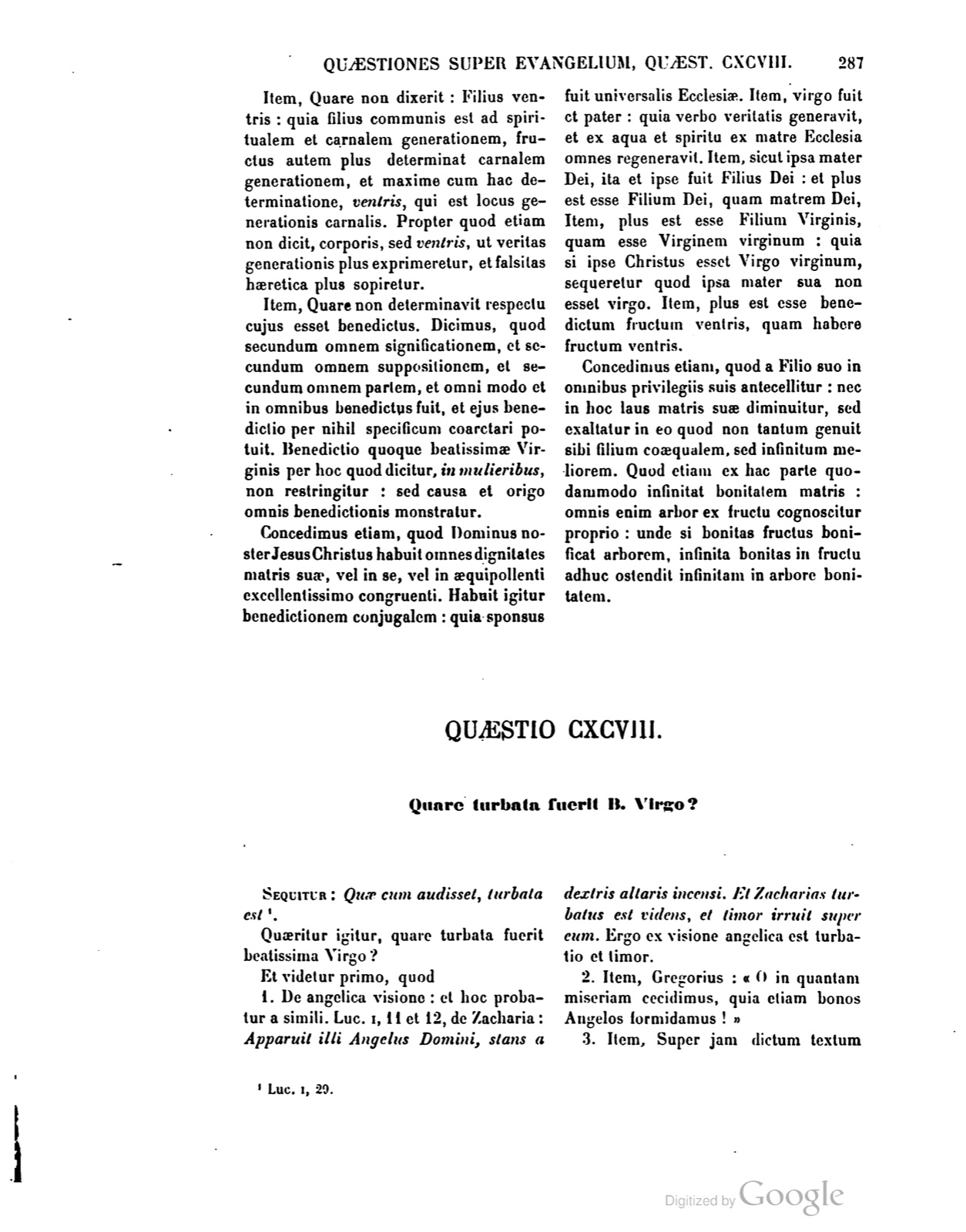
Concedimus etiam, quod Dominus noster Jesus Christus habuit omnes dignitates matris suae, vel in se, vel in aequipollenti excellentissimo congruenti. Habuit igitur benedictionem conjugalem: quia sponsus fuit universalis Ecclesiae. Item, virgo fuit et pater: quia verbo veritatis generavit, et ex aqua et spiritu ex matre Ecclesia omnes regeneravit. Item, sicut ipsa mater Dei, ita et ipse fuit Filius Dei: et plus est esse Filium Dei, quam matrem Dei. Item, plus est esse Filium Virginis, quam esse Virginem virginum: quia si ipse Christus esset Virgo virginum, sequeretur quod ipsa mater sua non esset virgo. Item, plus est esse benedictum fructum ventris, quam habere fructum ventris.
Concedimus etiam, quod a Filio suo in omnibus privilegiis suis antecellitur: nec in hoc laus matris suae diminuitur, sed exaltatur in eo quod non tantum genuit sibi filium coaequalem, sed infinitum meliorem. Quod etiam ex hac parte quodammodo infinitat bonitatem matris: omnis enim arbor ex fructu cognoscitur proprio: unde si bonitas fructus bonificat arborem, infinita bonitas in fructu adhuc ostendit infinitam in arbore bonitatem.
Likewise, the Angel did not add, Blessed is the fruit of your womb, because her fruit was not yet fruit of the womb, but as it were promised; in this phrase, Blessed are you among women, he comprehended the fruit. But the Church added it because he was shown to it and commended to the most blessed Virgin. The order is clear from the sufficiency.
Likewise, why did he not say Son of the womb? Because son is common to spiritual and carnal generation, but fruit determines carnal generation more, and especially with this determination, of the womb, which is the place of carnal generation. For this reason also it does not say of the body, but of the womb, so that the truth of generation might be more expressed and heretical falsehood more lulled to sleep.
Likewise, why did he not determine with respect to what he was blessed? We say that according to every signification, and according to every supposition, and according to every part, and in every way and in all things he was blessed, and his blessing could not be narrowed by anything specific. The blessing of the most blessed Virgin also is not restricted through the phrase among women, but the cause and origin of every blessing is shown.
We also concede that our Lord Jesus Christ had all the dignities of his mother, either in himself or in some most excellent fitting equivalent. Therefore he had the conjugal blessing, because he was spouse of the universal Church. Likewise, he was virgin and father, because by the word of truth he generated, and from water and spirit, from mother Church, he regenerated all. Likewise, just as she was mother of God, so he was Son of God; and it is greater to be Son of God than mother of God. Likewise, it is greater to be Son of the Virgin than to be Virgin of virgins, because if Christ himself were Virgin of virgins, it would follow that his mother herself was not a virgin. Likewise, it is greater to be the blessed fruit of the womb than to have fruit of the womb.
We also concede that she is surpassed by her Son in all her privileges; nor in this is the praise of his mother diminished, but exalted, in that she generated for herself not only an equal son but one infinitely better. This also, from this side, in a certain way infinitizes the goodness of the mother: for every tree is known from its own fruit; whence, if the goodness of the fruit makes the tree good, infinite goodness in the fruit still shows infinite goodness in the tree.
If a page does not appear, its photograph has not been uploaded yet.