Works › The Mariale: Questions on “Missus est”
Volume 37 · pp. 211–214
Question 148. Whether she shared in the passion of the Son?
A marker with ≈ is an approximate page boundary, placed by measure of the text; the page photographs remain the authority. In the paired views, clicking a page marker brings that page into view.
QUAESTIO CXLVIII. Utrum communicaverit passioni Filii?
Post haec quaeritur de privilegio quod est communicatio passionis.
Et videtur secundum quod exponitur primo, quod
1. Non fuerit ei passio communicata per illud Isaiae, LXIII, 3: Torcular calcavi solus, et de gentibus non est vir mecum. Glossa: « Tormenta sustinui. » Item, Glossa: « Solus Samson praecisis crinibus fuit 1, etc. » Nec Angelus, nec Archangelus, nec quilibet caelestis spiritus, denique humani generis nullus, vel Gentilis, vel Judaeus, sed solus Deus pugnat et superat: ergo nulli est passio communicata.
2. Item, Omnes alii sunt in statu salvandorum et redimendorum: ipse solus redemptor et salvator: sed ad redemptionem passio pertinet: ergo ipse solus fuit passus.
3. Item, In immolatione Isaac et omnibus aliis figuris passionis, numquam figuratur sub participatione plurium: ergo et in figurato tantum debet esse passus unus pro omnibus.
4. Item, Psal. CXL, 10: Singulariter sum ego, donec transeam. Et sic videtur, quod communicatio passionis non est privilegium beatissimae Virginis: eo quod non fuit communicata alicui creaturae.
E converso videtur, quod non possit esse privilegium beatissimae Virginis:
1. Eo quod pluribus et non ipsi soli fuerit communicatum: quod probatur per illud Job, XIX, 20: Pelli meae, consumptis carnibus, adhaesit os meum. Glossa Gregorii: « In osse fortitudo, in carne corporis infirmitas designatur: per os Christus, per carnem discipuli designantur, qui tempore passionis infirmi fuerunt: per pellem quae exterior est, feminae sanctae designantur, quae exterioribus Deo ministeriis servirunt. Quare igitur consumptis carnibus os Domini adhaesit pelli suae? quia fortitudo ejus fugientibus se discipulis invenit juxta se mulieres: » ergo non soli Mariae tempore passionis communicata est passio vel fides passionis.
2. Item, Joan. XIX, 25: Stabant juxta crucem Jesu mater ejus, etc.: ergo ipsa non sola consors passionis.
3. Item, Ibidem, v. 26 et 27: In cruce dixit Jesus matri suae: Mulier, ecce filius tuus. Deinde dicit discipulo: Ecce mater tua. Hic nota qualiter beatus Joannes honoratur tanto privilegio, ut filius Virginis diceretur, et ut sibi mater Dei committeretur: nec hoc factum fuisset, si non fuisset fidelis servus et prudens, cui committeret Dominus matrem suam. Si autem fidelis, ergo habuit fidem et passionem.
4. Item, Marc. XIV, 51 et 52: Adolescens quidam sequebatur eum, amictus sindone super nudo: et tenuerunt eum. At ille, rejecta sindone, nudus profugit ab eis. Glossa: « Ab eis, quorum et praesentiam detestabatur et facta, non a Deo, cujus amorem etiam absens corpore fixum servavit in mente. » Sed charitas non est sine fide. Ergo Joannes habuit fidem compassionis.
QUESTION 148. Whether she shared in the passion of the Son?
After this inquiry is made concerning the privilege which is sharing in the passion.
And according as it is expounded first, it seems that
1. The passion was not communicated to her, by that saying of Isaiah 63:3: I have trodden the winepress alone, and of the nations there is not a man with me. The Gloss says: “I sustained torments.” Likewise, the Gloss says: “Samson alone, after his hair had been cut off 1, etc.” Neither Angel nor Archangel nor any heavenly spirit, finally no one of the human race, either Gentile or Jew, but God alone fights and conquers; therefore the passion is communicated to no one.
2. Likewise, all others are in the state of those to be saved and redeemed; he alone is redeemer and savior. But passion pertains to redemption. Therefore he alone suffered.
3. Likewise, in the immolation of Isaac and in all other figures of the passion, it is never figured under a participation of several. Therefore also in the thing figured only one ought to have suffered for all.
4. Likewise, Psalm 140:10: I am singularly alone until I pass. And thus it seems that sharing in the passion is not a privilege of the most blessed Virgin, since it was not communicated to any creature.
Conversely, it seems that it cannot be a privilege of the most blessed Virgin:
1. Because it was communicated to many and not to her alone. This is proved by that saying of Job 19:20: With my flesh consumed, my bone has clung to my skin. Gregory’s Gloss says: “In the bone strength is designated, in the flesh the weakness of the body is designated. By the bone Christ is designated, by the flesh the disciples are designated, who were weak at the time of the passion. By the skin, which is exterior, the holy women are designated, who served God by exterior ministries. Why therefore, when the flesh had been consumed, did the bone of the Lord cling to his skin? Because his strength, when his disciples fled, found women beside him.” Therefore at the time of the passion the passion or faith of the passion was not communicated to Mary alone.
2. Likewise, John 19:25: There stood beside the cross of Jesus his mother, etc.; therefore she was not the only sharer in the passion.
3. Likewise, in the same place, verses 26 and 27: On the cross Jesus said to his mother: Woman, behold your son. Then he said to the disciple: Behold your mother. Here note how blessed John is honored by so great a privilege, that he would be called son of the Virgin and that the Mother of God would be entrusted to him. Nor would this have been done if he had not been a faithful and prudent servant, to whom the Lord would entrust his mother. But if faithful, then he had faith and passion.
4. Likewise, Mark 14:51-52: A certain young man was following him, clothed with a linen cloth over his naked body, and they seized him. But he, casting off the linen cloth, fled naked from them. The Gloss says: “From them, whose presence and deeds he detested, not from God, whose love, even absent in body, he kept fixed in mind.” But charity is not without faith. Therefore John had faith of compassion.
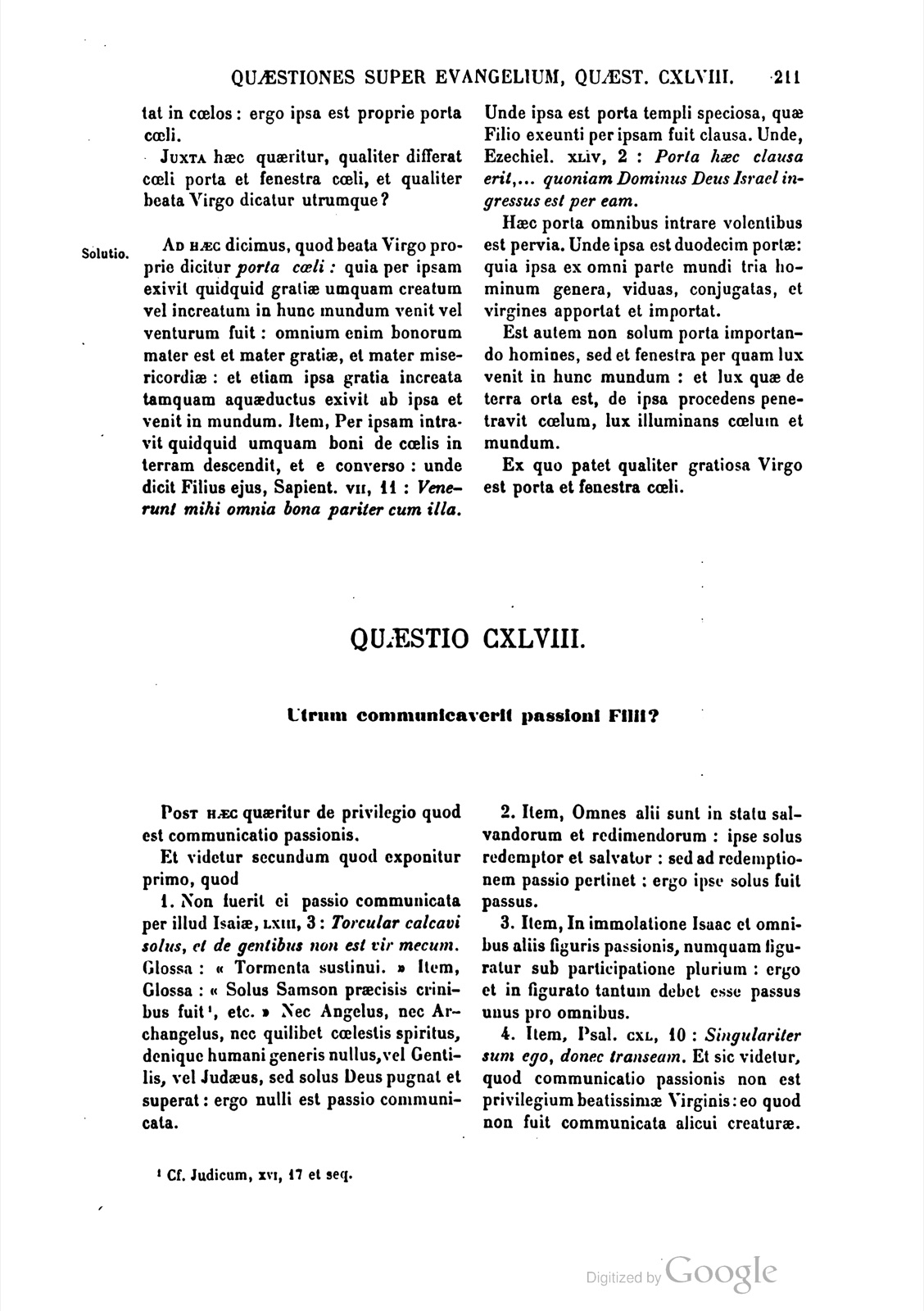
5. Item, Lazarus fuit nuper suscitatus in anima et corpore, et multa de poenis infernalibus narravit, ut dicit Chrysostomus. De illo igitur qualiter opinabile est, quod tam cito ceciderit a fide. Item, Latro in cruce per veram poenitentiam placuit Deo: sed sine fide impossibile est placere Deo 2: ergo habuit fidem et compassionem: ergo hoc non est privilegium Dominae nostrae, quod potest etiam latroni convenire. Item, Elias et Henoch qui locuti fuerunt cum Domino in transfiguratione, habuerunt etiam fidem incarnationis et passionis. Item, Joannes Baptista in limbo habuit fidem. Item, Multi absentes quibus Dominus non praedicaverat, ut ille de quo dixit, Matth. VIII, 10: Non inveni tantam fidem in Israel. Et multi alii. Item, Glossa super illud Marci, XIV, 72: Et coepit flere: « Egreditur foras ut ab impiis secretus, negationis culpam liberius abluat fletibus. » Item, Cornelius fidem habuit et praesens non fuit.
Et videtur ex his quod multi tempore passionis habuerunt fidem, et per consequens passionem. Et sic non potest poni privilegium fides passionis vel communicatio passionis.
Sed contra:
1. Si de eo quod magis videtur inesse et non inest, nec de eo quod minus. Sed maxime videbatur de mulieribus, quod habuerunt fidem passionis, ut patet supra per Glossam Gregorii. Et inter mulieres maxime videbatur de Maria Magdalena: sed illa non habuit fidem tunc: ergo nec aliquis nec aliqua earum. Minor patet, Joan. XX, 1: Maria Magdalene venit mane, cum adhuc tenebrae essent, ad monumentum. Chrysostomus: « Quia adhuc fuit in tenebris infidelitatis. » Item, Joan. XX, 13: Mulier, quid ploras? Glossa: « Non lacrymas nudas, sed fidem quaere: bonae lacrymae, si Jesum agnoscas. » Et infra, v. 17: Noli me tangere, nondum enim ascendi ad Patrem meum. Glossa: « Non quod nollet tangi nisi cum ascendisset in caelum, cum et mulieres et alii in terra eum tetigisse legantur et non sedentem in caelo. » Vult igitur sic se specialiter tangi, id est, sic se credi, ut sit aequalis Patri: et quia ista adhuc in eum carnaliter credebat, quem sicut hominem flebat, audit: Noli me tangere, id est, sic in me credere: quia nondum in corde tuo ascendi ad Patrem meum, id est, nondum credis me esse aequalem Patri: tunc tanges cum me in Patre Deum credes. Item, Quem mortuum credis viventem tangere non mereris.
5. Likewise, Lazarus had recently been raised in soul and body, and told many things about the punishments of hell, as Chrysostom says. Therefore regarding him, how is it believable that he so quickly fell from faith? Likewise, the thief on the cross pleased God through true penitence; but without faith it is impossible to please God 2. Therefore he had faith and compassion; therefore this is not a privilege of our Lady, since it can also belong to the thief. Likewise, Elijah and Enoch, who spoke with the Lord in the transfiguration, also had faith in the incarnation and the passion. Likewise, John the Baptist had faith in limbo. Likewise, many absent persons to whom the Lord had not preached, such as the one of whom he said, Matthew 8:10: I have not found such great faith in Israel. And many others. Likewise, the Gloss on that saying of Mark 14:72: And he began to weep: “He goes outside so that, separated from the impious, he may more freely wash away the fault of denial with tears.” Likewise, Cornelius had faith and was not present.
And from these things it seems that many at the time of the passion had faith, and consequently passion. And thus faith of the passion or communication of the passion cannot be posited as a privilege.
But to the contrary:
1. If concerning that which seems more to be present and is not present, neither concerning what is less. But most of all it seemed concerning the women that they had faith of the passion, as is clear above through Gregory’s Gloss. And among the women it seemed most of all concerning Mary Magdalene; but she did not then have faith. Therefore neither did any man nor any of those women. The minor premise is clear from John 20:1: Mary Magdalene came early, while it was still dark, to the tomb. Chrysostom says: “Because she was still in the darkness of unbelief.” Likewise, John 20:13: Woman, why are you weeping? The Gloss says: “Seek not bare tears, but faith; tears are good if you recognize Jesus.” And below, verse 17: Do not touch me, for I have not yet ascended to my Father. The Gloss says: “Not that he was unwilling to be touched unless he had ascended into heaven, since women and others are read to have touched him on earth and not while sitting in heaven.” Therefore he wishes himself to be touched specially in this way, that is, to be believed in this way, as equal to the Father. And because she was still believing carnally in him whom she was weeping for as a man, she hears: Do not touch me, that is, do not believe in me in this way, because I have not yet ascended to my Father in your heart, that is, you do not yet believe me to be equal to the Father. Then you will touch me when you believe me to be God in the Father. Likewise, you do not deserve to touch as living the one whom you believe dead.
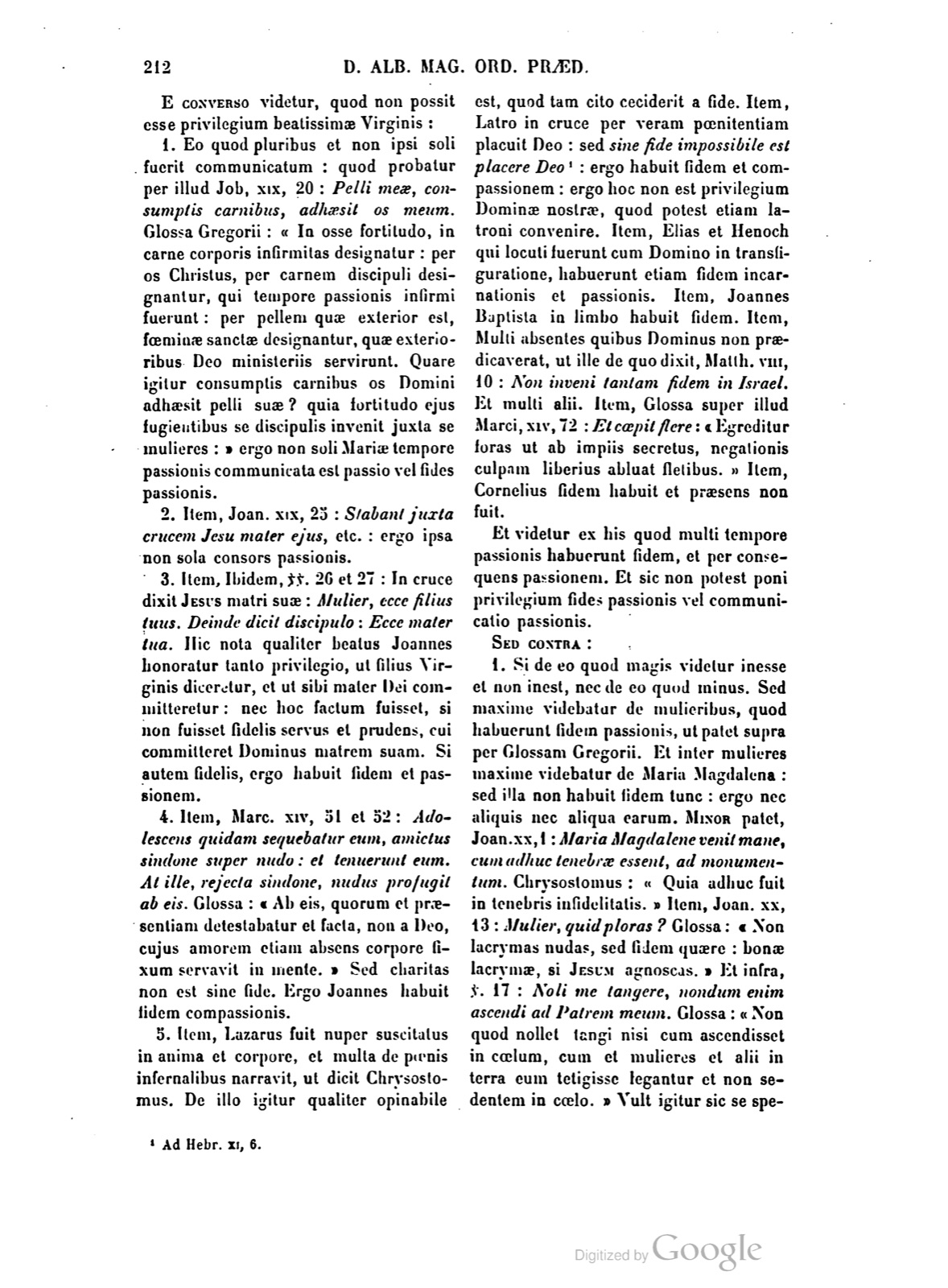
Ex his patet, quod Magdalena de qua minime videbatur, in passione Domini discredidit et cecidit: ergo et omnes alii.
2. Item, Matth. XXVI, 31: Omnes vos scandalum patiemini in me in ista nocte. Glossa: « Praedicit quid passuri sunt, ut post eventum non desperent, sed poenitentia liberentur. » Item, Infra, v. 56: Discipuli omnes, relicto eo, fugerunt. Item, Petrus qui expressissime fidem fuit protestatus, ter negavit: ergo multo fortius alii. Item, Marci, XIV, 5: Quidam adolescens amictus sindone. Glossae: « Possumus hunc Joannem fuisse intelligere. » Ergo Joannes fugit. Item, Joan. XX, 4: Currebant duo simul. Et infra, v. 8: Tunc ergo introivit et ille discipulus, qui venerat prius ad monumentum: et vidit, et credidit. Et sic patet, quod Joannes non prius credidit. Item, De mulieribus, Bernardus: « Sic vos, o bonae mulieres, cuinam, quaeso, excubias exhibetis? cui aromata comparatis, paratis unguenta? Si sciretis quantus is sit, quam sit inter mortuos liber 3, mortuus iste quem vos ungere pergitis, vos forsitan petissetis ab eo ungi. Nonne iste est, quem unxit Deus oleo laetitiae prae consortibus suis 4? Beatae eritis vos, si gloriari potueritis revertentes, et dicere, quod de plenitudine ejus accepimus nos omnes 5. Enimvero factum est ita. Nam revera unctae remeant, quae uncturae venerant. Missae ab Angelo opus faciunt Evangelistae, factae Apostolae Apostolorum, dum festinant ad annuntiandum mane misericordiam Domini 6. » Ex his patet, quod mulieres in passione Domini discrediderunt.
3. Item, Quod beatissima Virgo sola tempore passionis permanserit in fide, videtur posse subtiliter inveniri secundum Isaiam, LXIII, 3, cum dicit: Torcular calcavi solus, et de gentibus non est vir mecum. Si enim omnes homines voluisset excludere, suffecisset dicere: Calcavi solus: et sic superfluum esset dicere: De gentibus non est vir mecum. Item, sic dixisset potius: De gentibus nullus est mecum. Quando igitur viros exclusit, constat quod aliquam feminam reliquit, quam non exclusit, quae torcular passionis secum sustinuit et calcavit.
Item, Magis videbatur de mulieribus quam de viris, quod secum calcaverant: quia illae stabant circa crucem: ergo si voluisset omnes excludere, potius debuit eas expressisse de quibus videbatur magis inesse.
From these things it is clear that Magdalene, concerning whom it least seemed so, disbelieved and fell in the Lord’s passion; therefore so did all the others.
2. Likewise, Matthew 26:31: All of you will suffer scandal in me in this night. The Gloss says: “He foretells what they will suffer, so that after the event they may not despair, but may be freed by penitence.” Likewise, below, verse 56: All the disciples, leaving him, fled. Likewise, Peter, who had most expressly professed faith, denied three times; therefore much more the others. Likewise, Mark 14:5: A certain young man clothed with a linen cloth. The Glosses say: “We can understand this to have been John.” Therefore John fled. Likewise, John 20:4: The two ran together. And below, verse 8: Then therefore that disciple who had come first to the tomb also entered; and he saw and believed. And thus it is clear that John did not believe earlier. Likewise, concerning the women Bernard says: “Thus you, O good women, for whom, I ask, do you keep watch? For whom do you buy spices and prepare ointments? If you knew how great he is, how free among the dead 3 is that dead one whom you are proceeding to anoint, perhaps you would ask to be anointed by him. Is he not the one whom God anointed with the oil of gladness above his fellows 4? Blessed will you be if, returning, you can glory and say that from his fullness we have all received 5. Indeed it happened so. For truly anointed they return, who had come to anoint. Sent by the Angel, they do the work of an Evangelist; made Apostles of the Apostles, while they hasten to announce the mercy of the Lord in the morning 6.” From these things it is clear that the women disbelieved in the passion of the Lord.
3. Likewise, that the most blessed Virgin alone remained in faith at the time of the passion seems capable of being found subtly according to Isaiah 63:3, when he says: I have trodden the winepress alone, and of the nations there is not a man with me. For if he had wished to exclude all human beings, it would have been sufficient to say, I have trodden alone; and thus it would be superfluous to say, Of the nations there is not a man with me. Likewise, he would rather have said: Of the nations no one is with me. Therefore when he excluded men, it is clear that he left some woman whom he did not exclude, who sustained and trod the winepress of the passion with him.
Likewise, it seemed more concerning the women than concerning the men that they had trodden with him, because those women were standing around the cross. Therefore if he had wished to exclude all, he ought rather to have expressed those concerning whom it seemed more to be present.
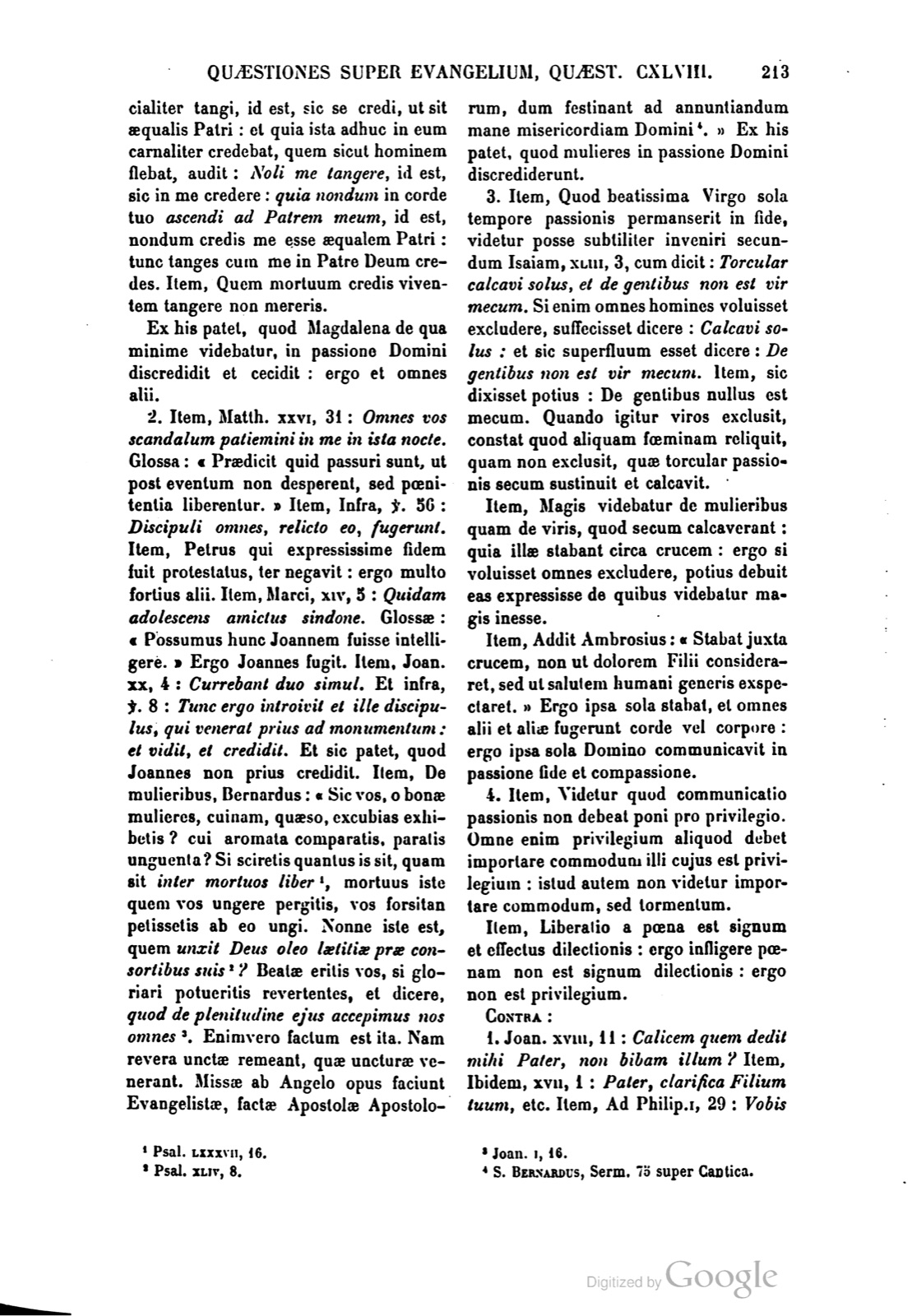
Item, Addit Ambrosius: « Stabat juxta crucem, non ut dolorem Filii consideraret, sed ut salutem humani generis exspectaret. » Ergo ipsa sola stabat, et omnes alii et aliae fugerunt corde vel corpore: ergo ipsa sola Domino communicavit in passione fide et compassione.
4. Item, Videtur quod communicatio passionis non debeat poni pro privilegio. Omne enim privilegium aliquod debet importare commodum illi cujus est privilegium: istud autem non videtur importare commodum, sed tormentum.
Item, Liberatio a poena est signum et effectus dilectionis: ergo infligere poenam non est signum dilectionis: ergo non est privilegium.
Contra:
1. Joan. XVIII, 11: Calicem quem dedit mihi Pater, non bibam illum? Item, Ibidem, XVII, 1: Pater, clarifica Filium tuum, etc. Item, Ad Philip. I, 29: Vobis donatum est pro Christo, non solum ut in eum credatis, sed ut etiam pro illo patiamini. Item, Ad Hebr. XII, 6: Flagellat Deus omnem filium quem recepit. Item, Jacob. I, 2: Omne gaudium existimate, fratres mei, cum in tentationes varias incideritis. Item, Act. V, 41: Ibant Apostoli gaudentes a conspectu consilii, quoniam digni, etc. Ex his igitur patet et manifestum est, quod communicatio passionis est privilegium.
2. Item, Quod in passione Domini sustinuerit beatissima Virgo, patet per Damascenum 7, qui dicit, quod dolores quos effugit pariens, in Christi passione sustinuit. Luc. II, 35: Tuam ipsius animam pertransibit gladius. Item, Isa. LXVI, 7: Antequam parturiret, peperit: antequam veniret partus ejus, peperit masculum. Ex hoc sequitur, quod aliquando peperit sine parturitione et sine dolore. Et postmodum, v. 8, sequitur: Numquid parturiet terra in die una, aut parietur gens simul, quia parturivit et peperit Sion filios suos? Ergo aliquando peperit gentem simul, et cum parturitione et dolore: ergo peperit Filium suum primogenitum sine dolore in sua nativitate, postea peperit totam gentem simul in Filii passione, ubi facta fuit ei in adjutorium simile sibi, ubi ipsa mater misericordiae Patrem misericordiarum in summo opere misericordiae adjuvit, et una secum omnes homines regeneravit. Et haec regeneratio cum summo dolore utriusque fuit. Unde Glossa ibi posita: « Multo labore in fide genuit. »
Ex his patet, quod Pater misericordiarum soli matri misericordiae opus summae misericordiae, id est, passionem communicavit 8.
Likewise, Ambrose adds: “She stood beside the cross, not that she might consider the pain of the Son, but that she might await the salvation of the human race.” Therefore she alone stood, and all others, men and women, fled in heart or body. Therefore she alone communicated with the Lord in the passion by faith and compassion.
4. Likewise, it seems that sharing in the passion ought not to be posited as a privilege. For every privilege ought to import some advantage for the one whose privilege it is; but this seems to import not advantage, but torment.
Likewise, liberation from punishment is a sign and effect of love. Therefore to inflict punishment is not a sign of love; therefore it is not a privilege.
To the contrary:
1. John 18:11: The chalice which the Father has given me, shall I not drink it? Likewise, in the same place, 17:1: Father, glorify your Son, etc. Likewise, Philippians 1:29: It has been given to you for Christ, not only that you should believe in him, but that you should also suffer for him. Likewise, Hebrews 12:6: God scourges every son whom he receives. Likewise, James 1:2: Esteem it all joy, my brothers, when you fall into various temptations. Likewise, Acts 5:41: The Apostles went rejoicing from the presence of the council, because they were worthy, etc. From these things, therefore, it is clear and manifest that sharing in the passion is a privilege.
2. Likewise, that the most blessed Virgin endured in the passion of the Lord is clear through Damascene 7, who says that the pains which she escaped in giving birth, she sustained in Christ’s passion. Luke 2:35: A sword shall pass through your own soul. Likewise, Isaiah 66:7: Before she was in labor, she brought forth; before her travail came, she brought forth a male child. From this it follows that at some time she gave birth without travail and without pain. And afterward, verse 8, it follows: Shall the earth be in labor in one day, or shall a nation be born at once, because Zion has been in labor and has brought forth her sons? Therefore at some time she brought forth a nation at once, and with travail and pain. Therefore she brought forth her firstborn Son without pain in his nativity; afterward she brought forth the whole nation at once in the Son’s passion, where she was made as a help like him, where she herself, Mother of mercy, aided the Father of mercies in the highest work of mercy, and together with him regenerated all human beings. And this regeneration was with the highest pain of each. Whence the Gloss placed there says: “With much labor she begot in faith.”
From these things it is clear that the Father of mercies communicated to the Mother of mercy alone the work of highest mercy, that is, the passion 8.
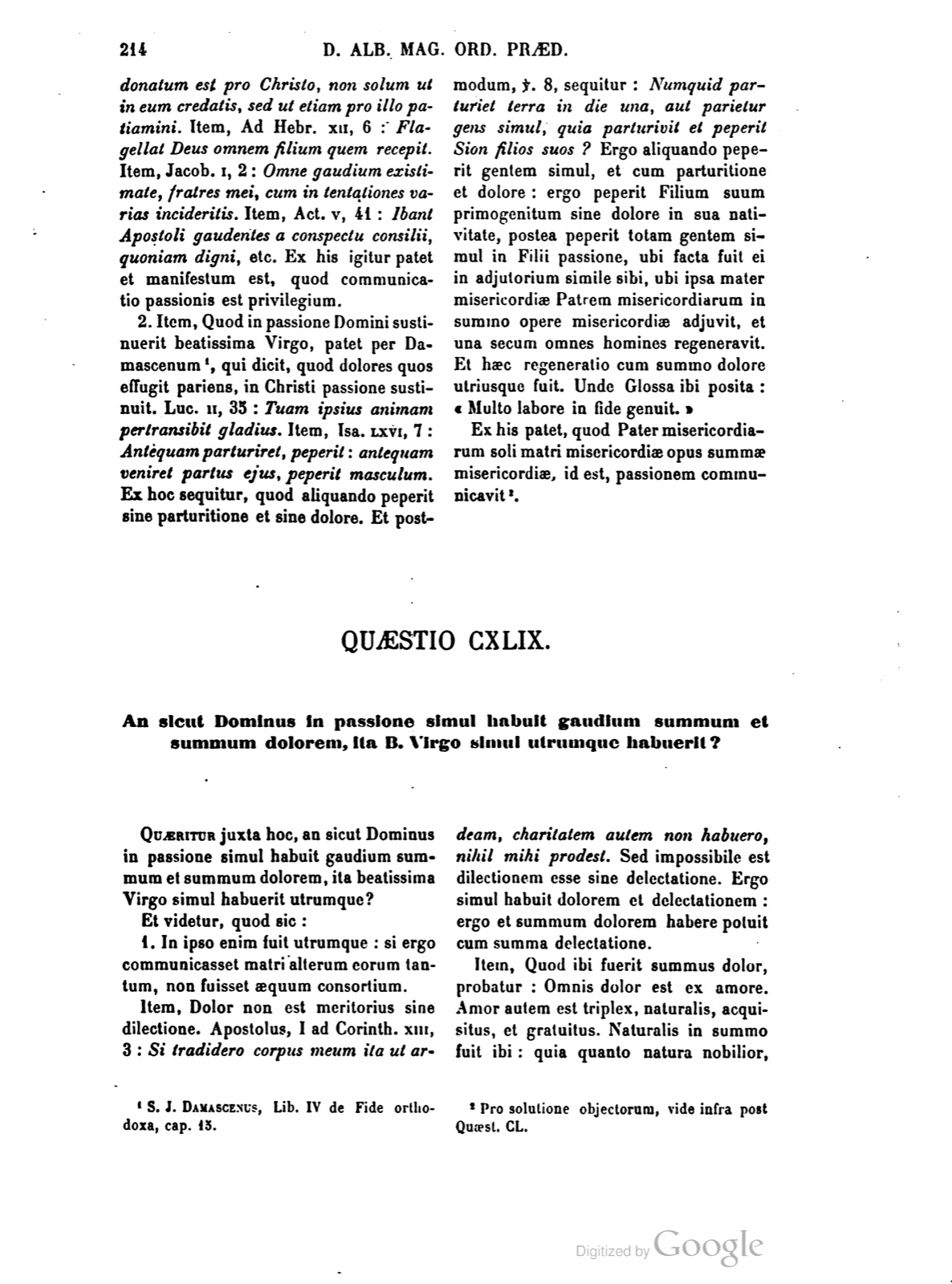
Notes
- Cf. Judges 16:17 and following. (Cf. Judicum, XVI, 17 et seq.) ↩
- Hebrews 11:6. (Ad Hebr. XI, 6.) ↩
- Psalm 87:16. (Psal. LXXXVII, 16.) ↩
- Psalm 44:8. (Psal. XLIV, 8.) ↩
- John 1:16. (Joan. I, 16.) ↩
- St. Bernard, Sermon 75 on the Canticle. (S. Bernardus, Serm. 75 super Cantica.) ↩
- St. John Damascene, book IV On the Orthodox Faith, chapter 15. (S. J. Damascenus, Lib. IV de Fide orthodoxa, cap. 15.) ↩
- For the solution of the objections, see below after Question 150. (Pro solutione objectorum, vide infra post Quaest. CL.) ↩
If a page does not appear, its photograph has not been uploaded yet.