Works › The Mariale: Questions on “Missus est”
Volume 37 · pp. 214–215
Question 149. Whether, just as the Lord in the passion at once had highest joy and highest sorrow, so the Blessed Virgin at once had both?
A marker with ≈ is an approximate page boundary, placed by measure of the text; the page photographs remain the authority. In the paired views, clicking a page marker brings that page into view.
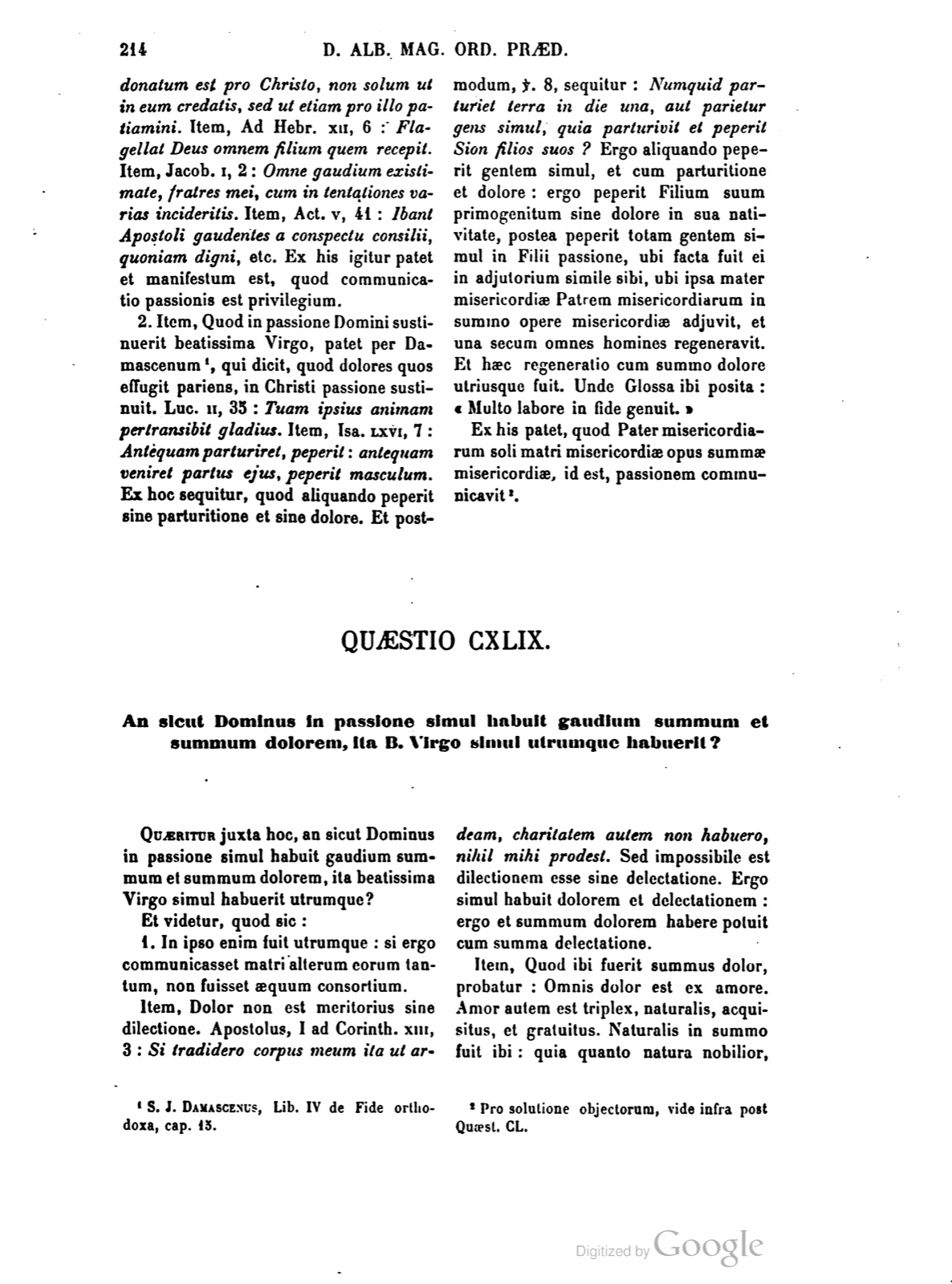
QUAESTIO CXLIX. An sicut Dominus in passione simul habuit gaudium summum et summum dolorem, ita B. Virgo simul utrumque habuerit?
Quaeritur juxta hoc, an sicut Dominus in passione simul habuit gaudium summum et summum dolorem, ita beatissima Virgo simul habuerit utrumque?
Et videtur, quod sic:
1. In ipso enim fuit utrumque: si ergo communicasset matri alterum eorum tantum, non fuisset aequum consortium.
Item, Dolor non est meritorius sine dilectione. Apostolus, I ad Corinth. XIII, 3: Si tradidero corpus meum ita ut ardeam, charitatem autem non habuero, nihil mihi prodest. Sed impossibile est dilectionem esse sine delectatione. Ergo simul habuit dolorem et delectationem: ergo et summum dolorem habere potuit cum summa delectatione.
Item, Quod ibi fuerit summus dolor, probatur: Omnis dolor est ex amore. Amor autem est triplex, naturalis, acquisitus, et gratuitus. Naturalis in summo fuit ibi: quia quanto natura nobilior, tanto nobiliores habet affectiones et operationes: sed ipsa summe habuit naturam nobilem: ergo summe nobilem amorem naturalem.
Item, Acquisitus fuit ibi in summo: omnes enim causae accidentales quae inducunt matrem ad diligendum filium suum, hic fuerunt in summo: numquam enim Filius matrem suam tantum dilexit, vel tantum honoravit, vel tantum dedit, vel pro ipsa sustinuit, et sic de singulis accidentalibus causis dilectionis: ergo amor acquisitus ibi in summo fuit.
Item, Gratuitus ibi in summo fuit: quia numquam alia mater vel alia creatura tantam charitatem habuit, ut supra patuit. Et sic beatissima Virgo ad Filium suum in summo habuit amorem naturalem, acquisitum, et gratuitum: ergo si iste triplex habitus amoris simul eliciat unum motum amoris in summo, illa erit dilectio intensissima, et dolor illi respondens erit dolor in summo: sed tam naturalis quam acquisita quam gratuita dilectio respectu nullius ita est intensa sicut est respectu vitae dilecti: ergo naturalis, acquisitus, infusus sive gratuitus amor in summo diligit vitam in dilecto: ergo de morte dilecti dolet in summo: ergo cum beata Virgo respectu Filii sui habuerit omnifariam dilectionem in summo, constat quod de morte ipsius habuit omnifariam dolorem in summo.
QUESTION 149. Whether, just as the Lord in the passion at once had highest joy and highest sorrow, so the Blessed Virgin at once had both?
In connection with this it is asked whether, just as the Lord in the passion at once had highest joy and highest sorrow, so the most blessed Virgin at once had both.
And it seems that she did:
1. For in him there was both; therefore if he had communicated only one of them to his mother, there would not have been an equal sharing.
Likewise, sorrow is not meritorious without love. The Apostle, 1 Corinthians 13:3: If I hand over my body so that I burn, but have not charity, it profits me nothing. But it is impossible for love to be without delight. Therefore she had sorrow and delight at once; therefore she could also have highest sorrow with highest delight.
Likewise, that there was highest sorrow there is proved: every sorrow is from love. But love is threefold: natural, acquired, and gratuitous. Natural love was there in the highest degree, because the nobler the nature, the nobler the affections and operations it has; but she had nature supremely noble; therefore she had supremely noble natural love.
Likewise, acquired love was there in the highest degree, for all accidental causes which induce a mother to love her son were here in the highest degree. For never did a Son so greatly love his mother, or so greatly honor her, or so greatly give to her, or endure so much for her, and so concerning the individual accidental causes of love. Therefore acquired love was there in the highest degree.
Likewise, gratuitous love was there in the highest degree, because no other mother or other creature ever had such great charity, as was clear above. And thus the most blessed Virgin had natural, acquired, and gratuitous love toward her Son in the highest degree. Therefore if this threefold habit of love at once elicits one movement of love in the highest degree, that will be most intense love, and the sorrow corresponding to it will be sorrow in the highest degree. But natural, acquired, and gratuitous love is not so intense with respect to anything as it is with respect to the life of the beloved. Therefore natural, acquired, infused or gratuitous love loves life in the beloved in the highest degree; therefore concerning the death of the beloved it grieves in the highest degree. Therefore since the blessed Virgin with respect to her Son had love in every way in the highest degree, it is clear that concerning his death she had sorrow in every way in the highest degree.
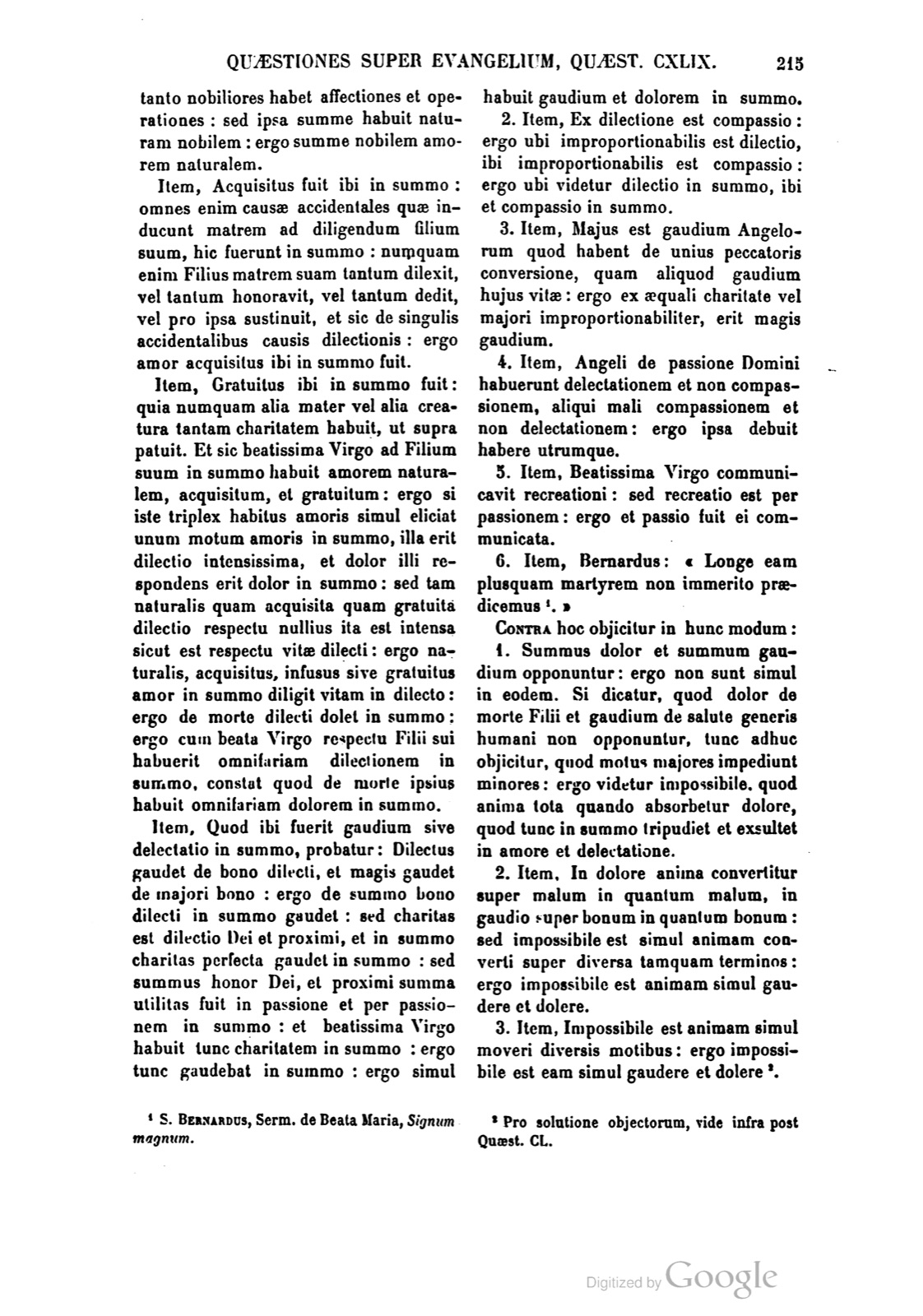
Item, Quod ibi fuerit gaudium sive delectatio in summo, probatur: Dilectus gaudet de bono dilecti, et magis gaudet de majori bono: ergo de summo bono dilecti in summo gaudet: sed charitas est dilectio Dei et proximi, et in summo charitas perfecta gaudet in summo: sed summus honor Dei, et proximi summa utilitas fuit in passione et per passionem in summo: et beatissima Virgo habuit tunc charitatem in summo: ergo tunc gaudebat in summo: ergo simul habuit gaudium et dolorem in summo.
2. Item, Ex dilectione est compassio: ergo ubi improportionabilis est dilectio, ibi improportionabilis est compassio: ergo ubi videtur dilectio in summo, ibi et compassio in summo.
3. Item, Majus est gaudium Angelorum quod habent de unius peccatoris conversione, quam aliquod gaudium hujus vitae: ergo ex aequali charitate vel majori improportionabiliter, erit magis gaudium.
4. Item, Angeli de passione Domini habuerunt delectationem et non compassionem, aliqui mali compassionem et non delectationem: ergo ipsa debuit habere utrumque.
5. Item, Beatissima Virgo communicavit recreationi: sed recreatio est per passionem: ergo et passio fuit ei communicata.
6. Item, Bernardus: « Longe eam plusquam martyrem non immerito praedicemus 1. »
Contra hoc objicitur in hunc modum:
1. Summus dolor et summum gaudium opponuntur: ergo non sunt simul in eodem. Si dicatur, quod dolor de morte Filii et gaudium de salute generis humani non opponuntur, tunc adhuc objicitur, quod motus majores impediunt minores: ergo videtur impossibile, quod anima tota quando absorbetur dolore, quod tunc in summo tripudiet et exsultet in amore et delectatione.
2. Item, In dolore anima convertitur super malum in quantum malum, in gaudio super bonum in quantum bonum: sed impossibile est simul animam converti super diversa tamquam terminos: ergo impossibile est animam simul gaudere et dolere.
3. Item, Impossibile est animam simul moveri diversis motibus: ergo impossibile est eam simul gaudere et dolere 2.
Likewise, that joy or delight was there in the highest degree is proved: the beloved rejoices in the good of the beloved, and rejoices more in a greater good; therefore he rejoices in the highest degree in the highest good of the beloved. But charity is love of God and neighbor, and perfect charity in the highest degree rejoices in the highest degree. But the highest honor of God and the highest usefulness of neighbor was in the passion and through the passion in the highest degree; and the most blessed Virgin then had charity in the highest degree. Therefore she then rejoiced in the highest degree; therefore she at once had joy and sorrow in the highest degree.
2. Likewise, compassion is from love; therefore where love is disproportionate, there compassion is disproportionate. Therefore where love seems to be in the highest degree, there also compassion is in the highest degree.
3. Likewise, the joy of Angels which they have over the conversion of one sinner is greater than any joy of this life. Therefore from equal charity, or disproportionately greater charity, there will be greater joy.
4. Likewise, Angels had delight concerning the Lord’s passion and not compassion; some evil persons had compassion and not delight. Therefore she ought to have had both.
5. Likewise, the most blessed Virgin shared in recreation; but recreation is through the passion; therefore the passion was also communicated to her.
6. Likewise, Bernard says: “We shall deservedly proclaim her far more than a martyr 1.”
Against this it is objected in this way:
1. Highest sorrow and highest joy are opposed; therefore they are not at once in the same subject. If it is said that sorrow concerning the death of the Son and joy concerning the salvation of the human race are not opposed, then it is still objected that greater movements impede lesser movements. Therefore it seems impossible that when the whole soul is absorbed by sorrow, it should then in the highest degree leap and exult in love and delight.
2. Likewise, in sorrow the soul is turned toward evil as evil, in joy toward good as good. But it is impossible for the soul at once to be turned toward different things as terms. Therefore it is impossible for the soul at once to rejoice and grieve.
3. Likewise, it is impossible for the soul at once to be moved by diverse movements. Therefore it is impossible for it at once to rejoice and grieve 2.
Notes
- St. Bernard, Sermon on Blessed Mary, Signum magnum. (S. Bernardus, Serm. de Beata Maria, Signum magnum.) ↩
- For the solution of the objections, see below after Question 150. (Pro solutione objectorum, vide infra post Quaest. CL.) ↩
If a page does not appear, its photograph has not been uploaded yet.