Works › The Mariale: Questions on “Missus est”
Volume 37 · pp. 210–211
Question 147. Whether she is fittingly called gate of heaven?
A marker with ≈ is an approximate page boundary, placed by measure of the text; the page photographs remain the authority. In the paired views, clicking a page marker brings that page into view.
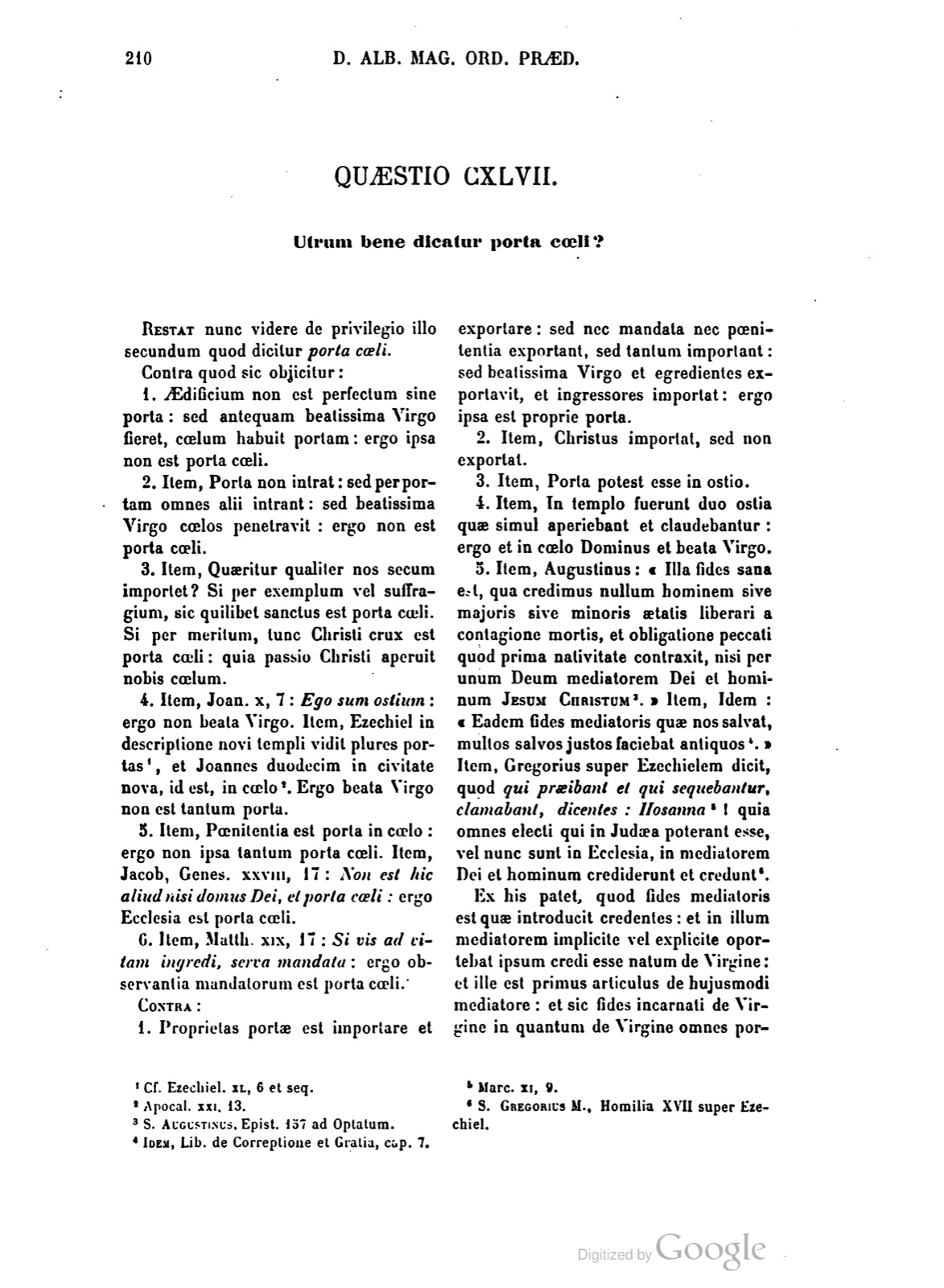
QUAESTIO CXLVII. Utrum bene dicatur porta caeli?
Restat nunc videre de privilegio illo secundum quod dicitur porta caeli.
Contra quod sic objicitur:
1. Aedificium non est perfectum sine porta: sed antequam beatissima Virgo fieret, caelum habuit portam: ergo ipsa non est porta caeli.
2. Item, Porta non intrat: sed per portam omnes alii intrant: sed beatissima Virgo caelos penetravit: ergo non est porta caeli.
3. Item, Quaeritur qualiter nos secum importet? Si per exemplum vel suffragium, sic quilibet sanctus est porta caeli. Si per meritum, tunc Christi crux est porta caeli: quia passio Christi aperuit nobis caelum.
4. Item, Joan. X, 7: Ego sum ostium: ergo non beata Virgo. Item, Ezechiel in descriptione novi templi vidit plures portas 1, et Joannes duodecim in civitate nova, id est, in caelo 2. Ergo beata Virgo non est tantum porta.
5. Item, Poenitentia est porta in caelo: ergo non ipsa tantum porta caeli. Item, Jacob, Genes. XXVIII, 17: Non est hic aliud nisi domus Dei, et porta caeli: ergo Ecclesia est porta caeli.
6. Item, Matth. XIX, 17: Si vis ad vitam ingredi, serva mandata: ergo observantia mandatorum est porta caeli.
Contra:
1. Proprietas portae est importare et exportare: sed nec mandata nec poenitentia exportant, sed tantum important: sed beatissima Virgo et egredientes exportavit, et ingressores importat: ergo ipsa est proprie porta.
2. Item, Christus importat, sed non exportat.
3. Item, Porta potest esse in ostio.
4. Item, In templo fuerunt duo ostia quae simul aperiebant et claudebantur: ergo et in caelo Dominus et beata Virgo.
5. Item, Augustinus: « Illa fides sana est, qua credimus nullum hominem sive majoris sive minoris aetatis liberari a contagione mortis, et obligatione peccati quod prima nativitate contraxit, nisi per unum Deum mediatorem Dei et hominum Jesum Christum 3. » Item, Idem: « Eadem fides mediatoris quae nos salvat, multos salvos justos faciebat antiquos 4. » Item, Gregorius super Ezechielem dicit, quod qui praeibant et qui sequebantur, clamabant, dicentes: Hosanna 5! quia omnes electi qui in Judaea poterant esse, vel nunc sunt in Ecclesia, in mediatorem Dei et hominum crediderunt et credunt 6. Ex his patet, quod fides mediatoris est quae introducit credentes: et in illum mediatorem implicite vel explicite oportebat ipsum credi esse natum de Virgine: et ille est primus articulus de hujusmodi mediatore: et sic fides incarnati de Virgine in quantum de Virgine omnes portat in caelos: ergo ipsa est proprie porta caeli.
QUESTION 147. Whether she is fittingly called gate of heaven?
It now remains to see concerning that privilege according to which she is called gate of heaven.
Against this it is objected thus:
1. A building is not complete without a gate. But before the most blessed Virgin came to be, heaven had a gate. Therefore she is not the gate of heaven.
2. Likewise, a gate does not enter, but all others enter through a gate. But the most blessed Virgin penetrated the heavens; therefore she is not the gate of heaven.
3. Likewise, it is asked how she imports us with herself. If through example or suffrage, then every saint is a gate of heaven in this way. If through merit, then Christ’s cross is the gate of heaven, because the passion of Christ opened heaven for us.
4. Likewise, John 10:7: I am the door; therefore not the blessed Virgin. Likewise, in the description of the new temple Ezekiel saw several gates 1, and John saw twelve in the new city, that is, in heaven 2. Therefore the blessed Virgin is not the only gate.
5. Likewise, penitence is a gate into heaven; therefore she alone is not the gate of heaven. Likewise, Jacob, Genesis 28:17: This is nothing other than the house of God and the gate of heaven; therefore the Church is the gate of heaven.
6. Likewise, Matthew 19:17: If you wish to enter into life, keep the commandments; therefore observance of the commandments is the gate of heaven.
To the contrary:
1. The property of a gate is to bring in and to carry out. But neither the commandments nor penitence carry out, but only bring in. But the most blessed Virgin both carried out those departing and brings in those entering. Therefore she is properly the gate.
2. Likewise, Christ brings in, but does not carry out.
3. Likewise, a gate can be in a doorway.
4. Likewise, in the temple there were two doors which were opened and closed together; therefore in heaven also there are the Lord and the blessed Virgin.
5. Likewise, Augustine says: “That faith is sound by which we believe that no human being, whether of greater or lesser age, is freed from the contagion of death and the obligation of sin which he contracted by his first birth, except through the one God, mediator of God and human beings, Jesus Christ 3.” Likewise, the same author says: “The same faith of the mediator which saves us was making many ancient righteous persons saved 4.” Likewise, Gregory on Ezekiel says that those who went before and those who followed were crying out, saying, Hosanna 5, because all the elect who could be in Judea, or now are in the Church, believed and believe in the mediator of God and human beings 6. From these things it is clear that faith in the mediator is what introduces believers; and with respect to that mediator it was necessary that he be believed implicitly or explicitly to have been born of the Virgin. And that is the first article concerning such a mediator. And thus faith in the one incarnate of the Virgin, insofar as he is of the Virgin, carries all into the heavens; therefore she is properly the gate of heaven.
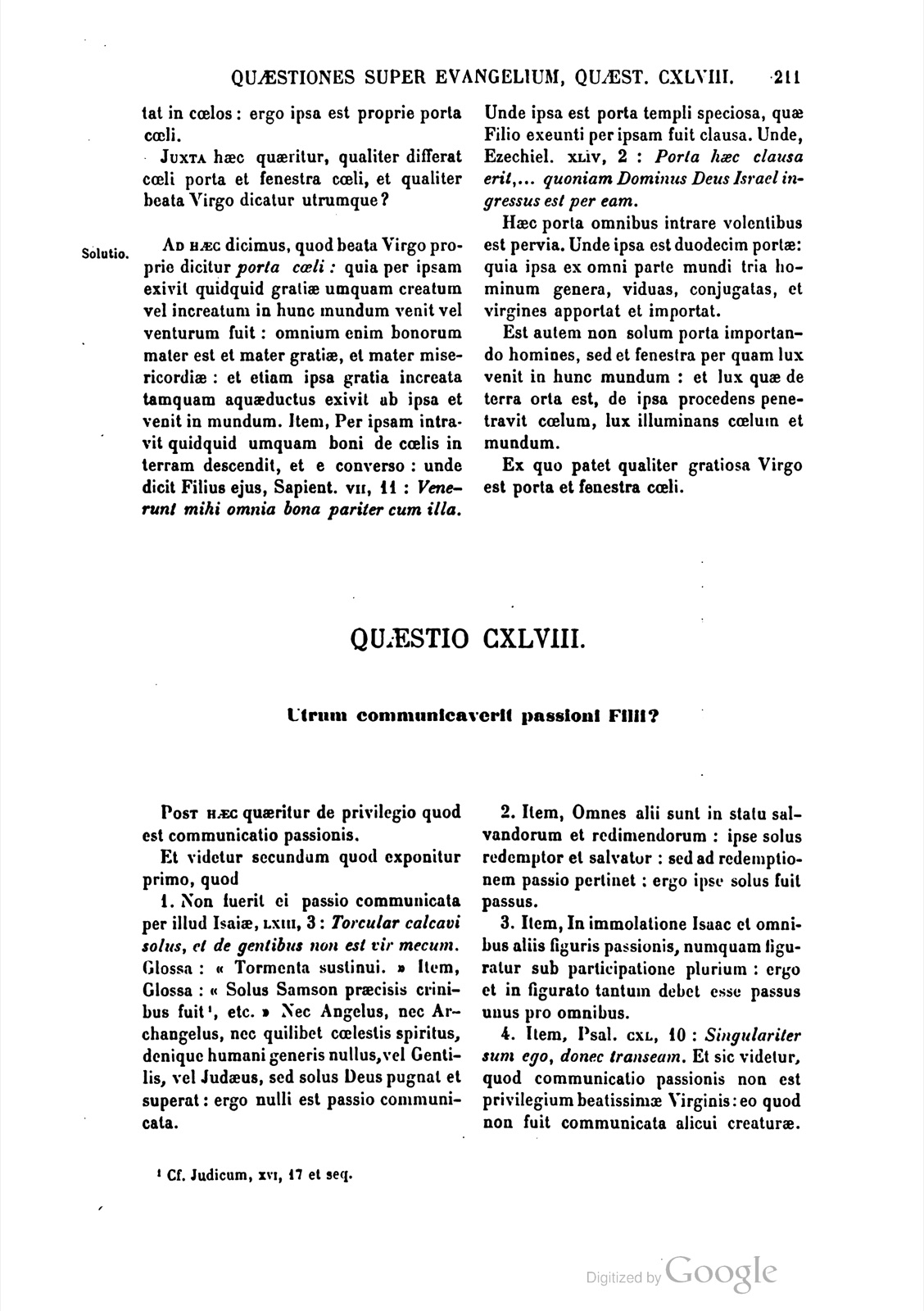
Juxta haec quaeritur, qualiter differat caeli porta et fenestra caeli, et qualiter beata Virgo dicatur utrumque?
Solutio. Ad haec dicimus, quod beata Virgo proprie dicitur porta caeli: quia per ipsam exivit quidquid gratiae umquam creatum vel increatum in hunc mundum venit vel venturum fuit: omnium enim bonorum mater est et mater gratiae, et mater misericordiae: et etiam ipsa gratia increata tamquam aquaeductus exivit ab ipsa et venit in mundum. Item, Per ipsam intravit quidquid umquam boni de caelis in terram descendit, et e converso: unde dicit Filius ejus, Sapient. VII, 11: Venerunt mihi omnia bona pariter cum illa.
Unde ipsa est porta templi speciosa, quae Filio exeunti per ipsam fuit clausa. Unde, Ezechiel. XLIV, 2: Porta haec clausa erit, ... quoniam Dominus Deus Israel ingressus est per eam.
Haec porta omnibus intrare volentibus est pervia. Unde ipsa est duodecim portae: quia ipsa ex omni parte mundi tria hominum genera, viduas, conjugatas, et virgines apportat et importat.
Est autem non solum porta importando homines, sed et fenestra per quam lux venit in hunc mundum: et lux quae de terra orta est, de ipsa procedens penetravit caelum, lux illuminans caelum et mundum.
Ex quo patet qualiter gratiosa Virgo est porta et fenestra caeli.
In connection with these things it is asked how the gate of heaven and the window of heaven differ, and in what way the blessed Virgin is called both.
Solution. To these things we say that the blessed Virgin is properly called gate of heaven, because through her went out whatever grace, created or uncreated, ever came or was to come into this world. For she is mother of all good things and mother of grace, and mother of mercy; and even uncreated grace itself, as through an aqueduct, went out from her and came into the world. Likewise, through her entered whatever good ever descended from the heavens to earth, and conversely. Whence her Son says, Wisdom 7:11: All good things came to me together with her.
Whence she is the beautiful gate of the temple, which was closed for the Son going out through her. Whence Ezekiel 44:2: This gate shall be closed, ... because the Lord God of Israel has entered through it.
This gate lies open to all who wish to enter. Whence she is the twelve gates, because from every part of the world she brings and imports the three kinds of human beings: widows, married women, and virgins.
But she is not only a gate by importing human beings, but also a window through which light came into this world; and the light which arose from the earth, proceeding from her, penetrated heaven, the light illuminating heaven and the world.
From this it is clear in what way the gracious Virgin is the gate and window of heaven.
Notes
- Cf. Ezekiel 40:6 and following. (Cf. Ezechiel. XL, 6 et seq.) ↩
- Apocalypse 21:13. (Apocal. XXI, 13.) ↩
- St. Augustine, Letter 157 to Optatus. (S. Augustinus, Epist. 157 ad Optatum.) ↩
- The same, book On Rebuke and Grace, chapter 7. (Idem, Lib. de Correptione et Gratia, cap. 7.) ↩
- Mark 11:9. (Marc. XI, 9.) ↩
- St. Gregory the Great, Homily 17 on Ezekiel. (S. Gregorius M., Homilia XVII super Ezechiel.) ↩
If a page does not appear, its photograph has not been uploaded yet.