Works › The Mariale: Questions on “Missus est”
Volume 37 · pp. 216–220
Question 150. Whether she had highest joy in the passion of the Son?
A marker with ≈ is an approximate page boundary, placed by measure of the text; the page photographs remain the authority. In the paired views, clicking a page marker brings that page into view.
QUAESTIO CL. Utrum habuerit summum gaudium in passione Filii?
Postquam probatum est, quod beatissima Virgo summum gaudium habuit in passione Filii, quaeritur de comparatione hujusmodi gaudii quod habuit in passione, ad alia gaudia, quando scilicet habuerit maximum gaudium?
Et videtur, quod in Filii sui conceptione, hac ratione:
1. Ex bono est gaudium. Job, III, 21: Quasi effodientes thesaurum, gaudentque vehementer cum invenerint sepulcrum. Ergo cum summo dono gaudium summum. Sed in conceptione accepit summum donum: cum enim Deus Pater Filium suum dedit, quomodo non etiam cum illo ei omnia bona donavit? ergo tunc summum gaudium habuit.
2. Item, Tunc tantum legitur cantasse canticum exsultationis, Luc. I, 46: Magnificat anima mea Dominum: ergo tunc maxime videtur gavisa fuisse.
3. Item, Ablatio vae est causa laetitiae: sed tunc, ut dictum est supra, ablatum est ei et fugit omne vae: ergo tunc summam habuit causam laetitiae.
4. Item, Novitas est causa laetitiae, etc. juxta illud Lucae, XV, 31 et seq.: Fili, tu semper mecum es, etc. Epulari autem et gaudere oportebat, etc. Ergo videtur a simili, quod beatissima Virgo in novitate conceptionis maximum effectum gaudii habuerit.
5. Item, Tunc cum summo conferibili dono accepit causam et meritum ad omnia alia dona necessario consequenda: ergo tunc summam habuit causam gaudii: ergo summum effectum gaudii.
E converso autem videtur, quod in nativitate Filii summum gaudium habuerit, ex hac ratione:
1. Si nativitas vel generatio fuerit perfectior, erit causa perfectioris et plenioris gaudii: sed perfectior et plenior est generatio ex utero quam in utero: ergo perfectius et plenius et majus fuit gaudium in nativitate quam in conceptione.
2. Item, Illa die dixit Angelus, Luc. II, 10 et 11: Ecce evangelizo vobis gaudium magnum, quod erit omni populo: quia natus est vobis hodie Salvator. Si igitur nativitas Domini est causa gaudii: ergo ille qui habet improportionabiliter propinquiorem comparationem ad Salvatorem quam omnes alii, habebit improportionabiliter majorem causam gaudii: haec autem est mater Salvatoris: ergo illa die habuit summum gaudium.
3. Item, Joan. XVI, 21: Mulier cum parit, tristitiam habet, quia venit hora ejus: cum autem peperit puerum, jam non meminit pressurae propter gaudium, etc. Ergo, etc.
4. Item, Luc. I, 14: Et multi in nativitate ejus gaudebunt, etc. Ergo majus gaudium videtur pertinere ad nativitatem quam ad conceptionem.
5. Item, In conceptione ipsam delectationem tantum habuit visu intellectuali: in nativitate vero intellectuali et sensuali: ergo tunc tantum reficiebatur intellectus, nunc autem intellectus et sensus: ergo tunc tantum gaudium fuit,
QUESTION 150. Whether she had highest joy in the passion of the Son?
After it has been proved that the most blessed Virgin had highest joy in the passion of the Son, inquiry is made concerning the comparison of joy of this kind which she had in the passion with other joys, namely when she had the greatest joy.
And it seems that it was in the conception of her Son, for this reason:
1. Joy is from good. Job 3:21: As those digging up a treasure, they rejoice vehemently when they have found the tomb. Therefore with the highest gift there is highest joy. But in the conception she received the highest gift, for when God the Father gave his Son, how did he not also with him give all good things to her? Therefore then she had highest joy.
2. Likewise, only then is she read to have sung the song of exultation, Luke 1:46: My soul magnifies the Lord. Therefore then she seems to have rejoiced most greatly.
3. Likewise, the removal of woe is a cause of gladness. But then, as was said above, every woe was removed from her and fled. Therefore then she had the highest cause of gladness.
4. Likewise, newness is a cause of gladness, etc., according to that saying of Luke 15:31 and following: Son, you are always with me, etc. But it was fitting to feast and rejoice, etc. Therefore by likeness it seems that the most blessed Virgin had the greatest effect of joy in the newness of conception.
5. Likewise, then, with the highest conferrable gift, she received the cause and merit for all other gifts necessarily to be attained. Therefore then she had the highest cause of joy; therefore the highest effect of joy.
Conversely, however, it seems that she had highest joy in the nativity of the Son, from this reason:
1. If nativity or generation was more perfect, it will be the cause of more perfect and fuller joy. But generation from the womb is more perfect and fuller than generation in the womb. Therefore joy was more perfect and fuller and greater in the nativity than in the conception.
2. Likewise, on that day the Angel said, Luke 2:10-11: Behold, I announce to you great joy which shall be for all the people, because today a Savior is born to you. Therefore if the Lord’s nativity is the cause of joy, then the one who has a disproportionately nearer relation to the Savior than all others will have a disproportionately greater cause of joy. But this one is the mother of the Savior. Therefore on that day she had highest joy.
3. Likewise, John 16:21: A woman, when she gives birth, has sadness, because her hour has come; but when she has brought forth the child, she no longer remembers the pressure because of joy, etc. Therefore, etc.
4. Likewise, Luke 1:14: And many will rejoice in his nativity, etc. Therefore greater joy seems to pertain to nativity than to conception.
5. Likewise, in the conception she had that delight only by intellectual sight, but in the nativity by intellectual and sensible sight. Therefore then only the intellect was refreshed, but now the intellect and the sense were refreshed; therefore then there was only joy,
nunc autem exsultatio et laetitia: ergo majus gaudium.
6. Item, Similius fuit gaudio patriae, ubi oculus corporis reficietur Domini humanitate, et oculus cordis in ejus divinitate: sed meliori et honorabiliori similius, est melius et honorabilius: ergo nobilius fuit gaudium nativitatis quam conceptionis.
7. Item, Bonum additum bono, magis facit ipsum esse bonum: ergo magis dilectum majorem dilectionem: sed conceptio est bonum, partus est bonum: ergo bonum duplicatum duplicat delectationem: ergo gaudium quod fuit in conceptione, duplicatum fuit in nativitate.
8. Item, Prius gaudebat se virginem concepisse, nunc vero virginem peperisse et virginem lactare: ergo modo habuit maximum gaudium.
Contra videtur, quod
1. Majus habuit gaudium in Filii passione: quia, ut dictum est supra, ipsa numquam gavisa fuit tantum de aliquo, quantum de honore Dei et salute proximi: sed utrumque fuit in passione in summo: ergo tunc habuit gaudium in summo.
2. Item, Charitas gaudet de bono dilecti. Triplex autem est bonum, honestum, utile, et delectabile. Quodlibet istorum in beatissima Virgine in passione respectu Filii sui fuit in summo. Unde ipse appellat passionem suam claritatem. Joan. XVII, 5: Clarifica me tu, Pater: propter honorem scilicet quem summum habuit per passionem, propter quam Deus exaltavit illum, et donavit illi nomen quod est super omne nomen 1, etc. Appellat etiam eam cibum et potum propter delectationem quam in summo effectu tunc habuit. Numquam enim in aliquo creato tantum delectatus fuit, quantum in redemptione generis humani per passionem. Appellat etiam eam donum dicens: Calicem quem dedit mihi Pater 2, propter suum lucrum quod mediante passione acquisivit, per quam omnia ad se traxit. Sic igitur quodlibet genus boni dilecti in passione fuit in summo: ergo et in diligente tunc fuit delectatio in summo.
3. Item, Motivum affectus et generativum delectationis non est nisi bonum. Bonum autem aliud creatum, aliud increatum: ergo si utrumque in summo movebat affectum recte dispositum, utrumque causabat delectationem in summo. Bonum autem increatum semper in summo est in se, sed non semper in summo in ostensione et exhibitione, ipso testante qui ait, Joan. XV, 13: Majorem hac dilectionem nemo habet, ut animam, etc.
4. Item, Summus effectus boni est redemptio generis humani: ergo summum increatum et summum creatum bonum in passione simul movebant affectum beatissimae Virginis optime dispositum: ergo tunc summum habuit gaudium.
5. Item, In conceptione fuit mater Dei et hominis in utero, in nativitate fuit mater Dei et hominis ex utero, in passione autem est mater Dei et hominis redemptoris: unde quae prius fuit mater creatoris, modo est mater redemptoris sive recreatoris: ergo duplicatum est donum et bonum: ergo gaudium.
6. Item, In conceptione et nativitate fuit effecta mater tantum unius Dei et hominis, in passione vero fuit facta mater omnium hominum: ergo tunc multiplicatum et majus gaudium habuit.
but now there was exultation and gladness; therefore greater joy.
6. Likewise, it was more similar to the joy of the homeland, where the eye of the body will be refreshed in the humanity of the Lord, and the eye of the heart in his divinity. But what is more similar to the better and more honorable is better and more honorable. Therefore the joy of the nativity was nobler than that of the conception.
7. Likewise, good added to good makes it more to be good; therefore the more beloved thing makes a greater love. But conception is a good, and birth is a good. Therefore a doubled good doubles delight; therefore the joy which was in the conception was doubled in the nativity.
8. Likewise, earlier she rejoiced that she had conceived as a virgin, but now that she had given birth as a virgin and was nursing as a virgin. Therefore then she had the greatest joy.
To the contrary, it seems that
1. She had greater joy in the passion of the Son, because, as was said above, she never rejoiced so much about anything as about the honor of God and the salvation of neighbor. But both were in the passion in the highest degree. Therefore then she had joy in the highest degree.
2. Likewise, charity rejoices in the good of the beloved. But good is threefold: honorable, useful, and delightful. Any one of these in the most blessed Virgin with respect to her Son was in the highest degree in the passion. Whence he himself calls his passion brightness. John 17:5: Glorify me, Father, namely because of the honor which he had in the highest degree through the passion, because of which God exalted him and gave him the name which is above every name 1, etc. He also calls it food and drink because of the delight which he then had in the highest effect. For he was never so much delighted in any created thing as in the redemption of the human race through the passion. He also calls it a gift, saying, The chalice which my Father gave me 2, because of his profit which he acquired by means of the passion, through which he drew all things to himself. Thus therefore every genus of the beloved’s good was in the passion in the highest degree; therefore also in the one loving there was then delight in the highest degree.
3. Likewise, the mover of affection and generator of delight is nothing except good. But one good is created, another uncreated. Therefore if each moved the rightly disposed affection in the highest degree, each caused delight in the highest degree. But the uncreated good is always in the highest degree in itself, but not always in the highest degree in manifestation and display, as he himself testifies who says, John 15:13: Greater love than this no one has, that he lay down his soul, etc.
4. Likewise, the highest effect of good is the redemption of the human race. Therefore the highest uncreated good and the highest created good in the passion at once moved the optimally disposed affection of the most blessed Virgin; therefore then she had highest joy.
5. Likewise, in the conception she was mother of God and man in the womb; in the nativity she was mother of God and man from the womb; but in the passion she is mother of God and man the redeemer. Whence she who before was mother of the creator is now mother of the redeemer or recreator. Therefore the gift and good are doubled; therefore so is the joy.
6. Likewise, in the conception and nativity she was made mother only of one God and man, but in the passion she was made mother of all human beings. Therefore then she had multiplied and greater joy.
7. Item, Finis melior est et nobilior his quae sunt ad finem: ergo quod fini propinquius est, melius est et nobilius: sed conceptio est propter nativitatem, nativitas propter passionem, passio propter redemptionem: ergo passio fini propinquior: ergo melior: ergo majus delectamentum: ergo majus gaudium.
Quod autem in resurrectione Filii maximum gaudium habuit, videtur: quoniam
1. Effectus dilectionis est flere cum flentibus, gaudere cum gaudentibus, juxta illud Joannis, XIV, 28: Si diligeretis me, gauderetis, etc. Sed Dominus summum gaudium habuit in resurrectione: quoniam gaudebat anima et cum corpore et divinitate: ergo Domina nostra in summo debuit tunc gaudere.
2. Item, Dicit Apostolus 3, quod traditus est propter delicta nostra, et resurrexit propter justificationem nostram. Ergo etiam ex parte nostri resurrectio propinquior fuit fini: ergo major causa gaudii.
3. Item, Ecclesia tunc specialiter utitur hac exsultatione: « Haec est dies quam fecit Dominus. »
4. Item, In illo festo plus cantatur Alleluia quam in alio festo: ergo videtur, quod cantus illius festi sit maxime causa gaudii.
5. Item, Resurrectio Christi est causa et exemplar illius vitae in qua est summa exsultatio: ergo illud festum propinquissimum est summo gaudio: ergo tunc debet esse summum in hac vita gaudium.
6. Item, Beatissima Virgo plus dilexit Filium quam totum mundum: ergo plus gavisa fuit de bono Filii, quam de bono totius mundi: sed bonum mundi et poena Christi fuit in passione, bonum autem Christi, scilicet liberatio ab omni poena, fuit in resurrectione: ergo plus gavisa fuit de resurrectione quam de passione.
Videtur autem, quod maximum in Christi ascensione habuerit gaudium. Tunc enim Filius primo dicitur habuisse gaudium et festum perfectum. Tunc enim primo in reportatione ovis in humeris convocat amicos suos, dicens: Congratulamini mihi, omnes amici mei 4.
Item, Tunc primo pater Filio suo prodigo fecit festum cum amicis suis 5. Item, Tunc primo rediit de exsilio in palatium. Item, Tunc primo janua caeli aperta est, et homo introductus. Item, Tunc primo redemptio completa est, et ruina jam in parte restaurata. Item, Tunc primo maximus honor Filio et matri exhibitus est, quando caro sua super choros Angelorum exaltata est. Item, Tunc primo quantum ad manifestationem datum est ei nomen quod est super omne nomen 6. Cum igitur in ascensione fuerit completissimus effectus boni et propinquissimus fini, videtur quod tunc maximum habuerit gaudium beatissima Virgo Maria.
Adhuc autem videtur majus his omnibus hoc quod
1. Habuit gaudium in ipsius assumptione. Tunc enim perfecte habuit gaudium fruitionis, ante autem non.
2. Item, Illud gaudium nullam secum patitur tristitiam vel poenam sicut omnia praedicta: ergo videtur majus omnibus illis.
7. Likewise, the end is better and nobler than those things which are for the end. Therefore what is nearer the end is better and nobler. But conception is for nativity, nativity for passion, passion for redemption. Therefore the passion is nearer the end; therefore better; therefore a greater delight; therefore greater joy.
But that she had greatest joy in the resurrection of the Son seems so, since:
1. The effect of love is to weep with those who weep and to rejoice with those who rejoice, according to John 14:28: If you loved me, you would rejoice, etc. But the Lord had highest joy in the resurrection, since he rejoiced in soul and with body and divinity. Therefore our Lady ought then to have rejoiced in the highest degree.
2. Likewise, the Apostle says 3 that he was handed over for our offenses and rose again for our justification. Therefore also on our part the resurrection was nearer the end; therefore a greater cause of joy.
3. Likewise, the Church then specially uses this exultation: “This is the day which the Lord has made.”
4. Likewise, in that feast Alleluia is sung more than in another feast. Therefore it seems that the song of that feast is especially a cause of joy.
5. Likewise, the resurrection of Christ is the cause and exemplar of that life in which there is highest exultation. Therefore that feast is nearest to highest joy; therefore then there ought to be the highest joy in this life.
6. Likewise, the most blessed Virgin loved the Son more than the whole world; therefore she rejoiced more over the good of the Son than over the good of the whole world. But the good of the world and the punishment of Christ were in the passion, whereas the good of Christ, namely liberation from every punishment, was in the resurrection. Therefore she rejoiced more over the resurrection than over the passion.
But it seems that she had the greatest joy in Christ’s ascension. For then the Son is first said to have had perfect joy and feast. For then first, in carrying back the sheep on his shoulders, he summons his friends, saying: Rejoice with me, all my friends 4.
Likewise, then first the father made a feast with his friends for his prodigal son 5. Likewise, then first he returned from exile to the palace. Likewise, then first the gate of heaven was opened and man was introduced. Likewise, then first redemption was completed and the ruin already restored in part. Likewise, then first the greatest honor was shown to the Son and mother, when his flesh was exalted above the choirs of Angels. Likewise, then first, as to manifestation, the name which is above every name was given to him 6. Since therefore in the ascension there was the most complete effect of good and the nearest to the end, it seems that the most blessed Virgin Mary then had the greatest joy.
Furthermore, however, this seems greater than all these, namely that
1. She had joy in her own assumption. For then she perfectly had the joy of fruition, but not before.
2. Likewise, that joy suffers no sadness or punishment with itself as all the aforesaid do. Therefore it seems greater than all those.
3. Item, Illud secundum statum patriae, alia secundum statum viae. Isa. XXXI, 9: Ignis ejus in Sion, et caminus ejus in Jerusalem.
4. Item, Majus est esse beatam quam esse matrem Dei, si alterum separaretur ab altero: ergo beatissima Virgo majus accepit in sua assumptione gaudium, quam in Filii nativitate: ergo majus tunc habuit gaudium quam ante.
Contra haec omnia:
Et primo de gaudio conceptionis objicitur in hunc modum: quo dato datur reliquum, et non convertitur, majus est illo: sed dato, quod sit mater Dei, datur beatitudo fruitionis, et non econtra: ergo gaudium conceptionis majus est gaudio fruitionis: ergo majus omnibus aliis: quia quidquid majus majore, etiam majus est minore 7.
Responsio ad quaestiones CXLVIII, CXLIX et CL.
Ad haec solvendo dicimus, quod hoc privilegium quod dicitur communicatio passionis, duo importat, fidem crucifixi Dei et hominis, et per se passionem ex compassione patientis. Et fuit quadruplex diversitas respectu passionis Dominicae. Quidam nec habebant fidem, nec compassionem, sicut infideles Deo insultantes, blasphemantes, et illudentes, et daemones. Quidam compassionem, sed non fidem, ut Apostoli et mulieres illae quibus dictum est: Filiae Jerusalem, nolite flere super me, sed super vos ipsas flete 8. Quidam fidei cognitionem, sed non compassionem, ut Angeli et alii extra statum viae positi, et latro qui fidem habuit, sed non compassionem per se, et hoc quia circumdatus fuit propria mortis passione. Sola beatissima Virgo tunc fidem habuit, et compassionem crucifixi Dei et hominis, et per se passionem ex compassione patientis. Et sic sola fuit, cui datum est hoc privilegium, scilicet communicatio passionis, cui Filius ut dare posset praemium, voluit communicare passionis meritum, et ut ipsam participem faceret beneficii redemptionis, participem esse voluit et poenae passionis: quatenus sicut fuit adjutrix redemptionis per compassionem, ita mater fieret omnium per recreationem: et sicut totus mundus obligatur Deo per suam passionem, ita et Dominae omnium per compassionem.
Contra haec objecta per objecta in contrarium sunt soluta. Concedimus enim quod sicut Dominus omnium simul habuit summum gaudium et summum dolorem, sic Domina nostra simul habuit summam compassionem et summam congratulationem, compassione existente in natura simul et in ratione ut natura, congratulatione autem in ratione ut ratione. Et intelligantur haec verba sicut in materia Dominicae passionis. Vel dicatur, quod summum tristabile in tali genere est dupliciter accipere. Uno modo ut summe contrarium appetitui, et sic summum infert dolorem. Alio modo prout est via et medium ad summum delectabile, et sic infert summum gaudium. Et sic anima beatissima Virginis apprehendit mortem Filii sui ut summe contrariam appetitui, et sic summum intulit ei dolorem: et ut medium in redemptionem humani generis, et sic causavit in ea summam delectationem. Et possunt haec simul esse: quia unum materia est ad alterum: vel secundum alium modum via ad alterum est medium in ipsum.
3. Likewise, that joy is according to the state of the homeland, the others according to the state of the way. Isaiah 31:9: His fire is in Zion, and his furnace in Jerusalem.
4. Likewise, to be blessed is greater than to be mother of God, if one were separated from the other. Therefore the most blessed Virgin received greater joy in her assumption than in the nativity of the Son; therefore then she had greater joy than before.
Against all these:
And first concerning the joy of conception it is objected in this way: that upon the giving of which the rest is given, and not conversely, is greater than that. But when it is given that she is mother of God, the beatitude of fruition is given, and not conversely. Therefore the joy of conception is greater than the joy of fruition; therefore greater than all others, because whatever is greater than the greater is also greater than the lesser 7.
Response to Questions 148, 149, and 150.
To these things, in solving them, we say that this privilege which is called sharing in the passion imports two things: faith in the crucified God and man, and through itself passion from compassion for the one suffering. And there was a fourfold diversity with respect to the Lord’s passion. Some had neither faith nor compassion, such as unbelievers insulting God, blaspheming and mocking, and demons. Some had compassion but not faith, as the Apostles and those women to whom it was said: Daughters of Jerusalem, do not weep over me, but weep over yourselves 8. Some had knowledge of faith but not compassion, as Angels and others placed outside the state of the way, and the thief, who had faith but not compassion through itself, and this because he was surrounded by his own suffering of death. The most blessed Virgin alone then had faith and compassion for the crucified God and man, and through itself passion from compassion for the one suffering. And thus she alone was the one to whom this privilege was given, namely sharing in the passion; to her the Son, so that he might be able to give reward, wished to communicate the merit of the passion, and so that he might make her a sharer in the benefit of redemption, he wished her also to be a sharer in the penalty of the passion: to the extent that, just as she was helper of redemption through compassion, so she would become mother of all through recreation; and just as the whole world is obligated to God through his passion, so also to the Lady of all through compassion.
The objections against these things have been solved through the objections to the contrary. For we concede that just as the Lord of all at once had highest joy and highest sorrow, so our Lady at once had highest compassion and highest congratulation, with compassion existing in nature at once and in reason as nature, but congratulation in reason as reason. And let these words be understood as in the matter of the Lord’s passion. Or let it be said that the highest saddening thing in such a genus can be taken in two ways: in one way as supremely contrary to appetite, and thus it brings on highest sorrow; in another way insofar as it is the way and means to the highest delightful thing, and thus it brings on highest joy. And thus the soul of the most blessed Virgin apprehended the death of her Son as supremely contrary to appetite, and thus it brought the highest sorrow upon her; and as means toward the redemption of the human race, and thus it caused in her the highest delight. And these can be together, because one is matter for the other, or according to another mode, the way to the other is a means into it.
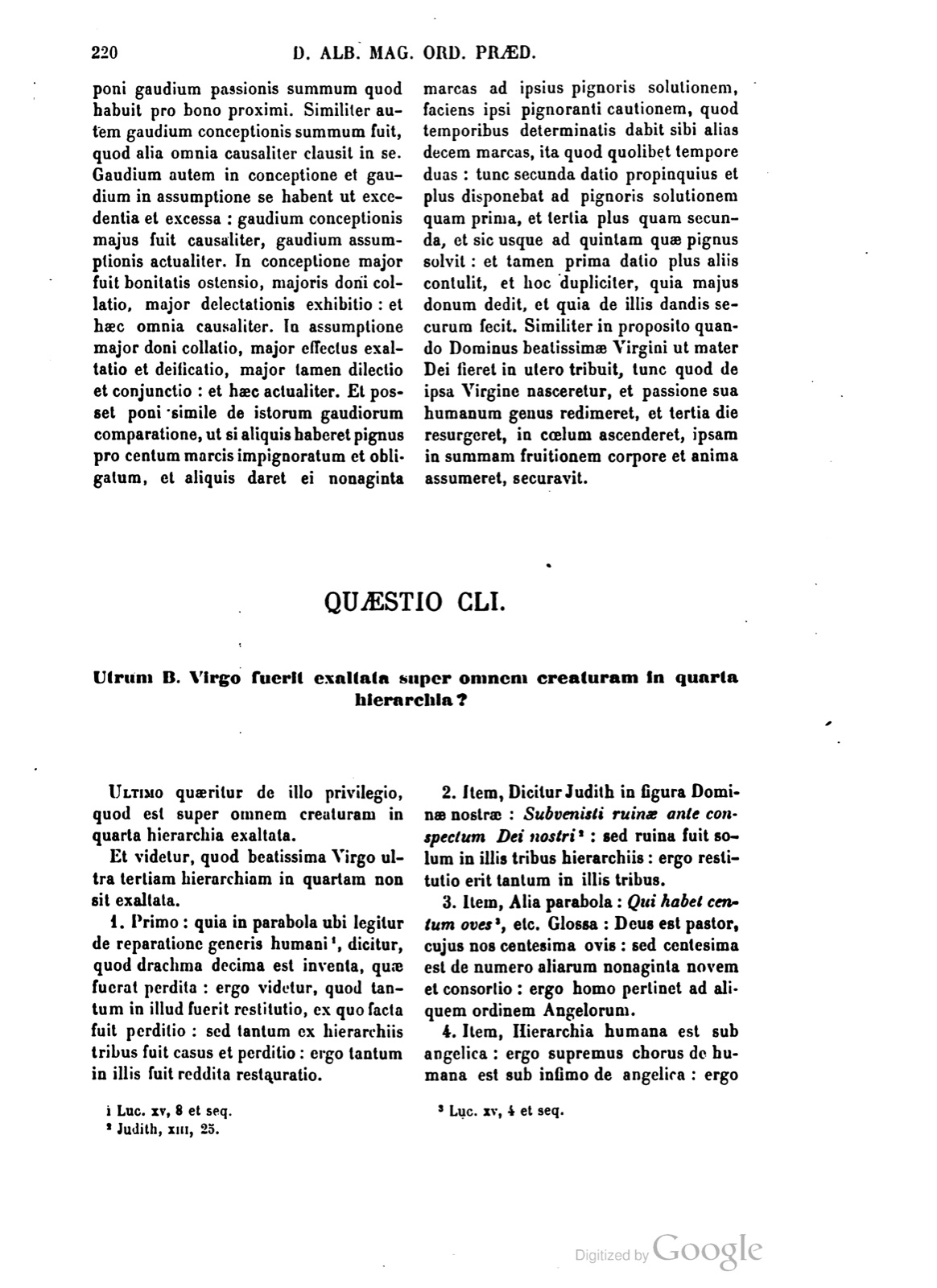
Quod autem objicitur de comparatione gaudiorum, sic respondemus, quod si fiat comparatio secundum quod posterius includit in se prius, sic nulla est quaestio, ut si quaeratur, an unum est plura quam duo, et duo quam tria, et sic de aliis. Nativitas enim includit in se conceptionem, passio nativitatem, et sic de aliis: et sic ordinantur ad se invicem secundum superadditionem. Et sic magnum fuit gaudium conceptionis, majus nativitatis, et adhuc majus passionis, et sic ulterius. Si autem fiat comparatio per oppositionem et separationem, ita quod posterius accipiatur per se sine intellectu prioris, et si sic comparentur, sic dico, quod gaudium quod habuit in conceptione, majus fuit omnibus gaudiis vitae et viae: quia tunc accepit majus bonum et certitudinem omnium aliorum suo tempore conferendorum. Et differunt gaudia viae et vitae hoc modo. Gaudium enim nihil aliud est quam delectatio in bono, vel de bono. Est autem bonum sui et bonum proximi in conceptione et nativitate et in passione Domini, in resurrectione autem bonum Dei et in ascensione. Et sic posset poni gaudium passionis summum quod habuit pro bono proximi. Similiter autem gaudium conceptionis summum fuit, quod alia omnia causaliter clausit in se. Gaudium autem in conceptione et gaudium in assumptione se habent ut excedentia et excessa: gaudium conceptionis majus fuit causaliter, gaudium assumptionis actualiter. In conceptione major fuit bonitatis ostensio, majoris doni collatio, major delectationis exhibitio: et haec omnia causaliter. In assumptione major doni collatio, major effectus exaltatio et deificatio, major tamen dilectio et conjunctio: et haec actualiter. Et posset poni simile de istorum gaudiorum comparatione, ut si aliquis haberet pignus pro centum marcis impignoratum et obligatum, et aliquis daret ei nonaginta marcas ad ipsius pignoris solutionem, faciens ipsi pignoranti cautionem, quod temporibus determinatis dabit sibi alias decem marcas, ita quod quolibet tempore duas: tunc secunda datio propinquius et plus disponebat ad pignoris solutionem quam prima, et tertia plus quam secunda, et sic usque ad quintam quae pignus solvit: et tamen prima datio plus aliis contulit, et hoc dupliciter, quia majus donum dedit, et quia de illis dandis securum fecit. Similiter in proposito quando Dominus beatissimae Virgini ut mater Dei fieret in utero tribuit, tunc quod de ipsa Virgine nasceretur, et passione sua humanum genus redimeret, et tertia die resurgeret, in caelum ascenderet, ipsam in summam fruitionem corpore et anima assumeret, securavit.
But as to what is objected concerning the comparison of joys, we respond thus: if the comparison is made according as the later includes the prior in itself, then there is no question, as if it were asked whether one is several more than two, and two more than three, and so with the others. For nativity includes conception in itself, passion includes nativity, and so with the others; and thus they are ordered to each other according to superaddition. And thus the joy of conception was great, that of nativity greater, and that of passion still greater, and so further. But if the comparison is made by opposition and separation, so that the later is taken through itself without understanding of the prior, and if they are compared in this way, then I say that the joy which she had in conception was greater than all joys of life and of the way, because then she received the greater good and the certainty of all the others to be conferred in their own time. And the joys of the way and of life differ in this way. For joy is nothing other than delight in good or concerning good. But there is the good of oneself and the good of neighbor in the conception and nativity and in the Lord’s passion; in the resurrection, however, the good of God, and in the ascension. And thus the joy of the passion which she had for the good of neighbor could be posited as highest. Similarly, however, the joy of conception was highest, because it enclosed all the others causally in itself. But joy in conception and joy in assumption are related as exceeding and exceeded: the joy of conception was greater causally, the joy of assumption actually. In conception there was a greater showing of goodness, a conferral of a greater gift, a greater display of delight, and all these causally. In assumption there was a greater conferral of the gift, a greater exaltation and deification of the effect, and nevertheless greater love and conjunction, and these actually. And a likeness could be posited concerning the comparison of these joys, as if someone had a pledge pawned and obligated for one hundred marks, and someone gave him ninety marks toward the payment of that pledge, making for the pledger a surety that at determined times he would give him another ten marks, so that at each time two: then the second giving was more nearly and more disposing toward the payment of the pledge than the first, and the third more than the second, and so up to the fifth, which paid the pledge. And nevertheless the first giving contributed more than the others, and this in two ways, because it gave a greater gift and because it made him secure about those to be given. Similarly in the matter proposed, when the Lord granted to the most blessed Virgin that she should become mother of God in the womb, then he made secure that he would be born from that Virgin, redeem the human race by his passion, rise on the third day, ascend into heaven, and assume her in body and soul into the highest fruition.
Notes
- Philippians 2:9. (Ad Philip. II, 9.) ↩
- John 18:11. (Joan. XVIII, 11.) ↩
- Romans 4:25. (Ad Roman. IV, 25.) ↩
- Luke 15:6. (Luc. XV, 6.) ↩
- Ibid., verse 29. (Ibid. v. 29.) ↩
- Philippians 2:9. (Ad Philip. II, 9.) ↩
- For the solution of all the objections, see immediately below. (Pro solutione omnium objectorum, vide immediate infra.) ↩
- Luke 23:28. (Luc. XXIII, 28.) ↩
If a page does not appear, its photograph has not been uploaded yet.