Works › The Mariale: Questions on “Missus est”
Volume 37 · pp. 148–149
Question 92. Whether modesty was in her
A marker with ≈ is an approximate page boundary, placed by measure of the text; the page photographs remain the authority. In the paired views, clicking a page marker brings that page into view.
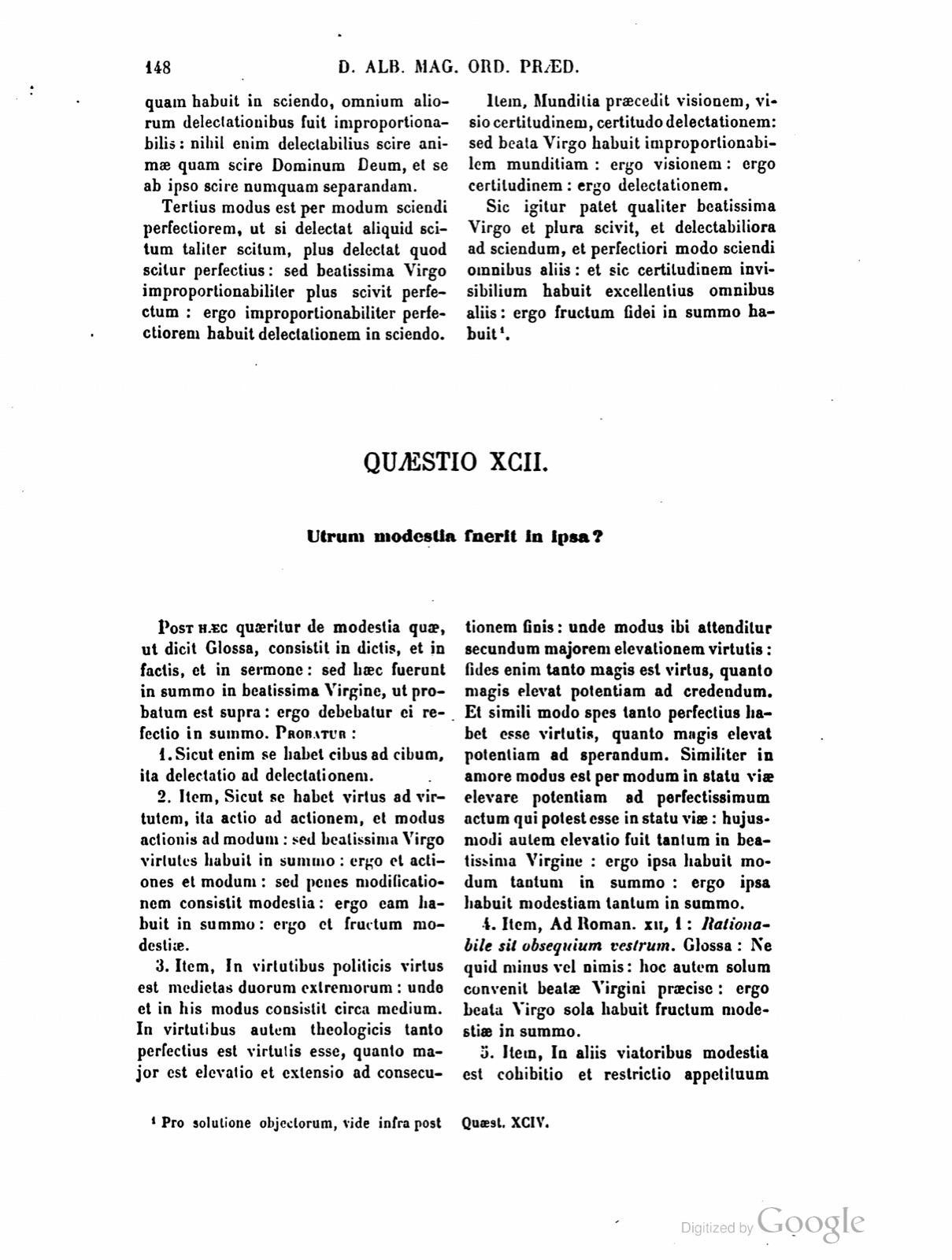
QUAESTIO XCII.
Utrum modestia fuerit in ipsa?
Post haec quaeritur de modestia quae, ut dicit Glossa, consistit in dictis, et in factis, et in sermone: sed haec fuerunt in summo in beatissima Virgine, ut probatum est supra: ergo debebatur ei refectio in summo. Probatur:
1. Sicut enim se habet cibus ad cibum, ita delectatio ad delectationem.
2. Item, Sicut se habet virtus ad virtutem, ita actio ad actionem, et modus actionis ad modum: sed beatissima Virgo virtutes habuit in summo: ergo et actiones et modum: sed penes modificationem consistit modestia: ergo eam habuit in summo: ergo et fructum modestiae.
3. Item, In virtutibus politicis virtus est medietas duorum extremorum: unde et in his modus consistit circa medium. In virtutibus autem theologicis tanto perfectius est virtutis esse, quanto major est elevatio et extensio ad consecutionem finis: unde modus ibi attenditur secundum majorem elevationem virtutis: fides enim tanto magis est virtus, quanto magis elevat potentiam ad credendum. Et simili modo spes tanto perfectius habet esse virtutis, quanto magis elevat potentiam ad sperandum. Similiter in amore modus est per modum in statu viae elevare potentiam ad perfectissimum actum qui potest esse in statu viae: hujusmodi autem elevatio fuit tantum in beatissima Virgine: ergo ipsa habuit modum tantum in summo: ergo ipsa habuit modestiam tantum in summo.
4. Item, Ad Roman. XII, 1: Rationabile sit obsequium vestrum. Glossa: Ne quid minus vel nimis: hoc autem solum convenit beatae Virgini praecise: ergo beata Virgo sola habuit fructum modestiae in summo.
QUESTION 92.
Whether modesty was in her.
After these things inquiry is made concerning modesty, which, as the Gloss says, consists in sayings and in deeds and in speech. But these were in the highest degree in the most blessed Virgin, as was proved above; therefore refreshment in the highest degree was owed to her. It is proved:
1. For as food is related to food, so delight is related to delight.
2. Likewise, as virtue is related to virtue, so action is related to action, and the mode of action to mode. But the most blessed Virgin had the virtues in the highest degree; therefore also the actions and the mode. But modesty consists with regard to modification; therefore she had it in the highest degree; therefore also the fruit of modesty.
3. Likewise, in political virtues virtue is the mean of two extremes; hence also in these the mode consists around the middle. But in theological virtues the being of virtue is more perfect insofar as there is a greater elevation and extension to the attainment of the end; hence the mode there is considered according to the greater elevation of the virtue. For faith is more a virtue insofar as it elevates the power more to believing. And in a similar way hope has the being of virtue more perfectly insofar as it elevates the power more to hoping. Likewise, in love the mode is, by mode in the state of the way, to elevate the power to the most perfect act that can exist in the state of the way. But an elevation of this kind existed only in the most blessed Virgin; therefore she had such a mode in the highest degree; therefore she had such modesty in the highest degree.
4. Likewise, Romans 12:1: Let your service be reasonable. The Gloss says: Lest anything be less or too much. But this precisely befits the blessed Virgin alone; therefore the blessed Virgin alone had the fruit of modesty in the highest degree.
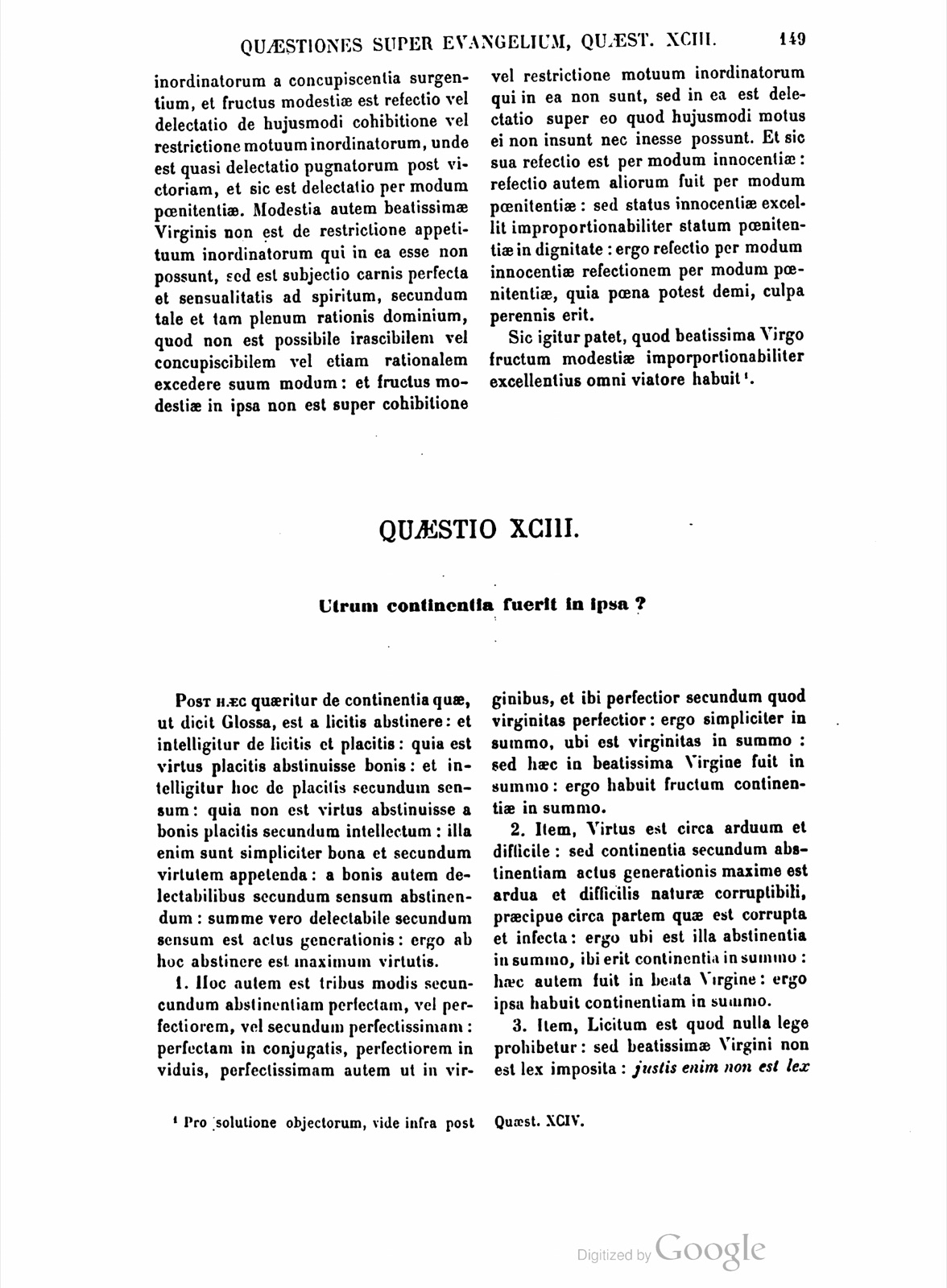
5. Item, In aliis viatoribus modestia est cohibitio et restrictio appetituum inordinatorum a concupiscentia surgentium, et fructus modestiae est refectio vel delectatio de hujusmodi cohibitione vel restrictione motuum inordinatorum, unde est quasi delectatio pugnatorum post victoriam, et sic est delectatio per modum poenitentiae. Modestia autem beatissimae Virginis non est de restrictione appetituum inordinatorum qui in ea esse non possunt, sed est subjectio carnis perfecta et sensualitatis ad spiritum, secundum tale et tam plenum rationis dominium, quod non est possibile irascibilem vel concupiscibilem vel etiam rationalem excedere suum modum: et fructus modestiae in ipsa non est super cohibitione vel restrictione motuum inordinatorum qui in ea non sunt, sed in ea est delectatio super eo quod hujusmodi motus ei non insunt nec inesse possunt. Et sic sua refectio est per modum innocentiae: refectio autem aliorum fuit per modum poenitentiae: sed status innocentiae excellit improportionabiliter statum poenitentiae in dignitate: ergo refectio per modum innocentiae refectionem per modum poenitentiae, quia poena potest demi, culpa perennis erit.
Sic igitur patet, quod beatissima Virgo fructum modestiae improportionabiliter excellentius omni viatore habuit 1.
5. Likewise, in other wayfarers modesty is the restraint and restriction of disordered appetites rising from concupiscence, and the fruit of modesty is refreshment or delight concerning the restraint or restriction of disordered movements of this kind; hence it is as it were the delight of fighters after victory, and thus it is delight by mode of penitence. But the modesty of the most blessed Virgin is not from the restriction of disordered appetites that cannot exist in her; rather it is the perfect subjection of the flesh and of sensuality to the spirit, according to such and so full a dominion of reason that it is not possible for the irascible or the concupiscible or even the rational power to exceed its mode. And the fruit of modesty in her is not over the restraint or restriction of disordered movements, which are not in her, but in her there is delight over the fact that movements of this kind are not present in her nor can be present. And thus her refreshment is by mode of innocence; but the refreshment of others was by mode of penitence. But the state of innocence disproportionately surpasses the state of penitence in dignity; therefore refreshment by mode of innocence surpasses refreshment by mode of penitence, because punishment can be taken away, but fault will be everlasting.
Thus, therefore, it is plain that the most blessed Virgin had the fruit of modesty disproportionately more excellently than every wayfarer 1.
Notes
- For the solution of the objections, see below after Question 94. (Pro solutione objectorum, vide infra post Quaest. XCIV.) ↩
If a page does not appear, its photograph has not been uploaded yet.