Works › The Mariale: Questions on “Missus est”
Volume 37 · pp. 150–151
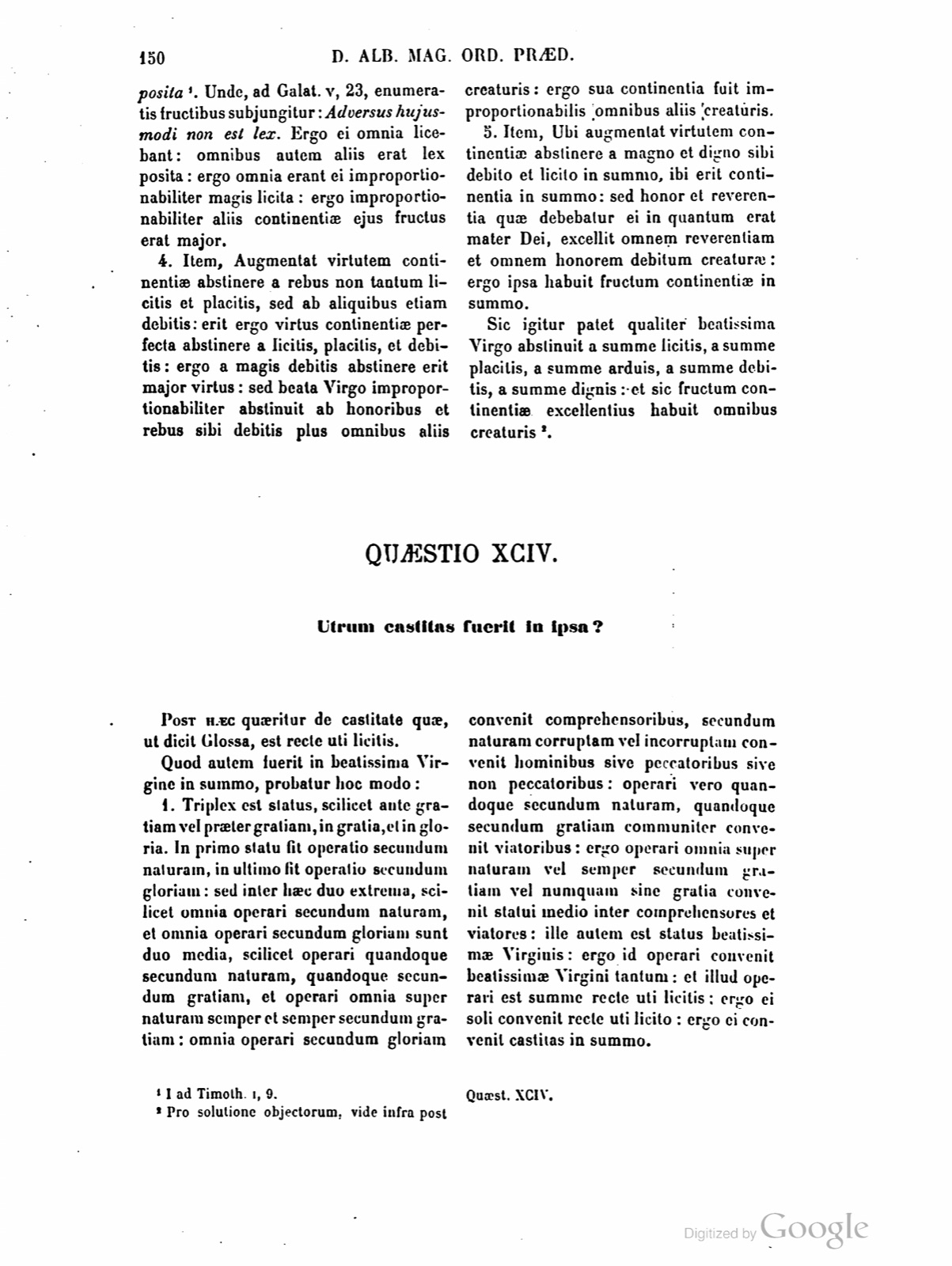
Question 94. Whether chastity was in her
A marker with ≈ is an approximate page boundary, placed by measure of the text; the page photographs remain the authority. In the paired views, clicking a page marker brings that page into view.
QUAESTIO XCIV.
Utrum castitas fuerit in ipsa?
Post haec quaeritur de castitate quae, ut dicit Glossa, est recte uti licitis.
Quod autem fuerit in beatissima Virgine in summo, probatur hoc modo:
1. Triplex est status, scilicet ante gratiam vel praeter gratiam, in gratia, et in gloria. In primo statu fit operatio secundum naturam, in ultimo fit operatio secundum gloriam: sed inter haec duo extrema, scilicet omnia operari secundum naturam, et omnia operari secundum gloriam sunt duo media, scilicet operari quandoque secundum naturam, quandoque secundum gratiam, et operari omnia super naturam semper et semper secundum gratiam: omnia operari secundum gloriam convenit comprehensoribus, secundum naturam corruptam vel incorruptam convenit hominibus sive peccatoribus sive non peccatoribus: operari vero quandoque secundum naturam, quandoque secundum gratiam communiter convenit viatoribus: ergo operari omnia super naturam vel semper secundum gratiam vel numquam sine gratia convenit statui medio inter comprehensores et viatores: ille autem est status beatissimae Virginis: ergo id operari convenit beatissimae Virgini tantum: et illud operari est summe recte uti licitis; ergo ei soli convenit recte uti licito: ergo ei convenit castitas in summo.
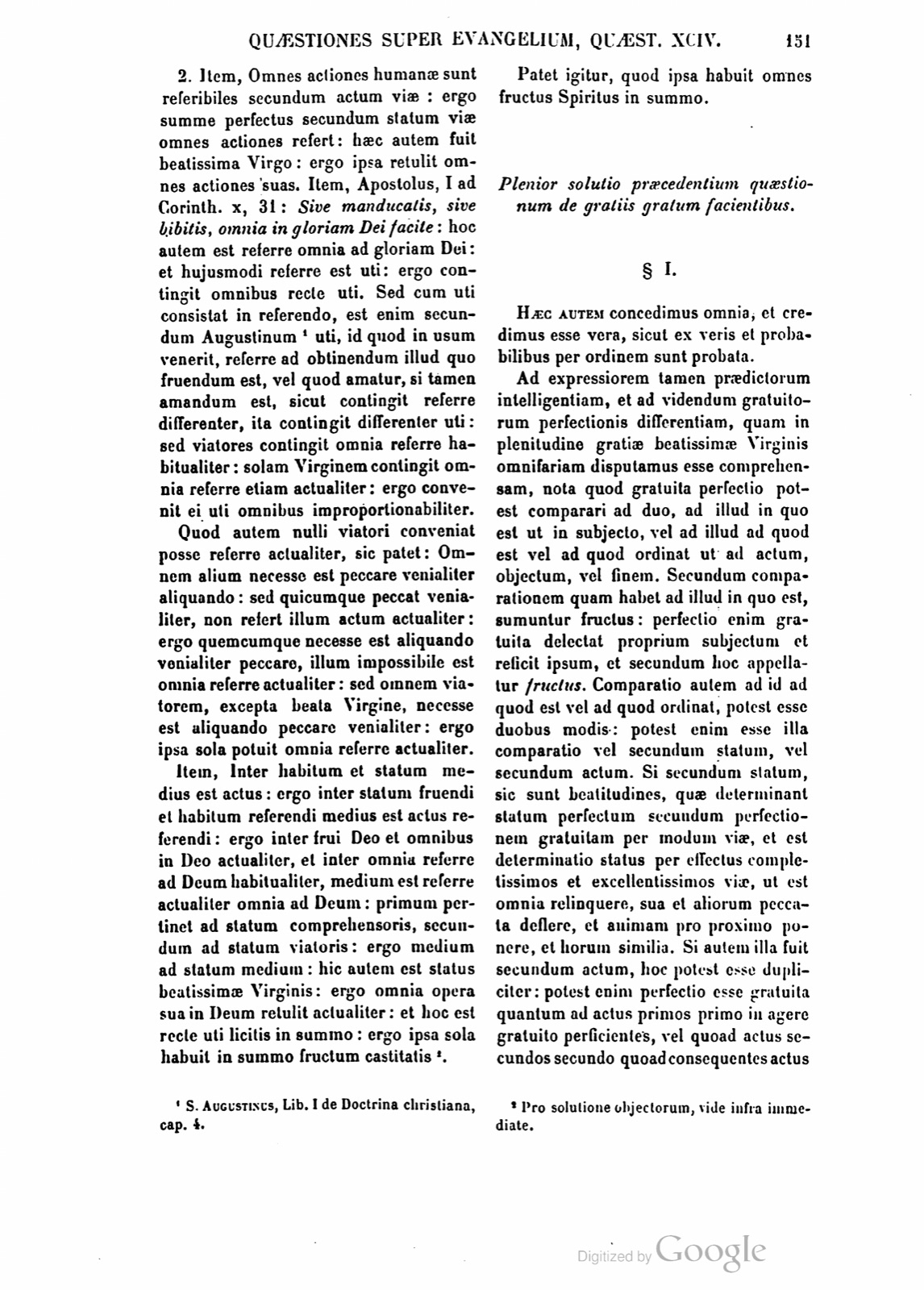
2. Item, Omnes actiones humanae sunt referibiles secundum actum viae: ergo summe perfectus secundum statum viae omnes actiones refert: haec autem fuit beatissima Virgo: ergo ipsa retulit omnes actiones suas. Item, Apostolus, I ad Corinth. X, 31: Sive manducatis, sive bibitis, omnia in gloriam Dei facite: hoc autem est referre omnia ad gloriam Dei: et hujusmodi referre est uti: ergo contingit omnibus recte uti. Sed cum uti consistat in referendo, est enim secundum Augustinum uti, id quod in usum venerit, referre ad obtinendum illud quo fruendum est, vel quod amatur, si tamen amandum est 1, sicut contingit referre differenter, ita contingit differenter uti: sed viatores contingit omnia referre habitualiter: solam Virginem contingit omnia referre etiam actualiter: ergo convenit ei uti omnibus improportionabiliter.
QUESTION 94.
Whether chastity was in her.
After these things inquiry is made concerning chastity, which, as the Gloss says, is to use licit things rightly.
That it was in the most blessed Virgin in the highest degree is proved in this way:
1. There is a threefold state, namely before grace or apart from grace, in grace, and in glory. In the first state operation takes place according to nature; in the last, operation takes place according to glory. But between these two extremes, namely to operate all things according to nature and to operate all things according to glory, there are two intermediate things, namely to operate sometimes according to nature, sometimes according to grace, and to operate all things above nature always and always according to grace. To operate all things according to glory belongs to comprehensors; according to corrupted or incorrupted nature belongs to human beings, whether sinners or non-sinners; but to operate sometimes according to nature, sometimes according to grace, commonly belongs to wayfarers. Therefore to operate all things above nature, or always according to grace, or never without grace, belongs to the middle state between comprehensors and wayfarers. But that is the state of the most blessed Virgin; therefore that operation belongs only to the most blessed Virgin. And that operation is to use licit things rightly in the highest degree; therefore to her alone it belongs to use what is licit rightly; therefore chastity belongs to her in the highest degree.
2. Likewise, all human actions are referable according to the act of the way; therefore the one supremely perfect according to the state of the way refers all actions. But this was the most blessed Virgin; therefore she referred all her actions. Likewise, the Apostle, 1 Corinthians 10:31: Whether you eat, or whether you drink, do all things unto the glory of God. But this is to refer all things to the glory of God; and referring of this kind is using. Therefore it happens for all to use rightly. But since using consists in referring, for according to Augustine to use is to refer that which has come into use to obtaining that which is to be enjoyed, or that which is loved, if nevertheless it is to be loved 1, just as it happens to refer differently, so it happens to use differently. But it happens to wayfarers to refer all things habitually; it happens to the Virgin alone to refer all things even actually; therefore it belongs to her to use all things disproportionately.
Quod autem nulli viatori conveniat posse referre actualiter, sic patet: Omnem alium necesse est peccare venialiter aliquando: sed quicumque peccat venialiter, non refert illum actum actualiter: ergo quemcumque necesse est aliquando venialiter peccare, illum impossibile est omnia referre actualiter: sed omnem viatorem, excepta beata Virgine, necesse est aliquando peccare venialiter: ergo ipsa sola potuit omnia referre actualiter.
Item, Inter habitum et statum medius est actus: ergo inter statum fruendi et habitum referendi medius est actus referendi: ergo inter frui Deo et omnibus in Deo actualiter, et inter omnia referre ad Deum habitualiter, medium est referre actualiter omnia ad Deum: primum pertinet ad statum comprehensoris, secundum ad statum viatoris: ergo medium ad statum medium: hic autem est status beatissimae Virginis: ergo omnia opera sua in Deum retulit actualiter: et hoc est recte uti licitis in summo: ergo ipsa sola habuit in summo fructum castitatis 2.
Patet igitur, quod ipsa habuit omnes fructus Spiritus in summo.
But that it does not belong to any wayfarer to be able to refer actually is plain thus: every other one must sin venially at some time; but whoever sins venially does not refer that act actually. Therefore anyone whom it is necessary to sin venially at some time cannot refer all things actually. But every wayfarer, except the blessed Virgin, must sin venially at some time; therefore she alone was able to refer all things actually.
Likewise, between habit and state, act is intermediate; therefore between the state of enjoying and the habit of referring, the act of referring is intermediate. Therefore between enjoying God and all things in God actually, and referring all things to God habitually, the middle thing is to refer all things actually to God. The first belongs to the state of a comprehensor, the second to the state of a wayfarer; therefore the middle belongs to a middle state. But this is the state of the most blessed Virgin; therefore she referred all her works actually into God. And this is to use licit things rightly in the highest degree; therefore she alone had the fruit of chastity in the highest degree 2.
Therefore it is plain that she had all the fruits of the Spirit in the highest degree.
If a page does not appear, its photograph has not been uploaded yet.