Works › The Mariale: Questions on “Missus est”
Volume 37 · pp. 149–150
Question 93. Whether continence was in her
A marker with ≈ is an approximate page boundary, placed by measure of the text; the page photographs remain the authority. In the paired views, clicking a page marker brings that page into view.
QUAESTIO XCIII.
Utrum continentia fuerit in ipsa?
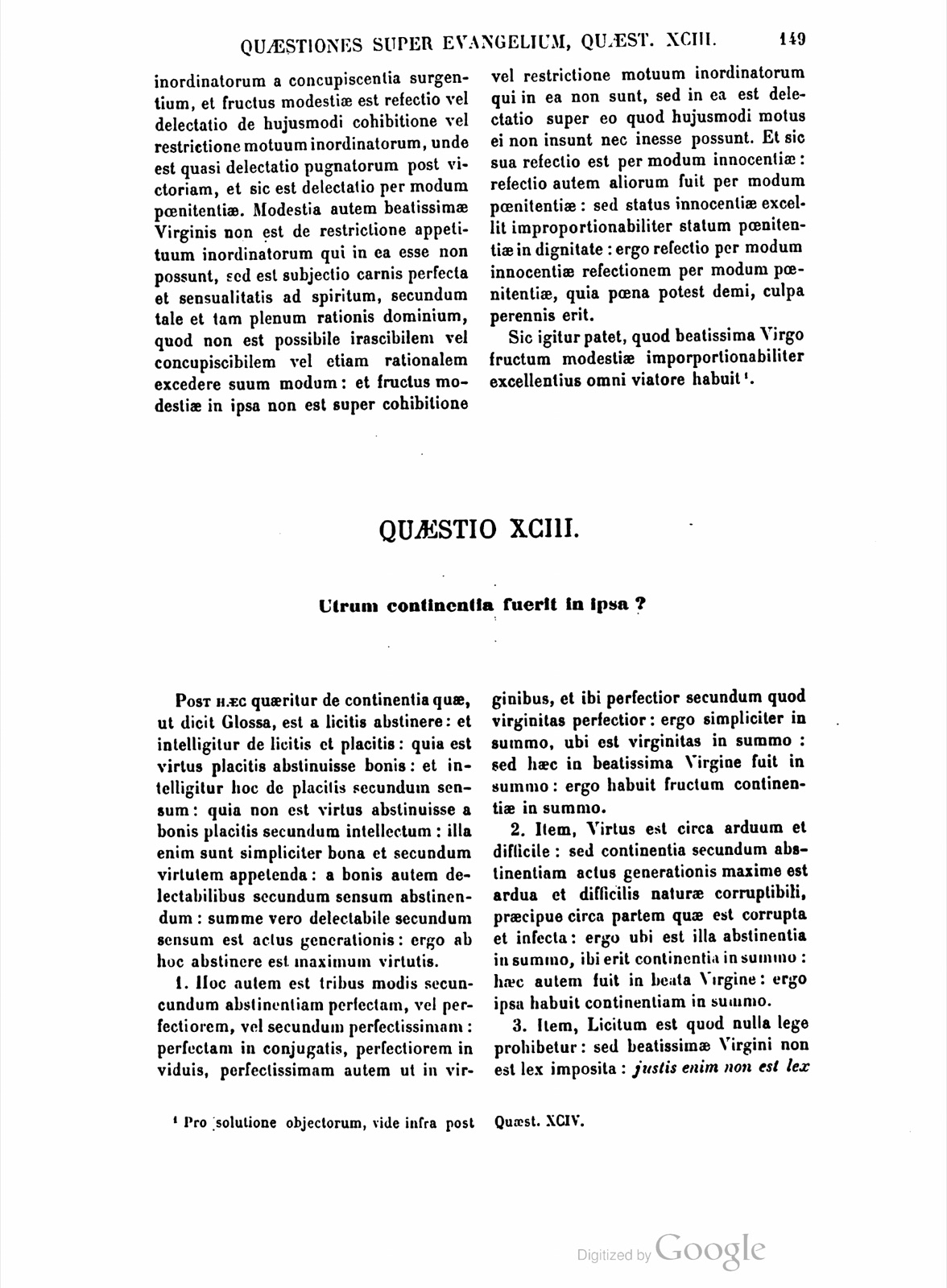
Post haec quaeritur de continentia quae, ut dicit Glossa, est a licitis abstinere: et intelligitur de licitis et placitis: quia est virtus placitis abstinuisse bonis: et intelligitur hoc de placitis secundum sensum: quia non est virtus abstinuisse a bonis placitis secundum intellectum: illa enim sunt simpliciter bona et secundum virtutem appetenda: a bonis autem delectabilibus secundum sensum abstinendum: summe vero delectabile secundum sensum est actus generationis: ergo ab hoc abstinere est maximum virtutis.
1. Hoc autem est tribus modis secundum abstinentiam perfectam, vel perfectiorem, vel secundum perfectissimam: perfectam in conjugatis, perfectiorem in viduis, perfectissimam autem ut in virginibus, et ibi perfectior secundum quod virginitas perfectior: ergo simpliciter in summo, ubi est virginitas in summo: sed haec in beatissima Virgine fuit in summo: ergo habuit fructum continentiae in summo.
2. Item, Virtus est circa arduum et difficile: sed continentia secundum abstinentiam actus generationis maxime est ardua et difficilis naturae corruptibili, praecipue circa partem quae est corrupta et infecta: ergo ubi est illa abstinentia in summo, ibi erit continentia in summo: haec autem fuit in beata Virgine: ergo ipsa habuit continentiam in summo.
3. Item, Licitum est quod nulla lege prohibetur: sed beatissimae Virgini non est lex imposita: justis enim non est lex posita 1. Unde, ad Galat. V, 23, enumeratis fructibus subjungitur: Adversus hujusmodi non est lex. Ergo ei omnia licebant: omnibus autem aliis erat lex posita: ergo omnia erant ei improportionabiliter magis licita: ergo improportionabiliter aliis continentiae ejus fructus erat major.
QUESTION 93.
Whether continence was in her.
After these things inquiry is made concerning continence, which, as the Gloss says, is to abstain from licit things. And it is understood concerning licit and pleasing things, because it is a virtue to have abstained from good pleasing things; and this is understood concerning pleasing things according to sense, because it is not a virtue to have abstained from goods pleasing according to intellect; for those are good simply and to be sought according to virtue. But one must abstain from goods delightful according to sense; and the act of generation is supremely delightful according to sense; therefore to abstain from this is the greatest thing of virtue.
1. Now this is in three ways according to perfect abstinence, or more perfect, or according to most perfect: perfect in the married, more perfect in widows, but most perfect as in virgins, and there more perfect according as virginity is more perfect. Therefore it is simply in the highest degree where virginity is in the highest degree. But this was in the most blessed Virgin in the highest degree; therefore she had the fruit of continence in the highest degree.
2. Likewise, virtue is concerned with what is arduous and difficult; but continence according to abstinence from the act of generation is most arduous and difficult for corruptible nature, especially concerning the part that is corrupted and infected. Therefore where that abstinence is in the highest degree, there continence will be in the highest degree; but this was in the blessed Virgin; therefore she had continence in the highest degree.
3. Likewise, what is licit is what is prohibited by no law; but no law is imposed on the most blessed Virgin, for the law is not placed for the just 1. Hence, in Galatians 5:23, after the fruits have been enumerated, it is added: Against such things there is no law. Therefore all things were licit to her; but law was placed for all others. Therefore all things were disproportionately more licit for her; therefore the fruit of her continence was disproportionately greater than that of others.
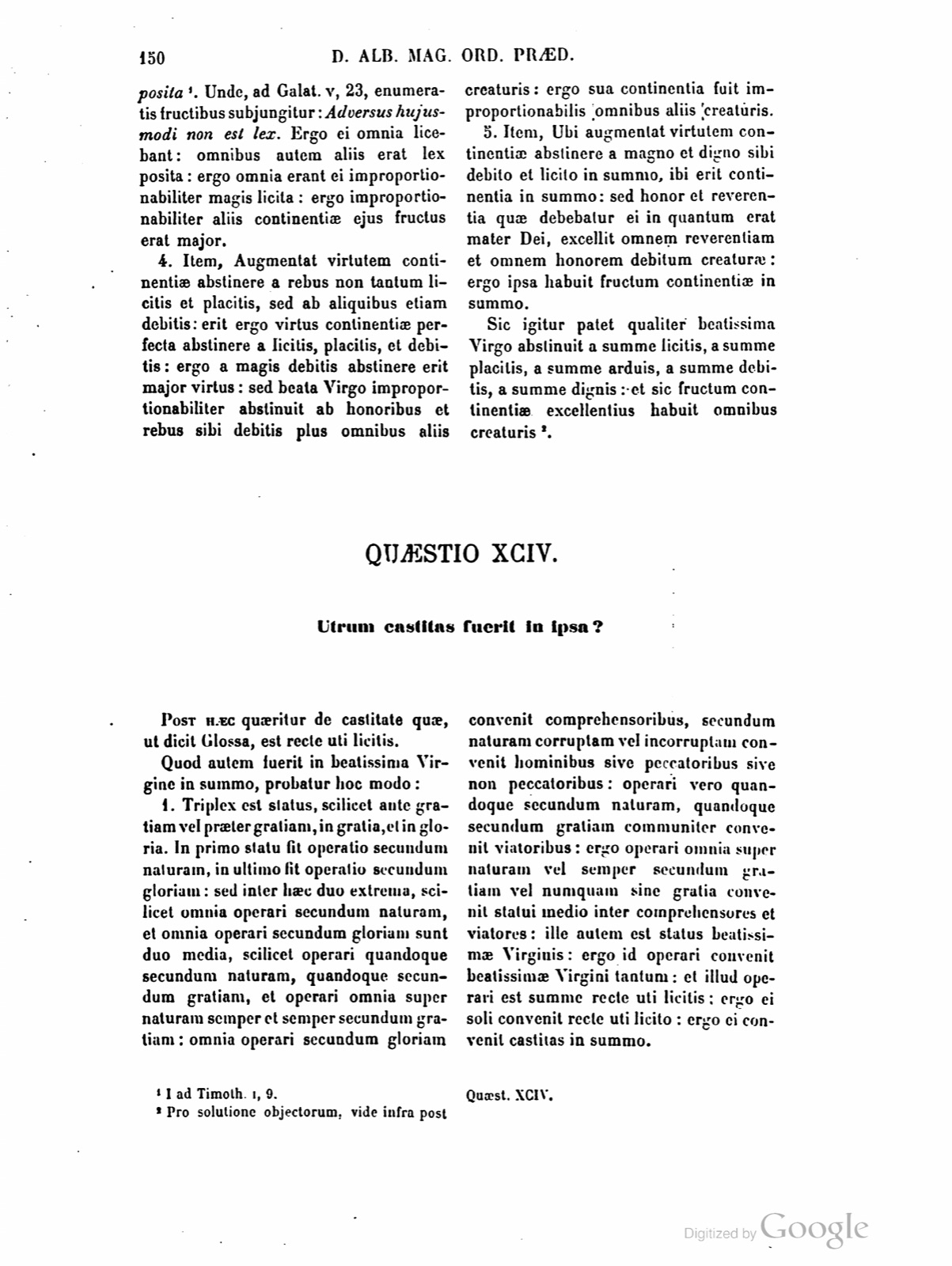
4. Item, Augmentat virtutem continentiae abstinere a rebus non tantum licitis et placitis, sed ab aliquibus etiam debitis: erit ergo virtus continentiae perfecta abstinere a licitis, placitis, et debitis: ergo a magis debitis abstinere erit major virtus: sed beata Virgo improportionabiliter abstinuit ab honoribus et rebus sibi debitis plus omnibus aliis creaturis: ergo sua continentia fuit improportionabilis omnibus aliis creaturis.
5. Item, Ubi augmentat virtutem continentiae abstinere a magno et digno sibi debito et licito in summo, ibi erit continentia in summo: sed honor et reverentia quae debebatur ei in quantum erat mater Dei, excellit omnem reverentiam et omnem honorem debitum creaturae: ergo ipsa habuit fructum continentiae in summo.
Sic igitur patet qualiter beatissima Virgo abstinuit a summe licitis, a summe placitis, a summe arduis, a summe debitis, a summe dignis: et sic fructum continentiae excellentius habuit omnibus creaturis 2.
4. Likewise, it increases the virtue of continence to abstain from things not only licit and pleasing, but also from some things owed. Therefore the virtue of continence will be perfect in abstaining from licit, pleasing, and owed things; therefore to abstain from things more owed will be a greater virtue. But the blessed Virgin disproportionately abstained from honors and things owed to her more than all other creatures; therefore her continence was disproportionate to all other creatures.
5. Likewise, where it increases the virtue of continence to abstain from something great and worthy, owed and licit to oneself in the highest degree, there continence will be in the highest degree. But the honor and reverence that was owed to her insofar as she was Mother of God surpasses every reverence and every honor owed to a creature; therefore she had the fruit of continence in the highest degree.
Thus, therefore, it is plain how the most blessed Virgin abstained from things supremely licit, from things supremely pleasing, from things supremely arduous, from things supremely owed, from things supremely worthy; and thus she had the fruit of continence more excellently than all creatures 2.
Notes
- 1 Timothy 1:9. (I ad Timoth. I, 9.) ↩
- For the solution of the objections, see below after Question 94. (Pro solutione objectorum, vide infra post Quaest. XCIV.) ↩
If a page does not appear, its photograph has not been uploaded yet.