Works › The Mariale: Questions on “Missus est”
Volume 37 · pp. 146–147
Question 90. Whether kindness was in her
A marker with ≈ is an approximate page boundary, placed by measure of the text; the page photographs remain the authority. In the paired views, clicking a page marker brings that page into view.
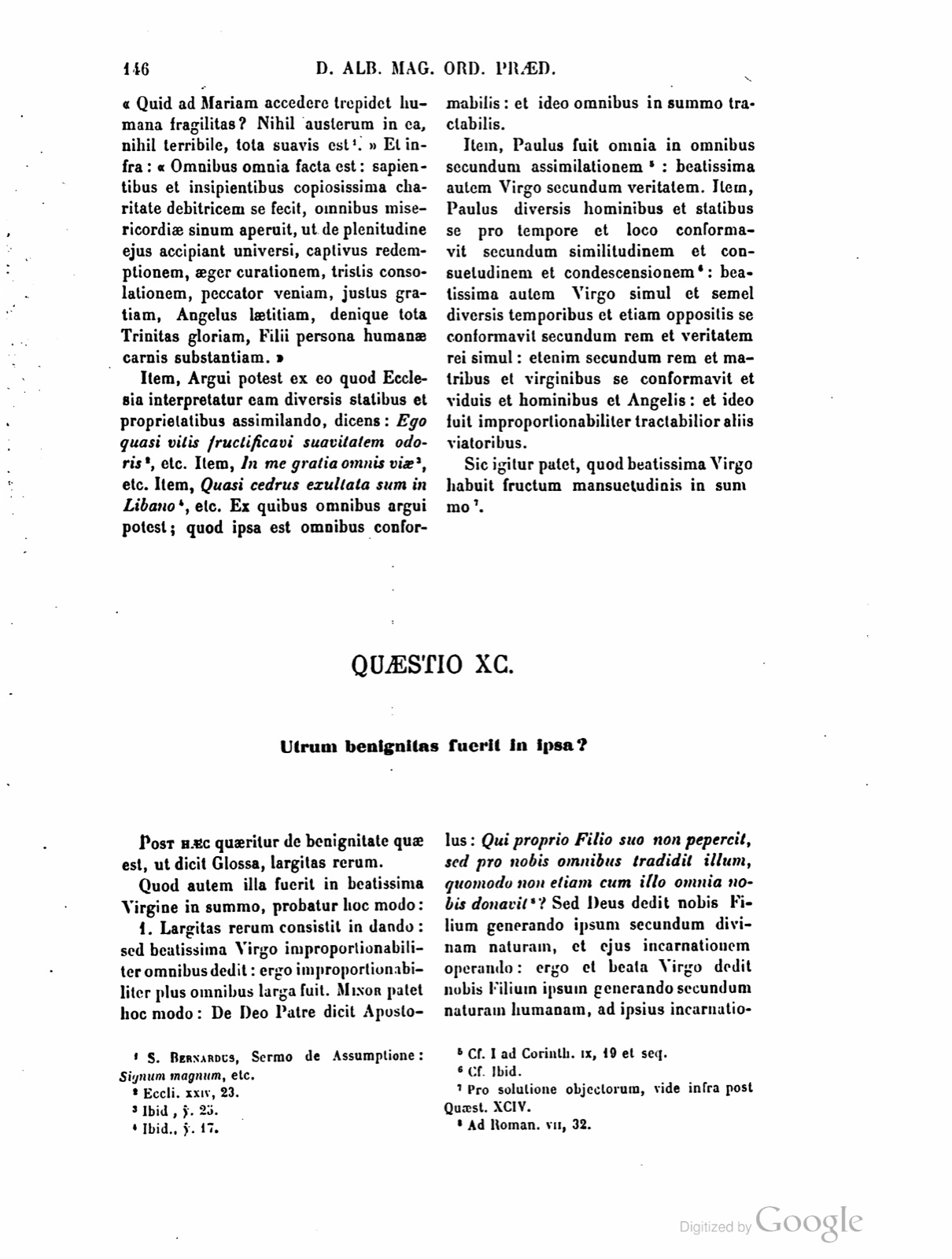
QUAESTIO XC.
Utrum benignitas fuerit in ipsa?
Post haec quaeritur de benignitate quae est, ut dicit Glossa, largitas rerum.
Quod autem illa fuerit in beatissima Virgine in summo, probatur hoc modo:
1. Largitas rerum consistit in dando: sed beatissima Virgo improportionabiliter omnibus dedit: ergo improportionabiliter plus omnibus larga fuit. Minor patet hoc modo: De Deo Patre dicit Apostolus: Qui proprio Filio suo non pepercit, sed pro nobis omnibus tradidit illum, quomodo non etiam cum illo omnia nobis donavit? 1 Sed Deus dedit nobis Filium generando ipsum secundum divinam naturam, et ejus incarnationem operando: ergo et beata Virgo dedit nobis Filium ipsum generando secundum naturam humanam, ad ipsius incarnationem carnem virgineam ministrando: ergo et ipsa Filium suum nobis dedit, et in eo nobis omnia contulit.
Item, Beatissima Virgo dedit omne dabile: ergo fuit magis larga omni viatore. Media patet. Omne enim dabile est Deus vel creatura: ipsa autem dedit Deum mundo, et mundum et omnia Deo. De primo dicitur in libro Sapientiae VII, 12: Quoniam bonorum omnium mater est. De secundo, ibidem, v. 11: Venerunt mihi omnia bona pariter cum illa.
2. Item, Psal. L, 20: Benigne fac. Glossa: "Filium mittendo, et peccata dimittendo." Sed inter omnes creaturas beatissima Virgo ad Filii missionem et peccati dimissionem sola officium et ministerium exhibet: ergo improportionabiliter plus omnibus dedit et dimisit: ergo improportionabiliter plus omnibus benigna fuit.
QUESTION 90.
Whether kindness was in her.
After these things inquiry is made concerning kindness, which is, as the Gloss says, largess of things.
That it was in the most blessed Virgin in the highest degree is proved in this way:
1. Largess of things consists in giving; but the most blessed Virgin gave to all disproportionately; therefore she was disproportionately more generous than all. The minor is plain in this way: the Apostle says concerning God the Father: He who did not spare his own Son, but handed him over for us all, how has he not also, with him, given us all things? 1 But God gave us the Son by generating him according to the divine nature and by working his incarnation. Therefore also the blessed Virgin gave us the Son by generating him according to human nature, by supplying virginal flesh for his incarnation. Therefore she too gave us her Son, and in him conferred all things upon us.
Likewise, the most blessed Virgin gave every giveable thing; therefore she was more generous than every wayfarer. The middle term is plain. For every giveable thing is God or a creature; but she gave God to the world, and the world and all things to God. Concerning the first it is said in the book of Wisdom 7:12: Since she is the mother of all good things. Concerning the second, in the same place, verse 11: All good things came to me together with her.
2. Likewise, Psalm 50:20: Do kindly. The Gloss says: "By sending the Son and by forgiving sins." But among all creatures the most blessed Virgin alone presents an office and ministry toward the mission of the Son and the remission of sin; therefore disproportionately more than all she gave and forgave; therefore disproportionately more than all she was kind.
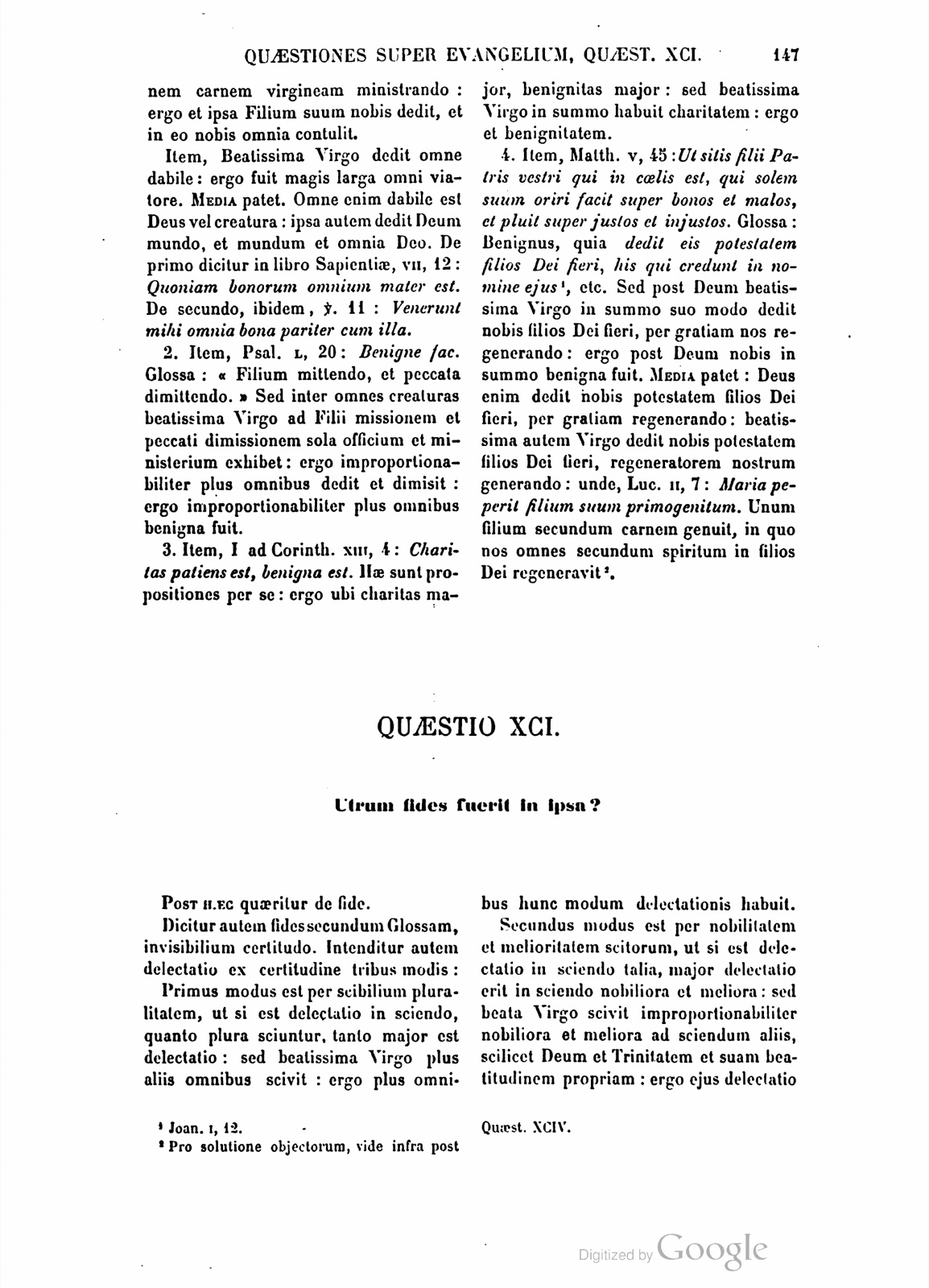
3. Item, I ad Corinth. XIII, 4: Charitas patiens est, benigna est. Hae sunt propositiones per se: ergo ubi charitas major, benignitas major: sed beatissima Virgo in summo habuit charitatem: ergo et benignitatem.
4. Item, Matth. V, 45: Ut sitis filii Patris vestri qui in caelis est, qui solem suum oriri facit super bonos et malos, et pluit super justos et injustos. Glossa: Benignus, quia dedit eis potestatem filios Dei fieri, his qui credunt in nomine ejus 2, etc. Sed post Deum beatissima Virgo in summo suo modo dedit nobis filios Dei fieri, per gratiam nos regenerando: ergo post Deum nobis in summo benigna fuit. Media patet: Deus enim dedit nobis potestatem filios Dei fieri, per gratiam regenerando: beatissima autem Virgo dedit nobis potestatem filios Dei fieri, regeneratorem nostrum generando: unde, Luc. II, 7: Maria peperit filium suum primogenitum. Unum filium secundum carnem genuit, in quo nos omnes secundum spiritum in filios Dei regeneravit 3.
3. Likewise, 1 Corinthians 13:4: Charity is patient, is kind. These are propositions through themselves; therefore where charity is greater, kindness is greater. But the most blessed Virgin had charity in the highest degree; therefore also kindness.
4. Likewise, Matthew 5:45: That you may be children of your Father who is in heaven, who makes his sun rise upon the good and the evil, and rains upon the just and the unjust. The Gloss says: He is kind, because he gave them the power to become children of God, to those who believe in his name 2, and so forth. But after God the most blessed Virgin, in the highest degree in her own manner, gave us to become children of God by regenerating us through grace; therefore after God she was kind to us in the highest degree. The middle term is plain: for God gave us the power to become children of God by regenerating through grace; but the most blessed Virgin gave us the power to become children of God by generating our regenerator. Hence Luke 2:7: Mary brought forth her firstborn son. She begot one son according to the flesh, in whom she regenerated all of us according to the spirit into sons of God 3.
Notes
- Romans 8:32. (Ad Roman. VIII, 32.) ↩
- John 1:12. (Joan. I, 12.) ↩
- For the solution of the objections, see below after Question 94. (Pro solutione objectorum, vide infra post Quaest. XCIV.) ↩
If a page does not appear, its photograph has not been uploaded yet.