Works › The Mariale: Questions on “Missus est”
Volume 37 · pp. 145–146
Question 89. Whether meekness was in her
A marker with ≈ is an approximate page boundary, placed by measure of the text; the page photographs remain the authority. In the paired views, clicking a page marker brings that page into view.
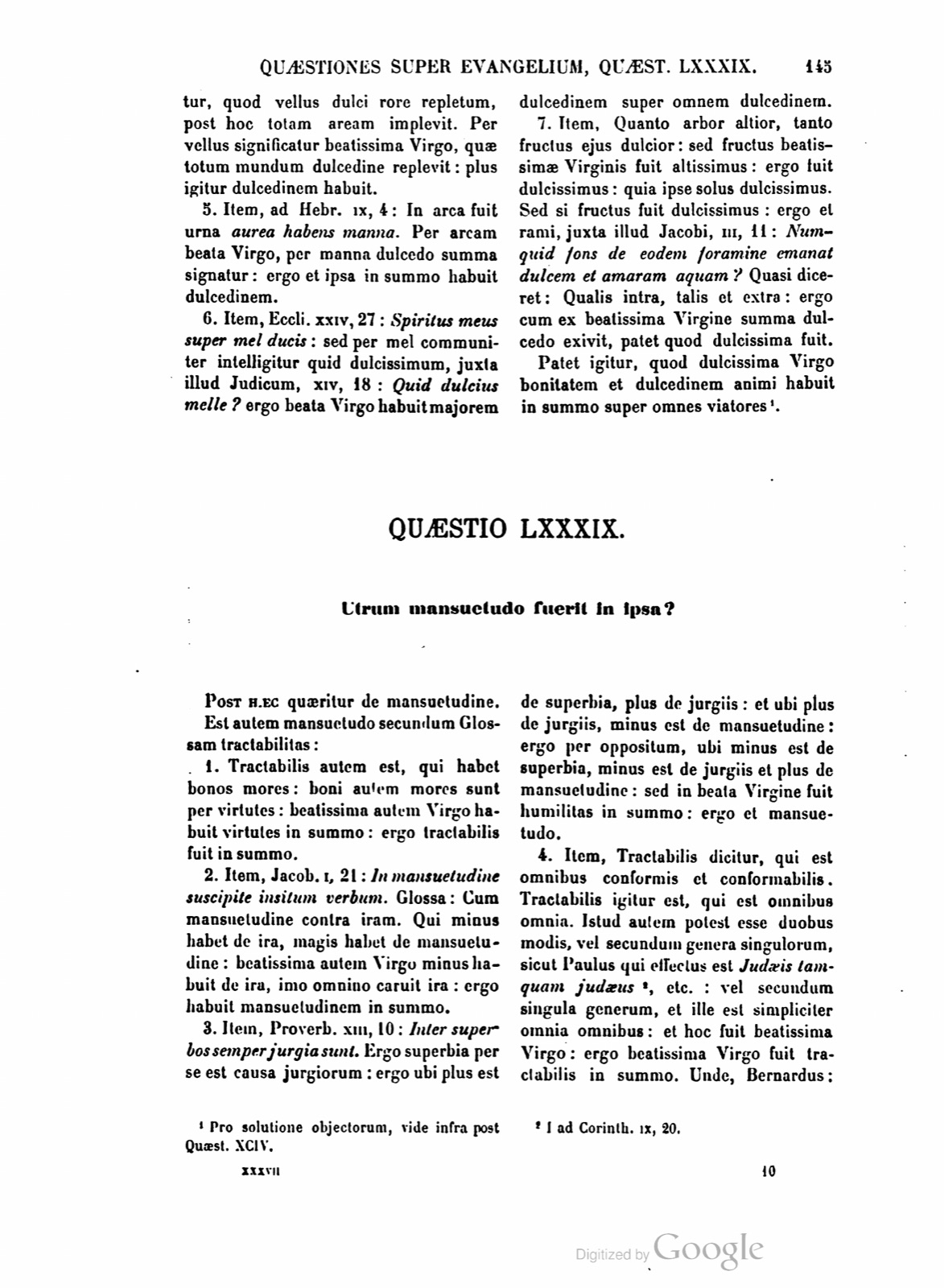
QUAESTIO LXXXIX.
Utrum mansuetudo fuerit in ipsa?
Post haec quaeritur de mansuetudine.
Est autem mansuetudo secundum Glossam tractabilitas:
1. Tractabilis autem est, qui habet bonos mores: boni autem mores sunt per virtutes: beatissima autem Virgo habuit virtutes in summo: ergo tractabilis fuit in summo.
2. Item, Jacob. I, 21: In mansuetudine suscipite insitum verbum. Glossa: Cum mansuetudine contra iram. Qui minus habet de ira, magis habet de mansuetudine: beatissima autem Virgo minus habuit de ira, imo omnino caruit ira: ergo habuit mansuetudinem in summo.
3. Item, Proverb. XIII, 10: Inter superbos semper jurgia sunt. Ergo superbia per se est causa jurgiorum: ergo ubi plus est de superbia, plus de jurgiis: et ubi plus de jurgiis, minus est de mansuetudine: ergo per oppositum, ubi minus est de superbia, minus est de jurgiis et plus de mansuetudine: sed in beata Virgine fuit humilitas in summo: ergo et mansuetudo.
4. Item, Tractabilis dicitur, qui est omnibus conformis et conformabilis. Tractabilis igitur est, qui est omnibus omnia. Istud autem potest esse duobus modis, vel secundum genera singulorum, sicut Paulus qui effectus est Judaeis tamquam Judaeus 1, etc.: vel secundum singula generum, et ille est simpliciter omnia omnibus: et hoc fuit beatissima Virgo: ergo beatissima Virgo fuit tractabilis in summo. Unde, Bernardus: "Quid ad Mariam accedere trepidet humana fragilitas? Nihil austerum in ea, nihil terribile, tota suavis est 2." Et infra: "Omnibus omnia facta est: sapientibus et insipientibus copiosissima charitate debitricem se fecit, omnibus misericordiae sinum aperuit, ut de plenitudine ejus accipiant universi, captivus redemptionem, aeger curationem, tristis consolationem, peccator veniam, justus gratiam, Angelus laetitiam, denique tota Trinitas gloriam, Filii persona humanae carnis substantiam."
QUESTION 89.
Whether meekness was in her.
After these things inquiry is made concerning meekness.
Now meekness, according to the Gloss, is tractableness:
1. Now one is tractable who has good morals; but good morals exist through virtues; and the most blessed Virgin had the virtues in the highest degree; therefore she was tractable in the highest degree.
2. Likewise, James 1:21: Receive the implanted word in meekness. The Gloss says: With meekness against anger. One who has less of anger has more of meekness; but the most blessed Virgin had less of anger, indeed she was altogether without anger; therefore she had meekness in the highest degree.
3. Likewise, Proverbs 13:10: Among the proud there are always quarrels. Therefore pride by itself is the cause of quarrels; therefore where there is more of pride, there is more of quarrels; and where there is more of quarrels, there is less of meekness. Therefore, by the opposite, where there is less of pride, there is less of quarrels and more of meekness. But in the blessed Virgin there was humility in the highest degree; therefore also meekness.
4. Likewise, one is called tractable who is conformed and conformable to all. Therefore one is tractable who is all things to all. But this can be in two ways: either according to the genera of individuals, as Paul, who was made to the Jews as a Jew 1, and so forth; or according to the individuals of the genera, and such a one is simply all things to all; and this was the most blessed Virgin. Therefore the most blessed Virgin was tractable in the highest degree. Hence Bernard says: "Why should human frailty tremble to approach Mary? There is nothing austere in her, nothing terrifying; she is wholly sweet 2." And below: "She was made all things to all: to the wise and to the unwise she made herself a debtor by most abundant charity; to all she opened the bosom of mercy, so that from her fullness all might receive: the captive redemption, the sick person healing, the sorrowful consolation, the sinner pardon, the just person grace, the Angel gladness, finally the whole Trinity glory, the person of the Son the substance of human flesh."
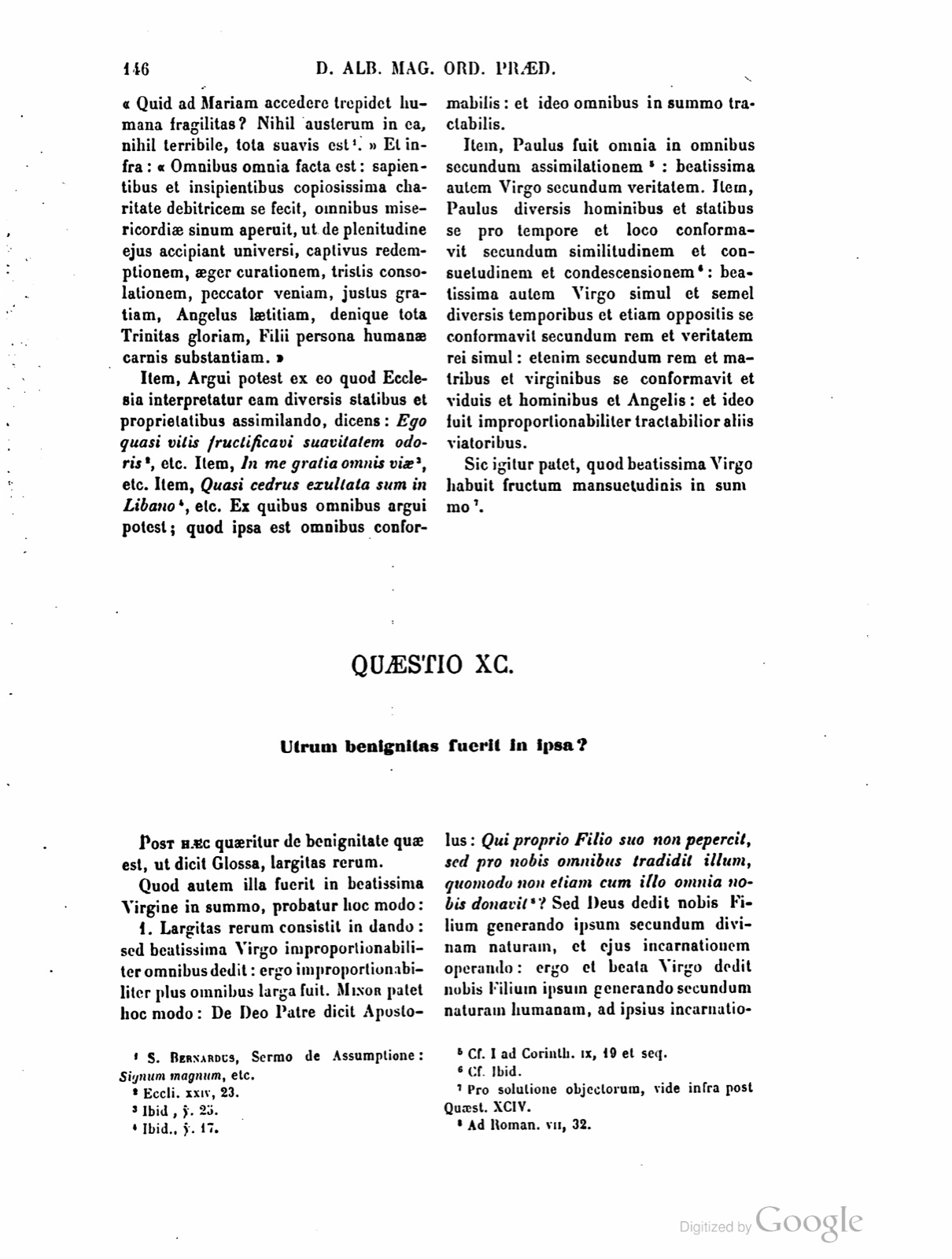
Item, Argui potest ex eo quod Ecclesia interpretatur eam diversis statibus et proprietatibus assimilando, dicens: Ego quasi vitis fructificavi suavitatem odoris 3, etc. Item, In me gratia omnis viae 4, etc. Item, Quasi cedrus exaltata sum in Libano 5, etc. Ex quibus omnibus argui potest, quod ipsa est omnibus conformabilis: et ideo omnibus in summo tractabilis.
Item, Paulus fuit omnia in omnibus secundum assimilationem 6: beatissima autem Virgo secundum veritatem. Item, Paulus diversis hominibus et statibus se pro tempore et loco conformavit secundum similitudinem et consuetudinem et condescensionem 7: beatissima autem Virgo simul et semel diversis temporibus et etiam oppositis se conformavit secundum rem et veritatem rei simul: etenim secundum rem et matribus et virginibus se conformavit et viduis et hominibus et Angelis: et ideo fuit improportionabiliter tractabilior aliis viatoribus.
Sic igitur patet, quod beatissima Virgo habuit fructum mansuetudinis in summo 8.
Likewise, it can be argued from the fact that the Church interprets her by assimilating her to diverse states and properties, saying: I, like a vine, have borne fruit in sweetness of fragrance 3, and so forth. Likewise, In me is the grace of every way 4, and so forth. Likewise, Like a cedar I was exalted in Lebanon 5, and so forth. From all these it can be argued that she is conformable to all; and therefore tractable to all in the highest degree.
Likewise, Paul was all things in all by assimilation 6; but the most blessed Virgin was so according to truth. Likewise, Paul conformed himself to diverse men and states according to time and place, according to likeness and custom and condescension 7; but the most blessed Virgin at once and in one moment conformed herself to diverse times and even to opposites according to reality and the truth of the thing at once. For according to reality she conformed herself both to mothers and to virgins, and to widows, and to human beings, and to Angels; and therefore she was disproportionately more tractable than other wayfarers.
Thus, therefore, it is plain that the most blessed Virgin had the fruit of meekness in the highest degree 8.
Notes
- 1 Corinthians 9:20. (I ad Corinth. IX, 20.) ↩
- St. Bernard, Sermon on the Assumption: A great sign, and so forth. (S. Bernardus, Sermo de Assumptione: Signum magnum, etc.) ↩
- Ecclesiasticus 24:23. (Eccli. XXIV, 23.) ↩
- In the same place, verse 25. (Ibid., v. 25.) ↩
- In the same place, verse 17. (Ibid., v. 17.) ↩
- Compare 1 Corinthians 9:19 and following. (Cf. I ad Corinth. IX, 19 et seq.) ↩
- Compare the same place. (Cf. Ibid.) ↩
- For the solution of the objections, see below after Question 94. (Pro solutione objectorum, vide infra post Quaest. XCIV.) ↩
If a page does not appear, its photograph has not been uploaded yet.