Works › The Mariale: Questions on “Missus est”
Volume 37 · pp. 142–143
Question 85. Whether the fruit that is peace was in her
A marker with ≈ is an approximate page boundary, placed by measure of the text; the page photographs remain the authority. In the paired views, clicking a page marker brings that page into view.
QUAESTIO LXXXV.
Utrum fructus qui est pax, fuerit in ipsa?
Post haec quaeritur de fructu qui est pax.
Quod fuerit in summo in beatissima Virgine, probatur hoc modo:
1. Luc. II, 14: Gloria in altissimis Deo, et in terra pax omnibus, etc.: beatissima Virgo omnibus improportionabiliter bonam voluntatem habuit: ergo et pacem.
2. Item, Joan. XIV, 27: Pacem relinquo vobis, pacem meam do vobis. Haec est duplex pax, scilicet pax aeternitatis et pax pectoris. Pax pectoris est quies a peccatis. Illam habuit beatissima Virgo in summo: in aliis enim quies a peccatis est cessatio peccandi: beatissima autem Virgo numquam cessavit, quia numquam peccavit: ergo beatissima Virgo habuit pacem pectoris in re, et pacem aeternitatis improportionabili certitudine: ergo habuit fructum pacis improportionabilius omni viatore.
QUESTION 85.
Whether the fruit that is peace was in her.
After these things inquiry is made concerning the fruit that is peace.
That it was in the highest degree in the most blessed Virgin is proved in this way:
1. Luke 2:14: Glory to God in the highest, and on earth peace to all, and so forth. The most blessed Virgin had good will disproportionately toward all; therefore also peace.
2. Likewise, John 14:27: Peace I leave to you; my peace I give to you. This is a twofold peace, namely the peace of eternity and the peace of the breast. The peace of the breast is rest from sins. The most blessed Virgin had that in the highest degree; for in others rest from sins is the cessation of sinning, but the most blessed Virgin never ceased, because she never sinned. Therefore the most blessed Virgin had peace of the breast in reality, and the peace of eternity with disproportionate certainty; therefore she had the fruit of peace more disproportionately than every wayfarer.
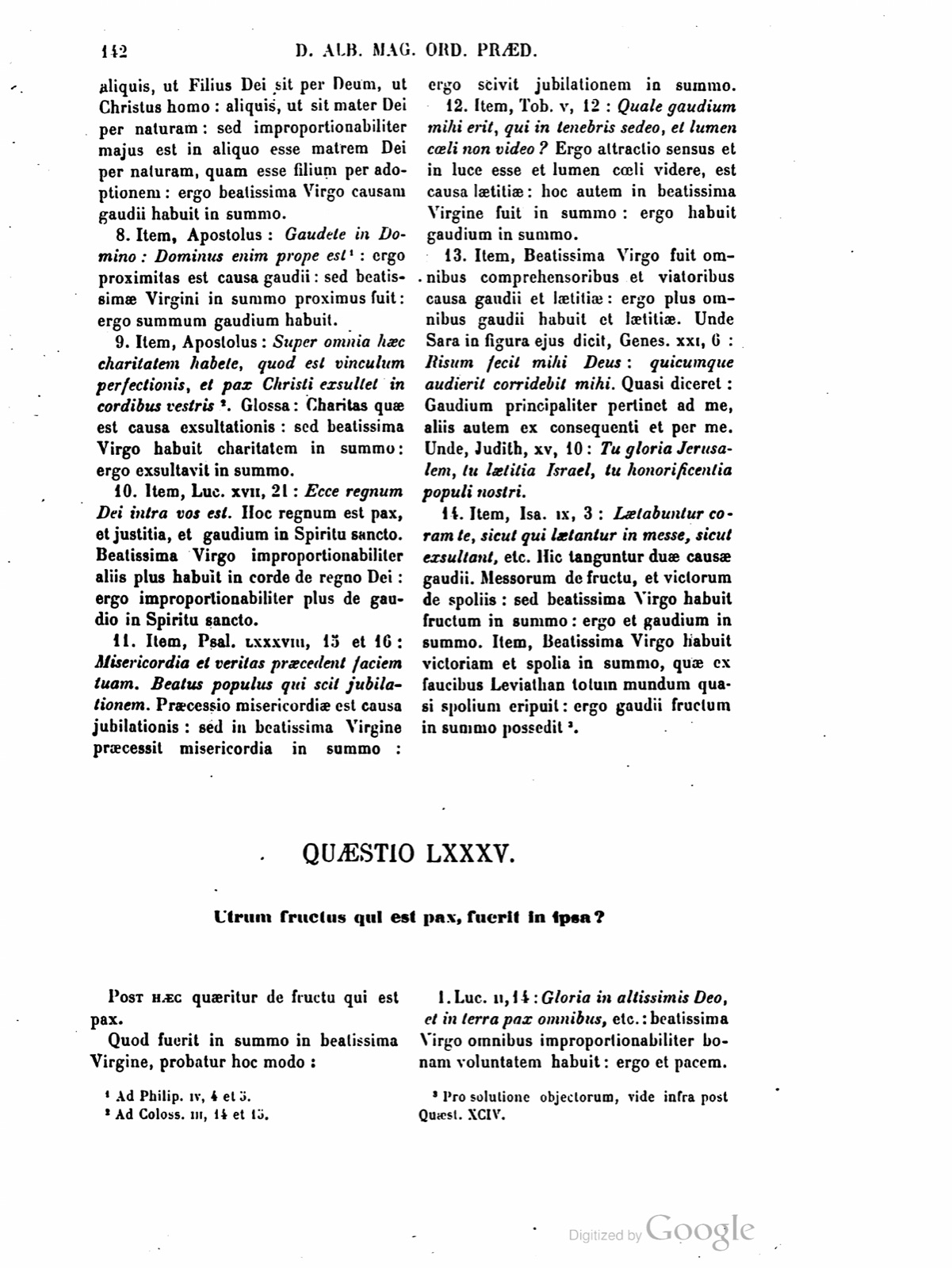
3. Item, Isa. XXXII, 17: Et erit opus justitiae pax: sed beatissima Virgo habuit justitiam in summo: ergo habuit pacem in summo.
4. Item, In Psalmo LXXV, 3: Factus est in pace locus ejus: sed improportionabiliter fuit locus Deo gratus in beatissima Virgine: ergo improportionabiliter pax.
5. Item, Mundus pacem ejus turbare non potuit: quia pauperrima spiritu fuit. Item, diabolus pacem ejus turbare non potuit: quia humilis in summo fuit. Sed nec caro eam turbare potuit: quia fomes in ea exstinctus fuit.
Et sic patet quomodo beatissima Virgo fructum pacis in summo habuit 1.
3. Likewise, Isaiah 32:17: And the work of justice will be peace. But the most blessed Virgin had justice in the highest degree; therefore she had peace in the highest degree.
4. Likewise, in Psalm 75:3: His place was made in peace. But in the most blessed Virgin there was disproportionately a place pleasing to God; therefore peace disproportionately.
5. Likewise, the world could not disturb her peace, because she was poorest in spirit. Likewise, the devil could not disturb her peace, because she was humble in the highest degree. But neither could the flesh disturb her, because the tinder of sin was extinguished in her.
And thus it is clear how the most blessed Virgin had the fruit of peace in the highest degree 1.
Notes
- For the solution of the objections, see below after Question 94. (Pro solutione objectorum, vide infra post Quaest. XCIV.) ↩
If a page does not appear, its photograph has not been uploaded yet.