Works › The Mariale: Questions on “Missus est”
Volume 37 · pp. 141–142
Question 84. Whether the fruit that is joy was in her
A marker with ≈ is an approximate page boundary, placed by measure of the text; the page photographs remain the authority. In the paired views, clicking a page marker brings that page into view.
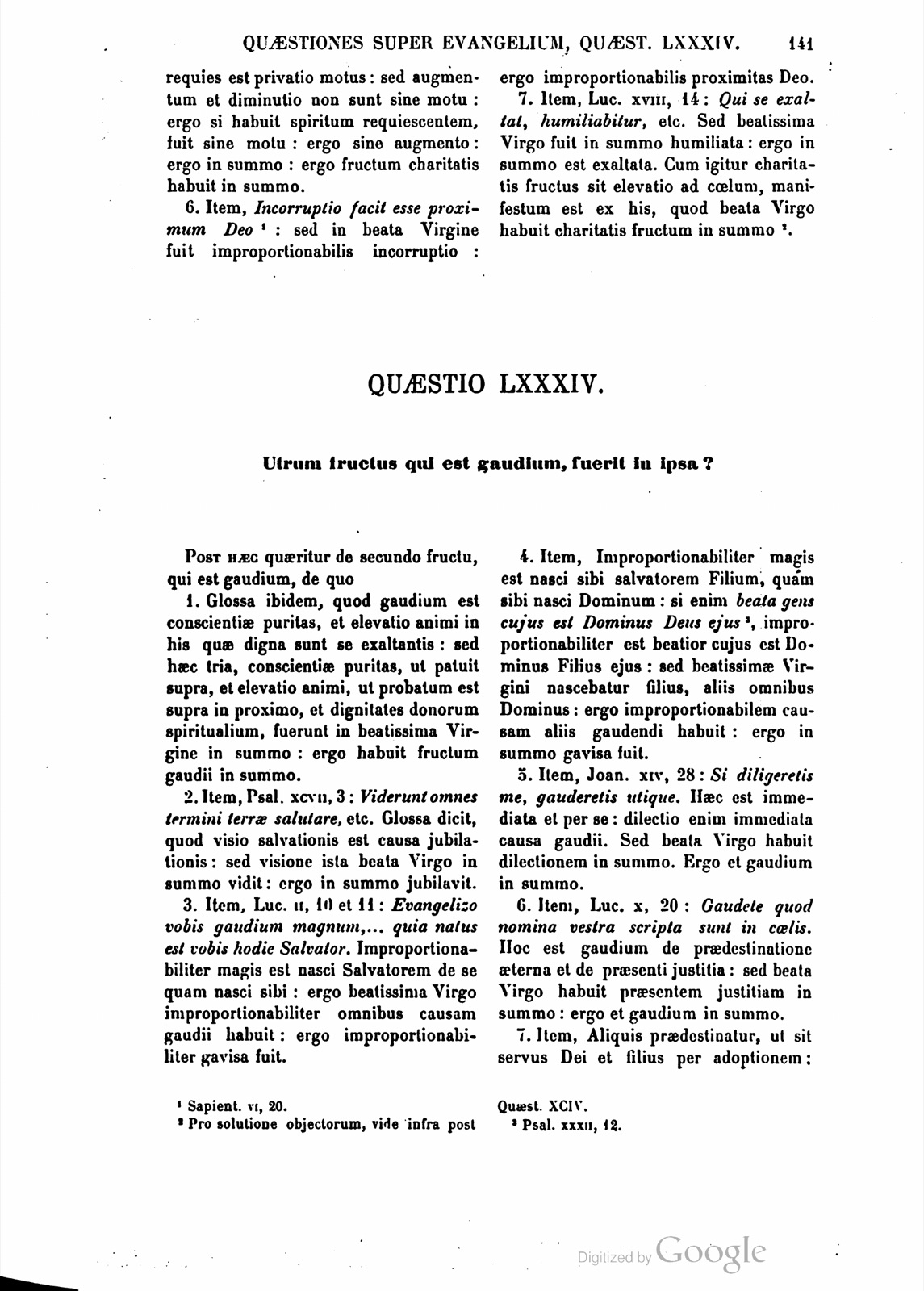
QUAESTIO LXXXIV.
Utrum fructus qui est gaudium, fuerit in ipsa?
Post haec quaeritur de secundo fructu, qui est gaudium, de quo
1. Glossa ibidem, quod gaudium est conscientiae puritas, et elevatio animi in his quae digna sunt se exaltantis: sed haec tria, conscientiae puritas, ut patuit supra, et elevatio animi, ut probatum est supra in proximo, et dignitates donorum spiritualium, fuerunt in beatissima Virgine in summo: ergo habuit fructum gaudii in summo.
2. Item, Psal. XCVII, 3: Viderunt omnes termini terrae salutare, etc. Glossa dicit, quod visio salvationis est causa jubilationis: sed visione ista beata Virgo in summo vidit: ergo in summo jubilavit.
3. Item, Luc. I, 10 et 11: Evangelizo vobis gaudium magnum, ... quia natus est vobis hodie Salvator. Improportionabiliter magis est nasci Salvatorem de se quam nasci sibi: ergo beatissima Virgo improportionabiliter omnibus causam gaudii habuit: ergo improportionabiliter gavisa fuit.
4. Item, Improportionabiliter magis est nasci sibi salvatorem Filium, quam sibi nasci Dominum: si enim beata gens cujus est Dominus Deus ejus 1, improportionabiliter est beatior cujus est Dominus Filius ejus: sed beatissimae Virgini nascebatur filius, aliis omnibus Dominus: ergo improportionabilem causam aliis gaudendi habuit: ergo in summo gavisa fuit.
5. Item, Joan. XIV, 28: Si diligeretis me, gauderetis utique. Haec est immediata et per se: dilectio enim immediata causa gaudii. Sed beata Virgo habuit dilectionem in summo. Ergo et gaudium in summo.
6. Item, Luc. X, 20: Gaudete quod nomina vestra scripta sunt in caelis. Hoc est gaudium de praedestinatione aeterna et de praesenti justitia: sed beata Virgo habuit praesentem justitiam in summo: ergo et gaudium in summo.
7. Item, Aliquis praedestinatur, ut sit servus Dei et filius per adoptionem: aliquis, ut Filius Dei sit per Deum, ut Christus homo: aliquis, ut sit mater Dei per naturam: sed improportionabiliter majus est in aliquo esse matrem Dei per naturam, quam esse filium per adoptionem: ergo beatissima Virgo causam gaudii habuit in summo.
8. Item, Apostolus: Gaudete in Domino: Dominus enim prope est 2: ergo proximitas est causa gaudii: sed beatissimae Virgini in summo proximus fuit: ergo summum gaudium habuit.
QUESTION 84.
Whether the fruit that is joy was in her.
After these things inquiry is made concerning the second fruit, which is joy, concerning which:
1. The Gloss in the same place says that joy is purity of conscience and the elevation of the soul exalting itself in the things that are worthy. But these three things, purity of conscience, as was clear above, and elevation of the soul, as was proved just above, and the dignities of spiritual gifts, were in the most blessed Virgin in the highest degree; therefore she had the fruit of joy in the highest degree.
2. Likewise, Psalm 97:3: All the ends of the earth have seen salvation, and so forth. The Gloss says that the vision of salvation is the cause of jubilation. But the blessed Virgin saw with this vision in the highest degree; therefore she jubilated in the highest degree.
3. Likewise, Luke 1:10 and 11: I proclaim to you a great joy, ... because today a Savior has been born to you. It is disproportionately greater that the Savior be born from oneself than be born for oneself; therefore the most blessed Virgin had disproportionately beyond all the cause of joy; therefore she rejoiced disproportionately.
4. Likewise, it is disproportionately greater that a savior Son be born to oneself than that the Lord be born to oneself. For if the nation whose Lord is its God is blessed 1, she whose Lord is her Son is disproportionately more blessed. But a son was born to the most blessed Virgin, whereas to all others the Lord was born; therefore she had a disproportionate cause of rejoicing beyond others; therefore she rejoiced in the highest degree.
5. Likewise, John 14:28: If you loved me, you would certainly rejoice. This is immediate and through itself, for love is the immediate cause of joy. But the blessed Virgin had love in the highest degree. Therefore also joy in the highest degree.
6. Likewise, Luke 10:20: Rejoice because your names are written in heaven. This is joy concerning eternal predestination and concerning present justice. But the blessed Virgin had present justice in the highest degree; therefore also joy in the highest degree.
7. Likewise, someone is predestined to be a servant of God and son by adoption; someone, that the Son of God be through him, as Christ the man; someone, that she be Mother of God by nature. But it is disproportionately greater for there to be in someone the Mother of God by nature than to be a son by adoption; therefore the most blessed Virgin had the cause of joy in the highest degree.
8. Likewise, the Apostle says: Rejoice in the Lord; for the Lord is near 2. Therefore nearness is a cause of joy. But he was near to the most blessed Virgin in the highest degree; therefore she had supreme joy.
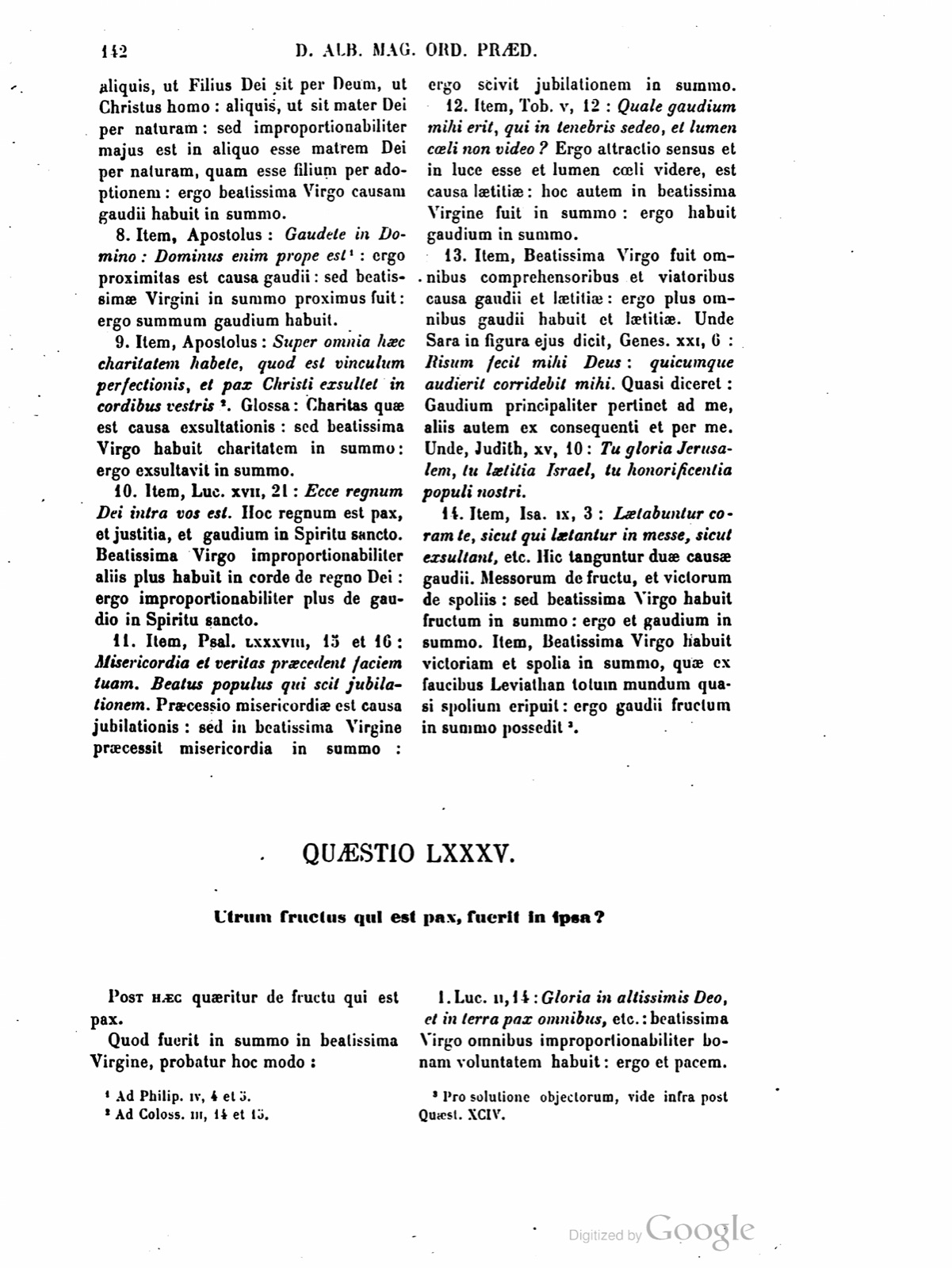
9. Item, Apostolus: Super omnia haec charitatem habete, quod est vinculum perfectionis, et pax Christi exsultet in cordibus vestris 3. Glossa: Charitas quae est causa exsultationis: sed beatissima Virgo habuit charitatem in summo: ergo exsultavit in summo.
10. Item, Luc. XVII, 21: Ecce regnum Dei intra vos est. Hoc regnum est pax, et justitia, et gaudium in Spiritu sancto. Beatissima Virgo improportionabiliter aliis plus habuit in corde de regno Dei: ergo improportionabiliter plus de gaudio in Spiritu sancto.
11. Item, Psal. LXXXVIII, 15 et 16: Misericordia et veritas praecedent faciem tuam. Beatus populus qui scit jubilationem. Praecessio misericordiae est causa jubilationis: sed in beatissima Virgine praecessit misericordia in summo: ergo scivit jubilationem in summo.
12. Item, Tob. V, 12: Quale gaudium mihi erit, qui in tenebris sedeo, et lumen caeli non video? Ergo attractio sensus et in luce esse et lumen caeli videre, est causa laetitiae: hoc autem in beatissima Virgine fuit in summo: ergo habuit gaudium in summo.
13. Item, Beatissima Virgo fuit omnibus comprehensoribus et viatoribus causa gaudii et laetitiae: ergo plus omnibus gaudii habuit et laetitiae. Unde Sara in figura ejus dicit, Genes. XXI, 6: Risum fecit mihi Deus: quicumque audierit corridebit mihi. Quasi diceret: Gaudium principaliter pertinet ad me, aliis autem ex consequenti et per me. Unde, Judith, XV, 10: Tu gloria Jerusalem, tu laetitia Israel, tu honorificentia populi nostri.
14. Item, Isa. IX, 3: Laetabuntur coram te, sicut qui laetantur in messe, sicut exsultant, etc. Hic tanguntur duae causae gaudii. Messorum de fructu, et victorum de spoliis: sed beatissima Virgo habuit fructum in summo: ergo et gaudium in summo. Item, Beatissima Virgo habuit victoriam et spolia in summo, quae ex faucibus Leviathan totum mundum quasi spolium eripuit: ergo gaudii fructum in summo possedit 4.
9. Likewise, the Apostle says: Above all these things have charity, which is the bond of perfection, and let the peace of Christ exult in your hearts 3. The Gloss says: Charity, which is the cause of exultation. But the most blessed Virgin had charity in the highest degree; therefore she exulted in the highest degree.
10. Likewise, Luke 17:21: Behold, the kingdom of God is within you. This kingdom is peace and justice and joy in the Holy Spirit. The most blessed Virgin had disproportionately more of the kingdom of God in her heart than others; therefore disproportionately more of joy in the Holy Spirit.
11. Likewise, Psalm 88:15 and 16: Mercy and truth shall go before your face. Blessed is the people that knows jubilation. The going before of mercy is the cause of jubilation. But in the most blessed Virgin mercy went before in the highest degree; therefore she knew jubilation in the highest degree.
12. Likewise, Tobit 5:12: What joy will there be for me, who sit in darkness and do not see the light of heaven? Therefore the attraction of sense and to be in light and to see the light of heaven is a cause of gladness. But this was in the most blessed Virgin in the highest degree; therefore she had joy in the highest degree.
13. Likewise, the most blessed Virgin was the cause of joy and gladness to all comprehensors and wayfarers; therefore she had more joy and gladness than all. Hence Sarah in her figure says, Genesis 21:6: God has made laughter for me; whoever hears will laugh with me. As if she were saying: Joy principally pertains to me, but to others consequently and through me. Hence Judith 15:10: You are the glory of Jerusalem, you are the gladness of Israel, you are the honor of our people.
14. Likewise, Isaiah 9:3: They will rejoice before you as those who rejoice in the harvest, as they exult, and so forth. Here two causes of joy are touched: that of reapers concerning fruit, and that of victors concerning spoils. But the most blessed Virgin had fruit in the highest degree; therefore also joy in the highest degree. Likewise, the most blessed Virgin had victory and spoils in the highest degree, since she snatched the whole world from the jaws of Leviathan as spoil; therefore she possessed the fruit of joy in the highest degree 4.
Notes
- Psalm 32:12. (Psal. XXXII, 12.) ↩
- Philippians 4:4 and 5. (Ad Philip. IV, 4 et 5.) ↩
- Colossians 3:14 and 15. (Ad Coloss. III, 14 et 15.) ↩
- For the solution of the objections, see below after Question 94. (Pro solutione objectorum, vide infra post Quaest. XCIV.) ↩
If a page does not appear, its photograph has not been uploaded yet.