Works › The Mariale: Questions on “Missus est”
Volume 37 · pp. 140–141
Question 83. Whether the fruit that is charity especially was in her
A marker with ≈ is an approximate page boundary, placed by measure of the text; the page photographs remain the authority. In the paired views, clicking a page marker brings that page into view.
QUAESTIO LXXXIII.
Utrum fructus qui est charitas specialiter, fuerit in ipsa?
Postea quaeritur de fructu qui est charitas specialiter.
Et probatur, quod in beatissima Virgine fuerit in summo, hoc modo:
1. Glossa super illud, Charitas est quae a terra ad Deum evocat. Et sic ibi duo innuuntur, quae pertinent ad hunc fructum, a terrenis separatio, ad caelum elevatio: utrumque istorum fuit in beatissima Virgine in summo: ergo et fructum charitatis habuit in summo. Quod improportionabiliter aliis a terrenis fuit separata, patet per hoc quod neque pulvis venialis peccati pedibus ejus adhaesit: quod omnibus aliis viatoribus inevitabile fuit. Quod ad caelum maxime elevata fuit, sic probatur: Habetur, Matth. VI, 21: Ubi est thesaurus tuus, etc.: ergo thesaurus trahit ad se fructum: sed beatissima Virgo habuit improportionabilem thesaurum in regno caelorum: ergo improportionabiliter elevabatur ad caelum.
2. Item, Elevativum elevans est gratia: sed in beatissima Virgine fuit improportionabiliter gratia: ergo, etc.
3. Item, In Psalmis fiunt tres quaestiones: Una, Quis ascendet in montem Domini 1? Altera, Quis stabit in loco sancto ejus 2? Tertia, Domine, quis habitabit 3, etc.? Quia difficile et perfectum est ascendere, difficilius et perfectius est stare, difficillimum et perfectissimum est habitare et quiescere. Sed ad statum Apostolorum qui majores ab Ecclesia dicuntur, pertinet ascendere, sed non habitare, imo descendere. Unde Angeli ascendebant et descendebant 4. Unde Apostolus rapiebatur usque ad tertium caelum 5, et mox descendit ad disponendum cubilia infirmorum: unde dicit, II ad Corinth. V, 13: Sive mente excedimus, Deo: sive sobrii sumus, vobis, etc. Ergo ad perfectiorem statum quam Apostolorum fuit, pertinet ascendere et quiescere: sed super statum Apostolorum non fuit status eminentior quam status beatae Virginis: ergo ad statum beatae Virginis pertinet ascendere et quiescere et habitare.
QUESTION 83.
Whether the fruit that is charity especially was in her.
Afterward inquiry is made concerning the fruit that is charity especially.
And it is proved that it was in the most blessed Virgin in the highest degree in this way:
1. The Gloss on that saying says: Charity is what calls forth from earth to God. And thus two things are suggested there that pertain to this fruit: separation from earthly things and elevation to heaven. Each of these was in the most blessed Virgin in the highest degree; therefore she had the fruit of charity also in the highest degree. That she was separated from earthly things disproportionately beyond others is clear from this, that not even the dust of venial sin clung to her feet; this was inevitable for all other wayfarers. That she was most greatly elevated to heaven is proved thus: It is had in Matthew 6:21: Where your treasure is, and so forth. Therefore treasure draws the fruit to itself. But the most blessed Virgin had a disproportionate treasure in the kingdom of heaven; therefore she was elevated to heaven disproportionately.
2. Likewise, the elevating thing that elevates is grace; but in the most blessed Virgin there was disproportionate grace; therefore, and so forth.
3. Likewise, three questions are made in the Psalms: one, Who will ascend into the mountain of the Lord 1? Another, Who will stand in his holy place 2? A third, Lord, who will dwell 3, and so forth? For to ascend is difficult and perfect, to stand is more difficult and more perfect, and to dwell and rest is most difficult and most perfect. But to the state of the Apostles, who are called greater by the Church, it belongs to ascend, but not to dwell; rather, to descend. Hence Angels were ascending and descending 4. Hence the Apostle was caught up even to the third heaven 5, and soon descended to arrange beds for the weak; hence he says, 2 Corinthians 5:13: Whether we are carried beyond in mind, it is for God; or whether we are sober, it is for you, and so forth. Therefore it belongs to a more perfect state than that of the Apostles to ascend and to rest. But above the state of the Apostles there was no state more eminent than the state of the blessed Virgin; therefore to the state of the blessed Virgin it belongs to ascend, rest, and dwell.
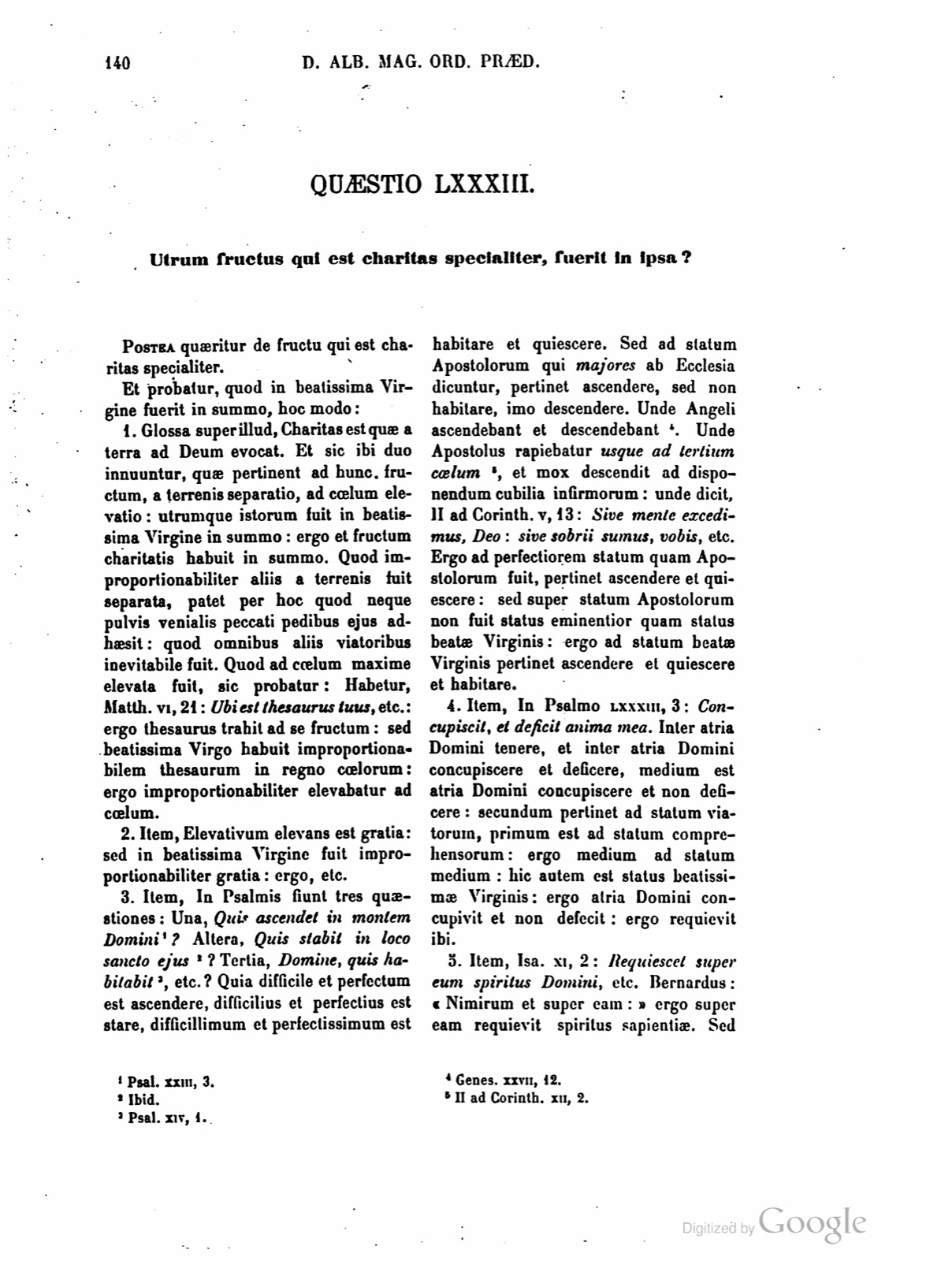
4. Item, In Psalmo LXXXIII, 3: Concupiscit, et deficit anima mea. Inter atria Domini tenere, et inter atria Domini concupiscere et deficere, medium est atria Domini concupiscere et non deficere: secundum pertinet ad statum viatorum, primum est ad statum comprehensorum: ergo medium ad statum medium: hic autem est status beatissimae Virginis: ergo atria Domini concupivit et non defecit: ergo requievit ibi.
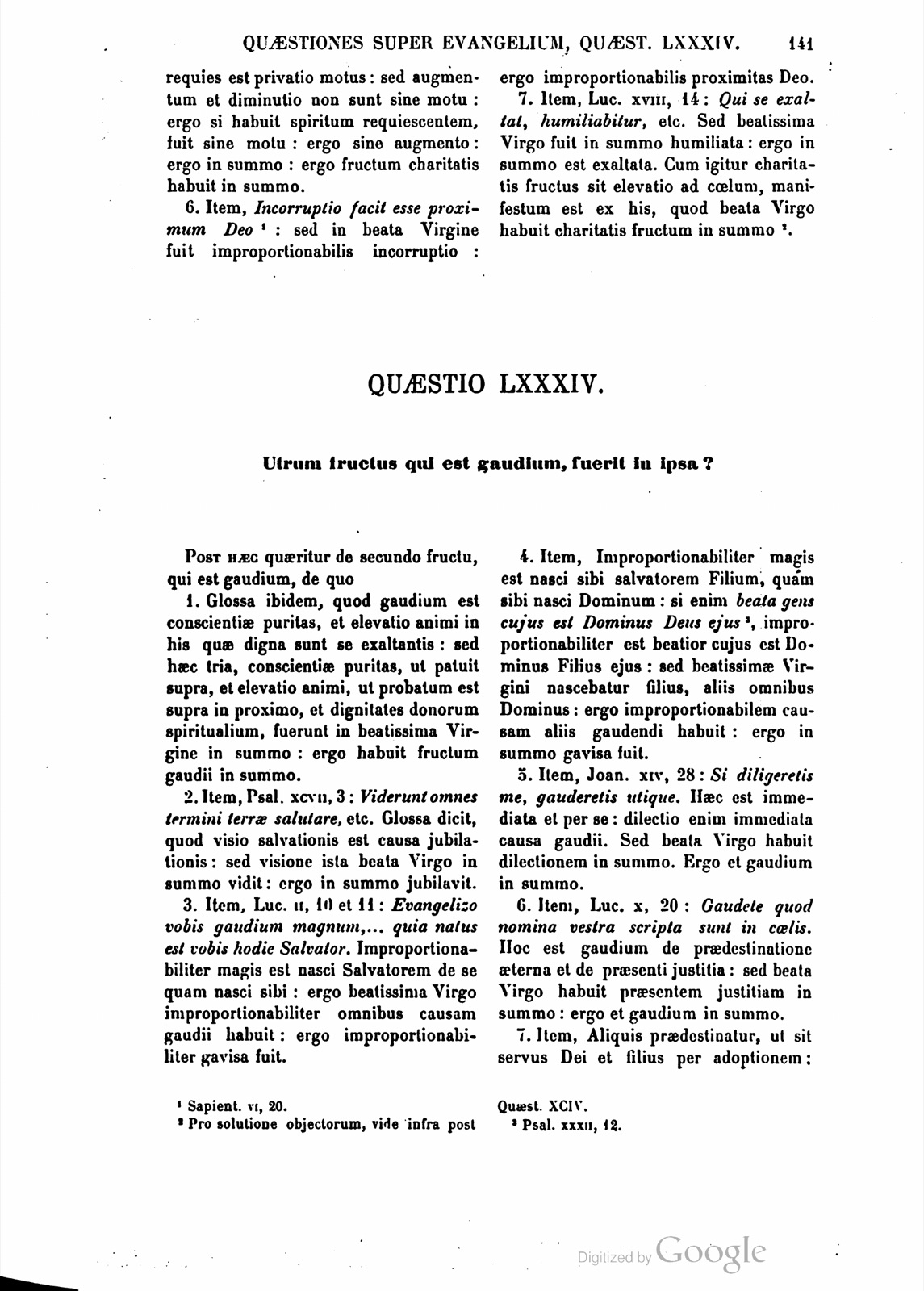
5. Item, Isa. XI, 2: Requiescet super eum spiritus Domini, etc. Bernardus: "Nimirum et super eam:" ergo super eam requievit spiritus sapientiae. Sed requies est privatio motus: sed augmentum et diminutio non sunt sine motu: ergo si habuit spiritum requiescentem, fuit sine motu: ergo sine augmento: ergo in summo: ergo fructum charitatis habuit in summo.
6. Item, Incorruptio facit esse proximum Deo 6: sed in beata Virgine fuit improportionabilis incorruptio: ergo improportionabilis proximitas Deo.
7. Item, Luc. XVIII, 14: Qui se exaltat, humiliabitur, etc. Sed beatissima Virgo fuit in summo humiliata: ergo in summo est exaltata. Cum igitur charitatis fructus sit elevatio ad caelum, manifestum est ex his, quod beata Virgo habuit charitatis fructum in summo 7.
4. Likewise, in Psalm 83:3: My soul longs and faints. Between holding the courts of the Lord, and longing for and fainting for the courts of the Lord, the middle is to long for the courts of the Lord and not faint. The second belongs to the state of wayfarers; the first is to the state of comprehensors; therefore the middle belongs to the middle state. But this is the state of the most blessed Virgin; therefore she longed for the courts of the Lord and did not faint; therefore she rested there.
5. Likewise, Isaiah 11:2: The spirit of the Lord shall rest upon him, and so forth. Bernard says: "Surely also upon her." Therefore the spirit of wisdom rested upon her. But rest is the privation of motion; but increase and decrease are not without motion. Therefore if she had the spirit resting, she was without motion; therefore without increase; therefore in the highest degree; therefore she had the fruit of charity in the highest degree.
6. Likewise, incorruption makes one be near to God 6. But in the blessed Virgin there was disproportionate incorruption; therefore disproportionate nearness to God.
7. Likewise, Luke 18:14: He who exalts himself will be humbled, and so forth. But the most blessed Virgin was humbled in the highest degree; therefore she is exalted in the highest degree. Since therefore the fruit of charity is elevation to heaven, it is manifest from these things that the blessed Virgin had the fruit of charity in the highest degree 7.
Notes
- Psalm 23:3. (Psal. XXIII, 3.) ↩
- The same place. (Ibid.) ↩
- Psalm 14:1. (Psal. XIV, 1.) ↩
- Genesis 28:12. (Genes. XXVIII, 12.) ↩
- 2 Corinthians 12:2. (II ad Corinth. XII, 2.) ↩
- Wisdom 6:20. (Sapient. VI, 20.) ↩
- For the solution of the objections, see below after Question 94. (Pro solutione objectorum, vide infra post Quaest. XCIV.) ↩
If a page does not appear, its photograph has not been uploaded yet.