Works › The Mariale: Questions on “Missus est”
Volume 37 · pp. 111–112
Response to Question XLIV concerning faith
A marker with ≈ is an approximate page boundary, placed by measure of the text; the page photographs remain the authority. In the paired views, clicking a page marker brings that page into view.
Responsio ad praecedentes quaestiones de virtutibus.
§ I.
Responsio ad Quaestionem XLIV de fide.
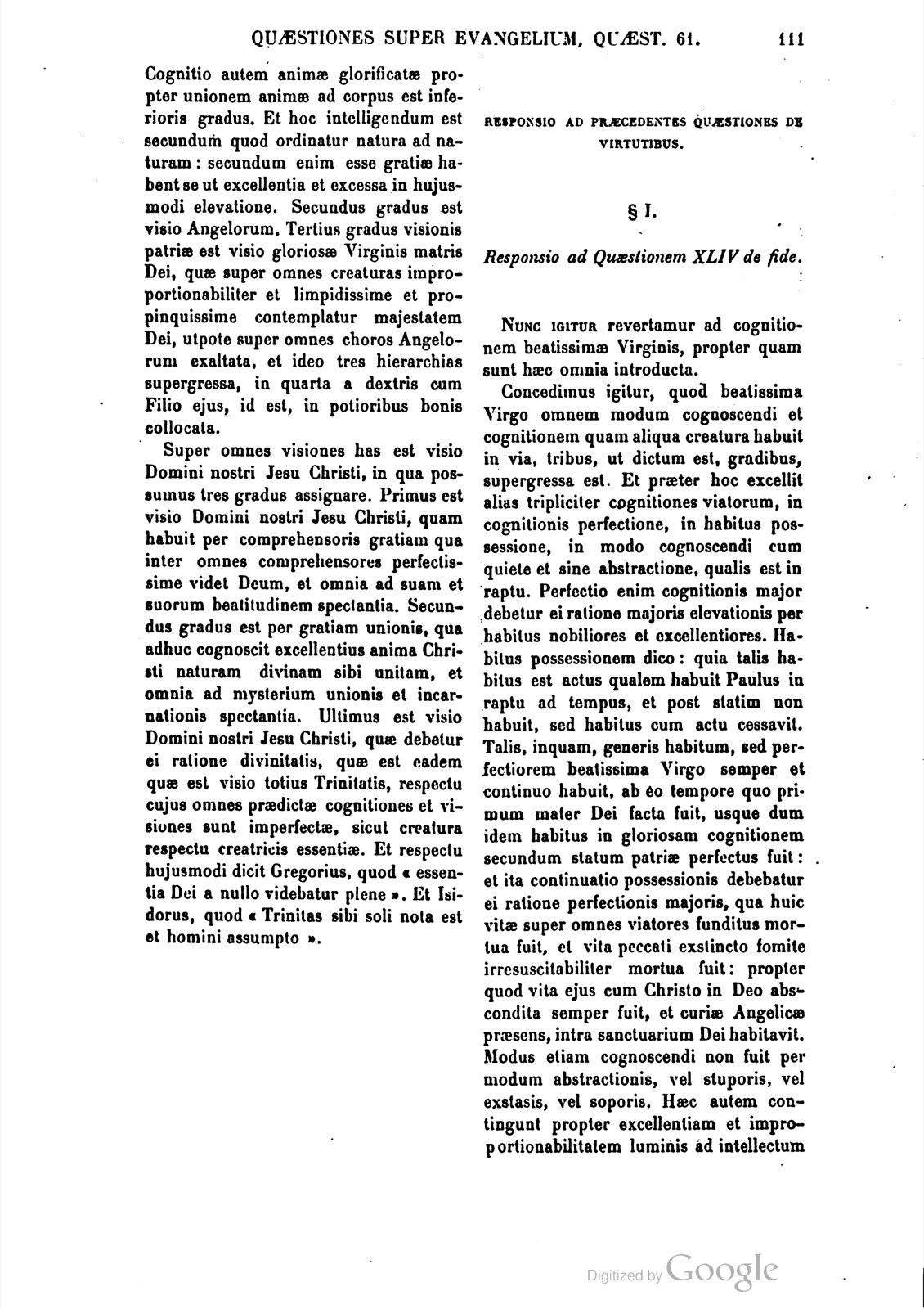
Nunc igitur revertamur ad cognitionem beatissimae Virginis, propter quam sunt haec omnia introducta.
Concedimus igitur, quod beatissima Virgo omnem modum cognoscendi et cognitionem quam aliqua creatura habuit in via, tribus, ut dictum est, gradibus, supergressa est. Et praeter hoc excellit alias tripliciter cognitiones viatorum, in cognitionis perfectione, in habitus possessione, in modo cognoscendi cum quiete et sine abstractione, qualis est in raptu. Perfectio enim cognitionis major debetur ei ratione majoris elevationis per habitus nobiliores et excellentiores. Habitus possessionem dico: quia talis habitus est actus qualem habuit Paulus in raptu ad tempus, et post statim non habuit, sed habitus cum actu cessavit. Talis, inquam, generis habitum, sed perfectiorem beatissima Virgo semper et continuo habuit, ab eo tempore quo primum mater Dei facta fuit, usque dum idem habitus in gloriosam cognitionem secundum statum patriae perfectus fuit: et ita continuatio possessionis debebatur ei ratione perfectionis majoris, qua huic vitae super omnes viatores funditus mortua fuit, et vita peccati exstincto fomite irresuscitabiliter mortua fuit: propter quod vita ejus cum Christo in Deo abscondita semper fuit, et curiae Angelicae praesens, intra sanctuarium Dei habitavit. Modus etiam cognoscendi non fuit per modum abstractionis, vel stuporis, vel exstasis, vel soporis. Haec autem contingunt propter excellentiam et improportionabilitatem luminis ad intellectum illuminabilem, ut patet per simile in corporali lumine et transfiguratione Domini 1, quando ostendit eis claritatem simillimam claritati gloriae. Dicitur enim, quod Petrus et qui cum eo erant, gravati erant somno, ita ut videre non possent. Unde Domino Petrus dixit: Bonum est nos hic esse,... nesciens quid diceret. Stupor enim circumdederat eum 2. Simili modo in lumine spirituali est. Unde Paulus excellentiori visione stupefactus dicit: Sive in corpore, nescio, sive extra corpus, nescio, Deus scit 3. Hunc autem stuporem beatissima Virgo non habuit, cujus intellectus deiformior illi luci proportionabilior fuit. Unde sicut eadem lux quae est aegris oculis odiosa, sanis oculis est amabilis, per eamdem etiam lucem clari oculi perfectius vident et sine perturbatione, aegri autem minus perfecte et cum perturbatione: ita spiritualis lux quae oculis Pauli fuit improportionabilis, et ideo raptum fecit cum stupore. Talis autem lux oculis beatissimae Virginis fuit proportionabilis sine stupore cum delectatione: et hoc debebatur ei ratione puritatis et munditiae, qua super Paulum et omnes viatores nitebat et improportionabiliter et excellenter.
Response to the preceding questions concerning the virtues.
§ I.
Response to Question XLIV concerning faith.
Now therefore let us return to the knowledge of the most blessed Virgin, on account of which all these things have been introduced.
Therefore we grant that the most blessed Virgin surpassed every mode of knowing and knowledge that any creature had on the way by three grades, as was said. And besides this she surpasses the other knowledges of wayfarers in three ways: in the perfection of knowledge, in possession of the habit, and in the mode of knowing with quiet and without abstraction, such as exists in rapture. For greater perfection of knowledge is owed to her by reason of greater elevation through nobler and more excellent habits. I say possession of the habit because such a habit is an act such as Paul had in rapture for a time, and afterward immediately did not have; rather, the habit ceased with the act. A habit, I say, of that genus, but more perfect, the most blessed Virgin always and continuously had from the time when she first became Mother of God until the same habit was perfected into glorious knowledge according to the state of the homeland. And thus continuity of possession was owed to her by reason of greater perfection, by which she was more fundamentally dead to this life than all wayfarers, and by reason of the life of sin, with the tinder extinguished, being dead beyond resurrection; on account of this her life was always hidden with Christ in God, and, present to the Angelic court, she dwelt within the sanctuary of God. Also her mode of knowing was not through the mode of abstraction, or stupor, or ecstasy, or sleep. But these things happen because of the excellence and disproportionality of light to the illuminable intellect, as is clear by a likeness in bodily light and the transfiguration of the Lord 1, when he showed them a clarity most like the clarity of glory. For it is said that Peter and those who were with him were weighed down with sleep, so that they could not see. Hence Peter said to the Lord: It is good for us to be here, ... not knowing what he was saying. For stupor had surrounded him 2. It is in a similar way in spiritual light. Hence Paul, stupefied by a more excellent vision, says: Whether in the body, I do not know; whether outside the body, I do not know; God knows 3. But the most blessed Virgin did not have this stupor, since her more deiform intellect was more proportioned to that light. Hence, just as the same light that is hateful to sick eyes is lovable to healthy eyes, and through that same light clear eyes see more perfectly and without disturbance, but sick eyes less perfectly and with disturbance; so too the spiritual light that was disproportionate to Paul's eyes, and therefore caused rapture with stupor, was proportionate to the eyes of the most blessed Virgin without stupor and with delight. And this was owed to her by reason of purity and cleanness, by which she shone above Paul and all wayfarers both disproportionately and excellently.
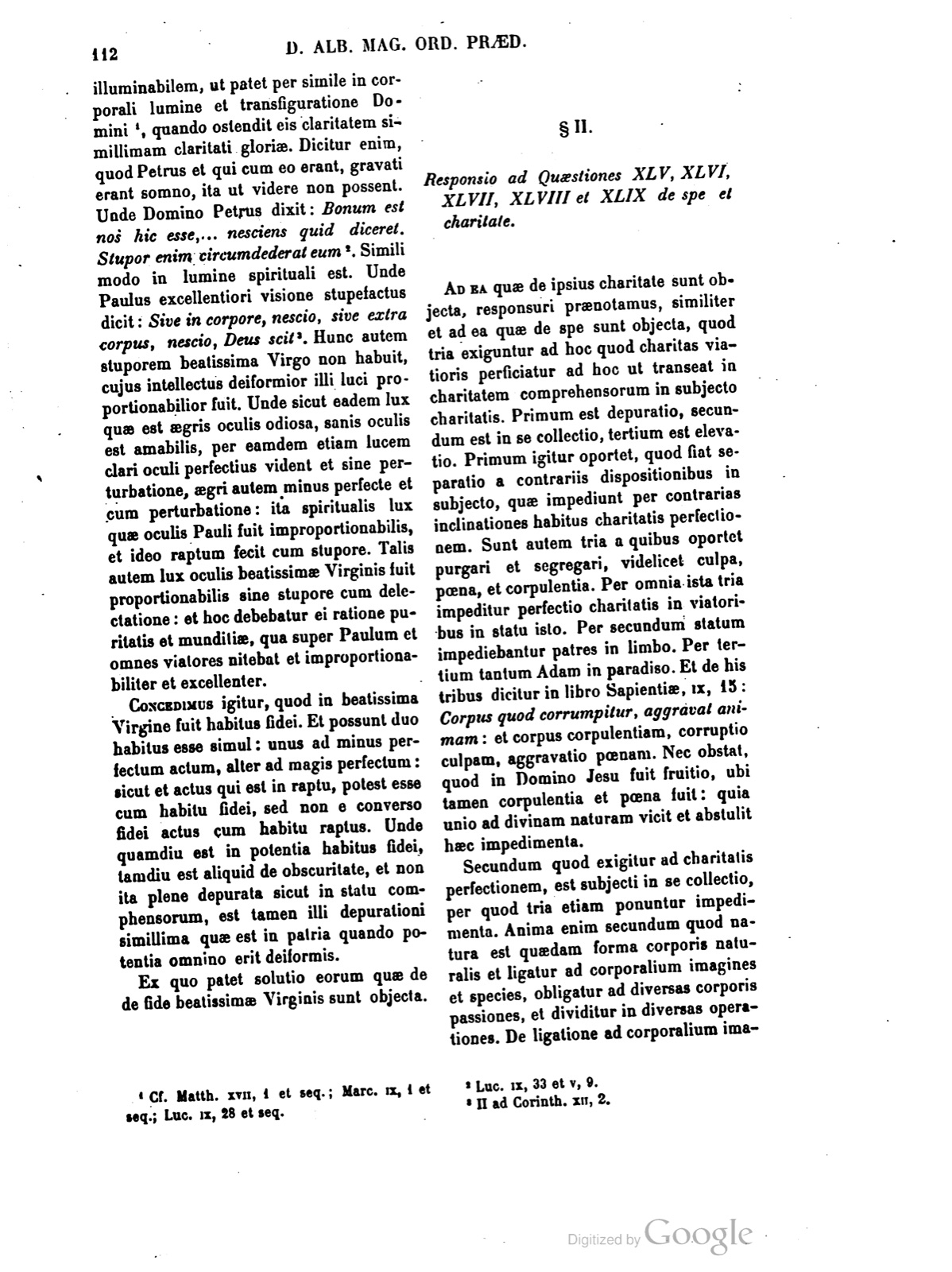
Concedimus igitur, quod in beatissima Virgine fuit habitus fidei. Et possunt duo habitus esse simul: unus ad minus perfectum actum, alter ad magis perfectum: sicut et actus qui est in raptu, potest esse cum habitu fidei, sed non e converso fidei actus cum habitu raptus. Unde quamdiu est in potentia habitus fidei, tamdiu est aliquid de obscuritate, et non ita plene depurata sicut in statu comprehensorum, est tamen illi depurationi persimillima quae est in patria quando potentia omnino erit deiformis.
Ex quo patet solutio eorum quae de fide beatissimae Virginis sunt objecta.
Therefore we grant that the habit of faith was in the most blessed Virgin. And two habits can exist together: one for a less perfect act, the other for a more perfect one; just as the act that is in rapture can exist with the habit of faith, but not conversely, the act of faith with the habit of rapture. Hence as long as the habit of faith is in potency, so long is there something of obscurity, and it is not purified so fully as in the state of comprehensors; nevertheless it is very similar to that purification that is in the homeland, when the power will be wholly deiform.
From this the solution of the things objected concerning the faith of the most blessed Virgin is clear.
If a page does not appear, its photograph has not been uploaded yet.