Works › The Mariale: Questions on “Missus est”
Volume 37 · pp. 87–89
Question XLIV. Whether the blessed Virgin had faith?
A marker with ≈ is an approximate page boundary, placed by measure of the text; the page photographs remain the authority. In the paired views, clicking a page marker brings that page into view.
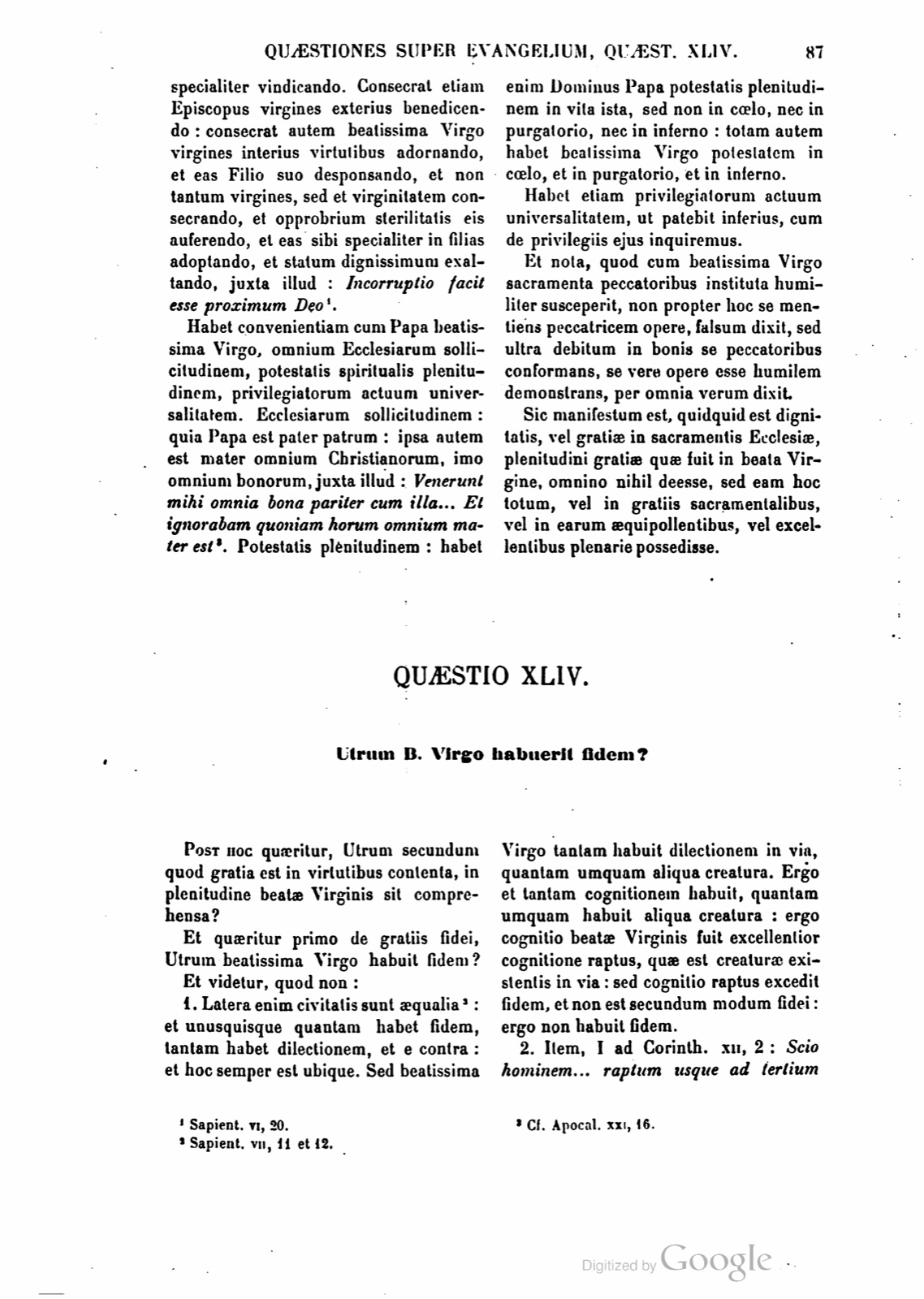
QUAESTIO XLIV. Utrum B. Virgo habuerit fidem?
Post hoc quaeritur, Utrum secundum quod gratia est in virtutibus contenta, in plenitudine beatae Virginis sit comprehensa?
Et quaeritur primo de gratiis fidei, Utrum beatissima Virgo habuit fidem?
Et videtur, quod non:
1. Latera enim civitatis sunt aequalia 1: et unusquisque quantam habet fidem, tantam habet dilectionem, et e contra: et hoc semper est ubique. Sed beatissima Virgo tantam habuit dilectionem in via, quantam umquam aliqua creatura. Ergo et tantam cognitionem habuit, quantam umquam habuit aliqua creatura: ergo cognitio beatae Virginis fuit excellentior cognitione raptus, quae est creaturae existentis in via: sed cognitio raptus excedit fidem, et non est secundum modum fidei: ergo non habuit fidem.
2. Item, II ad Corinth. XII, 2: Scio hominem... raptum usque ad tertium coelum. Super hoc dicit Glossa, quod Paulus vidit in raptu sicut qui sunt in tertia hierarchia. Ergo similiter beatissima Virgo vidit et excellentius: sed illi de tertia hierarchia non viderunt per fidem: ergo nec beatissima Virgo habuit fidem.
3. Item, Munditia cordis est ad videndum Deum dispositio, juxta illud: Beati mundo corde 2, etc. Ergo ubi major munditia, ibi major visio: sed nulla umquam creatura habuit tantam munditiam, quantam illa quae ea puritate nitebat qua sub Deo nulla major nequit intelligi: ergo numquam aliqua creatura habuit tam altam cognitionem: ergo ejus cognitio fuit supra raptum: ergo supra fidem. Quod enim superius est superiore, superius est inferiore.
4. Item, Entis ad non ens infinita est distantia: ergo peccator et non peccatrix habent distantiam in infinitum: sed tantum diviserunt peccata nostra inter nos et Deum: ergo ubi plus de peccato, ibi major divisio: et ubi minus de peccato, ibi minor divisio et major conjunctio: ergo ubi nihil omnino de peccato, proxima est conjunctio: et ubi aliquid de peccato, ibi non omnimoda conjunctio. Sed nulla pura creatura est vel fuit sine peccato in via, juxta illud Joannis: Si dixerimus quoniam peccatum non habemus 3, etc., excepta beata Virgine, de qua dicit Augustinus: « Cum de peccatis agitur, nullam volo de ipsa fieri mentionem. » Ergo numquam aliqua pura creatura ita conjuncta fuit Deo sicut beatissima Virgo: sed illa conjunctio est per cognitionem et dilectionem: ergo numquam aliqua creatura pura habuit tam altam cognitionem et dilectionem: ergo supra raptum: ergo supra fidem.
QUESTION XLIV. Whether the blessed Virgin had faith?
After this it is asked whether, insofar as grace is contained in the virtues, it is comprehended in the fullness of the blessed Virgin.
And first it is asked concerning the graces of faith, whether the most blessed Virgin had faith.
And it seems that she did not:
1. For the sides of the city are equal 1, and each person has as much love as he has faith, and conversely; and this is always so everywhere. But the most blessed Virgin had as much love on the way as any creature ever had. Therefore she also had as much knowledge as any creature ever had. Therefore the knowledge of the blessed Virgin was more excellent than the knowledge of rapture, which belongs to a creature existing on the way. But the knowledge of rapture exceeds faith and is not according to the mode of faith. Therefore she did not have faith.
2. Likewise, 2 Corinthians 12:2 says: I know a man... caught up to the third heaven. On this the Gloss says that Paul saw in rapture as those who are in the third hierarchy see. Therefore similarly the most blessed Virgin saw, and more excellently. But those of the third hierarchy did not see through faith. Therefore neither did the most blessed Virgin have faith.
3. Likewise, cleanness of heart is a disposition for seeing God, according to that saying: Blessed are the clean of heart 2, and so forth. Therefore where there is greater cleanness, there is greater vision. But no creature ever had such great cleanness as she who shone with that purity greater than which under God none can be understood. Therefore no creature ever had such high knowledge. Therefore her knowledge was above rapture; therefore above faith. For what is higher than the higher is higher than the lower.
4. Likewise, the distance of being from non-being is infinite. Therefore a sinner and a non-sinner have distance to infinity. But our sins alone have divided between us and God. Therefore where there is more of sin, there is greater division; and where there is less of sin, there is less division and greater conjunction. Therefore where there is altogether nothing of sin, the conjunction is nearest; and where there is anything of sin, there is not conjunction in every way. But no pure creature is or was without sin on the way, according to that saying of John: If we say that we do not have sin 3, and so forth, except the blessed Virgin, concerning whom Augustine says: "When sins are being treated, I wish no mention to be made of her." Therefore no pure creature was ever so joined to God as the most blessed Virgin. But that conjunction is through knowledge and love. Therefore no pure creature ever had such high knowledge and love; therefore above rapture; therefore above faith.
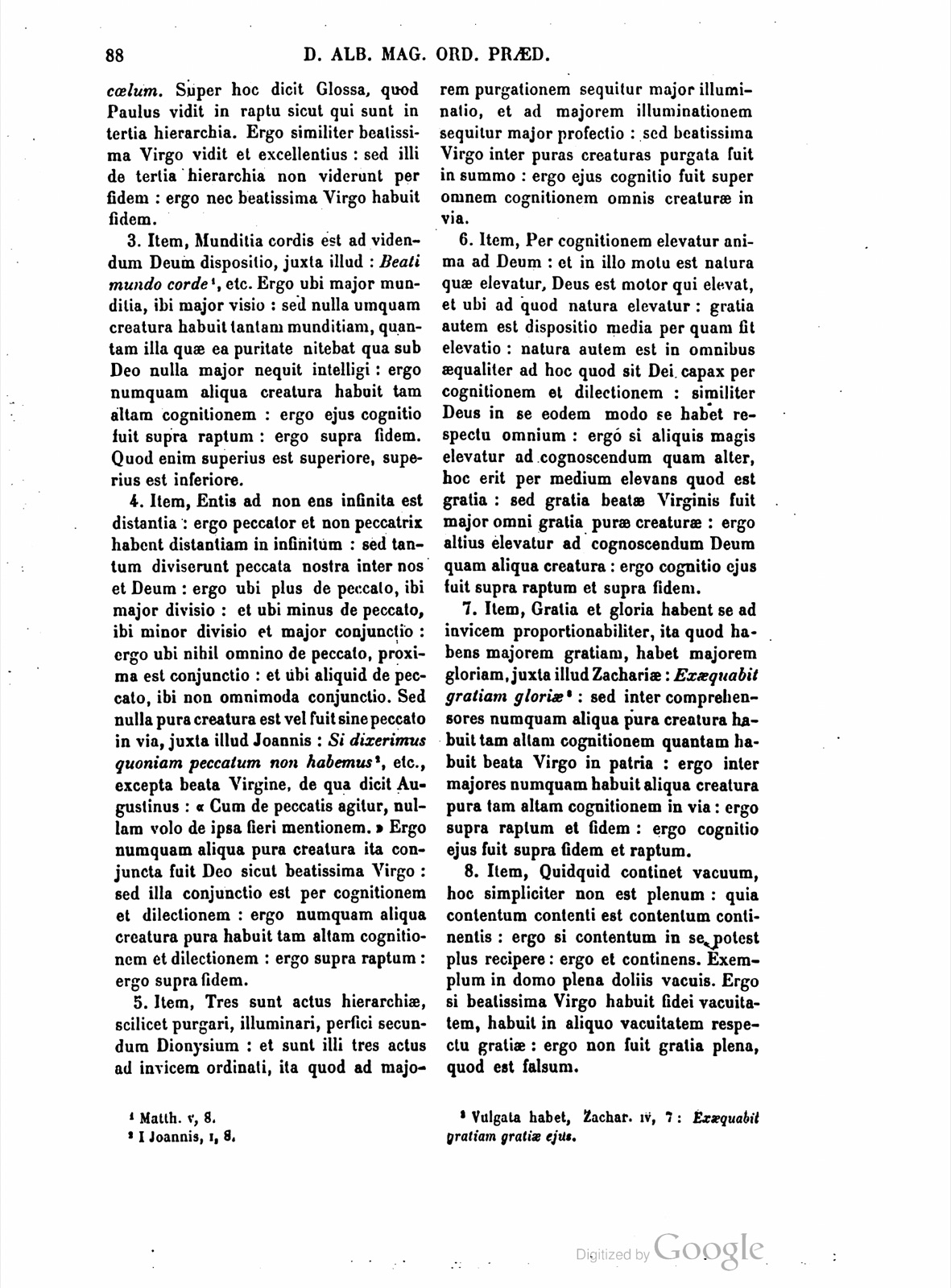
5. Item, Tres sunt actus hierarchiae, scilicet purgari, illuminari, perfici secundum Dionysium: et sunt illi tres actus ad invicem ordinati, ita quod ad majorem purgationem sequitur major illuminatio, et ad majorem illuminationem sequitur major profectio: sed beatissima Virgo inter puras creaturas purgata fuit in summo: ergo ejus cognitio fuit super omnem cognitionem omnis creaturae in via.
6. Item, Per cognitionem elevatur anima ad Deum: et in illo motu est natura quae elevatur, Deus est motor qui elevat, et ubi ad quod natura elevatur: gratia autem est dispositio media per quam fit elevatio: natura autem est in omnibus aequaliter ad hoc quod sit Dei capax per cognitionem et dilectionem: similiter Deus in se eodem modo se habet respectu omnium: ergo si aliquis magis elevatur ad cognoscendum quam alter, hoc erit per medium elevans quod est gratia: sed gratia beatae Virginis fuit major omni gratia purae creaturae: ergo altius elevatur ad cognoscendum Deum quam aliqua creatura: ergo cognitio ejus fuit supra raptum et supra fidem.
7. Item, Gratia et gloria habent se ad invicem proportionabiliter, ita quod habens majorem gratiam, habet majorem gloriam, juxta illud Zachariae: Exaequabit gratiam gloriae: sed inter comprehensores numquam aliqua pura creatura habuit tam altam cognitionem quantam habuit beata Virgo in patria: ergo inter majores numquam habuit aliqua creatura pura tam altam cognitionem in via: ergo supra raptum et fidem: ergo cognitio ejus fuit supra fidem et raptum.
8. Item, Quidquid continet vacuum, hoc simpliciter non est plenum: quia contentum contenti est contentum continentis: ergo si contentum in se potest plus recipere: ergo et continens. Exemplum in domo plena doliis vacuis. Ergo si beatissima Virgo habuit fidei vacuitatem, habuit in aliquo vacuitatem respectu gratiae: ergo non fuit gratia plena, quod est falsum.
9. Item, Quod beatissima Virgo fuit sapientior omni creatura, signatur per hoc quod liber qui intitulatur de Sapientia, de beatissima Virgine specialiter exponitur: et quae de sapientia Domini dicuntur, quasi de ipsa dicantur, Ecclesia interpretatur, ut patet in epistolis quae de ipsa leguntur: in sapientia autem nihil est de stultitia vel ignorantia: ergo beatissima Virgo plena fuit sapientia: sed in fide non est plena sapientia, sed ex parte, juxta illud: Ex parte cognoscimus, ex parte prophetamus 4: ergo beatissima Virgo non habuit fidem, sed plenam cognitionem.
5. Likewise, according to Dionysius, there are three acts of hierarchy, namely to be purged, to be illuminated, to be perfected; and those three acts are ordered to one another, so that greater illumination follows upon greater purgation, and greater advancement follows upon greater illumination. But the most blessed Virgin, among pure creatures, was purged in the highest degree. Therefore her knowledge was above every knowledge of every creature on the way.
6. Likewise, through knowledge the soul is elevated to God; and in that motion there is the nature that is elevated, God is the mover who elevates, and the where-to to which the nature is elevated. But grace is the middle disposition through which elevation happens. Now nature is in all things equally ordered to this, that it may be capable of God through knowledge and love. Similarly God in himself is related in the same way with respect to all. Therefore, if someone is elevated more to knowing than another, this will be through the elevating middle, which is grace. But the grace of the blessed Virgin was greater than every grace of a pure creature. Therefore she is elevated more highly to knowing God than any creature. Therefore her knowledge was above rapture and above faith.
7. Likewise, grace and glory are proportionally related to each other, such that one having greater grace has greater glory, according to that saying of Zechariah: He will equal grace to glory. But among comprehensors no pure creature ever had such high knowledge as the blessed Virgin had in the homeland. Therefore among the greater ones no pure creature ever had such high knowledge on the way. Therefore above rapture and faith; therefore her knowledge was above faith and rapture.
8. Likewise, whatever contains an empty thing is not full simply, because what is contained by the contained thing is contained by the container. Therefore if what is contained can receive more in itself, then the container can also receive more. An example is in a house full of empty casks. Therefore if the most blessed Virgin had the emptiness of faith, she had emptiness in some respect with regard to grace. Therefore she was not full of grace, which is false.
9. Likewise, that the most blessed Virgin was wiser than every creature is signified by this, that the book entitled Of Wisdom is specially expounded concerning the most blessed Virgin; and the things that are said about the wisdom of the Lord, the Church interprets as if they were said about her, as is clear in the epistles that are read about her. But in wisdom there is nothing of foolishness or ignorance. Therefore the most blessed Virgin was full of wisdom. But in faith there is not full wisdom, but wisdom in part, according to that saying: We know in part, we prophesy in part 4. Therefore the most blessed Virgin did not have faith, but full knowledge.
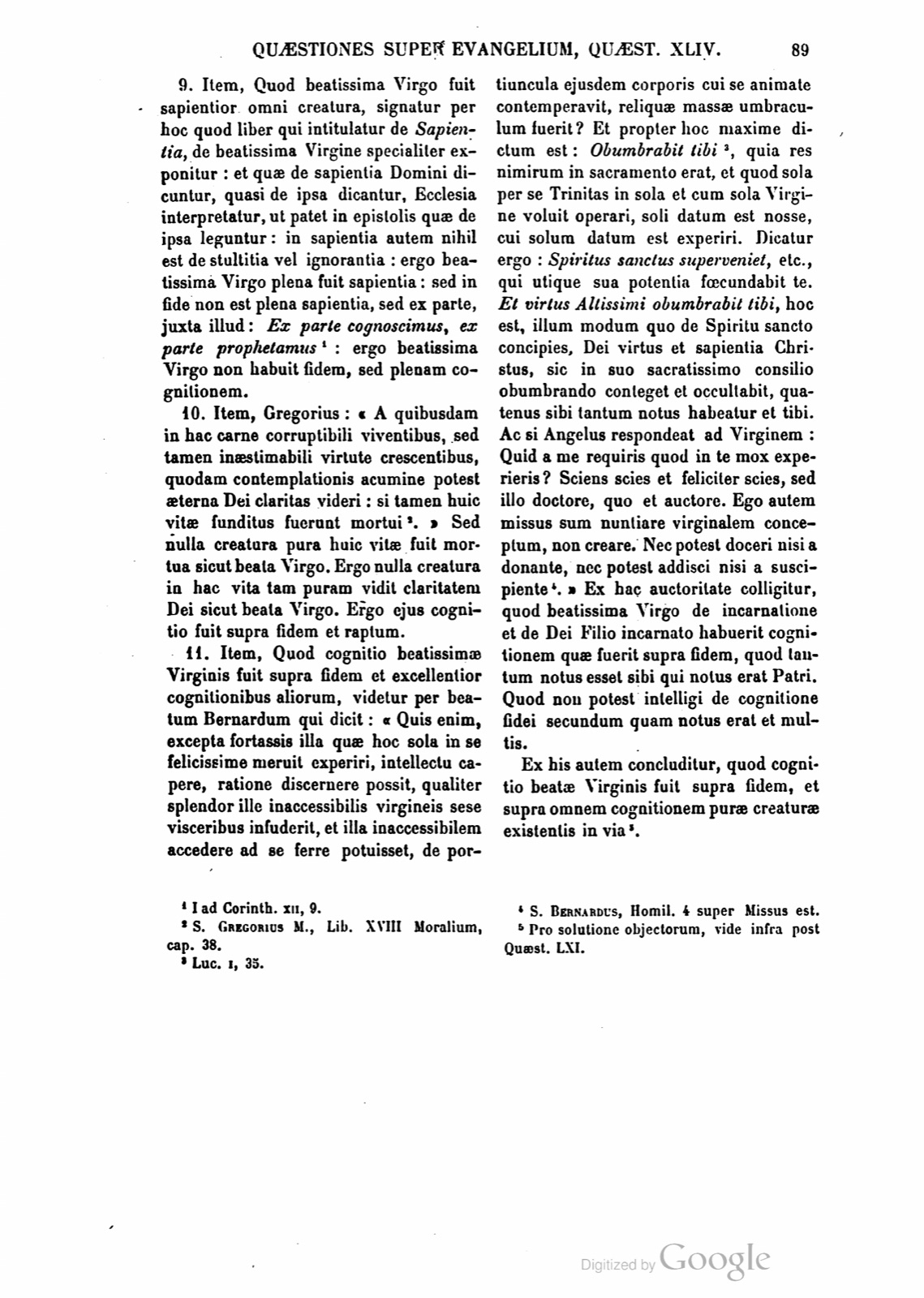
10. Item, Gregorius: « A quibusdam in hac carne corruptibili viventibus, sed tamen inaestimabili virtute crescentibus, quodam contemplationis acumine potest aeterna Dei claritas videri: si tamen huic vitae funditus fuerunt mortui 5. » Sed nulla creatura pura huic vitae fuit mortua sicut beata Virgo. Ergo nulla creatura in hac vita tam puram vidit claritatem Dei sicut beata Virgo. Ergo ejus cognitio fuit supra fidem et raptum.
11. Item, Quod cognitio beatissimae Virginis fuit supra fidem et excellentior cognitionibus aliorum, videtur per beatum Bernardum qui dicit: « Quis enim, excepta fortassis illa quae hoc sola in se felicissime meruit experiri, intellectu capere, ratione discernere possit, qualiter splendor ille inaccessibilis virgineis sese visceribus infuderit, et illa inaccessibilem accedere ad se ferre potuisset, de portiuncula ejusdem corporis cui se animate contemperavit, reliquae massae umbraculum fuerit? Et propter hoc maxime dictum est: Obumbrabit tibi 6, quia res nimirum in sacramento erat, et quod sola per se Trinitas in sola et cum sola Virgine voluit operari, soli datum est nosse, cui solum datum est experiri. Dicatur ergo: Spiritus sanctus superveniet, etc., qui utique sua potentia foecundabit te. Et virtus Altissimi obumbrabit tibi, hoc est, illum modum quo de Spiritu sancto concipies, Dei virtus et sapientia Christus, sic in suo sacratissimo consilio obumbrando conteget et occultabit, quatenus sibi tantum notus habeatur et tibi. Ac si Angelus respondeat ad Virginem: Quid a me requiris quod in te mox experieris? Sciens scies et feliciter scies, sed illo doctore, quo et auctore. Ego autem missus sum nuntiare virginalem conceptum, non creare. Nec potest doceri nisi a donante, nec potest addisci nisi a suscipiente 7. » Ex hac auctoritate colligitur, quod beatissima Virgo de incarnatione et de Dei Filio incarnato habuerit cognitionem quae fuerit supra fidem, quod tantum notus esset sibi qui notus erat Patri. Quod non potest intelligi de cognitione fidei secundum quam notus erat et multis.
Ex his autem concluditur, quod cognitio beatae Virginis fuit supra fidem, et supra omnem cognitionem purae creaturae existentis in via 8.
10. Likewise, Gregory says: "By certain persons living in this corruptible flesh, yet growing by inestimable virtue, the eternal clarity of God can be seen by a certain point of contemplation, if nevertheless they have been entirely dead to this life 5." But no pure creature was dead to this life as the blessed Virgin was. Therefore no creature in this life saw the pure clarity of God as the blessed Virgin did. Therefore her knowledge was above faith and rapture.
11. Likewise, that the knowledge of the most blessed Virgin was above faith and more excellent than the knowledges of others is seen through blessed Bernard, who says: "For who, perhaps excepting that woman alone who most happily merited to experience this in herself, could grasp by intellect, or discern by reason, how that inaccessible splendor poured itself into virginal viscera, and how she could bear the inaccessible one to approach her, from a little portion of that same body to which he joined himself as animate, and be a shading of the remaining mass? And because of this it was especially said: He will overshadow you 6, because the thing surely was in mystery, and what the Trinity alone by itself wished to work in the Virgin alone and with the Virgin alone, it was granted only to her to know, to whom alone it was granted to experience. Therefore let it be said: The Holy Spirit will come upon you, and so forth, who indeed by his power will make you fruitful. And the power of the Most High will overshadow you, that is, Christ, the power and wisdom of God, will in this way cover and hide in his most sacred counsel, by overshadowing, that mode by which you will conceive of the Holy Spirit, so that it may be known only to him and to you. As if the Angel were responding to the Virgin: Why do you ask of me what you will soon experience in yourself? Knowing, you will know, and happily you will know, but with him as teacher, as also with him as author. But I have been sent to announce the virginal conception, not to create it. Nor can it be taught except by the giver, nor can it be learned except by the receiver 7." From this authority it is gathered that the most blessed Virgin had knowledge concerning the incarnation and concerning the incarnate Son of God that was above faith, because he alone who was known to the Father was known so much to her. This cannot be understood of the knowledge of faith, according to which he was known also to many.
From these things it is concluded that the knowledge of the blessed Virgin was above faith, and above every knowledge of a pure creature existing on the way 8.
Notes
- Compare Apocalypse 21:16. (Cf. Apocal. XXI, 16.) ↩
- Matthew 5:8. (Matth. V, 8.) ↩
- 1 John 1:8. (I Joannis, I, 8.) ↩
- 1 Corinthians 13:9. (I ad Corinth. XIII, 9.) ↩
- St. Gregory the Great, Book XVIII of the Moralia, chapter 38. (S. Gregorius M., Lib. XVIII Moralium, cap. 38.) ↩
- Luke 1:35. (Luc. I, 35.) ↩
- St. Bernard, Homily 4 on Missus est. (S. Bernardus, Homil. 4 super Missus est.) ↩
- For the solution of the objections, see below after Question LXI. (Pro solutione objectorum, vide infra post Quaest. LXI.) ↩
If a page does not appear, its photograph has not been uploaded yet.