Works › The Mariale: Questions on “Missus est”
Volume 37 · pp. 109–111
Things to be premised for the solution of the preceding Questions, §§ III-V, remainder
A marker with ≈ is an approximate page boundary, placed by measure of the text; the page photographs remain the authority. In the paired views, clicking a page marker brings that page into view.
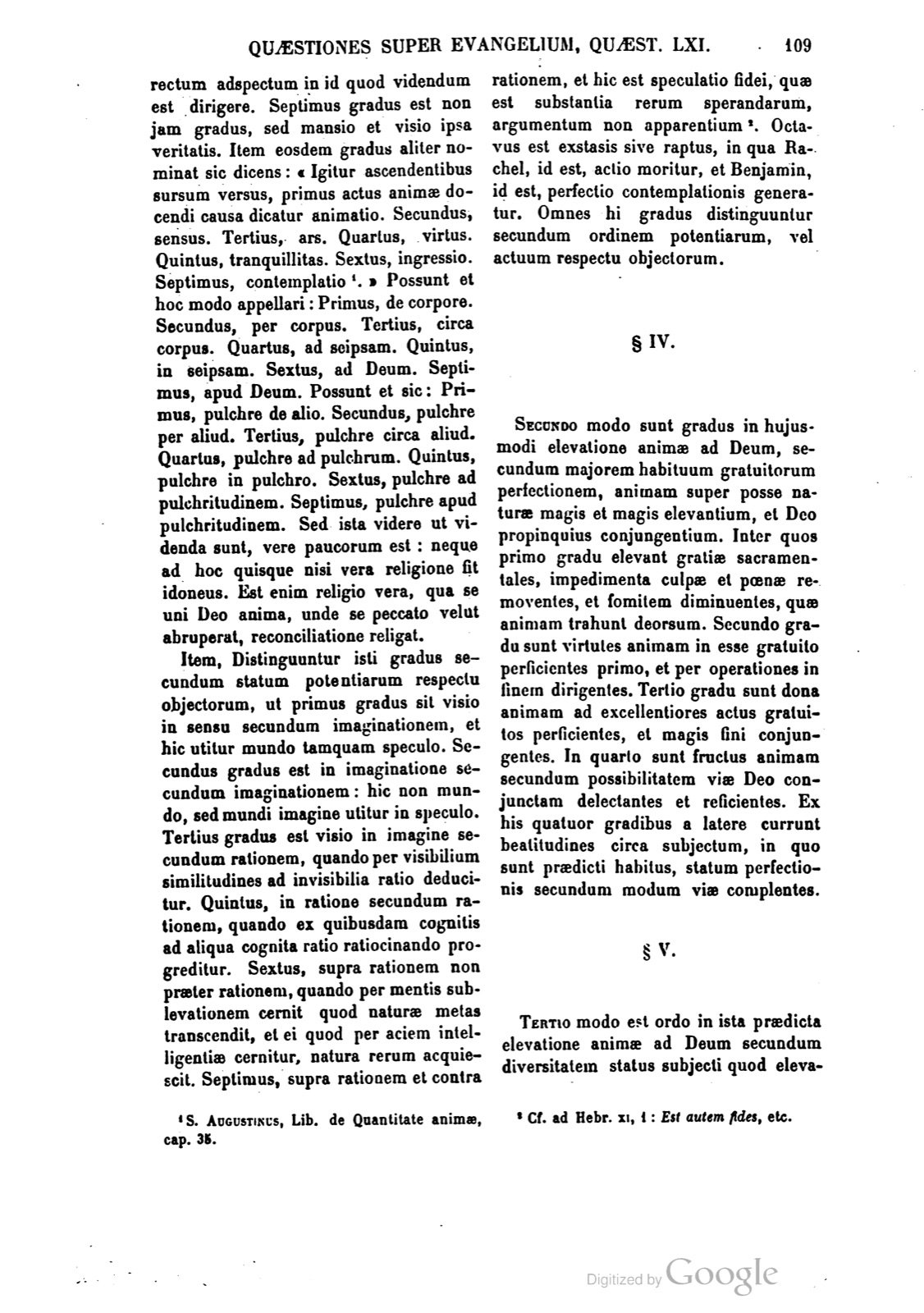
rectum adspectum in id quod videndum est dirigere. Septimus gradus est non jam gradus, sed mansio et visio ipsa veritatis. Item eosdem gradus aliter nominat sic dicens: "Igitur ascendentibus sursum versus, primus actus animae docendi causa dicatur animatio. Secundus, sensus. Tertius, ars. Quartus, virtus. Quintus, tranquillitas. Sextus, ingressio. Septimus, contemplatio 1." Possunt et hoc modo appellari: Primus, de corpore. Secundus, per corpus. Tertius, circa corpus. Quartus, ad seipsam. Quintus, in seipsam. Sextus, ad Deum. Septimus, apud Deum. Possunt et sic: Primus, pulchre de alio. Secundus, pulchre per aliud. Tertius, pulchre circa aliud. Quartus, pulchre ad pulchrum. Quintus, pulchre in pulchro. Sextus, pulchre ad pulchritudinem. Septimus, pulchre apud pulchritudinem. Sed ista videre ut videnda sunt, vere paucorum est: neque ad hoc quisque nisi vera religione fit idoneus. Est enim religio vera, qua se uni Deo anima, unde se peccato velut abruperat, reconciliatione religat.
Item, Distinguuntur isti gradus secundum statum potentiarum respectu objectorum, ut primus gradus sit visio in sensu secundum imaginationem, et hic utitur mundo tamquam speculo. Secundus gradus est in imaginatione secundum imaginationem: hic non mundo, sed mundi imagine utitur in speculo. Tertius gradus est visio in imagine secundum rationem, quando per visibilium similitudines ad invisibilia ratio deducitur. Quintus, in ratione secundum rationem, quando ex quibusdam cognitis ad aliqua cognita ratio ratiocinando progreditur. Sextus, supra rationem non praeter rationem, quando per mentis sublevationem cernit quod naturae metas transcendit, et ei quod per aciem intelligentiae cernitur, natura rerum acquiescit. Septimus, supra rationem et contra rationem, et hic est speculatio fidei, quae est substantia rerum sperandarum, argumentum non apparentium 2. Octavus est exstasis sive raptus, in qua Rachel, id est, actio moritur, et Benjamin, id est, perfectio contemplationis generatur. Omnes hi gradus distinguuntur secundum ordinem potentiarum, vel actuum respectu objectorum.
§ IV.
Secundo modo sunt gradus in hujusmodi elevatione animae ad Deum, secundum majorem habituum gratuitorum perfectionem, animam super posse naturae magis et magis elevantium, et Deo propinquius conjungentium. Inter quos primo gradu elevant gratiae sacramentales, impedimenta culpae et poenae removentes, et fomitem diminuentes, quae animam trahunt deorsum. Secundo gradu sunt virtutes animam in esse gratuito perficientes primo, et per operationes in finem dirigentes. Tertio gradu sunt dona animam ad excellentiores actus gratuitos perficientes, et magis fini conjungentes. In quarto sunt fructus animam secundum possibilitatem viae Deo conjunctam delectantes et reficientes. Ex his quatuor gradibus a latere currunt beatitudines circa subjectum, in quo sunt praedicti habitus, statum perfectionis secundum modum viae complentes.
to direct the straight gaze toward that which is to be seen. The seventh grade is no longer a grade, but the dwelling and vision of truth itself. Likewise, he names the same grades otherwise, speaking thus: "Therefore for those ascending upward, let the first act of the soul, for the sake of teaching, be called animation; the second, sense; the third, art; the fourth, virtue; the fifth, tranquillity; the sixth, entrance; the seventh, contemplation 1." They can also be named in this way: the first, from the body; the second, through the body; the third, about the body; the fourth, to itself; the fifth, into itself; the sixth, to God; the seventh, with God. They can also be named thus: the first, beautifully from another; the second, beautifully through another; the third, beautifully about another; the fourth, beautifully to the beautiful; the fifth, beautifully in the beautiful; the sixth, beautifully to beauty; the seventh, beautifully with beauty. But to see these things as they are to be seen belongs truly to few, nor is anyone made fit for this unless by true religion. For true religion is that by which the soul binds itself again to the one God by reconciliation, from whom it had, as it were, torn itself away by sin.
Likewise, these grades are distinguished according to the state of the powers with respect to objects, so that the first grade is vision in sense according to imagination, and here it uses the world as a mirror. The second grade is in imagination according to imagination; here it uses not the world, but the image of the world in a mirror. The third grade is vision in image according to reason, when reason is led through likenesses of visible things to invisible things. The fifth is in reason according to reason, when reason proceeds by reasoning from certain known things to other known things. The sixth is above reason, not beyond reason, when through an uplifting of the mind it perceives what transcends the bounds of nature, and the nature of things acquiesces in what is perceived through the sharp gaze of intelligence. The seventh is above reason and against reason, and here is the speculation of faith, which is the substance of things to be hoped for, the argument of things not apparent 2. The eighth is ecstasy or rapture, in which Rachel, that is, action, dies, and Benjamin, that is, the perfection of contemplation, is generated. All these grades are distinguished according to the order of powers, or of acts, with respect to objects.
§ IV.
In a second way there are grades in an elevation of the soul to God of this kind, according to the greater perfection of gratuitous habits, which elevate the soul more and more above the power of nature and join it more nearly to God. Among these, in the first grade sacramental graces elevate, removing the impediments of fault and punishment and lessening the tinder of sin, which draw the soul downward. In the second grade are the virtues, first perfecting the soul in gratuitous being and directing it through operations to the end. In the third grade are the gifts, perfecting the soul for more excellent gratuitous acts and joining it more to the end. In the fourth are the fruits, delighting and refreshing the soul joined to God according to the possibility of the way. From these four grades, at the side, run the beatitudes concerning the subject in which the aforesaid habits are, completing the state of perfection according to the mode of the way.
§ V.
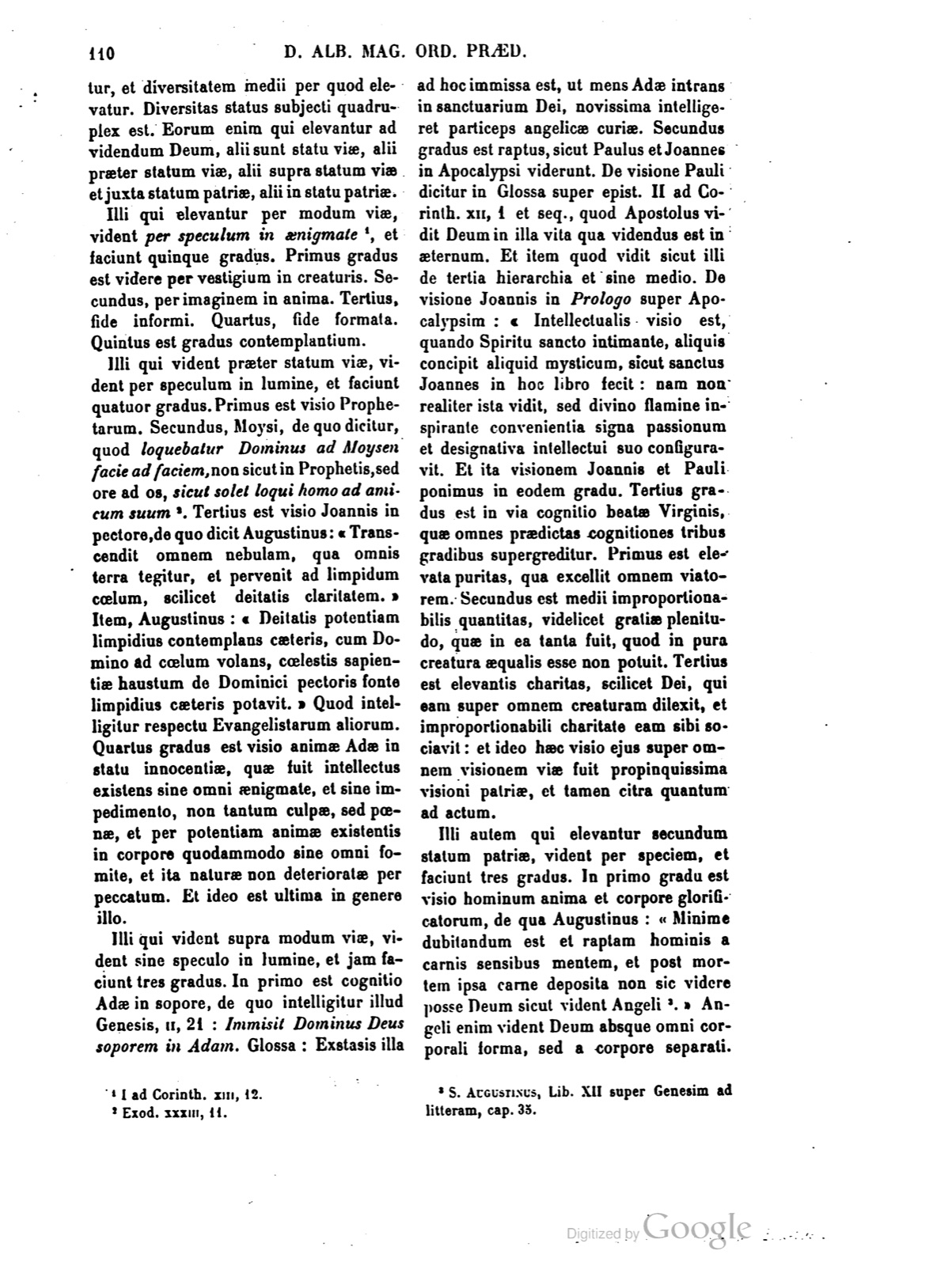
Tertio modo est ordo in ista praedicta elevatione animae ad Deum secundum diversitatem status subjecti quod elevatur, et diversitatem medii per quod elevatur. Diversitas status subjecti quadruplex est. Eorum enim qui elevantur ad videndum Deum, alii sunt statu viae, alii praeter statum viae, alii supra statum viae et juxta statum patriae, alii in statu patriae.
Illi qui elevantur per modum viae, vident per speculum in aenigmate 3, et faciunt quinque gradus. Primus gradus est videre per vestigium in creaturis. Secundus, per imaginem in anima. Tertius, fide informi. Quartus, fide formata. Quintus est gradus contemplantium.
Illi qui vident praeter statum viae, vident per speculum in lumine, et faciunt quatuor gradus. Primus est visio Prophetarum. Secundus, Moysi, de quo dicitur, quod loquebatur Dominus ad Moysen facie ad faciem, non sicut in Prophetis, sed ore ad os, sicut solet loqui homo ad amicum suum 4. Tertius est visio Joannis in pectore, de quo dicit Augustinus: "Transcendit omnem nebulam, qua omnis terra tegitur, et pervenit ad limpidum coelum, scilicet deitatis claritatem." Item, Augustinus: "Deitatis potentiam limpidius contemplans caeteris, cum Domino ad coelum volans, coelestis sapientiae haustum de Dominici pectoris fonte limpidius caeteris potavit." Quod intelligitur respectu Evangelistarum aliorum. Quartus gradus est visio animae Adae in statu innocentiae, quae fuit intellectus existens sine omni aenigmate, et sine impedimento, non tantum culpae, sed poenae, et per potentiam animae existentis in corpore quodammodo sine omni fomite, et ita naturae non deterioratae per peccatum. Et ideo est ultima in genere illo.
Illi qui vident supra modum viae, vident sine speculo in lumine, et jam faciunt tres gradus. In primo est cognitio Adae in sopore, de quo intelligitur illud Genesis, II, 21: Immisit Dominus Deus soporem in Adam. Glossa: Exstasis illa ad hoc immissa est, ut mens Adae intrans in sanctuarium Dei, novissima intelligeret particeps angelicae curiae. Secundus gradus est raptus, sicut Paulus et Joannes in Apocalypsi viderunt. De visione Pauli dicitur in Glossa super epist. II ad Corinth. XII, 1 et seq., quod Apostolus vidit Deum in illa vita qua videndus est in aeternum. Et item quod vidit sicut illi de tertia hierarchia et sine medio. De visione Joannis in Prologo super Apocalypsim: "Intellectualis visio est, quando Spiritu sancto intimante, aliquis concipit aliquid mysticum, sicut sanctus Joannes in hoc libro fecit: nam non realiter ista vidit, sed divino flamine inspirante convenientia signa passionum et designativa intellectui suo configuravit." Et ita visionem Joannis et Pauli ponimus in eodem gradu. Tertius gradus est in via cognitio beatae Virginis, quae omnes praedictas cognitiones tribus gradibus supergreditur. Primus est elevata puritas, qua excellit omnem viatorem. Secundus est medii improportionabilis quantitas, videlicet gratiae plenitudo, quae in ea tanta fuit, quod in pura creatura aequalis esse non potuit. Tertius est elevantis charitas, scilicet Dei, qui eam super omnem creaturam dilexit, et improportionabili charitate eam sibi sociavit: et ideo haec visio ejus super omnem visionem viae fuit propinquissima visioni patriae, et tamen citra quantum ad actum.
§ V.
In a third way there is an order in this aforesaid elevation of the soul to God according to the diversity of the state of the subject that is elevated and the diversity of the medium through which it is elevated. The diversity of the state of the subject is fourfold. For of those who are elevated to seeing God, some are in the state of the way, some beyond the state of the way, some above the state of the way and next to the state of the homeland, and some in the state of the homeland.
Those who are elevated through the mode of the way see through a mirror in an enigma 3, and make five grades. The first grade is to see through a vestige in creatures. The second, through an image in the soul. The third, by unformed faith. The fourth, by formed faith. The fifth is the grade of contemplatives.
Those who see beyond the state of the way see through a mirror in light, and make four grades. The first is the vision of the Prophets. The second is that of Moses, of whom it is said that the Lord spoke to Moses face to face, not as in the Prophets, but mouth to mouth, as a man is accustomed to speak to his friend 4. The third is the vision of John at the breast, concerning which Augustine says: "He transcended every cloud by which the whole earth is covered and came to the clear heaven, namely to the clarity of deity." Likewise Augustine says: "Contemplating the power of deity more clearly than the others, flying with the Lord to heaven, he drank more clearly than the others the draught of heavenly wisdom from the fountain of the Lord's breast." This is understood with respect to the other Evangelists. The fourth grade is the vision of Adam's soul in the state of innocence, which was an intellect existing without any enigma and without impediment, not only of fault but of punishment, and through the power of the soul existing in the body in a certain way without any tinder of sin, and thus of a nature not deteriorated through sin. And therefore it is the last in that genus.
Those who see above the mode of the way see without a mirror in light, and now make three grades. In the first is Adam's knowledge in sleep, concerning which that saying of Genesis 2:21 is understood: The Lord God cast sleep upon Adam. The Gloss says: That ecstasy was sent in for this, that Adam's mind, entering into the sanctuary of God, might understand the last things as a participant of the angelic court. The second grade is rapture, as Paul and John saw in the Apocalypse. Concerning Paul's vision, it is said in the Gloss on the epistle of 2 Corinthians 12:1 and following that the Apostle saw God in that life in which he is to be seen forever. And likewise that he saw as those of the third hierarchy see, and without a medium. Concerning John's vision, in the Prologue on the Apocalypse: "Intellectual vision is when, the Holy Spirit intimating it, someone conceives something mystical, as Saint John did in this book; for he did not really see those things, but, the divine breath inspiring, he configured fitting signs of sufferings and signs designative to his intellect." And thus we place the vision of John and of Paul in the same grade. The third grade is, on the way, the knowledge of the blessed Virgin, which surpasses all the aforesaid knowledges by three grades. The first is elevated purity, by which she surpasses every wayfarer. The second is the disproportionate quantity of the medium, namely the fullness of grace, which was so great in her that an equal could not exist in a pure creature. The third is the charity of the one elevating, namely of God, who loved her above every creature and joined her to himself by a disproportionate charity; and therefore this vision of hers was, above every vision of the way, nearest to the vision of the homeland, and yet short of it as to act.
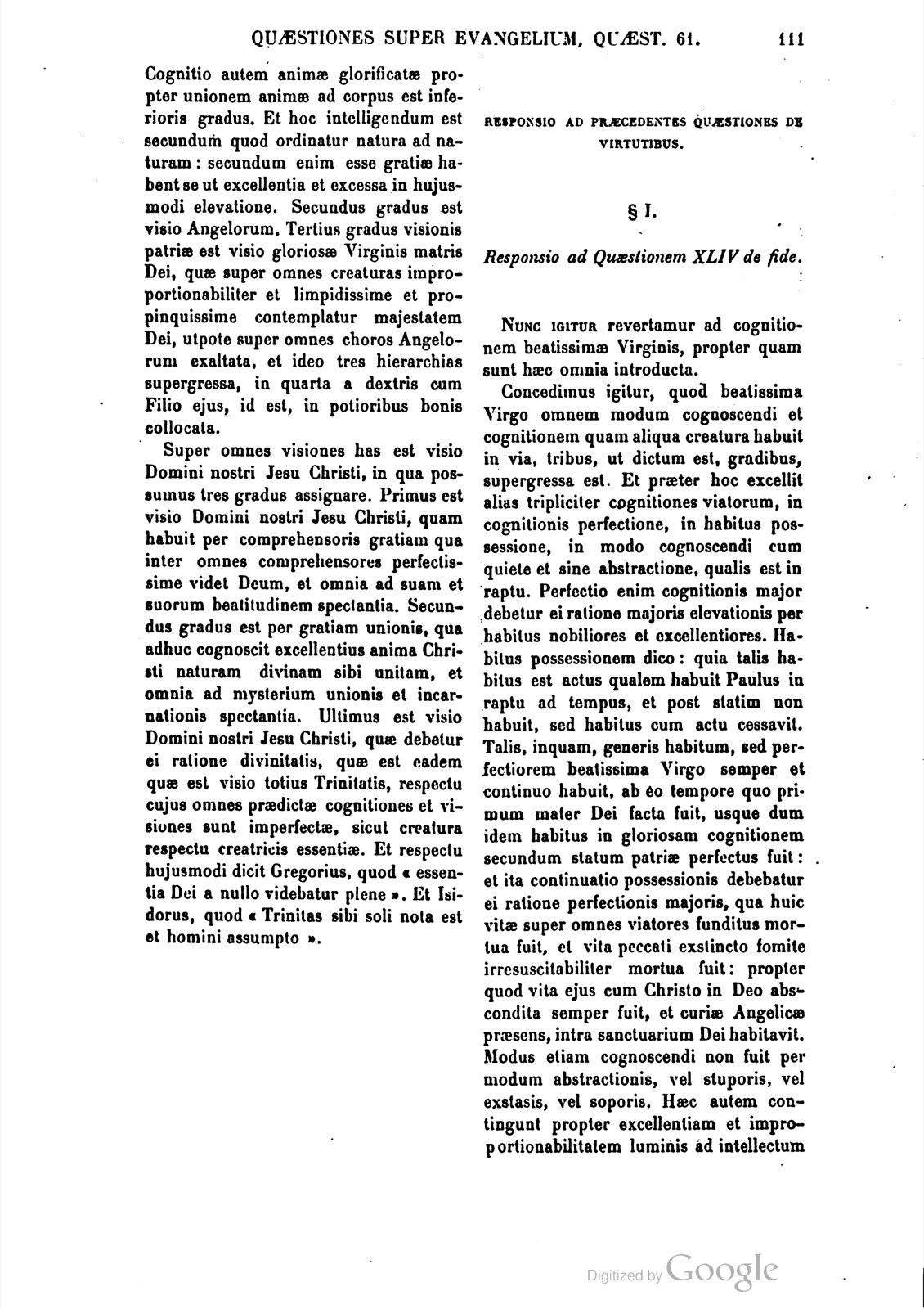
Illi autem qui elevantur secundum statum patriae, vident per speciem, et faciunt tres gradus. In primo gradu est visio hominum anima et corpore glorificatorum, de qua Augustinus: "Minime dubitandum est et raptam hominis a carnis sensibus mentem, et post mortem ipsa carne deposita non sic videre posse Deum sicut vident Angeli 5." Angeli enim vident Deum absque omni corporali forma, sed a corpore separati. Cognitio autem animae glorificatae propter unionem animae ad corpus est inferioris gradus. Et hoc intelligendum est secundum quod ordinatur natura ad naturam: secundum enim esse gratiae habent se ut excellentia et excessa in hujusmodi elevatione. Secundus gradus est visio Angelorum. Tertius gradus visionis patriae est visio gloriosae Virginis matris Dei, quae super omnes creaturas improportionabiliter et limpidissime et propinquissime contemplatur majestatem Dei, utpote super omnes choros Angelorum exaltata, et ideo tres hierarchias supergressa, in quarta a dextris cum Filio ejus, id est, in potioribus bonis collocata.
Super omnes visiones has est visio Domini nostri Jesu Christi, in qua possumus tres gradus assignare. Primus est visio Domini nostri Jesu Christi, quam habuit per comprehensoris gratiam qua inter omnes comprehensores perfectissime videt Deum, et omnia ad suam et suorum beatitudinem spectantia. Secundus gradus est per gratiam unionis, qua adhuc cognoscit excellentius anima Christi naturam divinam sibi unitam, et omnia ad mysterium unionis et incarnationis spectantia. Ultimus est visio Domini nostri Jesu Christi, quae debetur ei ratione divinitatis, quae est eadem quae est visio totius Trinitatis, respectu cujus omnes praedictae cognitiones et visiones sunt imperfectae, sicut creatura respectu creatricis essentiae. Et respectu hujusmodi dicit Gregorius, quod "essentia Dei a nullo videbatur plene." Et Isidorus, quod "Trinitas sibi soli nota est et homini assumpto."
But those who are elevated according to the state of the homeland see through species, and make three grades. In the first grade is the vision of men glorified in soul and body, concerning which Augustine says: "It must not be doubted that both the mind of a man caught away from the senses of flesh, and after death with the flesh itself laid aside, cannot see God as the Angels see him 5." For the Angels see God without any bodily form, but as separated from the body. But the knowledge of a glorified soul, because of the union of soul to body, is of an inferior grade. And this must be understood according as nature is ordered to nature; for according to the being of grace, they are related as what excels and what is exceeded in an elevation of this kind. The second grade is the vision of Angels. The third grade of the vision of the homeland is the vision of the glorious Virgin Mother of God, who, above all creatures, contemplates the majesty of God disproportionately, most clearly, and most nearly, inasmuch as she has been exalted above all the choirs of Angels and therefore, having passed beyond the three hierarchies, has been placed in the fourth at the right hand with her Son, that is, in the more powerful goods.
Above all these visions is the vision of our Lord Jesus Christ, in which we can assign three grades. The first is the vision of our Lord Jesus Christ that he had through the grace of a comprehensor, by which among all comprehensors he sees God most perfectly, and all things pertaining to his own beatitude and that of his own. The second grade is through the grace of union, by which the soul of Christ still more excellently knows the divine nature united to itself, and all things pertaining to the mystery of union and incarnation. The last is the vision of our Lord Jesus Christ that is owed to him by reason of divinity, which is the same as the vision of the whole Trinity; with respect to this all the aforesaid knowledges and visions are imperfect, as a creature is with respect to the creating essence. And with respect to this Gregory says that "the essence of God was fully seen by no one." And Isidore says that "the Trinity is known to itself alone and to the man assumed."
Notes
- St. Augustine, book On the Quantity of the Soul, chapter 35. (S. Augustinus, Lib. de Quantitate animae, cap. 35.) ↩
- Compare Hebrews 11:1: Now faith is, and so forth. (Cf. ad Hebr. XI, 1: Est autem fides, etc.) ↩
- 1 Corinthians 13:12. (I ad Corinth. XIII, 12.) ↩
- Exodus 33:11. (Exod. XXXIII, 11.) ↩
- St. Augustine, book XII On Genesis according to the Letter, chapter 35. (S. Augustinus, Lib. XII super Genesim ad litteram, cap. 35.) ↩
If a page does not appear, its photograph has not been uploaded yet.