Works › The Mariale: Questions on “Missus est”
Volume 37 · pp. 112–117
Response to Questions XLV-XLIX concerning hope and charity
A marker with ≈ is an approximate page boundary, placed by measure of the text; the page photographs remain the authority. In the paired views, clicking a page marker brings that page into view.
§ II.
Responsio ad Quaestiones XLV, XLVI, XLVII, XLVIII et XLIX de spe et charitate.
Ad ea quae de ipsius charitate sunt objecta, responsuri praenotamus, similiter et ad ea quae de spe sunt objecta, quod tria exiguntur ad hoc quod charitas viatoris perficiatur ad hoc ut transeat in charitatem comprehensorum in subjecto charitatis. Primum est depuratio, secundum est in se collectio, tertium est elevatio. Primum igitur oportet, quod fiat separatio a contrariis dispositionibus in subjecto, quae impediunt per contrarias inclinationes habitus charitatis perfectionem. Sunt autem tria a quibus oportet purgari et segregari, videlicet culpa, poena, et corpulentia. Per omnia ista tria impeditur perfectio charitatis in viatoribus in statu isto. Per secundum statum impediebantur tantum patres in limbo. Per tertium tantum Adam in paradiso. Et de his tribus dicitur in libro Sapientiae, IX, 15: Corpus quod corrumpitur, aggravat animam: et corpus corpulentiam, corruptio culpam, aggravatio poenam obstat, quod in Domino Jesu fuit. Nec tamen corpulentia obstat ubi fruitio, et poena fuit: quia unio ad divinam naturam vicit et abstulit haec impedimenta.
Secundum quod exigitur ad charitatis perfectionem, est subjecti in se collectio, per quod tria etiam ponuntur impedimenta. Anima enim secundum quod natura est quaedam forma corporis naturalis et ligatur ad corporalium imagines et species, obligatur ad diversas corporis passiones, et dividitur in diversas operationes. De ligatione ad corporalium imagines, Augustinus in libro X de Trinitate: "Tanta vis amoris est ut ea quae mens cum amore diu cogitaverit, eisque curae glutino inhaeserit, attrahit secum etiam cum ad se cogitandam quodammodo redit 1." Et infra: "Errat autem mens cum se istis imaginibus tanto amore conjungit, ut etiam se esse aliquid hujusmodi existimet 2." Post hoc dicit, quod fuerunt ex hoc diversi errores Philosophorum et aliorum ponentium eam ignem esse, alii atomos, et sic de aliis 3. Et ibi subjungitur sic: "Hinc ei oboritur erroris dedecus, dum rerum sensibilium imagines secernere a se non potest, ut se solam videat. Cohaeserunt enim mirabiliter glutino amoris, et haec est ejus immunditia, quoniam dum solam se nititur cogitare, hoc se putat esse sine quo se non potest cogitare. Cum igitur ei praecipitur, ut seipsam cognoscat, non se tamquam sibi detracta sit quaerat, sed id quod sibi addidit detrahat 4." Haec est prima collectio, scilicet ab imaginibus corporalibus detractio.
De obligatione ad corporis passiones, Augustinus in libro de Spiritu et anima: "Quibusdam affectibus et quadam amicitia anima corpori conjungitur, secundum quam amicitiam nemo umquam carnem suam odio habuit. Sociata namque illi, licet ejus societate praegravetur, ineffabili tamen conditione diligit illud, amat carcerem suum, et ideo libera esse non potest. Doloribus ejus vehementer afficitur. Formidat interitum, quae mori non potest. Timet defectum, quae per naturam non potest deficere. Oculorum speculatione depascitur, sonorum delectatur auditibus, suavissimis jucundatur odoribus, larga epulatione reficitur. Et licet his rebus nullatenus ipsa utatur, gravi tamen merore affligitur si subtrahantur 5."
§ II.
Response to Questions XLV, XLVI, XLVII, XLVIII and XLIX concerning hope and charity.
In order to respond to the things objected concerning her charity, and similarly to the things objected concerning hope, we note beforehand that three things are required so that the charity of a wayfarer may be perfected for this, that it pass over into the charity of comprehensors in the subject of charity. The first is purification; the second is collection into itself; the third is elevation. Therefore first there must be a separation from contrary dispositions in the subject, which through contrary inclinations impede the perfection of the habit of charity. Now there are three things from which one must be purged and separated, namely fault, punishment, and corpulence. Through all these three the perfection of charity in wayfarers in this state is impeded. Through the second state the fathers in limbo alone were impeded. Through the third Adam alone was impeded in paradise. And concerning these three it is said in the book of Wisdom 9:15: The body that is corrupted weighs down the soul. And body, as corpulence; corruption, as fault; weighing down, as punishment, stands opposed, which was in the Lord Jesus. Yet corpulence does not stand opposed where there was fruition, and there was punishment, because the union to the divine nature conquered and took away these impediments.
The second thing required for the perfection of charity is the collection of the subject into itself, through which three impediments also are posited. For the soul, insofar as it is by nature a certain form of a natural body and is bound to bodily images and species, is bound to diverse passions of the body and is divided into diverse operations. Concerning the binding to bodily images, Augustine says in book X On the Trinity: "So great is the force of love that the things which the mind has long thought upon with love, and to which it has clung by the glue of care, it draws with itself even when it in some way returns to thinking of itself 1." And below: "The mind errs when it joins itself to these images with such great love that it judges even itself to be something of this kind 2." After this he says that from this there were diverse errors of the Philosophers and of others, some positing that it is fire, others atoms, and so concerning the others 3. And there it is added thus: "From this the disgrace of error arises for it, while it cannot separate from itself the images of sensible things so as to see itself alone. For they have adhered wonderfully by the glue of love, and this is its uncleanness, because while it strives to think of itself alone, it thinks itself to be that without which it cannot think of itself. Therefore when it is commanded to know itself, let it not seek itself as if it had been taken away from itself, but let it take away what it has added to itself 4." This is the first collection, namely withdrawal from bodily images.
Concerning the binding to bodily passions, Augustine says in the book On Spirit and Soul: "By certain affections and a certain friendship the soul is joined to the body, according to which friendship no one ever hated his own flesh. For being associated with it, although it is weighed down by its association, nevertheless by an ineffable condition it loves it, loves its prison, and therefore cannot be free. It is vehemently affected by its pains. It fears destruction, though it cannot die. It fears deficiency, though by nature it cannot fail. It feeds on the sight of eyes, is delighted by the hearing of sounds, is pleased by the sweetest smells, is refreshed by a large feast. And although the soul itself in no way uses these things, nevertheless it is afflicted with heavy grief if they are taken away 5."
Tertium impedimentum est divisio ad operationes, de qua Augustinus in libro de Spiritu et anima: "Anima secundum sui operis officium variis nuncupatur nominibus. Dicitur enim anima, dum vegetat: spiritus, dum contemplatur: sensus, dum sentit: animus, dum sapit: dum intelligit, mens: dum discernit, ratio: dum recordatur, memoria: dum vult, voluntas 6." Ab istis ergo tribus colligitur anima in seipsam, per imaginationum corporalium abstractionem, per passionum corporis cessationem, per operationum unionem. De unione actuum dicit Augustinus: "Sensus vertitur in imaginationem, imaginatio in rationem, ratio in intellectum, intellectus in intelligentiam, intelligentia in Deum." De abstractione a passionibus, Augustinus in libro Soliloquiorum: "Dum in hoc corpore est anima, etiamsi plenissime videat, hoc est, intelligat Deum, tamen quia etiam corporis sensus utuntur opere proprio, si nihil quidem valent ad fallendum, non tamen nihil ad ambigendum 7." Et potest adhuc dici fides ea qua iis resistitur, et illud potius verum esse creditur. Item, quia in ista vita quamquam Deo intellecto anima jam beata sit, tamen quia multas molestias corporis sustinet, sperandum est ei post mortem omnia ista incommoda non futura. Ergo nec spes dum in hac vita est, animam deserit. Sed cum post hanc vitam totam se in Deum collegerit, charitas restat qua ibi teneatur. Item, Augustinus in libro de Spiritu et anima: "Bonum animae est Deus, cum effluentia dulcedinis suae. Bonum carnis est mundus, cum animae jucunditate. Sed mundus iste est exterior, Deus autem interior. Nihil enim est Deo interius, nihil eo praesentius. Interior est omni re, quia in ipso sunt omnia: exterior est omni re, quia ipse est super omnia. Ab hoc ergo mundo ad Deum revertentes, et quasi ab imo sursum ascendentes per nosmetipsos transire debemus. Ascendere enim ad Deum, est intrare ad seipsum, et non solum ad se intrare, sed ineffabili quodam modo introitus in intimis seipsum transire. Qui enim interius intrans et intrinsecus penetrans seipsum transcendit, ille veraciter ad Deum ascendit. Ab hujus ergo mundi distractionibus cor nostrum colligamus, et ad interiora gaudia revocemus. Et si cor nostrum tenere non possumus, saltem ab illicitis et vanis cogitationibus restringamus, ut aliquando in divinae contemplationis lumine nos figere valeamus. Haec est enim requies cordis nostri cum in Dei amore per desiderium figitur. Haec est vita cordis nostri, cum Deum suum contemplatur, et ipsa sua contemplatione suaviter reficitur. Et dulce est illi semper ad considerandum quod ad amandum et laudandum semper est suave. Nihil enim ad beatam vitam praestantius videtur, quam velut clausis carnalibus sensibus extra carnem mundique affectum quempiam inter semetipsum converti, alienumque effectum a mortalium cupiditatibus sibi soli et Deo loqui 8." De ista triplici collectione simul, scilicet actuum et affectuum, Augustinus in libro de Quantitate animae: "Purgatur mens a peccati colluvione, ab errorum obtenebratione, a rerum phantastica imaginatione, a rerum naturalium fallaci proportione, a rerum temporalium vana delectatione."
The third impediment is division toward operations, concerning which Augustine says in the book On Spirit and Soul: "According to the office of its work, the soul is named by various names. For it is called soul when it gives life; spirit when it contemplates; sense when it senses; animus when it is wise; mind when it understands; reason when it discerns; memory when it remembers; will when it wills 6." Therefore from these three the soul is gathered into itself: through abstraction from bodily imaginations, through cessation of the passions of the body, and through union of operations. Concerning the union of acts Augustine says: "Sense is turned into imagination, imagination into reason, reason into intellect, intellect into intelligence, intelligence into God." Concerning abstraction from passions, Augustine says in the book of Soliloquies: "While the soul is in this body, even if it most fully sees, that is, understands God, nevertheless because the senses of the body also use their own operation, though they have indeed no power to deceive, they nevertheless are not powerless to produce uncertainty 7." And it can still be called faith by which these things are resisted and that is believed rather to be true. Likewise, because in this life, although when God has been understood the soul is already blessed, nevertheless because it sustains many troubles of the body, one must hope for it that after death all these inconveniences will not exist. Therefore hope does not desert the soul while it is in this life. But when after this life it has wholly gathered itself into God, charity remains by which it is held there. Likewise, Augustine says in the book On Spirit and Soul: "The good of the soul is God, with the outpouring of his sweetness. The good of the flesh is the world, with the pleasantness of the soul. But this world is exterior; God, however, is interior. For nothing is more inward than God, nothing more present than he. He is interior to every thing, because all things are in him; he is exterior to every thing, because he is above all things. Therefore, returning from this world to God, and as if ascending upward from below, we must pass through ourselves. For to ascend to God is to enter into oneself, and not only to enter into oneself, but, by a certain ineffable mode of entering in the inmost parts, to pass beyond oneself. For he who, entering inwardly and penetrating intrinsically, transcends himself, truly ascends to God. Therefore let us gather our heart from the distractions of this world and call it back to inward joys. And if we cannot hold our heart, let us at least restrain it from unlawful and vain thoughts, so that at some time we may be able to fix ourselves in the light of divine contemplation. For this is the rest of our heart, when it is fixed by desire in the love of God. This is the life of our heart, when it contemplates its God and is sweetly refreshed by its own contemplation. And it is sweet to it always to consider what is always sweet to love and praise. For nothing seems more excellent for the blessed life than, as if with the bodily senses closed, to be turned outside the flesh and the affection of the world between oneself, and, as an effect alien to mortal desires, to speak to oneself alone and to God 8." Concerning this threefold collection together, namely of acts and affections, Augustine says in the book On the Quantity of the Soul: "The mind is purged from the filth of sin, from the darkening of errors, from the phantastic imagining of things, from the deceptive proportion of natural things, from the vain delight of temporal things."
Tertium quod exigitur ad charitatis perfectionem est elevatio, quae fit per tria: fit enim natura conante, gratia sublevante, Deo attrahente. De conamine naturae dictum est supra de Zachaeo, qui statura pusillus erat: et de sublevatione in Deum, quia ascendit in arborem 9. Sed quia non sufficit ad conjunctionem, quae est in charitatis perfectione, nec conatus naturae, nec sublevatio gratiae sine divinitatis attractione, ideo clamat sponsa: Trahe me post te 10, etc. Et Dominus in Evangelio: Nemo potest venire ad me, nisi Pater, qui misit me, traxerit eum 11, etc. Ad conamen naturae disponunt antecedentes miseriarum praesentium stimulationes, propriae defectibilitatis cognitio, et summae perfectionis naturalis appetitio. Ad istam elevationem disponunt antecedentes inchoative gratiae sacramentales et virtutes: gratiae sanando a malo culpae et poenae, virtutes adjiciendo in bonum. Progressive dona et fructus, dona ad excellentiores actus adjuvando, fructus laborantes reficiendo. Completive autem secundum statum viae beatitudines, secundum statum patriae dotes.
De attractione nota, quod tanto in naturalibus major est motus, quanto major sit appropinquatio ad finem suum. Et non est sola appropinquatio causa augmenti, sed etiam similitudo et convenientia ad suum ubi. Verbi gratia, ut quanto magis movetur lapis deorsum, tanto magis intenditur suus motus, et similiter ignis sursum. Et ita in naturalibus motus naturalis sufficit mutare comparationem mobilis ad suum ubi, et per hoc solum fit propinquus. Sed in voluntariis motus non sufficit mutare situm ipsius virtutis naturalis ad suum ubi quod est Deus. Et hoc est, quia in naturalibus est tantum ubi, ita quod ubi est motor tantum: sed in voluntariis ipsum ubi est motor et cooperator, et ita per id ad quod motus est, et quod movet per ipsum, habet motus quod fit appropinquatio. Est autem ipsius appropinquationis terminus perfecta conformitas voluntatis divinae et humanae deiformis effective.
Ad hanc attractionem et appropinquationem et conformitatem tria specialiter disponunt et antecedunt in via, opera instructionis vel aedificationis, opera patientiae et passionis, opera supererogationis. De operibus instructionis, Augustinus: "Lex haec est divinae providentiae, ut nemo nisi a superioribus adjuvetur ad cognoscendum et participandum gratiam." Unde et in Joanne legitur de Caipha, quod cum esset pontifex anni illius, prophetavit 12. In quo Dominus ostendit, quod etiam malis ratione praelationis ad utilitatem aliorum tribuit dona. Unde de Saule legitur, quod post unctionem, insiluit super regem spiritus Domini, et prophetavit 13. De operibus patientiae et passionis dicit Apostolus: Nam virtus in infirmitate perficitur 14. Quod etiam figuratur in Job, qui post perfectam victoriam per patientiam suam omnia bona recepit duplicia 15. De operationibus supererogationis, Marc. X, 29 et 30: Amen dico vobis, nemo est qui reliquerit, etc., qui non accipiat centies tantum, etc., et in saeculo futuro vitam aeternam. Consistit igitur ista perfectio charitatis transeuntis de statu viae in statum patriae in plena depuratione, et omnimoda collectione, et perfectissima elevatione.
The third thing required for the perfection of charity is elevation, which happens through three things: for it happens with nature striving, grace lifting up, and God attracting. Concerning the striving of nature it was said above about Zacchaeus, who was small in stature; and concerning the lifting up into God, that he climbed into a tree 9. But because neither the striving of nature nor the lifting up of grace without the attraction of divinity suffices for conjunction, which exists in the perfection of charity, therefore the bride cries out: Draw me after you 10, and so forth. And the Lord says in the Gospel: No one can come to me unless the Father who sent me draws him 11, and so forth. The stimulations of present miseries, knowledge of one's own defectibility, and appetite for the highest natural perfection dispose toward the striving of nature. Sacramental graces and virtues dispose inchoatively toward that elevation: graces by healing from the evil of fault and punishment, virtues by adding toward the good. Progressively, gifts and fruits dispose: gifts by helping toward more excellent acts, fruits by refreshing those who labor. But completively, according to the state of the way, the beatitudes dispose; according to the state of the homeland, the dowries.
Concerning attraction, note that in natural things the motion is greater the greater the approach to its end is. And approach alone is not the cause of increase, but also likeness and fittingness to its place. For example, the more a stone is moved downward, the more its motion is intensified; and similarly fire upward. And so in natural things natural motion suffices to change the relation of the movable thing to its place, and through this alone it becomes near. But in voluntary things motion does not suffice to change the situation of the natural power itself toward its place, which is God. And this is because in natural things there is only a place, so that the place is only a mover; but in voluntary things the place itself is the mover and cooperator, and so through that toward which the motion is, and which moves through itself, the motion has it that approach comes about. But the terminus of that approach itself is the perfect conformity of the divine and human will, deiform effectively.
For this attraction and approach and conformity, three things especially dispose and precede on the way: works of instruction or edification, works of patience and suffering, and works of supererogation. Concerning works of instruction, Augustine says: "This is the law of divine providence, that no one is helped except by superiors toward knowing and participating in grace." Hence in John it is also read concerning Caiaphas that, since he was pontiff of that year, he prophesied 12. In this the Lord showed that even to evil men, by reason of prelacy for the usefulness of others, he grants gifts. Hence concerning Saul it is read that after the anointing the Spirit of the Lord leapt upon the king and he prophesied 13. Concerning works of patience and suffering, the Apostle says: For virtue is perfected in weakness 14. This is also figured in Job, who after perfect victory through his patience received all his goods double 15. Concerning works of supererogation, Mark 10:29 and 30 says: Amen I say to you, there is no one who has left, and so forth, who will not receive a hundredfold, and so forth, and in the age to come eternal life. Therefore this perfection of charity passing from the state of the way into the state of the homeland consists in full purification, and all-mannered collection, and most perfect elevation.
Patet igitur, quod perfectio charitatis de statu viae in statum patriae transmutandae fit sine substantiali additione per perfectam sui in se collectionem, per actus extensionem, per actus et habitus meliorationem et nobilitatem, et per summam cum summo bono conjunctionem. Unde credimus, quod sicut corpus glorificatur suo modo, ita anima glorificatur suo modo. Manifestum est autem, quod corpus glorificatur per depurationem et elevationem et nobilitatem sine extrinseca adjectione. Corpus enim constitutum ex quatuor elementis et ex quinta essentia, secundum duos ordinatur status, statum scilicet corruptionis, et statum incorruptionis. Cum enim quatuor elementa sunt corporalia secundum partes, et quinta essentia sit incorporabilis, quamdiu in humano corpore dominantur et operantur qualitates elementales, et sunt activae et formales, et secundum eas regitur et administratur corpus, proprietates quintae essentiae sunt sopitae quasi sine actione. Necesse est ergo corpus subjacere poenalitati, passibilitati, corruptioni, et tandem dissolvi, propter continuam pugnam contrariorum ad invicem repugnantium: quorum tandem necesse est alterum vincere super alterum, et sic alterum expelli, et harmoniam destrui, et animam separari, et corpus dissolvi, juxta illud Philosophi: "Egrediente anima corpus exspirat et marcescit." Cum autem natura semper intendat sui continuationem, et sui esse perpetuationem, et sublimationem, in quantum potest, inconveniens esset, quod in corpore composito ex natura incorporali, ut ex natura lucis, et naturalibus corruptibilibus, ut sunt elementa, semper essent formales et activae proprietates naturam minus nobilium et corruptibilium, et numquam regularetur et administraretur corpus secundum naturam incorruptibilem et meliorem. Ergo necessario erit transitus de proprietatibus naturarum corruptibilium ad proprietatem naturae incorruptibilis et de actionibus naturarum corruptibilium ad actionem naturae incorruptibilis. Hoc autem fit cum corruptibile hoc induerit incorruptionem. In quo quidem statu remanebunt elementa secundum substantias suas sopitas cessantes ab actionibus materialibus secundum naturam corporis quinti dominio existente et omnes exercente actiones. Et sic naturae prius agentes, modo sopiuntur, et prius sopitae, modo omnes operationes in corpore operantur.
Therefore it is clear that the perfection of charity to be transformed from the state of the way into the state of the homeland comes about without substantial addition, through perfect collection of itself into itself, through extension of act, through improvement and nobility of act and habit, and through the highest conjunction with the highest good. Hence we believe that as the body is glorified in its own mode, so the soul is glorified in its own mode. But it is manifest that the body is glorified through purification and elevation and nobility without extrinsic addition. For a body constituted from the four elements and from the fifth essence is ordered according to two states, namely the state of corruption and the state of incorruption. For since the four elements are bodily according to parts, and the fifth essence is incorporeal, as long as elemental qualities dominate and operate in the human body, and are active and formal, and according to them the body is ruled and administered, the properties of the fifth essence are lulled, as it were without action. Therefore the body must be subject to penality, passibility, corruption, and finally to be dissolved, because of the continual battle of contraries fighting against one another; and of these one must finally conquer the other, and so the other be expelled, the harmony be destroyed, the soul be separated, and the body be dissolved, according to that saying of the Philosopher: "When the soul goes out, the body breathes out and withers." But since nature always intends its own continuation, and the perpetuation and sublimation of its own being, insofar as it can, it would be unfitting that in a body composed of an incorporeal nature, as from the nature of light, and corruptible natural things, such as the elements are, there should always be formal and active properties of less noble and corruptible natures, and that the body should never be ruled and administered according to an incorruptible and better nature. Therefore necessarily there will be a transition from the properties of corruptible natures to the property of incorruptible nature, and from the actions of corruptible natures to the action of incorruptible nature. But this happens when this corruptible thing puts on incorruption. In that state, indeed, the elements will remain according to their substances, lulled and ceasing from material actions, with the dominion of the nature of the fifth body existing and exercising all actions. And thus the natures formerly acting are then lulled, and those formerly lulled then work all operations in the body.
Simili modo glorificatio animae videtur fieri per hunc modum. Cum enim modo anima habeat operationes quasdam secundum proprietates naturales acquisitas, et quasdam secundum proprietates gratuitas, et operationes quae fiunt secundum qualitates naturales, fortes et evidentes sunt et frequentes, operationes gratuitae debiles et rarae et exiles et immanifestae: inconveniens autem est, quod substantia rationalis habens operationes magis et minus nobiles, semper exerceat minus nobiles cum evidentia et excellentia et frequentia, et numquam exerceat magis nobiles cum evidentia et excellentia: ergo necessario erit alter status animae, quo operationes nobiliores erunt excellentes et evidentes et animam perficientes, proprietates autem naturales sopitae et materiales et sine actione: hoc autem erit quando neque esurient neque sitient amplius, quantum ad nutritivam: quando neque nubent neque nubentur, quantum ad generativam: et sensus vertetur in imaginationem, et imaginatio in rationem, ut dictum est supra, quantum ad opera sensitiva: et sic in statu illo tantum erit anima secundum potentias operativas in Deum conversivas per actiones qualitatibus gratuitis informatas: et haec est glorificatio animae secundum se. Cum autem et ipsae proprietates gratuitae sive qualitates quaedam sunt imperfectae, quaedam cum imperfectis conjunctae: nec posset esse plene perfectum quod in se est imperfectum vel imperfectioni conjunctum, cum proprietates istae fiant summa animae perfectio, necesse est imperfectum evacuari, et perfectum ab ipso separari: sola autem charitas perfecta est, quae est vinculum perfectionis 16: ergo necesse est omnes alias virtutes evacuari vel sopiri ab actionibus, solam autem charitatem dominari, et exercere omnes operationes. Et tunc implebitur plene quod praeceptum est: Diliges Dominum Deum tuum ex toto corde tuo 17. Quod tunc implebitur quando omnis habitus naturalis cessabit quantum ad actum, et omnis alterius virtutis habitus erit sopitus quantum ad actum, et anima cum suo esse tota nobilissimo habitu implebitur, et nihil nisi charitas in anima ad actum egredietur, cum omnia praetereunt praeter amare Deum. Tunc fiet quod scriptum est: Sive prophetiae evacuabuntur, sive linguae cessabunt, sive scientia destruetur 18. Ipsa enim scientia materia est affectionis, et via in delectationem. Unde actus scientiae secundum quod est motus ad affectionem, destruetur, sola charitate totum occupante. Et haec est glorificatio charitatis quae glorificatam generat laetitiam, de qua dicit Petrus: Credentes autem exsultabitis laetitia inenarrabili et glorificata: reportantes finem fidei vestrae, salutem animarum 19.
In a similar way the glorification of the soul seems to happen by this mode. For since now the soul has certain operations according to acquired natural properties, and certain operations according to gratuitous properties, and the operations that happen according to natural qualities are strong and evident and frequent, but gratuitous operations are weak and rare and slight and not manifest, it is unfitting that a rational substance, having more and less noble operations, should always exercise the less noble ones with evidence and excellence and frequency, and never exercise the more noble ones with evidence and excellence. Therefore necessarily there will be another state of the soul, in which the nobler operations will be excellent and evident and perfective of the soul, but the natural and material properties will be lulled and without action. But this will be when they will neither hunger nor thirst any more, as to the nutritive power; when they will neither marry nor be given in marriage, as to the generative power; and when sense will be turned into imagination, and imagination into reason, as was said above, as to sensitive works. And thus in that state the soul will exist only according to the operative powers turned toward God through actions informed by gratuitous qualities; and this is the glorification of the soul according to itself. But since even the gratuitous properties or qualities themselves are partly imperfect, partly joined with imperfect things, and what is imperfect in itself or joined to imperfection could not be fully perfect, since those properties become the soul's highest perfection, the imperfect must be emptied out and the perfect separated from it. But charity alone is perfect, which is the bond of perfection 16. Therefore all other virtues must be emptied out or lulled from actions, while charity alone dominates and exercises all operations. And then what has been commanded will be fully fulfilled: You shall love the Lord your God from your whole heart 17. This will be fulfilled when every natural habit ceases as to act, and the habit of every other virtue will be lulled as to act, and the soul with its whole being will be filled with the noblest habit, and nothing except charity in the soul will go forth into act, when all things pass away except loving God. Then what is written will happen: Whether prophecies, they will be made void; whether tongues, they will cease; whether knowledge, it will be destroyed 18. For knowledge itself is the matter of affection and the way into delight. Hence the act of knowledge, insofar as it is a movement toward affection, will be destroyed, charity alone occupying the whole. And this is the glorification of charity, which generates glorified joy, concerning which Peter says: Believing, you will exult with joy unspeakable and glorified, carrying back the end of your faith, the salvation of souls 19.
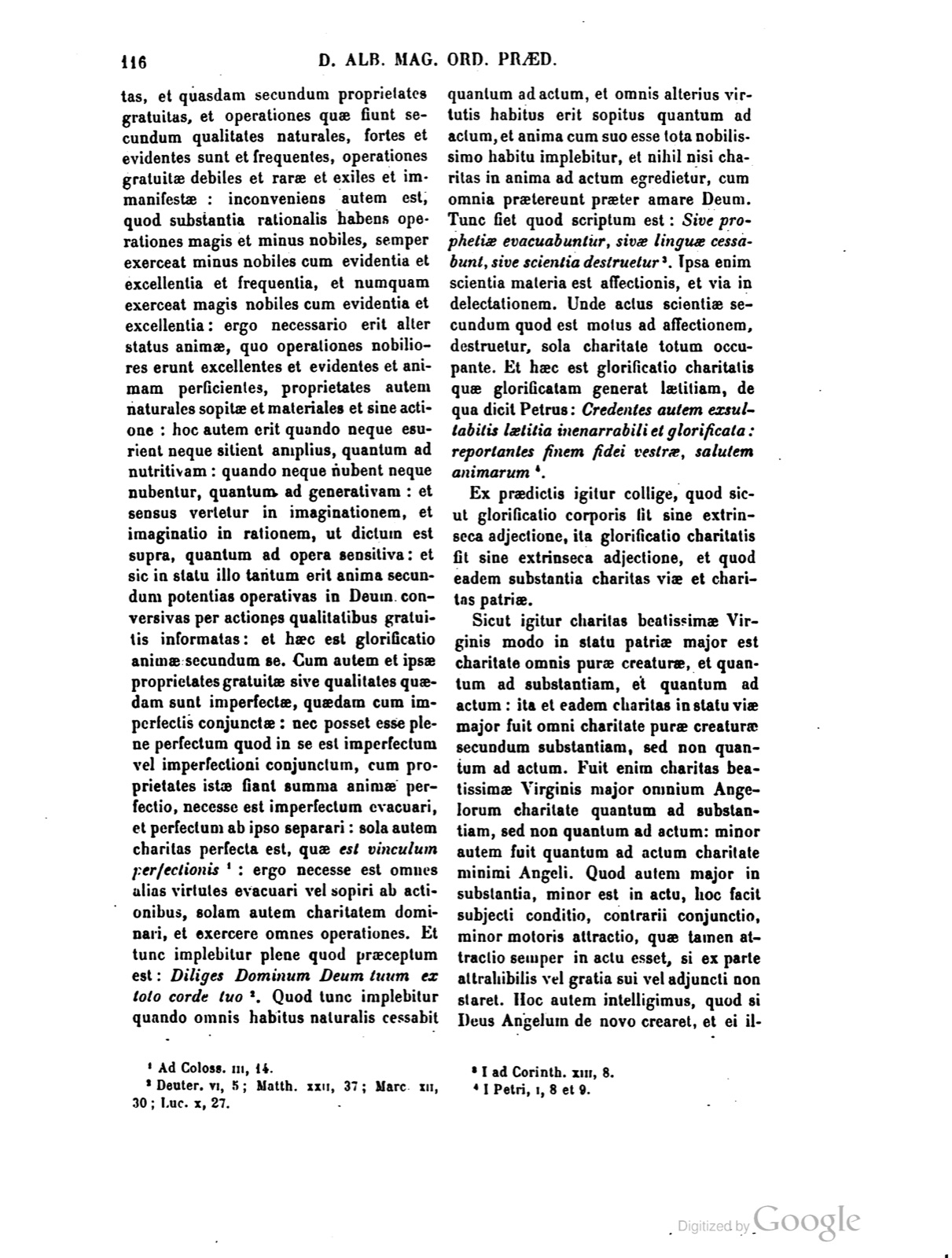
Ex praedictis igitur collige, quod sicut glorificatio corporis fit sine extrinseca adjectione, ita glorificatio charitatis fit sine extrinseca adjectione, et quod eadem substantia charitas viae et charitas patriae.
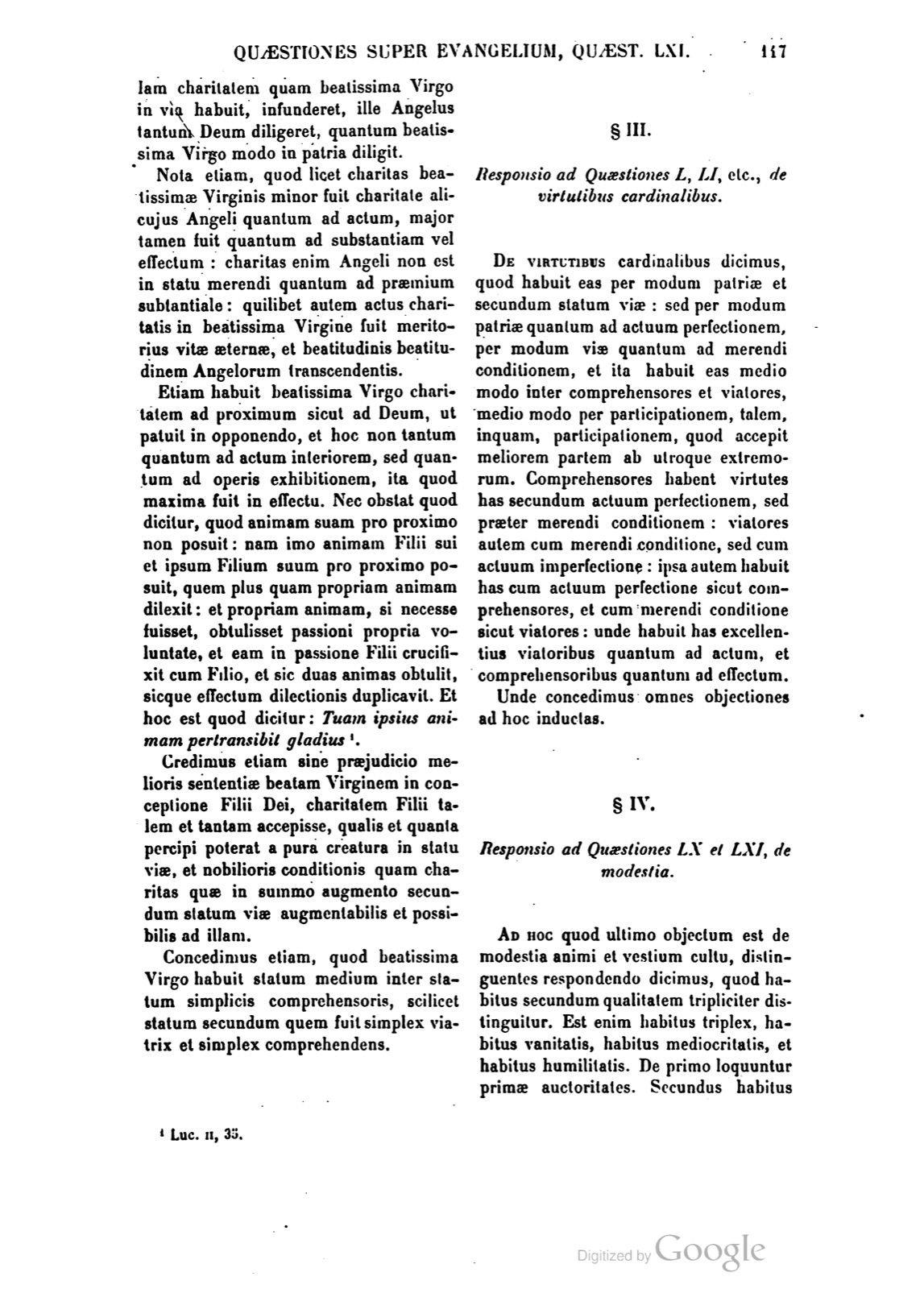
Sicut igitur charitas beatissimae Virginis modo in statu patriae major est charitate omnis purae creaturae, et quantum ad substantiam, et quantum ad actum: ita et eadem charitas in statu viae major fuit omni charitate purae creaturae secundum substantiam, sed non quantum ad actum. Fuit enim charitas beatissimae Virginis major omnium Angelorum charitate quantum ad substantiam, sed non quantum ad actum: minor autem fuit quantum ad actum charitate minimi Angeli. Quod autem major in substantia, minor est in actu, hoc facit subjecti conditio, contrarii conjunctio, minor motoris attractio, quae tamen attractio semper in actu esset, si ex parte attrahibilis vel gratia sui vel adjuncti non staret. Hoc autem intelligimus, quod si Deus Angelum de novo crearet, et ei illam charitatem quam beatissima Virgo in via habuit, infunderet, ille Angelus tantum Deum diligeret, quantum beatissima Virgo modo in patria diligit.
Nota etiam, quod licet charitas beatissimae Virginis minor fuit charitate alicujus Angeli quantum ad actum, major tamen fuit quantum ad substantiam vel effectum: charitas enim Angeli non est in statu merendi quantum ad praemium subtantiale: quilibet autem actus charitatis in beatissima Virgine fuit meritorius vitae aeternae, et beatitudinis beatitudinem Angelorum transcendentis.
Etiam habuit beatissima Virgo charitatem ad proximum sicut ad Deum, ut patuit in opponendo, et hoc non tantum quantum ad actum interiorem, sed quantum ad operis exhibitionem, ita quod maxima fuit in effectu. Nec obstat quod dicitur, quod animam suam pro proximo non posuit: nam imo animam Filii sui et ipsum Filium suum pro proximo posuit, quem plus quam propriam animam dilexit: et propriam animam, si necesse fuisset, obtulisset passioni propria voluntate, et eam in passione Filii crucifixit cum Filio, et sic duas animas obtulit, sicque effectum dilectionis duplicavit. Et hoc est quod dicitur: Tuam ipsius animam pertransibit gladius 20.
Credimus etiam sine praejudicio melioris sententiae beatam Virginem in conceptione Filii Dei, charitatem Filii talem et tantam accepisse, qualis et quanta percipi poterat a pura creatura in statu viae, et nobilioris conditionis quam charitas quae in summo augmento secundum statum viae augmentabilis et possibilis ad illam.
Concedimus etiam, quod beatissima Virgo habuit statum medium inter statum simplicis comprehensoris, scilicet statum secundum quem fuit simplex viatrix et simplex comprehendens.
Therefore gather from the things said before that, just as the glorification of the body happens without extrinsic addition, so the glorification of charity happens without extrinsic addition, and that the charity of the way and the charity of the homeland are the same substance.
Therefore, just as the charity of the most blessed Virgin now in the state of the homeland is greater than the charity of every pure creature, both as to substance and as to act, so also the same charity in the state of the way was greater than every charity of a pure creature according to substance, but not as to act. For the charity of the most blessed Virgin was greater than the charity of all Angels as to substance, but not as to act; indeed as to act it was less than the charity of the least Angel. That it is greater in substance but less in act is caused by the condition of the subject, the conjunction of the contrary, and the lesser attraction of the mover; yet that attraction would always be in act if something did not stand in the way on the part of the attractable thing, either by reason of itself or of something joined to it. But we understand this thus: if God were to create an Angel anew and infuse into him that charity which the most blessed Virgin had on the way, that Angel would love God as much as the most blessed Virgin now loves him in the homeland.
Note also that although the charity of the most blessed Virgin was less than the charity of some Angel as to act, nevertheless it was greater as to substance or effect. For the charity of an Angel is not in the state of meriting as to substantial reward; but every act of charity in the most blessed Virgin was meritorious of eternal life, and of a blessedness transcending the blessedness of the Angels.
The most blessed Virgin also had charity toward neighbor as toward God, as was clear in objecting, and this not only as to interior act, but as to the showing of work, so that she was greatest in effect. Nor does it stand in the way that it is said that she did not lay down her own soul for her neighbor; for indeed she laid down the soul of her Son and her Son himself for her neighbor, whom she loved more than her own soul. And her own soul, if it had been necessary, she would have offered to suffering by her own will, and in the passion of her Son she crucified it with her Son; and thus she offered two souls and so doubled the effect of love. And this is what is said: A sword shall pierce your own soul 20.
We also believe, without prejudice to a better opinion, that in the conception of the Son of God the blessed Virgin received the charity of the Son, such and so great as could be perceived by a pure creature in the state of the way, and of a nobler condition than charity that is augmentable and possible to that charity in the highest increase according to the state of the way.
We also grant that the most blessed Virgin had a middle state between the state of a simple comprehensor, namely a state according to which she was a simple wayfarer and a simple comprehender.
Notes
- St. Augustine, book X On the Trinity, chapter 5. (S. Augustinus, Lib. X de Trinitate, cap. 5.) ↩
- The same author, in the same place, chapter 6. (Idem, ibidem, cap. 6.) ↩
- The same author, in the same place, chapter 7. (Idem, ibidem, cap. 7.) ↩
- The same author, in the same place, chapter 8. (Idem, ibidem, cap. 8.) ↩
- The same author, book On Spirit and Soul, chapter 14. (Idem, Lib. de Spiritu et anima, cap. 14.) ↩
- The same author, in the same place, chapter 13. (Idem, ibid., cap. 13.) ↩
- The same author, book I of the Soliloquies, chapter 7. (Idem, Lib. I Soliloquiorum, cap. 7.) ↩
- St. Augustine, book On Spirit and Soul, chapter 14. (S. Augustinus, Lib. de Spiritu et anima, cap. 14.) ↩
- Compare Luke 19:2 and 3. (Cf. Luc. XIX, 2 et 3.) ↩
- Song of Songs 1:3. (Cant. I, 3.) ↩
- John 6:44. (Joan. VI, 44.) ↩
- John 11:51. (Joan. XI, 51.) ↩
- 1 Kings 10:10. (I Regum, X, 10.) ↩
- 2 Corinthians 12:9. (II ad Corinth. XII, 9.) ↩
- Job 42:12. (Job, XLII, 12.) ↩
- Colossians 3:14. (Ad Coloss. III, 14.) ↩
- Deuteronomy 6:5; Matthew 22:37; Mark 12:30; Luke 10:27. (Deuter. VI, 5; Matth. XXII, 37; Marc. XII, 30; Luc. X, 27.) ↩
- 1 Corinthians 13:8. (I ad Corinth. XIII, 8.) ↩
- 1 Peter 1:8 and 9. (I Petri, I, 8 et 9.) ↩
- Luke 2:35. (Luc. II, 35.) ↩
If a page does not appear, its photograph has not been uploaded yet.