Works › The Mariale: Questions on “Missus est”
Volume 37 · pp. 100–101
Question LV. According to what state fortitude was in the blessed Virgin?
A marker with ≈ is an approximate page boundary, placed by measure of the text; the page photographs remain the authority. In the paired views, clicking a page marker brings that page into view.
QUAESTIO LV. Secundum quem statum fortitudo fuerit in B. Virgine?
Consequenter quaeritur de fortitudine, secundum quem statum fuerit in beatissima Virgine? Et per ordinem quaeritur de speciebus sive de partibus ejus.
Et primo de magnanimitate, quae sic describitur: Magnanimitas est rationalis agressio terribilium. Quod haec in summo fuerit in beatissima Virgine, sic videtur: Terribilissimum enim in hac vita est dolor mortis: et quanto natura nobilior, tanto mors dolorosior et terribilior: sed spiritus improportionabiliter nobilior est corpore: ergo martyrium mentis majus est martyrio corporis: sed beatissima Virgo martyr est martyrio spirituali, alii martyres martyrio corporali, sicut patebit infra de martyrio et aureolis: ergo agressio terribilium improportionabiliter major fuit in beata Virgine quam in aliis.
Secunda est magnificentia, quae sic describitur: Magnificentia est rerum bene gestarum felix consummatio: consummatio autem rerum bene gestarum per beatam Virginem excellit improportionabiliter omnis purae creaturae consummationem: ergo in actu magnificentiae excellit omnem viatorem.
Tertia species est fiducia, quae sic describitur: Fiducia est certa spes perducendi ad finem rem quae incepta est: sed certitudo spei beatissimae Virginis fuit absoluta et infallibilis, omnium aliorum viatorum fiducia conditionalis est et fallibilis: sed infallibile excellit fallibile improportionabiliter in quantum tale: ergo fiducia beatae Virginis excellit fiduciam omnium viatorum.
QUESTION LV. According to what state fortitude was in the blessed Virgin?
Consequently it is asked concerning fortitude, according to what state it was in the most blessed Virgin. And in order it is asked concerning its species or parts.
And first concerning magnanimity, which is described thus: Magnanimity is the rational approach to terrible things. That this was in the most blessed Virgin in the highest degree is seen thus: for the most terrible thing in this life is the pain of death; and the nobler a nature is, the more painful and terrible death is. But the spirit is disproportionately nobler than the body. Therefore the martyrdom of the mind is greater than the martyrdom of the body. But the most blessed Virgin is a martyr by spiritual martyrdom; other martyrs are martyrs by bodily martyrdom, as will be clear below concerning martyrdom and aureoles. Therefore the approach to terrible things was disproportionately greater in the blessed Virgin than in others.
The second is magnificence, which is described thus: Magnificence is the happy consummation of things well done. But the consummation of things well done by the blessed Virgin surpasses disproportionately the consummation of every pure creature. Therefore in the act of magnificence she surpasses every wayfarer.
The third species is confidence, which is described thus: Confidence is a certain hope of bringing to the end the thing that has been begun. But the certainty of the hope of the most blessed Virgin was absolute and infallible, while the confidence of all other wayfarers is conditional and fallible. But the infallible surpasses the fallible disproportionately as such. Therefore the confidence of the blessed Virgin surpasses the confidence of all wayfarers.
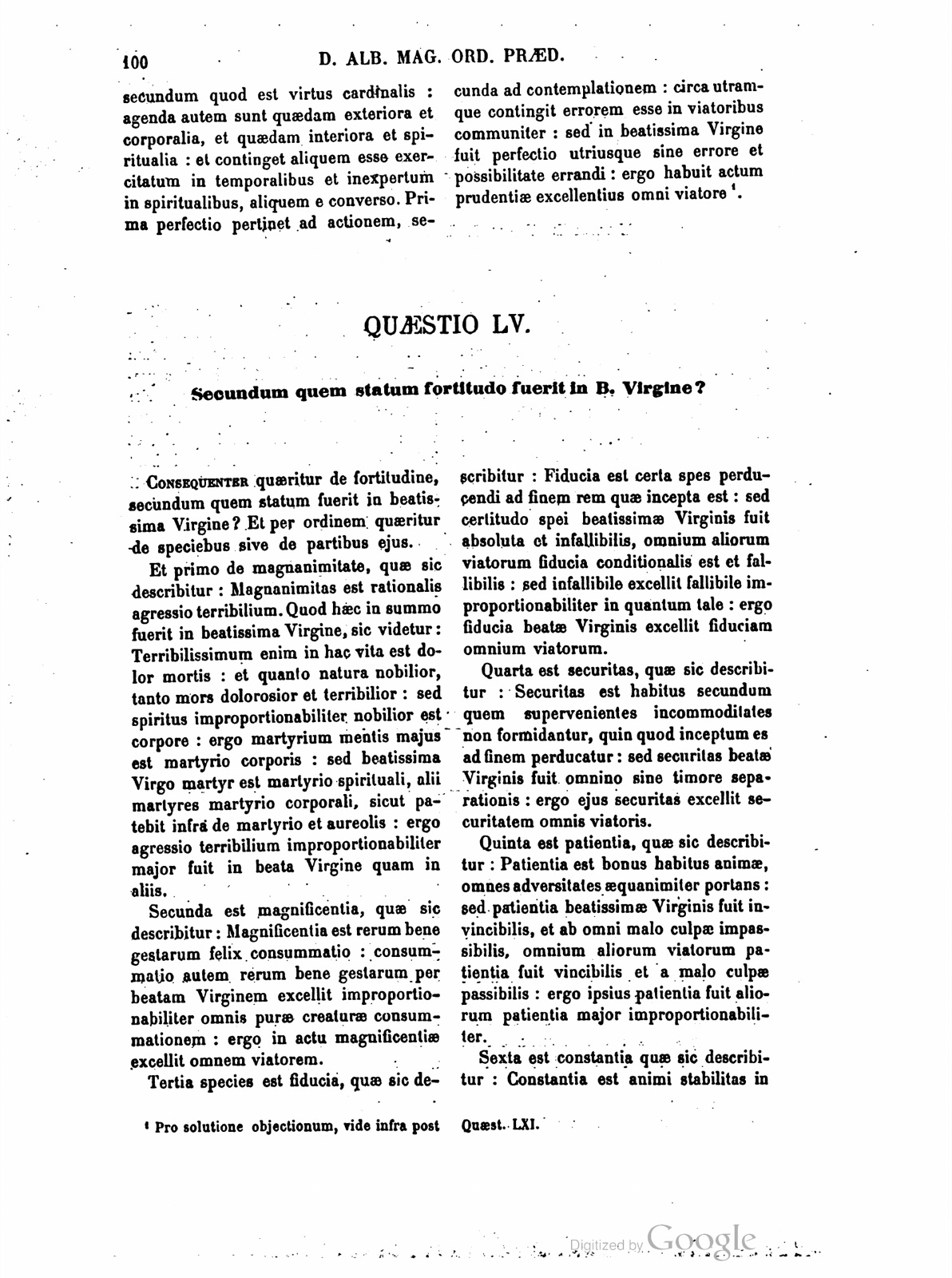
Quarta est securitas, quae sic describitur: Securitas est habitus secundum quem supervenientes incommoditates non formidantur, quin quod inceptum est ad finem perducatur: sed securitas beatae Virginis fuit omnino sine timore separationis: ergo ejus securitas excellit securitatem omnis viatoris.
Quinta est patientia, quae sic describitur: Patientia est bonus habitus animae, omnes adversitates aequanimiter portans: sed patientia beatissimae Virginis fuit invincibilis, et ab omni malo culpae impassibilis, omnium aliorum viatorum patientia fuit vincibilis et a malo culpae passibilis: ergo ipsius patientia fuit aliorum patientia major improportionabiliter.
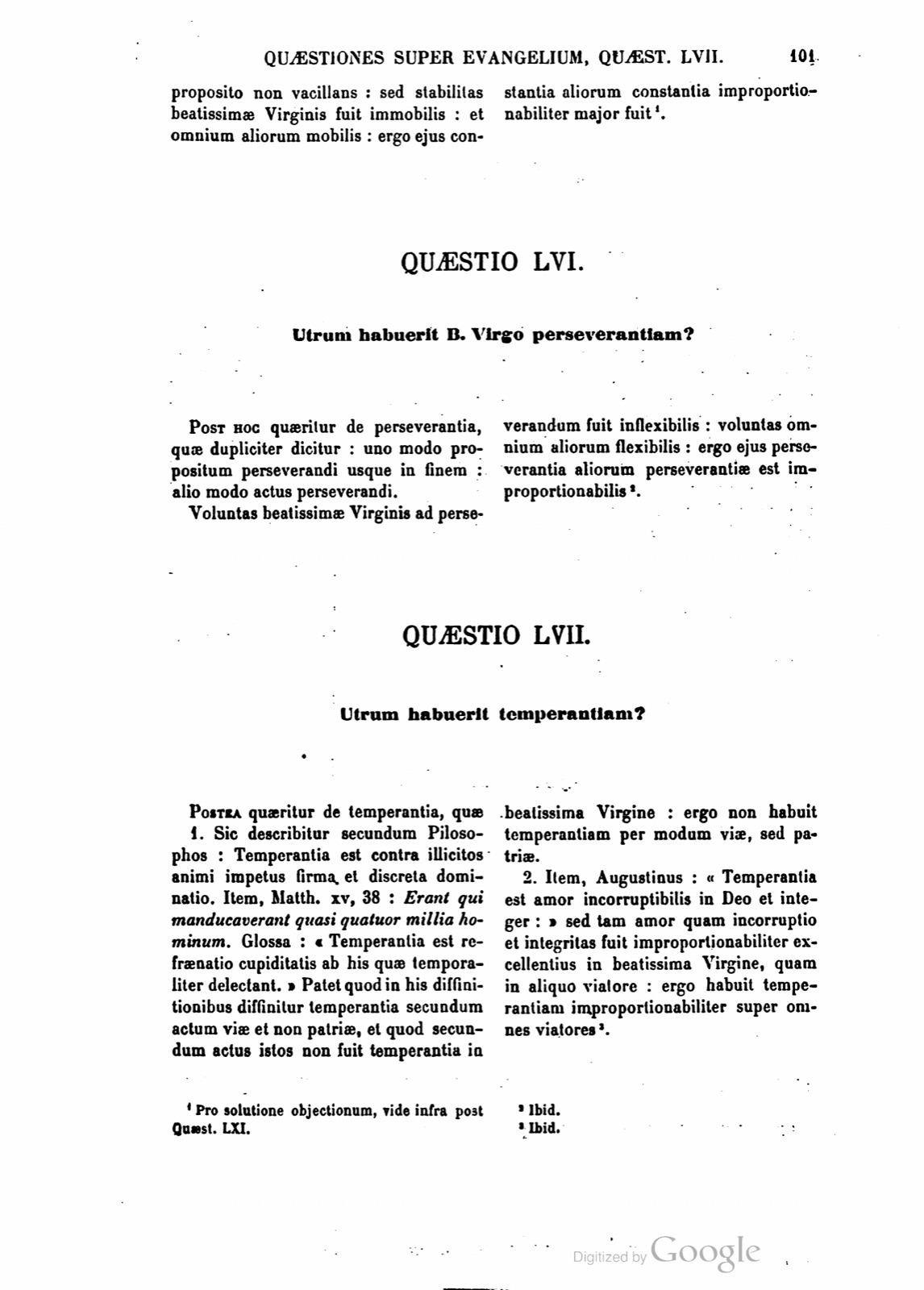
Sexta est constantia quae sic describitur: Constantia est animi stabilitas in proposito non vacillans: sed stabilitas beatissimae Virginis fuit immobilis: et omnium aliorum mobilis: ergo ejus constantia aliorum constantia improportionabiliter major fuit 1.
The fourth is security, which is described thus: Security is a habit according to which inconveniences that come upon one are not feared so as to prevent what has been begun from being brought to the end. But the security of the blessed Virgin was altogether without fear of separation. Therefore her security surpasses the security of every wayfarer.
The fifth is patience, which is described thus: Patience is a good habit of the soul, bearing all adversities with equanimity. But the patience of the most blessed Virgin was invincible and incapable of suffering any evil of fault, while the patience of all other wayfarers was conquerable and capable of suffering from the evil of fault. Therefore her patience was disproportionately greater than the patience of others.
The sixth is constancy, which is described thus: Constancy is the stability of the mind not wavering in its purpose. But the stability of the most blessed Virgin was immovable, and that of all others movable. Therefore her constancy was disproportionately greater than the constancy of others 1.
Notes
- For the solution of the objections, see below after Question LXI. (Pro solutione objectionum, vide infra post Quaest. LXI.) ↩
If a page does not appear, its photograph has not been uploaded yet.