Works › The Mariale: Questions on “Missus est”
Volume 37 · pp. 103–104
Question LXI. Whether she had modesty in the cultivation of garments?
A marker with ≈ is an approximate page boundary, placed by measure of the text; the page photographs remain the authority. In the paired views, clicking a page marker brings that page into view.
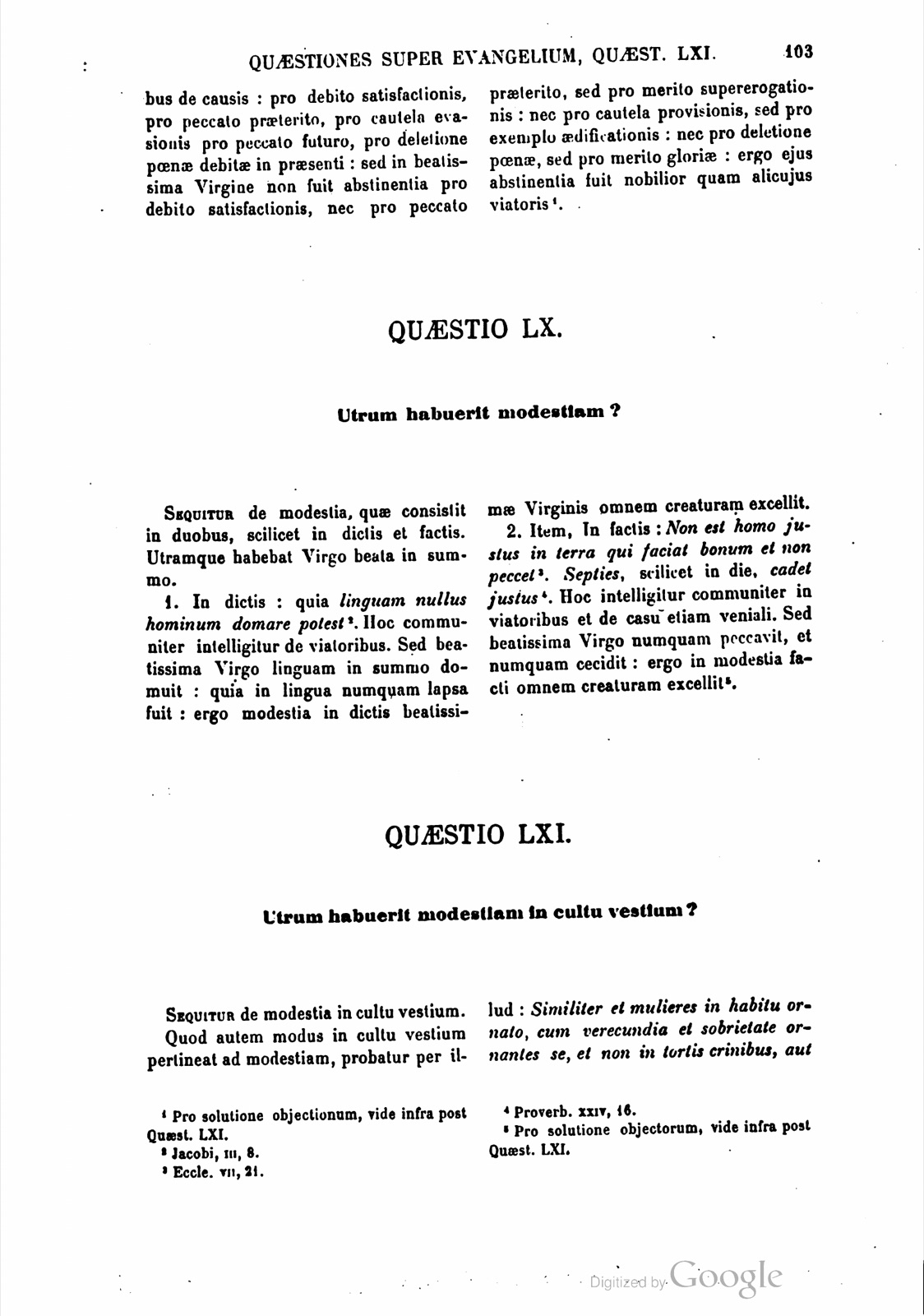
QUAESTIO LXI. Utrum habuerit modestiam in cultu vestium?
Sequitur de modestia in cultu vestium. Quod autem modus in cultu vestium pertineat ad modestiam, probatur per illud: Similiter et mulieres in habitu ornato, cum verecundia et sobrietate ornantes se, et non in tortis crinibus, aut auro, aut margaritis, vel veste pretiosa: sed quod decet mulieres, promittentes pietatem per opera bona 1.
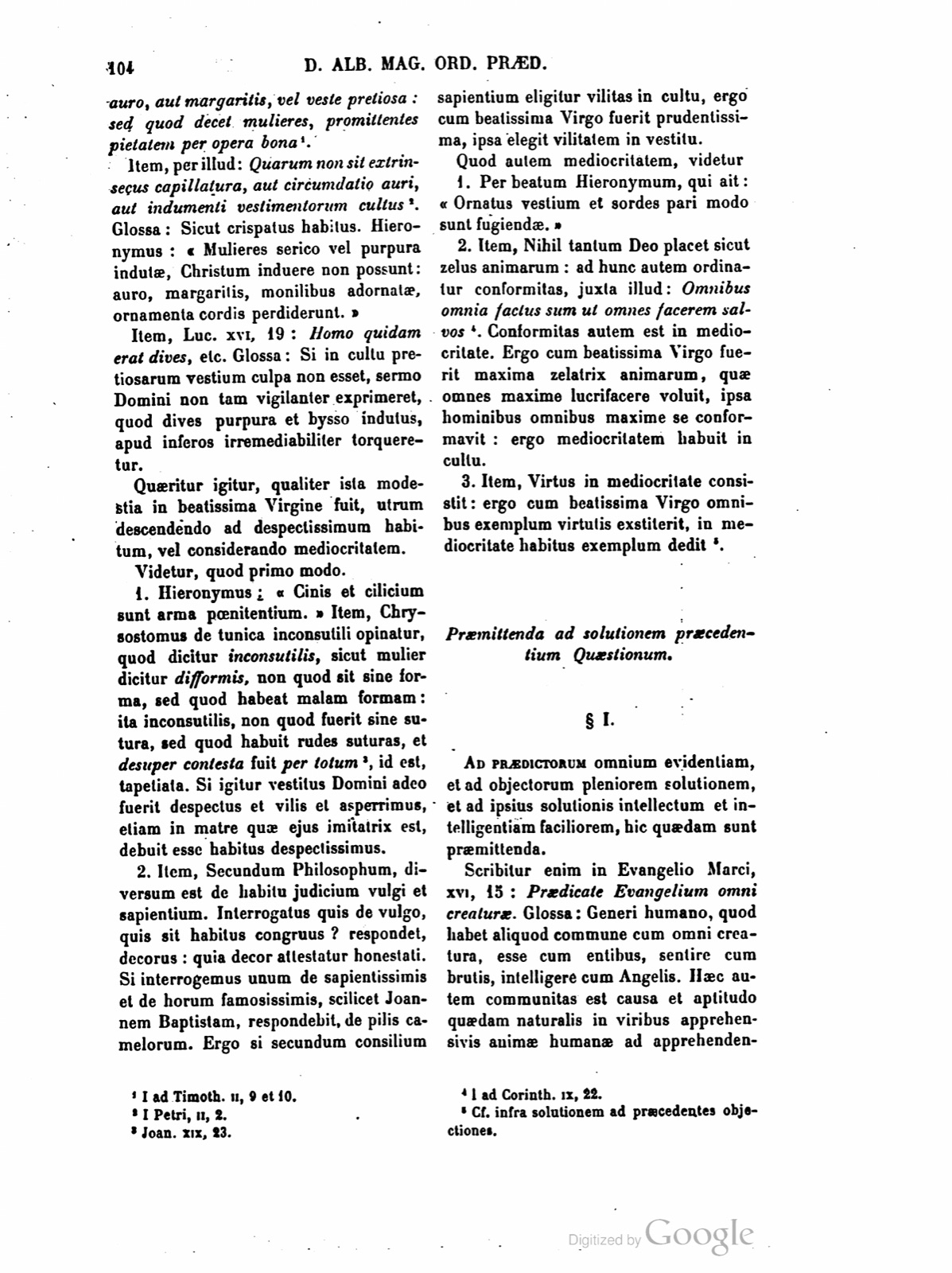
Item, per illud: Quarum non sit extrinsecus capillatura, aut circumdatio auri, aut indumenti vestimentorum cultus 2. Glossa: Sicut crispatus habitus. Hieronymus: "Mulieres serico vel purpura indutae, Christum induere non possunt: auro, margaritis, monilibus adornatae, ornamenta cordis perdiderunt."
Item, Luc. XVI, 19: Homo quidam erat dives, etc. Glossa: Si in cultu pretiosarum vestium culpa non esset, sermo Domini non tam vigilanter exprimeret, quod dives purpura et bysso indutus, apud inferos irremediabiliter torqueretur.
Quaeritur igitur, qualiter ista modestia in beatissima Virgine fuit, utrum descendendo ad despectissimum habitum, vel considerando mediocritatem.
Videtur, quod primo modo.
1. Hieronymus: "Cinis et cilicium sunt arma poenitentium." Item, Chrysostomus de tunica inconsutili opinatur, quod dicitur inconsutilis, sicut mulier dicitur difformis, non quod sit sine forma, sed quod habeat malam formam: ita inconsutilis, non quod fuerit sine sutura, sed quod habuit rudes suturas, et desuper contesta fuit per totum 3, id est, tapetiata. Si igitur vestitus Domini adeo fuerit despectus et vilis et asperrimus, etiam in matre quae ejus imitatrix est, debuit esse habitus despectissimus.
QUESTION LXI. Whether she had modesty in the cultivation of garments?
There follows concerning modesty in the cultivation of garments. That the mode in the cultivation of garments pertains to modesty is proved by that saying: Likewise women also in adorned clothing, adorning themselves with shamefacedness and sobriety, and not with braided hair, or gold, or pearls, or costly garment, but what befits women promising piety through good works 1.
Likewise, by that saying: Let theirs not be outward hair-arrangement, or wearing-around of gold, or the cultivation of clothing of garments 2. The Gloss says: as curled clothing. Jerome says: "Women clothed in silk or purple cannot put on Christ; adorned with gold, pearls, and necklaces, they have lost the ornaments of the heart."
Likewise, Luke 16:19 says: There was a certain rich man, and so forth. The Gloss says: If there were not fault in the cultivation of costly garments, the speech of the Lord would not so watchfully express that the rich man, clothed in purple and byssus, was tormented irreparably in the lower regions.
Therefore it is asked how that modesty was in the most blessed Virgin, whether by descending to the most despised clothing, or by considering moderation.
It seems that it was in the first way.
1. Jerome says: "Ash and hair-shirt are the arms of penitents." Likewise, Chrysostom, concerning the seamless tunic, is of the opinion that it is called seamless as a woman is called misshapen, not because she is without form, but because she has a bad form; so the tunic is called seamless, not because it was without sewing, but because it had rough seams and was woven all over on the outside 3, that is, covered like a tapestry. Therefore, if the garment of the Lord was so despised and lowly and most rough, there ought also to have been the most despised clothing in the mother who is his imitator.
2. Item, Secundum Philosophum, diversum est de habitu judicium vulgi et sapientium. Interrogatus quis de vulgo, quis sit habitus congruus? respondet, decorus: quia decor attestatur honestati. Si interrogemus unum de sapientissimis et de horum famosissimis, scilicet Joannem Baptistam, respondebit, de pilis camelorum. Ergo si secundum consilium sapientium eligitur vilitas in cultu, ergo cum beatissima Virgo fuerit prudentissima, ipsa elegit vilitatem in vestitu.
Quod autem mediocritatem, videtur:
1. Per beatum Hieronymum, qui ait: "Ornatus vestium et sordes pari modo sunt fugiendae."
2. Item, Nihil tantum Deo placet sicut zelus animarum: ad hunc autem ordinatur conformitas, juxta illud: Omnibus omnia factus sum ut omnes facerem salvos 4. Conformitas autem est in mediocritate. Ergo cum beatissima Virgo fuerit maxima zelatrix animarum, quae omnes maxime lucrifacere voluit, ipsa hominibus omnibus maxime se conformavit: ergo mediocritatem habuit in cultu.
3. Item, Virtus in mediocritate consistit: ergo cum beatissima Virgo omnibus exemplum virtutis exstiterit, in mediocritate habitus exemplum dedit 5.
2. Likewise, according to the Philosopher, the judgment of the common people and of the wise differs concerning clothing. If someone from the common people is asked, What clothing is fitting? he answers: beautiful, because beauty bears witness to honesty. If we ask one of the wisest and most famous of these, namely John the Baptist, he will answer: of camel's hair. Therefore, if lowliness in cultivation is chosen according to the counsel of the wise, then, since the most blessed Virgin was most prudent, she chose lowliness in clothing.
But that she had moderation appears:
1. Through blessed Jerome, who says: "The adornment of garments and filth are equally to be fled."
2. Likewise, nothing pleases God so much as zeal for souls. But conformity is ordered to this, according to that saying: I became all things to all, that I might make all safe 4. Now conformity is in moderation. Therefore, since the most blessed Virgin was the greatest zealot for souls, who willed to gain all persons most greatly, she conformed herself most greatly to all human beings. Therefore she had moderation in cultivation.
3. Likewise, virtue consists in moderation. Therefore, since the most blessed Virgin stood forth as an example of virtue to all, she gave an example in moderation of clothing 5.
If a page does not appear, its photograph has not been uploaded yet.