Works › The Mariale: Questions on “Missus est”
Volume 37 · pp. 92–93
Question XLVII. Whether the charity of the blessed Virgin Mary on the way was in a state such that it could be augmented?
A marker with ≈ is an approximate page boundary, placed by measure of the text; the page photographs remain the authority. In the paired views, clicking a page marker brings that page into view.
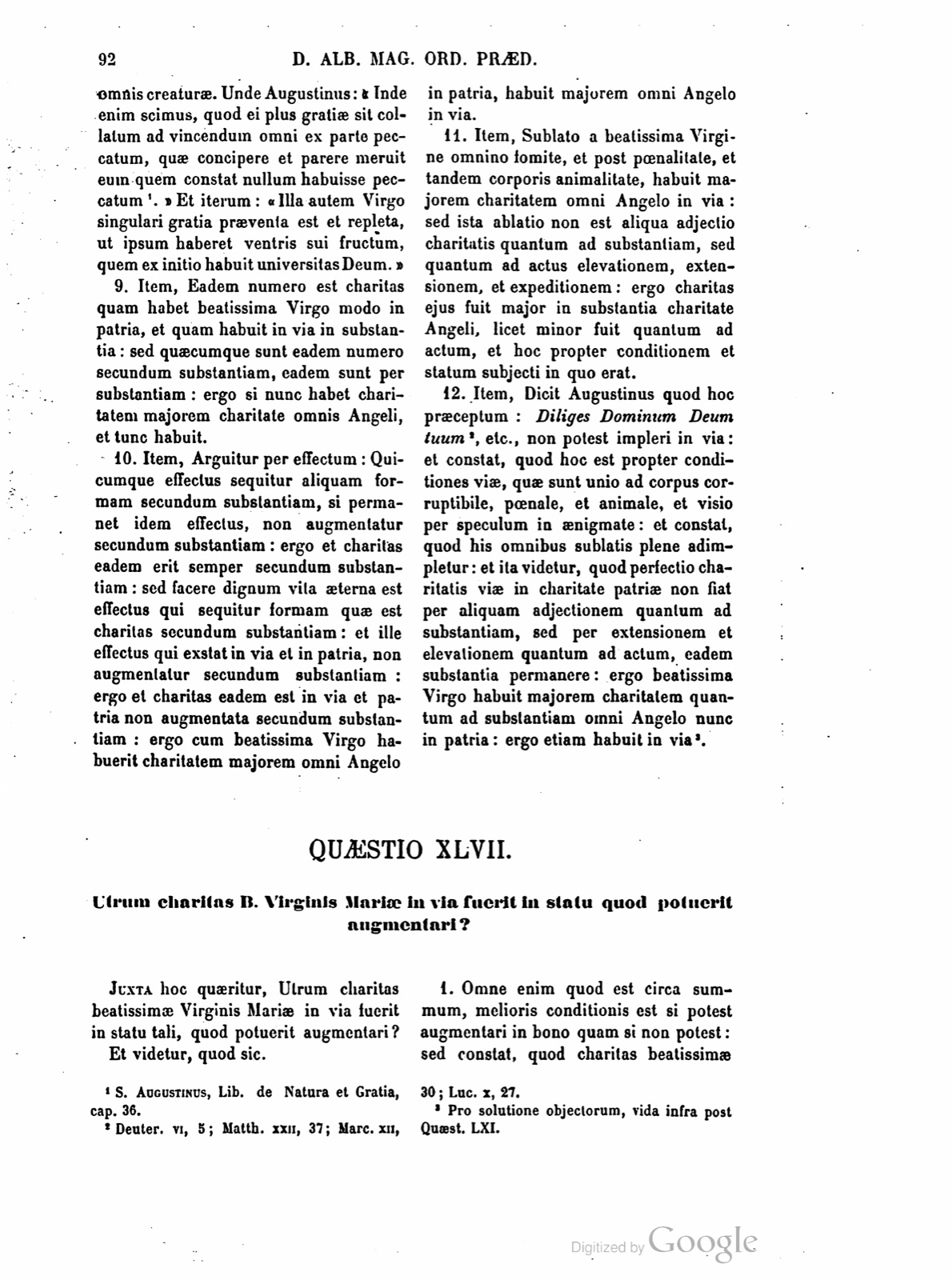
QUAESTIO XLVII. Utrum charitas B. Virginis Mariae in via fuerit in statu quod potuerit augmentari?
Juxta hoc quaeritur, Utrum charitas beatissimae Virginis Mariae in via fuerit in statu tali, quod potuerit augmentari?
Et videtur, quod sic.
1. Omne enim quod est circa summum, melioris conditionis est si potest augmentari in bono quam si non potest: sed constat, quod charitas beatissimae Virginis fuit citra summum, et in optimo statu: ergo potuit augmentari.
2. Item, Augustinus ad Hieronymum: « Charitas est virtus qua illud quod diligendum est, diligitur. Haec in aliis major, in aliis minor, in aliis nulla est, plenissima vero quae jam non possit augeri quamdiu hic homo vivit, invenitur in nemine 1: » quamdiu ergo hic est vivens, augeri potest.
Quod si concedatur. Contra:
1. Charitas beatissimae Virginis fuit perfectissima secundum statum: sed perfectius est quod in termino, quam id quod est citra terminum: sed quod augmentabile est, citra terminum est: sed charitas beatae Virginis fuit in termino et non citra terminum: ergo charitas beatae Virginis non est augmentabilis, sed in summo complemento secundum statum viae.
2. Item, Sicut nec in corporalibus, ita nec in spiritualibus quidquam est vacuum secundum actum: sed inter charitatem inaugmentabilem patriae, et charitatem augmentabilem viae, medium est charitas viae inaugmentabilis: ergo cum extrema exstent, aut medium erit, aut aliquod vacuum est: illud autem medium non congruit nisi beatissimae Virgini, quae fuit in statu viae summa et propinquissima statui patriae: ergo habebat charitatem inaugmentabilem in summo.
QUESTION XLVII. Whether the charity of the blessed Virgin Mary on the way was in a state such that it could be augmented?
Next to this it is asked whether the charity of the most blessed Virgin Mary on the way was in such a state that it could be augmented.
And it seems that it was.
1. For everything that is near the highest is of a better condition if it can be augmented in good than if it cannot. But it is evident that the charity of the most blessed Virgin was below the highest and in the best state. Therefore it could be augmented.
2. Likewise, Augustine to Jerome says: "Charity is the virtue by which that which must be loved is loved. This is greater in some, lesser in others, and in some none; but the fullest charity, which now cannot be increased, is found in no one as long as a man lives here 1." Therefore, as long as one is living here, it can be increased.
But if this is granted, to the contrary:
1. The charity of the most blessed Virgin was most perfect according to her state. But what is at the term is more perfect than that which is short of the term. But what is augmentable is short of the term. But the charity of the blessed Virgin was at the term and not short of the term. Therefore the charity of the blessed Virgin is not augmentable, but is in the highest completion according to the state of the way.
2. Likewise, just as in corporeal things, so also in spiritual things nothing is empty according to act. But between the unaugmentable charity of the homeland and the augmentable charity of the way, the middle is unaugmentable charity of the way. Therefore, since the extremes exist, either the middle will exist, or there is some emptiness. But that middle befits none except the most blessed Virgin, who was highest in the state of the way and nearest to the state of the homeland. Therefore she had unaugmentable charity in the highest degree.
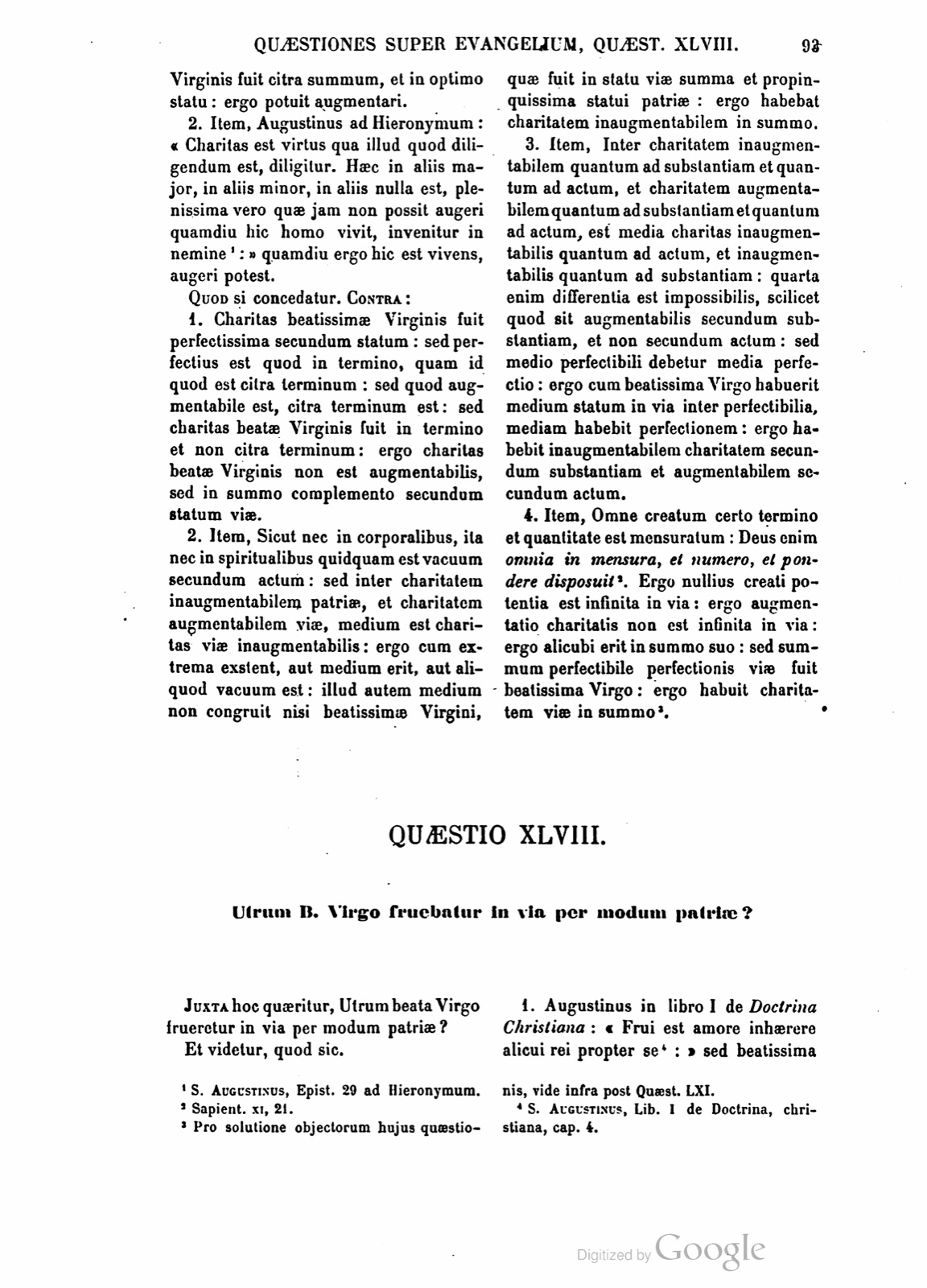
3. Item, Inter charitatem inaugmentabilem quantum ad substantiam et quantum ad actum, et charitatem augmentabilem quantum ad substantiam et quantum ad actum, est media charitas inaugmentabilis quantum ad actum, et inaugmentabilis quantum ad substantiam: quarta enim differentia est impossibilis, scilicet quod sit augmentabilis secundum substantiam, et non secundum actum: sed medio perfectibili debetur media perfectio: ergo cum beatissima Virgo habuerit medium statum in via inter perfectibilia, mediam habebit perfectionem: ergo habebit inaugmentabilem charitatem secundum substantiam et augmentabilem secundum actum.
4. Item, Omne creatum certo termino et quantitate est mensuratum: Deus enim omnia in mensura, et numero, et pondere disposuit 2. Ergo nullius creati potentia est infinita in via: ergo augmentatio charitatis non est infinita in via: ergo alicubi erit in summo suo: sed summum perfectibile perfectionis viae fuit beatissima Virgo: ergo habuit charitatem viae in summo 3.
3. Likewise, between charity unaugmentable as to substance and as to act, and charity augmentable as to substance and as to act, there is as a middle charity unaugmentable as to act and unaugmentable as to substance. For the fourth difference is impossible, namely that it be augmentable according to substance and not according to act. But a middle perfection is owed to a middle perfectible thing. Therefore, since the most blessed Virgin had a middle state on the way among perfectible things, she will have a middle perfection. Therefore she will have charity unaugmentable according to substance and augmentable according to act.
4. Likewise, every created thing is measured by a fixed term and quantity: for God disposed all things in measure, and number, and weight 2. Therefore the power of no created thing is infinite on the way. Therefore the augmentation of charity is not infinite on the way. Therefore somewhere it will be in its highest degree. But the highest perfectible thing of the perfection of the way was the most blessed Virgin. Therefore she had charity of the way in the highest degree 3.
Notes
- St. Augustine, Epistle 29 to Jerome. (S. Augustinus, Epist. 29 ad Hieronymum.) ↩
- Wisdom 11:21. (Sapient. XI, 21.) ↩
- For the solution of the objections of this question, see below after Question LXI. (Pro solutione objectorum hujus quaestionis, vide infra post Quaest. LXI.) ↩
If a page does not appear, its photograph has not been uploaded yet.