Works › The Mariale: Questions on “Missus est”
Volume 37 · pp. 93–94
Question XLVIII. Whether the blessed Virgin enjoyed on the way according to the mode of the homeland?
A marker with ≈ is an approximate page boundary, placed by measure of the text; the page photographs remain the authority. In the paired views, clicking a page marker brings that page into view.
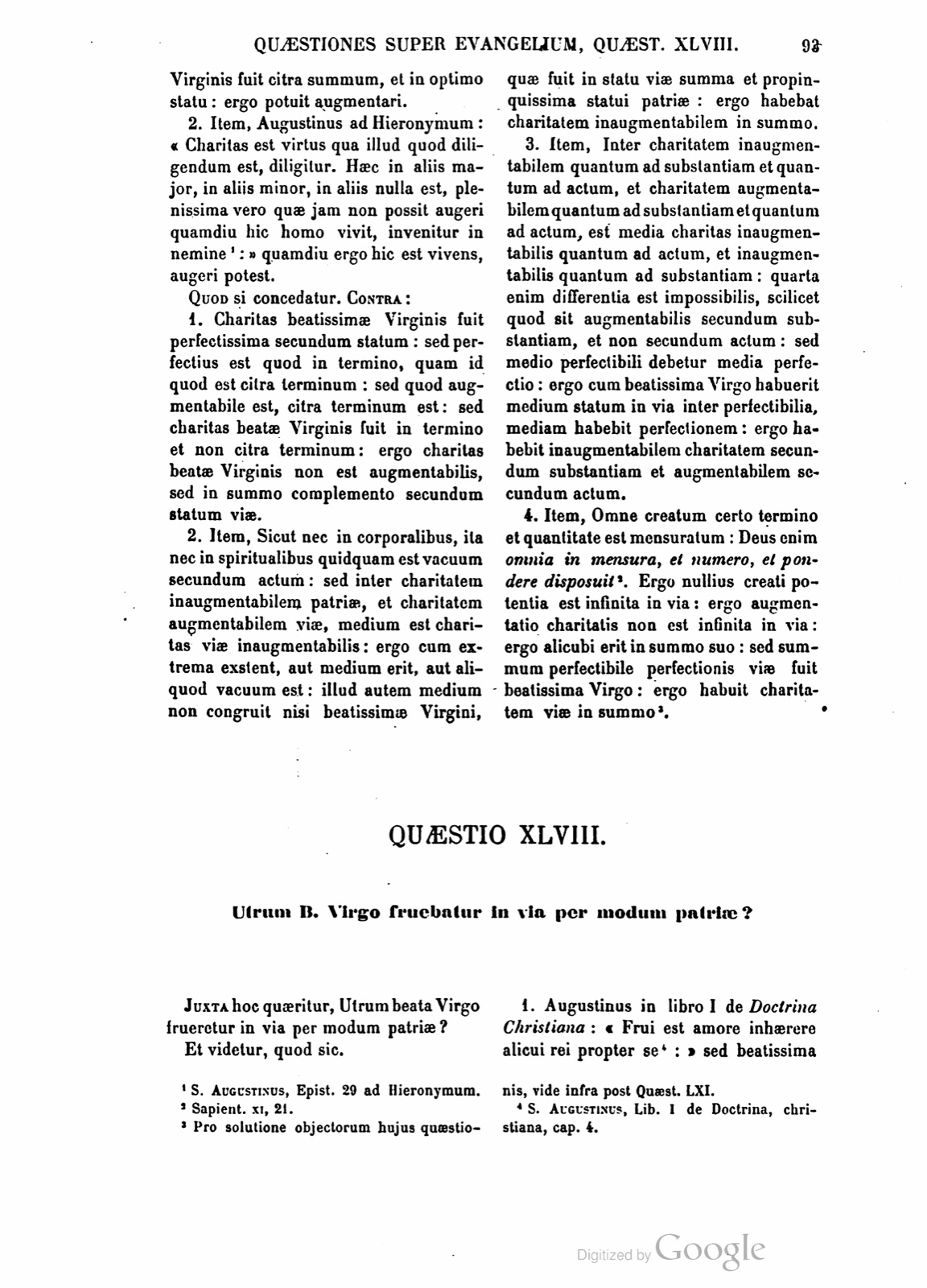
QUAESTIO XLVIII. Utrum B. Virgo fruebatur in via per modum patriae?
Juxta hoc quaeritur, Utrum beata Virgo frueretur in via per modum patriae?
Et videtur, quod sic.
1. Augustinus in libro I de Doctrina Christiana: « Frui est amore inhaerere alicui rei propter se 1: » sed beatissima Virgo inhaerebat summo amore propter se et inseparabiliter: ergo fruebatur.
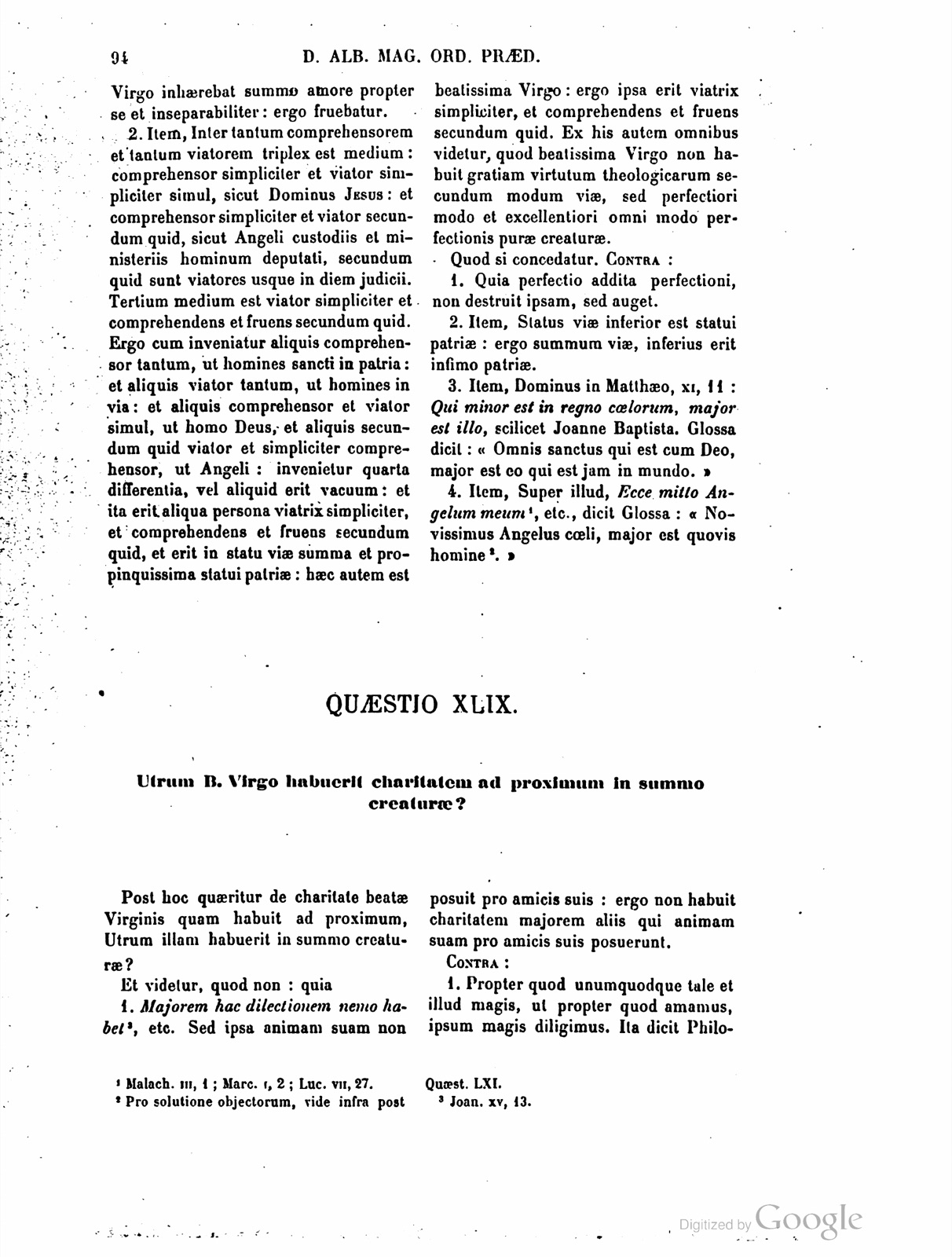
2. Item, Inter tantum comprehensorem et tantum viatorem triplex est medium: comprehensor simpliciter et viator simpliciter simul, sicut Dominus Jesus: et comprehensor simpliciter et viator secundum quid, sicut Angeli custodiis et ministeriis hominum deputati, secundum quid sunt viatores usque in diem judicii. Tertium medium est viator simpliciter et comprehendens et fruens secundum quid. Ergo cum inveniatur aliquis comprehensor tantum, ut homines sancti in patria: et aliquis viator tantum, ut homines in via: et aliquis comprehensor et viator simul, ut homo Deus, et aliquis secundum quid viator et simpliciter comprehensor, ut Angeli: invenietur quarta differentia, vel aliquid erit vacuum: et ita erit aliqua persona viatrix simpliciter, et comprehendens et fruens secundum quid, et erit in statu viae summa et propinquissima statui patriae: haec autem est beatissima Virgo: ergo ipsa erit viatrix simpliciter, et comprehendens et fruens secundum quid. Ex his autem omnibus videtur, quod beatissima Virgo non habuit gratiam virtutum theologicarum secundum modum viae, sed perfectiori modo et excellentiori omni modo perfectionis purae creaturae.
QUESTION XLVIII. Whether the blessed Virgin enjoyed on the way according to the mode of the homeland?
Next to this it is asked whether the blessed Virgin enjoyed on the way according to the mode of the homeland.
And it seems that she did.
1. Augustine in Book I On Christian Doctrine says: "To enjoy is to adhere by love to some thing for its own sake 1." But the most blessed Virgin adhered to the highest good by love for its own sake and inseparably. Therefore she enjoyed.
2. Likewise, between a comprehensor only and a wayfarer only there are three intermediates: one who is simply a comprehensor and simply a wayfarer at once, as the Lord Jesus; and one who is simply a comprehensor and a wayfarer in a certain respect, as Angels deputed to the guardianships and ministries of men are wayfarers in a certain respect until the day of judgment. The third intermediate is one who is simply a wayfarer and a comprehensor and enjoyer in a certain respect. Therefore, since there is found someone who is a comprehensor only, as holy men in the homeland; and someone who is a wayfarer only, as men on the way; and someone who is comprehensor and wayfarer at once, as the man-God; and someone who is in a certain respect a wayfarer and simply a comprehensor, as the Angels, a fourth difference will be found, or something will be empty. And thus there will be some person simply a wayfarer and a comprehensor and enjoyer in a certain respect, and she will be highest in the state of the way and nearest to the state of the homeland. But this is the most blessed Virgin. Therefore she herself will be simply a wayfarer, and a comprehensor and enjoyer in a certain respect. From all these things, however, it seems that the most blessed Virgin did not have the grace of the theological virtues according to the mode of the way, but in a more perfect mode and in every way more excellent than the mode of perfection of a pure creature.
Quod si concedatur. Contra:
1. Quia perfectio addita perfectioni, non destruit ipsam, sed auget.
2. Item, Status viae inferior est statui patriae: ergo summum viae, inferius erit infimo patriae.
3. Item, Dominus in Matthaeo, XI, 11: Qui minor est in regno coelorum, major est illo, scilicet Joanne Baptista. Glossa dicit: « Omnis sanctus qui est cum Deo, major est eo qui est jam in mundo. »
4. Item, Super illud, Ecce mitto Angelum meum, etc., dicit Glossa: « Novissimus Angelus coeli, major est quovis homine 2. »
But if this is granted, to the contrary:
1. Because perfection added to perfection does not destroy it, but increases it.
2. Likewise, the state of the way is lower than the state of the homeland. Therefore the highest thing of the way will be lower than the lowest thing of the homeland.
3. Likewise, the Lord says in Matthew 11:11: He who is lesser in the kingdom of heaven is greater than he, namely John the Baptist. The Gloss says: "Every saint who is with God is greater than one who is now in the world."
4. Likewise, on that saying, Behold, I send my Angel, and so forth, the Gloss says: "The least Angel of heaven is greater than any man 2."
If a page does not appear, its photograph has not been uploaded yet.