Works › The Mariale: Questions on “Missus est”
Volume 37 · pp. 90–92
Question XLVI. Whether charity was in the blessed Virgin?
A marker with ≈ is an approximate page boundary, placed by measure of the text; the page photographs remain the authority. In the paired views, clicking a page marker brings that page into view.
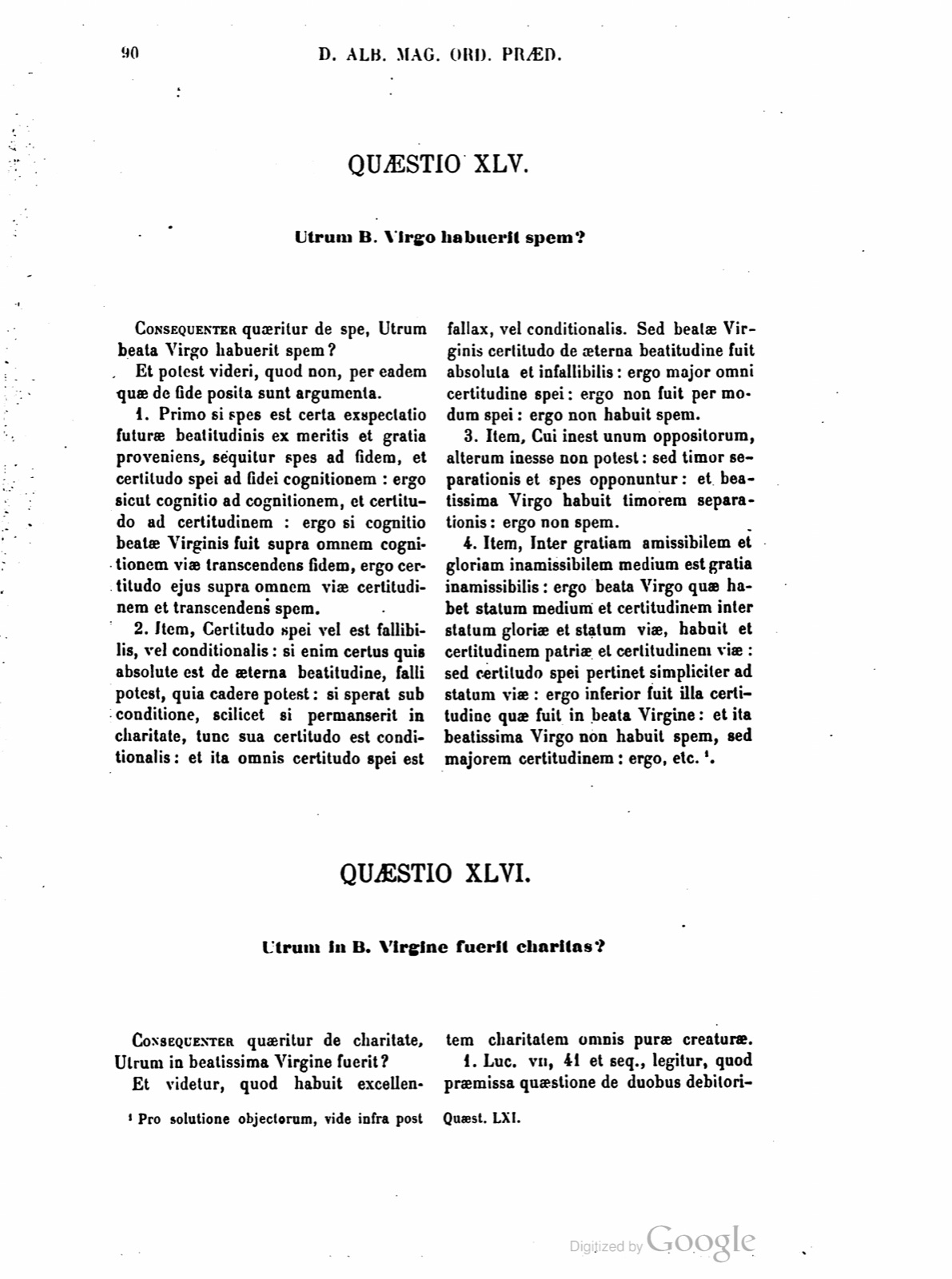
QUAESTIO XLVI. Utrum in B. Virgine fuerit charitas?
Consequenter quaeritur de charitate, Utrum in beatissima Virgine fuerit?
Et videtur, quod habuit excellentem charitatem omnis purae creaturae.
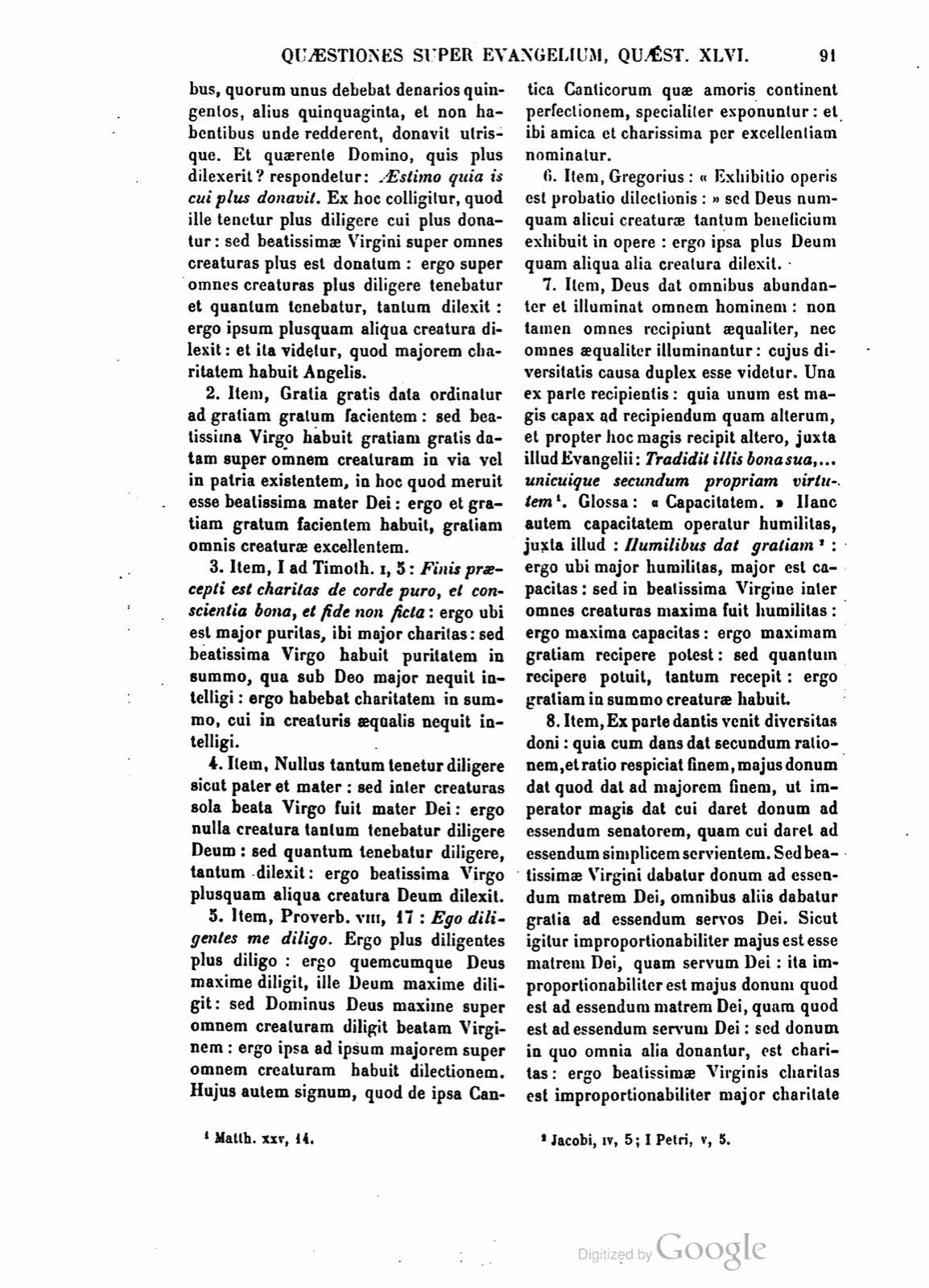
1. Luc. VII, 41 et seq., legitur, quod praemissa quaestione de duobus debitoribus, quorum unus debebat denarios quingentos, alius quinquaginta, et non habentibus unde redderent, donavit utrisque. Et quaerente Domino, quis plus dilexerit? respondetur: Aestimo quia is cui plus donavit. Ex hoc colligitur, quod ille tenetur plus diligere cui plus donatur: sed beatissimae Virgini super omnes creaturas plus est donatum: ergo super omnes creaturas plus diligere tenebatur et quantum tenebatur, tantum dilexit: ergo ipsum plusquam aliqua creatura dilexit: et ita videtur, quod majorem charitatem habuit Angelis.
2. Item, Gratia gratis data ordinatur ad gratiam gratum facientem: sed beatissima Virgo habuit gratiam gratis datam super omnem creaturam in via vel in patria existentem, in hoc quod meruit esse beatissima mater Dei: ergo et gratiam gratum facientem habuit, gratiam omnis creaturae excellentem.
3. Item, I ad Timoth. I, 5: Finis praecepti est charitas de corde puro, et conscientia bona, et fide non ficta: ergo ubi est major puritas, ibi major charitas: sed beatissima Virgo habuit puritatem in summo, qua sub Deo major nequit intelligi: ergo habebat charitatem in summo, cui in creaturis aequalis nequit intelligi.
4. Item, Nullus tantum tenetur diligere sicut pater et mater: sed inter creaturas sola beata Virgo fuit mater Dei: ergo nulla creatura tantum tenebatur diligere Deum: sed quantum tenebatur diligere, tantum dilexit: ergo beatissima Virgo plusquam aliqua creatura Deum dilexit.
5. Item, Proverb. VIII, 17: Ego diligentes me diligo. Ergo plus diligentes plus diligo: ergo quemcumque Deus maxime diligit, ille Deum maxime diligit: sed Dominus Deus maxime super omnem creaturam diligit beatam Virginem: ergo ipsa ad ipsum majorem super omnem creaturam habuit dilectionem. Hujus autem signum, quod de ipsa Cantica Canticorum quae amoris continent perfectionem, specialiter exponuntur: et ibi amica et charissima per excellentiam nominatur.
QUESTION XLVI. Whether charity was in the blessed Virgin?
Consequently it is asked concerning charity, whether it was in the most blessed Virgin.
And it seems that she had the charity that excels that of every pure creature.
1. In Luke 7:41 and following it is read that, after a question had been set forth concerning two debtors, of whom one owed five hundred denarii and the other fifty, and they did not have the means from which they could repay, he forgave both. And when the Lord asked who loved more, it is answered: I suppose he to whom he forgave more. From this it is gathered that one to whom more is given is bound to love more. But more was given to the most blessed Virgin above all creatures. Therefore she was bound to love more above all creatures, and as much as she was bound, so much she loved. Therefore she loved him more than any creature; and thus it seems that she had greater charity than the Angels.
2. Likewise, grace given gratis is ordered to grace making one pleasing. But the most blessed Virgin had grace given gratis above every creature existing on the way or in the homeland, in that she merited to be the most blessed mother of God. Therefore she also had grace making one pleasing, a grace excelling that of every creature.
3. Likewise, 1 Timothy 1:5 says: The end of the precept is charity from a pure heart, and a good conscience, and faith not feigned. Therefore where there is greater purity, there is greater charity. But the most blessed Virgin had purity in the highest degree, greater than which under God cannot be understood. Therefore she had charity in the highest degree, to which no equal in creatures can be understood.
4. Likewise, no one is bound to love so much as a father and mother are. But among creatures the blessed Virgin alone was mother of God. Therefore no creature was bound to love God so much. But as much as she was bound to love, so much she loved. Therefore the most blessed Virgin loved God more than any creature.
5. Likewise, Proverbs 8:17 says: I love those who love me. Therefore I love more those who love more. Therefore whomever God loves most, that person loves God most. But the Lord God loves the blessed Virgin most above every creature. Therefore she had love toward him greater above every creature. A sign of this is that the Canticles of Canticles, which contain the perfection of love, are specially expounded concerning her; and there she is named friend and dearest by excellence.
6. Item, Gregorius: « Exhibitio operis est probatio dilectionis: » sed Deus numquam alicui creaturae tantum beneficium exhibuit in opere: ergo ipsa plus Deum quam aliqua alia creatura dilexit.
7. Item, Deus dat omnibus abundanter et illuminat omnem hominem: non tamen omnes recipiunt aequaliter, nec omnes aequaliter illuminantur: cujus diversitatis causa duplex esse videtur. Una ex parte recipientis: quia unum est magis capax ad recipiendum quam alterum, et propter hoc magis recipit altero, juxta illud Evangelii: Tradidit illis bona sua, ... unicuique secundum propriam virtutem 1. Glossa: « Capacitatem. » Hanc autem capacitatem operatur humilitas, juxta illud: Humilibus dat gratiam 2: ergo ubi major humilitas, major est capacitas: sed in beatissima Virgine inter omnes creaturas maxima fuit humilitas: ergo maxima capacitas: ergo maximam gratiam recipere potest: sed quantum recipere potuit, tantum recepit: ergo gratiam in summo creaturae habuit.
8. Item, Ex parte dantis venit diversitas doni: quia cum dans dat secundum rationem, et ratio respiciat finem, majus donum dat quod dat ad majorem finem, ut imperator magis dat cui daret donum ad essendum senatorem, quam cui daret ad essendum simplicem servientem. Sed beatissimae Virgini dabatur donum ad essendum matrem Dei, omnibus aliis dabatur gratia ad essendum servos Dei. Sicut igitur improportionabiliter majus est esse matrem Dei, quam servum Dei: ita improportionabiliter est majus donum quod est ad essendum matrem Dei, quam quod est ad essendum servum Dei: sed donum in quo omnia alia donantur, est charitas: ergo beatissimae Virginis charitas est improportionabiliter major charitate omnis creaturae. Unde Augustinus: « Inde enim scimus, quod ei plus gratiae sit collatum ad vincendum omni ex parte peccatum, quae concipere et parere meruit eum quem constat nullum habuisse peccatum 3. » Et iterum: « Illa autem Virgo singulari gratia praeventa est et repleta, ut ipsum haberet ventris sui fructum, quem ex initio habuit universitas Deum. »
6. Likewise, Gregory says: "The exhibition of a work is the proof of love." But God never exhibited so great a benefit in work to any creature. Therefore she loved God more than any other creature.
7. Likewise, God gives abundantly to all and illumines every man; nevertheless not all receive equally, nor are all equally illumined. The cause of this diversity seems to be twofold. One is on the part of the recipient, because one is more capable of receiving than another, and because of this receives more than another, according to that saying of the Gospel: He delivered his goods to them, ... to each according to his proper power 1. The Gloss says: "Capacity." But humility works this capacity, according to that saying: He gives grace to the humble 2. Therefore where there is greater humility, there is greater capacity. But in the most blessed Virgin there was the greatest humility among all creatures. Therefore the greatest capacity; therefore she can receive the greatest grace. But as much as she could receive, so much she received. Therefore she had grace in the highest degree of a creature.
8. Likewise, on the part of the giver comes diversity of gift, because when the giver gives according to reason, and reason regards the end, he gives a greater gift when he gives for a greater end, as an emperor gives more to one to whom he would give a gift for being a senator, than to one to whom he would give for being a simple servant. But to the most blessed Virgin a gift was given for being the mother of God; to all others grace was given for being servants of God. Therefore, just as to be the mother of God is disproportionately greater than to be a servant of God, so the gift that is for being the mother of God is disproportionately greater than the one that is for being a servant of God. But the gift in which all other things are given is charity. Therefore the charity of the most blessed Virgin is disproportionately greater than the charity of every creature. Hence Augustine says: "From this we know that more grace was conferred on her for conquering sin from every side, because she merited to conceive and bear him whom it is evident had no sin 3." And again: "But that Virgin was forestalled and filled by singular grace, so that she might have as the fruit of her womb him whom the whole universe had as God from the beginning."
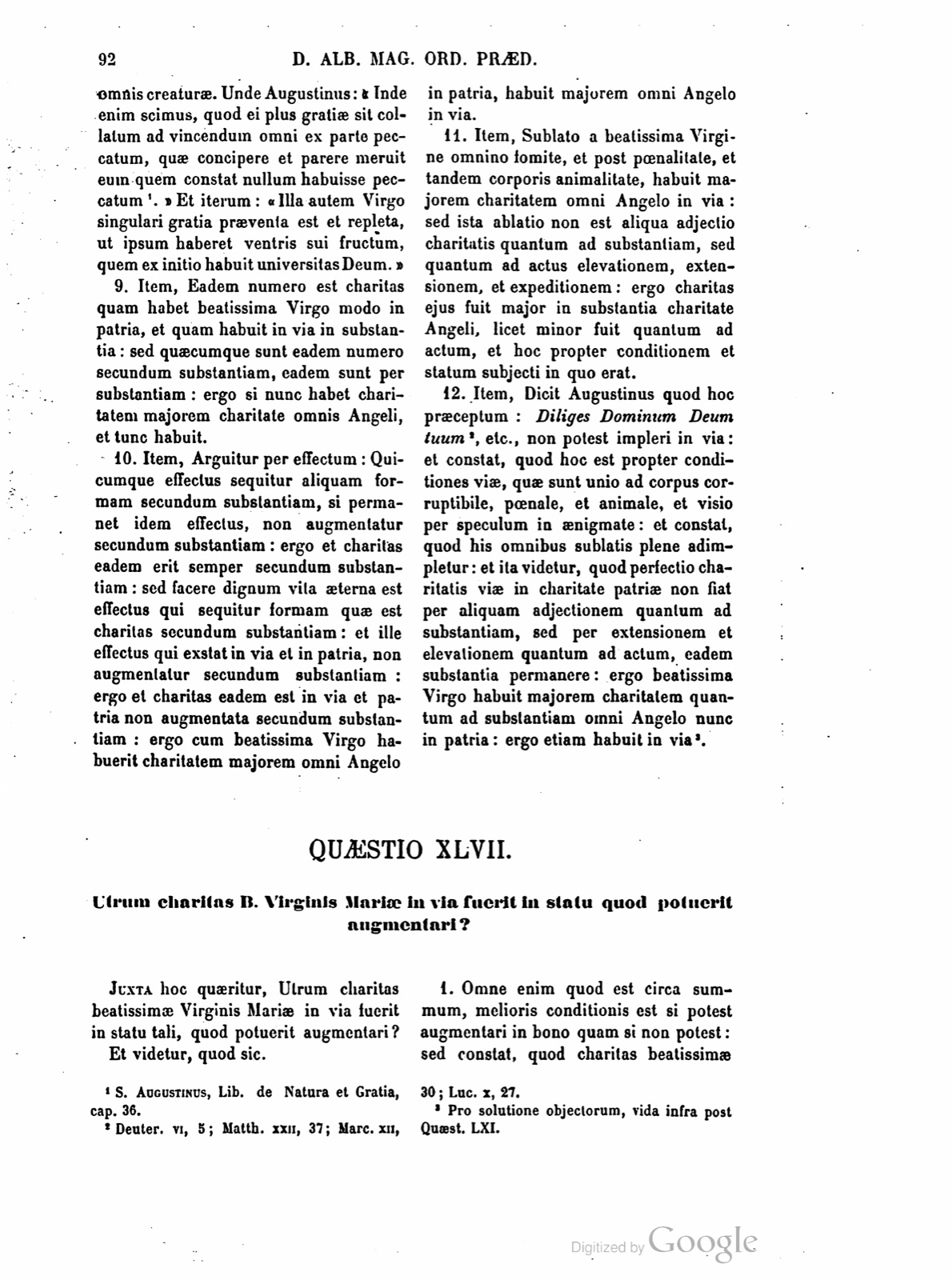
9. Item, Eadem numero est charitas quam habet beatissima Virgo modo in patria, et quam habuit in via in substantia: sed quaecumque sunt eadem numero secundum substantiam, eadem sunt per substantiam: ergo si nunc habet charitatem majorem charitate omnis Angeli, et tunc habuit.
10. Item, Arguitur per effectum: Quicumque effectus sequitur aliquam formam secundum substantiam, si permanet idem effectus, non augmentatur secundum substantiam: ergo et charitas eadem erit semper secundum substantiam: sed facere dignum vita aeterna est effectus qui sequitur formam quae est charitas secundum substantiam: et ille effectus qui exstat in via et in patria, non augmentatur secundum substantiam: ergo et charitas eadem est in via et patria non augmentata secundum substantiam: ergo cum beatissima Virgo habuerit charitatem majorem omni Angelo in patria, habuit majorem omni Angelo in via.
11. Item, Sublato a beatissima Virgine omnino fomite, et post poenalitate, et tandem corporis animalitate, habuit majorem charitatem omni Angelo in via: sed ista ablatio non est aliqua adjectio charitatis quantum ad substantiam, sed quantum ad actus elevationem, extensionem, et expeditionem: ergo charitas ejus fuit major in substantia charitate Angeli, licet minor fuit quantum ad actum, et hoc propter conditionem et statum subjecti in quo erat.
12. Item, Dicit Augustinus quod hoc praeceptum: Diliges Dominum Deum tuum 4, etc., non potest impleri in via: et constat, quod hoc est propter conditiones viae, quae sunt unio ad corpus corruptibile, poenale, et animale, et visio per speculum in aenigmate: et constat, quod his omnibus sublatis plene adimpletur: et ita videtur, quod perfectio charitatis viae in charitate patriae non fiat per aliquam adjectionem quantum ad substantiam, sed per extensionem et elevationem quantum ad actum, eadem substantia permanere: ergo beatissima Virgo habuit majorem charitatem quantum ad substantiam omni Angelo nunc in patria: ergo etiam habuit in via 5.
9. Likewise, the charity that the most blessed Virgin now has in the homeland is the same in number as that which she had on the way in substance. But whatever things are the same in number according to substance are the same by substance. Therefore if she now has charity greater than the charity of every Angel, she had it also then.
10. Likewise, argument is made from the effect: whatever effect follows some form according to substance, if the same effect remains, is not augmented according to substance. Therefore charity also will be the same always according to substance. But to make one worthy of eternal life is an effect that follows the form that is charity according to substance; and that effect, which exists on the way and in the homeland, is not augmented according to substance. Therefore charity also is the same on the way and in the homeland, not augmented according to substance. Therefore, since the most blessed Virgin had charity greater than every Angel in the homeland, she had it greater than every Angel on the way.
11. Likewise, when the tinder of sin was entirely taken away from the most blessed Virgin, and afterwards punishability, and finally the animality of the body, she had greater charity than every Angel on the way. But that taking away is not any addition of charity as to substance, but as to the elevation, extension, and expedition of act. Therefore her charity was greater in substance than the charity of an Angel, although it was lesser as to act, and this because of the condition and state of the subject in which it was.
12. Likewise, Augustine says that this precept, You shall love the Lord your God 4, and so forth, cannot be fulfilled on the way. And it is evident that this is because of the conditions of the way, which are union to a corruptible, penal, and animal body, and vision through a mirror in an enigma; and it is evident that when all these have been taken away, it is fully fulfilled. And thus it seems that the perfection of charity of the way in the charity of the homeland does not come about through any addition as to substance, but through extension and elevation as to act, while the same substance remains. Therefore the most blessed Virgin had greater charity as to substance than every Angel now in the homeland; therefore she also had it on the way 5.
Notes
- Matthew 25:14. (Matth. XXV, 14.) ↩
- James 4:5; 1 Peter 5:5. (Jacobi, IV, 5; I Petri, V, 5.) ↩
- St. Augustine, Book On Nature and Grace, chapter 36. (S. Augustinus, Lib. de Natura et Gratia, cap. 36.) ↩
- Deuteronomy 6:5; Matthew 22:37; Mark 12:30; Luke 10:27. (Deuter. VI, 5; Matth. XXII, 37; Marc. XII, 30; Luc. X, 27.) ↩
- For the solution of the objections, see below after Question LXI. (Pro solutione objectorum, vide infra post Quaest. LXI.) ↩
If a page does not appear, its photograph has not been uploaded yet.