Works › The Mariale: Questions on “Missus est”
Volume 37 · p. 90
Question XLV. Whether the blessed Virgin had hope?
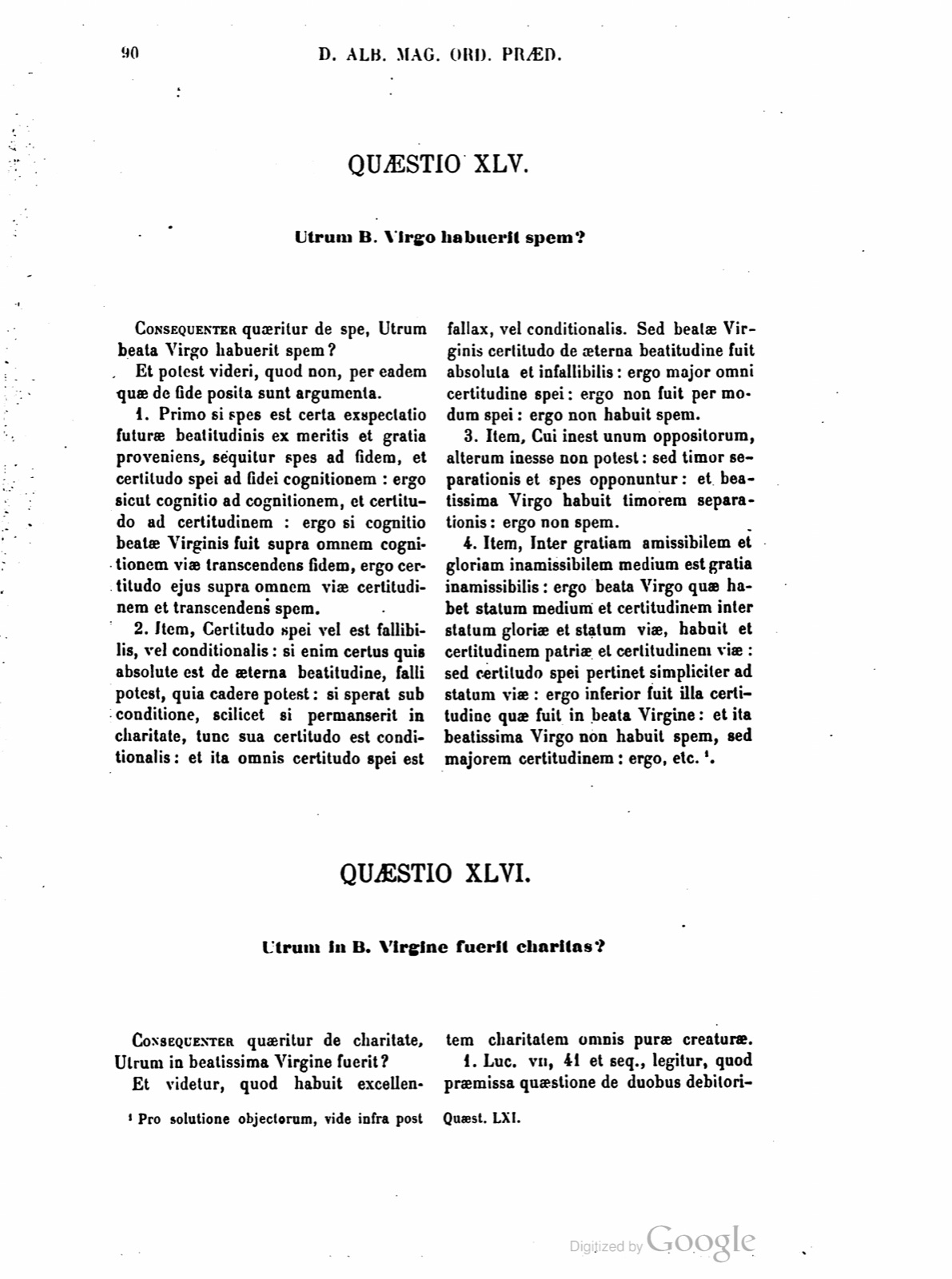
QUAESTIO XLV. Utrum B. Virgo habuerit spem?
Consequenter quaeritur de spe, Utrum beata Virgo habuerit spem?
Et potest videri, quod non, per eadem quae de fide posita sunt argumenta.
1. Primo si spes est certa exspectatio futurae beatitudinis ex meritis et gratia proveniens, sequitur spes ad fidem, et certitudo spei ad fidei cognitionem: ergo sicut cognitio ad cognitionem, et certitudo ad certitudinem: ergo si cognitio beatae Virginis fuit supra omnem cognitionem viae transcendens fidem, ergo certitudo ejus supra omnem viae certitudinem et transcendens spem.
2. Item, Certitudo spei vel est fallibilis, vel conditionalis: si enim certus quis absolute est de aeterna beatitudine, falli potest, quia cadere potest: si sperat sub conditione, scilicet si permanserit in charitate, tunc sua certitudo est conditionalis: et ita omnis certitudo spei est fallax, vel conditionalis. Sed beatae Virginis certitudo de aeterna beatitudine fuit absoluta et infallibilis: ergo major omni certitudine spei: ergo non fuit per modum spei: ergo non habuit spem.
3. Item, Cui inest unum oppositorum, alterum inesse non potest: sed timor separationis et spes opponuntur: et beatissima Virgo habuit timorem separationis: ergo non spem.
4. Item, Inter gratiam amissibilem et gloriam inamissibilem medium est gratia inamissibilis: ergo beata Virgo quae habet statum medium et certitudinem inter statum gloriae et statum viae, habuit et certitudinem patriae et certitudinem viae: sed certitudo spei pertinet simpliciter ad statum viae: ergo inferior fuit illa certitudine quae fuit in beata Virgine: et ita beatissima Virgo non habuit spem, sed majorem certitudinem: ergo, etc. 1.
QUESTION XLV. Whether the blessed Virgin had hope?
Consequently it is asked concerning hope, whether the blessed Virgin had hope.
And it can seem that she did not, through the same arguments that were set down concerning faith.
1. First, if hope is a certain expectation of future beatitude proceeding from merits and grace, hope follows upon faith, and the certitude of hope follows upon the knowledge of faith. Therefore as knowledge is to knowledge, so certitude is to certitude. Therefore if the knowledge of the blessed Virgin was above every knowledge of the way, transcending faith, then her certitude was above every certitude of the way and transcended hope.
2. Likewise, the certitude of hope is either fallible or conditional. For if someone is absolutely certain about eternal beatitude, he can be deceived, because he can fall; if he hopes under a condition, namely if he remains in charity, then his certitude is conditional. And thus every certitude of hope is deceptive or conditional. But the blessed Virgin's certitude about eternal beatitude was absolute and infallible. Therefore it was greater than every certitude of hope. Therefore it was not by the mode of hope. Therefore she did not have hope.
3. Likewise, when one of two opposites is present in someone, the other cannot be present. But fear of separation and hope are opposed; and the most blessed Virgin had fear of separation. Therefore she did not have hope.
4. Likewise, between losable grace and unlosable glory the middle is unlosable grace. Therefore the blessed Virgin, who has a middle state and certitude between the state of glory and the state of the way, had both the certitude of the homeland and the certitude of the way. But the certitude of hope belongs simply to the state of the way. Therefore it was lower than that certitude that was in the blessed Virgin. And thus the most blessed Virgin did not have hope, but a greater certitude. Therefore, and so forth 1.
Notes
- For the solution of the objections, see below after Question LXI. (Pro solutione objectorum, vide infra post Quaest. LXI.) ↩
If a page does not appear, its photograph has not been uploaded yet.