Works › The Mariale: Questions on “Missus est”
Volume 37 · pp. 82–83
Solution to the aforesaid, § I
A marker with ≈ is an approximate page boundary, placed by measure of the text; the page photographs remain the authority. In the paired views, clicking a page marker brings that page into view.
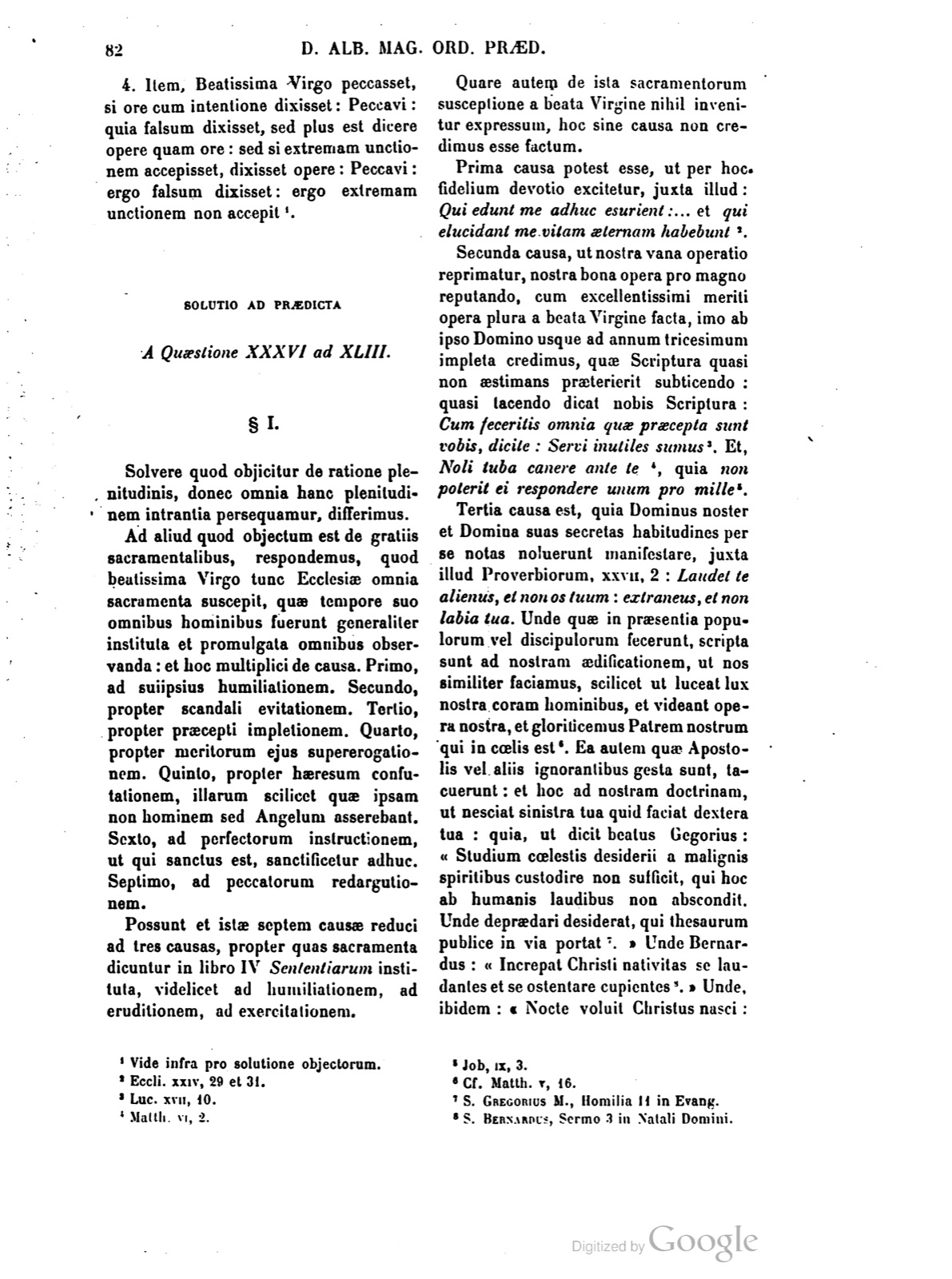
SOLUTIO AD PRAEDICTA. A Quaestione XXXVI ad XLIII.
§ I. Solvere quod objicitur de ratione plenitudinis, donec omnia hanc plenitudinem intrantia persequamur, differimus.
Ad aliud quod objectum est de gratiis sacramentalibus, respondemus, quod beatissima Virgo tunc Ecclesiae omnia sacramenta suscepit, quae tempore suo omnibus hominibus fuerunt generaliter instituta et promulgata omnibus observanda: et hoc multiplici de causa. Primo, ad suiipsius humiliationem. Secundo, propter scandali evitationem. Tertio, propter praecepti impletionem. Quarto, propter meritorum ejus supererogationem. Quinto, propter haeresum confutationem, illarum scilicet quae ipsam non hominem sed Angelum asserebant. Sexto, ad perfectorum instructionem, ut qui sanctus est, sanctificetur adhuc. Septimo, ad peccatorum redargutionem.
Possunt et istae septem causae reduci ad tres causas, propter quas sacramenta dicuntur in libro IV Sententiarum instituta, videlicet ad humiliationem, ad eruditionem, ad exercitationem.
Quare autem de ista sacramentorum susceptione a beata Virgine nihil invenitur expressum, hoc sine causa non credimus esse factum.
Prima causa potest esse, ut per hoc fidelium devotio excitetur, juxta illud: Qui edunt me adhuc esurient: ... et qui elucidant me vitam aeternam habebunt 1.
Secunda causa, ut nostra vana operatio reprimatur, nostra bona opera pro magno reputando, cum excellentissimi meriti opera plura a beata Virgine facta, imo ab ipso Domino usque ad annum tricesimum impleta credimus, quae Scriptura quasi non aestimans praeterierit subticendo: quasi tacendo dicat nobis Scriptura: Cum feceritis omnia quae praecepta sunt vobis, dicite: Servi inutiles sumus 2. Et, Noli tuba canere ante te 3, quia non poterit ei respondere unum pro mille 4.
Tertia causa est, quia Dominus noster et Domina suas secretas habitudines per se notas noluerunt manifestare, juxta illud Proverbiorum, XXVII, 2: Laudet te alienus, et non os tuum: extraneus, et non labia tua. Unde quae in praesentia populorum vel discipulorum fecerunt, scripta sunt ad nostram aedificationem, ut nos similiter faciamus, scilicet ut luceat lux nostra coram hominibus, et videant opera nostra, et glorificemus Patrem nostrum qui in caelis est 5. Ea autem quae Apostolis vel aliis ignorantibus gesta sunt, tacuerunt: et hoc ad nostram doctrinam, ut nesciat sinistra tua quid faciat dextera tua: quia, ut dicit beatus Gregorius: « Studium coelestis desiderii a malignis spiritibus custodire non sufficit, qui hoc ab humanis laudibus non abscondit. Unde depraedari desiderat, qui thesaurum publice in via portat 6. » Unde Bernardus: « Increpat Christi nativitas se laudantes et se ostentare cupientes 7. » Unde, ibidem: « Nocte voluit Christus nasci: ubi sunt qui tam impudenter ostentare gestiunt semetipsos? Denique tacet Christus, nuntiat eum Angelus, laudat multitudo coelestis exercitus. Laudet te alienus, et non os tuum. »
Quarta causa potest esse, quod Dominus certa quaedam nos dubitare permisit in via, ut mentes nostras alliciat ad concupiscendam perfectam cognitionem in patria. Unde, Exod. XII, 10: Nec remanebit quidquam ex eo usque mane: si quid residuum fuerit, igne comburetis. Glossa Gregorii: « Quod ex agno remanet, igne conburimus: quia quod de mysterio incarnationis ejus penetrare vel intelligere non possumus, potestati sancti Spiritus humiliter reservamus: ut non superbe quis audeat vel contemnere vel denuntiare quae non intelligit, sed igni tradat, id est, Spiritui sancto relinquat, videlicet donec omnia in futuro quolibet in quo cognitus sit et cognoscat 8. » Nec tamen interim nostra devotio sine exercitatione torpescat, secundum illud quod praecedit, ibidem, v. 9 et 10: Caput cum pedibus et intestinis vorabitis. Nec remanebit quidquam ex eo usque mane. Glossa Gregorii: « Caput agni vorare, est divinitatem illius fide percipere: pedes vorare, est vestigia humanitatis ejus amando et imitando sequi vel intelligere: intestina, id est, occulta verborum Christi et mystica mandata perquirere: quae voramus cum avide sumimus. In quo vorationis verbo pigritia nostra reprehenditur: quia verba ejus atque mysteria nec per nosipsos requirimus, et dicta ab aliis inviti audimus. Non remanebit quidquam ex eo usque mane: quia ejus dicta magna sunt excutienda sollicitudine, ut antequam veniat dies resurrectionis, in nocte praesentis vitae omnis mandata ejus intelligendo penetremus 9. »
SOLUTION TO THE AFORESAID. From Question XXXVI to XLIII.
§ I. We defer solving what is objected concerning the meaning of fullness until we have pursued all the things entering into this fullness.
To the other point that was objected concerning sacramental graces, we respond that the most blessed Virgin then received all the sacraments of the Church that in her time were generally instituted for all men and promulgated as to be observed by all; and this for a manifold cause. First, for the humiliation of herself. Second, because of the avoidance of scandal. Third, because of the fulfillment of the precept. Fourth, because of the supererogation of her merits. Fifth, because of the confutation of heresies, namely of those that asserted that she was not a human being but an Angel. Sixth, for the instruction of the perfect, that he who is holy may be sanctified still. Seventh, for the rebuke of sinners.
And these seven causes can be reduced to three causes, because of which sacraments are said in Book IV of the Sentences to have been instituted, namely for humiliation, for instruction, and for exercise.
But why nothing is found expressly about this reception of the sacraments by the blessed Virgin, we do not believe this was done without cause.
The first cause can be that through this the devotion of the faithful may be stirred up, according to that saying: Those who eat me will still hunger: ... and those who elucidate me will have eternal life 1.
The second cause is that our vain operation may be restrained, as we reckon our good works as something great, since we believe that many works of most excellent merit were done by the blessed Virgin, indeed fulfilled by the Lord himself up to his thirtieth year, which Scripture, as though not esteeming them, passed over by keeping silence; as if by being silent Scripture says to us: When you have done all things that are commanded you, say: We are useless servants 2. And: Do not sound a trumpet before yourself 3, because he will not be able to answer him one for a thousand 4.
The third cause is that our Lord and Lady did not wish to manifest by themselves their secret conditions, known to themselves, according to that saying of Proverbs 27:2: Let another praise you, and not your own mouth; a stranger, and not your lips. Hence the things they did in the presence of the peoples or disciples were written for our edification, so that we may act similarly, namely that our light may shine before men, and they may see our works, and we may glorify our Father who is in heaven 5. But the things done while the Apostles or others were ignorant, they kept silent; and this was for our instruction, that your left hand may not know what your right hand does; because, as blessed Gregory says: "It is not enough to guard the zeal of heavenly desire from malign spirits, if one does not hide this from human praises. Hence one desires to be plundered who carries a treasure publicly on the road 6." Hence Bernard says: "The birth of Christ rebukes those who praise themselves and desire to display themselves 7." Hence, in the same place: "Christ wished to be born at night: where are those who so shamelessly long to display themselves? Finally Christ is silent, the Angel announces him, the multitude of the heavenly army praises him. Let another praise you, and not your own mouth."
The fourth cause can be that the Lord permitted us to doubt certain things on the way, so that he may entice our minds to desire perfect knowledge in the homeland. Hence Exodus 12:10 says: Nothing from it shall remain until morning; if anything will have been left over, you shall burn it with fire. The Gloss of Gregory says: "What remains from the lamb, we burn with fire, because what we cannot penetrate or understand concerning the mystery of his incarnation, we humbly reserve to the power of the Holy Spirit, so that no one proudly dares either to despise or to denounce what he does not understand, but hands it over to fire, that is, leaves it to the Holy Spirit, namely until in the future all things are in anyone in whom he is known and he knows 8." Yet in the meantime let our devotion not grow sluggish without exercise, according to what precedes in the same place, verses 9 and 10: You shall eat the head with the feet and intestines. Nothing from it shall remain until morning. The Gloss of Gregory says: "To eat the head of the lamb is to receive his divinity by faith; to eat the feet is to follow or understand the footsteps of his humanity by loving and imitating; the intestines, that is, to seek out the hidden things of Christ's words and his mystical commands; we eat these when we take them eagerly. In this word of eating our sluggishness is reproved, because we neither seek his words and mysteries by ourselves, and we unwillingly hear things said by others. Nothing from it shall remain until morning, because his sayings are to be examined with great solicitude, so that before the day of resurrection comes, in the night of the present life, we may penetrate all his commands by understanding them 9."
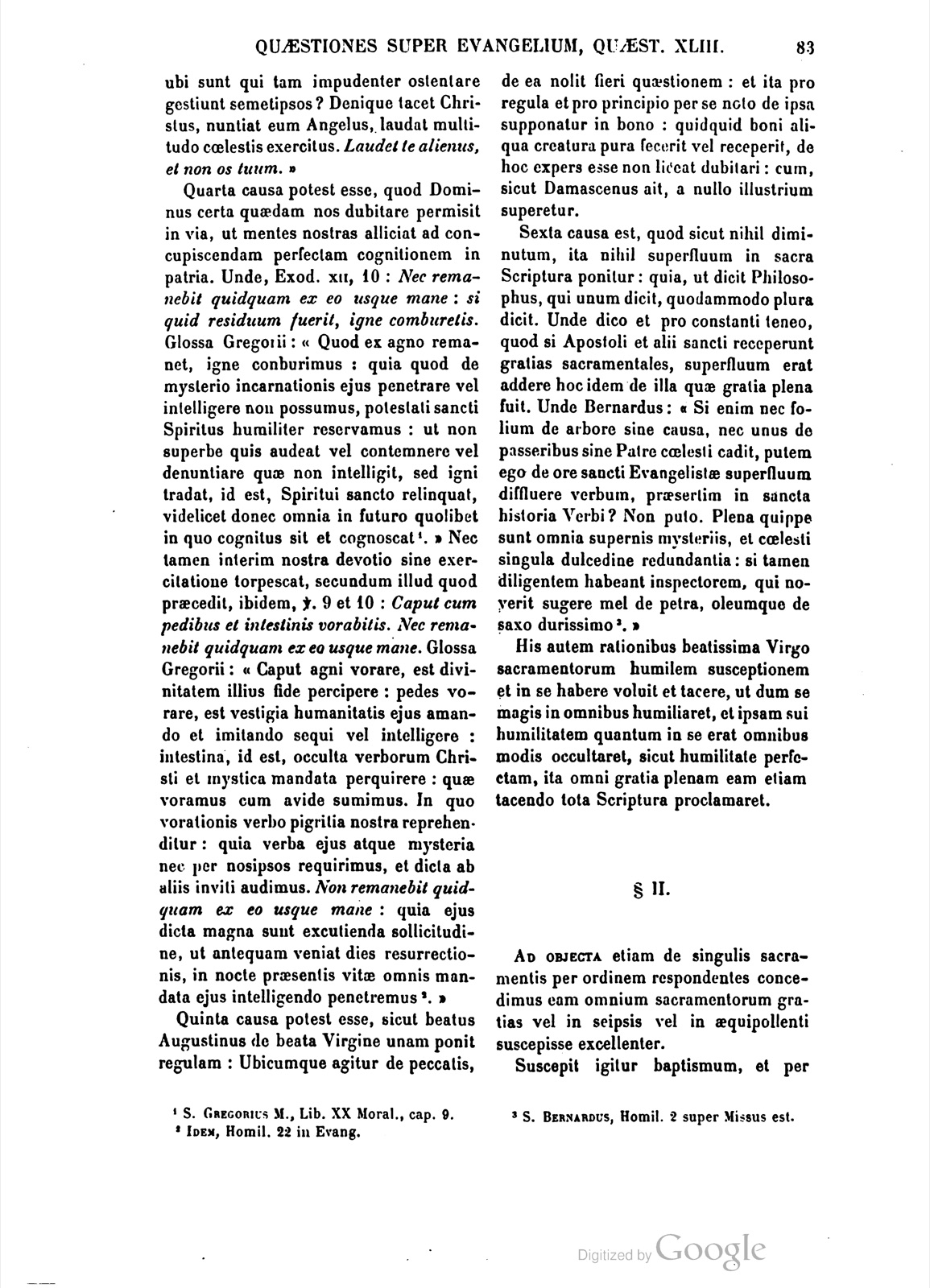
Quinta causa potest esse, sicut beatus Augustinus de beata Virgine unam ponit regulam: Ubicumque agitur de peccatis, de ea nolit fieri quaestionem: et ita pro regula et pro principio per se noto de ipsa supponatur in bono: quidquid boni aliqua creatura pura fecerit vel receperit, de hoc expers esse non liceat dubitari: cum, sicut Damascenus ait, a nullo illustrium superetur.
Sexta causa est, quod sicut nihil diminutum, ita nihil superfluum in sacra Scriptura ponitur: quia, ut dicit Philosophus, qui unum dicit, quodammodo plura dicit. Unde dico et pro constanti teneo, quod si Apostoli et alii sancti receperunt gratias sacramentales, superfluum erat addere hoc idem de illa quae gratia plena fuit. Unde Bernardus: « Si enim nec folium de arbore sine causa, nec unus de passeribus sine Patre coelesti cadit, putem ego de ore sancti Evangelistae superfluum diffluere verbum, praesertim in sancta historia Verbi? Non puto. Plena quippe sunt omnia supernis mysteriis, et coelesti singula dulcedine redundantia: si tamen diligentem habeant inspectorem, qui noverit sugere mel de petra, oleumque de saxo durissimo 10. »
His autem rationibus beatissima Virgo sacramentorum humilem susceptionem et in se habere voluit et tacere, ut dum se magis in omnibus humiliaret, et ipsam sui humilitatem quantum in se erat omnibus modis occultaret, sicut humilitate perfectam, ita omni gratia plenam eam etiam tacendo tota Scriptura proclamaret.
The fifth cause can be this: just as blessed Augustine places one rule concerning the blessed Virgin, Wherever sins are being treated, he does not wish a question to be made about her, so also let this be supposed in the good as a rule and as a principle known through itself concerning her: whatever good any pure creature has done or received, concerning this it is not permitted to doubt that she is without it, since, as Damascene says, she is surpassed by none of the illustrious.
The sixth cause is that, just as nothing diminished, so nothing superfluous is placed in sacred Scripture, because, as the Philosopher says, one who says one thing in a certain way says many things. Hence I say and hold as settled that, if the Apostles and other saints received sacramental graces, it was superfluous to add this same thing concerning her who was full of grace. Hence Bernard says: "For if neither a leaf from a tree falls without cause, nor one of the sparrows falls without the heavenly Father, shall I think that a superfluous word flows from the mouth of the holy Evangelist, especially in the sacred history of the Word? I do not think so. Indeed all things are full with heavenly mysteries, and the individual things overflow with celestial sweetness, if nevertheless they have a diligent inspector, one who knows how to suck honey from the rock and oil from the hardest stone 10."
For these reasons, then, the most blessed Virgin wished both to have in herself the humble reception of the sacraments and to keep silent about it, so that while she humbled herself more in all things and concealed, so far as was in her, her very humility in all ways, all Scripture, even by keeping silence, might proclaim her just as perfect in humility, so also full of every grace.
Notes
- Ecclesiasticus 24:29 and 31. (Eccli. XXIV, 29 et 31.) ↩
- Luke 17:10. (Luc. XVII, 10.) ↩
- Matthew 6:2. (Matth. VI, 2.) ↩
- Job 9:3. (Job, IX, 3.) ↩
- Compare Matthew 5:16. (Cf. Matth. V, 16.) ↩
- St. Gregory the Great, Homily 11 on the Gospels. (S. Gregorius M., Homilia 11 in Evang.) ↩
- St. Bernard, Sermon 3 on the Nativity of the Lord. (S. Bernardus, Sermo 3 in Natali Domini.) ↩
- St. Gregory the Great, Book XX of the Moralia, chapter 9. (S. Gregorius M., Lib. XX Moral., cap. 9.) ↩
- The same, Homily 22 on the Gospels. (Idem, Homil. 22 in Evang.) ↩
- St. Bernard, Homily 2 on Missus est. (S. Bernardus, Homil. 2 super Missus est.) ↩
If a page does not appear, its photograph has not been uploaded yet.