Works › The Mariale: Questions on “Missus est”
Volume 37 · pp. 75–76
Question XXXVI. Whether the sacraments are contained in this fullness?
A marker with ≈ is an approximate page boundary, placed by measure of the text; the page photographs remain the authority. In the paired views, clicking a page marker brings that page into view.
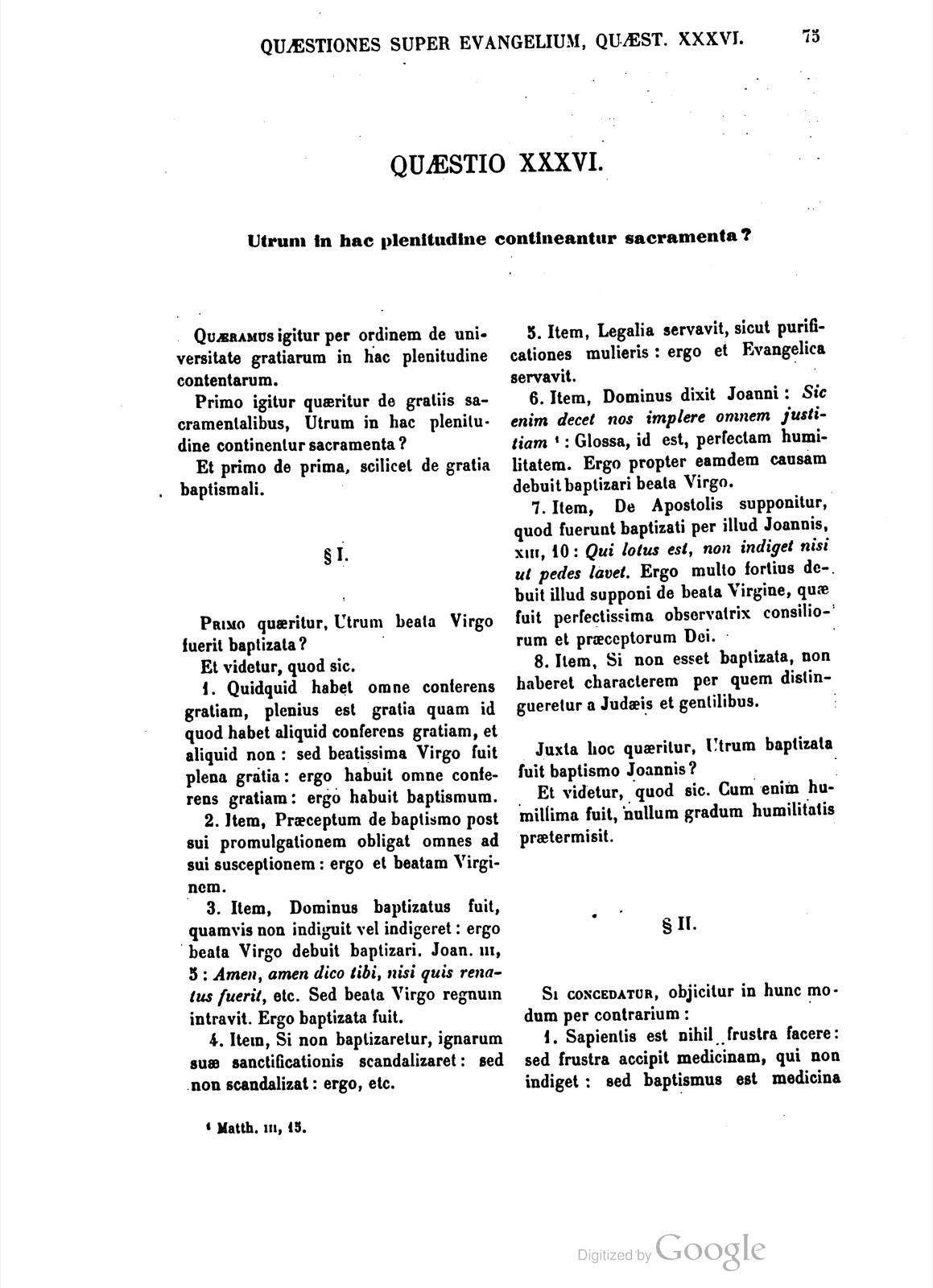
QUAESTIO XXXVI. Utrum in hac plenitudine contineantur sacramenta?
Quaeramus igitur per ordinem de universitate gratiarum in hac plenitudine contentarum.
Primo igitur quaeritur de gratiis sacramentalibus, Utrum in hac plenitudine continentur sacramenta?
Et primo de prima, scilicet de gratia baptismali.
§ I. Primo quaeritur, Utrum beata Virgo fuerit baptizata?
Et videtur, quod sic.
1. Quidquid habet omne conferens gratiam, plenius est gratia quam id quod habet aliquid conferens gratiam, et aliquid non: sed beatissima Virgo fuit plena gratia: ergo habuit omne conferens gratiam: ergo habuit baptismum.
2. Item, Praeceptum de baptismo post sui promulgationem obligat omnes ad sui susceptionem: ergo et beatam Virginem.
3. Item, Dominus baptizatus fuit, quamvis non indiguit vel indigeret: ergo beata Virgo debuit baptizari. Joan. III, 5: Amen, amen dico tibi, nisi quis renatus fuerit, etc. Sed beata Virgo regnum intravit. Ergo baptizata fuit.
4. Item, Si non baptizaretur, ignarum suae sanctificationis scandalizaret: sed non scandalizat: ergo, etc.
5. Item, Legalia servavit, sicut purificationes mulieris: ergo et Evangelica servavit.
6. Item, Dominus dixit Joanni: Sic enim decet nos implere omnem justitiam 1: Glossa, id est, perfectam humilitatem. Ergo propter eamdem causam debuit baptizari beata Virgo.
7. Item, De Apostolis supponitur, quod fuerunt baptizati per illud Joannis, XIII, 10: Qui lotus est, non indiget nisi ut pedes lavet. Ergo multo fortius debuit illud supponi de beata Virgine, quae fuit perfectissima observatrix consiliorum et praeceptorum Dei.
8. Item, Si non esset baptizata, non haberet characterem per quem distingueretur a Judaeis et gentilibus.
QUESTION XXXVI. Whether the sacraments are contained in this fullness?
Therefore let us ask in order concerning the universality of the graces contained in this fullness.
First, then, it is asked concerning sacramental graces, whether the sacraments are contained in this fullness.
And first concerning the first, namely concerning baptismal grace.
§ I. First it is asked whether the blessed Virgin was baptized.
And it seems that she was.
1. Whatever has every thing that confers grace is fuller of grace than that which has something that confers grace and something that does not. But the most blessed Virgin was full of grace. Therefore she had every thing that confers grace. Therefore she had baptism.
2. Likewise, the precept concerning baptism, after its promulgation, obliges all to receiving it. Therefore it obliged the blessed Virgin also.
3. Likewise, the Lord was baptized, although he had no need or would have no need. Therefore the blessed Virgin ought to have been baptized. John 3:5 says: Amen, amen, I say to you, unless someone has been born again, and so forth. But the blessed Virgin entered the kingdom. Therefore she was baptized.
4. Likewise, if she were not baptized, she would scandalize one ignorant of her sanctification. But she does not scandalize. Therefore, and so forth.
5. Likewise, she observed the legal rites, such as the purifications of a woman. Therefore she also observed the evangelical rites.
6. Likewise, the Lord said to John: For so it becomes us to fulfill all justice 1. The Gloss says, that is, perfect humility. Therefore for the same cause the blessed Virgin ought to have been baptized.
7. Likewise, concerning the Apostles it is supposed that they were baptized through that saying of John 13:10: He who is washed has no need except to wash his feet. Therefore much more ought that to have been supposed concerning the blessed Virgin, who was the most perfect observer of the counsels and precepts of God.
8. Likewise, if she had not been baptized, she would not have the character through which she would be distinguished from Jews and gentiles.
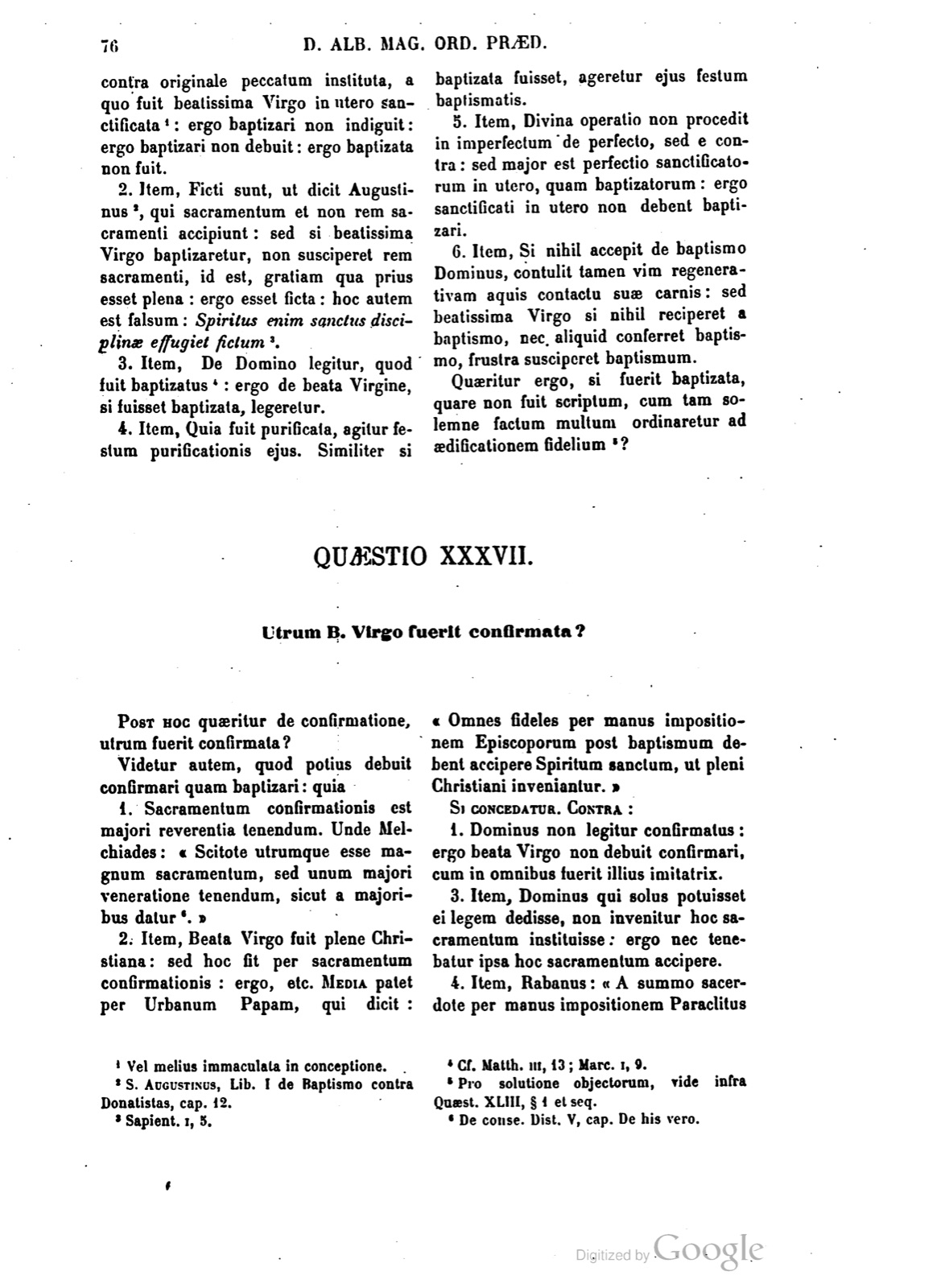
Juxta hoc quaeritur, Utrum baptizata fuit baptismo Joannis?
Et videtur, quod sic. Cum enim humillima fuit, nullum gradum humilitatis praetermisit.
§ II. Si concedatur, objicitur in hunc modum per contrarium:
1. Sapientis est nihil frustra facere: sed frustra accipit medicinam, qui non indiget: sed baptismus est medicina contra originale peccatum instituta, a quo fuit beatissima Virgo in utero sanctificata 2: ergo baptizari non indiguit: ergo baptizari non debuit: ergo baptizata non fuit.
2. Item, Ficti sunt, ut dicit Augustinus 3, qui sacramentum et non rem sacramenti accipiunt: sed si beatissima Virgo baptizaretur, non susciperet rem sacramenti, id est, gratiam qua prius esset plena: ergo esset ficta: hoc autem est falsum: Spiritus enim sanctus disciplinae effugiet fictum 4.
3. Item, De Domino legitur, quod fuit baptizatus 5: ergo de beata Virgine, si fuisset baptizata, legeretur.
4. Item, Quia fuit purificata, agitur festum purificationis ejus. Similiter si baptizata fuisset, ageretur ejus festum baptismatis.
5. Item, Divina operatio non procedit in imperfectum de perfecto, sed e contra: sed major est perfectio sanctificatorum in utero, quam baptizatorum: ergo sanctificati in utero non debent baptizari.
6. Item, Si nihil accepit de baptismo Dominus, contulit tamen vim regenerativam aquis contactu suae carnis: sed beatissima Virgo si nihil reciperet a baptismo, nec aliquid conferret baptismo, frustra susciperet baptismum.
Quaeritur ergo, si fuerit baptizata, quare non fuit scriptum, cum tam solemne factum multum ordinaretur ad aedificationem fidelium 6?
Next to this it is asked whether she was baptized with the baptism of John.
And it seems that she was. For since she was most humble, she omitted no degree of humility.
§ II. If this is granted, objection is made in this way to the contrary:
1. It belongs to a wise person to do nothing in vain. But one who has no need receives medicine in vain. Yet baptism is a medicine instituted against original sin, from which the most blessed Virgin was sanctified in the womb 2. Therefore she did not need to be baptized. Therefore she ought not to have been baptized. Therefore she was not baptized.
2. Likewise, as Augustine says 3, those are false who receive the sacrament and not the reality of the sacrament. But if the most blessed Virgin were baptized, she would not receive the reality of the sacrament, that is, the grace by which she was already full. Therefore she would be false. But this is false, for the Holy Spirit of discipline will flee the false 4.
3. Likewise, concerning the Lord it is read that he was baptized 5. Therefore concerning the blessed Virgin, if she had been baptized, it would be read.
4. Likewise, because she was purified, the feast of her purification is kept. Similarly, if she had been baptized, the feast of her baptism would be kept.
5. Likewise, divine operation does not proceed into the imperfect from the perfect, but on the contrary. But the perfection of those sanctified in the womb is greater than that of the baptized. Therefore those sanctified in the womb ought not to be baptized.
6. Likewise, if the Lord received nothing from baptism, nevertheless he conferred regenerating power on the waters by the contact of his flesh. But if the most blessed Virgin would receive nothing from baptism, nor confer anything on baptism, she would receive baptism in vain.
Therefore it is asked, if she was baptized, why it was not written, since so solemn a deed would be much ordered to the edification of the faithful 6.
Notes
- Matthew 3:15. (Matth. III, 15.) ↩
- Or better, immaculate in conception. (Vel melius immaculata in conceptione.) ↩
- St. Augustine, Book I, On Baptism against the Donatists, chapter 12. (S. Augustinus, Lib. I de Baptismo contra Donatistas, cap. 12.) ↩
- Wisdom 1:5. (Sapient. I, 5.) ↩
- Compare Matthew 3:13; Mark 1:9. (Cf. Matth. III, 13; Marc. I, 9.) ↩
- For the solution of the objections, see below, Question XLIII, § 1 and following. (Pro solutione objectorum, vide infra Quaest. XLIII, § 1 et seq.) ↩
If a page does not appear, its photograph has not been uploaded yet.